Market Overview
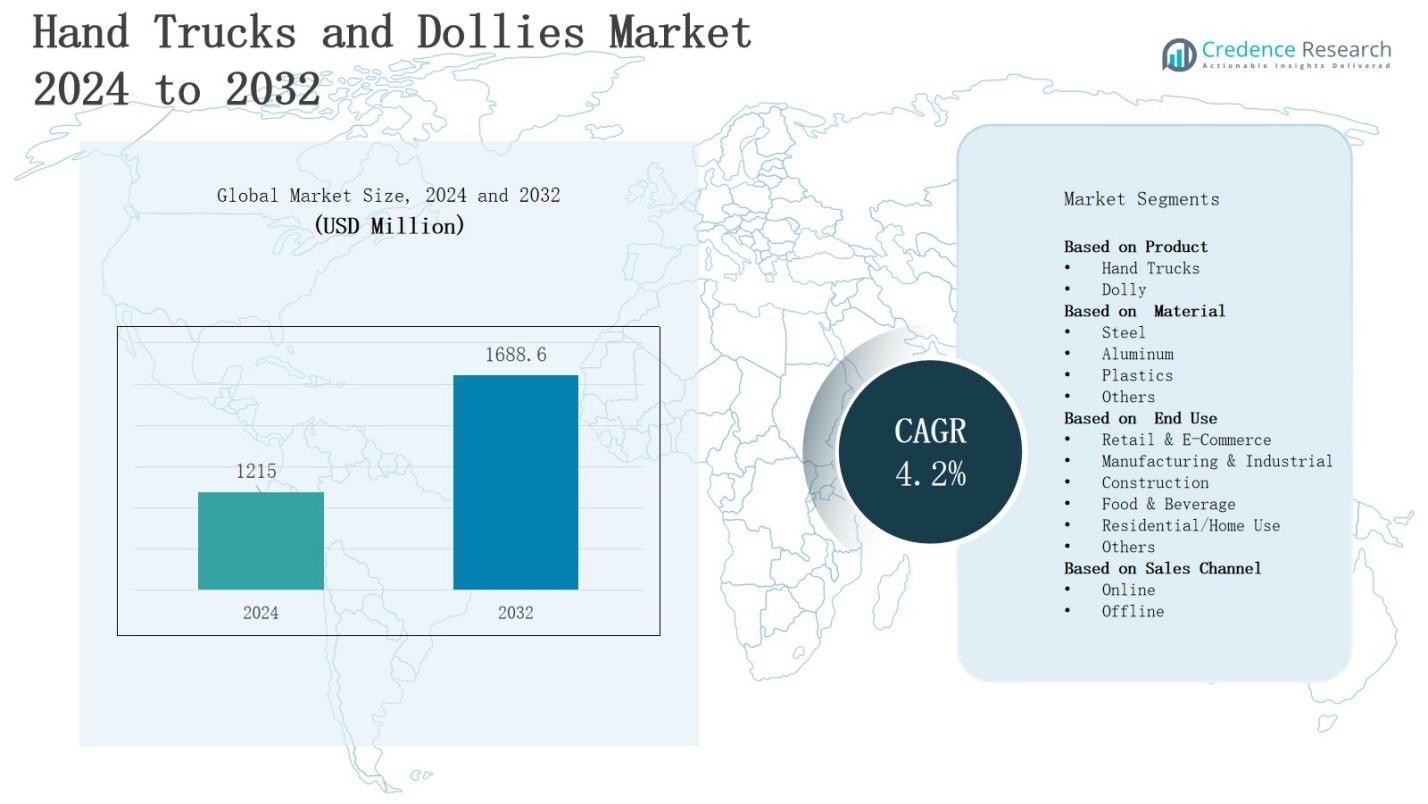
The hand trucks and dollies market is projected to grow from USD 1,215 million in 2024 to USD 1,688.6 million by 2032, registering a CAGR of 4.2% during the forecast period.
| REPORT ATTRIBUTE | DETAILS |
|---|---|
| Historical Period | 2020-2024 |
| Base Year | 2024 |
| Forecast Period | 2025-2032 |
| Hand Trucks and Dollies Market Size 2024 | USD 1,215 Million |
| Hand Trucks and Dollies Market, CAGR | 4.2% |
| Hand Trucks and Dollies Market Size 2032 | USD 1,688.6 Million |
Market growth in the hand trucks and dollies sector is driven by rising demand in logistics, warehousing, and retail operations to improve material handling efficiency and reduce labor strain. Expanding e-commerce activities and increasing adoption in manufacturing facilities for safe and quick goods movement further support demand. Trends include the development of lightweight, foldable, and ergonomically designed models, integration of advanced materials for enhanced durability, and growing preference for multi-functional equipment. Sustainability initiatives are encouraging the use of recyclable and eco-friendly materials, while innovations in wheel design and load capacity are enhancing product performance across diverse industrial and commercial applications.
The hand trucks and dollies market spans North America, Europe, Asia-Pacific, and the Rest of the World, with each region contributing uniquely to growth. North America leads with advanced logistics and safety-focused adoption, while Europe emphasizes sustainable materials and ergonomic designs. Asia-Pacific drives demand through rapid industrialization and e-commerce expansion, and the Rest of the World benefits from infrastructure development and retail growth. Key players include WOODEVER INDUSTRIAL CO., LTD., Magline, Inc., The Hand Truck Company, Shunhe, Milwaukee Hand Trucks, Harper Trucks, Inc., BIL Group, Wesco Industrial Products, LLC., Cosco Home & Office Products, and B&P Manufacturing.
Market Insights
- The hand trucks and dollies market is projected to grow from USD 1,215 million in 2024 to USD 1,688.6 million by 2032, registering a CAGR of 4.2% during the forecast period.
- Rising demand from logistics, warehousing, and retail operations is driving adoption, supported by the need for efficiency, safety, and reduced labor strain.
- Expanding e-commerce and last-mile delivery services are boosting demand for lightweight, foldable, and space-efficient handling solutions.
- Technological advancements in materials, wheel design, and ergonomics are enhancing durability, load capacity, and operator comfort.
- The market faces challenges from high competition, price sensitivity, and durability issues in heavy-duty applications.
- North America leads with 32% market share, followed by Europe at 27%, Asia-Pacific at 29%, and Rest of the World at 12%.
- Key players include WOODEVER INDUSTRIAL CO., LTD., Magline, Inc., The Hand Truck Company, Shunhe, Milwaukee Hand Trucks, Harper Trucks, Inc., BIL Group, Wesco Industrial Products, LLC., Cosco Home & Office Products, and B&P Manufacturing.
Market Drivers
Rising Demand in Logistics, Warehousing, and Retail Sectors
The hand trucks and dollies market is witnessing significant growth due to expanding logistics, warehousing, and retail operations worldwide. Increasing trade volumes and the need for efficient goods handling solutions are boosting adoption across industries. It helps reduce manual labor strain, enhances productivity, and ensures safer transportation of goods. Large-scale distribution centers, supermarkets, and fulfillment hubs are prioritizing these tools to streamline workflows and improve operational efficiency in high-volume environments.
- For instance, in July 2024, LPP Logistics launched a second e-commerce warehouse in Romania, increasing warehouse activity that relies on hand trucks and dollies for faster order processing.
Growth in E-Commerce and Last-Mile Delivery Requirements
The rapid expansion of e-commerce platforms has accelerated the need for reliable material handling equipment. The hand trucks and dollies market benefits from increasing last-mile delivery operations that require frequent loading and unloading of goods. It supports businesses in improving delivery timelines while minimizing damage to products. Warehouses and delivery services are investing in versatile, lightweight, and foldable models to meet dynamic operational demands and space constraints efficiently.
- For instance, FedEx implemented real-time tracking and smart locker systems, increasing first-attempt delivery success rates by 12% and enhancing customer satisfaction with flexible parcel pickup options.
Technological Advancements and Product Innovation
Continuous innovation in design and materials is enhancing the efficiency and durability of hand trucks and dollies. Manufacturers are introducing products with improved wheel systems, adjustable frames, and ergonomic grips to cater to diverse load types. It increases user comfort and operational safety, particularly in industrial and commercial settings. The integration of advanced composites and corrosion-resistant alloys is extending product life while maintaining lightweight structures for ease of mobility.
Focus on Workplace Safety and Labor Efficiency
Workplace safety regulations and the need to minimize employee fatigue are encouraging wider adoption of material handling aids. The hand trucks and dollies market benefits from the emphasis on reducing workplace injuries caused by manual lifting. It allows organizations to comply with safety standards while enhancing productivity. Industries are adopting these solutions to optimize load capacity management, reduce handling time, and support sustainable, injury-free work environments across varied operational conditions.
Market Trends
Adoption of Lightweight and Foldable Designs for Space Efficiency
Manufacturers are focusing on developing lightweight, foldable hand trucks and dollies to cater to modern space constraints in warehouses, retail outlets, and delivery vehicles. The hand trucks and dollies market is witnessing demand for compact models that can be stored easily without compromising load capacity. It supports small businesses, courier services, and urban delivery operators where space optimization is critical. Foldable designs also enhance portability, making them suitable for varied on-site handling applications.
- For instance, Sound Professionals offers a foldable aluminum hand truck that weighs only 2.8 lbs and can carry up to 110 pounds, making it highly portable and easy to store in vehicles or tight spaces.
Integration of Ergonomic Features for Operator Comfort
Ergonomic advancements are becoming a central trend, with products now offering adjustable handles, padded grips, and improved weight distribution. It reduces operator fatigue during repetitive lifting and transportation tasks. The hand trucks and dollies market benefits from designs that prioritize operator health while increasing efficiency. Industrial users are adopting ergonomic solutions to align with workplace safety standards, reduce injury risks, and enhance long-term workforce productivity in physically demanding environments.
- For instance, Utz Group offers dollies with ergonomic handles that simplify pushing and steering, reducing strain and enabling smooth, controlled movement in various environments.
Use of Advanced Materials for Durability and Performance
The shift toward high-strength, corrosion-resistant materials such as aluminum alloys and reinforced composites is enhancing product lifespan. It enables hand trucks and dollies to perform effectively in challenging industrial and outdoor conditions. The hand trucks and dollies market is seeing demand for durable yet lightweight frames that support heavier loads. Manufacturers are investing in material innovation to create solutions that balance strength, weight, and cost-effectiveness for diverse end-user requirements.
Customization and Multi-Functional Product Development
End-users are seeking versatile equipment capable of adapting to multiple load types and operational settings. It drives manufacturers to introduce convertible models that can function as both hand trucks and platform dollies. The hand trucks and dollies market benefits from this trend by appealing to sectors that require flexibility in handling solutions. Custom load supports, wheel types, and adjustable platforms are becoming standard offerings to meet evolving operational demands efficiently.
Market Challenges Analysis
High Competition and Price Sensitivity in a Fragmented Market
The hand trucks and dollies market faces intense competition due to the presence of numerous regional and global manufacturers offering similar products. It creates significant price pressure, limiting profit margins for suppliers. Customers often prioritize cost over advanced features, which challenges manufacturers aiming to introduce innovative, higher-priced models. The fragmented nature of the market makes brand differentiation difficult, leading to reliance on aggressive pricing strategies and volume-based sales to maintain market share.
Maintenance Costs and Limitations in Heavy-Duty Applications
Durability concerns and recurring maintenance needs present challenges, particularly in heavy-duty industrial operations where wear and tear occur rapidly. The hand trucks and dollies market experiences demand for robust solutions, yet some models fall short in sustaining high load capacities over extended use. It forces frequent replacements or repairs, impacting operational budgets. Industrial buyers seek equipment with higher reliability, and failure to meet these expectations can lead to reduced adoption in demanding sectors.
Market Opportunities
Expansion Potential in E-Commerce and Last-Mile Delivery Operations
The rapid growth of e-commerce and last-mile delivery services is creating strong demand for efficient material handling equipment. The hand trucks and dollies market can benefit from tailored solutions designed for quick loading, unloading, and transportation in urban environments. It enables logistics companies to improve operational efficiency and reduce delivery times. Compact, foldable, and lightweight models have strong potential for adoption among courier services, small retailers, and on-demand delivery platforms.
Rising Demand for Customizable and Multi-Functional Designs
An increasing preference for versatile equipment that can adapt to varied operational needs presents significant growth opportunities. The hand trucks and dollies market can leverage this by offering modular designs with interchangeable parts, adjustable load platforms, and specialized wheel configurations. It allows businesses to handle diverse goods efficiently while optimizing storage space. Manufacturers focusing on customization can attract customers in industrial, retail, and hospitality sectors seeking flexible, durable, and cost-effective handling solutions.
Market Segmentation Analysis:
By Product
The hand trucks and dollies market is segmented into hand trucks and dollies, each serving distinct handling needs. Hand trucks remain popular in warehouses, retail, and delivery services for their upright design and ease of maneuverability. Dollies, with flat platforms and swivel wheels, are preferred for transporting bulkier or heavier loads over short distances. It enables businesses to choose equipment based on load type, operational speed, and storage considerations, ensuring efficiency in diverse environments.
- For instance, B&P Manufacturing offers a modular hand truck lineup that allows users to customize frames, noses, wheels, handles, and accessories, aiming to reduce user fatigue and improve ergonomic efficiency in material handling tasks
By Material
Products are manufactured using steel, aluminum, plastics, and other materials to meet varied performance requirements. Steel offers high strength and durability, making it suitable for industrial and heavy-duty applications. Aluminum provides a lightweight yet sturdy option, reducing operator fatigue during frequent use. Plastic variants appeal to light-duty and residential markets due to their affordability and resistance to corrosion. It allows users to select materials based on weight, load capacity, and environmental conditions.
- For instance, BlueScope Steel offers durable steel products tailored for challenging environments, used in construction and infrastructure sectors for their proven strength and versatility.
By End Use
Key end-use sectors include retail & e-commerce, manufacturing & industrial, construction, food & beverage, residential/home use, and others. Retail and e-commerce operations require portable, space-efficient models for quick product movement. Manufacturing and industrial sectors prioritize high-capacity, durable solutions. Construction sites demand rugged designs for handling heavy building materials, while the food & beverage industry values hygienic, easy-to-clean equipment. It supports residential and small business users with compact, versatile products that enhance productivity in various settings.
Segments:
Based on Product
- Hand Trucks
- Dolly
Based on Material
- Steel
- Aluminum
- Plastics
- Others
Based on End Use
- Retail & E-Commerce
- Manufacturing & Industrial
- Construction
- Food & Beverage
- Residential/Home Use
- Others
Based on Sales Channel
- Online
- Offline
Based on the Geography:
- North America
- U.S.
- Canada
- Mexico
- Europe
- Germany
- France
- U.K.
- Italy
- Spain
- Rest of Europe
- Asia Pacific
- China
- Japan
- India
- South Korea
- South-east Asia
- Rest of Asia Pacific
- Latin America
- Brazil
- Argentina
- Rest of Latin America
- Middle East & Africa
- GCC Countries
- South Africa
- Rest of the Middle East and Africa
Regional Analysis
North America
North America holds 32% share of the hand trucks and dollies market, driven by strong demand across logistics, retail, and industrial sectors. High e-commerce penetration and the presence of large distribution networks fuel adoption of advanced material handling equipment. It benefits from continuous product innovation, with manufacturers introducing ergonomic and durable designs. The region’s emphasis on workplace safety standards supports the use of hand trucks and dollies to reduce manual lifting injuries. The construction and manufacturing industries further boost demand through frequent bulk material movement requirements. Government infrastructure investments create long-term growth opportunities for suppliers in this market.
Europe
Europe accounts for 27% share of the hand trucks and dollies market, supported by its robust retail networks and manufacturing base. The region prioritizes sustainability, encouraging the use of recyclable materials in equipment production. It benefits from rising automation in warehouses, where manual handling tools complement automated systems for flexible operations. The construction industry’s growth in Eastern Europe and the food & beverage sector’s need for hygienic transport solutions drive product demand. Stringent EU safety regulations promote the adoption of ergonomically designed models. Urban logistics initiatives in major cities further expand usage in last-mile delivery services.
Asia-Pacific
Asia-Pacific holds 29% share of the hand trucks and dollies market, fueled by rapid industrialization, expanding e-commerce, and large-scale infrastructure development. It sees strong adoption in China, India, and Southeast Asian countries due to booming manufacturing activities. Growing construction projects and the retail sector’s expansion enhance product utilization across varied applications. Manufacturers in the region leverage cost advantages to supply both domestic and export markets. Increasing awareness of operational efficiency and safety drives adoption in small and medium enterprises. Investment in modern warehousing facilities further strengthens demand across key economies.
Rest of the World
The Rest of the World captures 12% share of the hand trucks and dollies market, with growth led by the Middle East, Africa, and Latin America. It experiences rising adoption in logistics and retail sectors as regional trade volumes increase. Infrastructure development projects in Gulf countries and urban retail expansion in Latin America drive demand. The mining and construction industries in Africa also contribute to market growth. Local manufacturers focus on low-cost, durable solutions to cater to budget-conscious buyers. Growing import opportunities provide avenues for international suppliers to enter emerging markets.
Key Player Analysis
- WOODEVER INDUSTRIAL CO., LTD.
- Magline, Inc.
- The Hand Truck Company
- Shunhe
- Milwaukee Hand Trucks
- Harper Trucks, Inc.
- BIL Group
- Wesco Industrial Products, LLC.
- Cosco Home & Office Products
- B&P Manufacturing
Competitive Analysis
The hand trucks and dollies market is highly competitive, with a mix of global brands and regional manufacturers focusing on product innovation, durability, and ergonomic design to strengthen their market positions. It is characterized by companies introducing lightweight, foldable, and high-capacity models to meet evolving industry needs across logistics, retail, construction, and manufacturing. Leading players such as WOODEVER INDUSTRIAL CO., LTD., Magline, Inc., The Hand Truck Company, Shunhe, Milwaukee Hand Trucks, Harper Trucks, Inc., BIL Group, Wesco Industrial Products, LLC., Cosco Home & Office Products, and B&P Manufacturing emphasize material advancements, including aluminum alloys and reinforced composites, to enhance strength without increasing weight. Strategic initiatives include expanding distribution networks, optimizing cost efficiency, and offering customized solutions for specialized applications. Companies are also leveraging e-commerce channels to reach a wider customer base while maintaining a strong presence in traditional retail and industrial supply chains. Competitive intensity remains high, driving continuous improvements in product features, user safety, and operational versatility to capture a larger share of the growing material handling equipment demand.
Recent Developments
- In January 2025, Lifting Equipment Store USA (LES) announced a strategic partnership with Vestil Manufacturing Corp. to enhance its material handling solutions offering. Over recent months, LES, with Vestil’s collaboration, introduced more than 600 new product lines-totaling over 6,000 SKUs-on their website, aimed at improving workplace efficiency and safety.
- In January 2024, Joloda Hydraroll acquired Actiw Oy to strengthen its material handling capabilities and market presence.
- In November 2024, Stellar acquired Elliott Machine Work to expand manufacturing capabilities in industrial machinery, relevant for material handling equipment.
- In September 2024, Accio Robots partnered with SCM Champs to advance warehouse automation via SAP integration, impacting warehouse hand truck/dolly operations.
Market Concentration & Characteristics
The hand trucks and dollies market exhibits a moderately fragmented structure, with competition driven by a mix of established global brands and numerous regional manufacturers. It features a diverse product range catering to logistics, retail, construction, manufacturing, and residential applications. Leading players focus on innovation in lightweight materials, ergonomic designs, and foldable structures to enhance usability and durability. Price sensitivity remains a defining characteristic, influencing purchasing decisions in both industrial and consumer segments. The market shows steady growth potential supported by e-commerce expansion, workplace safety regulations, and infrastructure development. Customization options, including adjustable frames, convertible designs, and specialized wheels, cater to varied operational needs. Distribution channels span traditional industrial supply networks, retail outlets, and e-commerce platforms, ensuring broad market reach. Brand differentiation is achieved through product quality, load capacity innovation, and after-sales support, while regional players maintain competitiveness by offering cost-effective, durable solutions tailored to local industry requirements.
Report Coverage
The research report offers an in-depth analysis based on Product, Material, End-Use, Sales Channel and Geography. It details leading market players, providing an overview of their business, product offerings, investments, revenue streams, and key applications. Additionally, the report includes insights into the competitive environment, SWOT analysis, current market trends, as well as the primary drivers and constraints. Furthermore, it discusses various factors that have driven market expansion in recent years. The report also explores market dynamics, regulatory scenarios, and technological advancements that are shaping the industry. It assesses the impact of external factors and global economic changes on market growth. Lastly, it provides strategic recommendations for new entrants and established companies to navigate the complexities of the market.
Future Outlook
- Demand will grow with expanding e-commerce and last-mile delivery operations across global logistics networks.
- Warehouses and distribution centers will adopt more units to boost productivity and handling efficiency significantly.
- Manufacturers will prioritize lightweight, foldable, and space-saving designs to meet evolving operational and storage requirements.
- Advanced materials like aluminum alloys will improve durability while reducing weight for enhanced ease of mobility.
- Ergonomic innovations will enhance operator comfort, reduce fatigue, and align with workplace safety regulations worldwide.
- Customizable, multi-functional models will gain traction across industries needing adaptable and versatile handling equipment solutions.
- Sustainability initiatives will promote recyclable, eco-friendly materials in product manufacturing and packaging across key markets.
- Emerging markets will experience rising adoption fueled by infrastructure development and growing retail sector demands.
- Online sales platforms will expand reach, offering customers wider choices and competitive pricing for procurement.
- Competitive pricing strategies and unique product features will determine long-term success among global and regional manufacturers.

Request a Free Sample
Fill in your details and we'll send you a free sample report.
- Sample data tables & charts
- Research methodology
Market Dynamics
Rising Demand in Logistics, Warehousing, and Retail Sectors
Expanding logistics, warehousing, and retail operations are driving the adoption of hand trucks and dollies to improve material handling efficiency, reduce manual labor strain, and ensure safer transportation of goods in high-volume environments.
Growth in E-Commerce and Last-Mile Delivery Requirements
The rapid expansion of e-commerce platforms and last-mile delivery services is increasing the need for reliable, lightweight, and foldable material handling equipment to support frequent loading and unloading, improve delivery timelines, and optimize space in urban logistics.
Technological Advancements and Product Innovation
Continuous innovation in materials, wheel design, and ergonomics is enhancing the durability, load capacity, and operator comfort of hand trucks and dollies, making them more suitable for diverse industrial and commercial applications.
Focus on Workplace Safety and Labor Efficiency
Stricter workplace safety regulations and the need to minimize employee fatigue are encouraging organizations to adopt hand trucks and dollies, helping reduce workplace injuries from manual lifting and supporting compliance with safety standards.
Customization and Multi-Functional Product Development
Increasing demand for versatile, customizable equipment is driving manufacturers to offer modular designs and convertible models, enabling businesses to efficiently handle varied goods and adapt to different operational settings.
Need a Custom Version of This Report?
Tailor the scope, geography, or segments to your exact requirements.
- Custom geography or segment scope
- Direct access to our analyst team
Frequently Asked Questions
What is the current market size for hand trucks and dollies market, and what is its projected size in 2032?
At what Compound Annual Growth Rate is the hand trucks and dollies market projected to grow between 2025 and 2032?
Which hand trucks and dollies market segment held the largest share in 2024?
What are the primary factors fueling the growth of the hand trucks and dollies market?
Who are the leading companies in the hand trucks and dollies market?
Which region commanded the largest share of the hand trucks and dollies market in 2024?
Table of Content
Chapter 1 Market Segmentation
- 1.1 Segmentation Framework
- 1.1.1 Product and Service Classification
- 1.1.2 Application and End-Use Classification
- 1.1.3 Technology and Solution Classification
- 1.1.4 Customer and Distribution Channel Classification
- 1.1.5 Geographic Segmentation
- 1.1.6 Market Segment Definitions and Boundaries
- 1.2 By End Use
- 1.2.1 Retail & E-Commerce
- 1.2.2 Manufacturing & Industrial
- 1.2.3 Construction
- 1.2.4 Food & Beverage
- 1.2.5 Residential/Home Use
- 1.2.6 Others
- 1.3 By Product
- 1.3.1 Hand Trucks
- 1.3.2 Dolly
- 1.4 By Material
- 1.4.1 Steel
- 1.4.2 Aluminum
- 1.4.3 Plastics
- 1.4.4 Others
- 1.5 By Sales Channel
- 1.5.1 Online
- 1.5.2 Offline
Chapter 2 Introduction
- 2.1 Report Objectives and Scope
- 2.2 Product Definition and Industry Terminology
- 2.3 Market Inclusions and Exclusions
- 2.4 Research Process
- 2.4.1 Primary Research and Expert Interviews
- 2.4.2 Secondary Research and Source Review
- 2.4.3 Top-Down and Bottom-Up Estimation
- 2.4.4 Data Triangulation and Verification
- 2.5 Market Size Measurement Basis
- 2.5.1 2024: USD 1,215 million → 2032: USD 1,688.6 million
- 2.6 Historical and Forecast Reference Periods
- 2.6.1 Base Year: 2024
- 2.6.2 Forecast Period: 2024-2032
- 2.7 Research Assumptions and Limitations
Chapter 3 Executive Summary
- 3.1 Market Snapshot and Key Findings
- 3.2 Base-Year Market Size, 2024
- 3.3 Forecast Market Size, 2032
- 3.4 Revenue and Volume Growth Outlook
- 3.5 Key Demand and Supply Indicators
- 3.6 Leading Market Segments
- 3.7 Fastest-Growing Market Opportunities
- 3.8 Regional Performance Highlights
- 3.9 Technology and Industry Transformation
- 3.10 Competitive Landscape Summary
- 3.11 Analyst View and Strategic Implications
Chapter 4 Global Hand Trucks and Dollies Market Trends and Developments
- 4.1 Historical Industry Development
- 4.2 Recent Market Trends and Developments
- 4.3 Demand and Customer Behavior Trends
- 4.4 Technology and Product Innovation
- 4.5 Artificial Intelligence, Automation and Digitalization
- 4.6 Local Manufacturing and Supply Chain Realignment
- 4.7 Industry Partnerships, Mergers and Acquisitions
- 4.8 Sustainability and Circular Economy Developments
- 4.9 Government and Private Sector Investment Trends
- 4.10 Emerging Business Models and Commercialization
- 4.11 Industry Developments and Announcements
Chapter 5 Global Hand Trucks and Dollies Market Production, Supply and Demand Analysis
- 5.1 Demand Trend and Consumption Analysis
- 5.2 Demand Forecast, 2024-2032
- 5.3 Production and Output Trend
- 5.4 Production and Output Forecast, 2024-2032
- 5.5 Installed Capacity and Capacity Utilization
- 5.6 Company-Wise Production Plants and Statistics
- 5.6.1 Installed Production Capacity
- 5.6.2 Actual Production
- 5.6.3 Planned Capacity and Expansion Targets
- 5.7 Supply Chain Structure and Procurement Trends
- 5.8 Supply-Demand Gap and Bottlenecks
- 5.9 Import Dependence and Sourcing Structure
- 5.10 Contract Manufacturing and Outsourcing
- 5.11 Regional Supply and Demand Concentration
Chapter 6 Global Hand Trucks and Dollies Market Pricing Analysis
- 6.1 Pricing Structure and Measurement
- 6.2 Historical Pricing Trends
- 6.3 Pricing Outlook, 2024-2032
- 6.4 Average Selling Price and Unit Economics
- 6.5 Pricing by Product and Market Segment
- 6.6 Geographic Pricing Differences
- 6.7 Key Input, Energy, Labor and Logistics Costs
- 6.8 Contract Pricing and Purchasing Models
- 6.9 Pricing Sensitivity and Competitive Positioning
- 6.10 Price, Margin and Profitability Implications
Chapter 7 Global Hand Trucks and Dollies Market Dynamics
- 7.1 Market Growth Drivers
- 7.1.1 Demand-Side Drivers
- 7.1.2 Technology and Innovation Drivers
- 7.1.3 Infrastructure and Investment Drivers
- 7.1.4 Regulatory and Policy Drivers
- 7.2 Market Restraints
- 7.2.1 Cost and Affordability Constraints
- 7.2.2 Technology and Adoption Barriers
- 7.2.3 Supply Chain and Operational Constraints
- 7.3 Market Challenges
- 7.3.1 Competitive Pressure and Margin Erosion
- 7.3.2 Skills, Infrastructure and Implementation Gaps
- 7.4 Emerging Market Opportunities
- 7.5 Market Dynamics Impact and Time-Horizon Assessment
Chapter 8 Global Hand Trucks and Dollies Value Chain Analysis
- 8.1 Industry Value Chain Overview
- 8.2 Upstream Suppliers and Critical Inputs
- 8.3 Technology and Component Providers
- 8.4 Manufacturing or Service Delivery
- 8.5 Distribution, Channel Partners and Integrators
- 8.6 Downstream Applications and End Users
- 8.7 Value Addition and Profit Pools
- 8.8 Vertical Integration and Outsourcing
- 8.9 Supplier Concentration and Risk
- 8.10 Supply Chain Localization and Resilience
Chapter 9 Global Hand Trucks and Dollies Market Regulations and Policies
- 9.1 Relevant Laws, Standards and Compliance Frameworks
- 9.2 Product, Service, Safety and Quality Requirements
- 9.3 Government Policies, Incentives and Subsidies
- 9.4 Imports, Exports and Trade Barriers
- 9.5 Public Procurement and Local Content Requirements
- 9.6 Environmental and Sustainability Compliance
- 9.7 Upcoming Policy Changes and Market Implications
Chapter 10 Global Hand Trucks and Dollies Market Hotspots and Opportunities
- 10.1 Market Opportunity Mapping and Growth Hotspots
- 10.2 High-Growth Applications and Customer Groups
- 10.3 Underserved Markets and White-Space Opportunities
- 10.4 Emerging Technology and Product Opportunities
- 10.5 New Capacity and Investment Hotspots
- 10.6 Market Entry and Expansion Opportunities
- 10.7 Distribution and Partnership Opportunities
- 10.8 Near-Term and Long-Term Commercial Potential
- 10.9 Opportunity Attractiveness and Execution Risks
Chapter 11 Global Hand Trucks and Dollies Market Outlook, 2024-2032
- 11.1 Market Size and Analysis
- 11.1.1 Revenue (Market Measurement: 2024: USD 1,215 million → 2032: USD 1,688.6 million)
- 11.1.2 Market Volume and Quantity Sold
- 11.1.3 Historical Market Size
- 11.1.4 Base-Year Market Size, 2024
- 11.2 Market Forecast, 2024-2032
- 11.2.1 Revenue Forecast to 2032
- 11.2.2 Volume Forecast to 2032
- 11.2.3 CAGR and Year-on-Year Growth
- 11.2.4 Incremental Revenue Opportunity
- 11.3 Forecast Assumptions and Scenario Analysis
- 11.3.1 Base-Case Forecast
- 11.3.2 Optimistic and Conservative Scenarios
- 11.3.3 Technology, Pricing and Policy Sensitivities
- 11.4 Market Attractiveness and Growth Outlook
Chapter 12 Global Hand Trucks and Dollies Market Segmentation and Outlook
- 12.1 Segmentation Summary and Market Shares, 2024
- 12.2 Largest and Fastest-Growing Segments
- 12.3 By End Use - Market Size and Forecast, 2024-2032
- 12.3.1 Segment Definition and Scope
- 12.3.2 Historical Market Size
- 12.3.3 Revenue Forecast, 2024-2032
- 12.3.4 Volume Forecast, 2024-2032
- 12.3.5 Base-Year Market Share, 2024
- 12.3.6 Segment CAGR and Growth Drivers
- 12.3.7 Subsegment Market Size and Forecast
- 12.3.7.1 Retail & E-Commerce
- 12.3.7.2 Manufacturing & Industrial
- 12.3.7.3 Construction
- 12.3.7.4 Food & Beverage
- 12.3.7.5 Residential/Home Use
- 12.3.7.6 Others
- 12.3.8 Subsegment Pricing and Adoption Trends
- 12.3.9 Leading Suppliers and Competition
- 12.3.10 Regional Demand and Opportunities
- 12.4 By Product - Market Size and Forecast, 2024-2032
- 12.4.1 Segment Definition and Scope
- 12.4.2 Historical Market Size
- 12.4.3 Revenue Forecast, 2024-2032
- 12.4.4 Volume Forecast, 2024-2032
- 12.4.5 Base-Year Market Share, 2024
- 12.4.6 Segment CAGR and Growth Drivers
- 12.4.7 Subsegment Market Size and Forecast
- 12.4.7.1 Hand Trucks
- 12.4.7.2 Dolly
- 12.4.8 Subsegment Pricing and Adoption Trends
- 12.4.9 Leading Suppliers and Competition
- 12.4.10 Regional Demand and Opportunities
- 12.5 By Material - Market Size and Forecast, 2024-2032
- 12.5.1 Segment Definition and Scope
- 12.5.2 Historical Market Size
- 12.5.3 Revenue Forecast, 2024-2032
- 12.5.4 Volume Forecast, 2024-2032
- 12.5.5 Base-Year Market Share, 2024
- 12.5.6 Segment CAGR and Growth Drivers
- 12.5.7 Subsegment Market Size and Forecast
- 12.5.7.1 Steel
- 12.5.7.2 Aluminum
- 12.5.7.3 Plastics
- 12.5.7.4 Others
- 12.5.8 Subsegment Pricing and Adoption Trends
- 12.5.9 Leading Suppliers and Competition
- 12.5.10 Regional Demand and Opportunities
- 12.6 By Sales Channel - Market Size and Forecast, 2024-2032
- 12.6.1 Segment Definition and Scope
- 12.6.2 Historical Market Size
- 12.6.3 Revenue Forecast, 2024-2032
- 12.6.4 Volume Forecast, 2024-2032
- 12.6.5 Base-Year Market Share, 2024
- 12.6.6 Segment CAGR and Growth Drivers
- 12.6.7 Subsegment Market Size and Forecast
- 12.6.7.1 Online
- 12.6.7.2 Offline
- 12.6.8 Subsegment Pricing and Adoption Trends
- 12.6.9 Leading Suppliers and Competition
- 12.6.10 Regional Demand and Opportunities
- 12.7 Segment Growth Comparison
- 12.8 Segment Attractiveness and Priority Matrix
Chapter 13 Global Hand Trucks and Dollies End-Use and Application Market Outlook
- 13.1 End-Use Industry and Customer Demand Structure
- 13.2 Leading Applications and Customer Groups
- 13.3 End-Use Market Size, Share and Forecast
- 13.4 Major End-Use Industry Deep Dives
- 13.4.1 Customer Requirements and Use Cases
- 13.4.2 Demand and Replacement Cycles
- 13.4.3 Technical and Regulatory Considerations
- 13.4.4 Purchasing and Procurement Models
- 13.4.5 Leading Vendors and Distribution Channels
- 13.4.6 Forecast and Commercial Opportunities
- 13.5 Emerging Applications and Cross-Segment Demand
- 13.6 End-Use Industry Investment Priorities
Chapter 14 Global Hand Trucks and Dollies Geographic Market Outlook, 2024-2032
- 14.1 Regional Market Size and Share, 2024
- 14.2 Regional Market Forecast, 2024-2032
- 14.3 Regional Pricing, Production and Demand Differences
- 14.4 North America
- 14.4.1 United States
- 14.4.2 Canada
- 14.4.3 Mexico
- 14.5 Europe
- 14.5.1 Germany
- 14.5.2 France
- 14.5.3 Italy
- 14.5.4 United Kingdom
- 14.5.5 Spain
- 14.5.6 Poland
- 14.5.7 Russia
- 14.5.8 Netherlands
- 14.5.9 Belgium
- 14.5.10 Sweden
- 14.5.11 Denmark
- 14.5.12 Norway
- 14.5.13 Rest of Europe
- 14.6 Asia Pacific
- 14.6.1 China
- 14.6.2 India
- 14.6.3 Japan
- 14.6.4 South Korea
- 14.6.5 Thailand
- 14.6.6 Indonesia
- 14.6.7 Vietnam
- 14.6.8 Malaysia
- 14.6.9 Australia
- 14.6.10 Rest of Asia Pacific
- 14.7 Latin America
- 14.7.1 Brazil
- 14.7.2 Argentina
- 14.7.3 Colombia
- 14.7.4 Chile
- 14.7.5 Rest of Latin America
- 14.8 Middle East
- 14.8.1 Saudi Arabia
- 14.8.2 United Arab Emirates
- 14.8.3 Turkey
- 14.8.4 Israel
- 14.8.5 Iran
- 14.8.6 Rest of the Middle East
- 14.9 Africa
- 14.9.1 South Africa
- 14.9.2 Egypt
- 14.9.3 Nigeria
- 14.9.4 Morocco
- 14.9.5 Rest of Africa
- 14.10 Regional Investment, Policy and Supply Chain Differences
- 14.11 Regional Competitive Landscape
- 14.12 Geographic Growth Hotspots
Chapter 15 Global Hand Trucks and Dollies Technology, Innovation and Sustainability Outlook
- 15.1 Technology Landscape and Maturity
- 15.2 Product, Process and Service Innovation
- 15.3 AI, Automation and Digital Tools in the Industry
- 15.4 Technology Adoption and Performance Benchmarking
- 15.5 Innovation Pipeline and R&D Investment
- 15.6 Patent and Intellectual Property Trends
- 15.7 Energy Efficiency and Resource Management
- 15.8 Sustainability, Recycling and Circularity
- 15.9 Technology Roadmap, 2024-2032
- 15.10 Risks of Obsolescence and Technology Substitution
Chapter 16 Global Hand Trucks and Dollies Market Key Strategic Imperatives
- 16.1 Growth and Market Entry Priorities
- 16.2 High-Return Products and Segments
- 16.3 Pricing, Profitability and Cost Optimization
- 16.4 Technology Investment and Product Differentiation
- 16.5 Supply Chain Localization and Resilience
- 16.6 Distribution and Customer Acquisition
- 16.7 Partnership, Acquisition and Capacity Strategy
- 16.8 Regional Expansion Priorities
- 16.9 Short-, Medium- and Long-Term Actions
Chapter 17 Competition Outlook
- 17.1 Industry Competition Characteristics
- 17.2 Market Structure and Concentration
- 17.3 Market Share and Competitive Positioning, 2024
- 17.4 Company-Wise Revenue and Product Benchmarking
- 17.5 Production and Service Capacity Benchmarking
- 17.6 Technology, Pricing and Differentiation
- 17.7 Regional Footprint and Distribution Strength
- 17.8 Mergers, Acquisitions and Strategic Alliances
- 17.9 New Entrants and Competitive Threats
- 17.10 Porter's Five Forces and Industry Attractiveness
- 17.11 Competitive Outlook, 2024-2032
Chapter 18 Company Profiles
- 18.1 Company Coverage and Selection Criteria
- 18.2 WOODEVER INDUSTRIAL CO., LTD.
- 18.2.1 Business Description
- 18.2.2 Company Ownership and Geographic Presence
- 18.2.3 Product and Service Portfolio
- 18.2.4 Manufacturing and Operating Footprint
- 18.2.5 Production Capacity and Expansion Plans
- 18.2.6 Financial Performance and Investment
- 18.2.7 Market Share and Competitive Position
- 18.2.8 Technology and Innovation Capabilities
- 18.2.9 Strategic Alliances or Partnerships
- 18.2.10 Recent Developments
- 18.2.11 Growth Strategy and Outlook
- 18.3 Magline, Inc.
- 18.4 The Hand Truck Company
- 18.5 Shunhe
- 18.6 Milwaukee Hand Trucks
- 18.7 Harper Trucks, Inc.
- 18.8 BIL Group
- 18.9 Wesco Industrial Products, LLC.
- 18.10 Cosco Home & Office Products
- 18.11 B&P Manufacturing
- 18.12 Other Relevant Market Participants
Note: Every listed company is profiled on the structure shown under the first company. The company list is preliminary and may change based on research findings, market developments, data availability and client requirements.
Chapter 19 Disclaimer
- 19.1 Research and Forecast Disclaimer
- 19.2 Data Source and Estimation Limitations
Note: The depth of individual sections depends on data availability for this market. Volume, capacity, trade and other unit-based metrics are included where applicable.