Market Overview
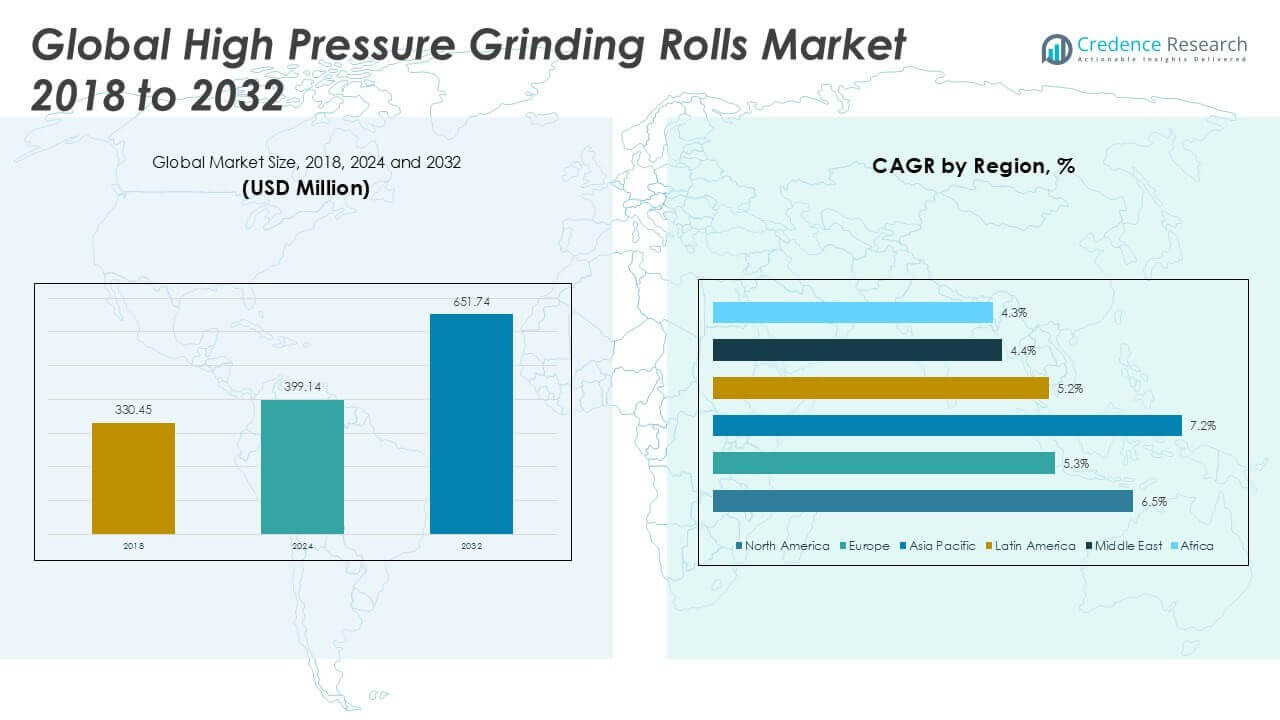
The global High Pressure Grinding Rolls Market is projected to grow from USD 399.14 million in 2024 to an estimated USD 651.74 million by 2032, registering a compound annual growth rate (CAGR) of 6.32% from 2025 to 2032.
| REPORT ATTRIBUTE | DETAILS |
|---|---|
| Historical Period | 2020-2023 |
| Base Year | 2024 |
| Forecast Period | 2025-2032 |
| High Pressure Grinding Rolls Market Size 2024 | USD 399.14 million |
| High Pressure Grinding Rolls Market, CAGR | 6.32% |
| High Pressure Grinding Rolls Market Size 2032 | USD 651.74 million |
Key drivers propelling the High Pressure Grinding Rolls Market include the growing emphasis on energy efficiency and reduced operational costs in mineral processing. High pressure grinding rolls offer significant advantages over traditional grinding mills, including lower energy consumption and higher throughput, which enhance overall process efficiency. Market trends indicate a shift toward integrating advanced automation and real-time monitoring systems that improve performance and reduce downtime. The demand for environmentally sustainable processes further accelerates the adoption of high-pressure grinding roll technology as industries seek to minimize carbon footprints and comply with regulatory standards.
Geographically, the Asia-Pacific region dominates the High Pressure Grinding Rolls Market due to rapid industrialization, expanding mining activities, and infrastructure development in countries such as China, India, and Australia. North America and Europe also contribute significantly, driven by investments in modernizing mineral processing facilities and increasing focus on sustainable operations. Key players in the market include Metso Outotec, FLSmidth, CITIC Heavy Industries, and Weir Group. These companies invest heavily in research and development to enhance product efficiency and expand their global presence through strategic partnerships and acquisitions.
Market Insights
- The global High Pressure Grinding Rolls Market is projected to grow from USD 399.14 million in 2024 to USD 651.74 million by 2032, with a CAGR of 6.32%.
- Increasing demand for energy-efficient and cost-effective grinding technologies in mining and cement industries drives market growth.
- Adoption of automation and real-time monitoring systems enhances grinding performance and reduces downtime, supporting market expansion.
- High initial capital investment and complex maintenance requirements pose challenges to widespread adoption.
- Asia-Pacific dominates the market due to rapid industrialization, expanding mining activities, and infrastructure development.
- North America and Europe show steady growth, fueled by modernization projects and stricter environmental regulations.
- Market players focus on R\&D and strategic collaborations to improve product efficiency and expand geographic presence
Market Drivers
Key Drivers Boosting the Adoption of High Pressure Grinding Rolls in Mining and Mineral Processing
The global High Pressure Grinding Rolls Market benefits from the increasing demand for energy-efficient grinding technologies in mining and mineral processing industries. It addresses the critical need to reduce energy consumption during ore grinding, which is one of the most energy-intensive processes in mineral extraction. The technology enhances throughput and improves grinding efficiency, enabling operators to lower operational costs. Rising global demand for minerals and metals drives mining activities, thereby fueling the requirement for advanced grinding solutions.
- For instance, approximately 50% of HPGR installations are found in the mining sector, where they are used to process materials such as gold, copper, and iron ore.
Growing Emphasis on Sustainable and Cost-Effective Industrial Processes in Cement and Construction Sectors
Industries such as cement and construction increasingly prioritize sustainable operations and cost reduction, which support the expansion of the global High Pressure Grinding Rolls Market. It offers significant advantages over traditional grinding mills by reducing energy usage and emissions. The ability to maintain consistent particle size distribution improves product quality, helping companies meet stringent environmental and quality standards. The ongoing shift toward eco-friendly manufacturing practices encourages adoption of high pressure grinding rolls, which contribute to lowering carbon footprints and enhancing resource utilization.
- For instance, sustainable grinding practices have led to a significant reduction in material waste and energy consumption across industrial sectors.
Technological Advancements Enhancing Operational Efficiency and Automation in Grinding Systems
Technological innovations in high pressure grinding roll systems improve process control, reliability, and overall operational efficiency. The global High Pressure Grinding Rolls Market leverages automation, real-time monitoring, and predictive maintenance to minimize downtime and optimize performance. These advancements enable remote diagnostics and faster response to equipment issues, reducing maintenance costs and extending machine lifespan. Manufacturers continue to invest in R\&D to integrate smart sensors and IoT technologies, ensurg the grinding rolls adapt to varying ore hardness and processing requirements with precision.
Increasing Investments and Infrastructure Development Driving Market Growth Across Key Regions
Infrastructure growth and mining investments worldwide stimulate the demand for efficient grinding technologies, contributing to the growth of the global High Pressure Grinding Rolls Market. Emerging economies in Asia-Pacific and Latin America expand mineral extraction and processing facilities, necessitating advanced equipment for high-volume operations. It supports modernization efforts in established markets such as North America and Europe, where aging grinding systems require upgrades for better efficiency. Government initiatives promoting resource development and industrial expansion further accelerate adoption of high pressure grinding rolls across various sectors.
Market Trends
Increasing Integration of Automation and Digital Technologies in Grinding Operations
The global High Pressure Grinding Rolls Market witnesses a rising trend toward automation and digital integration to enhance grinding process efficiency. It incorporates advanced control systems and sensors that enable real-time monitoring of operational parameters, allowing operators to optimize performance and reduce downtime. The use of predictive maintenance tools helps anticipate equipment failures, minimizing unplanned interruptions and lowering maintenance costs. Manufacturers focus on developing intelligent systems that adapt grinding pressure and speed based on ore characteristics. This trend improves overall productivity and supports seamless integration within smart mining and processing facilities.
- For instance, AI-powered control systems in grinding machines have reduced downtime by up to 40%, significantly improving operational efficiency.
Growing Preference for Sustainable and Environmentally Friendly Grinding Solutions
Sustainability drives key developments in the global High Pressure Grinding Rolls Market, with increasing demand for eco-friendly grinding equipment. It offers substantial energy savings compared to conventional grinding mills, contributing to reduced carbon emissions. Companies prioritize solutions that comply with stringent environmental regulations and support corporate social responsibility goals. The reduction in noise and dust emissions further aligns with sustainable operational practices. This trend encourages industry players to innovate products that balance high performance with lower environmental impact, enhancing the market appeal of high pressure grinding rolls.
- For instance, sustainable grinding practices have led to a 30% reduction in energy consumption across major industrial grinding operations, supporting eco-friendly initiatives.
Expansion of Multi-Material and Hybrid Grinding Technologies for Versatile Applications
The global High Pressure Grinding Rolls Market trends include the advancement of multi-material grinding rolls and hybrid systems to address diverse ore properties. It enables operators to process a wide range of mineral types with improved grinding efficiency and reduced wear rates. Manufacturers focus on developing rolls with enhanced wear-resistant materials, extending equipment lifespan and reducing downtime. Hybrid systems that combine grinding and crushing functions gain traction for their operational flexibility. This trend supports the growing need for customized grinding solutions tailored to specific processing requirements in various industries.
Increasing Focus on Retrofit and Modernization of Existing Grinding Equipment
Retrofitting and upgrading existing grinding installations represent a significant trend within the global High Pressure Grinding Rolls Market. It offers cost-effective alternatives to purchasing new equipment by enhancing the performance and energy efficiency of legacy systems. Operators seek modernization solutions to extend equipment life and improve throughput without major capital expenditure. The market sees rising demand for modular and scalable retrofit packages that integrate easily with current systems. This trend benefits mining and cement industries looking to optimize operations amid rising production pressures and tightening environmental standards.
Market Challenges
High Initial Capital Investment and High Maintenance Requirements Restricting Market Expansion
The High Pressure Grinding Rolls Market faces challenges related to the substantial initial capital investment required for equipment procurement and installation. It demands significant upfront costs, which may deter small and mid-sized operators from adopting this technology. The complexity of the machinery also translates into higher maintenance expenses and the need for skilled technicians to ensure optimal operation. Downtime caused by maintenance or repairs can affect overall productivity, creating reluctance among potential buyers. These factors limit the widespread adoption of high pressure grinding rolls, particularly in regions with budget constraints and limited technical expertise.
- For instance, the global high-pressure grinding rolls market had approximately 50% of installations in the mining sector, with companies utilizing over 24,000 metric tons of grinding media annually.
Technical Limitations and Material Wear Impacting Operational Efficiency and Adoption
The High Pressure Grinding Rolls Market encounters operational challenges due to material wear and technical limitations inherent in the grinding process. It requires robust wear-resistant materials for rolls, which can increase production costs and complicate manufacturing. Variability in ore hardness and composition affects grinding efficiency and may lead to inconsistent output quality. The technology demands precise control to avoid equipment damage and maintain performance standards. These technical challenges constrain market growth, requiring continuous innovation to improve durability and adaptability. Operators must balance performance gains with maintenance demands to maximize the benefits of high pressure grinding rolls.
Market Opportunities
Rising Demand for Energy-Efficient and Sustainable Grinding Solutions Creating Growth Opportunities
The High Pressure Grinding Rolls Market presents significant opportunities due to increasing industry focus on energy efficiency and sustainable operations. It offers a grinding technology that reduces power consumption and lowers carbon emissions compared to conventional mills. Growing environmental regulations and corporate sustainability commitments encourage companies to invest in cleaner, more efficient equipment. The rising demand for minerals and cement in emerging economies further supports market expansion. Manufacturers that develop innovative, eco-friendly grinding rolls stand to capture a larger share of this growing market segment.
Expansion in Mining and Infrastructure Development Driving Equipment Adoption Globally
Rapid industrialization and infrastructure development worldwide create favorable conditions for the High Pressure Grinding Rolls Market. It supports modernization efforts in mining and mineral processing facilities, which require high-capacity, reliable grinding solutions. Increasing investments in mining projects in Asia-Pacific, Latin America, and Africa generate demand for advanced grinding technologies. Retrofit and upgrade projects also offer opportunities to enhance performance and extend equipment life in existing plants. Companies that tailor their product offerings to regional requirements and focus on after-sales service can capitalize on these expanding opportunities.
Market Segmentation Analysis
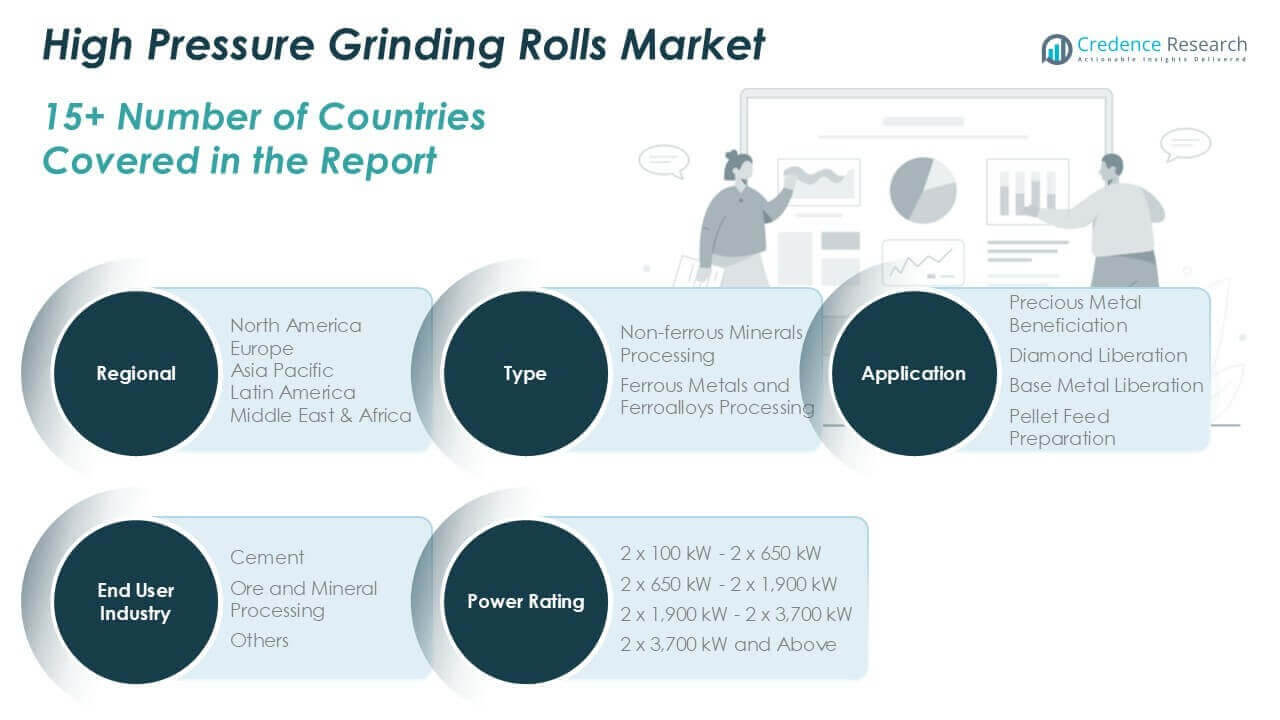
By Type
The High Pressure Grinding Rolls Market segments its type into non-ferrous minerals processing and ferrous metals and ferroalloys processing. It caters to industries that require efficient grinding of diverse mineral types. Non-ferrous minerals processing dominates due to the rising extraction of metals like copper, aluminum, and nickel, which demand energy-efficient grinding solutions. Ferrous metals and ferroalloys processing also contribute significantly, driven by the steel and alloy manufacturing sectors seeking enhanced throughput nd reduced power consumption.
By Application
Applications in the High Pressure Grinding Rolls Market include precious metal beneficiation, diamond liberation, base metal liberation, and pellet feed preparation. It supports processes that demand precise particle size control and improved grinding efficiency. Precious metal beneficiation and diamond liberation represent niche segments with specialized requirements, while base metal liberation and pellet feed preparation constitute larger shares due to broad industrial use. The technology’s ability to improve product quality and reduce operational costs fuels its adoption across these applications.
By End Use Industry
The market serves several end-use industries, primarily cement, ore and mineral processing, and others. It plays a critical role in cement production by improving raw material grinding efficiency and reducing energy consumption. Ore and mineral processing remain the largest end-use segment, reflecting the market’s close association with mining activities worldwide. Other industries adopting high pressure grinding rolls include chemical processing and infrastructure development, contributing to steady demand growth.
By Power Rating
Power rating segments in the High Pressure Grinding Rolls Market range from 2 x 100 kW to above 2 x 3,700 kW. It offers varied power options to meet different capacity requirements across industries. Lower power ratings suit small to mid-sized operations, while higher ratings support large-scale mining and mineral processing facilities. The availability of multiple power configurations allows flexibility for operators to optimize grinding performance based on throughput and ore characteristics.
Segments
Based on Type
- Non-ferrous Minerals Processing
- Ferrous Metals and Ferroalloys Processing
Based on Application
- Precious Metal Beneficiation
- Diamond Liberation
- Base Metal Liberation
- Pellet Feed Preparation
Based on end Use Industry
- Cement
- Ore and Mineral Processing
- Others
Based on Power Rating
- 2 x 100 kW - 2 x 650 kW
- 2 x 650 kW - 2 x 1,900 kW
- 2 x 1,900 kW - 2 x 3,700 kW
- 2 x 3,700 kW and Above
Based on Region
- North America
- U.S.
- Canada
- Mexico
- Europe
- UK
- France
- Germany
- Italy
- Spain
- Russia
- Belgium
- Netherlands
- Austria
- Sweden
- Poland
- Denmark
- Switzerland
- Rest of Europe
- Asia Pacific
- China
- Japan
- South Korea
- India
- Australia
- Thailand
- Indonesia
- Vietnam
- Malaysia
- Philippines
- Taiwan
- Rest of Asia Pacific
- Latin America
- Brazil
- Argentina
- Peru
- Chile
- Colombia
- Rest of Latin America
- Middle East
- UAE
- KSA
- Israel
- Turkey
- Iran
- Rest of Middle East
- Africa
- Egypt
- Nigeria
- Algeria
- Morocco
- Rest of Africa
Regional Analysis
North America High Pressure Grinding Rolls Market The North America High Pressure Grinding Rolls Market holds approximately 25% market share in 2024, with a valuation of USD 99.70 million, expected to reach USD 163.58 million by 2032 at a CAGR of 6.5%. It benefits from robust mining activities in the United States and Canada, driven by demand for minerals and metals across industries. Investments in modernizing mineral processing plants and adopting energy-efficient grinding technologies propel growth. Stringent environmental regulations encourage sustainable grinding solutions. Technological advancements and strong industrial infrastructure further support market expansion in this region
Europe High Pressure Grinding Rolls Market Europe commands around 19.5% market share in 2024, with the High Pressure Grinding Rolls Market valued at USD 78.05 million and forecasted to grow to USD 117.02 million by 2032, at a CAGR of 5.3%. The region serves established mining and cement industries, particularly in Germany, France, and the UK. Growth stems from efforts to improve operational efficiency and reduce carbon emissions. Upgrading aging grinding equipment to meet environmental standards fuels demand. Europe’s focus on sustainability and energy conservation drives adoption of high-performance grinding technologies.
Asia Pacific High Pressure Grinding Rolls Market The Asia Pacific region dominates with nearly 44% market share in 2024, holding a market value of USD 176.07 million, projected to reach USD 305.52 million by 2032 with a CAGR of 7.2%. Rapid industrialization, expanding mining activities, and infrastructure development in China, India, and Australia drive demand. Growing mineral and cement consumption in emerging economies supports adoption of advanced grinding solutions. Government initiatives promoting resource development and energy efficiency further accelerate growth. The region attracts significant investments from key manufacturers targeting high-growth markets.
Latin America High Pressure Grinding Rolls Market Latin America accounts for about 6% market share in 2024, valued at USD 24.11 million, expected to rise to USD 35.88 million by 2032 with a CAGR of 5.2%. Growth reflects expanding mining operations in Brazil, Chile, and Peru. Rising demand for base and precious metals stimulates investment in grinding technology. The mineral processing sector seeks cost-effective, energy-efficient solutions. Infrastructure and skilled labor challenges moderate growth but maintain an overall positive outlook.
Middle East and Africa High Pressure Grinding Rolls Market The Middle East and Africa collectively represent approximately 6% market share in 2024, with a combined market value of USD 21.20 million, expected to grow to USD 29.74 million by 2032 at CAGRs of 4.4% and 4.3% respectively. Growth drivers include mining exploration and infrastructure projects in Saudi Arabia, UAE, South Africa, and Nigeria. Demand for efficient, environmentally friendly grinding technologies supports development. Slower industrialization and regulatory constraints limit rapid expansion, offering moderate growth opportunities amid evolving industrial landscapes.
Key players
- ABB Ltd.
- FLSmidth & Co. A/S
- SGS S.A.
- KHD Humboldt
- Köppern Group
- Metso Oyj
- Outotec Oyj
- ThyssenKrupp Industrial Solutions AG (Polysius AG)
- CITIC Heavy Industries, Co., Ltd. (CITIC HIC)
Competitive Analysis
The global High Pressure Grinding Rolls Market features intense competition among established multinational corporations and regional players. It relies heavily on continuous innovation and technological advancements to maintain market position. Key companies focus on expanding product portfolios with energy-efficient and automated grinding solutions. Strategic mergers, acquisitions, and partnerships help players enhance their geographic reach and service capabilities. The market demands strong after-sales support and customization to meet varied industrial requirements. Cost competitiveness and operational efficiency influence client decisions, intensifying rivalry. Leading companies invest substantially in research and development to improve roll durability and process efficiency, ensuring they stay ahead in a rapidly evolving market landscape.
Recent Developments
- In Q1 2025, ABB reported strong financial performance, with revenues of \$7.94 billion and a 13% increase in operational EBITA. The company reaffirmed its 2025 outlook, acknowledging increased uncertainty in the business environment.
- In February 2025, Metso launched the HPGRSense solution for optimizing grinding efficiency through accurate monitoring of its HRCe high-pressure grinding rolls. This stand-alone system provides continuous simultaneous monitoring of the rolls, eliminating the need to stop the process for inspections.
- In 2024, CITIC HIC participated in setting China National Standards for high-pressure grinding rolls, promoting the development of large-scale HPGRs towards intelligence in the domestic market. The company maintained a leading position within China's mineral processing market by using international advanced design and manufacturing standards
Market Concentration and Characteristics
The global High Pressure Grinding Rolls Market exhibits a moderately concentrated structure dominated by a few key players with strong technological capabilities and extensive industry experience. It features high entry barriers due to the substantial capital investment and specialized expertise required for manufacturing advanced grinding equipment. Market leaders focus on innovation, product differentiation, and strategic collaborations to maintain competitive advantages. The demand for customized solutions tailored to diverse mineral processing needs drives continuous product development. Customer loyalty depends heavily on reliable after-sales service and technical support, influencing market dynamics. The market’s characteristics reflect steady growth fueled by industrial modernization and sustainability requirements, encouraging existing players to strengthen their presence while limiting new entrants.
Report Coverage
The esearch report offers an in-depth analysis based on Type, Application, end Use Industry, Power Rating and Region. It details leading market players, providing an overview of their business, product offerings, investments, revenue streams, and key applications. Additionally, the report includes insights into the competitive environment, SWOT analysis, current market trends, as well as the primary drivers and constraints. Furthermore, it discusses various factors that have driven market expansion in recent years. The report also explores market dynamics, regulatory scenarios, and technological advancements that are shaping the industry. It assesses the impact of external factors and global economic changes on market growth. Lastly, it provides strategic recommendations for new entrants and established companies to navigate the complexities of the market.
Future Outlook
- The global High Pressure Grinding Rolls Market will experience sustained growth driven by rising demand for energy-efficient grinding technologies across mining and cement industries.
- Technological advancements integrating automation and IoT will enhance operational efficiency and reduce maintenance costs, increasing market adoption.
- Emerging economies in Asia-Pacific and Latin America will offer significant growth opportunities due to expanding mining activities and infrastructure development.
- Increasing regulatory focus on reducing carbon emissions will encourage adoption of sustainable grinding solutions like high pressure grinding rolls.
- Retrofit and modernization projects in developed regions will drive demand for upgraded grinding equipment to improve productivity and compliance.
- Manufacturers will prioritize research and development to develop wear-resistant materials, extending equipment lifespan and lowering downtime.
- Integration of real-time monitoring and predictive maintenance tools will become standard features, optimizing performance and minimizing unplanned outages.
- The market will see rising customization options tailored to specific ore types and processing requirements, improving grinding precision.
- Strategic partnerships and mergers among key players will enhance geographic reach and technological capabilities, intensifying competition.
- Growing awareness of total cost of ownership and lifecycle efficiency will shift customer preference toward high pressure grinding rolls over traditional mills.

Request a Free Sample
Fill in your details and we'll send you a free sample report.
- Sample data tables & charts
- Research methodology
Market Dynamics
Emphasis on Energy Efficiency and Cost Reduction
High pressure grinding rolls (HPGR) offer lower energy consumption and higher throughput compared to traditional grinding mills, helping operators reduce operational costs and improve process efficiency. This is particularly important in mining and cement industries where energy costs are significant.
Integration of Automation and Real-Time Monitoring
The adoption of advanced automation, real-time monitoring, and predictive maintenance systems enhances grinding performance, reduces downtime, and optimizes operational efficiency, making HPGR technology more attractive to industrial users.
Demand for Sustainable and Environmentally Friendly Processes
Industries are increasingly seeking solutions that minimize carbon footprints and comply with stricter environmental regulations. HPGRs support these goals by reducing energy usage, emissions, and material waste compared to conventional grinding technologies.
Expansion of Mining and Infrastructure Activities in Emerging Markets
Rapid industrialization and infrastructure development, especially in Asia-Pacific and Latin America, are driving increased mining activities and the need for efficient, high-capacity grinding solutions, boosting HPGR adoption.
Technological Advancements and Customization
Continuous R&D investment is leading to the development of wear-resistant materials, hybrid grinding systems, and intelligent control features, enabling HPGRs to handle diverse ore types and processing requirements with greater precision and reliability.
Need a Custom Version of This Report?
Tailor the scope, geography, or segments to your exact requirements.
- Custom geography or segment scope
- Direct access to our analyst team
Frequently Asked Questions
What is the market size of the global High Pressure Grinding Rolls Market in 2023, and what is its forecast for 2032?
what are the key drivers fueling the growth of the High Pressure Grinding Rolls Market?
Which regions dominate the global High Pressure Grinding Rolls Market, and why?
Who are the leading companies in the High Pressure Grinding Rolls Market?
Table of Content
Chapter 1 Market Segmentation
- 1.1 Segmentation Framework
- 1.1.1 Product and Service Classification
- 1.1.2 Application and End-Use Classification
- 1.1.3 Technology and Solution Classification
- 1.1.4 Customer and Distribution Channel Classification
- 1.1.5 Geographic Segmentation
- 1.1.6 Market Segment Definitions and Boundaries
- 1.2 By Type
- 1.2.1 Non-ferrous Minerals Processing
- 1.2.2 Ferrous Metals and Ferroalloys Processing
- 1.3 By Application
- 1.3.1 Precious Metal Beneficiation
- 1.3.2 Diamond Liberation
- 1.3.3 Base Metal Liberation
- 1.3.4 Pellet Feed Preparation
- 1.4 By Power Rating
- 1.4.1 2 x 100 kW - 2 x 650 kW
- 1.4.2 2 x 650 kW - 2 x 1,900 kW
- 1.4.3 2 x 1,900 kW - 2 x 3,700 kW
- 1.4.4 2 x 3,700 kW and Above
- 1.5 By End Use Industry
- 1.5.1 Cement
- 1.5.2 Ore and Mineral Processing
- 1.5.3 Others
Chapter 2 Introduction
- 2.1 Report Objectives and Scope
- 2.2 Product Definition and Industry Terminology
- 2.3 Market Inclusions and Exclusions
- 2.4 Research Process
- 2.4.1 Primary Research and Expert Interviews
- 2.4.2 Secondary Research and Source Review
- 2.4.3 Top-Down and Bottom-Up Estimation
- 2.4.4 Data Triangulation and Verification
- 2.5 Market Size Measurement Basis
- 2.5.1 2024: USD 399.14 million → 2032: USD 651.74 million
- 2.6 Historical and Forecast Reference Periods
- 2.6.1 Base Year: 2024
- 2.6.2 Forecast Period: 2024-2032
- 2.7 Research Assumptions and Limitations
Chapter 3 Executive Summary
- 3.1 Market Snapshot and Key Findings
- 3.2 Base-Year Market Size, 2024
- 3.3 Forecast Market Size, 2032
- 3.4 Revenue and Volume Growth Outlook
- 3.5 Key Demand and Supply Indicators
- 3.6 Leading Market Segments
- 3.7 Fastest-Growing Market Opportunities
- 3.8 Regional Performance Highlights
- 3.9 Technology and Industry Transformation
- 3.10 Competitive Landscape Summary
- 3.11 Analyst View and Strategic Implications
Chapter 4 Global High Pressure Grinding Rolls Market Trends and Developments
- 4.1 Historical Industry Development
- 4.2 Recent Market Trends and Developments
- 4.3 Demand and Customer Behavior Trends
- 4.4 Technology and Product Innovation
- 4.5 Artificial Intelligence, Automation and Digitalization
- 4.6 Local Manufacturing and Supply Chain Realignment
- 4.7 Industry Partnerships, Mergers and Acquisitions
- 4.8 Sustainability and Circular Economy Developments
- 4.9 Government and Private Sector Investment Trends
- 4.10 Emerging Business Models and Commercialization
- 4.11 Industry Developments and Announcements
Chapter 5 Global High Pressure Grinding Rolls Market Production, Supply and Demand Analysis
- 5.1 Demand Trend and Consumption Analysis
- 5.2 Demand Forecast, 2024-2032
- 5.3 Production and Output Trend
- 5.4 Production and Output Forecast, 2024-2032
- 5.5 Installed Capacity and Capacity Utilization
- 5.6 Company-Wise Production Plants and Statistics
- 5.6.1 Installed Production Capacity
- 5.6.2 Actual Production
- 5.6.3 Planned Capacity and Expansion Targets
- 5.7 Supply Chain Structure and Procurement Trends
- 5.8 Supply-Demand Gap and Bottlenecks
- 5.9 Import Dependence and Sourcing Structure
- 5.10 Contract Manufacturing and Outsourcing
- 5.11 Regional Supply and Demand Concentration
Chapter 6 Global High Pressure Grinding Rolls Market Pricing Analysis
- 6.1 Pricing Structure and Measurement
- 6.2 Historical Pricing Trends
- 6.3 Pricing Outlook, 2024-2032
- 6.4 Average Selling Price and Unit Economics
- 6.5 Pricing by Product and Market Segment
- 6.6 Geographic Pricing Differences
- 6.7 Key Input, Energy, Labor and Logistics Costs
- 6.8 Contract Pricing and Purchasing Models
- 6.9 Pricing Sensitivity and Competitive Positioning
- 6.10 Price, Margin and Profitability Implications
Chapter 7 Global High Pressure Grinding Rolls Market Dynamics
- 7.1 Market Growth Drivers
- 7.1.1 Demand-Side Drivers
- 7.1.2 Technology and Innovation Drivers
- 7.1.3 Infrastructure and Investment Drivers
- 7.1.4 Regulatory and Policy Drivers
- 7.2 Market Restraints
- 7.2.1 Cost and Affordability Constraints
- 7.2.2 Technology and Adoption Barriers
- 7.2.3 Supply Chain and Operational Constraints
- 7.3 Market Challenges
- 7.3.1 Competitive Pressure and Margin Erosion
- 7.3.2 Skills, Infrastructure and Implementation Gaps
- 7.4 Emerging Market Opportunities
- 7.5 Market Dynamics Impact and Time-Horizon Assessment
Chapter 8 Global High Pressure Grinding Rolls Value Chain Analysis
- 8.1 Industry Value Chain Overview
- 8.2 Upstream Suppliers and Critical Inputs
- 8.3 Technology and Component Providers
- 8.4 Manufacturing or Service Delivery
- 8.5 Distribution, Channel Partners and Integrators
- 8.6 Downstream Applications and End Users
- 8.7 Value Addition and Profit Pools
- 8.8 Vertical Integration and Outsourcing
- 8.9 Supplier Concentration and Risk
- 8.10 Supply Chain Localization and Resilience
Chapter 9 Global High Pressure Grinding Rolls Market Regulations and Policies
- 9.1 Relevant Laws, Standards and Compliance Frameworks
- 9.2 Product, Service, Safety and Quality Requirements
- 9.3 Government Policies, Incentives and Subsidies
- 9.4 Imports, Exports and Trade Barriers
- 9.5 Public Procurement and Local Content Requirements
- 9.6 Environmental and Sustainability Compliance
- 9.7 Upcoming Policy Changes and Market Implications
Chapter 10 Global High Pressure Grinding Rolls Market Hotspots and Opportunities
- 10.1 Market Opportunity Mapping and Growth Hotspots
- 10.2 High-Growth Applications and Customer Groups
- 10.3 Underserved Markets and White-Space Opportunities
- 10.4 Emerging Technology and Product Opportunities
- 10.5 New Capacity and Investment Hotspots
- 10.6 Market Entry and Expansion Opportunities
- 10.7 Distribution and Partnership Opportunities
- 10.8 Near-Term and Long-Term Commercial Potential
- 10.9 Opportunity Attractiveness and Execution Risks
Chapter 11 Global High Pressure Grinding Rolls Market Outlook, 2024-2032
- 11.1 Market Size and Analysis
- 11.1.1 Revenue (Market Measurement: 2024: USD 399.14 million → 2032: USD 651.74 million)
- 11.1.2 Market Volume and Quantity Sold
- 11.1.3 Historical Market Size
- 11.1.4 Base-Year Market Size, 2024
- 11.2 Market Forecast, 2024-2032
- 11.2.1 Revenue Forecast to 2032
- 11.2.2 Volume Forecast to 2032
- 11.2.3 CAGR and Year-on-Year Growth
- 11.2.4 Incremental Revenue Opportunity
- 11.3 Forecast Assumptions and Scenario Analysis
- 11.3.1 Base-Case Forecast
- 11.3.2 Optimistic and Conservative Scenarios
- 11.3.3 Technology, Pricing and Policy Sensitivities
- 11.4 Market Attractiveness and Growth Outlook
Chapter 12 Global High Pressure Grinding Rolls Market Segmentation and Outlook
- 12.1 Segmentation Summary and Market Shares, 2024
- 12.2 Largest and Fastest-Growing Segments
- 12.3 By Type - Market Size and Forecast, 2024-2032
- 12.3.1 Segment Definition and Scope
- 12.3.2 Historical Market Size
- 12.3.3 Revenue Forecast, 2024-2032
- 12.3.4 Volume Forecast, 2024-2032
- 12.3.5 Base-Year Market Share, 2024
- 12.3.6 Segment CAGR and Growth Drivers
- 12.3.7 Subsegment Market Size and Forecast
- 12.3.7.1 Non-ferrous Minerals Processing
- 12.3.7.2 Ferrous Metals and Ferroalloys Processing
- 12.3.8 Subsegment Pricing and Adoption Trends
- 12.3.9 Leading Suppliers and Competition
- 12.3.10 Regional Demand and Opportunities
- 12.4 By Application - Market Size and Forecast, 2024-2032
- 12.4.1 Segment Definition and Scope
- 12.4.2 Historical Market Size
- 12.4.3 Revenue Forecast, 2024-2032
- 12.4.4 Volume Forecast, 2024-2032
- 12.4.5 Base-Year Market Share, 2024
- 12.4.6 Segment CAGR and Growth Drivers
- 12.4.7 Subsegment Market Size and Forecast
- 12.4.7.1 Precious Metal Beneficiation
- 12.4.7.2 Diamond Liberation
- 12.4.7.3 Base Metal Liberation
- 12.4.7.4 Pellet Feed Preparation
- 12.4.8 Subsegment Pricing and Adoption Trends
- 12.4.9 Leading Suppliers and Competition
- 12.4.10 Regional Demand and Opportunities
- 12.5 By Power Rating - Market Size and Forecast, 2024-2032
- 12.5.1 Segment Definition and Scope
- 12.5.2 Historical Market Size
- 12.5.3 Revenue Forecast, 2024-2032
- 12.5.4 Volume Forecast, 2024-2032
- 12.5.5 Base-Year Market Share, 2024
- 12.5.6 Segment CAGR and Growth Drivers
- 12.5.7 Subsegment Market Size and Forecast
- 12.5.7.1 2 x 100 kW - 2 x 650 kW
- 12.5.7.2 2 x 650 kW - 2 x 1,900 kW
- 12.5.7.3 2 x 1,900 kW - 2 x 3,700 kW
- 12.5.7.4 2 x 3,700 kW and Above
- 12.5.8 Subsegment Pricing and Adoption Trends
- 12.5.9 Leading Suppliers and Competition
- 12.5.10 Regional Demand and Opportunities
- 12.6 By End Use Industry - Market Size and Forecast, 2024-2032
- 12.6.1 Segment Definition and Scope
- 12.6.2 Historical Market Size
- 12.6.3 Revenue Forecast, 2024-2032
- 12.6.4 Volume Forecast, 2024-2032
- 12.6.5 Base-Year Market Share, 2024
- 12.6.6 Segment CAGR and Growth Drivers
- 12.6.7 Subsegment Market Size and Forecast
- 12.6.7.1 Cement
- 12.6.7.2 Ore and Mineral Processing
- 12.6.7.3 Others
- 12.6.8 Subsegment Pricing and Adoption Trends
- 12.6.9 Leading Suppliers and Competition
- 12.6.10 Regional Demand and Opportunities
- 12.7 Segment Growth Comparison
- 12.8 Segment Attractiveness and Priority Matrix
Chapter 13 Global High Pressure Grinding Rolls End-Use and Application Market Outlook
- 13.1 End-Use Industry and Customer Demand Structure
- 13.2 Leading Applications and Customer Groups
- 13.3 End-Use Market Size, Share and Forecast
- 13.4 Major End-Use Industry Deep Dives
- 13.4.1 Customer Requirements and Use Cases
- 13.4.2 Demand and Replacement Cycles
- 13.4.3 Technical and Regulatory Considerations
- 13.4.4 Purchasing and Procurement Models
- 13.4.5 Leading Vendors and Distribution Channels
- 13.4.6 Forecast and Commercial Opportunities
- 13.5 Emerging Applications and Cross-Segment Demand
- 13.6 End-Use Industry Investment Priorities
Chapter 14 Global High Pressure Grinding Rolls Geographic Market Outlook, 2024-2032
- 14.1 Regional Market Size and Share, 2024
- 14.2 Regional Market Forecast, 2024-2032
- 14.3 Regional Pricing, Production and Demand Differences
- 14.4 North America
- 14.4.1 United States
- 14.4.2 Canada
- 14.4.3 Mexico
- 14.5 Europe
- 14.5.1 Germany
- 14.5.2 France
- 14.5.3 Italy
- 14.5.4 United Kingdom
- 14.5.5 Spain
- 14.5.6 Poland
- 14.5.7 Russia
- 14.5.8 Netherlands
- 14.5.9 Belgium
- 14.5.10 Sweden
- 14.5.11 Denmark
- 14.5.12 Norway
- 14.5.13 Rest of Europe
- 14.6 Asia Pacific
- 14.6.1 China
- 14.6.2 India
- 14.6.3 Japan
- 14.6.4 South Korea
- 14.6.5 Thailand
- 14.6.6 Indonesia
- 14.6.7 Vietnam
- 14.6.8 Malaysia
- 14.6.9 Australia
- 14.6.10 Rest of Asia Pacific
- 14.7 Latin America
- 14.7.1 Brazil
- 14.7.2 Argentina
- 14.7.3 Colombia
- 14.7.4 Chile
- 14.7.5 Rest of Latin America
- 14.8 Middle East
- 14.8.1 Saudi Arabia
- 14.8.2 United Arab Emirates
- 14.8.3 Turkey
- 14.8.4 Israel
- 14.8.5 Iran
- 14.8.6 Rest of the Middle East
- 14.9 Africa
- 14.9.1 South Africa
- 14.9.2 Egypt
- 14.9.3 Nigeria
- 14.9.4 Morocco
- 14.9.5 Rest of Africa
- 14.10 Regional Investment, Policy and Supply Chain Differences
- 14.11 Regional Competitive Landscape
- 14.12 Geographic Growth Hotspots
Chapter 15 Global High Pressure Grinding Rolls Technology, Innovation and Sustainability Outlook
- 15.1 Technology Landscape and Maturity
- 15.2 Product, Process and Service Innovation
- 15.3 AI, Automation and Digital Tools in the Industry
- 15.4 Technology Adoption and Performance Benchmarking
- 15.5 Innovation Pipeline and R&D Investment
- 15.6 Patent and Intellectual Property Trends
- 15.7 Energy Efficiency and Resource Management
- 15.8 Sustainability, Recycling and Circularity
- 15.9 Technology Roadmap, 2024-2032
- 15.10 Risks of Obsolescence and Technology Substitution
Chapter 16 Global High Pressure Grinding Rolls Market Key Strategic Imperatives
- 16.1 Growth and Market Entry Priorities
- 16.2 High-Return Products and Segments
- 16.3 Pricing, Profitability and Cost Optimization
- 16.4 Technology Investment and Product Differentiation
- 16.5 Supply Chain Localization and Resilience
- 16.6 Distribution and Customer Acquisition
- 16.7 Partnership, Acquisition and Capacity Strategy
- 16.8 Regional Expansion Priorities
- 16.9 Short-, Medium- and Long-Term Actions
Chapter 17 Competition Outlook
- 17.1 Industry Competition Characteristics
- 17.2 Market Structure and Concentration
- 17.3 Market Share and Competitive Positioning, 2024
- 17.4 Company-Wise Revenue and Product Benchmarking
- 17.5 Production and Service Capacity Benchmarking
- 17.6 Technology, Pricing and Differentiation
- 17.7 Regional Footprint and Distribution Strength
- 17.8 Mergers, Acquisitions and Strategic Alliances
- 17.9 New Entrants and Competitive Threats
- 17.10 Porter's Five Forces and Industry Attractiveness
- 17.11 Competitive Outlook, 2024-2032
Chapter 18 Company Profiles
- 18.1 Company Coverage and Selection Criteria
- 18.2 Metso Outotec
- 18.2.1 Business Description
- 18.2.2 Company Ownership and Geographic Presence
- 18.2.3 Product and Service Portfolio
- 18.2.4 Manufacturing and Operating Footprint
- 18.2.5 Production Capacity and Expansion Plans
- 18.2.6 Financial Performance and Investment
- 18.2.7 Market Share and Competitive Position
- 18.2.8 Technology and Innovation Capabilities
- 18.2.9 Strategic Alliances or Partnerships
- 18.2.10 Recent Developments
- 18.2.11 Growth Strategy and Outlook
- 18.3 FLSmidth & Co. A/S
- 18.4 CITIC Heavy Industries
- 18.5 Weir Group
- 18.6 Köppern Group
- 18.7 ThyssenKrupp Industrial Solutions AG
- 18.8 ABB Ltd.
- 18.9 KHD Humboldt Wedag
- 18.10 SGS S.A.
- 18.11 Other Relevant Market Participants
Note: Every listed company is profiled on the structure shown under the first company. The company list is preliminary and may change based on research findings, market developments, data availability and client requirements.
Chapter 19 Disclaimer
- 19.1 Research and Forecast Disclaimer
- 19.2 Data Source and Estimation Limitations
Note: The depth of individual sections depends on data availability for this market. Volume, capacity, trade and other unit-based metrics are included where applicable.