
Market Overview
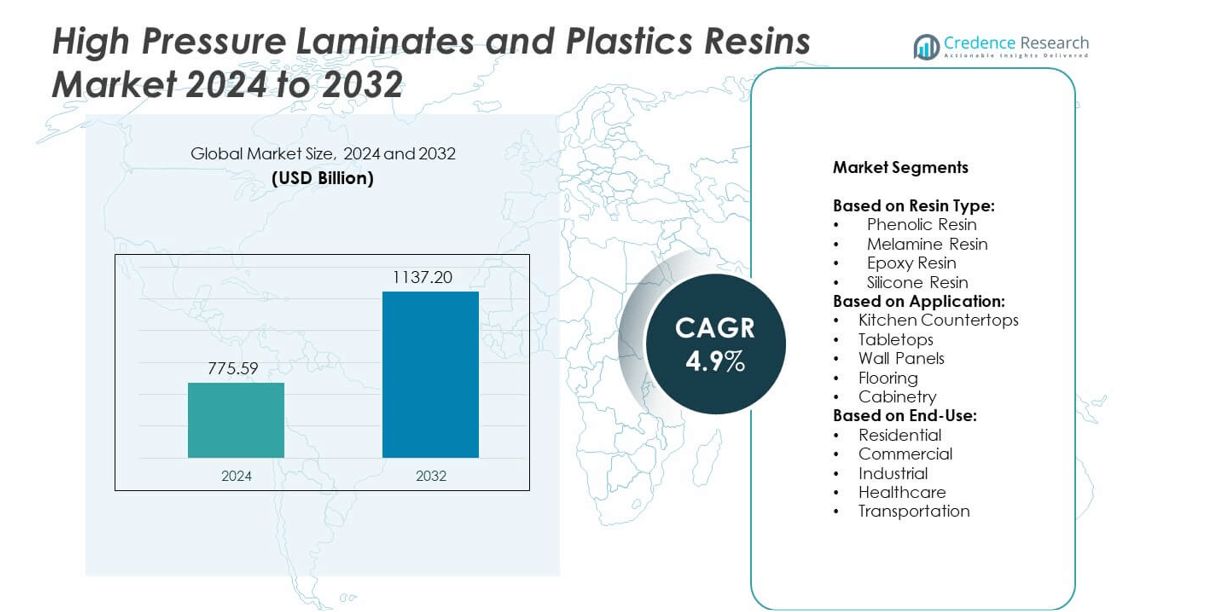
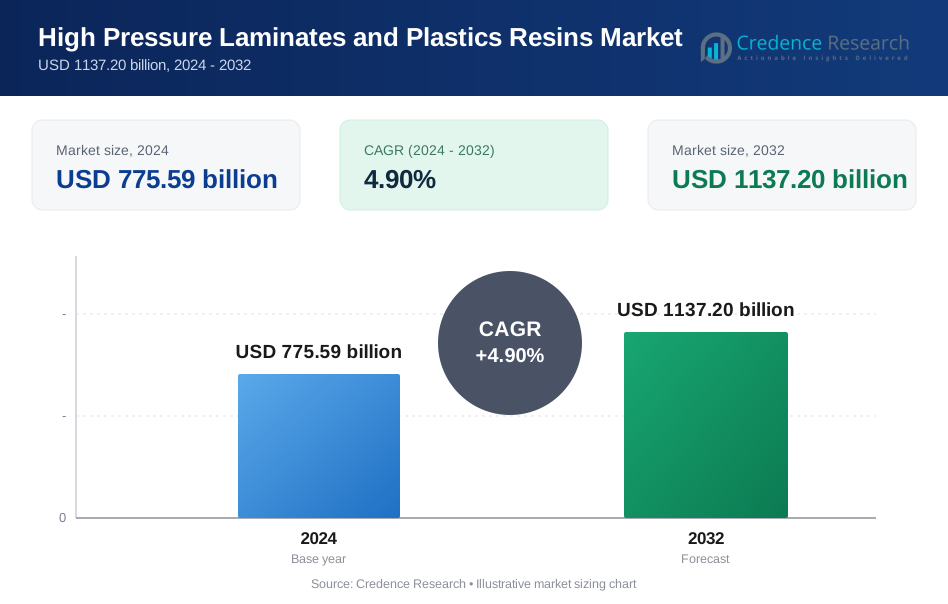
The High Pressure Laminates and Plastics Resins Market size was valued at USD 775.59 billion in 2024 and is anticipated to reach USD 1137.20 billion by 2032, growing at a CAGR of 4.9% during the forecast period.
| REPORT ATTRIBUTE | DETAILS |
|---|---|
| Historical Period | 2020-2023 |
| Base Year | 2024 |
| Forecast Period | 2025-2032 |
| High Pressure Laminates and Plastics Resins Market Size 2024 | USD 775.59 billion |
| High Pressure Laminates and Plastics Resins Market, CAGR | 4.9% |
| High Pressure Laminates and Plastics Resins Market Size 2032 | USD 1137.20 billion |
The High Pressure Laminates and Plastics Resins market grows with rising demand in construction, furniture, and automotive industries. Increasing preference for durable, lightweight, and aesthetic materials supports widespread adoption across residential and commercial applications. Eco-friendly resins and recyclable laminates gain traction under stricter environmental regulations and consumer awareness of sustainability. Advances in digital printing and surface technologies enhance product customization, boosting market appeal. It continues to expand with urbanization, infrastructure investments, and innovation in high-performance materials meeting diverse industrial needs
North America and Europe lead the High Pressure Laminates and Plastics Resins market with strong adoption in construction, interiors, and commercial spaces, supported by technological innovation and sustainability regulations. Asia Pacific shows rapid expansion due to urbanization, rising incomes, and large-scale infrastructure projects across China and India. Latin America and the Middle East & Africa demonstrate steady growth from construction and hospitality investments. Key players driving the market include Kronospan, Trespa International, Egger, and Wilsonart, each focusing on innovation and regional expansion.
Market Insights
- The High Pressure Laminates and Plastics Resins market was valued at USD 775.59 billion in 2024 and is projected to reach USD 1137.20 billion by 2032, growing at a CAGR of 4.9%.
- Strong demand from construction, furniture, and interior design industries fuels market expansion, supported by consumer preference for durable and aesthetic materials.
- Growing trend toward decorative laminates with advanced textures, finishes, and digital printing technologies enhances product appeal across residential and commercial sectors.
- Competition intensifies among global players focusing on innovation, eco-friendly materials, and regional expansions to strengthen market presence.
- Volatility in raw material prices, dependence on petroleum-based inputs, and strict environmental regulations act as restraints for manufacturers.
- North America and Europe dominate through advanced technologies and sustainable adoption, while Asia Pacific shows rapid growth due to infrastructure projects and urbanization.
- Latin America and the Middle East & Africa demonstrate steady demand, with rising investments in residential, commercial, and hospitality construction supporting future growth opportunities.
Market Drivers
Rising Dmand from Construction and Interior Applications
The High Pressure Laminates and Plastics Resins market benefits strongly from expanding construction and interior projects. Increasing urbanization drives demand for durable, cost-effective, and aesthetic building materials. These laminates provide resistance to scratches, stains, and moisture, making them suitable for countertops, flooring, and wall panels. Plastic resins support a wide variety of architectural applications due to their strength and flexibility. It supports large-scale adoption in both residential and commercial projects. Growth in modular construction techniques further strengthens demand for lightweight yet durable materials.
- For instance, Greenlam Industries commenced commercial production of a greenfield laminates manufacturing facility at Naidupeta, Andhra Pradesh, on September 29, 2023. This facility, which is a project of the company's subsidiary, Greenlam South, has an annual installed capacity of 3.5 million sheets and boards. This expansion, along with other projects, increased the company's total consolidated capacity to 24.52 million sheets annually.
Expanding Role of Consumer Goods and Automotive Industries
The High Pressure Laminates and Plastics Resins market gains traction from growing consumer goods and automotive industries. Demand rises for materials that combine durability, lightweight properties, and visual appeal. Automakers increasingly use laminates for interior trims, dashboards, and panels due to their design flexibility. Plastic resins enable vehicle manufacturers to reduce weight, improve efficiency, and meet safety standards. It provides manufacturers with cost-effective options while ensuring compliance with performance requirements. Consumer product companies also integrate laminates into furniture and appliances to enhance product longevity.
- For instance, The Hyundai IONIQ 6, launched globally in 2022, is built on the Electric-Global Modular Platform (E-GMP) and features a streamlined design with a low drag coefficient of 0.21, contributing to its energy efficiency.
Sustainability and Adoption of Eco-Friendly Alternatives
The High Pressure Laminates and Plastics Resins market evolves with greater emphasis on sustainability. Companies invest in bio-based resins and low-emission laminates to meet regulatory standards. Demand grows for recyclable and environmentally responsible materials in furniture, flooring, and packaging applications. It drives innovation in greener production methods while reducing reliance on petroleum-based inputs. Governments introduce stricter environmental guidelines, encouraging industries to shift towards eco-friendly solutions. Rising consumer preference for sustainable products supports steady adoption across diverse sectors.
Technological Advancements and Product Customization
The High Pressure Laminates and Plastics Resins market expands through innovations in design, texture, and manufacturing technologies. Advanced digital printing enables laminates with realistic patterns and enhanced aesthetic appeal. Plastic resins benefit from improved processing methods that deliver greater strength and durability. It allows producers to create materials tailored to end-user specifications. Customization in colors, finishes, and performance features improves competitiveness among manufacturers. Continuous R&D investments create opportunities for high-value applications across architecture, automotive, and industrial sectors.
Market Trends
Growing Use of Decorative and Aesthetic Solutions Across Industries
The High Pressure Laminates and Plastics Resins market observes a shift toward decorative and aesthetic solutions. Rising consumer preference for visually appealing surfaces drives demand for innovative designs. Manufacturers introduce laminates with varied textures, finishes, and color patterns to meet this need. Plastic resins are increasingly applied in stylish consumer goods and durable furniture. It enables manufacturers to balance aesthetics with functionality. Growth in interior design and lifestyle-driven purchases further accelerates the use of decorative laminates.
- For instance, Fundermax introduced its updated "Exterior 2.3" collection for Max Compact Exterior panels at the BAU 2023 trade show, which featured new decors and surface finishes. Fundermax's Max Compact panels have consistently been manufactured with a core of approximately 65% natural fibers, derived mainly from wood by-products, ensuring a high renewable content.
Integration of Advanced Digital Printing and Surface Technologies
The High Pressure Laminates and Plastics Resins market benefits from advances in digital printing and surface technologies. Manufacturers adopt printing methods that replicate natural materials such as wood, stone, or marble with precision. High-resolution printing enhances realism and creates stronger market acceptance in premium interiors. Surface technology improvements increase durability against scratches, wear, and chemicals. It enhances product lifespan while maintaining aesthetic quality. This trend supports a wider adoption in commercial and residential applications requiring long-lasting finishes.
- For instance, Wilsonart Traceless Laminate, which was launched before 2023, features anti-fingerprint technology. The product exhibits heat resistance, but manufacturer documentation specifies that it should not be subjected to temperatures higher than 275°F (135°C) for substantial periods. An extension of the Traceless line, including Solicor and Compact versions, was introduced in 2023
Increasing Preference for Lightweight and Functional Materials
The High Pressure Laminates and Plastics Resins market grows with rising demand for lightweight yet functional materials. Automotive, aerospace, and packaging sectors drive adoption to reduce weight without compromising performance. Plastic resins enable significant fuel efficiency improvements in transportation industries. Laminates find use in modular furniture and mobile structures due to ease of handling. It offers durability while maintaining cost-effectiveness. This preference for lightweight materials reflects a broader trend toward efficiency and sustainability across industries.
Emphasis on Sustainable and Circular Economy Practices
The High Pressure Laminates and Plastics Resins market evolves under pressure for sustainable practices. Manufacturers focus on recyclable laminates and bio-based resin formulations to reduce environmental impact. Stricter government regulations reinforce this shift toward eco-conscious production. Consumer awareness of environmental impact increases demand for green-certified products. It encourages industries to expand recycling capabilities and use renewable raw materials. Companies embracing sustainability gain stronger positioning in global markets emphasizing circular economy principles.
Market Challenges Analysis
Volatility in Raw Material Prices and Supply Chain Constraints
The High Pressure Laminates and Plastics Resins market faces challenges from fluctuating raw material costs and supply disruptions. Dependence on petroleum-based inputs exposes manufacturers to oil price volatility, which directly impacts production expenses. Geopolitical tensions and trade restrictions further limit the stable availability of essential raw materials. It pressures companies to balance cost efficiency with consistent product supply. Delays in logistics and transportation add complexity for manufacturers operating across global markets. These issues restrict long-term planning and increase operational risks for industry participants.
Environmental Regulations and Sustainability Pressures
The High Pressure Laminates and Plastics Resins market must address strict environmental standards and sustainability expectations. Rising concerns about emissions, plastic waste, and recyclability create compliance burdens for manufacturers. Companies face higher costs to adopt eco-friendly production methods and invest in recycling infrastructure. It challenges smaller players with limited resources to meet regulatory demands. Growing consumer demand for sustainable products forces a shift toward bio-based alternatives, which remain expensive and less scalable. Regulatory and market pressures together create barriers for consistent profitability in the sector.
Market Opportunities
Expansion Across Emerging Economies and Infrastructure Growth
The High Pressure Laminates and Plastics Resins market has strong opportunities in emerging economies experiencing rapid urbanization and infrastructure growth. Rising investments in residential, commercial, and industrial construction create demand for durable, versatile, and cost-effective materials. Expanding middle-class populations increase consumption of furniture, consumer goods, and interior décor, supporting higher laminate adoption. Plastic resins play a vital role in packaging and automotive industries, both of which are growing in developing regions. It positions manufacturers to expand market presence through local production facilities. Strategic partnerships with regional players further enhance access to fast-developing markets.
Innovation in Eco-Friendly Materials and Advanced Applications
The High Pressure Laminates and Plastics Resins market can capitalize on innovation in sustainable and high-performance materials. Demand grows for recyclable laminates and bio-based resins aligned with green building certifications and regulatory compliance. Manufacturers developing low-emission, lightweight, and durable products strengthen their competitive edge. It also creates opportunities for advanced applications in automotive, healthcare, and aerospace sectors requiring performance-driven solutions. Growth in digital printing technologies enables customized designs for premium interior and architectural markets. Companies investing in sustainable innovation and value-added solutions stand to capture long-term opportunities.
Market Segmentation Analysis:
By Resin Type:
The High Pressure Laminates and Plastics Resins market demonstrates diverse demand across multiple categories. Phenolic resin dominates due to its high resistance to heat, chemicals, and impact, making it suitable for heavy-duty surfaces in laboratories and industrial spaces. Melamine resin secures strong adoption in decorative laminates because of its hardness and ability to deliver scratch-resistant finishes. Epoxy resin finds rising use in applications requiring superior bonding strength and chemical resistance, particularly in industrial and healthcare environments. Silicone resin, valued for its thermal stability and weather resistance, gains traction in specialized applications across transportation and high-performance construction projects. It creates opportunities for manufacturers to target both mass-market and niche demand.
- For instance, Sumitomo Bakelite is a major manufacturer of phenolic resins and high-performance plastics for various applications, including automotive, electronic, and industrial components. The company also produces materials for laminates used in circuit boards. The company's European High-Performance Plastics subsidiary (SBHPP Europe) operates multiple facilities, including one in Genk with an 80,000-tonnes capacity. According to Belgian company filings, Sumitomo Bakelite Europe had a total turnover of €88.7 million in 2024.
By Application:
The High Pressure Laminates and Plastics Resins market sees consistent growth across kitchen countertops, tabletops, wall panels, flooring, and cabinetry. Kitchen countertops hold the largest share due to their high durability and resistance to stains, which makes them popular in both residential and commercial kitchens. Tabletop applications gain traction in hospitality and educational sectors, where long-lasting surfaces are critical. Wall panels and flooring applications expand due to increasing demand for decorative and functional interior solutions in modern buildings. Cabinetry applications also grow steadily with rising demand for stylish, functional storage solutions in homes and offices. It supports the broader adoption of laminates across multiple building segments.
- For instance, Egger operates 22 production facilities across 11 countries and sells its products to customers in over 120 countries. The company's focus has diversified from solely laminate flooring to include a wide range of wood-based materials and timber
By End-Use:
The High Pressure Laminates and Plastics Resins market spans residential, commercial, industrial, healthcare, and transportation sectors. Residential applications dominate through widespread demand for furniture, flooring, and interior décor. Commercial spaces such as offices, retail stores, and hospitality centers integrate laminates and resins for durability and design flexibility. Industrial applications require high-performance laminates with chemical and impact resistance, driving demand for phenolic and epoxy resins. Healthcare facilities adopt these materials for hygienic and easy-to-maintain surfaces in laboratories and patient areas. Transportation end-use grows with laminates used in vehicle interiors to reduce weight and improve durability. It reflects the versatility of these materials across industries seeking both performance and aesthetics.
Segments:
Based on Resin Type:
- Phenolic Resin
- Melamine Resin
- Epoxy Resin
- Silicone Resin
Based on Application:
- Kitchen Countertops
- Tabletops
- Wall Panels
- Flooring
- Cabinetry
Based on End-Use:
- Residential
- Commercial
- Industrial
- Healthcare
- Transportation
Based on the Geography:
- North America
- U.S.
- Canada
- Mexico
- Europe
- UK
- France
- Germany
- Italy
- Spain
- Russia
- Belgium
- Netherlands
- Austria
- Sweden
- Poland
- Denmark
- Switzerland
- Rest of Europe
- Asia Pacific
- China
- Japan
- South Korea
- India
- Australia
- Thailand
- Indonesia
- Vietnam
- Malaysia
- Philippines
- Taiwan
- Rest of Asia Pacific
- Latin America
- Brazil
- Argentina
- Peru
- Chile
- Colombia
- Rest of Latin America
- Middle East
- UAE
- KSA
- Israel
- Turkey
- Iran
- Rest of Middle East
- Africa
- Egypt
- Nigeria
- Algeria
- Morocco
- Rest of Africa
Regional Analysis
North America
North America holds a significant position in the High Pressure Laminates and Plastics Resins market with a market share of 32%. Strong demand arises from the construction, residential, and commercial interior sectors. Kitchen countertops, wall panels, and flooring represent core applications, supported by high renovation spending in the United States and Canada. The region benefits from advanced technological infrastructure, which supports the production of durable and innovative laminates with superior finishes. Growth in sustainable construction practices drives adoption of eco-friendly resin-based laminates that meet stringent green building standards. Healthcare facilities across the region also invest in hygienic laminates with anti-bacterial properties to meet safety requirements. It maintains steady expansion through well-established supply chains, major global players, and consistent innovation in digital printing technologies tailored to consumer preferences.
Europe
Europe secures a market share of 27%, driven by strong focus on sustainability and compliance with environmental regulations. The construction sector emphasizes eco-friendly and recyclable materials, creating high demand for bio-based resins and low-emission laminates. Countries such as Germany, France, Italy, and the United Kingdom showcase consistent adoption of laminates in residential interiors, commercial offices, and retail projects. The hospitality and transportation sectors also contribute significantly, with laminates widely used in furniture and vehicle interiors. European consumers prioritize both design and sustainability, creating opportunities for manufacturers offering premium and environmentally responsible solutions. It strengthens further due to regulatory frameworks such as REACH and the EU Green Deal that mandate reduced emissions and waste. Continuous investment in R&D supports advanced surface technologies and customized design solutions, positioning Europe as a mature but innovative market.
Asia Pacific
Asia Pacific dominates growth momentum in the High Pressure Laminates and Plastics Resins market with a market share of 29%. Rapid urbanization, rising disposable income, and large-scale infrastructure projects across China, India, Japan, and Southeast Asia fuel expansion. Residential demand is especially strong, with laminates widely used in cabinetry, flooring, and countertops for urban housing developments. Commercial spaces, including offices, malls, and educational institutions, create additional opportunities through high-volume furniture requirements. Manufacturing strength in the region ensures cost-efficient production and widespread supply. It also benefits from government-backed smart city initiatives and rising adoption of eco-friendly construction practices. The strong base of regional producers coupled with global players expanding manufacturing facilities positions Asia Pacific as the fastest-growing contributor to overall market share.
Latin America
Latin America contributes a market share of 7%, supported by growing construction activities and rising demand for affordable residential solutions. Brazil and Mexico lead regional consumption, with significant adoption in kitchen countertops, flooring, and wall panels. Increasing investments in commercial infrastructure, including hotels and retail complexes, enhance opportunities for laminates and resins. The region’s growing middle-class population fuels demand for stylish and durable home interiors at competitive prices. Industrial and healthcare sectors also show gradual uptake as modern facilities adopt functional, cost-effective materials. It remains a developing market where affordability and durability drive consumer choices more than advanced customization. Regional manufacturers often collaborate with international players to expand product offerings and access new technologies.
Middle East & Africa
The Middle East & Africa region holds a market share of 5%, reflecting emerging but steady adoption trends. High demand originates from the booming construction sector in Gulf countries such as Saudi Arabia, the UAE, and Qatar. Large infrastructure investments, including commercial complexes, hotels, and airports, drive laminates and resin-based applications. Africa, though smaller in demand, shows rising interest in residential projects as urbanization increases. Healthcare investments also support growth, with laminates used for hygienic and durable wall panels and cabinetry. It continues to expand through strong construction pipelines and growing awareness of high-quality interior solutions. Partnerships between global suppliers and local distributors are strengthening regional market access and supply availability.
Key Player Analysis
- Kronospan
- Trespa International
- Resopal
- Uniboard
- Egger
- DLH Industries
- Wilsonart
- Arpa Industriale S.p.A
- Alvic
- Wilamex
- Maica Internationa
- Polyrey
- Abet Laminatin
- The Formica Corpora
- Formic a
Competitive Analysis
Competitive landscape of the High Pressure Laminates and Plastics Resins market features key players such as Kronospan, Trespa International, Resopal, Uniboard, Egger, DLH Industries, Wilsonart, Arpa Industriale S.p.A, Alvic, Wilamex, Maica Internationa, Polyrey, Abet Laminatin, The Formica Corpora, and Formic a. These companies compete by offering a wide portfolio of laminates and resins designed to meet diverse industry requirements across construction, residential, commercial, healthcare, and transportation sectors. They emphasize product durability, aesthetic value, and eco-friendly materials to strengthen customer loyalty and comply with strict regulatory standards. Market leaders continue to expand production capabilities and integrate advanced digital printing and surface technologies, enabling highly customized finishes. Innovation in bio-based and recyclable resins supports long-term sustainability goals and positions manufacturers strongly in environmentally conscious markets. Partnerships, acquisitions, and regional expansions remain core strategies to enhance global reach and build stronger distribution networks. Competitive intensity increases with growing demand for decorative laminates and lightweight resin solutions across Asia Pacific and North America. Continuous R&D investments allow these players to differentiate their products with improved performance, durability, and design flexibility. The market remains dynamic, with established players leveraging innovation, scale, and sustainability to maintain leadership and expand into emerging economies.
Recent Developments
- In 2025, Trespa International plans to participate in Future Facade 2025 held on 7 & 8 May 2025, where it will showcase sustainable, high-performance facade panels designed to store CO₂
- In 2023, Kronospan opened a new Design Centre in Bucharest, showcasing its Harmony collection and enhanced customer engagement
- In 2023, Wilsonart launched new residential HPL designs under the theme “affordable luxury”.
Report Coverage
The research report offers an in-depth analysis based on Resin Type, Application, End-Use and Geography. It details leading market players, providing an overview of their business, product offerings, investments, revenue streams, and key applications. Additionally, the report includes insights into the competitive environment, SWOT analysis, current market trends, as well as the primary drivers and constraints. Furthermore, it discusses various factors that have driven market expansion in recent years. The report also explores market dynamics, regulatory scenarios, and technological advancements that are shaping the industry. It assesses the impact of external factors and global economic changes on market growth. Lastly, it provides strategic recommendations for new entrants and established companies to navigate the complexities of the market.
Future Outlook
- The market will expand with rising construction and interior design activities worldwide.
- Demand will grow for decorative laminates with advanced textures and finishes.
- Eco-friendly resins and recyclable laminates will gain strong adoption under sustainability goals.
- Manufacturers will invest in bio-based raw materials to meet environmental regulations.
- Asia Pacific will remain the fastest-growing region due to urbanization and infrastructure growth.
- North America and Europe will continue leading innovation with premium and green-certified products.
- Digital printing technology will support greater customization in furniture and interiors.
- Automotive and transportation sectors will increase use of lightweight laminates and resins.
- Healthcare and industrial facilities will adopt laminates for durability and hygiene benefits.
- Strategic partnerships and regional expansions will shape long-term competitiveness in the market.
Request a Free Sample
Fill in your details and we'll send you a free sample report.
- Sample data tables & charts
- Research methodology
Need a Custom Version of This Report?
Tailor the scope, geography, or segments to your exact requirements.
- Custom geography or segment scope
- Direct access to our analyst team
Frequently Asked Questions
What is the current market size for High Pressure Laminates and Plastics Resins market, and what is its projected size in 2032?
Which High Pressure Laminates and Plastics Resins market segment held the largest share in 2024?
What are the primary factors fueling the growth of the High Pressure Laminates and Plastics Resins market?
Who are the leading companies in the High Pressure Laminates and Plastics Resins Market?
Table of Content
Chapter 1. Report Introduction
- 1.1 Report Description & Purpose
- 1.1.1 Report Title & Market Definition
- 1.1.2 Unique Selling Propositions (USP) & Key Differentiators
- 1.1.3 Value Proposition for Stakeholders
- 1.2 Research Objectives
- 1.2.1 Market Sizing Objectives (Volume & Revenue)
- 1.2.2 Segmentation Objectives
- 1.2.3 Competitive Intelligence Objectives
- 1.2.4 Forecast & Scenario Objectives
- 1.3 Report Scope
- 1.3.1 High Pressure Laminates and Plastics Resins Scope – Types & Subtypes Covered
- 1.3.2 Geographic Scope – Regions & Countries Covered
- 1.3.3 Historical Period, Base Year & Forecast Period (2024; forecast to 2032)
- 1.3.4 Inclusions & Exclusions
- 1.4 HS Code & Classification Framework
- 1.5 Currency, Units & Pricing Basis
- 1.6 Target Stakeholders
- 1.7 Limitations & Assumptions
Chapter 2. Executive Summary
- 2.1 Global High Pressure Laminates and Plastics Resins Market Snapshot
- 2.1.1 Market Size – Historical (2024) & Forecast (2024-2032) (2024: USD 775.59 billion → 2032: USD 1137.20 billion)
- 2.1.2 Volume & Revenue – Global Totals
- 2.1.3 Key Market Highlights – Top Five Facts
- 2.2 High Pressure Laminates and Plastics Resins Market Segmentation Snapshot
- 2.2.1 Market Split by Region – 2024 vs. 2032
- 2.3 Competitive Snapshot
- 2.3.1 Top 10 Players by Revenue Share – 2024
- 2.3.2 Top 10 Players by Volume Share – 2024
- 2.3.3 Recent Strategic Developments (18-Month Summary)
- 2.4 Key Investment Highlights & Strategic Conclusions
Chapter 3. High Pressure Laminates and Plastics Resins Market Dynamics & Industry Analysis
- 3.1 Market Overview & Context
- 3.1.1 High Pressure Laminates and Plastics Resins Market Position in the Broader Automotive Value Chain
- 3.1.2 OEM vs. Replacement Market Dynamics
- 3.1.3 Market Maturity & Development Stage by Region
- 3.2 High Pressure Laminates and Plastics Resins Market Drivers
- 3.3 High Pressure Laminates and Plastics Resins Market Restraints & Challenges
- 3.4 High Pressure Laminates and Plastics Resins Market Opportunities
- 3.5 Porter's Five Forces Analysis
- 3.5.1 Threat of New Entrants
- 3.5.2 Bargaining Power of Suppliers
- 3.5.3 Bargaining Power of Buyers
- 3.5.4 Threat of Substitutes
- 3.5.5 Competitive Rivalry – Intensity Assessment
- 3.6 High Pressure Laminates and Plastics Resins Value Chain Analysis
- 3.6.1 Upstream – Raw Material/Input Suppliers
- 3.6.1.1 Raw Material/Input 1
- 3.6.1.2 Raw Material/Input 2
- 3.6.1.3 Raw Material/Input 3
- 3.6.2 Midstream – Production/Manufacturing/Service Delivery
- 3.6.2.1 Production/Process Overview
- 3.6.2.2 Key Facility Locations & Capacity by Manufacturer
- 3.6.3 Downstream – Distribution & End Consumer
- 3.6.3.1 Primary Channel – B2B/OEM
- 3.6.3.2 Secondary Channels – Dealer, Retail, Online, Direct
- 3.6.4 Value Chain Profitability Analysis
- 3.6.1 Upstream – Raw Material/Input Suppliers
- 3.7 PESTEL Analysis
- 3.7.1 Political Factors
- 3.7.2 Economic Factors
- 3.7.3 Social Factors
- 3.7.4 Technological Factors
- 3.7.5 Environmental Factors
- 3.7.6 Legal Factors
- 3.8 High Pressure Laminates and Plastics Resins Supply Chain Analysis
- 3.8.1 Raw Material/Input Supply Risk Assessment
- 3.8.2 Manufacturing Concentration Risk (Geographic Exposure)
- 3.8.3 Trade Disruption Impact Analysis
- 3.9 Regulatory & Policy Landscape
Note: The regulatory and policy landscape section covers regulations based on their applicability to the market, High Pressure Laminates and Plastics Resins category, geography, and scope of the study. Only regulatory frameworks with a material impact on operations, compliance, trade, sustainability, or market access are analyzed in detail.
Chapter 4. Key Investment Pockets & Opportunity Analysis
- 4.1 High Pressure Laminates and Plastics Resins Market Attractiveness Analysis
- 4.1.1 By Region – Investment Attractiveness Matrix (Volume × CAGR)
- 4.2 Absolute Revenue Growth Opportunity
- 4.2.1 By Region – Absolute USD Growth Through 2032
- 4.3 Incremental Volume Opportunity
- 4.3.1 By Region – Incremental Volume Through 2032
- 4.3.2 Segment – Incremental Volume
- 4.4 Emerging Submarket Opportunity Deep Dive (Subject to Applicability)
- 4.5 Emerging Market Opportunity Scorecards
- 4.5.1 United States
- 4.5.2 Europe
- 4.5.3 Asia
- 4.5.4 Middle East & Africa
Note: Emerging Market Opportunity Scorecards will be included based on relevance and strategic importance. Regions listed are indicative and may vary depending on data availability and market dynamics.
Chapter 5. High Pressure Laminates and Plastics Resins Import-Export Analysis & Trade Flows
- 5.1 Global Trade Overview
- 5.1.1 Global Export Value by Country (2024)
- 5.1.2 Global Export Volume by Country (2024)
- 5.1.3 Global Import Value by Country (2024)
- 5.1.4 Global Import Volume by Country (2024)
- 5.1.5 Net Trade Balance by Country (2024)
- 5.2 Export Analysis – Segment
- 5.2.1 Type 1 (HS Code)
- 5.2.2 Type 2 (HS Code)
- 5.2.3 Type 3 (HS Code)
- 5.2.4 Type 4 (HS Code)
- 5.2.5 Type 5 (HS Code)
- 5.3 Import Analysis – Segment
- 5.3.1 Type 1 (HS Code)
- 5.3.2 Type 2 (HS Code)
- 5.3.3 Type 3 (HS Code)
- 5.3.4 Type 4 (HS Code)
- 5.3.5 Type 5 (HS Code)
- 5.4 Average Unit Trade Prices
- 5.4.1 Average Export Price – Segment & Country
- 5.4.2 Average Import Price – Segment & Source Country
- 5.4.3 Price Trends (2024)
- 5.5 Key Trade Route Analysis
- 5.5.1 Trade Route 1
- 5.5.2 Trade Route 2
- 5.5.3 Trade Route 3
- 5.5.4 Trade Route 4
- 5.5.5 Trade Route 5
- 5.6 Trade Policy Impact Assessment
- 5.6.1 US Anti-Dumping & Section 301 Tariffs
- 5.6.2 EU Customs Union Impact
- 5.6.3 Major Free Trade Agreements
- 5.6.4 USMCA Rules of Origin
Note: Trade policy analysis will be included only where relevant to the High Pressure Laminates and Plastics Resins market.
Chapter 6. Competitive Landscape & Company Benchmarking
- 6.1 High Pressure Laminates and Plastics Resins Market Concentration & Structure
- 6.1.1 Herfindahl-Hirschman Index (HHI) – vs. 2024
- 6.1.2 Tier 1, Tier 2 & Tier 3 Market Structure
- 6.1.3 Global, Regional & Local Player Dynamics
- 6.2 High Pressure Laminates and Plastics Resins Market Share Analysis – 2024
- 6.2.1 Global Revenue Share by Company
- 6.2.2 Global Volume Share by Company
- 6.2.3 Regional Revenue Share
- 6.2.4 Market Share Evolution ( vs. 2024)
- 6.2.5 OEM Segment Share by Company
- 6.2.6 Replacement Segment Share by Company
- 6.3 Production/Delivery Capacity & Facility Analysis
- 6.3.1 Global Installed Capacity
- 6.3.2 Capacity Utilization Rates
- 6.3.3 Production/Output Volume
- 6.3.4 Facility Locations & Capacity Map
- 6.3.5 Planned Capacity Additions
- 6.4 High Pressure Laminates and Plastics Resins Competitive Benchmarking Matrix
- 6.4.1 Revenue, Volume, CAGR & Profitability Comparison
- 6.4.2 Channel Revenue Mix
- 6.4.3 Geographic Revenue Exposure
- 6.4.4 R&D Intensity
- 6.4.5 Sustainability Maturity
- 6.5 Strategic Developments in High Pressure Laminates and Plastics Resins (Last 24 Months)
- 6.5.1 Mergers, Acquisitions & Divestments
- 6.5.2 New High Pressure Laminates and Plastics Resins Launches
- 6.5.3 Facility Expansions
- 6.5.4 Strategic Alliances, Joint Ventures & Partnerships
- 6.5.5 Distribution Expansion & Market Entry
- 6.5.6 Sustainability & ESG Initiatives
- 6.6 Competitive Strategy Mapping
- 6.6.1 Leader, Challenger, Follower & Niche Classification
- 6.6.2 Pricing Strategy Comparison
- 6.6.3 Channel Strategy Matrix
Note: Strategic developments are included based on their materiality and the availability of reliable information.
Chapter 7. Global High Pressure Laminates and Plastics Resins Market – By Distribution Channel
- 7.1 Segment Overview
- 7.1.1 Volume & Revenue Split by Channel (2024 & 2032)
- 7.1.2 Channel Mix Evolution (2024-2032)
Chapter 8. Regional Market Analysis – Global Overview
- 8.1 Global Regional Overview
- 8.1.1 Regional Volume Share
- 8.1.2 Regional Revenue Share
- 8.1.3 Regional Volume by Region
- 8.1.4 Regional Revenue by Region
- 8.1.5 Regional Forecast Through 2032
- 8.2 Cross-Regional Segment Analysis
- 8.2.1 By Distribution Channel
- 8.2.2 By Brand/Price Tier
Chapter 9. North America High Pressure Laminates and Plastics Resins Market
- 9.1 United States
- 9.2 Canada
- 9.3 Mexico
Chapter 10. Europe High Pressure Laminates and Plastics Resins Market
- 10.1 Germany
- 10.2 France
- 10.3 Italy
- 10.4 United Kingdom
- 10.5 Spain
- 10.6 Poland
- 10.7 Russia
- 10.8 Netherlands
- 10.9 Belgium
- 10.10 Sweden
- 10.11 Denmark
- 10.12 Norway
- 10.13 Rest of Europe
Chapter 11. Asia Pacific High Pressure Laminates and Plastics Resins Market
- 11.1 China
- 11.2 India
- 11.3 Japan
- 11.4 South Korea
- 11.5 Thailand
- 11.6 Indonesia
- 11.7 Vietnam
- 11.8 Malaysia
- 11.9 Australia
- 11.10 Rest of Asia Pacific
Chapter 12. Latin America High Pressure Laminates and Plastics Resins Market
- 12.1 Brazil
- 12.2 Argentina
- 12.3 Colombia
- 12.4 Chile
- 12.5 Rest of Latin America
Chapter 13. Middle East High Pressure Laminates and Plastics Resins Market
- 13.1 Saudi Arabia
- 13.2 United Arab Emirates
- 13.3 Turkey
- 13.4 Israel
- 13.5 Iran
- 13.6 Rest of the Middle East
Chapter 14. Africa High Pressure Laminates and Plastics Resins Market
- 14.1 South Africa
- 14.2 Egypt
- 14.3 Nigeria
- 14.4 Morocco
- 14.5 Rest of Africa
Chapter 15. High Pressure Laminates and Plastics Resins Company Profiles
- 15.1 [Company 01]
- 15.1.1 Company Overview
- 15.1.2 Key Management Personnel
- 15.1.3 Products & Services Portfolio
- 15.1.4 Financial Performance
- 15.1.5 Key Market Focus & Geographic Presence
- 15.1.6 Recent Developments & Strategic Initiatives
Note: The company profile list is preliminary and may change based on research findings, market developments, data availability, and client requirements.
Chapter 16. Appendices
- Appendix A – List of Abbreviations & Acronyms
- Appendix B – Industry Classification Code Reference – Full Series
- Appendix C – Production & Capacity Data Tables
- Appendix D – End-Use & Demand Base Tables
- Appendix E – Consumption & Replacement Rate Assumptions
- Appendix F – ASP Reference Tables
- Appendix G – Manufacturing & Facility Database
- Appendix H – Import-Export Data Tables
- Appendix I – Regulatory Summary Tables
- Appendix J – Primary Research Participant List (Anonymized)
- Appendix K – Primary Research Questionnaire Framework
- Appendix L – Data Sources & Bibliography
- Appendix M – Market Size Divergence & Source Comparison
Chapter 17. Research Methodology
- 17.1 Research Framework & Philosophy
- 17.2 Secondary Research – Sources, Hierarchy & Data Extraction
- 17.3 Data Modeling – Bottom-Up & Top-Down Market Sizing
- 17.4 Primary Research – Stakeholder Framework, LOI & Sample Sizes
- 17.5 Forecast Methodology – Regression, Scenario & Sensitivity Analysis
- 17.6 Quality Control – Four-Layer Validation Framework
- 17.7 Limitations & Standard Assumptions
- 17.8 Disclaimer
