
Hybrid Fabrics Market Overview:
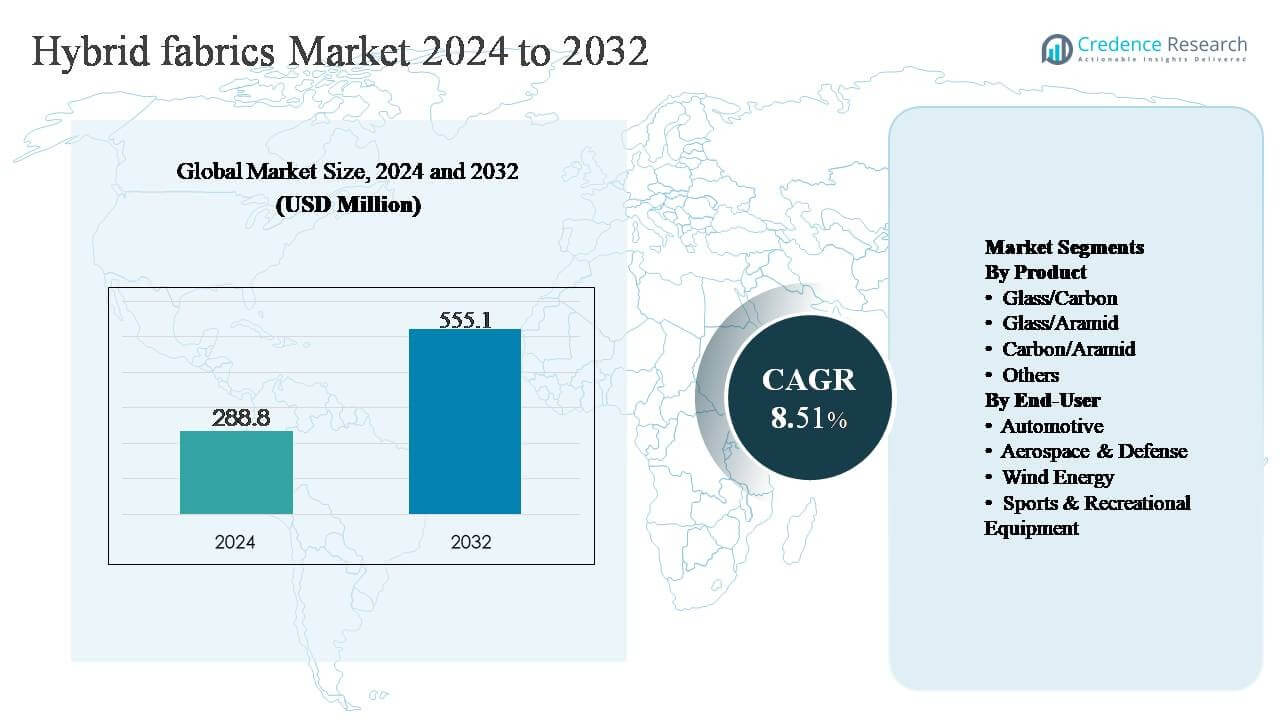
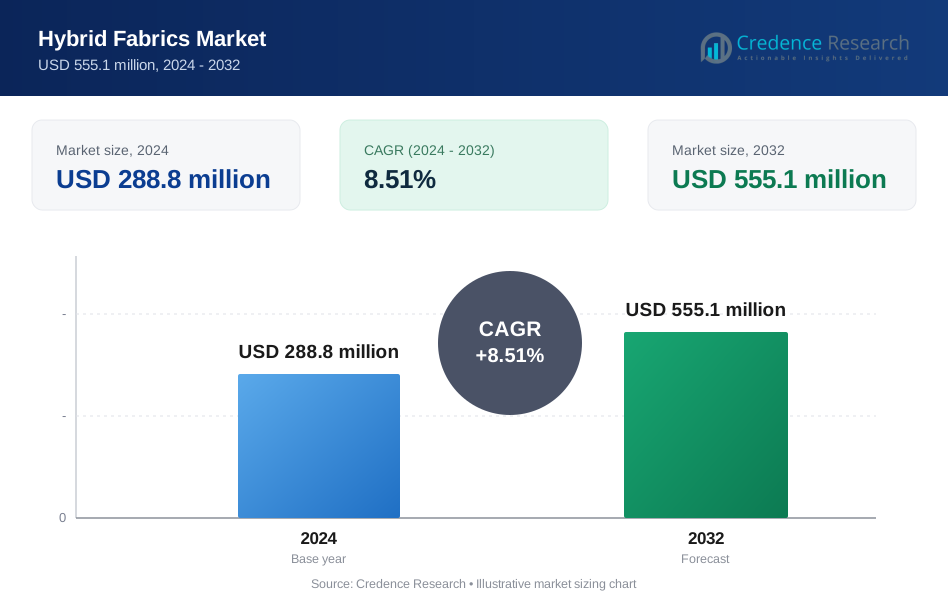
The Hybrid Fabrics market is witnessing robust growth driven by increasing demand for materials that combine the functional advantages of multiple fibers, such as strength, flexibility, durability, and lightweight performance. The market size was valued at USD 288.8 million in 2024 and is anticipated to reach USD 555.1 million by 2032, expanding at a CAGR of 8.51% during the forecast period.
| REPORT ATTRIBUTE | DETAILS |
|---|---|
| Historical Period | 2020-2023 |
| Base Year | 2024 |
| Forecast Period | 2025-2032 |
| Hybrid Fabrics Market Size 2024 | USD 288.8 million |
| Hybrid Fabrics Market , CAGR | 8.51% |
| Hybrid Fabrics Market Size 2032 | USD 555.1 million |
Hybrid Fabrics Market Insights
- Market growth is primarily driven by increasing demand for lightweight, high-strength materials in automotive, aerospace & defense, and wind energy, where hybrid fabrics enable optimized performance at lower cost compared to single-fiber composites.
- Key market trends include growing use of glass/carbon hybrids as the dominant product segment due to cost-performance balance, and rising penetration in electric vehicles, wind turbine blades, and high-performance sports equipment.
- The competitive landscape features established global players focusing on advanced fabric architectures, OEM collaborations, and scalable production, while high processing complexity and recycling limitations remain key market restraints.
- Regionally, North America leads with about 34% market share, followed by Europe at 29% and Asia-Pacific at 26%, while automotive remains the leading end-use segment, supported by aerospace and wind energy demand.
Hybrid Fabrics Market Segmentation Analysis:
By Product:
The hybrid fabrics market by product is led by glass/carbon hybrids, which account for the dominant share due to their balanced combination of high stiffness, strength, and cost efficiency. Glass/carbon fabrics are widely adopted where weight reduction and mechanical performance are required without the premium cost of full carbon composites, making them attractive across automotive and wind applications. Carbon/aramid fabrics follow, driven by demand for impact resistance and fatigue performance, particularly in high-stress environments. Glass/aramid hybrids serve niche structural and protective uses, while other combinations support application-specific customization.
- For instance, Toray Industries supplies glass–carbon hybrid reinforcements combining T700 carbon fiber with tensile strength of 4.9 GPa and tensile modulus of 230 GPa, integrated with E-glass fibers exhibiting a modulus of approximately 72 GPa, enabling optimized stiffness-to-cost performance in structural panels.
By End-User:
By end-user, the automotive segment holds the largest market share, driven by increasing use of hybrid fabrics in structural reinforcements, body panels, and interior components to meet lightweighting and fuel-efficiency targets. Automakers favor hybrid fabrics for their ability to optimize strength-to-weight ratios at controlled costs. Aerospace & defense represents a high-value segment, supported by demand for fatigue resistance and damage tolerance. Wind energy adoption is growing in turbine blades for stiffness enhancement, while sports and recreational equipment benefits from performance-driven material innovation.
- For instance, BMW Group has applied glass/carbon hybrid fabrics in structural roof and body components, combining carbon fibers with tensile modulus of 230 GPa and E-glass fibers at 72 GPa, enabling mass reduction while maintaining torsional stiffness in passenger vehicle platforms.
Key Growth Drivers
Lightweighting Demand Across Transportation Industries
The growing emphasis on lightweight materials across automotive, aerospace, and defense industries remains a primary growth driver for the hybrid fabrics market. Manufacturers increasingly adopt hybrid fabrics to reduce component weight while maintaining structural integrity, safety, and durability. By combining fibers such as carbon, glass, and aramid, hybrid fabrics deliver optimized stiffness, impact resistance, and fatigue performance at lower cost compared to single-fiber composites. This balance supports compliance with fuel-efficiency regulations and emission reduction targets while improving payload capacity and energy efficiency. The ability of hybrid fabrics to replace metal components in semi-structural and structural applications further accelerates adoption, particularly in electric vehicles and next-generation aircraft platforms.
- For instance, SGL Carbon supplies hybrid fabric-based preforms for automotive structural components designed to withstand compressive loads above 200 MPa, enabling metal replacement in semi-structural body elements.
Performance Optimization at Controlled Material Costs
Hybrid fabrics enable manufacturers to tailor material performance without incurring the high costs associated with full carbon or aramid composites. This cost-performance optimization is a critical growth driver, especially for high-volume applications. Glass/carbon and glass/aramid hybrids offer improved mechanical properties, vibration damping, and thermal stability while reducing raw material expenditure. Industries such as wind energy and automotive increasingly select hybrid fabrics to balance durability and production economics. This flexibility allows end users to meet mechanical performance targets while maintaining competitive pricing, supporting wider commercialization across industrial and consumer applications.
- For instance, Hexcel supplies HexForce® hybrid woven reinforcements that combine HexTow® IM7 carbon fiber (typically 5.5-5.6 GPa tensile strength) with high-strength glass fibers. These materials are engineered to optimize crash-relevant energy absorption and structural integrity for high-volume automotive manufacturing, effectively managing high compressive loads in safety-critical components such as B-pillars and chassis structures."
Expanding Use in Renewable Energy and Infrastructure Applications The expansion of renewable energy projects, particularly in wind power, is significantly driving demand for hybrid fabrics. Wind turbine blades require materials that deliver high stiffness, fatigue resistance, and long service life under cyclic loading. Hybrid fabrics meet these requirements by combining carbon fiber’s stiffness with glass fiber’s cost efficiency. Additionally, infrastructure applications such as bridges, reinforcement panels, and retrofitting solutions increasingly use hybrid fabrics to enhance structural performance and longevity. The long-term durability and corrosion resistance of hybrid composites position them as preferred materials in energy and infrastructure investments.
Key Trends & Opportunities
Advancements in Fabric Architecture and Manufacturing Techniques
Continuous innovation in weaving, knitting, and nonwoven technologies is transforming hybrid fabric performance and design flexibility. Advanced fabric architectures, including multiaxial and 3D hybrid fabrics, enable superior load distribution and damage tolerance. These advancements create opportunities for manufacturers to develop application-specific solutions for complex geometries in aerospace, automotive, and sports equipment. Improved automation and digital design tools further reduce material waste and production time, making hybrid fabrics more accessible for large-scale manufacturing.
- For instance, SAERTEX develops multiaxial non-crimp hybrid fabrics combining carbon and glass fibers with fiber orientation layers at 0°/±45°/90°, achieving in-plane shear strengths above 80 MPa in structural laminates used for transportation and industrial components.
Growing Adoption in Electric Vehicles and High-Performance Sports
The rapid growth of electric vehicles and high-performance sports equipment presents strong opportunities for hybrid fabric suppliers. Electric vehicles demand lightweight, crash-resistant materials to offset battery weight and extend driving range. Hybrid fabrics fulfill these requirements while offering cost advantages over full carbon composites. Similarly, sports and recreational equipment manufacturers increasingly use hybrid fabrics to enhance strength, impact resistance, and user comfort. This trend supports premium product differentiation and expands the addressable market for hybrid fabric solutions.
- For instance, Callaway Golf utilizes triaxial carbon and thermoforged carbon crown panels in its drivers including the 2025 Elyte and Paradym series which are up to 35% thinner than previous carbon materials. These aerospace-grade composites are engineered to withstand the intense stress of impact while reducing crown weight by over 40% compared to titanium, allowing for optimized center of gravity and increased forgiveness."
Key Challenges
Complexity in Design and Material Integration
Designing and manufacturing hybrid fabrics involve complex material integration challenges. Different fibers exhibit varying mechanical, thermal, and chemical behaviors, requiring precise engineering to ensure compatibility and consistent performance. Inadequate fiber alignment or bonding can lead to stress concentrations and reduced durability. These complexities increase development time and require specialized technical expertise, which can limit adoption among smaller manufacturers and slow product standardization across industries.
High Processing Costs and Limited Recycling Options
Despite cost advantages over single high-performance fibers, hybrid fabrics still face challenges related to processing costs and recyclability. Specialized manufacturing equipment and controlled processing conditions increase capital expenditure. Additionally, recycling hybrid composites remains technically challenging due to mixed fiber compositions, limiting end-of-life recovery options. Growing regulatory and sustainability pressures require improved recycling solutions, and the lack of mature infrastructure for hybrid fabric reuse may restrain long-term market growth.
Regional Analysis
North America
North America holds a significant share of the hybrid fabrics market, accounting for approximately 34% of global revenue. The region benefits from strong demand across automotive, aerospace & defense, and wind energy sectors, supported by advanced composite manufacturing capabilities. The United States leads regional consumption due to high adoption of lightweight materials in electric vehicles, aircraft structures, and defense equipment. Ongoing investments in renewable energy infrastructure, particularly wind power installations, further strengthen demand. Additionally, the presence of established composite manufacturers and continuous R&D in advanced fabric architectures reinforces North America’s leadership position.
Europe
Europe represents around 29% of the global hybrid fabrics market, driven by stringent emission regulations and a strong focus on lightweighting and sustainability. Countries such as Germany, France, and the United Kingdom are key contributors, with widespread use of hybrid fabrics in automotive components, aerospace structures, and wind turbine blades. The region’s mature wind energy sector strongly supports glass/carbon hybrid adoption. European manufacturers emphasize material efficiency, recyclability, and performance optimization, which aligns well with hybrid fabric solutions. Strong collaboration between OEMs and material suppliers continues to support steady market growth.
Asia-Pacific
Asia-Pacific accounts for approximately 26% of the global market and is the fastest-growing regional segment. Rapid industrialization, expanding automotive production, and rising wind energy installations in China, India, and Japan are key growth drivers. The region benefits from cost-competitive manufacturing, increasing investments in composite materials, and growing adoption of lightweight solutions in transportation and infrastructure projects. China dominates regional demand due to large-scale wind turbine manufacturing and automotive output. Expanding aerospace programs and increasing use of hybrid fabrics in sports and recreational equipment further strengthen Asia-Pacific’s market position.
Latin America
Latin America holds about 6% of the global hybrid fabrics market, supported by gradual growth in automotive manufacturing, wind energy projects, and infrastructure development. Brazil and Mexico are the primary contributors, with increasing adoption of hybrid composites in wind turbine blades and lightweight automotive components. While the market remains smaller compared to developed regions, rising investments in renewable energy and industrial modernization are creating new opportunities. Limited local composite manufacturing capabilities remain a constraint, but increasing technology transfer and foreign investment are expected to support steady regional expansion.
Middle East & Africa
The Middle East & Africa region accounts for roughly 5% of global market share, driven mainly by infrastructure development, renewable energy projects, and niche aerospace applications. Countries in the Middle East are increasingly investing in wind energy and advanced materials to diversify beyond traditional oil-based industries. Hybrid fabrics are gaining traction in construction reinforcement and energy applications due to their durability and corrosion resistance. Although adoption remains relatively limited, growing industrial diversification initiatives and long-term renewable energy strategies are expected to gradually improve market penetration across the region.
Hybrid Fabrics Market Segmentations:
By Product
- Glass/Carbon
- Glass/Aramid
- Carbon/Aramid
- Others
By End-User
- Automotive
- Aerospace & Defense
- Wind Energy
- Sports & Recreational Equipment
By Geography
- North America
- U.S.
- Canada
- Mexico
- Europe
- Germany
- France
- U.K.
- Italy
- Spain
- Rest of Europe
- Asia Pacific
- China
- Japan
- India
- South Korea
- South-east Asia
- Rest of Asia Pacific
- Latin America
- Brazil
- Argentina
- Rest of Latin America
- Middle East & Africa
- GCC Countries
- South Africa
- Rest of the Middle East and Africa
Competitive Landscape
The competitive landscape of the hybrid fabrics market is moderately consolidated and characterized by the presence of global composite material manufacturers alongside specialized technical textile producers. Key players compete on material performance, fiber integration expertise, and the ability to deliver application-specific hybrid solutions across automotive, aerospace & defense, wind energy, and sports equipment sectors. Companies increasingly focus on developing optimized glass/carbon and carbon/aramid fabric architectures to balance strength, weight, and cost efficiency. Strategic collaborations with OEMs, investments in advanced weaving and multiaxial fabric technologies, and expansion of production capacities are common competitive strategies. Additionally, players emphasize process innovation and quality consistency to meet stringent certification requirements, particularly in aerospace and energy applications. Regional manufacturing footprints and supply chain reliability also play a critical role in competitive positioning, as customers seek scalable production and long-term material availability.
Key Player Analysis
- Toray Industries, Inc.
- Hexcel Corporation
- Teijin Limited
- SGL Carbon
- Solvay S.A.
- Mitsubishi Chemical Corporation
- Zoltek Companies, Inc.
- Exel Composites Plc
- Axiom Materials Inc.
Recent Developments
- In November 2025,Toray confirmed its participation at SAMPE Japan 2025, demonstrating next-generation composite material technologies that include high-performance fiber reinforcements and hybrid fabric developments tailored for industrial and transportation applications.
- In April 2025, Teijin Limited announced the rollout of Digital Product Passport (DPP) compliant aramid and carbon fiber products, improving supply chain traceability for advanced composites and hybrid materials in regulated markets (especially Europe’s emerging environmental standards).
- In February 2025, Hexcel showcased its latest innovations in lightweight, high-performance composite materials relevant to hybrid fabrics and reinforcements designed to enhance aerospace efficiency and sustainability (e.g., HexPly prepregs and HexTow fibers for structural applications).
Report Coverage
The research report offers an in-depth analysis based on Product, End-User and Geography. It details leading market players, providing an overview of their business, product offerings, investments, revenue streams, and key applications. Additionally, the report includes insights into the competitive environment, SWOT analysis, current market trends, as well as the primary drivers and constraints. Furthermore, it discusses various factors that have driven market expansion in recent years. The report also explores market dynamics, regulatory scenarios, and technological advancements that are shaping the industry. It assesses the impact of external factors and global economic changes on market growth. Lastly, it provides strategic recommendations for new entrants and established companies to navigate the complexities of the market.
Request a Free Sample
Fill in your details and we'll send you a free sample report.
- Sample data tables & charts
- Research methodology
Need a Custom Version of This Report?
Tailor the scope, geography, or segments to your exact requirements.
- Custom geography or segment scope
- Direct access to our analyst team
Frequently Asked Questions
What is the current market size for Hybrid Fabrics, and what is its projected size in 2032?
At what Compound Annual Growth Rate is the Hybrid Fabrics market projected to grow between 2024 and 2032?
Which Hybrid Fabrics segment held the largest share in 2024?
What are the primary factors fueling the growth of the Hybrid Fabrics market?
Who are the leading companies in the Hybrid Fabrics market?
Which region commanded the largest share of the Hybrid Fabrics market in 2024?
Table of Content
Chapter 1. Report Introduction
- 1.1 Report Description & Purpose
- 1.1.1 Report Title & Market Definition
- 1.1.2 Unique Selling Propositions (USP) & Key Differentiators
- 1.1.3 Value Proposition for Stakeholders
- 1.2 Research Objectives
- 1.2.1 Market Sizing Objectives (Volume & Revenue) (Volume Where Applicable)
- 1.2.2 Segmentation Objectives
- 1.2.3 Competitive Intelligence Objectives
- 1.2.4 Forecast & Scenario Objectives
- 1.3 Report Scope
- 1.3.1 Hybrid Fabrics Scope – Segments & Subsegments Covered
- 1.3.2 Geographic Scope – Regions & Countries Covered
- 1.3.3 Historical Period, Base Year & Forecast Period (2024; forecast to 2032)
- 1.3.4 Inclusions & Exclusions
- 1.4 Industry Classification & Applicable Codes
- 1.5 Currency, Measurement Units & Valuation Basis
- 1.6 Target Stakeholders
- 1.7 Limitations & Assumptions
Chapter 2. Executive Summary
- 2.1 Global Hybrid Fabrics Market Snapshot
- 2.1.1 Market Size – Historical (2024) & Forecast (2024-2032) (2024: USD 288.8 million → 2032: USD 555.1 million)
- 2.1.2 Volume & Revenue – Global Totals (Volume Where Applicable)
- 2.1.3 Key Market Highlights – Top Five Facts
- 2.2 Hybrid Fabrics Market Segmentation Snapshot
- 2.2.1 Market Split by Region – 2024 vs. 2032
- 2.3 Competitive Snapshot
- 2.3.1 Top 10 Players by Revenue Share – 2024
- 2.3.2 Top 10 Players by Volume Share – 2024 (Volume Where Applicable)
- 2.3.3 Recent Strategic Developments (18-Month Summary)
- 2.4 Key Investment Highlights & Strategic Conclusions
Chapter 3. Hybrid Fabrics Market Dynamics & Industry Analysis
- 3.1 Market Overview & Context
- 3.1.1 Hybrid Fabrics Market Position in the Broader Industry Value Chain
- 3.1.2 Demand Structure & Purchasing Dynamics
- 3.1.3 Market Maturity & Development Stage by Region
- 3.2 Hybrid Fabrics Market Drivers
- 3.3 Hybrid Fabrics Market Restraints & Challenges
- 3.4 Hybrid Fabrics Market Opportunities
- 3.5 Porter's Five Forces Analysis
- 3.5.1 Threat of New Entrants
- 3.5.2 Bargaining Power of Suppliers
- 3.5.3 Bargaining Power of Buyers
- 3.5.4 Threat of Substitutes
- 3.5.5 Competitive Rivalry – Intensity Assessment
- 3.6 Hybrid Fabrics Value Chain Analysis
- 3.6.1 Upstream – Key Inputs, Resources & Suppliers
- 3.6.1.1 Key Input/Resource 1
- 3.6.1.2 Key Input/Resource 2
- 3.6.1.3 Key Input/Resource 3
- 3.6.2 Midstream – Core Operations & Value Creation
- 3.6.2.1 Operating Model & Process Overview
- 3.6.2.2 Key Operating Locations & Capabilities by Company
- 3.6.3 Downstream – Market Channels & End Users
- 3.6.3.1 Direct Sales & Customer Engagement Channels
- 3.6.3.2 Indirect Sales, Intermediaries & Partner Channels
- 3.6.4 Value Chain Profitability Analysis
- 3.6.1 Upstream – Key Inputs, Resources & Suppliers
- 3.7 PESTEL Analysis
- 3.7.1 Political Factors
- 3.7.2 Economic Factors
- 3.7.3 Social Factors
- 3.7.4 Technological Factors
- 3.7.5 Environmental Factors
- 3.7.6 Legal Factors
- 3.8 Hybrid Fabrics Supply Chain Analysis
- 3.8.1 Critical Input & Resource Availability Risk Assessment
- 3.8.2 Supplier & Operational Concentration Risk (Geographic Exposure)
- 3.8.3 Supply & Service Disruption Impact Analysis
- 3.9 Regulatory & Policy Landscape
Note: The regulatory and policy landscape section covers regulations based on their applicability to the market, Hybrid Fabrics category, geography, and scope of the study. Only regulatory frameworks with a material impact on operations, compliance, trade, sustainability, or market access are analyzed in detail.
Chapter 4. Key Investment Pockets & Opportunity Analysis
- 4.1 Hybrid Fabrics Market Attractiveness Analysis
- 4.1.1 By Region – Investment Attractiveness Matrix (Market Size × CAGR)
- 4.2 Absolute Revenue Growth Opportunity
- 4.2.1 By Region – Absolute Revenue Growth Through 2032
- 4.3 Incremental Demand Opportunity
- 4.3.1 By Region – Incremental Demand Through 2032
- 4.3.2 Segment – Incremental Demand
- 4.4 Emerging Submarket Opportunity Deep Dive (Subject to Applicability)
- 4.5 Priority Market Opportunity Scorecards
- 4.5.1 United States
- 4.5.2 Europe
- 4.5.3 Asia
- 4.5.4 Middle East & Africa
Note: Priority market opportunity scorecards reflect the geographic scope and strategic relevance of the study. Listed markets are indicative and may be adapted to the industry.
Chapter 5. Hybrid Fabrics Cross-Border Trade & Market Access Analysis
- 5.1 International Trade & Cross-Border Activity Overview
- 5.1.1 Global Export Value by Country (2024)
- 5.1.2 Global Export Volume by Country (2024) (Volume Where Applicable)
- 5.1.3 Global Import Value by Country (2024)
- 5.1.4 Global Import Volume by Country (2024) (Volume Where Applicable)
- 5.1.5 Net Trade Balance by Country (2024)
- 5.2 Export Analysis – Segment
- 5.2.1 Category 1 (Applicable Classification Code)
- 5.2.2 Category 2 (Applicable Classification Code)
- 5.2.3 Category 3 (Applicable Classification Code)
- 5.2.4 Category 4 (Applicable Classification Code)
- 5.2.5 Category 5 (Applicable Classification Code)
- 5.3 Import Analysis – Segment
- 5.3.1 Category 1 (Applicable Classification Code)
- 5.3.2 Category 2 (Applicable Classification Code)
- 5.3.3 Category 3 (Applicable Classification Code)
- 5.3.4 Category 4 (Applicable Classification Code)
- 5.3.5 Category 5 (Applicable Classification Code)
- 5.4 Cross-Border Pricing & Transaction Benchmarks
- 5.4.1 Export Pricing – Segment & Country
- 5.4.2 Import Pricing – Segment & Source Country
- 5.4.3 Price Trends (2024)
- 5.5 Key Cross-Border Trade & Delivery Routes
- 5.5.1 Cross-Border Trade/Delivery Route 1
- 5.5.2 Cross-Border Trade/Delivery Route 2
- 5.5.3 Cross-Border Trade/Delivery Route 3
- 5.5.4 Cross-Border Trade/Delivery Route 4
- 5.5.5 Cross-Border Trade/Delivery Route 5
- 5.6 Trade Policy & Market Access Impact Assessment
- 5.6.1 Tariff & Non-Tariff Barriers
- 5.6.2 Regional Trade & Economic Integration Frameworks
- 5.6.3 Bilateral & Multilateral Trade Agreements
- 5.6.4 Cross-Border Operating, Licensing & Localization Requirements
Note: This chapter applies where cross-border trade or delivery is relevant to Hybrid Fabrics. Goods, services, and digital offerings are assessed using applicable classifications and transaction measures. Import-export volumes, trade balances, and route analyses are included only where meaningful to the market.
Chapter 6. Competitive Landscape & Company Benchmarking
- 6.1 Hybrid Fabrics Market Concentration & Structure
- 6.1.1 Herfindahl-Hirschman Index (HHI) – vs. 2024
- 6.1.2 Leading, Mid-Sized & Emerging Player Structure
- 6.1.3 Global, Regional & Local Player Dynamics
- 6.2 Hybrid Fabrics Market Share Analysis – 2024
- 6.2.1 Global Revenue Share by Company
- 6.2.2 Global Volume Share by Company (Volume Where Applicable)
- 6.2.3 Regional Revenue Share
- 6.2.4 Market Share Evolution ( vs. 2024)
- 6.2.5 Company Market Share by Key Segment
- 6.2.6 Company Market Share by Customer Group
- 6.3 Operating Scale, Capacity & Infrastructure Analysis
- 6.3.1 Global Operating Scale & Supply Capacity
- 6.3.2 Resource Utilization & Operating Efficiency
- 6.3.3 Output, Service Delivery & Activity Metrics
- 6.3.4 Operating Footprint & Infrastructure Map
- 6.3.5 Planned Operational & Capacity Expansion
- 6.4 Hybrid Fabrics Competitive Benchmarking Matrix
- 6.4.1 Revenue, Growth, Profitability & Operating Metric Comparison
- 6.4.2 Channel Revenue Mix
- 6.4.3 Geographic Revenue Exposure
- 6.4.4 R&D Intensity
- 6.4.5 Sustainability Maturity
- 6.5 Strategic Developments in Hybrid Fabrics (Last 24 Months)
- 6.5.1 Mergers, Acquisitions & Divestments
- 6.5.2 New Products, Services & Solutions in Hybrid Fabrics
- 6.5.3 Operational & Infrastructure Expansions
- 6.5.4 Strategic Alliances, Joint Ventures & Partnerships
- 6.5.5 Distribution Expansion & Market Entry
- 6.5.6 Sustainability & ESG Initiatives
- 6.6 Competitive Strategy Mapping
- 6.6.1 Leader, Challenger, Follower & Niche Classification
- 6.6.2 Pricing Strategy Comparison
- 6.6.3 Channel Strategy Matrix
Note: Strategic developments are included based on their materiality and the availability of reliable information.
Chapter 7. Global Hybrid Fabrics Market – By Sales & Delivery Channel
- 7.1 Segment Overview
- 7.1.1 Volume & Revenue Split by Channel (2024 & 2032) (Volume Where Applicable)
- 7.1.2 Channel Mix Evolution (2024-2032)
Chapter 8. Regional Market Analysis – Global Overview
- 8.1 Global Regional Overview
- 8.1.1 Regional Volume Share (Volume Where Applicable)
- 8.1.2 Regional Revenue Share
- 8.1.3 Regional Volume by Region (Volume Where Applicable)
- 8.1.4 Regional Revenue by Region
- 8.1.5 Regional Forecast Through 2032
- 8.2 Cross-Regional Segment Analysis
- 8.2.1 By Sales & Delivery Channel
- 8.2.2 By Competitive Positioning & Price Tier
Chapter 9. North America Hybrid Fabrics Market
- 9.1 United States
- 9.2 Canada
- 9.3 Mexico
Chapter 10. Europe Hybrid Fabrics Market
- 10.1 Germany
- 10.2 France
- 10.3 Italy
- 10.4 United Kingdom
- 10.5 Spain
- 10.6 Poland
- 10.7 Russia
- 10.8 Netherlands
- 10.9 Belgium
- 10.10 Sweden
- 10.11 Denmark
- 10.12 Norway
- 10.13 Rest of Europe
Chapter 11. Asia Pacific Hybrid Fabrics Market
- 11.1 China
- 11.2 India
- 11.3 Japan
- 11.4 South Korea
- 11.5 Thailand
- 11.6 Indonesia
- 11.7 Vietnam
- 11.8 Malaysia
- 11.9 Australia
- 11.10 Rest of Asia Pacific
Chapter 12. Latin America Hybrid Fabrics Market
- 12.1 Brazil
- 12.2 Argentina
- 12.3 Colombia
- 12.4 Chile
- 12.5 Rest of Latin America
Chapter 13. Middle East Hybrid Fabrics Market
- 13.1 Saudi Arabia
- 13.2 United Arab Emirates
- 13.3 Turkey
- 13.4 Israel
- 13.5 Iran
- 13.6 Rest of the Middle East
Chapter 14. Africa Hybrid Fabrics Market
- 14.1 South Africa
- 14.2 Egypt
- 14.3 Nigeria
- 14.4 Morocco
- 14.5 Rest of Africa
Chapter 15. Hybrid Fabrics Company Profiles
- 15.1 [Company 01]
- 15.1.1 Company Overview
- 15.1.2 Key Management Personnel
- 15.1.3 Products & Services Portfolio
- 15.1.4 Financial Performance
- 15.1.5 Key Market Focus & Geographic Presence
- 15.1.6 Recent Developments & Strategic Initiatives
Note: The company profile list is preliminary and may change based on research findings, market developments, data availability, and client requirements.
Chapter 16. Appendices
- Appendix A – List of Abbreviations & Acronyms
- Appendix B – Industry Classification Code Reference – Full Series
- Appendix C – Supply, Output & Operating Capacity Data Tables
- Appendix D – End-Use & Demand Base Tables
- Appendix E – Demand, Adoption & Usage Assumptions
- Appendix F – Pricing & Revenue Metric Reference Tables
- Appendix G – Company Operations & Infrastructure Database
- Appendix H – Cross-Border Trade & Activity Data Tables (Where Applicable)
- Appendix I – Regulatory Summary Tables
- Appendix J – Primary Research Participant List (Anonymized)
- Appendix K – Primary Research Questionnaire Framework
- Appendix L – Data Sources & Bibliography
- Appendix M – Market Size Divergence & Source Comparison
Chapter 17. Research Methodology
- 17.1 Research Framework & Philosophy
- 17.2 Secondary Research – Sources, Hierarchy & Data Extraction
- 17.3 Data Modeling – Bottom-Up & Top-Down Market Sizing
- 17.4 Primary Research – Stakeholder Framework, LOI & Sample Sizes
- 17.5 Forecast Methodology – Regression, Scenario & Sensitivity Analysis
- 17.6 Quality Control – Four-Layer Validation Framework
- 17.7 Limitations & Standard Assumptions
- 17.8 Disclaimer
