
Market Overview
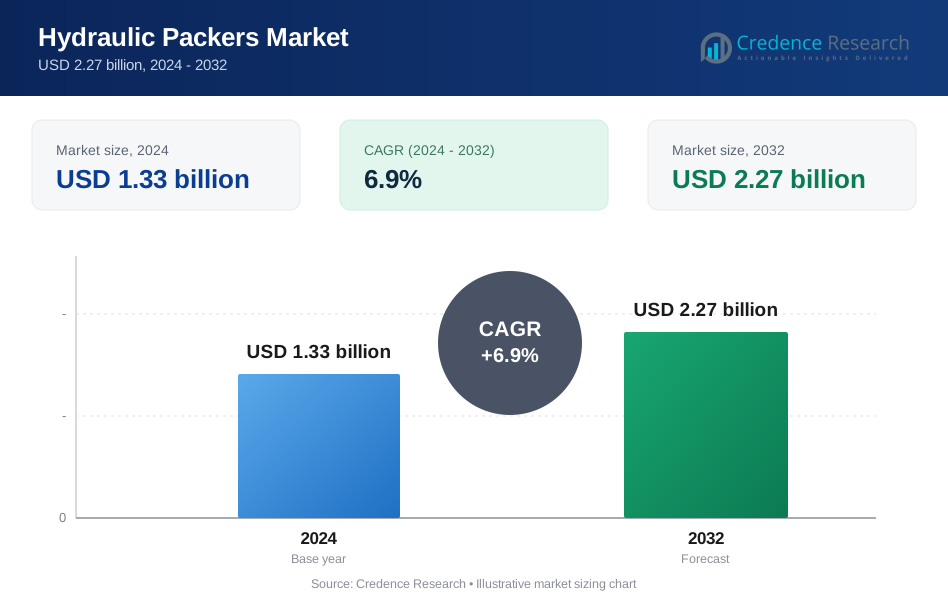
Hydraulic Packers market size was valued at USD 1.33 billion in 2024 and is projected to reach USD 2.27 billion by 2032, growing at a CAGR of 6.9% during the forecast period.
| REPORT ATTRIBUTE | DETAILS |
|---|---|
| Historical Period | 2020-2023 |
| Base Year | 2024 |
| Forecast Period | 2025-2032 |
| Hydraulic Packers Market Size 2024 | USD 1.33 Billion |
| Hydraulic Packers Market, CAGR | 6.9% |
| Hydraulic Packers Market Size 2032 | USD 2.27 Billion |
The hydraulic packers market is characterized by strong competition, with leading players including Halliburton, Schlumberger, Baker Hughes, Weatherford, and National Oilwell Varco driving innovation through advanced packer technologies and global service networks. These companies focus on developing high-pressure, high-temperature solutions, composite drillable designs, and smart packers with real-time monitoring capabilities to meet growing demand from complex wells. North America leads the market with over 35% share in 2024, supported by extensive shale drilling and offshore exploration activities in the U.S. and Canada. Asia Pacific follows as a rapidly growing region, fueled by rising energy demand and increasing onshore and offshore exploration investments.
Market Insights
- The hydraulic packers market was valued at USD 1.33 billion in 2024 and is projected to reach USD 2.27 billion by 2032, growing at a CAGR of 6.9%.
- Rising drilling and well intervention activities in both onshore and offshore fields are driving demand, with retrievable packers holding over 45% market share in 2024.
- Technological advancements such as HPHT-rated and composite drillable packers are emerging as key trends, along with smart packers offering real-time well monitoring.
- The market is highly competitive with global players investing in R&D, product innovation, and service expansion to strengthen their presence.
- North America leads with more than 35% share, followed by Asia Pacific as the fastest-growing region, while Europe and the Middle East sustain demand through mature field redevelopment and offshore projects.
Market Segmentation Analysis:
By Type
Retrievable packers dominate the hydraulic packers market, capturing over 45% share in 2024. Their reusability, simple installation, and ability to be easily removed make them ideal for workover, stimulation, and temporary zonal isolation operations. Growing demand for cost-efficient well interventions in mature fields further supports their use. Permanent packers hold a notable share, favored for their reliability in long-term completions under high-pressure and high-temperature conditions. Service packers remain a smaller segment, mainly used for testing and maintenance activities, benefiting from rising demand for frequent well servicing and production optimization.
- For instance, The Halliburton X-Trieve HP retrievable packer is engineered to handle hydrostatic pressures up to 28,000 psi.
By Material
Metal-based packers lead the market with more than 50% share in 2024, driven by their superior strength and durability in high-pressure, high-temperature (HPHT) environments. They are widely used in deepwater and unconventional wells where operational reliability is crucial. Rubber-based packers account for a significant share, preferred in shallow or medium-depth wells due to their cost-effectiveness and flexibility. Composite packers are rapidly gaining traction, supported by the growing need for lightweight drillable solutions that reduce rig time and simplify operations in multistage fracturing and complex well completions.
- For instance, SLB’s BluePack Ultra PH permanent hydraulic-set packer is rated for 15,000 psi and 350°F in production or isolation applications
By Application
Oil and gas applications hold over 60% share of the hydraulic packers market in 2024, driven by increasing drilling activity in both onshore and offshore fields. Demand for reliable zonal isolation and production optimization in unconventional reservoirs fuels adoption. Water well applications represent a growing segment, supported by rising water infrastructure development and agricultural water management projects. Geothermal applications are expanding steadily as renewable energy projects accelerate globally, creating demand for packers capable of withstanding extreme temperatures and providing long-term sealing performance in geothermal wells.

Key Growth Drivers
Rising Oil and Gas Exploration Activities
Growing exploration and production activities globally are boosting demand for hydraulic packers. Expanding offshore drilling projects and unconventional resource development require reliable zonal isolation tools. Retrievable and permanent packers are increasingly deployed to optimize production efficiency and reduce downtime. Emerging markets in the Middle East, Latin America, and Asia-Pacific are witnessing significant investments in deepwater and shale exploration, directly driving packer adoption. This expansion ensures consistent demand across both greenfield and brownfield projects, strengthening market growth during the forecast period.
- For instance, Packers Plus ran a 24-stage refrac system in a well in Manitoba, using a 2.875-inch liner over a measured depth of 2,305 metres, injecting 906 cubic metres of fluid in just over 10 hours.
Increasing Well Intervention and Workover Operations
Mature oilfields are driving the need for frequent well interventions and workover operations. Hydraulic packers, especially retrievable types, play a crucial role in isolating zones during stimulation and recompletion activities. Rising focus on maximizing production from aging wells and extending well life cycles further fuels market demand. Service companies are investing in advanced hydraulic packer designs to reduce rig time and improve operational efficiency. This driver is expected to remain critical as operators prioritize cost-effective well management solutions across both onshore and offshore assets.
- For instance, Oilfield Service Professionals used their 14-inch NEXUS™ packer system to complete a 9,300-psi casing test under deepwater Gulf of Mexico conditions, achieving zero leak-off over 30 minutes without damage or elastomer deformation.
Technological Advancements in Packer Design
Innovation in packer materials and design is enhancing performance and reliability in challenging environments. Development of HPHT-rated and composite packers allows operators to handle extreme downhole conditions while minimizing operational risks. Smart packers with real-time monitoring capabilities are gaining traction, enabling operators to make data-driven decisions during completions. These advancements improve efficiency and reduce non-productive time, making them highly attractive for complex wells. Continuous R&D investment by major manufacturers is expected to accelerate adoption of advanced hydraulic packers over the coming years.
Key Trends & Opportunities
Growing Adoption in Geothermal Energy Projects
The rise in renewable energy investment is creating new opportunities for hydraulic packer suppliers. Geothermal wells require reliable sealing solutions to manage extreme temperatures and pressures. Composite and metal-based packers are increasingly selected for these projects due to their durability and performance. Government incentives and funding for renewable projects are encouraging developers to expand geothermal capacity globally. This trend opens a niche but steadily growing application segment for packer manufacturers, diversifying revenue streams beyond the traditional oil and gas industry.
- For instance, Fervo Energy in 2023 ran a 30-day well test at its Project Red in northern Nevada. The flow rate achieved was 63 liters per second, allowing for about 3.5 MW electric power from that enhanced geothermal system.
Shift Toward Composite and Drillable Packers
Operators are increasingly favoring composite packers for multistage fracturing and unconventional completions. These packers are lightweight, drillable, and help reduce operational complexity and rig time. Adoption is growing in North America’s shale basins and spreading to international markets. As drilling activity becomes more complex, demand for cost-effective and efficient packer solutions is likely to increase. Manufacturers focusing on developing innovative composite designs are positioned to benefit from this shift and capture a greater share of the growing unconventional completions market.
- For instance, The Iceland Deep Drilling Project (IDDP) aimed to access and harness supercritical hydrothermal fluids, a state of water that is neither gas nor liquid and holds more energy than conventional steam. This required drilling wells in Iceland's geothermal fields to depths of 4 to 5 kilometers to reach projected temperatures of 400-600 degree Celsius.
Key Challenges
High Initial and Maintenance Costs
Hydraulic packers involve significant initial investment, particularly permanent packers designed for HPHT applications. Maintenance and replacement during workovers also add to operational expenses, especially in offshore environments. Smaller operators may face budget constraints, limiting adoption. This cost challenge can delay deployment of advanced packer technologies despite their performance benefits. Market players are focusing on offering cost-optimized designs and rental options to make solutions accessible for a wider customer base and to overcome financial barriers that hinder market expansion.
Key Challenge 2: Operational Risks and Reliability Concerns
Failure of hydraulic packers during operations can lead to costly downtime, production losses, and safety hazards. Complex well conditions, such as extreme pressures, corrosive fluids, and thermal cycling, increase the risk of packer malfunction. Reliability concerns often push operators to favor proven designs over new innovations, slowing technology adoption. Manufacturers must invest in rigorous testing and field trials to improve trust in advanced packer solutions. Addressing these reliability issues is critical to ensure market confidence and sustained adoption.
Regional Analysis
North America
North America leads the hydraulic packers market with over 35% share in 2024, driven by robust shale gas and tight oil drilling activities. The U.S. dominates regional demand due to its extensive unconventional resource development, especially in the Permian, Bakken, and Eagle Ford basins. Canada also contributes significantly, supported by oil sands and conventional well completions. Strong presence of major service providers and continuous technological innovations strengthen market penetration. Government support for domestic energy production and favorable regulations further boost adoption, making North America the key revenue-generating region for hydraulic packer manufacturers and service companies.
Europe
Europe holds a considerable share of the hydraulic packers market, supported by mature oilfields in the North Sea and rising well intervention activities. Countries such as Norway and the UK drive demand for retrievable and permanent packers to maximize production from aging wells. Investments in geothermal energy projects in Germany, France, and the Netherlands are creating additional opportunities. Stringent safety and environmental standards push operators toward advanced, reliable packer solutions. Growing focus on energy transition and the need to maintain production efficiency in declining fields sustain steady market growth across the region through the forecast period.
Asia Pacific
Asia Pacific is one of the fastest-growing regions in the hydraulic packers market, capturing more than 25% share in 2024. China, India, and Australia are key contributors, driven by rising energy demand, increased onshore drilling, and investments in offshore exploration projects. The region is also witnessing growing adoption of hydraulic packers in geothermal applications, particularly in Indonesia and the Philippines. Rapid industrialization and expanding refining capacities are encouraging new well completions. Presence of local packer manufacturers offering cost-competitive solutions enhances market accessibility and supports widespread adoption across both national oil companies and independent operators.
Middle East & Africa
Middle East & Africa command a significant portion of the hydraulic packers market, anchored by large-scale oil production in Saudi Arabia, UAE, and Kuwait. The region relies heavily on permanent packers for long-term completions in high-pressure reservoirs. Increased focus on enhanced oil recovery and production optimization in mature fields drives demand. Africa’s emerging exploration activity in Nigeria and Angola adds to market growth potential. Strategic investments in upstream capacity expansion and strong government initiatives to sustain oil output ensure consistent adoption of advanced hydraulic packer systems across both onshore and offshore projects.
Latin America
Latin America represents a growing market for hydraulic packers, fueled by rising drilling activities in Brazil, Argentina, and Mexico. Brazil’s pre-salt offshore fields are major drivers of demand for high-performance permanent and retrievable packers. Argentina’s Vaca Muerta shale development is contributing to rising usage in unconventional wells. Government reforms and foreign investment in the energy sector are supporting drilling and well completion activities. Growing interest in geothermal projects in Chile further diversifies regional demand. This combination of conventional, unconventional, and renewable energy exploration supports steady market expansion across Latin America during the forecast period.
Market Segmentations:
By Type:
- Retrievable Packers
- Permanent Packers
- Service Packers
By Material:
- Metal
- Rubber
- Composite
By Application:
- Oil and Gas
- Water Well
- Geothermal
By Geography:
- North America
- U.S.
- Canada
- Mexico
- Europe
- Germany
- France
- U.K.
- Italy
- Spain
- Rest of Europe
- Asia Pacific
- China
- Japan
- India
- South Korea
- South-east Asia
- Rest of Asia Pacific
- Latin America
- Brazil
- Argentina
- Rest of Latin America
- Middle East & Africa
- GCC Countries
- South Africa
- Rest of the Middle East and Africa
Competitive Landscape
The hydraulic packers market features key players such as Halliburton, DeepWell Services, Apex Energy Services, Packers Plus Energy Services, Sanjel Energy Services, Weatherford, Baker Hughes, Tendeka, National Oilwell Varco, Petrolern, Newpark Resources, Sierra Hamilton, Tetra Technologies, Aquila Services, and Schlumberger. These companies compete through extensive product portfolios, advanced packer technologies, and strong service capabilities across onshore and offshore operations. Strategic initiatives include development of high-pressure, high-temperature packers, expansion of rental and service offerings, and integration of digital monitoring systems to enhance well performance. Many are focusing on cost-efficient solutions to support operators in mature field interventions and unconventional resource development. Continuous R&D investment, global distribution networks, and collaborations with oilfield service providers help strengthen market presence and customer reach. Competitive intensity remains high as both multinational corporations and regional players work to capture market share through technology upgrades and differentiated service delivery.
Key Player Analysis
- Halliburton
- DeepWell Services
- Apex Energy Services
- Packers Plus Energy Services
- Sanjel Energy Services
- Weatherford
- Baker Hughes
- Tendeka
- National Oilwell Varco
- Petrolern
- Newpark Resources
- Sierra Hamilton
- Tetra Technologies
- Aquila Services
- Schlumberger
Recent Developments
- In 2025, Halliburton launched the SmartWell Turing electro-hydraulic control system to improve reservoir flow control, aiming to reduce rig time and operational risk
- In 2025, SLB (Schlumberger) introduced Electris, a portfolio of digitally enabled electric well completion technologies that provide real-time production intelligence to maximize recovery.
- In 2025, Baker Hughes was selected by Fervo Energy to deliver geothermal power-generation equipment for new power plants, expanding its presence in renewable energy sectors.
Report Coverage
The research report offers an in-depth analysis based on Type, Material, Application and Geography. It details leading market players, providing an overview of their business, product offerings, investments, revenue streams, and key applications. Additionally, the report includes insights into the competitive environment, SWOT analysis, current market trends, as well as the primary drivers and constraints. Furthermore, it discusses various factors that have driven market expansion in recent years. The report also explores market dynamics, regulatory scenarios, and technological advancements that are shaping the industry. It assesses the impact of external factors and global economic changes on market growth. Lastly, it provides strategic recommendations for new entrants and established companies to navigate the complexities of the market.
Future Outlook
- Demand for hydraulic packers will grow with rising shale and deepwater drilling projects.
- Adoption of retrievable packers will increase due to their cost efficiency and reusability.
- Technological innovation will focus on HPHT-rated and composite packer designs.
- Digital monitoring and smart packer systems will gain traction for real-time well data.
- Geothermal applications will expand, creating new opportunities for high-temperature packers.
- Asia Pacific and Middle East will witness the fastest market growth with new drilling activity.
- Service companies will offer more rental and turnkey solutions to reduce operator costs.
- Sustainability initiatives will drive development of lightweight and drillable materials.
- Mergers and partnerships will intensify as players aim to expand service portfolios.
- Market competition will push manufacturers to deliver highly reliable and field-tested solutions.
Request a Free Sample
Fill in your details and we'll send you a free sample report.
- Sample data tables & charts
- Research methodology
Need a Custom Version of This Report?
Tailor the scope, geography, or segments to your exact requirements.
- Custom geography or segment scope
- Direct access to our analyst team
Frequently Asked Questions
What is the current market size for Hydraulic Packers market, and what is its projected size in 2032?
At what Compound Annual Growth Rate is the Hydraulic Packers market projected to grow between 2025 and 2032?
Which Hydraulic Packers market segment held the largest share in 2024?
What are the primary factors fueling the growth of the Hydraulic Packers market?
Who are the leading companies in the Hydraulic Packers market?
Which region commanded the largest share of the Hydraulic Packers market in 2024?
Table of Content
Chapter 1. Report Introduction
- 1.1 Report Description & Purpose
- 1.1.1 Report Title & Market Definition
- 1.1.2 Unique Selling Propositions (USP) & Key Differentiators
- 1.1.3 Value Proposition for Stakeholders
- 1.2 Research Objectives
- 1.2.1 Market Sizing Objectives (Volume & Revenue)
- 1.2.2 Segmentation Objectives
- 1.2.3 Competitive Intelligence Objectives
- 1.2.4 Forecast & Scenario Objectives
- 1.3 Report Scope
- 1.3.1 Hydraulic Packers Scope – Types & Subtypes Covered
- 1.3.2 Geographic Scope – Regions & Countries Covered
- 1.3.3 Historical Period, Base Year & Forecast Period (2024; forecast to 2032)
- 1.3.4 Inclusions & Exclusions
- 1.4 HS Code & Classification Framework
- 1.5 Currency, Units & Pricing Basis
- 1.6 Target Stakeholders
- 1.7 Limitations & Assumptions
Chapter 2. Executive Summary
- 2.1 Global Hydraulic Packers Market Snapshot
- 2.1.1 Market Size – Historical (2024) & Forecast (2024-2032) (2024: USD 1.33 billion → 2032: USD 2.27 billion)
- 2.1.2 Volume & Revenue – Global Totals
- 2.1.3 Key Market Highlights – Top Five Facts
- 2.2 Hydraulic Packers Market Segmentation Snapshot
- 2.2.1 Market Split by Region – 2024 vs. 2032
- 2.3 Competitive Snapshot
- 2.3.1 Top 10 Players by Revenue Share – 2024
- 2.3.2 Top 10 Players by Volume Share – 2024
- 2.3.3 Recent Strategic Developments (18-Month Summary)
- 2.4 Key Investment Highlights & Strategic Conclusions
Chapter 3. Hydraulic Packers Market Dynamics & Industry Analysis
- 3.1 Market Overview & Context
- 3.1.1 Hydraulic Packers Market Position in the Broader Automotive Value Chain
- 3.1.2 OEM vs. Replacement Market Dynamics
- 3.1.3 Market Maturity & Development Stage by Region
- 3.2 Hydraulic Packers Market Drivers
- 3.3 Hydraulic Packers Market Restraints & Challenges
- 3.4 Hydraulic Packers Market Opportunities
- 3.5 Porter's Five Forces Analysis
- 3.5.1 Threat of New Entrants
- 3.5.2 Bargaining Power of Suppliers
- 3.5.3 Bargaining Power of Buyers
- 3.5.4 Threat of Substitutes
- 3.5.5 Competitive Rivalry – Intensity Assessment
- 3.6 Hydraulic Packers Value Chain Analysis
- 3.6.1 Upstream – Raw Material/Input Suppliers
- 3.6.1.1 Raw Material/Input 1
- 3.6.1.2 Raw Material/Input 2
- 3.6.1.3 Raw Material/Input 3
- 3.6.2 Midstream – Production/Manufacturing/Service Delivery
- 3.6.2.1 Production/Process Overview
- 3.6.2.2 Key Facility Locations & Capacity by Manufacturer
- 3.6.3 Downstream – Distribution & End Consumer
- 3.6.3.1 Primary Channel – B2B/OEM
- 3.6.3.2 Secondary Channels – Dealer, Retail, Online, Direct
- 3.6.4 Value Chain Profitability Analysis
- 3.6.1 Upstream – Raw Material/Input Suppliers
- 3.7 PESTEL Analysis
- 3.7.1 Political Factors
- 3.7.2 Economic Factors
- 3.7.3 Social Factors
- 3.7.4 Technological Factors
- 3.7.5 Environmental Factors
- 3.7.6 Legal Factors
- 3.8 Hydraulic Packers Supply Chain Analysis
- 3.8.1 Raw Material/Input Supply Risk Assessment
- 3.8.2 Manufacturing Concentration Risk (Geographic Exposure)
- 3.8.3 Trade Disruption Impact Analysis
- 3.9 Regulatory & Policy Landscape
Note: The regulatory and policy landscape section covers regulations based on their applicability to the market, Hydraulic Packers category, geography, and scope of the study. Only regulatory frameworks with a material impact on operations, compliance, trade, sustainability, or market access are analyzed in detail.
Chapter 4. Key Investment Pockets & Opportunity Analysis
- 4.1 Hydraulic Packers Market Attractiveness Analysis
- 4.1.1 By Region – Investment Attractiveness Matrix (Volume × CAGR)
- 4.2 Absolute Revenue Growth Opportunity
- 4.2.1 By Region – Absolute USD Growth Through 2032
- 4.3 Incremental Volume Opportunity
- 4.3.1 By Region – Incremental Volume Through 2032
- 4.3.2 Segment – Incremental Volume
- 4.4 Emerging Submarket Opportunity Deep Dive (Subject to Applicability)
- 4.5 Emerging Market Opportunity Scorecards
- 4.5.1 United States
- 4.5.2 Europe
- 4.5.3 Asia
- 4.5.4 Middle East & Africa
Note: Emerging Market Opportunity Scorecards will be included based on relevance and strategic importance. Regions listed are indicative and may vary depending on data availability and market dynamics.
Chapter 5. Hydraulic Packers Import-Export Analysis & Trade Flows
- 5.1 Global Trade Overview
- 5.1.1 Global Export Value by Country (2024)
- 5.1.2 Global Export Volume by Country (2024)
- 5.1.3 Global Import Value by Country (2024)
- 5.1.4 Global Import Volume by Country (2024)
- 5.1.5 Net Trade Balance by Country (2024)
- 5.2 Export Analysis – Segment
- 5.2.1 Type 1 (HS Code)
- 5.2.2 Type 2 (HS Code)
- 5.2.3 Type 3 (HS Code)
- 5.2.4 Type 4 (HS Code)
- 5.2.5 Type 5 (HS Code)
- 5.3 Import Analysis – Segment
- 5.3.1 Type 1 (HS Code)
- 5.3.2 Type 2 (HS Code)
- 5.3.3 Type 3 (HS Code)
- 5.3.4 Type 4 (HS Code)
- 5.3.5 Type 5 (HS Code)
- 5.4 Average Unit Trade Prices
- 5.4.1 Average Export Price – Segment & Country
- 5.4.2 Average Import Price – Segment & Source Country
- 5.4.3 Price Trends (2024)
- 5.5 Key Trade Route Analysis
- 5.5.1 Trade Route 1
- 5.5.2 Trade Route 2
- 5.5.3 Trade Route 3
- 5.5.4 Trade Route 4
- 5.5.5 Trade Route 5
- 5.6 Trade Policy Impact Assessment
- 5.6.1 US Anti-Dumping & Section 301 Tariffs
- 5.6.2 EU Customs Union Impact
- 5.6.3 Major Free Trade Agreements
- 5.6.4 USMCA Rules of Origin
Note: Trade policy analysis will be included only where relevant to the Hydraulic Packers market.
Chapter 6. Competitive Landscape & Company Benchmarking
- 6.1 Hydraulic Packers Market Concentration & Structure
- 6.1.1 Herfindahl-Hirschman Index (HHI) – vs. 2024
- 6.1.2 Tier 1, Tier 2 & Tier 3 Market Structure
- 6.1.3 Global, Regional & Local Player Dynamics
- 6.2 Hydraulic Packers Market Share Analysis – 2024
- 6.2.1 Global Revenue Share by Company
- 6.2.2 Global Volume Share by Company
- 6.2.3 Regional Revenue Share
- 6.2.4 Market Share Evolution ( vs. 2024)
- 6.2.5 OEM Segment Share by Company
- 6.2.6 Replacement Segment Share by Company
- 6.3 Production/Delivery Capacity & Facility Analysis
- 6.3.1 Global Installed Capacity
- 6.3.2 Capacity Utilization Rates
- 6.3.3 Production/Output Volume
- 6.3.4 Facility Locations & Capacity Map
- 6.3.5 Planned Capacity Additions
- 6.4 Hydraulic Packers Competitive Benchmarking Matrix
- 6.4.1 Revenue, Volume, CAGR & Profitability Comparison
- 6.4.2 Channel Revenue Mix
- 6.4.3 Geographic Revenue Exposure
- 6.4.4 R&D Intensity
- 6.4.5 Sustainability Maturity
- 6.5 Strategic Developments in Hydraulic Packers (Last 24 Months)
- 6.5.1 Mergers, Acquisitions & Divestments
- 6.5.2 New Hydraulic Packers Launches
- 6.5.3 Facility Expansions
- 6.5.4 Strategic Alliances, Joint Ventures & Partnerships
- 6.5.5 Distribution Expansion & Market Entry
- 6.5.6 Sustainability & ESG Initiatives
- 6.6 Competitive Strategy Mapping
- 6.6.1 Leader, Challenger, Follower & Niche Classification
- 6.6.2 Pricing Strategy Comparison
- 6.6.3 Channel Strategy Matrix
Note: Strategic developments are included based on their materiality and the availability of reliable information.
Chapter 7. Global Hydraulic Packers Market – By Distribution Channel
- 7.1 Segment Overview
- 7.1.1 Volume & Revenue Split by Channel (2024 & 2032)
- 7.1.2 Channel Mix Evolution (2024-2032)
Chapter 8. Regional Market Analysis – Global Overview
- 8.1 Global Regional Overview
- 8.1.1 Regional Volume Share
- 8.1.2 Regional Revenue Share
- 8.1.3 Regional Volume by Region
- 8.1.4 Regional Revenue by Region
- 8.1.5 Regional Forecast Through 2032
- 8.2 Cross-Regional Segment Analysis
- 8.2.1 By Distribution Channel
- 8.2.2 By Brand/Price Tier
Chapter 9. North America Hydraulic Packers Market
- 9.1 United States
- 9.2 Canada
- 9.3 Mexico
Chapter 10. Europe Hydraulic Packers Market
- 10.1 Germany
- 10.2 France
- 10.3 Italy
- 10.4 United Kingdom
- 10.5 Spain
- 10.6 Poland
- 10.7 Russia
- 10.8 Netherlands
- 10.9 Belgium
- 10.10 Sweden
- 10.11 Denmark
- 10.12 Norway
- 10.13 Rest of Europe
Chapter 11. Asia Pacific Hydraulic Packers Market
- 11.1 China
- 11.2 India
- 11.3 Japan
- 11.4 South Korea
- 11.5 Thailand
- 11.6 Indonesia
- 11.7 Vietnam
- 11.8 Malaysia
- 11.9 Australia
- 11.10 Rest of Asia Pacific
Chapter 12. Latin America Hydraulic Packers Market
- 12.1 Brazil
- 12.2 Argentina
- 12.3 Colombia
- 12.4 Chile
- 12.5 Rest of Latin America
Chapter 13. Middle East Hydraulic Packers Market
- 13.1 Saudi Arabia
- 13.2 United Arab Emirates
- 13.3 Turkey
- 13.4 Israel
- 13.5 Iran
- 13.6 Rest of the Middle East
Chapter 14. Africa Hydraulic Packers Market
- 14.1 South Africa
- 14.2 Egypt
- 14.3 Nigeria
- 14.4 Morocco
- 14.5 Rest of Africa
Chapter 15. Hydraulic Packers Company Profiles
- 15.1 [Company 01]
- 15.1.1 Company Overview
- 15.1.2 Key Management Personnel
- 15.1.3 Products & Services Portfolio
- 15.1.4 Financial Performance
- 15.1.5 Key Market Focus & Geographic Presence
- 15.1.6 Recent Developments & Strategic Initiatives
Note: The company profile list is preliminary and may change based on research findings, market developments, data availability, and client requirements.
Chapter 16. Appendices
- Appendix A – List of Abbreviations & Acronyms
- Appendix B – Industry Classification Code Reference – Full Series
- Appendix C – Production & Capacity Data Tables
- Appendix D – End-Use & Demand Base Tables
- Appendix E – Consumption & Replacement Rate Assumptions
- Appendix F – ASP Reference Tables
- Appendix G – Manufacturing & Facility Database
- Appendix H – Import-Export Data Tables
- Appendix I – Regulatory Summary Tables
- Appendix J – Primary Research Participant List (Anonymized)
- Appendix K – Primary Research Questionnaire Framework
- Appendix L – Data Sources & Bibliography
- Appendix M – Market Size Divergence & Source Comparison
Chapter 17. Research Methodology
- 17.1 Research Framework & Philosophy
- 17.2 Secondary Research – Sources, Hierarchy & Data Extraction
- 17.3 Data Modeling – Bottom-Up & Top-Down Market Sizing
- 17.4 Primary Research – Stakeholder Framework, LOI & Sample Sizes
- 17.5 Forecast Methodology – Regression, Scenario & Sensitivity Analysis
- 17.6 Quality Control – Four-Layer Validation Framework
- 17.7 Limitations & Standard Assumptions
- 17.8 Disclaimer
