
| REPORT ATTRIBUTE | DETAILS |
|---|---|
| Historical Period | 2019-2022 |
| Base Year | 2023 |
| Forecast Period | 2024-2032 |
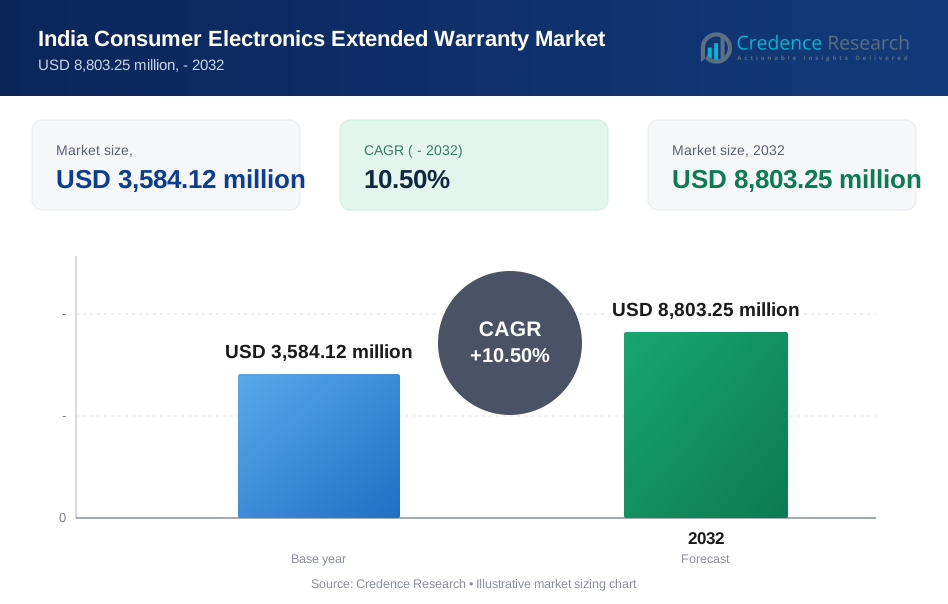
| India Consumer Electronics Extended Warranty Market Size 2023 | USD 3,584.12 million |
| India Consumer Electronics Extended Warranty Market, CAGR | 10.50% |
| India Consumer Electronics Extended Warranty Market Size 2032 | USD 8,803.25 million |
Market Overview
The India Consumer Electronics Extended Warranty Market is projected to grow from USD 3,584.12 million in 2023 to an estimated USD 8,803.25 million by 2032, with a compound annual growth rate (CAGR) of 10.50% from 2024 to 2032. This robust growth is attributed to the increasing penetration of consumer electronics in the Indian market, combined with rising awareness about the benefits of warranty extensions. Consumers are increasingly opting for extended warranty services to safeguard their investments in electronics such as smartphones, laptops, and home appliances, driving a substantial expansion in market size over the forecast period.
Market drivers for the India Consumer Electronics Extended Warranty Market include a surge in the adoption of high-end electronics and the frequent release of new technology that requires protection. Moreover, the growing disposable income in India allows consumers to invest in extended warranty services, enhancing their product lifespan and ensuring protection against potential damages and malfunctions. Trends such as the integration of IoT technology in consumer electronics and the resultant increase in complexity of devices also significantly contribute to the market growth, as more sophisticated products demand more comprehensive warranty services.
Geographically, urban regions in India dominate the Consumer Electronics Extended Warranty Market due to higher consumer electronics purchases and greater awareness about the benefits of warranty services. Key players in the market include Warranty Bazaar, Onsitego, GoWarranty, and OneAssist, who are actively expanding their services across the country to meet the growing demands. These companies are focusing on strategic partnerships with electronics manufacturers and retailers to offer tailored warranty programs, thereby enhancing customer satisfaction and loyalty in the competitive market landscape.
Market Drivers
Increasing Penetration of Consumer Electronics:
As India continues to witness a surge in the adoption of consumer electronics, the demand for extended warranties naturally escalates For instance, the proliferation of devices such as smartphones, tablets, laptops, and other smart appliances in households across the country creates a fertile ground for extended warranty services. Consumers, eager to protect their investments in these high-value items, are increasingly opting for extended warranties that offer peace of mind against potential technical issues and failures. Consumers, eager to protect their investments in these high-value items, are increasingly opting for extended warranties that offer peace of mind against potential technical issues and failures.
Rising Consumer Awareness and Expectations:
There has been a significant shift in consumer behavior towards the maintenance and longevity of electronics. Indian consumers are becoming more aware of the benefits of extended warranties, such as hassle-free repairs and replacements, which in turn drives the market. For instance, a recent survey showed that 65% of consumers now understand the benefits of extended warranties, up from just 45% two years ago. This awareness is bolstered by aggressive marketing and educational campaigns by warranty providers who highlight the cost benefits and convenience of extended warranty plans over time.
Growth in Disposable Income:
The steady rise in disposable income among the middle class in India is another vital driver for the extended warranty market. As disposable income increases, so does consumer spending on electronics along with a willingness to invest in protective services like extended warranties. This demographic shift ensures that more consumers are equipped to purchase warranties, which not only extends the lifespan of their devices but also enhances their user experience by providing additional security.
Technological Advancements in Consumer Electronics:
The rapid rate of technological advancements in consumer electronics compels a corresponding need for extended warranty services. Newer technologies, while improving the functionality and interconnectivity of devices, also increase the complexity and the potential cost of repairs. Extended warranties are thus becoming essential for consumers who need assurance that their technologically advanced and often expensive devices are covered against malfunctions and futuristic damages.
Market Trends
Increased Adoption of Online Warranty Services:
There is a notable shift towards the digital acquisition of extended warranties, as consumers increasingly prefer the convenience of online platforms. For instance, companies are leveraging websites and mobile apps to facilitate easy registration, claim processing, and customer support. This trend is not only enhancing customer experience but also expanding market reach to tech-savvy consumers across various demographics.
Integration with IoT and Smart Devices:
As Internet of Things (IoT) technology becomes more prevalent in consumer electronics, extended warranties are evolving to cover smart home devices and systems. These sophisticated gadgets, which often integrate multiple functions and connectivity options, require specialized support and protection plans. For example, warranty providers are adapting by offering services that cater specifically to the unique needs of IoT device users.
Customizable and Flexible Warranty Plans:
Customization is becoming a key factor in the extended warranty sector. Consumers are looking for flexible warranty plans that can be tailored to fit specific needs and budgets, rather than one-size-fits-all solutions. Providers are responding by offering a range of plans with variable coverage terms, price points, and benefits, thus allowing consumers to choose warranties that best suit their individual requirements.
Partnerships with Manufacturers and Retailers:
There is a growing trend of collaboration between warranty service providers, manufacturers, and retailers. Such partnerships are mutually beneficial; they not only help in offering bundled services at the point of sale but also ensure that consumers receive standardized and seamless support. These collaborations are strengthening the ecosystem and improving the overall customer service experience.
Emphasis on Sustainable Practices:
Sustainability is increasingly influencing consumer choices, including in the extended warranty market. Warranty providers are beginning to adopt eco-friendly practices, such as promoting repairs over replacements and using sustainable materials for any replacements provided. This not only appeals to environmentally conscious consumers but also aligns with global sustainability goals.
Expansion of Coverage to Include Accidental Damage:
Traditionally, extended warranties covered malfunctions and manufacturing defects. However, the trend is shifting towards including protection against accidental damage, such as drops or liquid spills. This comprehensive coverage is becoming a decisive factor for many consumers when choosing extended warranties, particularly for high-value and portable electronics.
Use of AI and Analytics to Enhance Service Efficiency:
Artificial intelligence (AI) and analytics are being increasingly utilized by warranty providers to streamline operations and enhance customer service. AI-driven diagnostics, predictive maintenance, and customer service bots are making the claims process faster and more efficient, significantly improving the customer experience.
Market Restraints and Challenges
Consumer Skepticism and Trust Issues:
One of the primary challenges in the extended warranty market is the prevalent skepticism among consumers regarding the value and authenticity of warranty plans. Many consumers have experienced or heard about inadequate service support, claim denials, or lengthy processing times, which foster distrust and reluctance to invest in extended warranties. Overcoming this skepticism requires warranty providers to enhance transparency, improve customer service, and ensure honest marketing of warranty terms and conditions.
High Cost of Premium Plans:
Extended warranties, especially those offering comprehensive coverage, can be perceived as expensive, deterring price-sensitive consumers. In a market like India, where cost efficiency is often a priority, the perceived high cost of premium warranty plans can significantly restrict market penetration. Providers must strategize to balance coverage comprehensiveness with affordability to attract a broader customer base.
Regulatory and Compliance Issues:
The extended warranty sector in India is subject to various regulations that can pose challenges to new entrants and existing players alike. Navigating these regulatory waters requires clear compliance with consumer protection laws and financial regulations, which can be both time-consuming and costly. Continuous changes and updates in regulatory frameworks can further complicate compliance efforts.
Limited Awareness in Rural Areas:
While urban centers show high levels of awareness and uptake of extended warranties, rural areas lag significantly behind. The lack of awareness and limited availability of warranty services in these regions restrict market growth. Expanding the market into rural areas involves increased marketing efforts and the establishment of service networks that can handle claims and repairs locally.
Integration Challenges with New Technologies:
As consumer electronics evolve rapidly, integrating extended warranties with new technologies poses a significant challenge. Warranty providers must continuously update their offerings to cover new types of failures and technological issues that weren't previously known. Staying ahead in technological adeptness requires ongoing investments in training and systems upgrades, which can be resource-intensive.
Competition from Free Warranty Extensions and Insurance Products:
Some manufacturers offer extended warranty periods as a promotion, which can deter consumers from purchasing additional coverage. Similarly, various insurance products now cover electronic devices, offering similar protections, often at competitive prices. This creates a challenging environment for extended warranty providers to differentiate their offerings and capture market share.
Market Segmentation Analysis
By Product Type:
In the India Consumer Electronics Extended Warranty Market, smartphones and tablets lead the segment, buoyed by their high sales and vulnerability to damage. The need for extended warranties for computers and laptops is bolstered by the escalating reliance on digital technology for both personal and professional uses. Meanwhile, the market for extended warranties on home appliances is expanding as consumers increasingly invest in high-end, technologically sophisticated household devices, seeking to protect these significant investments. Together, these trends underscore the growing importance of extended warranties across various electronics categories.
By Coverage Type
Standard Protection Plans, offering coverage for typical mechanical failures and manufacturer defects, remain a popular choice among consumers seeking basic assurance against common technical issues. Meanwhile, the portability of many consumer electronics has driven the increased favorability of Accidental Damage Protection warranties, which cover incidents like drops and liquid spills. Additionally, Comprehensive Coverage Plans are gaining traction as they provide extensive protection, including from theft and loss, alongside a broader range of mechanical and electrical issues, meeting consumer demands for more thorough coverage options.
By Distribution Channel
Many consumers prefer purchasing extended warranties directly from OEMs (Original Equipment Manufacturers) at the point of sale, valuing the assurance provided by brand-backed warranties. Large electronics retailers also capitalize on this by offering their own or third-party warranty extensions as convenient add-on services. Additionally, there is a growing trend towards buying extended warranties through online platforms, which attract a younger, tech-savvy demographic with competitive pricing and the ease of digital transactions. These various purchasing channels reflect the diverse preferences of consumers in the extended warranty market.
Segments
Based on Product Type
- Smartphones and Tablets
- Computers and Laptops
- Home Appliances
Based on Coverage Type
- Standard Protection Plans
- Accidental Damage Protection
- Comprehensive Coverage Plans
Based on Distribution Channel
- OEMs (Original Equipment Manufacturers)
- Retailers
- Online Platforms
Regional Analysis
Northern India (30% Market Share)
Northern India, with New Delhi as its hub, commands a substantial portion of the market share due to its high consumer purchasing power and concentration of technology hubs. The region benefits from a dense population and a robust retail network that promotes the sale of consumer electronics and associated warranty services. Additionally, the presence of major electronics markets like Nehru Place fosters a conducive environment for extended warranty uptake.
Western India (25% Market Start Share)
Western India, particularly Maharashtra and Gujarat, plays a critical role in the extended warranty market. The region's commercial vitality, particularly in Mumbai and Pune, drives the adoption of advanced consumer electronics, necessitating extended warranties. The affluent consumer base here is more inclined to invest in protective schemes to safeguard their high-end electronics.
Southern India (20% Market Share)
With a strong presence of IT and tech companies, especially in Bangalore and Hyderabad, Southern India showcases significant growth potential in the extended warranty market. The tech-savvy population here is well-informed about the benefits of extended warranties, driving demand. However, the market penetration is slightly lower compared to the North, primarily due to the varied economic backdrop across different states.
Eastern India (15% Market Share)
Eastern India, including West Bengal and Orissa, holds a smaller share of the market. The lower market penetration here can be attributed to less consumer awareness and a smaller urban population compared to other regions. However, the growing retail and digital infrastructure is slowly driving awareness and adoption of extended warranties.
Key players
- OnsiteGo
- OneAssist
- GadgetCops
- Syska Gadget Secure
- Warranty Bazaar
- Acko
- IFFCO Tokio
Competitive Analysis
In the competitive landscape of the India Consumer Electronics Extended Warranty Market, differentiation is largely driven by the breadth of coverage options, customer service quality, and technological integration. OnsiteGo and OneAssist are prominent for their comprehensive coverage and robust customer service platforms, which enhance user satisfaction and loyalty. Syska Gadget Secure and Warranty Bazaar compete by offering competitively priced plans tailored to a wide range of devices. Newer entrants like GadgetCops are innovating with quick service turnaround times and seamless claim processes. Meanwhile, Acko leverages its strong online presence to provide convenient and efficient warranty services. IFFCO Tokio, traditionally an insurance provider, brings a trust factor and insurance expertise, which it extends into extended warranty services, thereby offering additional security to consumers. Together, these players create a dynamic and competitive environment, continually pushing for improvements in service and coverage to meet evolving consumer expectations.
Recent Developments
In January 2023, Voltas and OneDios joined forces to roll out a nationwide extended warranty program, empowering customers to purchase extended warranties for Voltas and Voltas Beko products via the OneDios app. This collaboration ensures access to brand-authorized services, original spare parts, and competitive pricing, while the app simplifies warranty claims and enables users to lodge complaints in under 60 seconds
In February 2024, AmTrust disclosed adjustments in automotive warranty program claim severity amidst shifting industry dynamics. Concurrently, the company intensified its focus on engaging with past customers, aiming to bolster customer satisfaction and retention.
In March 2024, ASSURANT Inc. unveiled an innovative AI-powered claims chatbot designed to facilitate swift and hassle-free claims processing for customers, enhancing overall service efficiency and customer experience.
By April 2024, Asurion had forged a partnership with electric scooter manufacturer Okinawa Autotech to introduce an extended warranty initiative in India, covering essential powertrain components. This collaboration aims to provide Okinawa Autotech customers with added peace of mind and confidence in their electric scooter ownership experience.
Market Concentration and Characteristics
The India Consumer Electronics Extended Warranty Market is moderately concentrated, featuring a mix of established players and emerging entrants that are shaping the industry landscape. Key characteristics of this market include a strong focus on customer service and competitive differentiation through coverage options and pricing strategies. Major players like OnsiteGo, OneAssist, and Syska Gadget Secure dominate the market, leveraging brand reputation and extensive service networks to maintain their market share. However, the market also sees vigorous competition from newer companies such as Acko and GadgetCops, which innovate by offering streamlined online processes and flexible warranty terms. This dynamic competitive environment drives continual improvements in service offerings and coverage plans, reflecting the market's responsiveness to the evolving needs and preferences of Indian consumers. The industry's growth is further influenced by technological advancements and increasing consumer awareness, which encourage broader adoption of extended warranty services across various electronics segments.
Report Coverage
The research report offers an in-depth analysis based on Product Type, Coverage Type, Distribution Channel. It details leading market players, providing an overview of their business, product offerings, investments, revenue streams, and key applications. Additionally, the report includes insights into the competitive environment, SWOT analysis, current market trends, as well as the primary drivers and constraints. Furthermore, it discusses various factors that have driven market expansion in recent years. The report also explores market dynamics, regulatory scenarios, and technological advancements that are shaping the industry. It assesses the impact of external factors and global economic changes on market growth. Lastly, it provides strategic recommendations for new entrants and established companies to navigate the complexities of the market.
Future Outlook
- As sales of consumer electronics continue to rise, driven by technological advancements and increasing digital adoption, the demand for extended warranties is expected to grow proportionally.
- The trend towards digital solutions will likely accelerate, with more consumers opting for the convenience of purchasing and managing extended warranties through online platforms.
- Providers are expected to offer more customized warranty options, allowing consumers to tailor coverage based on their specific needs and preferences.
- As Internet of Things (IoT) devices become more prevalent in homes, the need for specialized extended warranties to cover these sophisticated technologies will increase.
- Efforts to educate consumers about the benefits of extended warranties will result in higher penetration rates, particularly in underrepresented regions.
- Advanced technologies like AI and machine learning will be increasingly used to streamline claims processing and customer service, enhancing the overall user experience.
- Sustainability will become more critical, with warranty providers likely adopting more environmentally friendly practices in their operations and service offerings.
- Expect stricter regulations governing the extended warranty sector, aimed at protecting consumers and ensuring fair practices.
- More collaborations between warranty providers, electronics manufacturers, and retailers are anticipated, aiming to offer integrated services and improve customer satisfaction.
- The market will see a shift towards more comprehensive plans that cover a wider range of issues, including accidental damage and theft, meeting the growing consumer demand for all-encompassing protection solutions
Request a Free Sample
Fill in your details and we'll send you a free sample report.
- Sample data tables & charts
- Research methodology
Need a Custom Version of This Report?
Tailor the scope, geography, or segments to your exact requirements.
- Custom geography or segment scope
- Direct access to our analyst team
Frequently Asked Questions
What is the market size of the India Consumer Electronics Extended Warranty Market in 2023 and 2032, and what is the expected CAGR?
What is driving the growth of the India Consumer Electronics Extended Warranty Market?
How are technological advancements affecting the extended warranty market?
What trends are shaping the extended warranty market in India?
Who are the key players in the India Consumer Electronics Extended Warranty Market?
What are the challenges facing the extended warranty market in India?
Table of Content
Chapter 1. Report Introduction
- 1.1 Report Description & Purpose
- 1.1.1 Report Title & Market Definition
- 1.1.2 Unique Selling Propositions (USP) & Key Differentiators
- 1.1.3 Value Proposition for Stakeholders
- 1.2 Research Objectives
- 1.2.1 Market Sizing Objectives (Volume & Revenue)
- 1.2.2 Segmentation Objectives
- 1.2.3 Competitive Intelligence Objectives
- 1.2.4 Forecast & Scenario Objectives
- 1.3 Report Scope
- 1.3.1 India Consumer Electronics Extended Warranty Scope – Types & Subtypes Covered
- 1.3.2 Geographic Scope – Regions & Countries Covered
- 1.3.3 Historical Period, Base Year & Forecast Period (the historical period; forecast to 2032)
- 1.3.4 Inclusions & Exclusions
- 1.4 HS Code & Classification Framework
- 1.5 Currency, Units & Pricing Basis
- 1.6 Target Stakeholders
- 1.7 Limitations & Assumptions
Chapter 2. Executive Summary
- 2.1 Global India Consumer Electronics Extended Warranty Market Snapshot
- 2.1.1 Market Size – Historical (the historical period) & Forecast (2032) (base year: USD 3,584.12 million → 2032: USD 8,803.25 million)
- 2.1.2 Volume & Revenue – Global Totals
- 2.1.3 Key Market Highlights – Top Five Facts
- 2.2 India Consumer Electronics Extended Warranty Market Segmentation Snapshot
- 2.2.1 Market Split by Region – vs. 2032
- 2.3 Competitive Snapshot
- 2.3.1 Top 10 Players by Revenue Share –
- 2.3.2 Top 10 Players by Volume Share –
- 2.3.3 Recent Strategic Developments (18-Month Summary)
- 2.4 Key Investment Highlights & Strategic Conclusions
Chapter 3. India Consumer Electronics Extended Warranty Market Dynamics & Industry Analysis
- 3.1 Market Overview & Context
- 3.1.1 India Consumer Electronics Extended Warranty Market Position in the Broader Automotive Value Chain
- 3.1.2 OEM vs. Replacement Market Dynamics
- 3.1.3 Market Maturity & Development Stage by Region
- 3.2 India Consumer Electronics Extended Warranty Market Drivers
- 3.3 India Consumer Electronics Extended Warranty Market Restraints & Challenges
- 3.4 India Consumer Electronics Extended Warranty Market Opportunities
- 3.5 Porter's Five Forces Analysis
- 3.5.1 Threat of New Entrants
- 3.5.2 Bargaining Power of Suppliers
- 3.5.3 Bargaining Power of Buyers
- 3.5.4 Threat of Substitutes
- 3.5.5 Competitive Rivalry – Intensity Assessment
- 3.6 India Consumer Electronics Extended Warranty Value Chain Analysis
- 3.6.1 Upstream – Raw Material/Input Suppliers
- 3.6.1.1 Raw Material/Input 1
- 3.6.1.2 Raw Material/Input 2
- 3.6.1.3 Raw Material/Input 3
- 3.6.2 Midstream – Production/Manufacturing/Service Delivery
- 3.6.2.1 Production/Process Overview
- 3.6.2.2 Key Facility Locations & Capacity by Manufacturer
- 3.6.3 Downstream – Distribution & End Consumer
- 3.6.3.1 Primary Channel – B2B/OEM
- 3.6.3.2 Secondary Channels – Dealer, Retail, Online, Direct
- 3.6.4 Value Chain Profitability Analysis
- 3.6.1 Upstream – Raw Material/Input Suppliers
- 3.7 PESTEL Analysis
- 3.7.1 Political Factors
- 3.7.2 Economic Factors
- 3.7.3 Social Factors
- 3.7.4 Technological Factors
- 3.7.5 Environmental Factors
- 3.7.6 Legal Factors
- 3.8 India Consumer Electronics Extended Warranty Supply Chain Analysis
- 3.8.1 Raw Material/Input Supply Risk Assessment
- 3.8.2 Manufacturing Concentration Risk (Geographic Exposure)
- 3.8.3 Trade Disruption Impact Analysis
- 3.9 Regulatory & Policy Landscape
Note: The regulatory and policy landscape section covers regulations based on their applicability to the market, India Consumer Electronics Extended Warranty category, geography, and scope of the study. Only regulatory frameworks with a material impact on operations, compliance, trade, sustainability, or market access are analyzed in detail.
Chapter 4. Key Investment Pockets & Opportunity Analysis
- 4.1 India Consumer Electronics Extended Warranty Market Attractiveness Analysis
- 4.1.1 By Region – Investment Attractiveness Matrix (Volume × CAGR)
- 4.2 Absolute Revenue Growth Opportunity
- 4.2.1 By Region – Absolute USD Growth Through 2032
- 4.3 Incremental Volume Opportunity
- 4.3.1 By Region – Incremental Volume Through 2032
- 4.3.2 Segment – Incremental Volume
- 4.4 Emerging Submarket Opportunity Deep Dive (Subject to Applicability)
- 4.5 Emerging Market Opportunity Scorecards
- 4.5.1 United States
- 4.5.2 Europe
- 4.5.3 Asia
- 4.5.4 Middle East & Africa
Note: Emerging Market Opportunity Scorecards will be included based on relevance and strategic importance. Regions listed are indicative and may vary depending on data availability and market dynamics.
Chapter 5. India Consumer Electronics Extended Warranty Import-Export Analysis & Trade Flows
- 5.1 Global Trade Overview
- 5.1.1 Global Export Value by Country (the historical period)
- 5.1.2 Global Export Volume by Country (the historical period)
- 5.1.3 Global Import Value by Country (the historical period)
- 5.1.4 Global Import Volume by Country (the historical period)
- 5.1.5 Net Trade Balance by Country (the historical period)
- 5.2 Export Analysis – Segment
- 5.2.1 Type 1 (HS Code)
- 5.2.2 Type 2 (HS Code)
- 5.2.3 Type 3 (HS Code)
- 5.2.4 Type 4 (HS Code)
- 5.2.5 Type 5 (HS Code)
- 5.3 Import Analysis – Segment
- 5.3.1 Type 1 (HS Code)
- 5.3.2 Type 2 (HS Code)
- 5.3.3 Type 3 (HS Code)
- 5.3.4 Type 4 (HS Code)
- 5.3.5 Type 5 (HS Code)
- 5.4 Average Unit Trade Prices
- 5.4.1 Average Export Price – Segment & Country
- 5.4.2 Average Import Price – Segment & Source Country
- 5.4.3 Price Trends (the historical period)
- 5.5 Key Trade Route Analysis
- 5.5.1 Trade Route 1
- 5.5.2 Trade Route 2
- 5.5.3 Trade Route 3
- 5.5.4 Trade Route 4
- 5.5.5 Trade Route 5
- 5.6 Trade Policy Impact Assessment
- 5.6.1 US Anti-Dumping & Section 301 Tariffs
- 5.6.2 EU Customs Union Impact
- 5.6.3 Major Free Trade Agreements
- 5.6.4 USMCA Rules of Origin
Note: Trade policy analysis will be included only where relevant to the India Consumer Electronics Extended Warranty market.
Chapter 6. Competitive Landscape & Company Benchmarking
- 6.1 India Consumer Electronics Extended Warranty Market Concentration & Structure
- 6.1.1 Herfindahl-Hirschman Index (HHI) – vs.
- 6.1.2 Tier 1, Tier 2 & Tier 3 Market Structure
- 6.1.3 Global, Regional & Local Player Dynamics
- 6.2 India Consumer Electronics Extended Warranty Market Share Analysis –
- 6.2.1 Global Revenue Share by Company
- 6.2.2 Global Volume Share by Company
- 6.2.3 Regional Revenue Share
- 6.2.4 Market Share Evolution ( vs. )
- 6.2.5 OEM Segment Share by Company
- 6.2.6 Replacement Segment Share by Company
- 6.3 Production/Delivery Capacity & Facility Analysis
- 6.3.1 Global Installed Capacity
- 6.3.2 Capacity Utilization Rates
- 6.3.3 Production/Output Volume
- 6.3.4 Facility Locations & Capacity Map
- 6.3.5 Planned Capacity Additions
- 6.4 India Consumer Electronics Extended Warranty Competitive Benchmarking Matrix
- 6.4.1 Revenue, Volume, CAGR & Profitability Comparison
- 6.4.2 Channel Revenue Mix
- 6.4.3 Geographic Revenue Exposure
- 6.4.4 R&D Intensity
- 6.4.5 Sustainability Maturity
- 6.5 Strategic Developments in India Consumer Electronics Extended Warranty (Last 24 Months)
- 6.5.1 Mergers, Acquisitions & Divestments
- 6.5.2 New India Consumer Electronics Extended Warranty Launches
- 6.5.3 Facility Expansions
- 6.5.4 Strategic Alliances, Joint Ventures & Partnerships
- 6.5.5 Distribution Expansion & Market Entry
- 6.5.6 Sustainability & ESG Initiatives
- 6.6 Competitive Strategy Mapping
- 6.6.1 Leader, Challenger, Follower & Niche Classification
- 6.6.2 Pricing Strategy Comparison
- 6.6.3 Channel Strategy Matrix
Note: Strategic developments are included based on their materiality and the availability of reliable information.
Chapter 7. Global India Consumer Electronics Extended Warranty Market – By Distribution Channel
- 7.1 Segment Overview
- 7.1.1 Volume & Revenue Split by Channel ( & 2032)
- 7.1.2 Channel Mix Evolution (2032)
Chapter 8. Regional Market Analysis – Global Overview
- 8.1 Global Regional Overview
- 8.1.1 Regional Volume Share
- 8.1.2 Regional Revenue Share
- 8.1.3 Regional Volume by Region
- 8.1.4 Regional Revenue by Region
- 8.1.5 Regional Forecast Through 2032
- 8.2 Cross-Regional Segment Analysis
- 8.2.1 By Distribution Channel
- 8.2.2 By Brand/Price Tier
Chapter 9. North America India Consumer Electronics Extended Warranty Market
- 9.1 United States
- 9.2 Canada
- 9.3 Mexico
Chapter 10. Europe India Consumer Electronics Extended Warranty Market
- 10.1 Germany
- 10.2 France
- 10.3 Italy
- 10.4 United Kingdom
- 10.5 Spain
- 10.6 Poland
- 10.7 Russia
- 10.8 Netherlands
- 10.9 Belgium
- 10.10 Sweden
- 10.11 Denmark
- 10.12 Norway
- 10.13 Rest of Europe
Chapter 11. Asia Pacific India Consumer Electronics Extended Warranty Market
- 11.1 China
- 11.2 India
- 11.3 Japan
- 11.4 South Korea
- 11.5 Thailand
- 11.6 Indonesia
- 11.7 Vietnam
- 11.8 Malaysia
- 11.9 Australia
- 11.10 Rest of Asia Pacific
Chapter 12. Latin America India Consumer Electronics Extended Warranty Market
- 12.1 Brazil
- 12.2 Argentina
- 12.3 Colombia
- 12.4 Chile
- 12.5 Rest of Latin America
Chapter 13. Middle East India Consumer Electronics Extended Warranty Market
- 13.1 Saudi Arabia
- 13.2 United Arab Emirates
- 13.3 Turkey
- 13.4 Israel
- 13.5 Iran
- 13.6 Rest of the Middle East
Chapter 14. Africa India Consumer Electronics Extended Warranty Market
- 14.1 South Africa
- 14.2 Egypt
- 14.3 Nigeria
- 14.4 Morocco
- 14.5 Rest of Africa
Chapter 15. India Consumer Electronics Extended Warranty Company Profiles
- 15.1 [Company 01]
- 15.1.1 Company Overview
- 15.1.2 Key Management Personnel
- 15.1.3 Products & Services Portfolio
- 15.1.4 Financial Performance
- 15.1.5 Key Market Focus & Geographic Presence
- 15.1.6 Recent Developments & Strategic Initiatives
Note: The company profile list is preliminary and may change based on research findings, market developments, data availability, and client requirements.
Chapter 16. Appendices
- Appendix A – List of Abbreviations & Acronyms
- Appendix B – Industry Classification Code Reference – Full Series
- Appendix C – Production & Capacity Data Tables
- Appendix D – End-Use & Demand Base Tables
- Appendix E – Consumption & Replacement Rate Assumptions
- Appendix F – ASP Reference Tables
- Appendix G – Manufacturing & Facility Database
- Appendix H – Import-Export Data Tables
- Appendix I – Regulatory Summary Tables
- Appendix J – Primary Research Participant List (Anonymized)
- Appendix K – Primary Research Questionnaire Framework
- Appendix L – Data Sources & Bibliography
- Appendix M – Market Size Divergence & Source Comparison
Chapter 17. Research Methodology
- 17.1 Research Framework & Philosophy
- 17.2 Secondary Research – Sources, Hierarchy & Data Extraction
- 17.3 Data Modeling – Bottom-Up & Top-Down Market Sizing
- 17.4 Primary Research – Stakeholder Framework, LOI & Sample Sizes
- 17.5 Forecast Methodology – Regression, Scenario & Sensitivity Analysis
- 17.6 Quality Control – Four-Layer Validation Framework
- 17.7 Limitations & Standard Assumptions
- 17.8 Disclaimer
