
| REPORT ATTRIBUTE | DETAILS |
|---|---|
| Historical Period | 2019-2022 |
| Base Year | 2023 |
| Forecast Period | 2024-2032 |
| India dashcam market Size 2023 | USD 102.73 million |
| India dashcam market, CAGR | 14.82% |
| India dashcam market Size 2032 | USD 356.69 million |
Market Overview
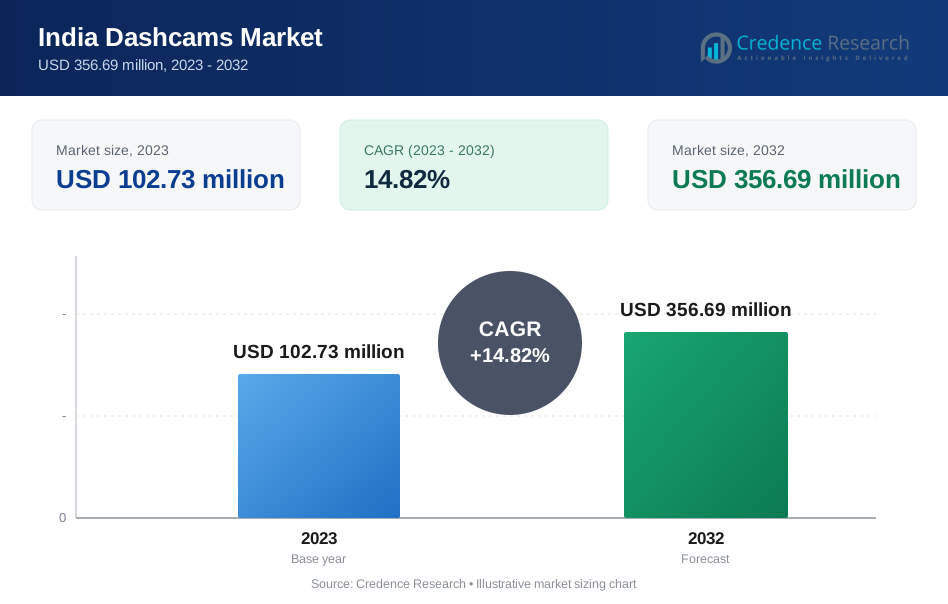
The India dashcam market is projected to grow from USD 102.73 million in 2023 to USD 356.69 million by 2032, with a robust compound annual growth rate (CAGR) of 14.82%.
The India dashcam market is driven by increasing road safety concerns, rising vehicle ownership, and government initiatives promoting safer driving practices. The growing awareness among consumers about the benefits of dashcams, such as accident evidence and insurance claims support, has further accelerated market growth. Additionally, the expansion of the e-commerce sector and increasing demand for high-definition and smart dashcam features are fueling the adoption of these devices. Technological advancements, such as integration with GPS, real-time video streaming, and artificial intelligence, are also contributing to market expansion. The rise in incidents of road accidents and traffic violations in urban areas has heightened the demand for reliable vehicle surveillance systems, thereby boosting the dashcam market in India. Moreover, affordable pricing and ease of installation are making dashcams more accessible to a broader range of vehicle owners, further driving market growth.
The India dashcam market is influenced by regional factors, with major urban centers driving adoption in the northern, western, southern, and eastern parts of the country. In northern India, cities like Delhi and Chandigarh see significant demand due to rising vehicle ownership and safety concerns. Western India, including Mumbai and Pune, has a high concentration of fleet operators, further fueling dashcam usage. Southern India, with tech hubs like Bengaluru and Chennai, is witnessing increased adoption due to growing awareness and disposable income levels. Eastern India, though traditionally slower in adoption, is gradually catching up due to improving road infrastructure and rising vehicle ownership. Key players in the India dashcam market include global and regional brands like Hewlett-Packard, DOD-Tech, Panasonic, Blueskysea, DDPai, YI Technology, Xiaomi, and Azdome, among others, offering a range of products from basic to advanced dashcams that cater to the diverse needs of both individual consumers and commercial fleets.
Market Insights
- The India dashcam market was valued at USD 102.73 million in 2023 and is projected to reach USD 356.69 million by 2032, growing at a CAGR of 14.82%.
- Rising concerns over road safety and increasing accident rates are driving the demand for dashcams across both personal and commercial vehicles.
- Technological advancements, such as GPS integration, cloud storage, and real-time video streaming, are shaping market trends.
- The market is highly competitive, with key players like Hewlett-Packard, Panasonic, Xiaomi, and DDPai offering a range of products to cater to varying consumer needs.
- High initial costs of advanced dashcam models and privacy concerns surrounding data security are key market restraints.
- Northern and Western India dominate the market, driven by urbanization, high vehicle ownership, and fleet management requirements.
- Growing adoption in Southern and Eastern India is expected to drive future growth due to increasing awareness and e-commerce accessibility.
Market Drivers
Rising Road Safety Concerns
One of the primary drivers for the growth of the India dashcam market is the increasing emphasis on road safety. As road accidents and traffic violations continue to rise, both consumers and authorities are seeking ways to enhance driving safety. Dashcams provide an effective solution by capturing real-time footage of road incidents, offering crucial evidence in case of accidents. For instance, the India Status Report on Road Safety 2024 highlights that road traffic injuries were the 13th leading cause of mortality in India, underscoring the importance of measures like dashcams to improve road safety. This growing need for accident documentation and proof is prompting both private vehicle owners and commercial fleets to adopt dashcam technology.
Growing Vehicle Ownership
India’s expanding middle class and rising disposable income are contributing to a steady increase in vehicle ownership. With more vehicles on the road, the demand for safety and security features is also rising. Dashcams offer an affordable and easy-to-install solution for vehicle owners, ensuring enhanced protection against theft, accidents, and other unforeseen events. For instance, there are around 260 million two-wheelers and 50 million cars on Indian roads, reflecting the significant growth in vehicle ownership. This trend of rising vehicle ownership is fueling the adoption of dashcams across personal and commercial vehicles.
Technological Advancements
Advancements in technology are also driving the growth of the dashcam market in India. The latest dashcams are equipped with high-definition video recording, GPS tracking, and smart features like cloud storage and real-time streaming. Additionally, innovations such as artificial intelligence integration for collision detection and driver behavior analysis are making dashcams more attractive to consumers. These technological improvements have significantly enhanced the functionality and reliability of dashcams, making them a preferred choice among vehicle owners.
Government Initiatives and Regulations
Government regulations and initiatives promoting road safety are playing a pivotal role in the dashcam market’s growth. Several regions in India have introduced laws requiring vehicle owners to install safety devices such as dashcams, particularly for commercial vehicles. These regulations, combined with rising awareness of road safety, are accelerating the adoption of dashcams in both personal and fleet vehicles. For instance, the Indian government's Road Safety Week initiative promotes the use of dashcams to enhance road safety. As the government continues to focus on improving road safety, the demand for dashcams is expected to increase.
Market Trends
Increased Adoption of Smart Dashcams
A significant trend in the Indian dashcam market is the growing preference for smart dashcams. These devices now offer more than just video recording; they come with integrated features such as GPS tracking, real-time video streaming, and cloud storage. The ability to connect to mobile apps for remote access, notifications, and data backup is becoming increasingly popular among consumers. As technology evolves, smart dashcams are providing greater value to users by offering enhanced functionality, making them a key trend in the market.
Demand for High-Definition and Night Vision Dashcams
There is a rising demand for high-definition (HD) and night vision-enabled dashcams in India. Consumers are increasingly seeking better video quality to ensure that recordings are clear and detailed, especially in low-light conditions. HD resolution, along with infrared night vision technology, allows for clearer footage during nighttime or poor weather conditions. As road safety concerns grow, users are prioritizing high-quality video capture to ensure the reliability and accuracy of the recorded evidence, driving the trend towards advanced dashcam features.
Expansion of E-Commerce Channels
The rise of e-commerce platforms has significantly contributed to the growing popularity of dashcams in India. Online retail platforms provide easy access to a wide range of dashcam options at competitive prices, allowing consumers to compare features and prices more conveniently. With the increasing penetration of the internet and online shopping, dashcam sales through e-commerce websites are expected to continue to grow. For instance, the number of online shoppers in India is predicted to increase to 427 million by 2027, reflecting the growing influence of e-commerce on consumer purchasing behavior. This trend is especially evident in urban areas, where consumers are becoming more tech-savvy and comfortable purchasing vehicle accessories online.
Integration with Advanced Driver Assistance Systems (ADAS)
Another key trend in the Indian dashcam market is the integration of dashcams with Advanced Driver Assistance Systems (ADAS). Dashcams are increasingly being designed to work in conjunction with ADAS features such as lane departure warnings, collision alerts, and parking sensors. This integration provides an added layer of safety and convenience for drivers. As the demand for ADAS grows, especially among high-end and commercial vehicles, dashcams are becoming an essential part of the overall safety system, further fueling their market adoption.
Market Challenges Analysis
High Initial Cost and Affordability Concerns
One of the key challenges facing the India dashcam market is the high initial cost associated with advanced models. While basic dashcams are relatively affordable, the more feature-rich versions with high-definition video recording, GPS tracking, and cloud connectivity come at a significantly higher price point. For many consumers, particularly in rural and semi-urban areas, the affordability of these devices remains a concern. Despite the long-term benefits, such as enhanced road safety and insurance claims support, the upfront cost can deter potential buyers, limiting market penetration in price-sensitive segments.
Privacy and Data Security Issues
Another challenge faced by the India dashcam market is concerns surrounding privacy and data security. Dashcams record continuous video footage, which can raise privacy issues for both drivers and pedestrians. The storage and management of sensitive data, such as video recordings, are subject to regulatory scrutiny. While many dashcams now offer cloud storage, concerns about data breaches and unauthorized access to personal information remain. For instance, the Ministry of Industry and Information Technology (MIIT) has introduced regulations that mandate strict data security measures for connected vehicles, including dashcams. Additionally, the lack of clear regulations regarding the handling and sharing of video footage could lead to misuse or violations of privacy. As the market for dashcams expands, addressing these privacy and data security issues will be crucial for fostering consumer trust and ensuring compliance with local laws.
Market Opportunities
Growing Demand for Fleet Management Solutions
India’s expanding logistics and transportation sectors present significant opportunities for the dashcam market. Commercial vehicle fleets, including trucks, delivery vans, and ride-sharing services, are increasingly adopting dashcams as part of their fleet management solutions. Dashcams provide real-time video surveillance, offering benefits such as route optimization, driver behavior monitoring, and enhanced security. Additionally, they assist in preventing fraudulent insurance claims and reducing operational costs by improving driver accountability. With the Indian government's focus on improving road safety and promoting efficient transportation, fleet operators are increasingly incorporating dashcams into their vehicles to ensure safer operations, thereby driving market growth.
Expansion in Tier 2 and Tier 3 Cities
While dashcam adoption is growing in urban areas, there is significant untapped potential in India’s tier 2 and tier 3 cities. As vehicle ownership rises in these regions, consumers are becoming more aware of the benefits of dashcams for safety, security, and insurance purposes. With increasing internet penetration and the availability of e-commerce platforms, dashcams are becoming more accessible to a wider audience. Furthermore, the affordability of basic models is improving, making them more appealing to a price-sensitive market. Expanding distribution networks and targeted marketing in these emerging markets will offer considerable growth opportunities for dashcam manufacturers and retailers in India.
Market Segmentation Analysis:
By Technology:
The India dashcam market is segmented by technology into Basic and Advanced categories. Basic dashcams offer essential features like video recording, loop recording, and basic storage, catering primarily to budget-conscious consumers. These devices are often installed in personal vehicles, providing fundamental safety and security functions without advanced features. On the other hand, advanced dashcams come equipped with superior functionalities such as GPS tracking, real-time video streaming, night vision, and cloud storage. These are particularly popular among tech-savvy consumers and businesses seeking comprehensive security solutions. As road safety concerns grow, the demand for advanced models is increasing, especially in urban areas and commercial fleets, where high-quality video recording and additional features like ADAS integration are becoming essential. The shift towards more sophisticated technology reflects the rising consumer preference for enhanced security and vehicle monitoring, positioning advanced dashcams as a key growth driver in the market.
By Product:
In terms of product types, the India dashcam market is divided into 1-Channel, 2-Channel, and Rear View segments. The 1-Channel dashcam is the most common, recording footage from the front of the vehicle, making it an ideal choice for consumers seeking basic functionality. The 2-Channel dashcam, which records both front and rear views, offers enhanced security and broader coverage, making it popular among commercial vehicle owners and those prioritizing all-around surveillance. Rear-view dashcams are increasingly being adopted for their ability to provide additional visibility when reversing, reducing blind spots and enhancing safety. This segment has gained traction, particularly for personal vehicles, as consumers seek more comprehensive protection. As consumer demand shifts towards more robust surveillance systems, the 2-Channel and Rear View dashcam segments are expected to experience significant growth, catering to both safety-conscious individuals and fleet operators.
Segments:
Based on Technology:
- Basic
- Advanced
Based on Product:
- 1-Channel
- 2-Channel
- Rear View
Based on Video Quality:
- SD & HD
- Full HD & 4K
Based on Application:
- Commercial Vehicle
- Personal Vehicle
Based on Distribution Channel:
- Online
- In-Store
Based on the Geography:
- Northern
- Western
- Southern
- Eastern
Regional Analysis
Northern India
Northern India holds a significant share of the dashcam market in India, accounting for approximately 30% of the total market. This region's dominance is driven by its high urbanization rates, with major cities such as Delhi, Chandigarh, and Lucknow seeing rapid growth in vehicle ownership and increasing awareness about road safety. The demand for dashcams is particularly high among private vehicle owners, fleet operators, and commercial vehicles. As road accidents continue to rise in metropolitan areas, consumers are becoming more inclined to invest in dashcams for enhanced security and evidence documentation in case of accidents. Furthermore, the increasing number of delivery services and ride-sharing companies in cities like Delhi and Gurgaon has fueled the adoption of dashcams in commercial vehicles. The market in the northern region is expected to continue its strong growth due to continued urbanization, increased disposable incomes, and rising safety concerns among consumers.
Western India
Western India holds a substantial share of the dashcam market, contributing around 28% of the overall market. This region, which includes major urban centers such as Mumbai, Pune, Ahmedabad, and Surat, has witnessed considerable growth in vehicle ownership and demand for advanced automotive technology. Mumbai, being a key commercial hub, has a high penetration of fleet operators, including taxi services, logistics companies, and e-commerce delivery services, all of which are increasingly adopting dashcams for improved security and fleet management. Moreover, the region’s growing focus on road safety and government initiatives promoting safer driving practices have also contributed to the rise in dashcam adoption. With rising disposable income levels, greater awareness about road safety, and the popularity of online shopping for vehicle accessories, the demand for dashcams is expected to grow rapidly in this region in the coming years.
Southern India
Southern India represents approximately 22% of the Indian dashcam market. Key cities such as Bengaluru, Chennai, Hyderabad, and Kochi are witnessing significant growth in vehicle ownership, particularly among middle-class consumers. The increasing awareness about the importance of road safety and the need for comprehensive vehicle surveillance has led to a growing demand for dashcams. This trend is particularly strong in the commercial vehicle sector, where fleet operators are investing in dashcams for enhanced security, route optimization, and driver behavior monitoring. Additionally, the expanding e-commerce sector in Southern India has led to a rise in demand for delivery vehicle fleet management solutions, further propelling the adoption of dashcams. The affordability of basic dashcam models and the increasing availability of e-commerce platforms offering competitive prices are making these devices more accessible to a larger audience in the region.
Eastern India
Eastern India accounts for approximately 20% of the total dashcam market in India. The region, which includes cities like Kolkata, Bhubaneswar, and Patna, is experiencing a steady rise in vehicle ownership due to increasing economic development and improved road infrastructure. While the adoption rate of dashcams in Eastern India has traditionally lagged behind that of other regions, it is now gaining momentum as consumers become more aware of the benefits of dashcams in enhancing road safety and providing protection in case of accidents. As vehicle owners in this region look for cost-effective solutions, basic dashcam models are seeing higher adoption rates. Moreover, the increasing presence of e-commerce platforms has made dashcams more accessible to consumers across the region, facilitating market growth. While the adoption of advanced dashcam technology may still be limited, the region's growing middle class and the expansion of commercial vehicle fleets are expected to drive future growth.
Key Player Analysis
- Hewlett-Packard Company
- DOD-Tech Co. Ltd.
- Panasonic Corporation
- Blueskysea
- DDPai
- YI Technology
- Azdome
- Shenzhen Future Automotive Technology Co., Ltd
- Junsun
- Xiaomi
- Anytek
- Company 13
- Company 14
- Company 15
- Others
Competitive Analysis
The India dashcam market is highly competitive, with numerous global and regional players offering a variety of products to meet the growing demand for vehicle safety and monitoring solutions. Leading players in the market include Hewlett-Packard, DOD-Tech, Panasonic, Blueskysea, DDPai, YI Technology, Azdome, Shenzhen Future Automotive Technology Co., Ltd, Junsun, Xiaomi, and Anytek. These companies have established strong brand recognition and offer a wide range of dashcam models catering to different segments of consumers, from budget models to advanced, feature-rich devices. Companies are continuously innovating, introducing models with advanced features such as GPS integration, cloud storage, real-time video streaming, and smart connectivity to stay ahead in the market. Some players focus on affordability, offering budget-friendly dashcams that still provide essential features like basic video recording and loop storage, making them attractive to price-sensitive consumers. Others target tech-savvy individuals and businesses, offering high-end models with features such as night vision, advanced driver assistance systems (ADAS), and high-definition video quality. The market is also marked by significant competition in terms of product variety and distribution channels. For instance, the India Status Report on Road Safety 2024 emphasized the importance of advanced safety features in reducing road traffic fatalities. Many brands are expanding their reach through e-commerce platforms, making dashcams more accessible to a wider audience across urban and rural areas. Additionally, as the market matures, companies are adopting new strategies to differentiate themselves, such as offering warranty packages, better customer support, and enhanced integration with mobile apps. Continuous advancements in technology, such as the integration of AI for driver behavior monitoring, are also shaping the competitive landscape. As the demand for vehicle safety and monitoring solutions rises, competition among these players is expected to intensify.
Recent Developments
- In February 2024, LG Innotek made a significant advancement in automotive technology by creating a dashboard camera module equipped with a built-in heater, ensuring functionality in cold climates. This innovation is particularly targeted at enhancing the performance of autonomous vehicles in frosty conditions, such as in the South Korean region.
- In January 2024, Ficosa and indie Semiconductor partnered for the development of AI-based automotive camera solutions. The partnership would provide enhanced safety and help develop and commercialize automotive camera solutions by deploying neural network-based (NN) artificial intelligence (AI) processing.
- In October 2023, Qubo, a smart device brand owned by Hero Electronix, introduced new dashcam products called Dashcam Pro X and Dashcam Pro 3K, with advanced features such as GPS tracking, loop recording, time-lapse, and front and rear cameras to track vehicles in real-time.
- In September 2023, Firsttech LLC, launched DroneMobile XC Dash Cam. It seamlessly integrates with compatible remote start and security systems so users can see what is happening in and around their cars in real-time.
- In January 2023, Garmin Ltd. launched Garmin Dash Cam Live, which is connected to the LTE network and allows drivers to access a live exterior view of their vehicle.
Market Concentration & Characteristics
The India dashcam market exhibits a moderate level of market concentration, with a few dominant players holding significant market shares, while numerous smaller and regional brands continue to compete for market penetration. The market is characterized by a mix of global brands offering premium, high-tech models and local companies providing more affordable, entry-level products. This structure allows consumers to choose from a wide range of options based on their preferences for price, features, and brand reputation. As technology continues to evolve, the demand for advanced dashcam features such as high-definition video recording, cloud storage, GPS tracking, and integration with driver assistance systems (ADAS) is increasing. This trend is driving innovation, particularly among premium players focused on providing sophisticated and feature-rich solutions. At the same time, the growing popularity of online shopping platforms is enhancing accessibility for consumers, contributing to the market's fragmentation. The market’s characteristics reflect a shift toward tech-driven solutions, with a noticeable rise in consumer interest in smart dashcams that offer seamless connectivity and cloud-based services. Additionally, as awareness of road safety grows, commercial fleet operators are becoming a key customer segment, further diversifying the market. Despite competition from both established and emerging players, the market remains dynamic, with constant innovation and product differentiation shaping its future trajectory.
Report Coverage
The research report offers an in-depth analysis based on Technology, Product, Video Quality, Application, Distribution Channel and Geography. It details leading market players, providing an overview of their business, product offerings, investments, revenue streams, and key applications. Additionally, the report includes insights into the competitive environment, SWOT analysis, current market trends, as well as the primary drivers and constraints. Furthermore, it discusses various factors that have driven market expansion in recent years. The report also explores market dynamics, regulatory scenarios, and technological advancements that are shaping the industry. It assesses the impact of external factors and global economic changes on market growth. Lastly, it provides strategic recommendations for new entrants and established companies to navigate the complexities of the market.
Future Outlook
- The India dashcam market is expected to grow significantly, driven by increasing demand for vehicle safety and security solutions.
- Technological advancements, including GPS, ADAS integration, and real-time streaming, will be key drivers of market growth.
- Rising concerns over road safety and accident rates will further fuel the adoption of dashcams in both personal and commercial vehicles.
- The affordability of entry-level dashcam models will make them more accessible to a wider audience, particularly in smaller cities and rural areas.
- Fleet operators in logistics, ride-sharing, and delivery services will continue to be major adopters of dashcams for vehicle management and monitoring.
- Increasing penetration of e-commerce platforms will make dashcams more accessible, allowing for wider distribution across India.
- Government initiatives promoting road safety are likely to create a favorable environment for the adoption of dashcams.
- The integration of advanced features such as AI-powered driver assistance, voice control, and cloud connectivity will attract tech-savvy consumers.
- As competition intensifies, brands will focus on differentiation through product innovation, customer service, and pricing strategies.
- Regional markets like Southern and Eastern India are expected to witness substantial growth as vehicle ownership and safety awareness increase.
Request a Free Sample
Fill in your details and we'll send you a free sample report.
- Sample data tables & charts
- Research methodology
Need a Custom Version of This Report?
Tailor the scope, geography, or segments to your exact requirements.
- Custom geography or segment scope
- Direct access to our analyst team
Frequently Asked Questions
What is the current size of the India Dashcams Market?
What factors are driving the growth of the India Dashcams Market?
What are the key segments within the India Dashcams Market?
What are some challenges faced by the India Dashcams Market?
Table of Content
Chapter 1. Report Introduction
- 1.1 Report Description & Purpose
- 1.1.1 Report Title & Market Definition
- 1.1.2 Unique Selling Propositions (USP) & Key Differentiators
- 1.1.3 Value Proposition for Stakeholders
- 1.2 Research Objectives
- 1.2.1 Market Sizing Objectives (Volume & Revenue)
- 1.2.2 Segmentation Objectives
- 1.2.3 Competitive Intelligence Objectives
- 1.2.4 Forecast & Scenario Objectives
- 1.3 Report Scope
- 1.3.1 India Dashcams Scope – Types & Subtypes Covered
- 1.3.2 Geographic Scope – Regions & Countries Covered
- 1.3.3 Historical Period, Base Year & Forecast Period (2023; forecast to 2032)
- 1.3.4 Inclusions & Exclusions
- 1.4 HS Code & Classification Framework
- 1.5 Currency, Units & Pricing Basis
- 1.6 Target Stakeholders
- 1.7 Limitations & Assumptions
Chapter 2. Executive Summary
- 2.1 Global India Dashcams Market Snapshot
- 2.1.1 Market Size – Historical (2023) & Forecast (2023-2032) (2023: USD 102.73 million → 2032: USD 356.69 million)
- 2.1.2 Volume & Revenue – Global Totals
- 2.1.3 Key Market Highlights – Top Five Facts
- 2.2 India Dashcams Market Segmentation Snapshot
- 2.2.1 Market Split by Region – 2023 vs. 2032
- 2.3 Competitive Snapshot
- 2.3.1 Top 10 Players by Revenue Share – 2023
- 2.3.2 Top 10 Players by Volume Share – 2023
- 2.3.3 Recent Strategic Developments (18-Month Summary)
- 2.4 Key Investment Highlights & Strategic Conclusions
Chapter 3. India Dashcams Market Dynamics & Industry Analysis
- 3.1 Market Overview & Context
- 3.1.1 India Dashcams Market Position in the Broader Automotive Value Chain
- 3.1.2 OEM vs. Replacement Market Dynamics
- 3.1.3 Market Maturity & Development Stage by Region
- 3.2 India Dashcams Market Drivers
- 3.3 India Dashcams Market Restraints & Challenges
- 3.4 India Dashcams Market Opportunities
- 3.5 Porter's Five Forces Analysis
- 3.5.1 Threat of New Entrants
- 3.5.2 Bargaining Power of Suppliers
- 3.5.3 Bargaining Power of Buyers
- 3.5.4 Threat of Substitutes
- 3.5.5 Competitive Rivalry – Intensity Assessment
- 3.6 India Dashcams Value Chain Analysis
- 3.6.1 Upstream – Raw Material/Input Suppliers
- 3.6.1.1 Raw Material/Input 1
- 3.6.1.2 Raw Material/Input 2
- 3.6.1.3 Raw Material/Input 3
- 3.6.2 Midstream – Production/Manufacturing/Service Delivery
- 3.6.2.1 Production/Process Overview
- 3.6.2.2 Key Facility Locations & Capacity by Manufacturer
- 3.6.3 Downstream – Distribution & End Consumer
- 3.6.3.1 Primary Channel – B2B/OEM
- 3.6.3.2 Secondary Channels – Dealer, Retail, Online, Direct
- 3.6.4 Value Chain Profitability Analysis
- 3.6.1 Upstream – Raw Material/Input Suppliers
- 3.7 PESTEL Analysis
- 3.7.1 Political Factors
- 3.7.2 Economic Factors
- 3.7.3 Social Factors
- 3.7.4 Technological Factors
- 3.7.5 Environmental Factors
- 3.7.6 Legal Factors
- 3.8 India Dashcams Supply Chain Analysis
- 3.8.1 Raw Material/Input Supply Risk Assessment
- 3.8.2 Manufacturing Concentration Risk (Geographic Exposure)
- 3.8.3 Trade Disruption Impact Analysis
- 3.9 Regulatory & Policy Landscape
Note: The regulatory and policy landscape section covers regulations based on their applicability to the market, India Dashcams category, geography, and scope of the study. Only regulatory frameworks with a material impact on operations, compliance, trade, sustainability, or market access are analyzed in detail.
Chapter 4. Key Investment Pockets & Opportunity Analysis
- 4.1 India Dashcams Market Attractiveness Analysis
- 4.1.1 By Region – Investment Attractiveness Matrix (Volume × CAGR)
- 4.2 Absolute Revenue Growth Opportunity
- 4.2.1 By Region – Absolute USD Growth Through 2032
- 4.3 Incremental Volume Opportunity
- 4.3.1 By Region – Incremental Volume Through 2032
- 4.3.2 Segment – Incremental Volume
- 4.4 Emerging Submarket Opportunity Deep Dive (Subject to Applicability)
- 4.5 Emerging Market Opportunity Scorecards
- 4.5.1 United States
- 4.5.2 Europe
- 4.5.3 Asia
- 4.5.4 Middle East & Africa
Note: Emerging Market Opportunity Scorecards will be included based on relevance and strategic importance. Regions listed are indicative and may vary depending on data availability and market dynamics.
Chapter 5. India Dashcams Import-Export Analysis & Trade Flows
- 5.1 Global Trade Overview
- 5.1.1 Global Export Value by Country (2023)
- 5.1.2 Global Export Volume by Country (2023)
- 5.1.3 Global Import Value by Country (2023)
- 5.1.4 Global Import Volume by Country (2023)
- 5.1.5 Net Trade Balance by Country (2023)
- 5.2 Export Analysis – Segment
- 5.2.1 Type 1 (HS Code)
- 5.2.2 Type 2 (HS Code)
- 5.2.3 Type 3 (HS Code)
- 5.2.4 Type 4 (HS Code)
- 5.2.5 Type 5 (HS Code)
- 5.3 Import Analysis – Segment
- 5.3.1 Type 1 (HS Code)
- 5.3.2 Type 2 (HS Code)
- 5.3.3 Type 3 (HS Code)
- 5.3.4 Type 4 (HS Code)
- 5.3.5 Type 5 (HS Code)
- 5.4 Average Unit Trade Prices
- 5.4.1 Average Export Price – Segment & Country
- 5.4.2 Average Import Price – Segment & Source Country
- 5.4.3 Price Trends (2023)
- 5.5 Key Trade Route Analysis
- 5.5.1 Trade Route 1
- 5.5.2 Trade Route 2
- 5.5.3 Trade Route 3
- 5.5.4 Trade Route 4
- 5.5.5 Trade Route 5
- 5.6 Trade Policy Impact Assessment
- 5.6.1 US Anti-Dumping & Section 301 Tariffs
- 5.6.2 EU Customs Union Impact
- 5.6.3 Major Free Trade Agreements
- 5.6.4 USMCA Rules of Origin
Note: Trade policy analysis will be included only where relevant to the India Dashcams market.
Chapter 6. Competitive Landscape & Company Benchmarking
- 6.1 India Dashcams Market Concentration & Structure
- 6.1.1 Herfindahl-Hirschman Index (HHI) – vs. 2023
- 6.1.2 Tier 1, Tier 2 & Tier 3 Market Structure
- 6.1.3 Global, Regional & Local Player Dynamics
- 6.2 India Dashcams Market Share Analysis – 2023
- 6.2.1 Global Revenue Share by Company
- 6.2.2 Global Volume Share by Company
- 6.2.3 Regional Revenue Share
- 6.2.4 Market Share Evolution ( vs. 2023)
- 6.2.5 OEM Segment Share by Company
- 6.2.6 Replacement Segment Share by Company
- 6.3 Production/Delivery Capacity & Facility Analysis
- 6.3.1 Global Installed Capacity
- 6.3.2 Capacity Utilization Rates
- 6.3.3 Production/Output Volume
- 6.3.4 Facility Locations & Capacity Map
- 6.3.5 Planned Capacity Additions
- 6.4 India Dashcams Competitive Benchmarking Matrix
- 6.4.1 Revenue, Volume, CAGR & Profitability Comparison
- 6.4.2 Channel Revenue Mix
- 6.4.3 Geographic Revenue Exposure
- 6.4.4 R&D Intensity
- 6.4.5 Sustainability Maturity
- 6.5 Strategic Developments in India Dashcams (Last 24 Months)
- 6.5.1 Mergers, Acquisitions & Divestments
- 6.5.2 New India Dashcams Launches
- 6.5.3 Facility Expansions
- 6.5.4 Strategic Alliances, Joint Ventures & Partnerships
- 6.5.5 Distribution Expansion & Market Entry
- 6.5.6 Sustainability & ESG Initiatives
- 6.6 Competitive Strategy Mapping
- 6.6.1 Leader, Challenger, Follower & Niche Classification
- 6.6.2 Pricing Strategy Comparison
- 6.6.3 Channel Strategy Matrix
Note: Strategic developments are included based on their materiality and the availability of reliable information.
Chapter 7. Global India Dashcams Market – By Distribution Channel
- 7.1 Segment Overview
- 7.1.1 Volume & Revenue Split by Channel (2023 & 2032)
- 7.1.2 Channel Mix Evolution (2023-2032)
Chapter 8. Regional Market Analysis – Global Overview
- 8.1 Global Regional Overview
- 8.1.1 Regional Volume Share
- 8.1.2 Regional Revenue Share
- 8.1.3 Regional Volume by Region
- 8.1.4 Regional Revenue by Region
- 8.1.5 Regional Forecast Through 2032
- 8.2 Cross-Regional Segment Analysis
- 8.2.1 By Distribution Channel
- 8.2.2 By Brand/Price Tier
Chapter 9. North America India Dashcams Market
- 9.1 United States
- 9.2 Canada
- 9.3 Mexico
Chapter 10. Europe India Dashcams Market
- 10.1 Germany
- 10.2 France
- 10.3 Italy
- 10.4 United Kingdom
- 10.5 Spain
- 10.6 Poland
- 10.7 Russia
- 10.8 Netherlands
- 10.9 Belgium
- 10.10 Sweden
- 10.11 Denmark
- 10.12 Norway
- 10.13 Rest of Europe
Chapter 11. Asia Pacific India Dashcams Market
- 11.1 China
- 11.2 India
- 11.3 Japan
- 11.4 South Korea
- 11.5 Thailand
- 11.6 Indonesia
- 11.7 Vietnam
- 11.8 Malaysia
- 11.9 Australia
- 11.10 Rest of Asia Pacific
Chapter 12. Latin America India Dashcams Market
- 12.1 Brazil
- 12.2 Argentina
- 12.3 Colombia
- 12.4 Chile
- 12.5 Rest of Latin America
Chapter 13. Middle East India Dashcams Market
- 13.1 Saudi Arabia
- 13.2 United Arab Emirates
- 13.3 Turkey
- 13.4 Israel
- 13.5 Iran
- 13.6 Rest of the Middle East
Chapter 14. Africa India Dashcams Market
- 14.1 South Africa
- 14.2 Egypt
- 14.3 Nigeria
- 14.4 Morocco
- 14.5 Rest of Africa
Chapter 15. India Dashcams Company Profiles
- 15.1 [Company 01]
- 15.1.1 Company Overview
- 15.1.2 Key Management Personnel
- 15.1.3 Products & Services Portfolio
- 15.1.4 Financial Performance
- 15.1.5 Key Market Focus & Geographic Presence
- 15.1.6 Recent Developments & Strategic Initiatives
Note: The company profile list is preliminary and may change based on research findings, market developments, data availability, and client requirements.
Chapter 16. Appendices
- Appendix A – List of Abbreviations & Acronyms
- Appendix B – Industry Classification Code Reference – Full Series
- Appendix C – Production & Capacity Data Tables
- Appendix D – End-Use & Demand Base Tables
- Appendix E – Consumption & Replacement Rate Assumptions
- Appendix F – ASP Reference Tables
- Appendix G – Manufacturing & Facility Database
- Appendix H – Import-Export Data Tables
- Appendix I – Regulatory Summary Tables
- Appendix J – Primary Research Participant List (Anonymized)
- Appendix K – Primary Research Questionnaire Framework
- Appendix L – Data Sources & Bibliography
- Appendix M – Market Size Divergence & Source Comparison
Chapter 17. Research Methodology
- 17.1 Research Framework & Philosophy
- 17.2 Secondary Research – Sources, Hierarchy & Data Extraction
- 17.3 Data Modeling – Bottom-Up & Top-Down Market Sizing
- 17.4 Primary Research – Stakeholder Framework, LOI & Sample Sizes
- 17.5 Forecast Methodology – Regression, Scenario & Sensitivity Analysis
- 17.6 Quality Control – Four-Layer Validation Framework
- 17.7 Limitations & Standard Assumptions
- 17.8 Disclaimer
