
| REPORT ATTRIBUTE | DETAILS |
|---|---|
| Historical Period | 2019-2022 |
| Base Year | 2023 |
| Forecast Period | 2024-2032 |
| Industrial Gloves Market Size 2023 | USD 8,925.2 Million |
| Industrial Gloves Market, CAGR | 13.30% |
| Industrial Gloves Market Size 2032 | USD 27,459.1 Million |
Market Insights
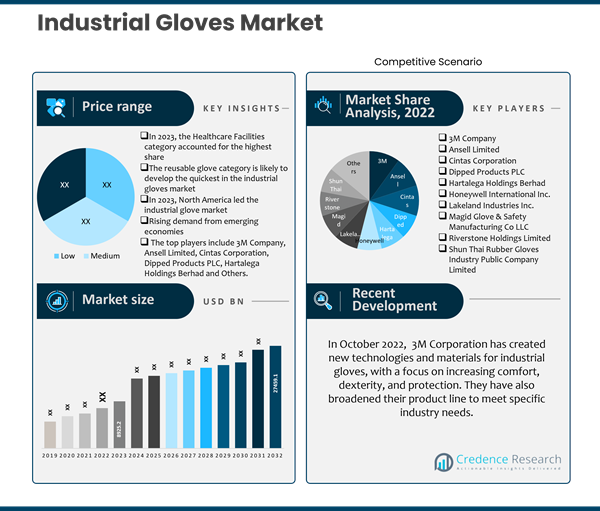
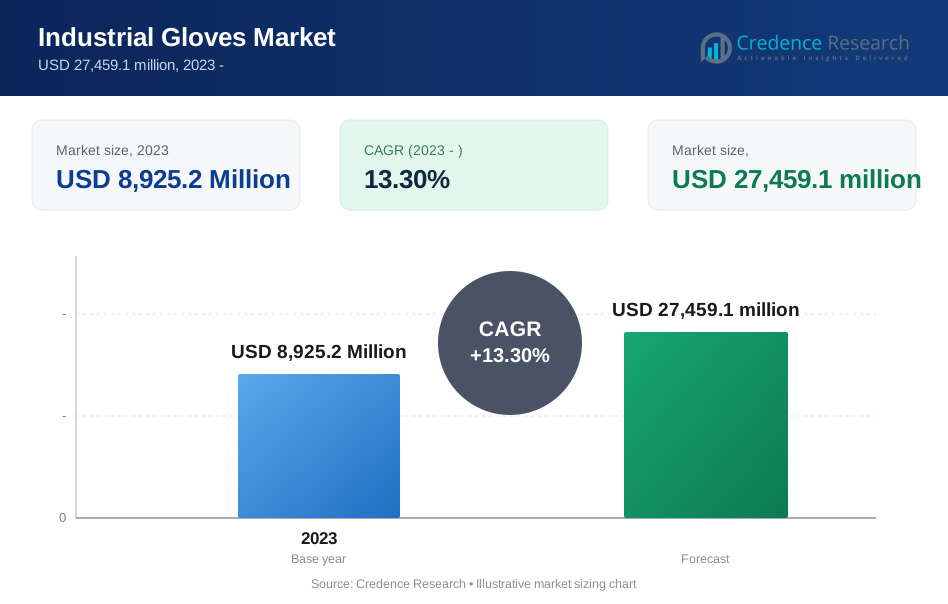
- The global demand for Industrial Gloves was valued at USD 8,925.2 Million in 2023 and is expected to reach USD 27,459.1 Million in 2032, growing at a CAGR of 13.30% between 2024 and 2032.
- The nitrile gloves category is anticipated to rise quickly in the industrial gloves market over the projection period, and Vinyl Gloves are another major portion of the market.
- In 2023, the disposal gloves sector accounted for the largest proportion of the industrial gloves market, while the reusable glove category is projected to develop the fastest in the industrial gloves market.
- Healthcare has the highest market share in the Industrial Gloves Market, followed by Chemical Handling and Manufacturing.
- In 2023, the Healthcare Facilities category accounted for the greatest proportion of the industrial gloves market, and the automotive industry is projected to rise rapidly.
- In 2023, North America led the industrial glove market, and the industrial glove market in Europe is predicted to grow fast in the next years.
- The rising number of occupational injuries fuels market expansion.
- Labor shortages and rising expenses impede market growth
Executive Summary
Market Definition
Industrial gloves are specialized types of personal protective equipment (PPE) that protect workers' hands against a wide range of occupational hazards and risks. These gloves are precisely designed to defend against a variety of dangers, including cuts and abrasions, chemical exposure, and severe temperatures. They serve an important role in worker safety and are essential components in many industries, including manufacturing, construction, healthcare, and chemicals. Industrial gloves are made from a variety of materials, each designed to handle specific types of dangers. They also come in a variety of forms, including disposable gloves for single use and reusable gloves for extended use. The type of gloves used is determined by the unique hazards in the workplace.
Market Overview
The global Industrial Gloves market has witnessed steady growth in recent years and is expected to grow at a CAGR of 13.30% between 2024 and 2032. The market was valued at USD 8,925.2 million in 2023 and is expected to reach USD 27,459.1 million in 2032.
One of the key reasons driving market expansion is the strict rules established by various governments throughout the world regarding occupational safety. With an increased emphasis on employee health and safety, enterprises are required to utilize protective equipment, including industrial gloves, to help prevent accidents and injuries. Furthermore, the boom in industrial activity in emerging nations, particularly in industries such as manufacturing, automotive, and chemical processing, is increasing the demand for industrial gloves. The ongoing growth of these industries necessitates adherence to safety regulations, which contributes to market expansion. Moreover, when new materials and technologies are introduced, industrial gloves become more durable, flexible, and chemically and abrasion-resistant. Innovation in glove manufacturing technique assures outstanding performance, increasing demand in a variety of industries.
Segmentation by Material
- The nitrile gloves category is predicted to grow fast in the industrial gloves market throughout the forecast period. Nitrile gloves offer excellent resistance to a wide range of chemicals, including oils, solvents, and other harsh compounds commonly found in industrial situations.
- Vinyl Gloves are another prominent section in the market. Vinyl gloves are well-known for being inexpensive, comfortable to wear, and appropriate for short-term use in industries such as food service, janitorial, and general cleaning. They are latex-free, making them an excellent choice for people with latex allergies.
Segmentation by Types
- In 2023, the disposal gloves segment accounted for the highest share of the industrial gloves market. The medical business is the most frequent user of disposable gloves since it requires the highest level of sanitation and infection control.
- The reusable glove category is likely to develop the quickest in the industrial gloves market during the forecast period. Reusable gloves are becoming increasingly popular in the industrial glove market due to their potential cost savings and environmental sustainability.
Segmentation by Application
- Healthcare accounts for the greatest market share in the Industrial Gloves Market. Healthcare personnel use gloves for a variety of duties to maintain hygiene and prevent cross-contamination, resulting in a high demand for gloves in this industry.
- The Chemical Handling section also contributes to the Phosphorus Trichloride Market. Phosphorus trichloride is widely employed in chemical synthesis, particularly for the creation of insecticides, plasticizers, and flame retardants.
- Manufacturing is the third segment that has an impact on the market. In the phosphorus trichloride market,
Segmentation by End User
- In 2023, the Healthcare Facilities category accounted for the highest share of the industrial gloves market. Medicines in industrial gloves are mostly used to create customized gloves for pharmaceutical manufacturing setups. These gloves are developed to meet certain requirements such as sterility, chemical resistance, and contamination protection.
- The automotive sector is predicted to grow quickly in the industrial gloves market over the forecast period. Assembly line workers, mechanics, and automotive technicians frequently need to wear gloves to protect their hands from cuts, abrasions, and punctures when handling a large number of mechanical parts and tools.
Segmentation by Region
- In 2023, North America led the industrial glove market.
- The industrial glove market in Europe is expected to expand rapidly in the next years.
- The rest of the world, including Latin America, the Middle East, and Africa, supplies the remaining demand for Industrial Gloves.
North America dominated the industrial glove market in 2023. The booming construction and electronics sectors in Canada and Mexico are principally responsible for this growth since they generate a high need for industrial gloves to ensure worker safety. One of the primary motivations is the introduction of stronger safety regulations in industries such as manufacturing, chemicals, and oil and gas. In the United States, there is a greater emphasis on worker safety, which has raised the demand for protective equipment such as gloves. Because disposable gloves are always required, the healthcare business is a big user. In a similar vein, the food and beverage, pharmaceutical, and automotive industries also contribute significantly to market demand. Businesses are investing in R&D to develop gloves with superior features, such as touchscreen compatibility, more skill, and ecologically friendly materials.
However, The industrial glove market in Europe is predicted to grow rapidly in the next years. The industrial gloves market in Europe is quickly growing due to a variety of factors, including tougher safety rules, increased awareness of workplace hazards, and advancements in glove materials and technologies. They are likely to dominate the market due to their low cost and ease of use, particularly in industries requiring high hygiene, such as food processing and healthcare. Despite their rarity, reusable gloves are critical in businesses that require long-term protection against tougher conditions such as chemicals and heavy machinery. Gloves with greater grip and chemical resistance provide better protection and comfort as a consequence of material and glove design advancements.
Key Highlights of the Report
The global Industrial Gloves market is segmented by Material, Types, Applications, End User, and region. In 2023, the disposal gloves segment accounted for the largest proportion of the industrial gloves market, with the automotive sector expected to increase quickly. Furthermore, the Chemical Handling segment also contributes to the Phosphorus Trichloride Market, and Manufacturing is the third category that has an impact on the market, with North America leading the market growth.
The Industrial Gloves Market is being driven by an increased emphasis on workplace safety requirements, rising awareness of hand hygiene, and the expansion of industries such as healthcare and manufacturing. These factors are driving market growth by stressing the need for hand protection in various work settings. However, market restrictions include fluctuating raw material prices, competition from other hand protection options, and the need to maintain quality standards. Despite these limitations, possibilities exist in technological breakthroughs in glove materials, increased demand in emerging economies, and the opportunity for glove product customisation and specialization, all of which can help to enhance market growth and innovation in the industrial glove sector.
Nonetheless, North America dominated the industrial glove market in 2023. The thriving construction and electronics industries in Canada and Mexico are primarily responsible for this expansion since they generate significant demand for industrial gloves to maintain worker safety. However, the industrial glove market in Europe is expected to expand substantially in the next years. The industrial gloves market in Europe is rapidly expanding due to a number of factors, including stricter safety regulations, higher awareness of workplace risks, and developments in glove materials and technologies.
What Are The Main Drivers Of The Global Industrial Gloves Market?
Key market drivers include growing emphasis on workplace safety rules, improved awareness of hand hygiene and protection, and the growth of industries including healthcare and manufacturing.
What Are The Major Challenges Faced By The Global Industrial Gloves Market?
The market's primary restrictions are fluctuating raw material prices, competition from other hand protection options, and the maintenance of quality standards.
What Are The Growth Opportunities In The Global Industrial Gloves Market?
Despite these limitations, opportunities exist in the form of technological improvements in glove materials, increased demand in emerging economies, and the opportunity for glove product customisation and specialization, all of which can enhance market growth and innovation in the industrial gloves sector.
Market Drivers
The increasing incidence of workplace injuries
The rise in occupational injuries has resulted in a greater need for personal protective equipment (PPE), particularly industrial gloves. Employers are increasingly realizing the importance of safeguarding their employees from risks, resulting in a boom in the use of gloves as a preventive measure. Furthermore, companies are becoming more mindful of the financial and operational costs of workplace injuries. The direct and indirect costs of accidents, such as medical bills, lost productivity, and potential legal liabilities, encourage businesses to engage in preventative measures, such as providing industrial gloves to workers. Furthermore, when employees become more aware of workplace hazards, they want their employers to offer proper safety equipment, such as gloves, which influences market growth.
Market Restraint
Labor shortages and costs
The industrial glove industry is facing significant challenges because to a labor shortage and rising costs. The aftermath of COVID-19 outbreaks, as well as ongoing supply chain disruptions, have exacerbated these issues. There is a particularly acute labor shortage in the industrial sector, which includes glove manufacturing. The outbreak reduced labor-force participation, which has since recovered slowly. The United States employs around 4 million fewer workers than it did prior to the outbreak, whereas high job vacancy rates in Europe are driven by disruptions in migrant labor flows. In a competitive market, firms are spending more to acquire and retain people; hence, labor costs have climbed.
Opportunities
Various technological advancements
Technological improvements in industrial gloves have had a tremendous impact on the market. Innovations in materials, design, and production processes have resulted in gloves that provide improved protection, comfort, and utility. Modern industrial gloves today include improved chemical resistance, grip, flexibility, and even smart technology such as touch sensitivity. Nanotechnology and novel materials such as nitrile have increased glove performance and durability. Furthermore, collaboration between research institutions and manufacturers has fuelled the creation of specialty gloves tailored to specific industry needs, moving the market forward.
Competitive Landscape
Key Players
The global Industrial Gloves market is highly competitive, with several key players. Some of the major players in the market and their market share are as follows:
- 3M Company
- Ansell Limited
- Cintas Corporation
- Dipped Products PLC
- Hartalega Holdings Berhad
- Honeywell International Inc.
- Lakeland Industries Inc.
- Magid Glove & Safety Manufacturing Co LLC
- Riverstone Holdings Limited
- Shun Thai Rubber Gloves Industry Public Company Limited
- Smart Glove Corporation Sdn Bhd
- Top Glove Corporation Bhd
- Uvex Winter Holding Gmbh & Co. Kg.
- Others
These organizations prioritize product innovation, distribution channel expansion, and mergers and acquisitions to stay competitive.
The global Industrial Gloves market's key players continually seek to stay ahead by offering new products and developments.
In September 2023, Ansell Limited has stated that it will invest US$ 80 million over the next three years to develop a new manufacturing facility in Tamil Nadu, India. The new facility will be capable of producing a wide range of products, with a primary concentration on surgical and life science gloves for domestic and foreign markets.
In March 2023, Honeywell International Inc has concentrated on creating gloves with advanced characteristics like touchscreen compatibility, anti-static qualities, and thermal insulation. They have also focused on ergonomic designs to improve user comfort.
How are Companies Performing in the Industrial Gloves Market?
Companies in the Industrial Gloves Market are performing well, with both existing players and new entrants entering the market. Recent market innovations include advancements in sustainable glove materials, novel designs for increased protection, and the use of smart technology to improve safety. Sustainability is a top priority, with companies aiming to reduce carbon emissions in their production processes and promote eco-friendly glove solutions. The industry is seeing a change toward more sustainable methods and a higher emphasis on environmental responsibility, indicating a growing trend towards greener solutions in the industrial gloves sector.
Summary of Key Findings
- Various technological advances are the market's main opportunities.
- Market segmented by Material, Types, Applications, End User, and region.
- In 2023, the Healthcare Facilities category accounted for the greatest proportion of the industrial gloves market
- The reusable glove category is expected to develop the fastest in the industrial gloves market.
- North America is leading market growth; the market is highly competitive with key players including 3M Company, Ansell Limited, Cintas Corporation, Dipped Products PLC, Hartalega Holdings Berhad and Others.
Future Outlook
- Continued focus on worker safety and cleanliness.
- Improvements in glove materials and technology.
- Rising demand from emerging economies.
- An increase in specialized and bespoke glove goods
- Implementation of sustainable and environmentally friendly glove options
How CXOs Can Benefit from the Credence Research Industrial Gloves Market Report
The Credence Research Industrial Gloves Market Report provides CXOs with a comprehensive overview of the market, including:
- Market size and growth forecast:The report provides detailed estimates of the global Industrial Gloves market size, segmented by Material, Type, Application, End User, and region. It also includes forecasts for the market through 2032 based on key trends and drivers.
- Market segmentation:The report segments the Industrial Gloves market by Material, Type, Application, End User, and region. This segmentation provides CXOs with a granular understanding of the market and the opportunities in each segment.
- Competitive Landscape:The report profiles the key players in the Industrial Gloves market and provides insights into their strategies, product offerings, and financial performance. This information can help CXOs to identify and assess their competition.
- Key trends and drivers:The report identifies and analyzes the key trends and drivers that are shaping the Industrial Gloves market. This information can help CXOs to make informed decisions about their investments and strategies.
CXOs can use the insights from the Credence Research Industrial Gloves Market Report to:
- Identify growth opportunities:The report can help CXOs identify new growth opportunities in the Industrial Gloves market. For example, highlighting emerging trends such as the increasing demand for specialized glove products tailored to specific industries or applications.
- Make informed investment decisions: The report can help CXOs make informed investment decisions about Industrial Gloves. For example, Identifying key market trends and growth drivers to guide investment strategies and Analyzing competitive landscape and market dynamics to assess market opportunities
- Develop competitive strategies:The report can help CXOs develop competitive strategies for their Industrial Gloves businesses. For example, the report may offer information on innovative use cases for Industrial Gloves, potential partnerships or collaborations with other industry players, and strategies to differentiate products or services in the market.
- Track market developments:The report can help CXOs track market developments and stay ahead of the curve. For example, the report provides insights into the latest trends and innovations in the Industrial Gloves market.
Overall, the Credence Research Industrial Gloves Market Report is a valuable resource for CXOs who are looking to gain a deeper understanding of the market and identify opportunities for growth.
Segmentation
-
By Material:
- Nitrile Gloves
- Latex Gloves
- Vinyl Gloves
- Neoprene Gloves
- Polyethylene (PE) Gloves
- Butyl Gloves
- Leather Gloves
-
By Type:
- Disposable Gloves
- Reusable Gloves
- Chemical-Resistant Gloves
- Cut-Resistant Gloves
- Heat-Resistant Gloves
- Cold-Resistant Gloves
- Impact-Resistant Gloves
-
By Application:
- Chemical Handling
- Healthcare
- Food Processing
- Construction
- Manufacturing
- Welding
- Janitorial and Cleaning
-
By End User:
- Healthcare Facilities
- Food Service Industry
- Manufacturing Sector
- Construction Industry
- Chemical Industry
- Automotive Sector
- Janitorial and Cleaning Services
-
By Region
- North America
- US
- Canada
- Mexico
- Europe
- Germany
- France
- UK
- Italy
- Spain
- Rest of Europe
- Asia Pacific
- China
- Japan
- India
- South Korea
- South-east Asia
- Rest of Asia Pacific
- Latin America
- Brazil
- Argentina
- Rest of Latin America
- Middle East & Africa
- GCC Countries
- South Africa
- Rest of Middle East and Africa
- North America
Adjacent Markets
In the Industrial Gloves market, there are several adjacent markets which have high revenue growth opportunities. The key adjacent markets for Industrial Gloves market -
Adjacent Markets |
||
| Personal Protective Equipment (PPE) Market | Hearing Protection Devices Market | Disposable Protective Clothing Market |
| Safety Footwear Market | Respiratory Protection Equipment Market | Head Protection Equipment Market |
| Protective Eyewear Market | Fall Protection Equipment Market | High-Visibility Clothing Market |
Request a Free Sample
Fill in your details and we'll send you a free sample report.
- Sample data tables & charts
- Research methodology
Need a Custom Version of This Report?
Tailor the scope, geography, or segments to your exact requirements.
- Custom geography or segment scope
- Direct access to our analyst team
Frequently Asked Questions
What is the current size of the global Industrial Gloves market?
What is the expected growth rate of the Industrial Gloves market between 2024 and 2032?
Which segment is leading the market share in terms of Application?
Which Material segment governs the demand for Industrial Gloves in the world?
Which Type segment is expected to post the Highest CAGR during the forecast period?
Which region is fueling the growth of the Industrial Gloves industry?
Who are the major players in the global Industrial Gloves market?
What are the major market drivers of the Industrial Gloves industry?
What are the major market restraints of the Industrial Gloves industry?
What are the major market opportunities of the Industrial Gloves industry?
Table of Content
Chapter 1. Report Introduction
- 1.1 Report Description & Purpose
- 1.1.1 Report Title & Market Definition
- 1.1.2 Unique Selling Propositions (USP) & Key Differentiators
- 1.1.3 Value Proposition for Stakeholders
- 1.2 Research Objectives
- 1.2.1 Market Sizing Objectives (Volume & Revenue)
- 1.2.2 Segmentation Objectives
- 1.2.3 Competitive Intelligence Objectives
- 1.2.4 Forecast & Scenario Objectives
- 1.3 Report Scope
- 1.3.1 Industrial Gloves Scope – Types & Subtypes Covered
- 1.3.2 Geographic Scope – Regions & Countries Covered
- 1.3.3 Historical Period, Base Year & Forecast Period (2023; forecast to the forecast period)
- 1.3.4 Inclusions & Exclusions
- 1.4 HS Code & Classification Framework
- 1.5 Currency, Units & Pricing Basis
- 1.6 Target Stakeholders
- 1.7 Limitations & Assumptions
Chapter 2. Executive Summary
- 2.1 Global Industrial Gloves Market Snapshot
- 2.1.1 Market Size – Historical (2023) & Forecast (the forecast period) (2023: USD 8,925.2 Million → forecast year: USD 27,459.1 million)
- 2.1.2 Volume & Revenue – Global Totals
- 2.1.3 Key Market Highlights – Top Five Facts
- 2.2 Industrial Gloves Market Segmentation Snapshot
- 2.2.1 Market Split by Region – 2023 vs.
- 2.3 Competitive Snapshot
- 2.3.1 Top 10 Players by Revenue Share – 2023
- 2.3.2 Top 10 Players by Volume Share – 2023
- 2.3.3 Recent Strategic Developments (18-Month Summary)
- 2.4 Key Investment Highlights & Strategic Conclusions
Chapter 3. Industrial Gloves Market Dynamics & Industry Analysis
- 3.1 Market Overview & Context
- 3.1.1 Industrial Gloves Market Position in the Broader Automotive Value Chain
- 3.1.2 OEM vs. Replacement Market Dynamics
- 3.1.3 Market Maturity & Development Stage by Region
- 3.2 Industrial Gloves Market Drivers
- 3.3 Industrial Gloves Market Restraints & Challenges
- 3.4 Industrial Gloves Market Opportunities
- 3.5 Porter's Five Forces Analysis
- 3.5.1 Threat of New Entrants
- 3.5.2 Bargaining Power of Suppliers
- 3.5.3 Bargaining Power of Buyers
- 3.5.4 Threat of Substitutes
- 3.5.5 Competitive Rivalry – Intensity Assessment
- 3.6 Industrial Gloves Value Chain Analysis
- 3.6.1 Upstream – Raw Material/Input Suppliers
- 3.6.1.1 Raw Material/Input 1
- 3.6.1.2 Raw Material/Input 2
- 3.6.1.3 Raw Material/Input 3
- 3.6.2 Midstream – Production/Manufacturing/Service Delivery
- 3.6.2.1 Production/Process Overview
- 3.6.2.2 Key Facility Locations & Capacity by Manufacturer
- 3.6.3 Downstream – Distribution & End Consumer
- 3.6.3.1 Primary Channel – B2B/OEM
- 3.6.3.2 Secondary Channels – Dealer, Retail, Online, Direct
- 3.6.4 Value Chain Profitability Analysis
- 3.6.1 Upstream – Raw Material/Input Suppliers
- 3.7 PESTEL Analysis
- 3.7.1 Political Factors
- 3.7.2 Economic Factors
- 3.7.3 Social Factors
- 3.7.4 Technological Factors
- 3.7.5 Environmental Factors
- 3.7.6 Legal Factors
- 3.8 Industrial Gloves Supply Chain Analysis
- 3.8.1 Raw Material/Input Supply Risk Assessment
- 3.8.2 Manufacturing Concentration Risk (Geographic Exposure)
- 3.8.3 Trade Disruption Impact Analysis
- 3.9 Regulatory & Policy Landscape
Note: The regulatory and policy landscape section covers regulations based on their applicability to the market, Industrial Gloves category, geography, and scope of the study. Only regulatory frameworks with a material impact on operations, compliance, trade, sustainability, or market access are analyzed in detail.
Chapter 4. Key Investment Pockets & Opportunity Analysis
- 4.1 Industrial Gloves Market Attractiveness Analysis
- 4.1.1 By Region – Investment Attractiveness Matrix (Volume × CAGR)
- 4.2 Absolute Revenue Growth Opportunity
- 4.2.1 By Region – Absolute USD Growth Through the forecast period
- 4.3 Incremental Volume Opportunity
- 4.3.1 By Region – Incremental Volume Through the forecast period
- 4.3.2 Segment – Incremental Volume
- 4.4 Emerging Submarket Opportunity Deep Dive (Subject to Applicability)
- 4.5 Emerging Market Opportunity Scorecards
- 4.5.1 United States
- 4.5.2 Europe
- 4.5.3 Asia
- 4.5.4 Middle East & Africa
Note: Emerging Market Opportunity Scorecards will be included based on relevance and strategic importance. Regions listed are indicative and may vary depending on data availability and market dynamics.
Chapter 5. Industrial Gloves Import-Export Analysis & Trade Flows
- 5.1 Global Trade Overview
- 5.1.1 Global Export Value by Country (2023)
- 5.1.2 Global Export Volume by Country (2023)
- 5.1.3 Global Import Value by Country (2023)
- 5.1.4 Global Import Volume by Country (2023)
- 5.1.5 Net Trade Balance by Country (2023)
- 5.2 Export Analysis – Segment
- 5.2.1 Type 1 (HS Code)
- 5.2.2 Type 2 (HS Code)
- 5.2.3 Type 3 (HS Code)
- 5.2.4 Type 4 (HS Code)
- 5.2.5 Type 5 (HS Code)
- 5.3 Import Analysis – Segment
- 5.3.1 Type 1 (HS Code)
- 5.3.2 Type 2 (HS Code)
- 5.3.3 Type 3 (HS Code)
- 5.3.4 Type 4 (HS Code)
- 5.3.5 Type 5 (HS Code)
- 5.4 Average Unit Trade Prices
- 5.4.1 Average Export Price – Segment & Country
- 5.4.2 Average Import Price – Segment & Source Country
- 5.4.3 Price Trends (2023)
- 5.5 Key Trade Route Analysis
- 5.5.1 Trade Route 1
- 5.5.2 Trade Route 2
- 5.5.3 Trade Route 3
- 5.5.4 Trade Route 4
- 5.5.5 Trade Route 5
- 5.6 Trade Policy Impact Assessment
- 5.6.1 US Anti-Dumping & Section 301 Tariffs
- 5.6.2 EU Customs Union Impact
- 5.6.3 Major Free Trade Agreements
- 5.6.4 USMCA Rules of Origin
Note: Trade policy analysis will be included only where relevant to the Industrial Gloves market.
Chapter 6. Competitive Landscape & Company Benchmarking
- 6.1 Industrial Gloves Market Concentration & Structure
- 6.1.1 Herfindahl-Hirschman Index (HHI) – vs. 2023
- 6.1.2 Tier 1, Tier 2 & Tier 3 Market Structure
- 6.1.3 Global, Regional & Local Player Dynamics
- 6.2 Industrial Gloves Market Share Analysis – 2023
- 6.2.1 Global Revenue Share by Company
- 6.2.2 Global Volume Share by Company
- 6.2.3 Regional Revenue Share
- 6.2.4 Market Share Evolution ( vs. 2023)
- 6.2.5 OEM Segment Share by Company
- 6.2.6 Replacement Segment Share by Company
- 6.3 Production/Delivery Capacity & Facility Analysis
- 6.3.1 Global Installed Capacity
- 6.3.2 Capacity Utilization Rates
- 6.3.3 Production/Output Volume
- 6.3.4 Facility Locations & Capacity Map
- 6.3.5 Planned Capacity Additions
- 6.4 Industrial Gloves Competitive Benchmarking Matrix
- 6.4.1 Revenue, Volume, CAGR & Profitability Comparison
- 6.4.2 Channel Revenue Mix
- 6.4.3 Geographic Revenue Exposure
- 6.4.4 R&D Intensity
- 6.4.5 Sustainability Maturity
- 6.5 Strategic Developments in Industrial Gloves (Last 24 Months)
- 6.5.1 Mergers, Acquisitions & Divestments
- 6.5.2 New Industrial Gloves Launches
- 6.5.3 Facility Expansions
- 6.5.4 Strategic Alliances, Joint Ventures & Partnerships
- 6.5.5 Distribution Expansion & Market Entry
- 6.5.6 Sustainability & ESG Initiatives
- 6.6 Competitive Strategy Mapping
- 6.6.1 Leader, Challenger, Follower & Niche Classification
- 6.6.2 Pricing Strategy Comparison
- 6.6.3 Channel Strategy Matrix
Note: Strategic developments are included based on their materiality and the availability of reliable information.
Chapter 7. Global Industrial Gloves Market – By Distribution Channel
- 7.1 Segment Overview
- 7.1.1 Volume & Revenue Split by Channel (2023 & )
- 7.1.2 Channel Mix Evolution (the forecast period)
Chapter 8. Regional Market Analysis – Global Overview
- 8.1 Global Regional Overview
- 8.1.1 Regional Volume Share
- 8.1.2 Regional Revenue Share
- 8.1.3 Regional Volume by Region
- 8.1.4 Regional Revenue by Region
- 8.1.5 Regional Forecast Through the forecast period
- 8.2 Cross-Regional Segment Analysis
- 8.2.1 By Distribution Channel
- 8.2.2 By Brand/Price Tier
Chapter 9. North America Industrial Gloves Market
- 9.1 United States
- 9.2 Canada
- 9.3 Mexico
Chapter 10. Europe Industrial Gloves Market
- 10.1 Germany
- 10.2 France
- 10.3 Italy
- 10.4 United Kingdom
- 10.5 Spain
- 10.6 Poland
- 10.7 Russia
- 10.8 Netherlands
- 10.9 Belgium
- 10.10 Sweden
- 10.11 Denmark
- 10.12 Norway
- 10.13 Rest of Europe
Chapter 11. Asia Pacific Industrial Gloves Market
- 11.1 China
- 11.2 India
- 11.3 Japan
- 11.4 South Korea
- 11.5 Thailand
- 11.6 Indonesia
- 11.7 Vietnam
- 11.8 Malaysia
- 11.9 Australia
- 11.10 Rest of Asia Pacific
Chapter 12. Latin America Industrial Gloves Market
- 12.1 Brazil
- 12.2 Argentina
- 12.3 Colombia
- 12.4 Chile
- 12.5 Rest of Latin America
Chapter 13. Middle East Industrial Gloves Market
- 13.1 Saudi Arabia
- 13.2 United Arab Emirates
- 13.3 Turkey
- 13.4 Israel
- 13.5 Iran
- 13.6 Rest of the Middle East
Chapter 14. Africa Industrial Gloves Market
- 14.1 South Africa
- 14.2 Egypt
- 14.3 Nigeria
- 14.4 Morocco
- 14.5 Rest of Africa
Chapter 15. Industrial Gloves Company Profiles
- 15.1 [Company 01]
- 15.1.1 Company Overview
- 15.1.2 Key Management Personnel
- 15.1.3 Products & Services Portfolio
- 15.1.4 Financial Performance
- 15.1.5 Key Market Focus & Geographic Presence
- 15.1.6 Recent Developments & Strategic Initiatives
Note: The company profile list is preliminary and may change based on research findings, market developments, data availability, and client requirements.
Chapter 16. Appendices
- Appendix A – List of Abbreviations & Acronyms
- Appendix B – Industry Classification Code Reference – Full Series
- Appendix C – Production & Capacity Data Tables
- Appendix D – End-Use & Demand Base Tables
- Appendix E – Consumption & Replacement Rate Assumptions
- Appendix F – ASP Reference Tables
- Appendix G – Manufacturing & Facility Database
- Appendix H – Import-Export Data Tables
- Appendix I – Regulatory Summary Tables
- Appendix J – Primary Research Participant List (Anonymized)
- Appendix K – Primary Research Questionnaire Framework
- Appendix L – Data Sources & Bibliography
- Appendix M – Market Size Divergence & Source Comparison
Chapter 17. Research Methodology
- 17.1 Research Framework & Philosophy
- 17.2 Secondary Research – Sources, Hierarchy & Data Extraction
- 17.3 Data Modeling – Bottom-Up & Top-Down Market Sizing
- 17.4 Primary Research – Stakeholder Framework, LOI & Sample Sizes
- 17.5 Forecast Methodology – Regression, Scenario & Sensitivity Analysis
- 17.6 Quality Control – Four-Layer Validation Framework
- 17.7 Limitations & Standard Assumptions
- 17.8 Disclaimer
