
Market Overview
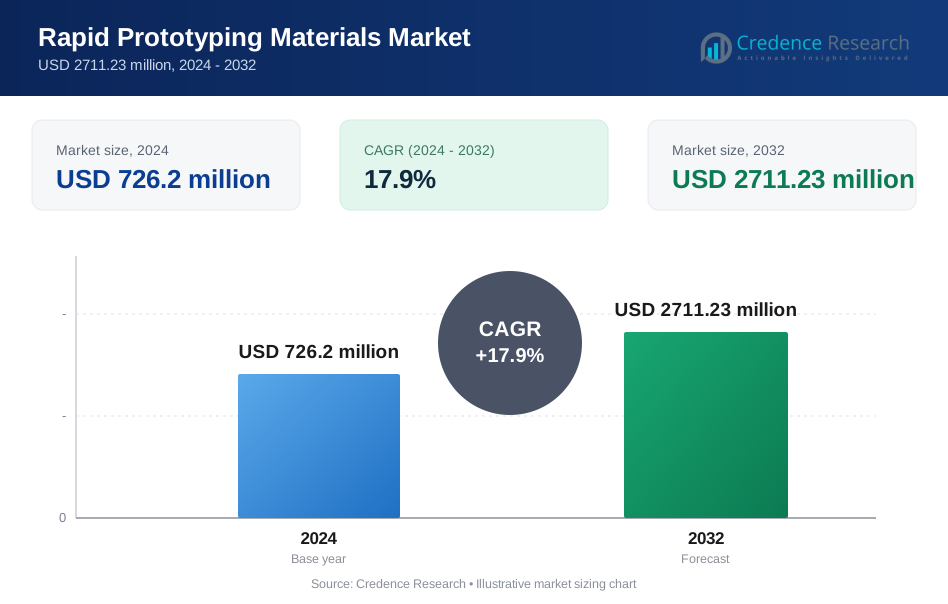
Rapid Prototyping Materials Market size was valued USD 726.2 million in 2024 and is anticipated to reach USD 2711.23 million by 2032, at a CAGR of 17.9% during the forecast period.
| REPORT ATTRIBUTE | DETAILS |
|---|---|
| Historical Period | 2020-2023 |
| Base Year | 2024 |
| Forecast Period | 2025-2032 |
| Rapid Prototyping Materials Market Size 2024 | USD 726.2 Million |
| Rapid Prototyping Materials Market, CAGR | 17.9% |
| Rapid Prototyping Materials Market Size 2032 | USD 2711.23 Million |
The Rapid Prototyping Materials Market features strong competition among global material innovators specializing in advanced polymers, engineered metal powders, ceramics, and composite solutions tailored for additive and subtractive manufacturing. Leading companies strengthen their positions through R&D investments, capacity expansion, and collaborations with 3D printing system manufacturers to improve material performance, printability, and end-use durability. The market benefits from increasing adoption across automotive, aerospace, and medical device prototyping, which drives demand for high-precision and functional materials. Asia-Pacific emerges as the leading region with an exact 38% market share, supported by its extensive manufacturing ecosystem, rapid industrialization, and expanding 3D printing infrastructure.
Market Insights
- The market was valued at USD 726.2 million in 2024 and is projected to reach USD 2711.23 million by 2032 at a 17.9% CAGR, reflecting strong global expansion.
- Rising demand for high-precision polymers and metal powders in automotive, aerospace, and medical prototyping drives market growth as industries prioritize faster development cycles and functional testing.
- Trends favor advanced composites, recyclable materials, and formulations optimized for SLA, SLS, and metal AM systems, strengthening adoption across industrial design and low-volume manufacturing.
- Competitive activity intensifies as material producers expand R&D, enhance purity and performance attributes, and collaborate with 3D printing manufacturers to improve compatibility and global supply reach.
- Asia-Pacific leads with 38% share, supported by rapid industrialization and manufacturing capacity, while polymers remain the dominant material segment with the highest usage across consumer goods, automotive prototyping, and medical modeling applications.
 Market Segmentation Analysis:
- By Material
The rapid prototyping materials market remains dominated by polymer-based materials, holding an estimated 48% share due to their versatility, low cost, and compatibility with a wide range of additive manufacturing systems. Their ease of processing, high dimensional accuracy, and suitability for functional prototyping in automotive, consumer goods, and medical devices reinforce their leadership. Metals continue to grow as aerospace and defense applications demand stronger, heat-resistant materials. Ceramics and other specialty materials advance steadily with R&D in high-precision biomedical implants and electronics, but polymer grades retain dominance through continuous formulation improvements and broad printer compatibility.
- For instance, Toray Industries Inc. developed its high-performance Torayca® T1100G carbon fiber grade, delivering a tensile modulus of 324 GPa and tensile strength of 7.0 GPa, enabling advanced polymer-matrix composites optimized for precision prototyping in aerospace structures and high-load industrial components.
- By Technology
Additive technologies represent the dominant category with a 55% market share, driven by their ability to produce complex geometries, reduce material wastage, and accelerate design cycles across automotive, aerospace, and healthcare sectors. Within additive, Fused Deposition Modelling (FDM) leads due to its affordability and material diversity, while SLA and SLS gain traction for precision and high-performance prototyping. Subtractive and compressive methods, including CNC machining and casting, maintain stable demand for high-tolerance metal parts. The strong shift toward digital fabrication workflows continues to advance additive platforms as the preferred technology.
- For instance, FPG recently commissioned a new carbon-fiber plant (Plant A at its Renwu complex) with an annual production capacity of 1,600 tons a move underscoring its strategic shift toward high-value, engineering-grade plastics and composite materials.
- By Application
The automotive sector dominates the application landscape with a 32% market share, supported by the industry's reliance on rapid prototype iterations for design validation, tooling development, and lightweight component testing. Prototyping demand accelerates as OEMs and EV manufacturers compress development timelines and adopt additive manufacturing for both functional parts and aesthetic models. The medical segment expands quickly with rising adoption of anatomical models and implant trials, while aerospace applications benefit from precision material developments. Academic institutions and government programs strengthen adoption through research grants and technology integration initiatives, further broadening market penetration.
Key Growth Drivers
1. Expansion of Additive Manufacturing Across Industries
The rapid adoption of additive manufacturing in automotive, aerospace, medical, and consumer goods sectors drives substantial demand for advanced prototyping materials. Industries increasingly integrate 3D printing to shorten development cycles, reduce tooling costs, and accelerate product iterations. Lightweight polymers, metal powders, and high-temperature composites gain traction as engineering teams shift toward digital fabrication workflows. As OEMs prioritize rapid design validation and functional part testing, material suppliers benefit from continuous upgrades in formulation, printability, and mechanical performance, reinforcing sustained market growth.
- For instance, Evonik Industries expanded its INFINAM® photopolymers portfolio with INFINAM® TI 5400 L, a tough, white resin engineered for highly durable functional prototypes which delivers a typical tensile strength of approximately 40 MPa and high elongation at break of up to 200%.
2. Rising Need for Functional Prototyping and Custom Components
Growing emphasis on producing functional prototypes rather than aesthetic models boosts the demand for durable, high-performance materials. Manufacturers require materials with improved strength, heat stability, and chemical resistance to simulate real-world conditions during product testing. The trend intensifies in medical devices, EV components, and aerospace assemblies where part accuracy and reliability remain critical. Customization requirementsm from patient-specific implants to tailored industrial components further accelerate material innovation. This shift positions advanced polymers, metals, and composites as core enablers of faster, iterative product development cycles across multiple industries.
- For instance, SABIC’s ULTEM™ 9085 resin, certified for aerospace use, delivers a tensile strength of 70 MPa and a heat-deflection temperature of 153°C, enabling flight-ready functional prototypes. SABIC also introduced its LNP™ THERMOCOMP™ AM compounds reinforced with carbon fiber, achieving flexural modulus levels up to 20 GPa, supporting high-rigidity EV and industrial components fabricated through additive manufacturing.
3. Increased R&D Investments in Next-Generation Material Formulations
R&D advancements play a central role in expanding the capabilities of rapid prototyping materials. Companies invest in engineered resins, fine metal powders, ceramic blends, and hybrid materials that enhance dimensional stability and surface finish while enabling complex geometries. Efforts to reduce post-processing, improve recyclability, and ensure compatibility with high-speed additive systems support faster adoption. Material innovation also aligns with regulatory requirements in medical and aerospace applications, where certification-driven design validation demands high-quality prototypes. Such advancements broaden applications and strengthen the technology’s integration into mainstream manufacturing processes.
Key Trends & Opportunities
1. Growing Adoption of High-Performance and Sustainable Materials
A key trend involves the shift toward performance-enhanced and environmentally responsible materials. Bio-based polymers, recyclable resins, and low-emission metal powders gain traction as manufacturers align with sustainability targets. High-temperature composites and ceramic-based materials create new opportunities in aerospace, automotive electrification, and industrial tooling by enabling durability and precision. The adoption of sustainable prototyping materials also supports circular manufacturing models. As companies expand corporate ESG commitments, material suppliers that develop greener, high-strength, and cost-efficient alternatives capture a larger share of emerging applications.
- For instance, PPG Industries introduced its CORAFLON® powder coating technology with ultra-low VOC content, engineered for extreme durability and weathering resistance for architectural applications. Concurrently, PPG offers high-performance structural film adhesives designed for aerospace composite assemblies, such as the PPG AE-244 structural film adhesive, which provides high lap shear strength at room temperature for high-load applications.
2. Integration of Digital Workflows and Advanced Printing Platforms
Rapid prototyping is increasingly supported by integrated digital workflows, including automated slicing software, AI-driven design tools, and cloud-based collaboration platforms. These capabilities enhance material utilization, improve accuracy, and reduce development time. Hybrid additive–subtractive systems create opportunities for materials compatible with multi-step fabrication. Advancements in SLA, SLS, and metal AM machines further push demand for specialty materials optimized for speed, surface finish, and structural integrity. The convergence of software, hardware, and materials strengthens end-user adoption across research institutions and industrial design teams.
- For instance, Novelis (following its acquisition of Aleris) supplies aerospace-grade aluminum plate produced at its Zhenjiang facility, capable of manufacturing wide plate up to 3.8 meters in width.
3. Expansion of Industrial Applications in EVs, Aerospace, and Healthcare
New application opportunities continue to emerge in electric vehicles, aerospace interior components, surgical guides, dental prosthetics, and defense prototypes. These industries require materials capable of meeting stringent mechanical, thermal, and biocompatibility standards. Lightweight composites and high-precision metal powders enable structurally reliable prototypes for performance testing. In healthcare, anatomical models and patient-matched components create recurring material demand. As industrial OEMs accelerate innovation cycles, rapid prototyping materials gain deeper penetration, establishing new revenue streams across both high-value and volume-driven segments.
Key Challenges
1. High Material Costs and Limited Scalability for Mass Production
Despite growing adoption, premium polymers, specialty resins, and metal powders remain costly, restricting usage in cost-sensitive segments. Material pricing increases further when high purity, tight particle size distribution, or biocompatibility certifications are required. These constraints limit scalability for large-volume production, making traditional manufacturing more economical for certain applications. Additionally, procurement challenges and limited regional availability of advanced materials extend lead times. Manufacturers must balance prototyping speed with operational budgets, creating a barrier that slows adoption in emerging markets and small-scale design firms.
2. Inconsistent Material Performance and Compatibility Across Technologies
Variations in material quality, printability, and end-use performance pose challenges across different additive and subtractive platforms. Inconsistent mechanical properties, warping, surface defects, and limited cross-compatibility between machines reduce efficiency and increase post-processing. Industries requiring strict tolerances such as aerospace and medical face constraints when materials fail to meet repeatability standards. Furthermore, rapid innovation leads to fragmented material portfolios, increasing complexity for end users selecting optimal material technology combinations. These limitations hinder seamless workflow integration and slow widespread adoption of rapid prototyping solutions.
Market Segmentations:
By Material:
- Polymer
- Metal
By Technology:
- Fused Deposition Modelling (FDM)
- Stereolithography (SLA)
By Application:
- Automotive
- Consumer goods
By Geography
- North America
- U.S.
- Canada
- Mexico
- Europe
- Germany
- France
- U.K.
- Italy
- Spain
- Rest of Europe
- Asia Pacific
- China
- Japan
- India
- South Korea
- South-east Asia
- Rest of Asia Pacific
- Latin America
- Brazil
- Argentina
- Rest of Latin America
- Middle East & Africa
- GCC Countries
- South Africa
- Rest of the Middle East and Africa
Competitive Landscape
The competitive landscape of the Rapid Prototyping Materials Market players such as Toray Industries Inc., Precision Castparts Corp., Formosa Plastics Group, Evonik Industries, SABIC, PPG Industries Inc., Aleris International, Cytec Solvay Group, Alcoa Inc., and Allegheny Technologies Incorporated. the Rapid Prototyping Materials Market is shaped by manufacturers that focus on developing high-performance polymers, engineered metal powders, ceramics, and composite materials optimized for modern prototyping technologies. Companies emphasize innovations that enhance mechanical strength, thermal stability, and printability to meet the rising demand for functional prototypes in automotive, aerospace, medical, and industrial sectors. Advancements in material formulations compatible with FDM, SLA, SLS, and metal additive manufacturing improve surface finish and dimensional accuracy, reducing post-processing requirements. Strategic investments in sustainable materials, capacity expansion, and collaborations with 3D printer manufacturers strengthen market visibility. Continuous R&D efforts, certification-driven quality improvements, and global distribution networks further reinforce the competitive position of leading material suppliers in this evolving market.
Key Player Analysis
- Toray Industries Inc.
- Precision Castparts Corp.
- Formosa Plastics Group
- Evonik Industries
- SABIC
- PPG Industries Inc.
- Aleris International
- Cytec Solvay Group
- Alcoa Inc.
- Allegheny Technologies Incorporated
Recent Developments
- In March 2025, Stratasys announced they partnered with major aerospace/defense players like Boeing, Northrop Grumman, U.S. Air Force, Blue Origin, & Raytheon to qualify their new high-performance polymers, Antero 800NA and 840CN03, for demanding, mission-critical 3D printed parts on their F900 platform, enabling faster, cheaper, and more reliable production of flight-ready components.
- In October 2024, Toraysee cleaning cloths are available for purchase online through several retailers, including major e-commerce sites like Amazon and various specialty cleaning supply stores. The product line has been available with new designs, including those made from recycled materials, launched periodically.
- In August 2024, Alcoa Corporation acquired Alumina Limited. With the acquisition, Alcoa now fully owns the Alcoa World Alumina and Chemicals (AWAC) joint venture, previously held at a 60% stake, which includes several bauxite mines and alumina refineries across key regions such as Australia, Brazil, and Guinea.
Report Coverage
The research report offers an in-depth analysis based on Material, Technology, Application and Geography. It details leading market players, providing an overview of their business, product offerings, investments, revenue streams, and key applications. Additionally, the report includes insights into the competitive environment, SWOT analysis, current market trends, as well as the primary drivers and constraints. Furthermore, it discusses various factors that have driven market expansion in recent years. The report also explores market dynamics, regulatory scenarios, and technological advancements that are shaping the industry. It assesses the impact of external factors and global economic changes on market growth. Lastly, it provides strategic recommendations for new entrants and established companies to navigate the complexities of the market.
Future Outlook
- The market will expand as additive manufacturing becomes a standard tool across automotive, aerospace, and medical industries.
- Demand will rise for high-performance polymers and metal powders that support functional prototyping and lightweight engineering.
- Sustainable and recyclable materials will gain traction as manufacturers adopt stricter environmental goals.
- Advancements in SLA, SLS, and metal AM platforms will accelerate innovation in specialized material formulations.
- Hybrid additive–subtractive systems will create opportunities for materials engineered for multi-process workflows.
- Medical and dental prototyping will grow with increased adoption of biocompatible and patient-specific materials.
- Automation and AI-driven design tools will enhance material efficiency and reduce production cycles.
- Industrial adoption will shift toward materials enabling short-run manufacturing beyond traditional prototyping.
- Regional manufacturing hubs will invest in capacity expansion to reduce supply chain dependence.
- Collaboration between material suppliers and 3D printer manufacturers will shape next-generation material compatibility.
Request a Free Sample
Fill in your details and we'll send you a free sample report.
- Sample data tables & charts
- Research methodology
Need a Custom Version of This Report?
Tailor the scope, geography, or segments to your exact requirements.
- Custom geography or segment scope
- Direct access to our analyst team
Frequently Asked Questions
What is the current market size for the Rapid Prototyping Materials Market, and what is its projected size in 2032?
At what Compound Annual Growth Rate is the Rapid Prototyping Materials Market projected to grow between 2024 and 2032?
Which Rapid Prototyping Materials Market segment held the largest share in 2024?
What are the primary factors fueling the growth of the Rapid Prototyping Materials Market?
Who are the leading companies in the Rapid Prototyping Materials Market?
Which region commanded the largest share of the Rapid Prototyping Materials Market in 2024?
Table of Content
Chapter 1. Report Introduction
- 1.1 Report Description & Purpose
- 1.1.1 Report Title & Market Definition
- 1.1.2 Unique Selling Propositions (USP) & Key Differentiators
- 1.1.3 Value Proposition for Stakeholders
- 1.2 Research Objectives
- 1.2.1 Market Sizing Objectives (Volume & Revenue)
- 1.2.2 Segmentation Objectives
- 1.2.3 Competitive Intelligence Objectives
- 1.2.4 Forecast & Scenario Objectives
- 1.3 Report Scope
- 1.3.1 Rapid Prototyping Materials Scope – Types & Subtypes Covered
- 1.3.2 Geographic Scope – Regions & Countries Covered
- 1.3.3 Historical Period, Base Year & Forecast Period (2024; forecast to 2032)
- 1.3.4 Inclusions & Exclusions
- 1.4 HS Code & Classification Framework
- 1.5 Currency, Units & Pricing Basis
- 1.6 Target Stakeholders
- 1.7 Limitations & Assumptions
Chapter 2. Executive Summary
- 2.1 Global Rapid Prototyping Materials Market Snapshot
- 2.1.1 Market Size – Historical (2024) & Forecast (2024-2032) (2024: USD 726.2 million → 2032: USD 2711.23 million)
- 2.1.2 Volume & Revenue – Global Totals
- 2.1.3 Key Market Highlights – Top Five Facts
- 2.2 Rapid Prototyping Materials Market Segmentation Snapshot
- 2.2.1 Market Split by Region – 2024 vs. 2032
- 2.3 Competitive Snapshot
- 2.3.1 Top 10 Players by Revenue Share – 2024
- 2.3.2 Top 10 Players by Volume Share – 2024
- 2.3.3 Recent Strategic Developments (18-Month Summary)
- 2.4 Key Investment Highlights & Strategic Conclusions
Chapter 3. Rapid Prototyping Materials Market Dynamics & Industry Analysis
- 3.1 Market Overview & Context
- 3.1.1 Rapid Prototyping Materials Market Position in the Broader Automotive Value Chain
- 3.1.2 OEM vs. Replacement Market Dynamics
- 3.1.3 Market Maturity & Development Stage by Region
- 3.2 Rapid Prototyping Materials Market Drivers
- 3.3 Rapid Prototyping Materials Market Restraints & Challenges
- 3.4 Rapid Prototyping Materials Market Opportunities
- 3.5 Porter's Five Forces Analysis
- 3.5.1 Threat of New Entrants
- 3.5.2 Bargaining Power of Suppliers
- 3.5.3 Bargaining Power of Buyers
- 3.5.4 Threat of Substitutes
- 3.5.5 Competitive Rivalry – Intensity Assessment
- 3.6 Rapid Prototyping Materials Value Chain Analysis
- 3.6.1 Upstream – Raw Material/Input Suppliers
- 3.6.1.1 Raw Material/Input 1
- 3.6.1.2 Raw Material/Input 2
- 3.6.1.3 Raw Material/Input 3
- 3.6.2 Midstream – Production/Manufacturing/Service Delivery
- 3.6.2.1 Production/Process Overview
- 3.6.2.2 Key Facility Locations & Capacity by Manufacturer
- 3.6.3 Downstream – Distribution & End Consumer
- 3.6.3.1 Primary Channel – B2B/OEM
- 3.6.3.2 Secondary Channels – Dealer, Retail, Online, Direct
- 3.6.4 Value Chain Profitability Analysis
- 3.6.1 Upstream – Raw Material/Input Suppliers
- 3.7 PESTEL Analysis
- 3.7.1 Political Factors
- 3.7.2 Economic Factors
- 3.7.3 Social Factors
- 3.7.4 Technological Factors
- 3.7.5 Environmental Factors
- 3.7.6 Legal Factors
- 3.8 Rapid Prototyping Materials Supply Chain Analysis
- 3.8.1 Raw Material/Input Supply Risk Assessment
- 3.8.2 Manufacturing Concentration Risk (Geographic Exposure)
- 3.8.3 Trade Disruption Impact Analysis
- 3.9 Regulatory & Policy Landscape
Note: The regulatory and policy landscape section covers regulations based on their applicability to the market, Rapid Prototyping Materials category, geography, and scope of the study. Only regulatory frameworks with a material impact on operations, compliance, trade, sustainability, or market access are analyzed in detail.
Chapter 4. Key Investment Pockets & Opportunity Analysis
- 4.1 Rapid Prototyping Materials Market Attractiveness Analysis
- 4.1.1 By Region – Investment Attractiveness Matrix (Volume × CAGR)
- 4.2 Absolute Revenue Growth Opportunity
- 4.2.1 By Region – Absolute USD Growth Through 2032
- 4.3 Incremental Volume Opportunity
- 4.3.1 By Region – Incremental Volume Through 2032
- 4.3.2 Segment – Incremental Volume
- 4.4 Emerging Submarket Opportunity Deep Dive (Subject to Applicability)
- 4.5 Emerging Market Opportunity Scorecards
- 4.5.1 United States
- 4.5.2 Europe
- 4.5.3 Asia
- 4.5.4 Middle East & Africa
Note: Emerging Market Opportunity Scorecards will be included based on relevance and strategic importance. Regions listed are indicative and may vary depending on data availability and market dynamics.
Chapter 5. Rapid Prototyping Materials Import-Export Analysis & Trade Flows
- 5.1 Global Trade Overview
- 5.1.1 Global Export Value by Country (2024)
- 5.1.2 Global Export Volume by Country (2024)
- 5.1.3 Global Import Value by Country (2024)
- 5.1.4 Global Import Volume by Country (2024)
- 5.1.5 Net Trade Balance by Country (2024)
- 5.2 Export Analysis – Segment
- 5.2.1 Type 1 (HS Code)
- 5.2.2 Type 2 (HS Code)
- 5.2.3 Type 3 (HS Code)
- 5.2.4 Type 4 (HS Code)
- 5.2.5 Type 5 (HS Code)
- 5.3 Import Analysis – Segment
- 5.3.1 Type 1 (HS Code)
- 5.3.2 Type 2 (HS Code)
- 5.3.3 Type 3 (HS Code)
- 5.3.4 Type 4 (HS Code)
- 5.3.5 Type 5 (HS Code)
- 5.4 Average Unit Trade Prices
- 5.4.1 Average Export Price – Segment & Country
- 5.4.2 Average Import Price – Segment & Source Country
- 5.4.3 Price Trends (2024)
- 5.5 Key Trade Route Analysis
- 5.5.1 Trade Route 1
- 5.5.2 Trade Route 2
- 5.5.3 Trade Route 3
- 5.5.4 Trade Route 4
- 5.5.5 Trade Route 5
- 5.6 Trade Policy Impact Assessment
- 5.6.1 US Anti-Dumping & Section 301 Tariffs
- 5.6.2 EU Customs Union Impact
- 5.6.3 Major Free Trade Agreements
- 5.6.4 USMCA Rules of Origin
Note: Trade policy analysis will be included only where relevant to the Rapid Prototyping Materials market.
Chapter 6. Competitive Landscape & Company Benchmarking
- 6.1 Rapid Prototyping Materials Market Concentration & Structure
- 6.1.1 Herfindahl-Hirschman Index (HHI) – vs. 2024
- 6.1.2 Tier 1, Tier 2 & Tier 3 Market Structure
- 6.1.3 Global, Regional & Local Player Dynamics
- 6.2 Rapid Prototyping Materials Market Share Analysis – 2024
- 6.2.1 Global Revenue Share by Company
- 6.2.2 Global Volume Share by Company
- 6.2.3 Regional Revenue Share
- 6.2.4 Market Share Evolution ( vs. 2024)
- 6.2.5 OEM Segment Share by Company
- 6.2.6 Replacement Segment Share by Company
- 6.3 Production/Delivery Capacity & Facility Analysis
- 6.3.1 Global Installed Capacity
- 6.3.2 Capacity Utilization Rates
- 6.3.3 Production/Output Volume
- 6.3.4 Facility Locations & Capacity Map
- 6.3.5 Planned Capacity Additions
- 6.4 Rapid Prototyping Materials Competitive Benchmarking Matrix
- 6.4.1 Revenue, Volume, CAGR & Profitability Comparison
- 6.4.2 Channel Revenue Mix
- 6.4.3 Geographic Revenue Exposure
- 6.4.4 R&D Intensity
- 6.4.5 Sustainability Maturity
- 6.5 Strategic Developments in Rapid Prototyping Materials (Last 24 Months)
- 6.5.1 Mergers, Acquisitions & Divestments
- 6.5.2 New Rapid Prototyping Materials Launches
- 6.5.3 Facility Expansions
- 6.5.4 Strategic Alliances, Joint Ventures & Partnerships
- 6.5.5 Distribution Expansion & Market Entry
- 6.5.6 Sustainability & ESG Initiatives
- 6.6 Competitive Strategy Mapping
- 6.6.1 Leader, Challenger, Follower & Niche Classification
- 6.6.2 Pricing Strategy Comparison
- 6.6.3 Channel Strategy Matrix
Note: Strategic developments are included based on their materiality and the availability of reliable information.
Chapter 7. Global Rapid Prototyping Materials Market – By Distribution Channel
- 7.1 Segment Overview
- 7.1.1 Volume & Revenue Split by Channel (2024 & 2032)
- 7.1.2 Channel Mix Evolution (2024-2032)
Chapter 8. Regional Market Analysis – Global Overview
- 8.1 Global Regional Overview
- 8.1.1 Regional Volume Share
- 8.1.2 Regional Revenue Share
- 8.1.3 Regional Volume by Region
- 8.1.4 Regional Revenue by Region
- 8.1.5 Regional Forecast Through 2032
- 8.2 Cross-Regional Segment Analysis
- 8.2.1 By Distribution Channel
- 8.2.2 By Brand/Price Tier
Chapter 9. North America Rapid Prototyping Materials Market
- 9.1 United States
- 9.2 Canada
- 9.3 Mexico
Chapter 10. Europe Rapid Prototyping Materials Market
- 10.1 Germany
- 10.2 France
- 10.3 Italy
- 10.4 United Kingdom
- 10.5 Spain
- 10.6 Poland
- 10.7 Russia
- 10.8 Netherlands
- 10.9 Belgium
- 10.10 Sweden
- 10.11 Denmark
- 10.12 Norway
- 10.13 Rest of Europe
Chapter 11. Asia Pacific Rapid Prototyping Materials Market
- 11.1 China
- 11.2 India
- 11.3 Japan
- 11.4 South Korea
- 11.5 Thailand
- 11.6 Indonesia
- 11.7 Vietnam
- 11.8 Malaysia
- 11.9 Australia
- 11.10 Rest of Asia Pacific
Chapter 12. Latin America Rapid Prototyping Materials Market
- 12.1 Brazil
- 12.2 Argentina
- 12.3 Colombia
- 12.4 Chile
- 12.5 Rest of Latin America
Chapter 13. Middle East Rapid Prototyping Materials Market
- 13.1 Saudi Arabia
- 13.2 United Arab Emirates
- 13.3 Turkey
- 13.4 Israel
- 13.5 Iran
- 13.6 Rest of the Middle East
Chapter 14. Africa Rapid Prototyping Materials Market
- 14.1 South Africa
- 14.2 Egypt
- 14.3 Nigeria
- 14.4 Morocco
- 14.5 Rest of Africa
Chapter 15. Rapid Prototyping Materials Company Profiles
- 15.1 [Company 01]
- 15.1.1 Company Overview
- 15.1.2 Key Management Personnel
- 15.1.3 Products & Services Portfolio
- 15.1.4 Financial Performance
- 15.1.5 Key Market Focus & Geographic Presence
- 15.1.6 Recent Developments & Strategic Initiatives
Note: The company profile list is preliminary and may change based on research findings, market developments, data availability, and client requirements.
Chapter 16. Appendices
- Appendix A – List of Abbreviations & Acronyms
- Appendix B – Industry Classification Code Reference – Full Series
- Appendix C – Production & Capacity Data Tables
- Appendix D – End-Use & Demand Base Tables
- Appendix E – Consumption & Replacement Rate Assumptions
- Appendix F – ASP Reference Tables
- Appendix G – Manufacturing & Facility Database
- Appendix H – Import-Export Data Tables
- Appendix I – Regulatory Summary Tables
- Appendix J – Primary Research Participant List (Anonymized)
- Appendix K – Primary Research Questionnaire Framework
- Appendix L – Data Sources & Bibliography
- Appendix M – Market Size Divergence & Source Comparison
Chapter 17. Research Methodology
- 17.1 Research Framework & Philosophy
- 17.2 Secondary Research – Sources, Hierarchy & Data Extraction
- 17.3 Data Modeling – Bottom-Up & Top-Down Market Sizing
- 17.4 Primary Research – Stakeholder Framework, LOI & Sample Sizes
- 17.5 Forecast Methodology – Regression, Scenario & Sensitivity Analysis
- 17.6 Quality Control – Four-Layer Validation Framework
- 17.7 Limitations & Standard Assumptions
- 17.8 Disclaimer
