Market Overview:
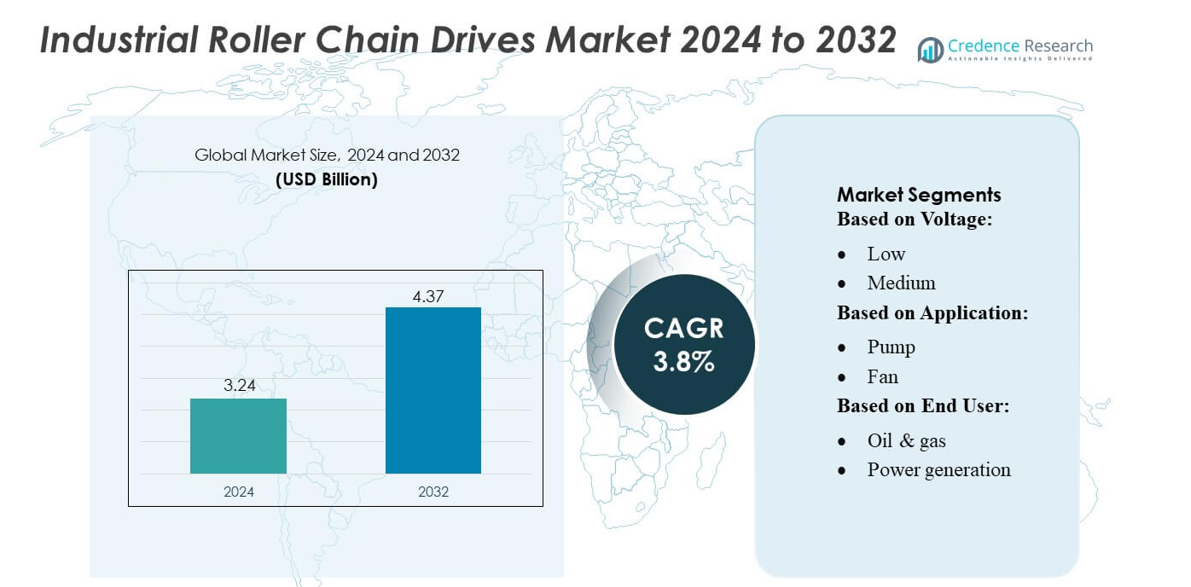
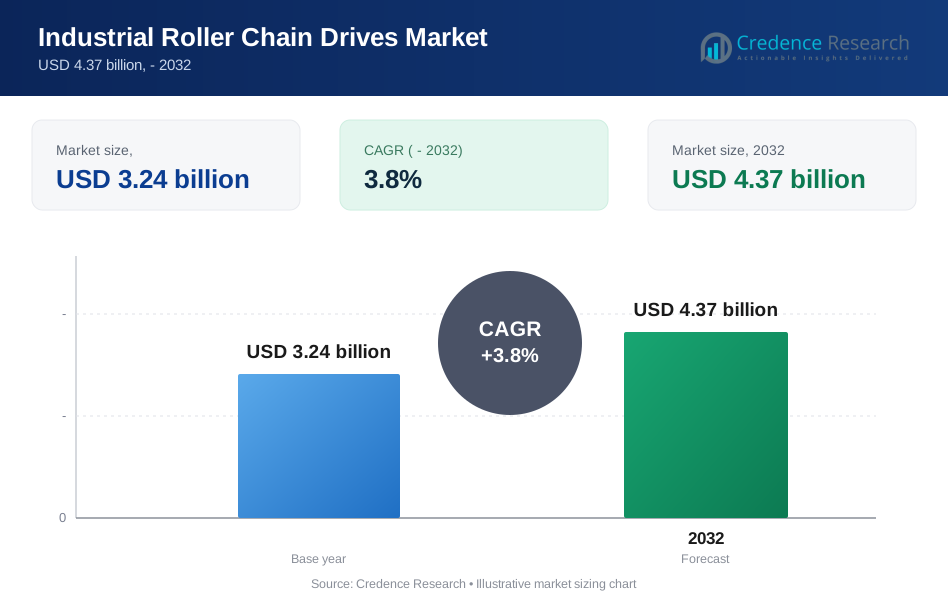
Industrial Roller Chain Drives Market size was valued USD 3.24 billion in 2024 and is anticipated to reach USD 4.37 billion by 2032, at a CAGR of 3.8% during the forecast period.
| REPORT ATTRIBUTE | DETAILS |
|---|---|
| Historical Period | 2020-2023 |
| Base Year | 2024 |
| Forecast Period | 2025-2032 |
| Industrial Roller Chain Drives Market Size 2024 | USD 3.24 billion |
| Industrial Roller Chain Drives Market, CAGR | 3.8% |
| Industrial Roller Chain Drives Market Size 2032 | USD 4.37 billion |
The Industrial Roller Chain Drives Market, including Rockwell Automation, Hitachi, WEG, Schneider Electric, Yaskawa, Danfoss, GE, Eaton, SIEMENS and ABB, consistently drive innovation in chain durability, precision manufacturing, and maintenance-free designs. Among all regions, Asia-Pacific leads with approximately 39 % market share, fueled by booming industrialization, widespread automation adoption, and expansion of heavy-machinery manufacturing. Producers leverage strong regional supply chains and cost-efficient production to deliver high-performance chain drives tailored for automotive, mining, and material-handling industries. This dominant region remains the focal point for global growth, while leading companies compete on quality, customization, and technological improvements to meet escalating demand worldwide.
Market Insights
- The Industrial Roller Chain Drives Market was valued at USD 3.24 billion in 2024 and is projected to reach USD 4.37 billion by 2032, registering a CAGR of 3.8% during the forecast period.
- Market drivers include rising demand for high-durability, low-maintenance chain systems and increased automation adoption across automotive, mining, and manufacturing sectors, enhancing operational efficiency.
- Key market trends highlight innovations in wear-resistant materials, precision-engineered chain designs, and smart monitoring features introduced by companies such as Rockwell Automation, Hitachi, WEG, Schneider Electric, Yaskawa, Danfoss, GE, Eaton, SIEMENS, and ABB.
- Market restraints involve fluctuating raw-material costs, operational challenges in extreme environments, and availability of alternative power-transmission technologies limiting rapid market expansion.
- Asia-Pacific leads regional performance with 39% market share, while heavy-duty and high-load chain segments dominate product adoption due to extensive use in processing, material handling, and heavy machinery applications.
Market Segmentation Analysis:
By Voltage
In the voltage-based segmentation of the industrial roller chain drives market, the low-voltage sub-segment emerges as dominant, capturing roughly 60–65% of the demand. This predominance is driven by the prevalence of small to mid-sized motors and drive systems in standard manufacturing, material handling, and conveyor applications, where low-voltage systems offer safer, cost-effective and easier-to-maintain solutions. Additionally, the broad availability of compatible low-voltage chain-drive systems and minimal infrastructure requirements underpins continued preference for this sub-segment.
- For instance, Rockwell Automation’s Allen-Bradley PowerFlex 525 low-voltage AC drives operate within a 0.4–22 kW power range and support embedded EtherNet/IP connectivity, enabling precise speed control in chain-driven conveyor systems while reducing installation time by up to 70 minutes per drive through their patented slot-based modular design.
By Application
Within the application categories, Conveyor (and general material handling) applications constitute the largest share, estimated around 35–40% of total usage. Roller chain drives are favored in conveyor systems because they deliver consistent, reliable power transmission under continuous duty - an essential requirement for production lines, logistics, and packaging operations. Demand is boosted by increasing automation in manufacturing and warehousing, rising throughput needs, and the need for efficient material flow. Secondary but significant contributions also arise from pump, fan, compressor, extruder and miscellaneous power-transmission uses, though none approach the conveyor sub-segment in scale.
- For instance, Hitachi’s SJ-P1 series industrial inverters, used widely in chain-driven conveyor systems, deliver precise torque control with a 200% overload capacity for 3 seconds and support motor outputs ranging from 0.75 kW up to 160 kW.
By End-User
On the end-user front, the Manufacturing sector (general industrial manufacturing facilities) commands the largest share, roughly in the range of 40–45% of total consumption. This dominance reflects the widespread deployment of roller chain drives across assembly lines, processing equipment, and material handling installations in factories. The growth is primarily driven by rising industrial automation, expansion of production capacities in emerging economies, and continuous modernization and replacement of legacy mechanical systems. Other end-users such as mining & metals, oil & gas, pulp & paper, marine, and miscellaneous industries contribute smaller but steady demand, often for specialized heavy-duty roller chains.
Key Growth Drivers
Rising Automation Across Manufacturing Facilities
The growing adoption of automated production lines across automotive, electronics, packaging, food processing, and general manufacturing sectors significantly accelerates the demand for roller chain drives. Automation initiatives require reliable, high-efficiency power-transmission components capable of operating under continuous duty, variable loads, and harsh conditions. Roller chain drives benefit from their durability, low maintenance frequency, and compatibility with automated conveyor and material-handling systems. As factories upgrade equipment to enhance throughput and reduce downtime, the need for robust mechanical drive systems continues to increase, reinforcing this segment’s expansion.
- For instance, WEG recently launched its W23 Sync+ Ultra IE6 motor, which supports motor outputs from 0.75 to 1250 kW, operates across a speed range of 750 to 6000 rpm, and maintains high efficiency even when load and speed are reduced by 25%, with efficiency losses of less than 2% under such conditions.
Expansion of Material Handling and Logistics Infrastructure
Rapid growth in warehousing, distribution centers, and intralogistics infrastructure is driving considerable consumption of roller chain drives, particularly for conveyor systems, packaging lines, pallet movement, and sorting equipment. The surge in e-commerce and just-in-time delivery models has intensified the requirement for reliable, high-cycle-life chain drives that ensure uninterrupted operations. The focus on increasing automation density within warehouses further boosts the installation of chain-driven conveyors. Continuous investments in fulfillment centers and industrial parks across developing regions strengthen the long-term demand outlook.
- For instance, Schneider Electric’s Altivar 610 series Variable Frequency Drive (VFD) supports motor outputs up to 110 kW (150 HP) and provides a continuous output current of 211 A at 2.5 kHz, with a peak transient current of 260 A for high torque conveyor startup.
Increased Demand from Heavy Industries and Process Sectors
Heavy industries such as mining, cement, steel manufacturing, and petrochemicals increasingly rely on roller chain drives for high-load, high-torque applications including crushers, grinders, conveyors, and process equipment. The drives’ mechanical strength, resistance to abrasion, and ability to operate in dusty, high-temperature, or corrosive environments make them essential components in such sectors. Expansion projects in metals & minerals processing, power generation, and oil & gas infrastructure add to the installation base. Moreover, modernization and replacement cycles for aging mechanical systems enhance recurring demand for premium roller chain solutions.
Key Trends & Opportunities
Adoption of Advanced Materials and Surface Treatments
A key trend shaping market evolution is the increasing use of advanced alloys, corrosion-resistant steels, and specialized surface treatments such as nickel plating, black oxide coating, and hardened bushings. These innovations extend service life, reduce wear, and enhance performance in demanding conditions. Manufacturers also offer lubrication-free and low-noise roller chains that address maintenance-reduction goals in automated plants. The shift toward sustainable and energy-efficient machinery presents opportunities for high-precision, long-life roller chains tailored for modern Industry 4.0-compliant facilities.
- For instance, Danfoss A/S’s VLT® AutomationDrive FC 302 features integrated overload capacity of 150% for 60 seconds, supports motor outputs ranging from 0.25 kW to 1.2 MW, and offers adjustable frequency control from 0.01 Hz to 650 Hz, enabling precise torque management in roller chain-driven conveyor systems.
Growing Integration of Predictive Maintenance and Smart Monitoring
The market is witnessing a rapid rise in predictive-maintenance-enabled chain drive systems, supported by sensors, condition-monitoring devices, and IoT-based analytics platforms. These technologies track vibration, chain elongation, temperature, and lubrication levels to prevent unexpected failures and costly downtime. Companies offering chain drives compatible with digital monitoring gain a competitive advantage, as end-users increasingly seek reliability, serviceability, and lifecycle insights. This trend creates opportunities for OEMs to design smart, retrofittable solutions that align with evolving industrial digitization strategies.
- For instance, Eaton’s PowerXL DG1 drive supports motor outputs from 0.75 kW up to 630 kW, operates across a mains‑voltage range (230 V, 400–500 V, 525–600 V), and remains fully functional in ambient temperatures up to 50 °C without derating.
Strong Opportunities in Emerging Industrial Economies
Expanding manufacturing capacities in Asia-Pacific, the Middle East, Latin America, and parts of Africa present sizable opportunities for roller chain drive suppliers. Rapid industrialization, growth of assembly plants, investment in material-handling systems, and the development of new industrial corridors drive equipment installations. These regions actively upgrade from traditional belt-drive systems to more durable and efficient chain drives. Localized production, cost-effective distribution networks, and aftermarket service support strengthen the opportunity landscape for global and regional manufacturers.
Key Challenges
Competition from Alternative Drive Technologies
Roller chain drives face increasing competition from belt drives, gear drives, and direct-drive systems. Belt drives offer lower noise and reduced lubrication needs, while gear and direct-drive technologies provide high efficiency and minimal maintenance in certain applications. As industries prioritize energy efficiency, noise reduction, and clean operational environments, adoption of alternative drive technologies may limit growth in specific segments. Manufacturers must innovate in low-lubrication designs and precision chains to maintain competitiveness amid the shift toward modern drive solutions.
Maintenance Requirements and Operational Downtime
Regular lubrication, tension adjustment, and periodic replacement are necessary to ensure optimal chain drive performance, which can increase maintenance workloads and operational costs. In high-cycle or high-speed environments, improper upkeep may lead to chain elongation, noise issues, and component failures. Unplanned downtime remains a significant concern, particularly in fully automated production lines where disruptions can be costly. These maintenance-intensive characteristics pose challenges for users moving toward maintenance-free or low-maintenance systems, influencing procurement decisions in advanced manufacturing setups.
Regional Analysis
North America
North America commands a significant position in the Industrial Roller Chain Drives Market, holding an estimated 28–30% market share, driven by strong adoption across automotive manufacturing, packaging machinery, and agricultural equipment. The region benefits from mature industrial automation capabilities and early integration of high-efficiency chain drive systems to enhance equipment reliability. Growth is further supported by continuous investments in maintenance-free and corrosion-resistant chain solutions tailored for harsh operating conditions. The United States leads demand due to extensive production facilities and a sustained shift toward energy-optimized mechanical power transmission components across multiple industrial environments.
Europe
Europe accounts for approximately 24–26% market share, sustained by its advanced manufacturing ecosystem and strict quality standards for industrial components. Countries such as Germany, Italy, and France drive demand through ongoing modernization of heavy machinery, material-handling systems, and food-processing lines. The region emphasizes precision-engineered roller chain drives designed for reduced noise, higher load capacity, and extended service life. Growing investments in Industry 4.0, coupled with the adoption of predictive maintenance and automated lubrication systems, continue to strengthen Europe’s position. Sustainability regulations also encourage the use of environmentally compliant materials and recyclable chain components.
Asia-Pacific
Asia-Pacific leads the Industrial Roller Chain Drives Market with a dominant 38–40% market share, underpinned by rapid industrialization, expansion of manufacturing hubs, and large-scale production of heavy machinery. China, Japan, South Korea, and India collectively drive substantial demand due to high machinery output, rising automation levels, and significant investments in automotive, construction, and industrial processing sectors. The region’s strong supply chain ecosystem supports cost-efficient production and widespread adoption of high-durability chain drives. Continuous capacity expansion in mining, agriculture, and logistics equipment further accelerates growth, establishing Asia-Pacific as the most dynamic and competitive regional market.
Latin America
Latin America captures roughly 6–7% market share, supported by steady demand from agriculture, mining, and general manufacturing industries. Countries such as Brazil, Mexico, and Argentina are increasing their use of robust roller chain drives to enhance productivity in processing plants and material-handling operations. The region benefits from incremental adoption of energy-efficient mechanical transmission systems and growing interest in low-maintenance chain designs suited for dusty or corrosive environments. Although industrial modernization progresses at a gradual pace, rising regional investments in infrastructure, food processing, and automotive assembly continue to stimulate market expansion across Latin America.
Middle East & Africa
The Middle East & Africa region holds an estimated 4–5% market share, driven by expanding industrial bases in sectors such as oil & gas, mining, construction, and heavy equipment manufacturing. Demand centers around high-strength, wear-resistant roller chain drives capable of sustaining extreme temperatures and abrasive operating conditions common across the region. Countries including Saudi Arabia, the UAE, and South Africa are prioritizing upgrades to material-handling systems, processing lines, and industrial machinery. Increasing diversification efforts in non-oil industries and rising automation adoption support moderate yet consistent market growth across this developing region.
Market Segmentations:
By Voltage:
- Low
- Medium
By Application:
- Pump
- Fan
By End User:
- Oil & gas
- Power generation
By Geography
- North America
- U.S.
- Canada
- Mexico
- Europe
- Germany
- France
- U.K.
- Italy
- Spain
- Rest of Europe
- Asia Pacific
- China
- Japan
- India
- South Korea
- South-east Asia
- Rest of Asia Pacific
- Latin America
- Brazil
- Argentina
- Rest of Latin America
- Middle East & Africa
- GCC Countries
- South Africa
- Rest of the Middle East and Africa
Competitive Landscape
The Industrial Roller Chain Drives Market features a highly competitive landscape shaped by leading global automation and power-transmission manufacturers, including Rockwell Automation, Inc., Hitachi, Ltd., WEG S.A., Schneider Electric, Yaskawa Electric Corporation, Danfoss A/S, General Electric Company, Eaton Corporation, SIEMENS AG, and ABB. The Industrial Roller Chain Drives Market reflects a competitive environment characterized by continuous technological enhancement, strong product differentiation, and strategic global expansion. Manufacturers prioritize developing high-strength, wear-resistant chain systems designed for improved load capacity, reduced maintenance needs, and enhanced operational reliability across heavy-duty industrial applications. Innovation focuses on precision engineering, advanced heat-treatment processes, and optimized lubrication mechanisms to boost efficiency and extend service life. Companies increasingly invest in automated production facilities and digital quality-control systems to ensure consistent performance standards. Market participants also strengthen competitiveness through regional distribution networks, aftermarket service initiatives, and product customization tailored to specific industrial equipment requirements, reinforcing long-term customer value and market stability.
Key Player Analysis
- Rockwell Automation, Inc.
- Hitachi, Ltd.
- WEG S.A.
- Schneider Electric
- Yaskawa Electric Corporation
- Danfoss A/S
- General Electric Company
- Eaton Corporation
- SIEMENS AG
- ABB
Recent Developments
- In August 2024, Yaskawa's GA800 variable speed drive is a versatile solution for controlling a wide range of motor technologies, applicable from simple fans and pumps to complex test dynamometers.
- In August 2024, Sprint Electric launched its new Generis AC drive technology which uses a patented switching method to eliminate the need for a DC link. This design enables four-quadrant control as standard, allowing for energy recovery and reducing harmonics. Key benefits include improved efficiency, less heat generation, higher motor precision, a unity power factor, minimal current distortion, and simplified control by removing the need for braking resistors.
- In January 2023, ABB announced the opening of its Mexico technology center for the North American region. The organization initially invested in its New Mexico Technology and Engineering Center (MXTEC) situated in Merida, Yucatan.
Report Coverage
The research report offers an in-depth analysis based on Voltage, Application, End-User and Geography. It details leading market players, providing an overview of their business, product offerings, investments, revenue streams, and key applications. Additionally, the report includes insights into the competitive environment, SWOT analysis, current market trends, as well as the primary drivers and constraints. Furthermore, it discusses various factors that have driven market expansion in recent years. The report also explores market dynamics, regulatory scenarios, and technological advancements that are shaping the industry. It assesses the impact of external factors and global economic changes on market growth. Lastly, it provides strategic recommendations for new entrants and established companies to navigate the complexities of the market.
Future Outlook
- The market will advance through wider adoption of high-efficiency roller chains designed to reduce friction and extend operational lifespan.
- Manufacturers will integrate smart monitoring features that enable predictive maintenance and minimize unplanned machine downtime.
- Material innovations such as advanced alloys and surface treatments will enhance durability and performance in harsh industrial environments.
- Automation growth across manufacturing, logistics, and processing sectors will continue to elevate demand for precision-engineered chain drives.
- Energy-optimized mechanical transmission systems will gain importance as industries prioritize lower power consumption.
- Emerging markets will drive future expansion through rapid industrialization and investments in heavy machinery.
- Customization of chain configurations for specialized equipment will increasingly influence purchasing decisions.
- Sustainability requirements will promote recyclable materials and eco-efficient production processes in chain manufacturing.
- Digital platforms for lifecycle management and remote condition assessment will strengthen aftermarket services.
- Strategic mergers, partnerships, and capacity expansions will shape competitive positioning and accelerate technological innovation.
Request a Free Sample
Fill in your details and we'll send you a free sample report.
- Sample data tables & charts
- Research methodology
Market Dynamics
Rising Automation Across Manufacturing Facilities
The increasing implementation of automated production lines in sectors such as automotive, electronics, packaging, and food processing is driving demand for reliable, high-efficiency roller chain drives. These systems are essential for continuous-duty, variable-load operations and are favored for their durability and compatibility with automated conveyor and material-handling equipment.
Expansion of Material Handling and Logistics Infrastructure
Growth in warehousing, distribution centers, and intralogistics - fueled by e-commerce and just-in-time delivery models - has led to higher consumption of roller chain drives for conveyors, packaging lines, and sorting equipment. The need for high-cycle-life, low-maintenance chain drives is critical to ensure uninterrupted operations in these fast-paced environments.
Increased Demand from Heavy Industries and Process Sectors
Heavy industries such as mining, cement, steel, and petrochemicals require robust roller chain drives for high-load, high-torque applications. The mechanical strength and resistance to harsh environments make these drives indispensable for crushers, grinders, and process equipment, with ongoing modernization and replacement cycles further boosting demand.
Adoption of Advanced Materials and Smart Monitoring
Innovations in wear-resistant materials, corrosion-resistant coatings, and lubrication-free designs are extending the service life and reducing maintenance needs of roller chain drives. Additionally, the integration of predictive maintenance and IoT-based monitoring systems is enhancing reliability and minimizing unplanned downtime, making these solutions more attractive to industrial users.
Rapid Industrialization in Emerging Markets
Asia-Pacific and other emerging regions are experiencing rapid industrial growth, leading to increased investments in manufacturing, heavy machinery, and material-handling infrastructure. This expansion is driving the adoption of high-performance roller chain drives, supported by strong regional supply chains and cost-effective production capabilities.
Need a Custom Version of This Report?
Tailor the scope, geography, or segments to your exact requirements.
- Custom geography or segment scope
- Direct access to our analyst team
Frequently Asked Questions
What is the current market size for the Industrial Roller Chain Drives Market, and what is its projected size in 2032?
At what Compound Annual Growth Rate is the Industrial Roller Chain Drives Market projected to grow between 2025 and 2032?
Who are the major players in this market?
Which Industrial Roller Chain Drives Market segment held the largest share in 2024?
who are the leading companies in the Industrial Roller Chain Drives Market?
Table of Content
Chapter 1 Market Segmentation
- 1.1 Segmentation Framework
- 1.1.1 Product and Service Classification
- 1.1.2 Application and End-Use Classification
- 1.1.3 Technology and Solution Classification
- 1.1.4 Customer and Distribution Channel Classification
- 1.1.5 Geographic Segmentation
- 1.1.6 Market Segment Definitions and Boundaries
- 1.2 By Voltage
- 1.2.1 Low Voltage
- 1.2.2 Medium Voltage
- 1.2.3 High Voltage
- 1.3 By End User
- 1.3.1 Manufacturing
- 1.3.2 Mining & Metals
- 1.3.3 Oil & Gas
- 1.3.4 Power Generation
- 1.3.5 Pulp & Paper
- 1.3.6 Marine
- 1.3.7 Other Industries
- 1.4 By Application
- 1.4.1 Conveyor & Material Handling
- 1.4.2 Pump
- 1.4.3 Fan
- 1.4.4 Compressor
- 1.4.5 Extruder
- 1.4.6 Other Power Transmission
Chapter 2 Introduction
- 2.1 Report Objectives and Scope
- 2.2 Product Definition and Industry Terminology
- 2.3 Market Inclusions and Exclusions
- 2.4 Research Process
- 2.4.1 Primary Research and Expert Interviews
- 2.4.2 Secondary Research and Source Review
- 2.4.3 Top-Down and Bottom-Up Estimation
- 2.4.4 Data Triangulation and Verification
- 2.5 Market Size Measurement Basis
- 2.5.1 2024: USD 3.24 billion → 2032: USD 4.37 billion
- 2.6 Historical and Forecast Reference Periods
- 2.6.1 Base Year: 2024
- 2.6.2 Forecast Period: 2024-2032
- 2.7 Research Assumptions and Limitations
Chapter 3 Executive Summary
- 3.1 Market Snapshot and Key Findings
- 3.2 Base-Year Market Size, 2024
- 3.3 Forecast Market Size, 2032
- 3.4 Revenue and Volume Growth Outlook
- 3.5 Key Demand and Supply Indicators
- 3.6 Leading Market Segments
- 3.7 Fastest-Growing Market Opportunities
- 3.8 Regional Performance Highlights
- 3.9 Technology and Industry Transformation
- 3.10 Competitive Landscape Summary
- 3.11 Analyst View and Strategic Implications
Chapter 4 Global Industrial Roller Chain Drives Market Trends and Developments
- 4.1 Historical Industry Development
- 4.2 Recent Market Trends and Developments
- 4.3 Demand and Customer Behavior Trends
- 4.4 Technology and Product Innovation
- 4.5 Artificial Intelligence, Automation and Digitalization
- 4.6 Local Manufacturing and Supply Chain Realignment
- 4.7 Industry Partnerships, Mergers and Acquisitions
- 4.8 Sustainability and Circular Economy Developments
- 4.9 Government and Private Sector Investment Trends
- 4.10 Emerging Business Models and Commercialization
- 4.11 Industry Developments and Announcements
Chapter 5 Global Industrial Roller Chain Drives Market Production, Supply and Demand Analysis
- 5.1 Demand Trend and Consumption Analysis
- 5.2 Demand Forecast, 2024-2032
- 5.3 Production and Output Trend
- 5.4 Production and Output Forecast, 2024-2032
- 5.5 Installed Capacity and Capacity Utilization
- 5.6 Company-Wise Production Plants and Statistics
- 5.6.1 Installed Production Capacity
- 5.6.2 Actual Production
- 5.6.3 Planned Capacity and Expansion Targets
- 5.7 Supply Chain Structure and Procurement Trends
- 5.8 Supply-Demand Gap and Bottlenecks
- 5.9 Import Dependence and Sourcing Structure
- 5.10 Contract Manufacturing and Outsourcing
- 5.11 Regional Supply and Demand Concentration
Chapter 6 Global Industrial Roller Chain Drives Market Pricing Analysis
- 6.1 Pricing Structure and Measurement
- 6.2 Historical Pricing Trends
- 6.3 Pricing Outlook, 2024-2032
- 6.4 Average Selling Price and Unit Economics
- 6.5 Pricing by Product and Market Segment
- 6.6 Geographic Pricing Differences
- 6.7 Key Input, Energy, Labor and Logistics Costs
- 6.8 Contract Pricing and Purchasing Models
- 6.9 Pricing Sensitivity and Competitive Positioning
- 6.10 Price, Margin and Profitability Implications
Chapter 7 Global Industrial Roller Chain Drives Market Dynamics
- 7.1 Market Growth Drivers
- 7.1.1 Demand-Side Drivers
- 7.1.2 Technology and Innovation Drivers
- 7.1.3 Infrastructure and Investment Drivers
- 7.1.4 Regulatory and Policy Drivers
- 7.2 Market Restraints
- 7.2.1 Cost and Affordability Constraints
- 7.2.2 Technology and Adoption Barriers
- 7.2.3 Supply Chain and Operational Constraints
- 7.3 Market Challenges
- 7.3.1 Competitive Pressure and Margin Erosion
- 7.3.2 Skills, Infrastructure and Implementation Gaps
- 7.4 Emerging Market Opportunities
- 7.5 Market Dynamics Impact and Time-Horizon Assessment
Chapter 8 Global Industrial Roller Chain Drives Value Chain Analysis
- 8.1 Industry Value Chain Overview
- 8.2 Upstream Suppliers and Critical Inputs
- 8.3 Technology and Component Providers
- 8.4 Manufacturing or Service Delivery
- 8.5 Distribution, Channel Partners and Integrators
- 8.6 Downstream Applications and End Users
- 8.7 Value Addition and Profit Pools
- 8.8 Vertical Integration and Outsourcing
- 8.9 Supplier Concentration and Risk
- 8.10 Supply Chain Localization and Resilience
Chapter 9 Global Industrial Roller Chain Drives Market Regulations and Policies
- 9.1 Relevant Laws, Standards and Compliance Frameworks
- 9.2 Product, Service, Safety and Quality Requirements
- 9.3 Government Policies, Incentives and Subsidies
- 9.4 Imports, Exports and Trade Barriers
- 9.5 Public Procurement and Local Content Requirements
- 9.6 Environmental and Sustainability Compliance
- 9.7 Upcoming Policy Changes and Market Implications
Chapter 10 Global Industrial Roller Chain Drives Market Hotspots and Opportunities
- 10.1 Market Opportunity Mapping and Growth Hotspots
- 10.2 High-Growth Applications and Customer Groups
- 10.3 Underserved Markets and White-Space Opportunities
- 10.4 Emerging Technology and Product Opportunities
- 10.5 New Capacity and Investment Hotspots
- 10.6 Market Entry and Expansion Opportunities
- 10.7 Distribution and Partnership Opportunities
- 10.8 Near-Term and Long-Term Commercial Potential
- 10.9 Opportunity Attractiveness and Execution Risks
Chapter 11 Global Industrial Roller Chain Drives Market Outlook, 2024-2032
- 11.1 Market Size and Analysis
- 11.1.1 Revenue (Market Measurement: 2024: USD 3.24 billion → 2032: USD 4.37 billion)
- 11.1.2 Market Volume and Quantity Sold
- 11.1.3 Historical Market Size
- 11.1.4 Base-Year Market Size, 2024
- 11.2 Market Forecast, 2024-2032
- 11.2.1 Revenue Forecast to 2032
- 11.2.2 Volume Forecast to 2032
- 11.2.3 CAGR and Year-on-Year Growth
- 11.2.4 Incremental Revenue Opportunity
- 11.3 Forecast Assumptions and Scenario Analysis
- 11.3.1 Base-Case Forecast
- 11.3.2 Optimistic and Conservative Scenarios
- 11.3.3 Technology, Pricing and Policy Sensitivities
- 11.4 Market Attractiveness and Growth Outlook
Chapter 12 Global Industrial Roller Chain Drives Market Segmentation and Outlook
- 12.1 Segmentation Summary and Market Shares, 2024
- 12.2 Largest and Fastest-Growing Segments
- 12.3 By Voltage - Market Size and Forecast, 2024-2032
- 12.3.1 Segment Definition and Scope
- 12.3.2 Historical Market Size
- 12.3.3 Revenue Forecast, 2024-2032
- 12.3.4 Volume Forecast, 2024-2032
- 12.3.5 Base-Year Market Share, 2024
- 12.3.6 Segment CAGR and Growth Drivers
- 12.3.7 Subsegment Market Size and Forecast
- 12.3.7.1 Low Voltage
- 12.3.7.2 Medium Voltage
- 12.3.7.3 High Voltage
- 12.3.8 Subsegment Pricing and Adoption Trends
- 12.3.9 Leading Suppliers and Competition
- 12.3.10 Regional Demand and Opportunities
- 12.4 By End User - Market Size and Forecast, 2024-2032
- 12.4.1 Segment Definition and Scope
- 12.4.2 Historical Market Size
- 12.4.3 Revenue Forecast, 2024-2032
- 12.4.4 Volume Forecast, 2024-2032
- 12.4.5 Base-Year Market Share, 2024
- 12.4.6 Segment CAGR and Growth Drivers
- 12.4.7 Subsegment Market Size and Forecast
- 12.4.7.1 Manufacturing
- 12.4.7.2 Mining & Metals
- 12.4.7.3 Oil & Gas
- 12.4.7.4 Power Generation
- 12.4.7.5 Pulp & Paper
- 12.4.7.6 Marine
- 12.4.7.7 Other Industries
- 12.4.8 Subsegment Pricing and Adoption Trends
- 12.4.9 Leading Suppliers and Competition
- 12.4.10 Regional Demand and Opportunities
- 12.5 By Application - Market Size and Forecast, 2024-2032
- 12.5.1 Segment Definition and Scope
- 12.5.2 Historical Market Size
- 12.5.3 Revenue Forecast, 2024-2032
- 12.5.4 Volume Forecast, 2024-2032
- 12.5.5 Base-Year Market Share, 2024
- 12.5.6 Segment CAGR and Growth Drivers
- 12.5.7 Subsegment Market Size and Forecast
- 12.5.7.1 Conveyor & Material Handling
- 12.5.7.2 Pump
- 12.5.7.3 Fan
- 12.5.7.4 Compressor
- 12.5.7.5 Extruder
- 12.5.7.6 Other Power Transmission
- 12.5.8 Subsegment Pricing and Adoption Trends
- 12.5.9 Leading Suppliers and Competition
- 12.5.10 Regional Demand and Opportunities
- 12.6 Segment Growth Comparison
- 12.7 Segment Attractiveness and Priority Matrix
Chapter 13 Global Industrial Roller Chain Drives End-Use and Application Market Outlook
- 13.1 End-Use Industry and Customer Demand Structure
- 13.2 Leading Applications and Customer Groups
- 13.3 End-Use Market Size, Share and Forecast
- 13.4 Major End-Use Industry Deep Dives
- 13.4.1 Customer Requirements and Use Cases
- 13.4.2 Demand and Replacement Cycles
- 13.4.3 Technical and Regulatory Considerations
- 13.4.4 Purchasing and Procurement Models
- 13.4.5 Leading Vendors and Distribution Channels
- 13.4.6 Forecast and Commercial Opportunities
- 13.5 Emerging Applications and Cross-Segment Demand
- 13.6 End-Use Industry Investment Priorities
Chapter 14 Global Industrial Roller Chain Drives Geographic Market Outlook, 2024-2032
- 14.1 Regional Market Size and Share, 2024
- 14.2 Regional Market Forecast, 2024-2032
- 14.3 Regional Pricing, Production and Demand Differences
- 14.4 North America
- 14.4.1 United States
- 14.4.2 Canada
- 14.4.3 Mexico
- 14.5 Europe
- 14.5.1 Germany
- 14.5.2 France
- 14.5.3 Italy
- 14.5.4 United Kingdom
- 14.5.5 Spain
- 14.5.6 Poland
- 14.5.7 Russia
- 14.5.8 Netherlands
- 14.5.9 Belgium
- 14.5.10 Sweden
- 14.5.11 Denmark
- 14.5.12 Norway
- 14.5.13 Rest of Europe
- 14.6 Asia Pacific
- 14.6.1 China
- 14.6.2 India
- 14.6.3 Japan
- 14.6.4 South Korea
- 14.6.5 Thailand
- 14.6.6 Indonesia
- 14.6.7 Vietnam
- 14.6.8 Malaysia
- 14.6.9 Australia
- 14.6.10 Rest of Asia Pacific
- 14.7 Latin America
- 14.7.1 Brazil
- 14.7.2 Argentina
- 14.7.3 Colombia
- 14.7.4 Chile
- 14.7.5 Rest of Latin America
- 14.8 Middle East
- 14.8.1 Saudi Arabia
- 14.8.2 United Arab Emirates
- 14.8.3 Turkey
- 14.8.4 Israel
- 14.8.5 Iran
- 14.8.6 Rest of the Middle East
- 14.9 Africa
- 14.9.1 South Africa
- 14.9.2 Egypt
- 14.9.3 Nigeria
- 14.9.4 Morocco
- 14.9.5 Rest of Africa
- 14.10 Regional Investment, Policy and Supply Chain Differences
- 14.11 Regional Competitive Landscape
- 14.12 Geographic Growth Hotspots
Chapter 15 Global Industrial Roller Chain Drives Technology, Innovation and Sustainability Outlook
- 15.1 Technology Landscape and Maturity
- 15.2 Product, Process and Service Innovation
- 15.3 AI, Automation and Digital Tools in the Industry
- 15.4 Technology Adoption and Performance Benchmarking
- 15.5 Innovation Pipeline and R&D Investment
- 15.6 Patent and Intellectual Property Trends
- 15.7 Energy Efficiency and Resource Management
- 15.8 Sustainability, Recycling and Circularity
- 15.9 Technology Roadmap, 2024-2032
- 15.10 Risks of Obsolescence and Technology Substitution
Chapter 16 Global Industrial Roller Chain Drives Market Key Strategic Imperatives
- 16.1 Growth and Market Entry Priorities
- 16.2 High-Return Products and Segments
- 16.3 Pricing, Profitability and Cost Optimization
- 16.4 Technology Investment and Product Differentiation
- 16.5 Supply Chain Localization and Resilience
- 16.6 Distribution and Customer Acquisition
- 16.7 Partnership, Acquisition and Capacity Strategy
- 16.8 Regional Expansion Priorities
- 16.9 Short-, Medium- and Long-Term Actions
Chapter 17 Competition Outlook
- 17.1 Industry Competition Characteristics
- 17.2 Market Structure and Concentration
- 17.3 Market Share and Competitive Positioning, 2024
- 17.4 Company-Wise Revenue and Product Benchmarking
- 17.5 Production and Service Capacity Benchmarking
- 17.6 Technology, Pricing and Differentiation
- 17.7 Regional Footprint and Distribution Strength
- 17.8 Mergers, Acquisitions and Strategic Alliances
- 17.9 New Entrants and Competitive Threats
- 17.10 Porter's Five Forces and Industry Attractiveness
- 17.11 Competitive Outlook, 2024-2032
Chapter 18 Company Profiles
- 18.1 Company Coverage and Selection Criteria
- 18.2 Rockwell Automation
- 18.2.1 Business Description
- 18.2.2 Company Ownership and Geographic Presence
- 18.2.3 Product and Service Portfolio
- 18.2.4 Manufacturing and Operating Footprint
- 18.2.5 Production Capacity and Expansion Plans
- 18.2.6 Financial Performance and Investment
- 18.2.7 Market Share and Competitive Position
- 18.2.8 Technology and Innovation Capabilities
- 18.2.9 Strategic Alliances or Partnerships
- 18.2.10 Recent Developments
- 18.2.11 Growth Strategy and Outlook
- 18.3 Hitachi
- 18.4 WEG
- 18.5 Schneider Electric
- 18.6 Yaskawa
- 18.7 Danfoss
- 18.8 General Electric (GE)
- 18.9 Eaton
- 18.10 SIEMENS
- 18.11 ABB
- 18.12 Other Relevant Market Participants
Note: Every listed company is profiled on the structure shown under the first company. The company list is preliminary and may change based on research findings, market developments, data availability and client requirements.
Chapter 19 Disclaimer
- 19.1 Research and Forecast Disclaimer
- 19.2 Data Source and Estimation Limitations
Note: The depth of individual sections depends on data availability for this market. Volume, capacity, trade and other unit-based metrics are included where applicable.