| REPORT ATTRIBUTE | DETAILS |
|---|---|
| Historical Period | 2020-2023 |
| Base Year | 2024 |
| Forecast Period | 2025-2032 |
| Industrial Scanner Market Size 2024 | USD 4,506.9 million |
| Industrial Scanner Market, CAGR | 6.16% |
| Industrial Scanner Market Size 2032 | USD 7,287.4 million |
Market Overview:
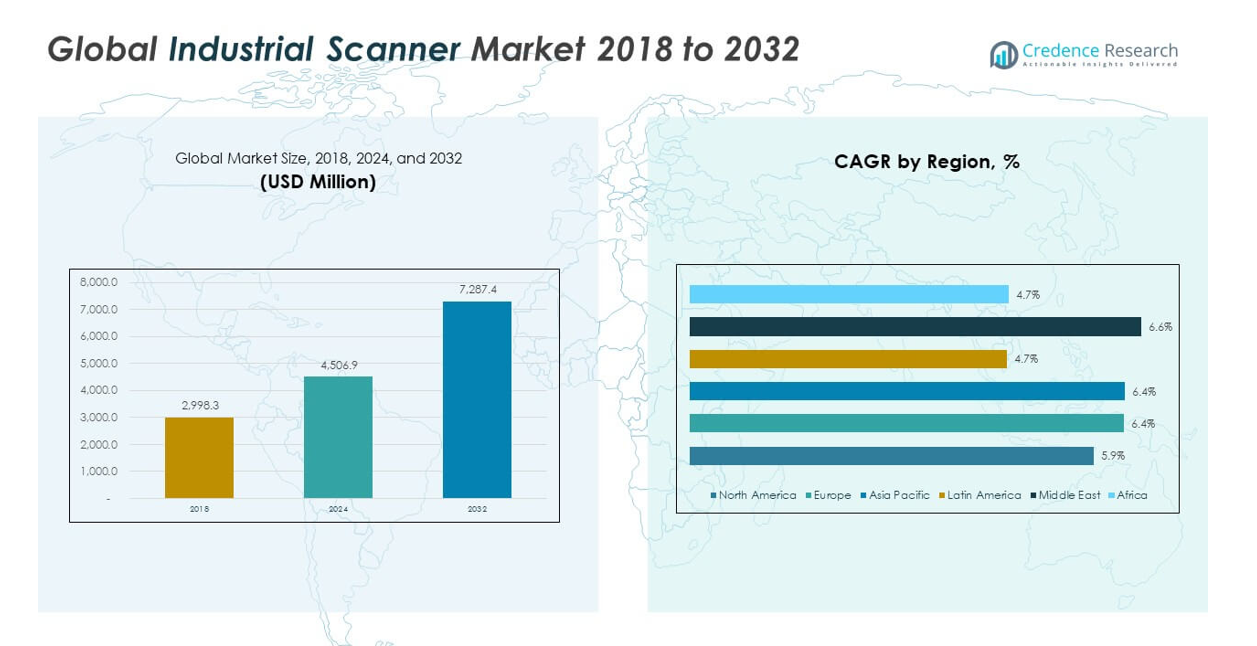
The Industrial Scanner Market size was valued at USD 2,998.3 million in 2018 to USD 4,506.9 million in 2024 and is anticipated to reach USD 7,287.4 million by 2032, at a CAGR of 6.16% during the forecast period.
The industrial scanner market is experiencing strong growth due to the increasing adoption of automation and digital transformation across multiple sectors. Industries such as manufacturing, logistics, retail, healthcare, and e-commerce are rapidly incorporating scanners to improve operational efficiency, reduce errors, and enable real-time tracking. Barcode scanners, including 1D and 2D variants, are extensively used in inventory management and supply chain processes. Technological advancements such as 3D imaging, AI-powered scanning, and IoT connectivity are enhancing the performance of industrial scanners, allowing for faster data capture and improved accuracy in complex environments. The rise of omnichannel retailing and global expansion of online shopping have also increased the need for robust scanning solutions in warehouses and distribution centers.
North America remains the leading region in the industrial scanner market, driven by strong technological infrastructure, widespread automation, and the presence of leading solution providers. The United States plays a key role, with high adoption across manufacturing, logistics, and healthcare sectors. The region’s focus on warehouse automation and the integration of smart technologies boosts demand for advanced scanner systems. Europe follows with steady growth, particularly in Germany, the UK, and France, where Industry 4.0 initiatives and stringent regulatory standards are accelerating scanner deployment. Asia Pacific is emerging as the fastest-growing region, with countries like China, Japan, South Korea, and India investing heavily in manufacturing modernization, e-commerce infrastructure, and digital supply chain solutions. The rapid rise of industrial automation and the presence of major manufacturing hubs further drive adoption. Meanwhile, Latin America and the Middle East & Africa are gradually gaining momentum, supported by increasing industrial development, retail expansion, and infrastructure investments.
Market Insights:
- The Industrial Scanner Market reached USD 4,506.9 million in 2024 and is projected to grow to USD 7,287.4 million by 2032, registering a CAGR of 6.16%.
- Rising automation across manufacturing and logistics is accelerating scanner integration to improve accuracy, workflow efficiency, and real-time data collection.
- Global e-commerce expansion is driving scanner demand in high-volume warehouses, where fast, error-free fulfillment is critical for operational success.
- Advancements in 2D/3D imaging, sensor precision, and IoT connectivity are transforming industrial scanners into intelligent, connected systems.
- Stringent regulations in healthcare, food, and pharmaceuticals are prompting widespread scanner use for traceability, compliance, and quality control.
- High initial costs and integration challenges limit scanner adoption among small and mid-sized enterprises with legacy systems and tight budgets.
- North America leads the market with strong infrastructure and early tech adoption, while Asia Pacific shows the fastest growth due to rapid industrialization and investment in digital supply chains.
Market Drivers:
Automation and Industry 4.0 Adoption Across Manufacturing and Logistics Sectors
The growing emphasis on automation across industrial sectors continues to drive demand for advanced scanning solutions. Manufacturing facilities and logistics providers are integrating scanners into production lines and distribution centers to improve operational accuracy and reduce manual errors. Fixed and handheld industrial scanners play a vital role in tracking components, verifying product integrity, and optimizing workflow efficiency. The move toward Industry 4.0 has created a need for real-time data collection and machine-to-machine communication, where scanners act as a crucial interface. Companies are deploying machine vision and barcode scanning technologies to meet quality assurance and compliance standards. The Industrial Scanner Market benefits directly from this trend by enabling faster and more reliable decision-making in automated environments.
- For example, Datalogic’s latest fixed industrial scanners, such as the Matrix 320, deliver high-resolution image capture with a 16:9 CMOS sensor and achieve read rates of up to 60 frames per second, supporting real-time data collection and machine-to-machine communication essential for automated production lines.
Expansion of Global E-Commerce and Need for Streamlined Fulfillment
The surge in global e-commerce activity has placed new demands on warehouse operations, supply chain management, and last-mile delivery networks. High-volume fulfillment centers require fast, accurate identification systems to process orders efficiently and meet delivery expectations. Scanners are essential tools in this context, facilitating inventory management, item sorting, and shipment validation. It supports growing consumer demand for speed and accuracy, especially in omnichannel retail models. Barcode and RFID scanning technologies allow operators to track goods in real-time and minimize inventory discrepancies. The Industrial Scanner Market is benefiting from this shift by delivering solutions that ensure end-to-end supply chain visibility and operational consistency.
Technological Advancements in Scanning Capabilities and Connectivity
Advances in imaging, sensor technology, and wireless communication have transformed the capabilities of industrial scanners. Modern systems feature enhanced resolution, multi-code recognition, and the ability to function in harsh environments with minimal latency. Integration with IoT platforms and cloud-based systems enables organizations to access, store, and analyze scanned data instantly. It allows businesses to monitor assets remotely, detect anomalies, and respond to changes in real time. The increasing sophistication of 2D and 3D scanners makes them suitable for diverse applications in sectors such as aerospace, automotive, and electronics. These innovations continue to expand the scope and appeal of the Industrial Scanner Market.
Regulatory Compliance, Traceability, and Quality Control Across Industries
Industries with strict regulatory frameworks, such as pharmaceuticals, food and beverage, and healthcare, require precise data capture and product traceability. Scanners help companies meet these requirements by ensuring accurate tracking of batches, expiry dates, and handling records throughout the value chain. In manufacturing, machine vision scanners support automated inspection systems that verify product dimensions, detect defects, and maintain consistent quality standards. It contributes to lower defect rates and higher operational reliability. Compliance-driven demand is pushing organizations to adopt scanners that align with global quality certifications and audit protocols. The Industrial Scanner Market supports these objectives through solutions that meet the technical and regulatory needs of mission-critical operations.
- For example, Datalogic’s latest fixed industrial scanners, such as the Matrix 320, deliver high-resolution image capture with a 16:9 CMOS sensor and achieve read rates of up to 60 frames per second, supporting real-time data collection and machine-to-machine communication essential for automated production lines
Market Trends:
Integration of AI and Machine Vision to Enhance Accuracy and Speed
Artificial intelligence and machine vision technologies are being integrated into industrial scanners to deliver faster and more accurate inspection, identification, and quality control processes. AI-enabled scanners can interpret complex visual data, recognize patterns, and make intelligent decisions without human intervention. These features are especially valuable in high-speed manufacturing and automated assembly lines, where traditional scanning systems may struggle. Machine vision allows scanners to detect micro-defects and ensure consistent product quality across large volumes. The Industrial Scanner Market is leveraging this trend to offer smart systems capable of adapting to varied environments and use cases. It is reshaping workflows by reducing reliance on manual verification and enhancing productivity.
- For example, Zebra Technologies’ FS40 Fixed Industrial Scanner and VS40 Machine Vision Smart Camera offer up to 60 frames per second (FPS) high-contrast barcode reading, with advanced machine vision toolsets that include trainable optical character recognition (OCR), object localization, and flaw detection, all powered by PRZM Intelligent Imaging for “first-time every-time data capture.
Shift Toward Wireless and Mobile Scanning for Greater Flexibility
The market is witnessing a significant shift toward wireless and mobile scanning solutions that offer greater operational flexibility. Portable scanners with Bluetooth, Wi-Fi, or cellular connectivity support real-time data transmission and are ideal for dynamic work environments such as warehouses, retail outlets, and field service operations. Businesses are replacing tethered systems with ergonomic, lightweight devices to enhance worker mobility and reduce physical strain. These advancements also support faster inventory audits, route optimization, and on-the-go product authentication. The Industrial Scanner Market benefits from this mobility trend by meeting the evolving demands of modern logistics and supply chain networks. It allows organizations to scale operations without extensive infrastructure investments.
- For instance, the Delock Industrial Barcode Scanner (Item No. 90556) exemplifies this trend with dual wireless connectivity Bluetooth 4.1 (up to 10 meters) and 2.4 GHz (up to 100 meters) and an inductive charging station that doubles as a data interface.
Growing Demand for 2D and 3D Scanners in Complex Industrial Applications
Industries are increasingly adopting 2D and 3D scanners for applications that require high-resolution imaging and depth perception. 2D scanners remain prevalent in traditional barcode reading but now offer support for more sophisticated symbologies and damaged code recognition. Meanwhile, 3D scanners are gaining traction in sectors such as aerospace, automotive, and electronics for their ability to generate precise spatial measurements and digital twins. It enables accurate modeling, defect analysis, and process optimization. The Industrial Scanner Market is expanding its portfolio with advanced imaging systems that serve both standard and high-precision use cases. It aligns with the industry’s push for tighter tolerances and superior quality assurance.
Increased Adoption of Scanning Solutions in Sustainable Supply Chains
Companies are incorporating scanning technologies to support sustainability initiatives, including waste reduction, energy efficiency, and transparent sourcing. Scanners help track materials, monitor usage, and ensure proper recycling or disposal through detailed documentation. By automating data capture across the supply chain, organizations gain better visibility into environmental performance and compliance. It supports closed-loop systems and product lifecycle assessments. The Industrial Scanner Market plays a strategic role in enabling digital traceability, which is critical for meeting environmental regulations and achieving ESG goals. This trend reinforces the scanner’s value beyond operational efficiency to broader corporate sustainability strategies.
Market Challenges Analysis:
High Implementation Costs and Integration Complexity Limit Adoption
Industrial scanners often require significant upfront investment, especially when integrated with advanced technologies such as machine vision, AI, and IoT platforms. Small and medium-sized enterprises may find it difficult to allocate budget for such systems, which include hardware, software, and training components. Integration with existing infrastructure can pose challenges, particularly in legacy manufacturing environments lacking standardization. Compatibility issues, system downtime during installation, and the need for skilled technicians contribute to increased costs and delays. The Industrial Scanner Market faces barriers when potential users hesitate to commit due to unclear return on investment or lack of internal resources. It must address these issues to expand adoption across smaller industrial setups and price-sensitive regions.
Operational Limitations in Harsh or Variable Working Conditions
Scanners deployed in extreme industrial environments face challenges related to durability, accuracy, and performance consistency. High temperatures, dust, vibrations, and moisture can impact scanner reliability, requiring specialized ruggedized devices that come at a premium. Some scanning technologies may struggle with reflective, damaged, or irregular surfaces, leading to data capture errors and process inefficiencies. Real-time performance can also be compromised in fast-paced environments where lighting or object alignment is suboptimal. The Industrial Scanner Market continues to invest in product enhancements, but technical limitations in harsh settings remain a concern. It must develop more adaptable and fault-tolerant solutions to meet the full spectrum of industrial use cases.
Market Opportunities:
Expansion in Emerging Markets Driven by Industrialization and Digital Transformation
Rapid industrial growth in emerging economies presents strong opportunities for scanner manufacturers. Countries in Asia Pacific, Latin America, and Africa are investing in manufacturing, logistics, and infrastructure modernization, increasing the need for reliable identification and tracking systems. Local enterprises are adopting automation to enhance productivity and reduce human error. The Industrial Scanner Market can benefit from this shift by offering cost-effective, scalable solutions tailored to regional requirements. It also opens avenues for partnerships with local system integrators and distributors. Government incentives supporting digital transformation further accelerate scanner deployment in small and mid-sized industries.
Rising Demand for Custom and Sector-Specific Scanning Solutions
Industry-specific requirements in sectors such as healthcare, aerospace, and food processing are creating demand for specialized scanning technologies. These applications often require high precision, regulatory compliance, and compatibility with industry standards. Customized scanner systems can offer a competitive edge by addressing unique operational challenges. The Industrial Scanner Market has an opportunity to grow by expanding product lines that meet niche technical needs. It can also explore value-added features such as AI-based defect detection, mobile app integration, and data analytics. This approach enhances customer value and promotes long-term adoption.
Market Segmentation Analysis:
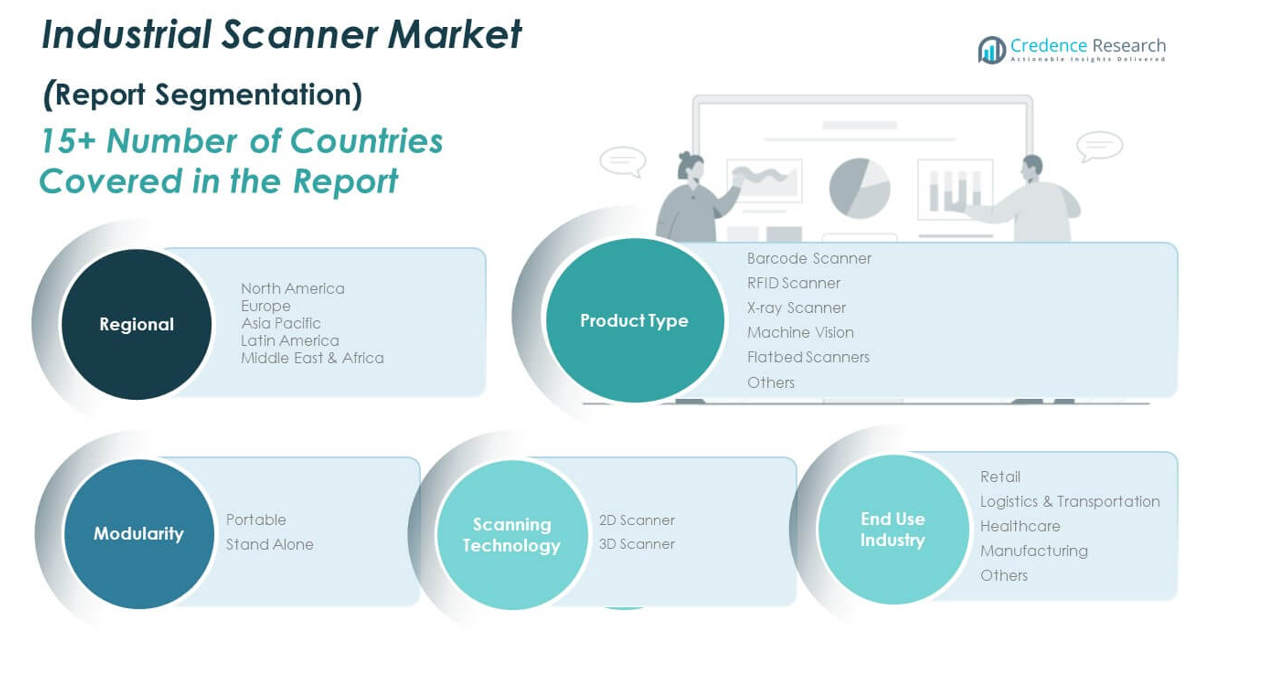
The Industrial Scanner Market is segmented by product type, modularity, scanning technology, and end-user industry.
By product type, barcode scanners dominate due to widespread use in retail and logistics, while RFID scanners are gaining traction in asset tracking applications. X-ray scanners find application in security and quality control, and machine vision systems support automation in manufacturing. Flatbed scanners and other niche technologies address specific documentation and industrial inspection needs.
- Smiths Detection’s HI-SCAN 6040 CTiX is a computed tomography X-ray scanner widely deployed at airport security checkpoints worldwide. According to official product documentation, it is certified for use in aviation security and is capable of screening up to 1,800 bags per hour.
By modularity, portable scanners hold a significant share, driven by demand in mobile inventory management and field operations. Stand-alone systems cater to fixed installations in high-throughput environments like warehouses and production lines.
By scanning technology, 2D scanners lead the market, offering fast and accurate data capture in compact formats. 3D scanners are expanding their footprint in advanced industrial applications requiring detailed spatial analysis and precision.
- For instance, Honeywell’s Granit XP 1990iSR 2D scanner is engineered for demanding industrial and warehouse environments, delivering fast omnidirectional scanning of both 1D and 2D barcodes.
By end-user industry, retail and logistics account for substantial adoption, followed by healthcare and manufacturing, where traceability, compliance, and automation drive scanner integration.
Segmentation:
By Product Type
- Barcode Scanner
- RFID Scanner
- X-ray Scanner
- Machine Vision
- Flatbed Scanners
- Others
By Modularity
- Portable
- Stand Alone
By Scanning Technology
- 2D Scanner
- 3D Scanner
By End-User Industry
- Retail
- Logistics & Transportation
- Healthcare
- Manufacturing
- Others
By Region
- North America
- U.S.
- Canada
- Mexico
- Europe
- Germany
- France
- U.K.
- Italy
- Spain
- Rest of Europe
- Asia Pacific
- China
- Japan
- India
- South Korea
- South-east Asia
- Rest of Asia Pacific
- Latin America
- Brazil
- Argentina
- Rest of Latin America
- Middle East & Africa
- GCC Countries
- South Africa
- Rest of the Middle East and Africa
Regional Analysis:
The North America Industrial Scanner Market size was valued at USD 823.02 million in 2018 to USD 1,222.07 million in 2024 and is anticipated to reach USD 1,943.56 million by 2032, at a CAGR of 5.9% during the forecast period. North America holds a significant share of the Industrial Scanner Market, supported by advanced automation, a robust logistics network, and early adoption of emerging technologies. The United States leads regional demand due to its mature industrial base and strong presence of global scanner manufacturers. High implementation across retail, healthcare, and manufacturing sectors drives recurring demand. It benefits from ongoing investment in AI-integrated scanning solutions and widespread deployment in e-commerce distribution hubs. The region continues to innovate in fixed scanning systems, particularly in warehouse automation. North America accounts for over 28% of global market revenue, reflecting its technological leadership and widespread infrastructure readiness.
The Europe Industrial Scanner Market size was valued at USD 716.28 million in 2018 to USD 1,090.41 million in 2024 and is anticipated to reach USD 1,792.71 million by 2032, at a CAGR of 6.4% during the forecast period. Europe maintains a strong position in the Industrial Scanner Market, driven by regulatory compliance, Industry 4.0 initiatives, and a well-developed industrial ecosystem. Germany, France, and the UK are major contributors, supported by innovation in machine vision and automation. Demand from automotive, food processing, and aerospace sectors remains steady. It supports traceability requirements and advanced quality control in precision manufacturing. The region is also advancing in sustainable supply chain management, increasing reliance on scanning technologies for transparency. Europe represents around 25% of the global market, highlighting its balanced growth across sectors.
The Asia Pacific Industrial Scanner Market size was valued at USD 1,016.41 million in 2018 to USD 1,549.08 million in 2024 and is anticipated to reach USD 2,550.60 million by 2032, at a CAGR of 6.4% during the forecast period. Asia Pacific is the fastest-growing region in the Industrial Scanner Market, fueled by rapid industrialization, expanding e-commerce, and digital infrastructure upgrades. China, Japan, India, and South Korea are leading adopters, with strong investments in smart manufacturing and logistics automation. The region offers cost advantages and large-scale production capacity, driving scanner deployment across end-user industries. It is seeing rising demand for portable and wireless scanners to support dynamic warehouse operations. Government-led digitalization initiatives further expand market opportunities. Asia Pacific holds over 32% of global revenue share, establishing its position as the dominant growth engine.
The Latin America Industrial Scanner Market size was valued at USD 173.30 million in 2018 to USD 241.18 million in 2024 and is anticipated to reach USD 348.34 million by 2032, at a CAGR of 4.7% during the forecast period. Latin America presents a developing opportunity for the Industrial Scanner Market, driven by modernization in retail, transportation, and manufacturing. Brazil and Mexico are key markets, where growing retail chains and logistics operations require efficient scanning solutions. Adoption is rising in food and beverage traceability and healthcare inventory systems. It is challenged by budget constraints and uneven digital infrastructure, which slows widespread deployment. Demand for rugged and low-maintenance scanners is increasing in industrial settings. Latin America contributes roughly 5% to global market revenue, with room for expansion through partnerships and public-sector support.
The Middle East Industrial Scanner Market size was valued at USD 189.79 million in 2018 to USD 293.40 million in 2024 and is anticipated to reach USD 491.90 million by 2032, at a CAGR of 6.6% during the forecast period. The Middle East is experiencing growing adoption of industrial scanners, driven by logistics development, smart city projects, and investment in digital manufacturing. Countries such as the UAE and Saudi Arabia lead regional demand through advanced infrastructure and automation in warehousing. It sees strong growth in healthcare and oil & gas sectors, where scanners support equipment monitoring and compliance. High-speed ports and airports also boost demand for real-time scanning systems. The region is embracing fixed and RFID-based solutions for streamlined operations. The Middle East contributes about 6% of global market revenue, with expansion aligned to national digital transformation goals.
The Africa Industrial Scanner Market size was valued at USD 79.45 million in 2018 to USD 110.74 million in 2024 and is anticipated to reach USD 160.32 million by 2032, at a CAGR of 4.7% during the forecast period. Africa remains an emerging market in the Industrial Scanner sector, with gradual adoption across logistics, retail, and public service sectors. South Africa leads in scanner deployment due to its relatively advanced supply chain and retail infrastructure. It is gaining interest in mobile and portable scanners to support flexible field operations and warehouse activities. Infrastructure limitations and high product costs constrain adoption across many regions. Opportunities lie in localized manufacturing, low-cost hardware, and donor-supported healthcare projects. Africa currently accounts for under 2% of global revenue but holds long-term potential with targeted digital investment.
Key Player Analysis:
- Honeywell International Inc.
- Zebra Technologies Corporation
- Datalogic S.p.A.
- Cognex Corporation
- Keyence Corporation
- SICK AG
- Hexagon AB / Leica Geosystems
- Denso Wave Incorporated
- Newland Auto-ID Tech Co., Ltd.
- Microscan Systems, Inc.
- Olympus Corporation
- GE Measurement & Control
Competitive Analysis:
The Industrial Scanner Market is highly competitive, with key players focusing on technological innovation, product customization, and global expansion. Companies such as Honeywell International, Zebra Technologies, Datalogic, and Cognex Corporation lead the market by offering advanced scanning solutions with AI, machine vision, and IoT integration. It reflects intense competition in sectors like manufacturing, logistics, and retail, where demand for speed and precision drives product differentiation. Keyence Corporation and SICK AG continue to expand their industrial automation portfolios to strengthen market presence. Regional players in Asia and Europe are introducing cost-effective and application-specific devices to capture niche segments. Strategic collaborations, mergers, and new product launches remain central to competitive positioning in this market.
Recent Developments:
- In January 2025, Cognex Corporation introduced its latest AI-powered barcode readers, the DataMan 290 and 390, designed for industrial applications. These devices deliver superior decoding capabilities and intuitive setup, allowing manufacturers to deploy them quickly on production lines. Cognex emphasized their reliability and efficiency in verifying codes on complex parts, reinforcing its leadership in smart barcode technology.
- In May 2025, Cognex announced a strategic partnership with IMA E‑COMMERCE to enhance e-commerce fulfillment. The collaboration integrates Cognex’s In‑Sight vision systems and DataMan barcode readers into IMA’s logistics operations, improving accuracy while reducing packaging waste and supporting sustainability goals
- In June 2025, Cognex launched OneVision™, a cloud-based machine vision platform that simplifies development and deployment of AI-powered inspection systems. The platform aims to lower barriers to automation by enabling seamless integration and scalable AI vision tools, enhancing the Industrial Scanner Market through smarter, more flexible machine vision solutions.
Market Concentration & Characteristics:
The Industrial Scanner Market exhibits moderate to high market concentration, with a few global players dominating in terms of technology leadership and distribution reach. It is characterized by strong emphasis on innovation, reliability, and integration capabilities with automation and enterprise systems. Leading companies maintain competitive advantage through proprietary technologies, broad product portfolios, and established client relationships across industries. The market favors vendors that can offer scalable, customizable solutions tailored to sector-specific needs. It also features growing demand for compact, rugged, and wireless scanning devices suitable for dynamic industrial environments. Entry barriers remain relatively high due to technical complexity, brand recognition, and certification requirements.
Report Coverage:
The research report offers an in-depth analysis based on product type, modularity, scanning technology, and end-user industry. It details leading market players, providing an overview of their business, product offerings, investments, revenue streams, and key applications. Additionally, the report includes insights into the competitive environment, SWOT analysis, current market trends, as well as the primary drivers and constraints. Furthermore, it discusses various factors that have driven market expansion in recent years. The report also explores market dynamics, regulatory scenarios, and technological advancements that are shaping the industry. It assesses the impact of external factors and global economic changes on market growth. Lastly, it provides strategic recommendations for new entrants and established companies to navigate the complexities of the market.
Future Outlook:
- Rising demand for automation across manufacturing and logistics will continue to drive scanner adoption.
- Integration of AI and machine vision will enhance accuracy, speed, and autonomous decision-making.
- E-commerce growth will boost investments in high-performance scanners for inventory and fulfillment.
- Emerging economies will offer expansion opportunities through industrial modernization and digital initiatives.
- Adoption of 3D scanning will increase in sectors requiring high-precision inspection and modeling.
- Demand for mobile and wireless scanners will rise to support flexible, real-time data capture.
- Compliance with traceability and quality standards will encourage scanner deployment in regulated industries.
- Advancements in sensor and imaging technologies will expand application scope and reliability.
- Partnerships between hardware providers and software integrators will accelerate customized solution development.
- Sustainability goals will support scanner use in transparent, resource-efficient supply chains.

Request a Free Sample
Fill in your details and we'll send you a free sample report.
- Sample data tables & charts
- Research methodology
Market Dynamics
Automation and Industry 4.0 Adoption
The push for automation and digital transformation in manufacturing and logistics is driving the integration of industrial scanners to improve operational accuracy, enable real-time data collection, and reduce manual errors. Scanners are essential for tracking components, verifying product integrity, and supporting machine-to-machine communication in automated environments.
Expansion of Global E-Commerce
The rapid growth of e-commerce is increasing the need for fast, accurate scanning solutions in warehouses and distribution centers to ensure efficient inventory management, order fulfillment, and shipment validation. This trend is fueling demand for barcode and RFID scanners that support high-volume, error-free operations.
Technological Advancements in Scanning
Innovations in 2D/3D imaging, sensor precision, and IoT connectivity are enhancing the performance and versatility of industrial scanners. These advancements enable faster, more accurate data capture and allow scanners to function reliably in complex and harsh industrial environments.
Regulatory Compliance and Traceability
Stringent regulations in sectors such as healthcare, food, and pharmaceuticals are prompting widespread adoption of scanners for traceability, compliance, and quality control. Scanners help companies meet regulatory requirements by ensuring accurate tracking of products and batches throughout the supply chain.
Rising Demand for Mobile and Wireless Solutions
The shift toward wireless and portable scanning devices is supporting greater operational flexibility, especially in dynamic environments like warehouses and field operations. Mobile scanners enable real-time data transmission and on-the-go product authentication, meeting the evolving needs of modern supply chains.
Need a Custom Version of This Report?
Tailor the scope, geography, or segments to your exact requirements.
- Custom geography or segment scope
- Direct access to our analyst team
Frequently Asked Questions
What is the current size of the Industrial Scanner Market?
What are the key segments within the Industrial Scanner Market?
What are some challenges faced by the Industrial Scanner Market?
Who are the major players in the Industrial Scanner Market?
Table of Content
Chapter 1 Market Segmentation
- 1.1 Segmentation Framework
- 1.1.1 Product and Service Classification
- 1.1.2 Application and End-Use Classification
- 1.1.3 Technology and Solution Classification
- 1.1.4 Customer and Distribution Channel Classification
- 1.1.5 Geographic Segmentation
- 1.1.6 Market Segment Definitions and Boundaries
- 1.2 By Modularity
- 1.2.1 Portable
- 1.2.2 Stand Alone
- 1.3 By Product Type
- 1.3.1 Barcode Scanner
- 1.3.2 RFID Scanner
- 1.3.3 X-ray Scanner
- 1.3.4 Machine Vision
- 1.3.5 Flatbed Scanners
- 1.3.6 Others
- 1.4 By End-User Industry
- 1.4.1 Retail
- 1.4.2 Logistics & Transportation
- 1.4.3 Healthcare
- 1.4.4 Manufacturing
- 1.4.5 Others
- 1.5 By Scanning Technology
- 1.5.1 2D Scanner
- 1.5.2 3D Scanner
Chapter 2 Introduction
- 2.1 Report Objectives and Scope
- 2.2 Product Definition and Industry Terminology
- 2.3 Market Inclusions and Exclusions
- 2.4 Research Process
- 2.4.1 Primary Research and Expert Interviews
- 2.4.2 Secondary Research and Source Review
- 2.4.3 Top-Down and Bottom-Up Estimation
- 2.4.4 Data Triangulation and Verification
- 2.5 Market Size Measurement Basis
- 2.5.1 2024: USD 4,506.9 million → 2032: USD 7,287.4 million
- 2.6 Historical and Forecast Reference Periods
- 2.6.1 Base Year: 2024
- 2.6.2 Forecast Period: 2024-2032
- 2.7 Research Assumptions and Limitations
Chapter 3 Executive Summary
- 3.1 Market Snapshot and Key Findings
- 3.2 Base-Year Market Size, 2024
- 3.3 Forecast Market Size, 2032
- 3.4 Revenue and Volume Growth Outlook
- 3.5 Key Demand and Supply Indicators
- 3.6 Leading Market Segments
- 3.7 Fastest-Growing Market Opportunities
- 3.8 Regional Performance Highlights
- 3.9 Technology and Industry Transformation
- 3.10 Competitive Landscape Summary
- 3.11 Analyst View and Strategic Implications
Chapter 4 Global Industrial Scanners Market Trends and Developments
- 4.1 Historical Industry Development
- 4.2 Recent Market Trends and Developments
- 4.3 Demand and Customer Behavior Trends
- 4.4 Technology and Product Innovation
- 4.5 Artificial Intelligence, Automation and Digitalization
- 4.6 Local Manufacturing and Supply Chain Realignment
- 4.7 Industry Partnerships, Mergers and Acquisitions
- 4.8 Sustainability and Circular Economy Developments
- 4.9 Government and Private Sector Investment Trends
- 4.10 Emerging Business Models and Commercialization
- 4.11 Industry Developments and Announcements
Chapter 5 Global Industrial Scanners Market Production, Supply and Demand Analysis
- 5.1 Demand Trend and Consumption Analysis
- 5.2 Demand Forecast, 2024-2032
- 5.3 Production and Output Trend
- 5.4 Production and Output Forecast, 2024-2032
- 5.5 Installed Capacity and Capacity Utilization
- 5.6 Company-Wise Production Plants and Statistics
- 5.6.1 Installed Production Capacity
- 5.6.2 Actual Production
- 5.6.3 Planned Capacity and Expansion Targets
- 5.7 Supply Chain Structure and Procurement Trends
- 5.8 Supply-Demand Gap and Bottlenecks
- 5.9 Import Dependence and Sourcing Structure
- 5.10 Contract Manufacturing and Outsourcing
- 5.11 Regional Supply and Demand Concentration
Chapter 6 Global Industrial Scanners Market Pricing Analysis
- 6.1 Pricing Structure and Measurement
- 6.2 Historical Pricing Trends
- 6.3 Pricing Outlook, 2024-2032
- 6.4 Average Selling Price and Unit Economics
- 6.5 Pricing by Product and Market Segment
- 6.6 Geographic Pricing Differences
- 6.7 Key Input, Energy, Labor and Logistics Costs
- 6.8 Contract Pricing and Purchasing Models
- 6.9 Pricing Sensitivity and Competitive Positioning
- 6.10 Price, Margin and Profitability Implications
Chapter 7 Global Industrial Scanners Market Dynamics
- 7.1 Market Growth Drivers
- 7.1.1 Demand-Side Drivers
- 7.1.2 Technology and Innovation Drivers
- 7.1.3 Infrastructure and Investment Drivers
- 7.1.4 Regulatory and Policy Drivers
- 7.2 Market Restraints
- 7.2.1 Cost and Affordability Constraints
- 7.2.2 Technology and Adoption Barriers
- 7.2.3 Supply Chain and Operational Constraints
- 7.3 Market Challenges
- 7.3.1 Competitive Pressure and Margin Erosion
- 7.3.2 Skills, Infrastructure and Implementation Gaps
- 7.4 Emerging Market Opportunities
- 7.5 Market Dynamics Impact and Time-Horizon Assessment
Chapter 8 Global Industrial Scanners Value Chain Analysis
- 8.1 Industry Value Chain Overview
- 8.2 Upstream Suppliers and Critical Inputs
- 8.3 Technology and Component Providers
- 8.4 Manufacturing or Service Delivery
- 8.5 Distribution, Channel Partners and Integrators
- 8.6 Downstream Applications and End Users
- 8.7 Value Addition and Profit Pools
- 8.8 Vertical Integration and Outsourcing
- 8.9 Supplier Concentration and Risk
- 8.10 Supply Chain Localization and Resilience
Chapter 9 Global Industrial Scanners Market Regulations and Policies
- 9.1 Relevant Laws, Standards and Compliance Frameworks
- 9.2 Product, Service, Safety and Quality Requirements
- 9.3 Government Policies, Incentives and Subsidies
- 9.4 Imports, Exports and Trade Barriers
- 9.5 Public Procurement and Local Content Requirements
- 9.6 Environmental and Sustainability Compliance
- 9.7 Upcoming Policy Changes and Market Implications
Chapter 10 Global Industrial Scanners Market Hotspots and Opportunities
- 10.1 Market Opportunity Mapping and Growth Hotspots
- 10.2 High-Growth Applications and Customer Groups
- 10.3 Underserved Markets and White-Space Opportunities
- 10.4 Emerging Technology and Product Opportunities
- 10.5 New Capacity and Investment Hotspots
- 10.6 Market Entry and Expansion Opportunities
- 10.7 Distribution and Partnership Opportunities
- 10.8 Near-Term and Long-Term Commercial Potential
- 10.9 Opportunity Attractiveness and Execution Risks
Chapter 11 Global Industrial Scanners Market Outlook, 2024-2032
- 11.1 Market Size and Analysis
- 11.1.1 Revenue (Market Measurement: 2024: USD 4,506.9 million → 2032: USD 7,287.4 million)
- 11.1.2 Market Volume and Quantity Sold
- 11.1.3 Historical Market Size
- 11.1.4 Base-Year Market Size, 2024
- 11.2 Market Forecast, 2024-2032
- 11.2.1 Revenue Forecast to 2032
- 11.2.2 Volume Forecast to 2032
- 11.2.3 CAGR and Year-on-Year Growth
- 11.2.4 Incremental Revenue Opportunity
- 11.3 Forecast Assumptions and Scenario Analysis
- 11.3.1 Base-Case Forecast
- 11.3.2 Optimistic and Conservative Scenarios
- 11.3.3 Technology, Pricing and Policy Sensitivities
- 11.4 Market Attractiveness and Growth Outlook
Chapter 12 Global Industrial Scanners Market Segmentation and Outlook
- 12.1 Segmentation Summary and Market Shares, 2024
- 12.2 Largest and Fastest-Growing Segments
- 12.3 By Modularity - Market Size and Forecast, 2024-2032
- 12.3.1 Segment Definition and Scope
- 12.3.2 Historical Market Size
- 12.3.3 Revenue Forecast, 2024-2032
- 12.3.4 Volume Forecast, 2024-2032
- 12.3.5 Base-Year Market Share, 2024
- 12.3.6 Segment CAGR and Growth Drivers
- 12.3.7 Subsegment Market Size and Forecast
- 12.3.7.1 Portable
- 12.3.7.2 Stand Alone
- 12.3.8 Subsegment Pricing and Adoption Trends
- 12.3.9 Leading Suppliers and Competition
- 12.3.10 Regional Demand and Opportunities
- 12.4 By Product Type - Market Size and Forecast, 2024-2032
- 12.4.1 Segment Definition and Scope
- 12.4.2 Historical Market Size
- 12.4.3 Revenue Forecast, 2024-2032
- 12.4.4 Volume Forecast, 2024-2032
- 12.4.5 Base-Year Market Share, 2024
- 12.4.6 Segment CAGR and Growth Drivers
- 12.4.7 Subsegment Market Size and Forecast
- 12.4.7.1 Barcode Scanner
- 12.4.7.2 RFID Scanner
- 12.4.7.3 X-ray Scanner
- 12.4.7.4 Machine Vision
- 12.4.7.5 Flatbed Scanners
- 12.4.7.6 Others
- 12.4.8 Subsegment Pricing and Adoption Trends
- 12.4.9 Leading Suppliers and Competition
- 12.4.10 Regional Demand and Opportunities
- 12.5 By End-User Industry - Market Size and Forecast, 2024-2032
- 12.5.1 Segment Definition and Scope
- 12.5.2 Historical Market Size
- 12.5.3 Revenue Forecast, 2024-2032
- 12.5.4 Volume Forecast, 2024-2032
- 12.5.5 Base-Year Market Share, 2024
- 12.5.6 Segment CAGR and Growth Drivers
- 12.5.7 Subsegment Market Size and Forecast
- 12.5.7.1 Retail
- 12.5.7.2 Logistics & Transportation
- 12.5.7.3 Healthcare
- 12.5.7.4 Manufacturing
- 12.5.7.5 Others
- 12.5.8 Subsegment Pricing and Adoption Trends
- 12.5.9 Leading Suppliers and Competition
- 12.5.10 Regional Demand and Opportunities
- 12.6 By Scanning Technology - Market Size and Forecast, 2024-2032
- 12.6.1 Segment Definition and Scope
- 12.6.2 Historical Market Size
- 12.6.3 Revenue Forecast, 2024-2032
- 12.6.4 Volume Forecast, 2024-2032
- 12.6.5 Base-Year Market Share, 2024
- 12.6.6 Segment CAGR and Growth Drivers
- 12.6.7 Subsegment Market Size and Forecast
- 12.6.7.1 2D Scanner
- 12.6.7.2 3D Scanner
- 12.6.8 Subsegment Pricing and Adoption Trends
- 12.6.9 Leading Suppliers and Competition
- 12.6.10 Regional Demand and Opportunities
- 12.7 Segment Growth Comparison
- 12.8 Segment Attractiveness and Priority Matrix
Chapter 13 Global Industrial Scanners End-Use and Application Market Outlook
- 13.1 End-Use Industry and Customer Demand Structure
- 13.2 Leading Applications and Customer Groups
- 13.3 End-Use Market Size, Share and Forecast
- 13.4 Major End-Use Industry Deep Dives
- 13.4.1 Customer Requirements and Use Cases
- 13.4.2 Demand and Replacement Cycles
- 13.4.3 Technical and Regulatory Considerations
- 13.4.4 Purchasing and Procurement Models
- 13.4.5 Leading Vendors and Distribution Channels
- 13.4.6 Forecast and Commercial Opportunities
- 13.5 Emerging Applications and Cross-Segment Demand
- 13.6 End-Use Industry Investment Priorities
Chapter 14 Global Industrial Scanners Geographic Market Outlook, 2024-2032
- 14.1 Regional Market Size and Share, 2024
- 14.2 Regional Market Forecast, 2024-2032
- 14.3 Regional Pricing, Production and Demand Differences
- 14.4 North America
- 14.4.1 United States
- 14.4.2 Canada
- 14.4.3 Mexico
- 14.5 Europe
- 14.5.1 Germany
- 14.5.2 France
- 14.5.3 Italy
- 14.5.4 United Kingdom
- 14.5.5 Spain
- 14.5.6 Poland
- 14.5.7 Russia
- 14.5.8 Netherlands
- 14.5.9 Belgium
- 14.5.10 Sweden
- 14.5.11 Denmark
- 14.5.12 Norway
- 14.5.13 Rest of Europe
- 14.6 Asia Pacific
- 14.6.1 China
- 14.6.2 India
- 14.6.3 Japan
- 14.6.4 South Korea
- 14.6.5 Thailand
- 14.6.6 Indonesia
- 14.6.7 Vietnam
- 14.6.8 Malaysia
- 14.6.9 Australia
- 14.6.10 Rest of Asia Pacific
- 14.7 Latin America
- 14.7.1 Brazil
- 14.7.2 Argentina
- 14.7.3 Colombia
- 14.7.4 Chile
- 14.7.5 Rest of Latin America
- 14.8 Middle East
- 14.8.1 Saudi Arabia
- 14.8.2 United Arab Emirates
- 14.8.3 Turkey
- 14.8.4 Israel
- 14.8.5 Iran
- 14.8.6 Rest of the Middle East
- 14.9 Africa
- 14.9.1 South Africa
- 14.9.2 Egypt
- 14.9.3 Nigeria
- 14.9.4 Morocco
- 14.9.5 Rest of Africa
- 14.10 Regional Investment, Policy and Supply Chain Differences
- 14.11 Regional Competitive Landscape
- 14.12 Geographic Growth Hotspots
Chapter 15 Global Industrial Scanners Technology, Innovation and Sustainability Outlook
- 15.1 Technology Landscape and Maturity
- 15.2 Product, Process and Service Innovation
- 15.3 AI, Automation and Digital Tools in the Industry
- 15.4 Technology Adoption and Performance Benchmarking
- 15.5 Innovation Pipeline and R&D Investment
- 15.6 Patent and Intellectual Property Trends
- 15.7 Energy Efficiency and Resource Management
- 15.8 Sustainability, Recycling and Circularity
- 15.9 Technology Roadmap, 2024-2032
- 15.10 Risks of Obsolescence and Technology Substitution
Chapter 16 Global Industrial Scanners Market Key Strategic Imperatives
- 16.1 Growth and Market Entry Priorities
- 16.2 High-Return Products and Segments
- 16.3 Pricing, Profitability and Cost Optimization
- 16.4 Technology Investment and Product Differentiation
- 16.5 Supply Chain Localization and Resilience
- 16.6 Distribution and Customer Acquisition
- 16.7 Partnership, Acquisition and Capacity Strategy
- 16.8 Regional Expansion Priorities
- 16.9 Short-, Medium- and Long-Term Actions
Chapter 17 Competition Outlook
- 17.1 Industry Competition Characteristics
- 17.2 Market Structure and Concentration
- 17.3 Market Share and Competitive Positioning, 2024
- 17.4 Company-Wise Revenue and Product Benchmarking
- 17.5 Production and Service Capacity Benchmarking
- 17.6 Technology, Pricing and Differentiation
- 17.7 Regional Footprint and Distribution Strength
- 17.8 Mergers, Acquisitions and Strategic Alliances
- 17.9 New Entrants and Competitive Threats
- 17.10 Porter's Five Forces and Industry Attractiveness
- 17.11 Competitive Outlook, 2024-2032
Chapter 18 Company Profiles
- 18.1 Company Coverage and Selection Criteria
- 18.2 Honeywell International Inc.
- 18.2.1 Business Description
- 18.2.2 Company Ownership and Geographic Presence
- 18.2.3 Product and Service Portfolio
- 18.2.4 Manufacturing and Operating Footprint
- 18.2.5 Production Capacity and Expansion Plans
- 18.2.6 Financial Performance and Investment
- 18.2.7 Market Share and Competitive Position
- 18.2.8 Technology and Innovation Capabilities
- 18.2.9 Strategic Alliances or Partnerships
- 18.2.10 Recent Developments
- 18.2.11 Growth Strategy and Outlook
- 18.3 Zebra Technologies Corporation
- 18.4 Datalogic S.p.A.
- 18.5 Cognex Corporation
- 18.6 Keyence Corporation
- 18.7 SICK AG
- 18.8 Hexagon AB
- 18.9 Denso Wave Incorporated
- 18.10 Newland Auto-ID Tech Co., Ltd.
- 18.11 Microscan Systems, Inc.
- 18.12 Other Relevant Market Participants
Note: Every listed company is profiled on the structure shown under the first company. The company list is preliminary and may change based on research findings, market developments, data availability and client requirements.
Chapter 19 Disclaimer
- 19.1 Research and Forecast Disclaimer
- 19.2 Data Source and Estimation Limitations
Note: The depth of individual sections depends on data availability for this market. Volume, capacity, trade and other unit-based metrics are included where applicable.