
Market Overview
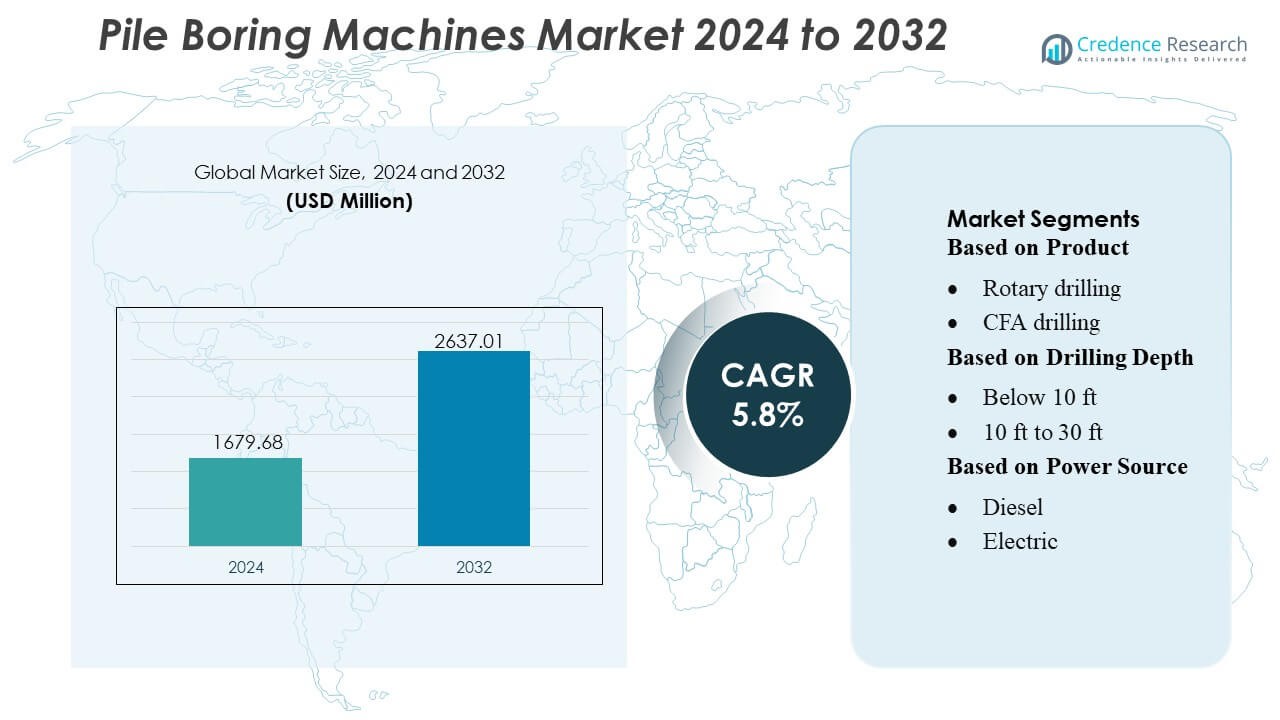
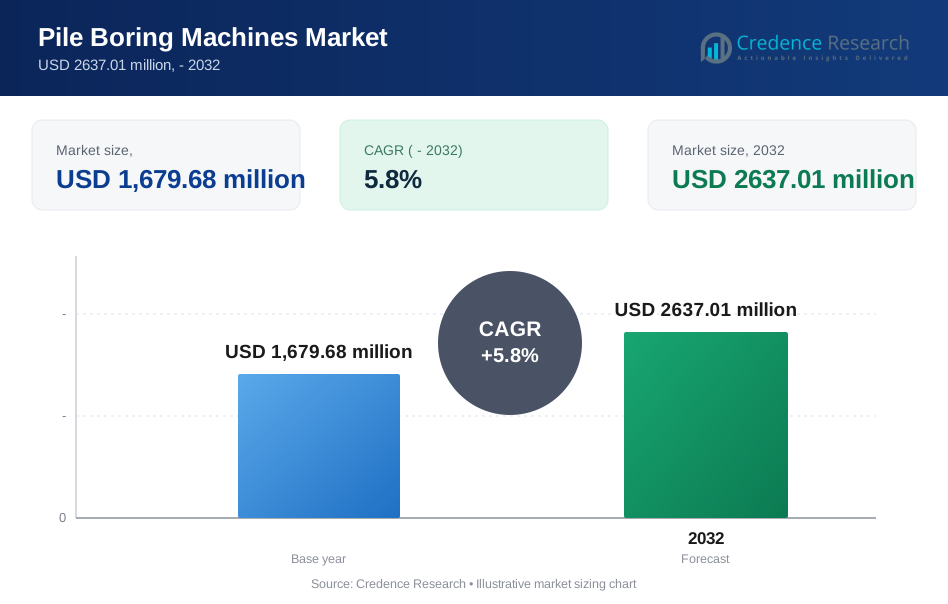
Pile Boring Machines Market size was valued USD 1679.68 million in 2024 and is anticipated to reach USD 2637.01 million by 2032, at a CAGR of 5.8% during the forecast period.
| REPORT ATTRIBUTE | DETAILS |
|---|---|
| Historical Period | 2020-2023 |
| Base Year | 2024 |
| Forecast Period | 2025-2032 |
| Pile Boring Machines Market Size 2024 | USD 1679.68 Million |
| Pile Boring Machines Market, CAGR | 5.8% |
| Pile Boring Machines Market Size 2032 | USD 2637.01 Million |
The Pile Boring Machines Market features a competitive environment shaped by global manufacturers that prioritize high-torque drilling systems, automation, and durable components to support large-scale infrastructure and high-rise development. Companies focus on expanding product portfolios that improve drilling precision, enhance fuel efficiency, and reduce vibration to meet diverse soil and depth requirements. Technological integration, including telematics and real-time monitoring, strengthens equipment reliability and job-site productivity. North America leads the global market with an exact 38% share, supported by strong construction activity, advanced machinery adoption, and sustained investment in transportation, commercial, and energy-related foundation projects.
Market Insights
- The Pile Boring Machines Market reached USD 1679.68 million in 2024 and is projected to hit USD 2637.01 million by 2032 at a 5.8% CAGR, reflecting steady demand across infrastructure and commercial construction.
- Market growth is driven by rising investments in high-rise buildings, transportation corridors, and deeper foundation requirements, strengthening adoption of rotary and CFA drilling systems with strong segment preference toward the 10 ft to 30 ft depth range.
- Advanced technologies such as automation, telematics, and real-time monitoring elevate equipment efficiency and reinforce the competitive landscape as manufacturers enhance durability and drilling accuracy.
- Key restraints include high equipment acquisition costs, complex maintenance needs, and operational challenges in urban zones with noise, emission, and vibration restrictions.
- Regionally, North America leads with a 38% share, followed by Europe and Asia-Pacific, supported by strong construction activity and growing demand for high-capacity, fuel-efficient piling equipment across diverse soil conditions.
Market Segmentation Analysis:
By Product
The product landscape of the Pile Boring Machines Market is led by rotary drilling, capturing the dominant share due to its versatility across infrastructure, commercial, and deep-foundation projects. Its ability to handle various soil conditions and deliver high torque output strengthens adoption in large bridge, metro, and high-rise construction. Demand accelerates as contractors prioritize equipment that supports faster penetration rates, reduced vibration, and compatibility with large-diameter piles. CFA drilling and micro piling follow, supported by urban redevelopment and low-noise site requirements, while hydraulic pile driving and Kelly drilling maintain niche roles in specialized geotechnical applications.
- For instance, Revlon established a 62,000-square-foot innovation center in Kenilworth, New Jersey, relocating its research and development operations to the Northeast Science and Technology (NEST) Center.
By Drilling Depth
The 10 ft to 30 ft depth segment holds the highest market share, driven by its widespread relevance in mid-depth foundation works for industrial facilities, housing projects, and transport infrastructure. Contractors prefer machines optimized for this range because they balance operational efficiency, fuel consumption, and equipment maneuverability, especially in congested urban sites. Growing global investments in road expansions, utility networks, and modular construction further increase demand. Below 10 ft machines remain essential for light civil works, while above 30 ft equipment gains traction in mega-projects requiring deep load-bearing foundations.
- For instance, Johnson & Johnson’s consumer health division revealed 16 new skincare research studies at the 2021 American Academy of Dermatology Virtual Meeting. The presentations, which included 3 oral publications and 13 poster presentations, highlighted targeted innovation in various aspects of skin health, including for women, cancer patients, and multicultural populations.
By Power Source
Diesel-powered machines dominate the market with the largest share, supported by their high power output, suitability for continuous heavy-duty cycles, and reliability in remote or off-grid construction zones. Their strong penetration in developing economies, where electrification of job sites remains limited, reinforces segment leadership. Demand persists across large infrastructure programs, including highways, ports, and mining-related piling tasks. Electric and hydraulic power sources are expanding steadily as contractors adopt lower-emission and precision-controlled alternatives, while hybrid solutions and other emerging technologies gain interest in projects prioritizing sustainability and reduced operating noise.
Key Growth Drivers
- Surge in Global Infrastructure Development Large-scale infrastructure programs accelerate demand for pile boring machines as governments expand transportation corridors, smart cities, and energy facilities. Growing investments in bridges, metro systems, and industrial zones increase the need for high-capacity equipment capable of delivering deeper and more precise foundations. Contractors prefer machines that support faster cycle times, larger pile diameters, and reduced downtime, strengthening procurement across both developed and emerging economies. The transition toward resilient and climate-ready infrastructure further reinforces sustained equipment adoption.
- For instance, FOREO LUNA 4 cleansing device integrates 16 T-Sonic pulsation intensities and ultra-hygienic silicone touchpoints. It offers up to 600 uses per full charge, improving both cleansing precision and user longevity.
- Growing Urbanization and High-Rise Construction Rapid urbanization increases the construction of high-rise residential towers, commercial buildings, and mixed-use complexes, driving demand for advanced piling equipment that can operate efficiently in restricted urban footprints. Machines with compact designs, low-vibration systems, and enhanced drilling accuracy gain strong preference. The need for deeper load-bearing foundations in seismic or unstable soil zones accelerates adoption of rotary and CFA drilling systems. Continuous redevelopment of aging urban infrastructure further amplifies the requirement for reliable and high-performance pile boring technologies.
- For instance, L’Oréal’s new North America Research & Innovation Center spans 250,000 sq ft and houses a 26,000 sq ft modular lab, on-site mini factory, and capacity for daily user testing with up to 400 consumers.
- Advancements in Drilling Technology and Automation Technological advancements significantly boost market growth as manufacturers integrate automation, telematics, and real-time monitoring systems into modern pile boring machines. Features such as automated drilling control, torque optimization, and predictive maintenance improve productivity and reduce operational errors. High-efficiency hydraulic systems, reduced-emission engines, and modular attachment designs enhance machine versatility across diverse soil conditions. Contractors embrace these innovations to improve safety, reduce fuel consumption, and optimize project timelines, supporting rapid technological adoption across global job sites.
Key Trends & Opportunities
- Rising Adoption of Low-Emission and Electric Piling Equipment Sustainability-focused regulations and green construction initiatives drive strong interest in electric and hybrid pile boring machines. Contractors increasingly evaluate low-noise, low-emission alternatives for metro corridors, urban redevelopment zones, and environmentally sensitive projects. Battery-powered systems and energy-efficient hydraulic drives create opportunities for manufacturers to tap into emerging eco-friendly equipment portfolios. As cities tighten emission norms, demand grows for machines that can comply with Tier 4 and Stage V standards while maintaining drilling power and operational reliability.
- For instance, Krones has deployed remote service over more than 20,000 machines worldwide via the CENTERSIGHT / Device Insight platform, enabling remote diagnostics and legally compliant access logging.
- Expansion of Smart Job-Site Integration The integration of digital technologies—such as GPS-based positioning, IoT-enabled performance tracking, and automated depth logging—creates opportunities for enhanced job-site efficiency. These tools help contractors monitor productivity, optimize drilling parameters, and reduce human error. Increasing adoption of BIM-linked drilling data and remote diagnostics enables better project planning and faster troubleshooting. As large contractors prioritize connected equipment ecosystems, demand rises for pile boring machines that seamlessly integrate with digital construction workflows.
- For instance, PackSys Global is known for building modular machines and configurable lines. The Mini 300 is a specific tube production line offered by the company. The Mini 300 line has a "remarkable production capacity of 300 tubes per minute" for small-diameter laminate tubes.
- Growth in Underground Utility and Renewable Energy Projects Expanding underground utilities, such as water pipelines, grid modernization, and fiber networks, generates new applications for compact and mid-depth pile boring machines. Wind farms, solar parks, and substation installations also require stable foundations, creating opportunities for specialized drilling systems. Rising investment in renewable energy infrastructure strengthens the market for machines capable of operating in mixed terrains and remote locations, particularly in Asia-Pacific, Europe, and North America.
Key Challenges
- High Equipment Costs and Maintenance Burden Pile boring machines require substantial capital investment, which limits adoption among small and mid-sized contractors. High maintenance needs—especially for engines, hydraulic systems, and wear-intensive drill components—further increase ownership costs. Unpredictable construction cycles and fluctuating raw material prices strain financial planning for equipment fleets. These cost pressures often push contractors toward rentals rather than new equipment purchases, constraining market expansion.
- Operational Constraints in Urban and Sensitive Environments Urban construction zones impose strict limitations related to noise, vibration, emissions, and space availability, creating operational challenges for traditional piling machines. Regulatory restrictions and community-impact concerns can delay or restrict drilling activities. Soil variability under dense cityscapes further complicates performance predictability, necessitating specialized attachments and advanced controls. Contractors face productivity losses when navigating these constraints, increasing demand for specialized low-vibration, compact, and environmentally compliant machines while challenging legacy equipment deployment.
Regional Analysis
North America
North America holds the leading position in the Pile Boring Machines Market with around 38% market share, supported by extensive investments in transportation upgrades, energy infrastructure, and commercial construction across the U.S. and Canada. Strong adoption of advanced rotary and CFA drilling systems reflects the region’s focus on high-efficiency equipment and strict compliance with emission and safety regulations. Manufacturers benefit from high procurement capacity among large contractors, while redevelopment of aging bridges, rail corridors, and utility networks strengthens long-term demand. Technological integration—such as telematics and automated drilling controls—further accelerates market expansion across major metropolitan construction zones.
Europe
Europe accounts for approximately 27% market share, driven by stringent sustainability regulations, rapid urban redevelopment, and expansion of underground utility networks. Countries across Western and Northern Europe prioritize low-emission and low-noise pile boring machines to align with environmental standards and urban construction requirements. The region’s strong engineering expertise supports adoption of advanced hydraulic and electric-powered systems in large civil works, including tunnels, metro lines, and renewable-energy foundations. Growth is reinforced by public investments in smart infrastructure and cross-border transport corridors, which create consistent demand for high-precision, noise-controlled piling technologies in densely populated environments.
Asia-Pacific
Asia-Pacific represents about 24% of the global market, driven by rapid urbanization, mega-infrastructure development, and large-scale residential and industrial construction across China, India, Japan, and Southeast Asia. High demand for deep foundations in high-rise structures, port expansions, and transportation megaprojects boosts adoption of rotary and Kelly drilling systems. Infrastructure initiatives such as economic corridors, metro networks, and renewable-energy installations further stimulate procurement. Competitive pricing, a strong contractor ecosystem, and increasing availability of high-capacity diesel and hydraulic machines position the region as the fastest-growing market, supported by rising foreign investments and government-backed construction programs.
Latin America
Latin America holds nearly 7% market share, supported by infrastructure modernization efforts across Brazil, Mexico, Chile, and Colombia. Rising investments in mining operations, road connectivity, and industrial facilities drive the need for durable and high-torque pile boring machines capable of operating in challenging terrain. Governments’ focus on improving logistics networks and port infrastructure enhances adoption of mid-depth and deep drilling systems. Market growth is steady but constrained by economic fluctuations and varying construction budgets. Nonetheless, expanding urban populations and increasing public-private partnerships create opportunities for contractors to deploy advanced piling technologies in key development zones.
Middle East & Africa
The Middle East & Africa region accounts for around 4% market share, supported by significant foundation requirements for large commercial complexes, energy facilities, and transportation infrastructure. In the Middle East, high-rise towers, smart cities, and industrial free zones drive consistent demand for high-capacity rotary and CFA machines. Africa experiences gradual growth through road, bridge, and utilities development fueled by international investments. Harsh soil conditions, remote project locations, and high equipment import costs challenge faster penetration, yet rising interest in durable, diesel-powered, and hybrid systems supports future market expansion across strategic construction corridors.
Market Segmentations:
By Product
- Rotary drilling
- CFA drilling
By Drilling Depth
- Below 10 ft
- 10 ft to 30 ft
By Power Source
- Diesel
- Electric
By Geography
- North America
- U.S.
- Canada
- Mexico
- Europe
- Germany
- France
- U.K.
- Italy
- Spain
- Rest of Europe
- Asia Pacific
- China
- Japan
- India
- South Korea
- South-east Asia
- Rest of Asia Pacific
- Latin America
- Brazil
- Argentina
- Rest of Latin America
- Middle East & Africa
- GCC Countries
- South Africa
- Rest of the Middle East and Africa
Competitive Landscape
The competitive landscape of the Pile Boring Machines players such as HEUFT Systemtechnik GmbH, Keyence Corporation, Anritsu Corporation, Körber AG, Cognex Corporation, Ishida Co., Ltd., Mettler-Toledo International Inc., ANTERAS VISION, ACG Group, and Omron Corporation. the Pile Boring Machines Market is shaped by manufacturers focusing on advanced drilling efficiency, precision control, and equipment durability to meet the demands of modern infrastructure and high-rise construction projects. Companies emphasize innovations in high-torque rotary systems, automated depth control, low-vibration mechanisms, and energy-efficient powertrains that improve operational accuracy and reduce downtime. The market also benefits from the growing integration of telematics, real-time diagnostics, and safety-enhancing features that support productivity in complex soil conditions and dense urban environments. Competitive differentiation increasingly centers on product reliability, customization options, and after-sales service networks that enable contractors to optimize performance and extend equipment life cycles.
Key Player Analysis
- HEUFT Systemtechnik GmbH
- Keyence Corporation
- Anritsu Corporation
- Körber AG
- Cognex Corporation
- Ishida Co., Ltd.
- Mettler-Toledo International Inc.
- ANTERAS VISION
- ACG Group
- Omron Corporation
Recent Developments
- In November 2024, Mindray introduced innovative upgrades to its A7 and A5 anesthesia systems under the A series anesthesia, incorporating cutting-edge technologies to empower anesthesiologists in delivering precise anesthesia, ultimately enhancing patient safety and operational efficiency during the perioperative phase.
- In September 2024, Okuma America Corporation launched CNC horizontal machining centers – the MA-4000H. The MA-4000H features one of the largest machining areas and has spindle power and speed for maximum efficiency and productivity.
- In May 2024, Walker's Shortbread launched the world's first interactive shortbread vending machine at Edinburgh Airport, partnering with World Duty Free (Avolta), allowing passengers to take a quiz to find their perfect shortbread for any occasion, offering a unique, sensory Scottish experience.
- In April 2024, Dispension Industries Inc. announced the launch of the contour top SmartServ. This is a specialized vending machine designed for selling beer and ready-to-drink (RTD) alcoholic beverages.
Report Coverage
The research report offers an in-depth analysis based on Product, Drilling Depth, Power Source and Geography. It details leading market players, providing an overview of their business, product offerings, investments, revenue streams, and key applications. Additionally, the report includes insights into the competitive environment, SWOT analysis, current market trends, as well as the primary drivers and constraints. Furthermore, it discusses various factors that have driven market expansion in recent years. The report also explores market dynamics, regulatory scenarios, and technological advancements that are shaping the industry. It assesses the impact of external factors and global economic changes on market growth. Lastly, it provides strategic recommendations for new entrants and established companies to navigate the complexities of the market.
Future Outlook
- The market will witness rising adoption of automated and digitally controlled piling systems to improve drilling accuracy and productivity.
- Demand for low-emission and hybrid powertrain machines will increase as sustainability regulations tighten across major construction regions.
- Compact and low-noise pile boring machines will gain strong traction in urban and restricted-space projects.
- Infrastructure modernization programs will continue to drive procurement of high-capacity rotary and CFA drilling equipment.
- Manufacturers will expand integration of telematics, predictive maintenance, and real-time performance monitoring.
- Growth in renewable energy and utility expansion projects will create new opportunities for specialized piling systems.
- Advances in high-strength materials and wear-resistant components will extend machine lifespan and reduce operating costs.
- Emerging Asian and African markets will experience accelerated adoption due to increasing investments in transport and industrial construction.
- Rental fleet expansion will intensify as contractors seek flexible access to advanced piling technologies.
- Industry collaboration between equipment OEMs and software providers will strengthen development of smart, connected piling solutions.
Request a Free Sample
Fill in your details and we'll send you a free sample report.
- Sample data tables & charts
- Research methodology
Need a Custom Version of This Report?
Tailor the scope, geography, or segments to your exact requirements.
- Custom geography or segment scope
- Direct access to our analyst team
Frequently Asked Questions
What is the current market size for the Pile Boring Machines Market, and what is its projected size in 2032?
At what Compound Annual Growth Rate is the Pile Boring Machines Market projected to grow between 2025 and 2032?
Which Pile Boring Machines Market segment held the largest share in 2024?
What are the primary factors fueling the growth of the Pile Boring Machines Market?
Who are the leading companies in the Pile Boring Machines Market?
Which region commanded the largest share of the Pile Boring Machines Market in 2024?
Table of Content
Chapter 1. Report Introduction
- 1.1 Report Description & Purpose
- 1.1.1 Report Title & Market Definition
- 1.1.2 Unique Selling Propositions (USP) & Key Differentiators
- 1.1.3 Value Proposition for Stakeholders
- 1.2 Research Objectives
- 1.2.1 Market Sizing Objectives (Volume & Revenue)
- 1.2.2 Segmentation Objectives
- 1.2.3 Competitive Intelligence Objectives
- 1.2.4 Forecast & Scenario Objectives
- 1.3 Report Scope
- 1.3.1 Pile Boring Machines Scope – Types & Subtypes Covered
- 1.3.2 Geographic Scope – Regions & Countries Covered
- 1.3.3 Historical Period, Base Year & Forecast Period (the historical period; forecast to 2032)
- 1.3.4 Inclusions & Exclusions
- 1.4 HS Code & Classification Framework
- 1.5 Currency, Units & Pricing Basis
- 1.6 Target Stakeholders
- 1.7 Limitations & Assumptions
Chapter 2. Executive Summary
- 2.1 Global Pile Boring Machines Market Snapshot
- 2.1.1 Market Size – Historical (the historical period) & Forecast (2032) (base year: USD 1,679.68 million → 2032: USD 2637.01 million)
- 2.1.2 Volume & Revenue – Global Totals
- 2.1.3 Key Market Highlights – Top Five Facts
- 2.2 Pile Boring Machines Market Segmentation Snapshot
- 2.2.1 Market Split by Region – vs. 2032
- 2.3 Competitive Snapshot
- 2.3.1 Top 10 Players by Revenue Share –
- 2.3.2 Top 10 Players by Volume Share –
- 2.3.3 Recent Strategic Developments (18-Month Summary)
- 2.4 Key Investment Highlights & Strategic Conclusions
Chapter 3. Pile Boring Machines Market Dynamics & Industry Analysis
- 3.1 Market Overview & Context
- 3.1.1 Pile Boring Machines Market Position in the Broader Automotive Value Chain
- 3.1.2 OEM vs. Replacement Market Dynamics
- 3.1.3 Market Maturity & Development Stage by Region
- 3.2 Pile Boring Machines Market Drivers
- 3.3 Pile Boring Machines Market Restraints & Challenges
- 3.4 Pile Boring Machines Market Opportunities
- 3.5 Porter's Five Forces Analysis
- 3.5.1 Threat of New Entrants
- 3.5.2 Bargaining Power of Suppliers
- 3.5.3 Bargaining Power of Buyers
- 3.5.4 Threat of Substitutes
- 3.5.5 Competitive Rivalry – Intensity Assessment
- 3.6 Pile Boring Machines Value Chain Analysis
- 3.6.1 Upstream – Raw Material/Input Suppliers
- 3.6.1.1 Raw Material/Input 1
- 3.6.1.2 Raw Material/Input 2
- 3.6.1.3 Raw Material/Input 3
- 3.6.2 Midstream – Production/Manufacturing/Service Delivery
- 3.6.2.1 Production/Process Overview
- 3.6.2.2 Key Facility Locations & Capacity by Manufacturer
- 3.6.3 Downstream – Distribution & End Consumer
- 3.6.3.1 Primary Channel – B2B/OEM
- 3.6.3.2 Secondary Channels – Dealer, Retail, Online, Direct
- 3.6.4 Value Chain Profitability Analysis
- 3.6.1 Upstream – Raw Material/Input Suppliers
- 3.7 PESTEL Analysis
- 3.7.1 Political Factors
- 3.7.2 Economic Factors
- 3.7.3 Social Factors
- 3.7.4 Technological Factors
- 3.7.5 Environmental Factors
- 3.7.6 Legal Factors
- 3.8 Pile Boring Machines Supply Chain Analysis
- 3.8.1 Raw Material/Input Supply Risk Assessment
- 3.8.2 Manufacturing Concentration Risk (Geographic Exposure)
- 3.8.3 Trade Disruption Impact Analysis
- 3.9 Regulatory & Policy Landscape
Note: The regulatory and policy landscape section covers regulations based on their applicability to the market, Pile Boring Machines category, geography, and scope of the study. Only regulatory frameworks with a material impact on operations, compliance, trade, sustainability, or market access are analyzed in detail.
Chapter 4. Key Investment Pockets & Opportunity Analysis
- 4.1 Pile Boring Machines Market Attractiveness Analysis
- 4.1.1 By Region – Investment Attractiveness Matrix (Volume × CAGR)
- 4.2 Absolute Revenue Growth Opportunity
- 4.2.1 By Region – Absolute USD Growth Through 2032
- 4.3 Incremental Volume Opportunity
- 4.3.1 By Region – Incremental Volume Through 2032
- 4.3.2 Segment – Incremental Volume
- 4.4 Emerging Submarket Opportunity Deep Dive (Subject to Applicability)
- 4.5 Emerging Market Opportunity Scorecards
- 4.5.1 United States
- 4.5.2 Europe
- 4.5.3 Asia
- 4.5.4 Middle East & Africa
Note: Emerging Market Opportunity Scorecards will be included based on relevance and strategic importance. Regions listed are indicative and may vary depending on data availability and market dynamics.
Chapter 5. Pile Boring Machines Import-Export Analysis & Trade Flows
- 5.1 Global Trade Overview
- 5.1.1 Global Export Value by Country (the historical period)
- 5.1.2 Global Export Volume by Country (the historical period)
- 5.1.3 Global Import Value by Country (the historical period)
- 5.1.4 Global Import Volume by Country (the historical period)
- 5.1.5 Net Trade Balance by Country (the historical period)
- 5.2 Export Analysis – Segment
- 5.2.1 Type 1 (HS Code)
- 5.2.2 Type 2 (HS Code)
- 5.2.3 Type 3 (HS Code)
- 5.2.4 Type 4 (HS Code)
- 5.2.5 Type 5 (HS Code)
- 5.3 Import Analysis – Segment
- 5.3.1 Type 1 (HS Code)
- 5.3.2 Type 2 (HS Code)
- 5.3.3 Type 3 (HS Code)
- 5.3.4 Type 4 (HS Code)
- 5.3.5 Type 5 (HS Code)
- 5.4 Average Unit Trade Prices
- 5.4.1 Average Export Price – Segment & Country
- 5.4.2 Average Import Price – Segment & Source Country
- 5.4.3 Price Trends (the historical period)
- 5.5 Key Trade Route Analysis
- 5.5.1 Trade Route 1
- 5.5.2 Trade Route 2
- 5.5.3 Trade Route 3
- 5.5.4 Trade Route 4
- 5.5.5 Trade Route 5
- 5.6 Trade Policy Impact Assessment
- 5.6.1 US Anti-Dumping & Section 301 Tariffs
- 5.6.2 EU Customs Union Impact
- 5.6.3 Major Free Trade Agreements
- 5.6.4 USMCA Rules of Origin
Note: Trade policy analysis will be included only where relevant to the Pile Boring Machines market.
Chapter 6. Competitive Landscape & Company Benchmarking
- 6.1 Pile Boring Machines Market Concentration & Structure
- 6.1.1 Herfindahl-Hirschman Index (HHI) – vs.
- 6.1.2 Tier 1, Tier 2 & Tier 3 Market Structure
- 6.1.3 Global, Regional & Local Player Dynamics
- 6.2 Pile Boring Machines Market Share Analysis –
- 6.2.1 Global Revenue Share by Company
- 6.2.2 Global Volume Share by Company
- 6.2.3 Regional Revenue Share
- 6.2.4 Market Share Evolution ( vs. )
- 6.2.5 OEM Segment Share by Company
- 6.2.6 Replacement Segment Share by Company
- 6.3 Production/Delivery Capacity & Facility Analysis
- 6.3.1 Global Installed Capacity
- 6.3.2 Capacity Utilization Rates
- 6.3.3 Production/Output Volume
- 6.3.4 Facility Locations & Capacity Map
- 6.3.5 Planned Capacity Additions
- 6.4 Pile Boring Machines Competitive Benchmarking Matrix
- 6.4.1 Revenue, Volume, CAGR & Profitability Comparison
- 6.4.2 Channel Revenue Mix
- 6.4.3 Geographic Revenue Exposure
- 6.4.4 R&D Intensity
- 6.4.5 Sustainability Maturity
- 6.5 Strategic Developments in Pile Boring Machines (Last 24 Months)
- 6.5.1 Mergers, Acquisitions & Divestments
- 6.5.2 New Pile Boring Machines Launches
- 6.5.3 Facility Expansions
- 6.5.4 Strategic Alliances, Joint Ventures & Partnerships
- 6.5.5 Distribution Expansion & Market Entry
- 6.5.6 Sustainability & ESG Initiatives
- 6.6 Competitive Strategy Mapping
- 6.6.1 Leader, Challenger, Follower & Niche Classification
- 6.6.2 Pricing Strategy Comparison
- 6.6.3 Channel Strategy Matrix
Note: Strategic developments are included based on their materiality and the availability of reliable information.
Chapter 7. Global Pile Boring Machines Market – By Distribution Channel
- 7.1 Segment Overview
- 7.1.1 Volume & Revenue Split by Channel ( & 2032)
- 7.1.2 Channel Mix Evolution (2032)
Chapter 8. Regional Market Analysis – Global Overview
- 8.1 Global Regional Overview
- 8.1.1 Regional Volume Share
- 8.1.2 Regional Revenue Share
- 8.1.3 Regional Volume by Region
- 8.1.4 Regional Revenue by Region
- 8.1.5 Regional Forecast Through 2032
- 8.2 Cross-Regional Segment Analysis
- 8.2.1 By Distribution Channel
- 8.2.2 By Brand/Price Tier
Chapter 9. North America Pile Boring Machines Market
- 9.1 United States
- 9.2 Canada
- 9.3 Mexico
Chapter 10. Europe Pile Boring Machines Market
- 10.1 Germany
- 10.2 France
- 10.3 Italy
- 10.4 United Kingdom
- 10.5 Spain
- 10.6 Poland
- 10.7 Russia
- 10.8 Netherlands
- 10.9 Belgium
- 10.10 Sweden
- 10.11 Denmark
- 10.12 Norway
- 10.13 Rest of Europe
Chapter 11. Asia Pacific Pile Boring Machines Market
- 11.1 China
- 11.2 India
- 11.3 Japan
- 11.4 South Korea
- 11.5 Thailand
- 11.6 Indonesia
- 11.7 Vietnam
- 11.8 Malaysia
- 11.9 Australia
- 11.10 Rest of Asia Pacific
Chapter 12. Latin America Pile Boring Machines Market
- 12.1 Brazil
- 12.2 Argentina
- 12.3 Colombia
- 12.4 Chile
- 12.5 Rest of Latin America
Chapter 13. Middle East Pile Boring Machines Market
- 13.1 Saudi Arabia
- 13.2 United Arab Emirates
- 13.3 Turkey
- 13.4 Israel
- 13.5 Iran
- 13.6 Rest of the Middle East
Chapter 14. Africa Pile Boring Machines Market
- 14.1 South Africa
- 14.2 Egypt
- 14.3 Nigeria
- 14.4 Morocco
- 14.5 Rest of Africa
Chapter 15. Pile Boring Machines Company Profiles
- 15.1 [Company 01]
- 15.1.1 Company Overview
- 15.1.2 Key Management Personnel
- 15.1.3 Products & Services Portfolio
- 15.1.4 Financial Performance
- 15.1.5 Key Market Focus & Geographic Presence
- 15.1.6 Recent Developments & Strategic Initiatives
Note: The company profile list is preliminary and may change based on research findings, market developments, data availability, and client requirements.
Chapter 16. Appendices
- Appendix A – List of Abbreviations & Acronyms
- Appendix B – Industry Classification Code Reference – Full Series
- Appendix C – Production & Capacity Data Tables
- Appendix D – End-Use & Demand Base Tables
- Appendix E – Consumption & Replacement Rate Assumptions
- Appendix F – ASP Reference Tables
- Appendix G – Manufacturing & Facility Database
- Appendix H – Import-Export Data Tables
- Appendix I – Regulatory Summary Tables
- Appendix J – Primary Research Participant List (Anonymized)
- Appendix K – Primary Research Questionnaire Framework
- Appendix L – Data Sources & Bibliography
- Appendix M – Market Size Divergence & Source Comparison
Chapter 17. Research Methodology
- 17.1 Research Framework & Philosophy
- 17.2 Secondary Research – Sources, Hierarchy & Data Extraction
- 17.3 Data Modeling – Bottom-Up & Top-Down Market Sizing
- 17.4 Primary Research – Stakeholder Framework, LOI & Sample Sizes
- 17.5 Forecast Methodology – Regression, Scenario & Sensitivity Analysis
- 17.6 Quality Control – Four-Layer Validation Framework
- 17.7 Limitations & Standard Assumptions
- 17.8 Disclaimer
