
Market Overview:
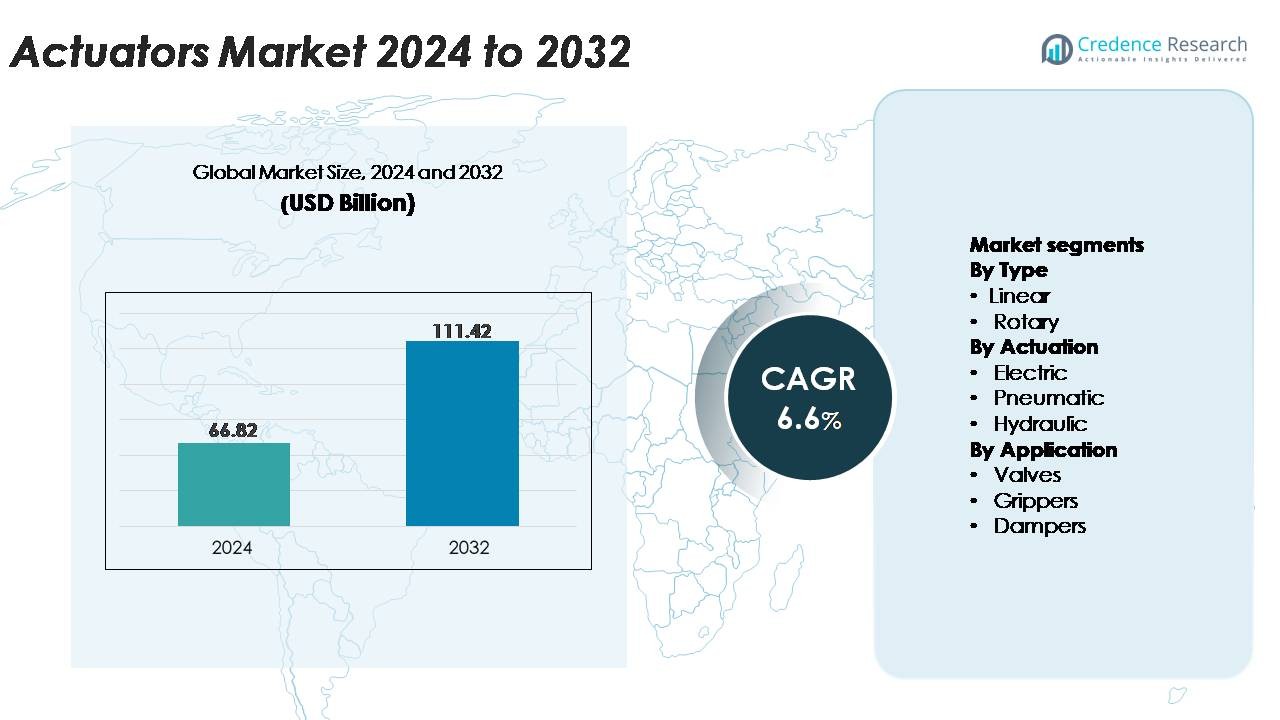
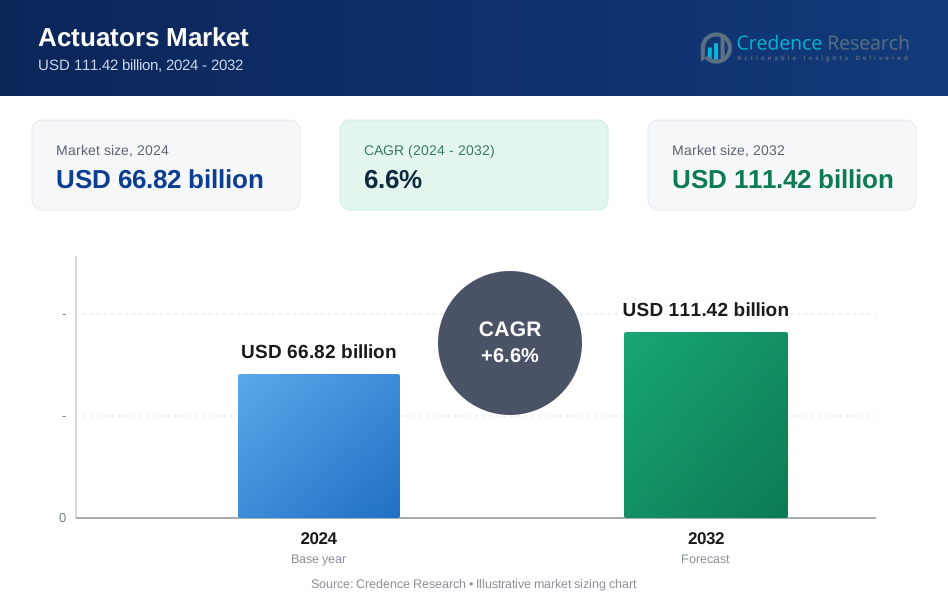
The global actuators market was valued at USD 66.82 billion in 2024 and is forecast to reach USD 111.42 billion by 2032, registering a CAGR of 6.6% over the forecast period.| REPORT ATTRIBUTE | DETAILS |
|---|---|
| Historical Period | 2020-2023 |
| Base Year | 2024 |
| Forecast Period | 2025-2032 |
| Actuators Market Size 2024 | USD 66.82 Billion |
| Actuators Market, CAGR | 6.6% |
| Actuators Market Size 2032 | USD 111.42 Billion |
Market Insights:
- The global actuators market was valued at USD 66.82 billion in 2024 and is projected to reach USD 111.42 billion by 2032, registering a CAGR of 6.6%, driven by rising adoption of automated motion-control systems across industries.
- Strong market growth is supported by increasing deployment of electric actuators in smart factories, robotics, and precision equipment, with electric actuation holding the largest segment share due to higher efficiency and digital integration capabilities.
- Key trends include rapid expansion of IIoT-enabled, sensor-integrated actuators, miniaturized high-precision devices for medical and electronics applications, and wider use in renewable energy systems.
- Competitive intensity remains high as leading players Emerson, ABB, Siemens, Parker Hannifin, Honeywell, Rotork, and SMC focus on smart technologies, reliability enhancement, and global service expansion, while supply chain volatility and material cost fluctuations act as restraints.
- Regionally, Asia-Pacific leads with 34% market share, followed by North America at 32% and Europe at 28%, supported by automation maturity, industrial investments, and strong demand from process and discrete manufacturing sectors.
Market Segmentation Analysis:
By Type Linear actuators dominate the market, accounting for the largest share due to their extensive use in industrial automation, robotics, material handling, and precision motion systems. Their high force output, compact design, and compatibility with electric, hydraulic, and pneumatic power sources strengthen adoption across manufacturing and process industries. Growing demand for precision-controlled movement in packaging lines, semiconductor equipment, and automotive assembly further reinforces their leadership. Rotary actuators continue to grow in applications requiring angular movement, but linear actuators remain the preferred choice for high-load, high-accuracy, and repeatable positioning tasks across diverse end-use sectors.- For instance, Parker Hannifin’s ETH125 electric linear actuator delivers up to 114,000 N of thrust with positioning repeatability of ±0.03 mm, enabling deployment in high-load automotive assembly and press-fit applications.
- For instance, SMC’s LEY100 electric rod actuator delivers a maximum pushing force of 12,000 N with a positioning repeatability of ±0.02 mm, enabling high-precision motion in semiconductor and laboratory equipment.
Key Growth Drivers
Rapid Industrial Automation and Expansion of Smart Manufacturing
Industrial automation remains the primary force accelerating actuator adoption across process and discrete industries. Manufacturers increasingly deploy automated machinery, robotic systems, and PLC-controlled equipment to enhance throughput, reduce labor dependency, and improve precision in production processes. Actuators enable controlled linear and rotary motion, making them essential in assembly lines, packaging equipment, robotic grippers, CNC tools, and quality-inspection systems. The emergence of smart factories amplifies this demand as actuators integrate with sensors, machine-vision modules, and IoT platforms for real-time performance monitoring and predictive maintenance. Industries such as automotive, electronics, pharmaceuticals, and semiconductors continue to expand automation intensity, creating sustained demand for compact, high-accuracy, and digitally compatible actuation systems. This shift toward faster, flexible, and data-driven production environments ensures long-term growth across electric, pneumatic, and hydraulic actuator categories.- For instance, Festo’s EPCO electric cylinder delivers thrust forces up to 1,300 N with stroke lengths reaching 400 mm and repeatability of ±0.02 mm, enabling high-accuracy, high-speed positioning in automated manufacturing cells.
- For instance, Thomson Industries’ Electrak® HD electric actuator delivers up to 10,000 N of force with integrated J1939 CANbus controls and on-board load monitoring, replacing hydraulic cylinders in mobile and industrial equipment with zero fluid leakage.
Growth of Robotics, Mechatronics, and Autonomous Systems
The expanding use of industrial robots, collaborative robots (cobots), autonomous mobile robots (AMRs), and automated guided vehicles (AGVs) fuels substantial demand for advanced actuator technologies. Actuators enable precise movement, grip strength, steering, and positioning, making them foundational to robotic functionality. Rising investments in automation within logistics, warehousing, healthcare, defense, and electronics manufacturing create strong demand for compact, lightweight, high-torque actuators designed for dynamic, multi-axis robotic operations. Cobots in particular rely on safe, low-noise, sensor-integrated electric actuators to perform repetitive, high-accuracy tasks alongside human workers. As robots gain higher payload capacities and motion sophistication, actuator manufacturers innovate with high-resolution motors, modular actuator assemblies, and enhanced communication capabilities. This broad robotics ecosystem ensures long-term, diversified demand for both linear and rotary actuator solutions.Key Trends & Opportunities:
Expansion of Smart, Connected, and Sensor-Integrated Actuators
A significant trend shaping the actuators industry is the shift toward smart, sensor-equipped actuation systems capable of self-diagnostics and data reporting. These next-generation actuators are embedded with load sensors, temperature sensors, torque feedback, and digital communication interfaces such as CANbus, IO-Link, and Ethernet/IP. Connected actuators enable continuous performance monitoring, allowing equipment operators to predict component failure, optimize energy use, and improve overall equipment effectiveness (OEE). This transition unlocks opportunities in predictive maintenance platforms, real-time process control, and automation of safety-critical operations. Adoption is accelerating in pharmaceuticals, food processing, semiconductor fabrication, and energy industries where precision and uptime are paramount. As Industry 4.0 initiatives expand globally, demand for intelligent actuators continues to rise, opening avenues for value-added software, remote monitoring solutions, and cloud-enabled control architectures. · For instance, the Rotork IQ3 Pro electric actuator stores up to 3,000 time-stamped diagnostic events and offers a position resolution of 7.5° at the output. It features robust torque-sensing capabilities, enabling precise monitoring and predictive maintenance across mission-critical operations.Growing Demand for Miniaturized and High-Precision Actuation Solutions
The market observes strong opportunities in miniaturized actuators designed for compact equipment, medical devices, laboratory automation, micro-assembly tools, and portable robotics. Precision-critical industries increasingly require actuators with high torque density, minimal backlash, low noise, and micron-level positional accuracy. Manufacturers respond by developing mini linear actuators, piezoelectric actuators, voice-coil actuators, and micro-rotary motors to address this emerging need. These technologies enable ultra-precise dosing, positioning, gripping, and optical alignment tasks. The broader trend of equipment downsizing in electronics, biotechnology, and surgical robotics further enhances demand for compact, lightweight actuator systems. As product design evolves toward smaller footprints and greater motion refinement, actuator suppliers gain new opportunities to innovate in materials, mechatronic integration, and fine-motion control systems.- For instance Physik Instrumente’s (PI) Q-545 miniature piezo-motor linear stage is available with a travel range of 13 mm or 26 mm. The stage offers a high position resolution in the nanometer range, with unidirectional repeatability down to 0.050 µm and a maximum speed of 8 mm/s in closed-loop operation, or up to 10 mm/s in open-loop mode.
Increasing Use of Actuators in Renewable Energy and Environmental Systems
Actuators play a growing role in renewable energy applications, including wind turbine pitch control, solar panel tracking systems, and energy-efficient HVAC equipment. The accelerating global transition toward clean energy and smart environmental management broadens deployment across power plants, desalination facilities, water treatment systems, and air-quality infrastructures. Precision-controlled actuators regulate damper positions, flow valves, and grid-balancing mechanisms, enabling operational efficiency and sustainability compliance. The expansion of utility-scale solar farms and offshore wind installations drives demand for corrosion-resistant, weather-proof actuator designs. With governments increasing support for decarbonization initiatives, actuators are positioned for strong adoption in green technologies and smart environmental systems.Key Challenges:
High Maintenance Requirements and Performance Limitations of Legacy Systems
Despite extensive adoption, traditional pneumatic and hydraulic actuators face notable challenges related to maintenance intensity, energy inefficiency, and operational complexity. Fluid leakage, pressure loss, heat generation, and frequent component replacements increase operational costs for industries relying heavily on legacy systems. These actuators also offer limited precision and slower response compared to modern electric variants, restricting their use in high-accuracy automation tasks. The transition to electric actuators requires significant upfront investment and compatibility upgrades across machinery and control architectures. Many industries remain constrained by existing infrastructure and budget limitations, slowing the shift toward advanced solutions. This imbalance between legacy system limitations and modernization needs represents a major challenge for the overall sector.Volatility in Raw Material Prices and Supply Chain Disruptions
Actuator manufacturing depends heavily on high-grade metals, alloys, motors, seals, electronic components, and machining processes. Fluctuations in prices of steel, aluminum, copper, rare earth magnets, and semiconductor components directly affect production costs. Global supply chain disruptions including geopolitical tensions, logistics delays, and shortages in electronic parts further constrain manufacturing timelines and inventory stability. Lead times for critical components such as precision bearings, control chips, and servo motors often extend during periods of supply stress, impacting OEM delivery schedules. Manufacturers must invest in supply chain diversification, localized sourcing, and inventory optimization to mitigate these risks. Persistent raw material volatility remains a substantial operational challenge for actuator producers worldwide.Regional Analysis:
North America North America holds a substantial share of the actuators market, accounting for around 32%, driven by strong automation adoption across manufacturing, aerospace, automotive, and energy sectors. The region benefits from widespread deployment of electric and smart actuators in industrial machinery, oil & gas facilities, and process plants. High investments in robotics, IIoT infrastructure, and advanced motion-control systems reinforce demand. The U.S. leads with extensive use of automated assembly lines, while Canada contributes through growth in mining, utilities, and renewable energy installations. Strong presence of global automation suppliers further strengthens the region’s competitive position. Europe Europe captures approximately 28% of the global actuators market, supported by advanced industrial automation, strong automotive production, and widespread modernization of process industries. Germany, Italy, and France dominate demand through extensive use of high-precision actuators in packaging, material handling, and industrial robotics. The region’s sustainability agenda accelerates adoption of electric actuators, particularly in energy-efficient HVAC systems and clean manufacturing environments. Investments in renewable energy, wastewater treatment, and smart infrastructure further stimulate market growth. The presence of established automation suppliers enables rapid technological integration across both discrete and process industries. Asia-Pacific Asia-Pacific leads the global actuators market with about 34% share, driven by rapid industrialization, large-scale manufacturing expansion, and strong growth in robotics and automotive production. China and Japan dominate consumption through extensive use in electronics, semiconductors, and advanced machinery. India and Southeast Asia contribute significantly due to increased infrastructure development, process plant upgrades, and adoption of automated equipment in textiles, food processing, and chemicals. Government-led automation initiatives and large investments in renewable energy and smart factories further strengthen demand for electric, pneumatic, and hydraulic actuators across the region. Latin America Latin America accounts for around 4% of the actuators market, with growth driven by expanding oil & gas operations, mining activities, and modernization of industrial facilities in Brazil, Mexico, and Argentina. Demand for pneumatic and hydraulic actuators remains strong in heavy-duty applications, while electric actuators gain traction in manufacturing and automation upgrades. The region’s growing investments in water treatment, food processing, and energy infrastructure support additional adoption. Despite economic fluctuations and slower automation maturity compared to major regions, increasing industrial digitization and regulatory compliance requirements contribute to steady market expansion. Middle East & Africa (MEA) The Middle East & Africa region holds approximately 2% of the global market, primarily supported by substantial demand from oil & gas, petrochemicals, power generation, and desalination industries. Actuators play a critical role in valve automation, flow control, and process optimization across large-scale energy and water infrastructure projects. GCC countries lead adoption through continuous investment in refinery expansion and utility modernization. Africa shows growing potential in mining, water management, and industrial equipment upgrades. While automation penetration remains comparatively lower, increasing industrial diversification and smart infrastructure initiatives drive incremental market growth.Market Segmentations:
By Type- Linear
- Rotary
- Electric
- Pneumatic
- Hydraulic
- Valves
- Grippers
- Dampers
- North America
- U.S.
- Canada
- Mexico
- Europe
- Germany
- France
- U.K.
- Italy
- Spain
- Rest of Europe
- Asia Pacific
- China
- Japan
- India
- South Korea
- South-east Asia
- Rest of Asia Pacific
- Latin America
- Brazil
- Argentina
- Rest of Latin America
- Middle East & Africa
- GCC Countries
- South Africa
- Rest of the Middle East and Africa
Competitive Landscape:
The actuators market features a highly competitive landscape characterized by established global manufacturers, specialized motion-control suppliers, and rapidly innovating automation technology providers. Leading companies such as Emerson Electric, ABB, Siemens, Parker Hannifin, Honeywell, Rockwell Automation, and Rotork maintain strong positions through extensive product portfolios spanning electric, pneumatic, and hydraulic actuators tailored for industrial, process, and infrastructure applications. These firms compete on precision, reliability, digital connectivity, and integration with advanced control systems. Continuous investments in smart, sensor-enabled actuators and IIoT platforms strengthen their technological advantage. Mid-sized players and niche specialists focus on compact actuators, valve automation systems, and application-specific solutions for robotics, medical devices, and semiconductor equipment. Strategic partnerships with system integrators, expansion into emerging economies, and upgrades to energy-efficient designs further shape the competitive environment. Overall, innovation, customization capability, and global service networks remain decisive factors in market leadership.Key Player Analysis:
- Curtiss-Wright Corporation
- Emerson Electric Co.
- Honeywell International Inc.
- Rotork plc
- ABB Ltd.
- Rockwell Automation, Inc.
- Siemens AG
- Parker Hannifin Corporation
- SMC Corporation
Recent Developments:
- In June 4, 2025, Rotork announced it joined Rockwell Automation’s Technology Partner Program major step in promoting its IQ3 Pro electric actuator with EtherNet/IP connectivity in industrial automation systems.
- In February 1, 2023, Curtiss-Wright,the company announced that it had been awarded a contract to provide electromechanical actuators for the first 16 platforms of the Dynetics “Enduring Shield” ground-based launcher system for the U.S. Army.
- In July 2022, Honeywell announced that Archer Aviation selected Honeywell to supply its MicroVCS thermal-management and actuator/climate-system technology for eVTOL aircraft.
Report Coverage:
The research report offers an in-depth analysis based on Type, Actuation, Application and Geography. It details leading market players, providing an overview of their business, product offerings, investments, revenue streams, and key applications. Additionally, the report includes insights into the competitive environment, SWOT analysis, current market trends, as well as the primary drivers and constraints. Furthermore, it discusses various factors that have driven market expansion in recent years. The report also explores market dynamics, regulatory scenarios, and technological advancements that are shaping the industry. It assesses the impact of external factors and global economic changes on market growth. Lastly, it provides strategic recommendations for new entrants and established companies to navigate the complexities of the market.Future Outlook:
- The market will witness accelerated adoption of electric actuators as industries shift toward energy-efficient and low-maintenance motion-control solutions.
- Smart, sensor-integrated actuators will become standard, enabling predictive maintenance and real-time equipment performance optimization.
- Robotics, cobots, and autonomous systems will drive strong demand for compact, high-precision actuators across manufacturing and logistics.
- Miniaturized actuators will gain traction in medical devices, laboratory automation, and semiconductor equipment.
- Advanced valve automation will expand with rising modernization of oil & gas, water treatment, and chemical processing facilities.
- Industrial IoT platforms will increasingly integrate with actuators, enhancing connectivity, diagnostics, and remote operation.
- Renewable energy applications, including wind and solar systems, will create new opportunities for durable and corrosion-resistant actuator designs.
- Material innovations and improved motor technologies will enhance actuator torque density, speed, and control accuracy.
- The aftermarket for actuator servicing, retrofitting, and automation upgrades will grow steadily across global industries.
- Emerging economies will experience rapid uptake as manufacturing capacity expands and automation investment intensifies.
Report Attribute Details
Details
Historical Period
-
Base Year
2024
Forecast Period
2024–2032
Actuators Size 2024
USD 66.82 billion
Actuators CAGR
6.6%
Actuators Size 2032
USD 111.42 billion
Request a Free Sample
Fill in your details and we'll send you a free sample report.
- Sample data tables & charts
- Research methodology
Need a Custom Version of This Report?
Tailor the scope, geography, or segments to your exact requirements.
- Custom geography or segment scope
- Direct access to our analyst team
Frequently Asked Questions
What is the current market size for the actuators market, and what is its projected size in 2032?
The actuators market is valued at USD 66.82 billion in 2024 and is projected to reach USD 111.42 billion by 2032.
At what Compound Annual Growth Rate is the actuators market projected to grow between 2024 and 2032?
The market is expected to grow at a CAGR of 6.6% during the forecast period.
Which actuators segment held the largest share in 2024?
The electric actuator segment held the largest share due to efficiency, precision, and digital integration.
What are the primary factors fueling the growth of the actuators market?
Rising industrial automation, smart factory adoption, robotics expansion, and demand for energy-efficient motion systems.
Who are the leading companies in the actuators market?
Key players include Emerson, ABB, Siemens, Parker Hannifin, Honeywell, Rotork, SMC, and Rockwell Automation.
Which region commanded the largest share of the actuators market in 2024?
Asia-Pacific led the market with 34% share, driven by rapid industrialization and automation growth.
Table of Content
Chapter 1 Market Segmentation
- 1.1 Segmentation Framework
- 1.1.1 Product and Service Classification
- 1.1.2 Application and End-Use Classification
- 1.1.3 Technology and Solution Classification
- 1.1.4 Customer and Distribution Channel Classification
- 1.1.5 Geographic Segmentation
- 1.1.6 Market Segment Definitions and Boundaries
Chapter 2 Introduction
- 2.1 Report Objectives and Scope
- 2.2 Product Definition and Industry Terminology
- 2.3 Market Inclusions and Exclusions
- 2.4 Research Process
- 2.4.1 Primary Research and Expert Interviews
- 2.4.2 Secondary Research and Source Review
- 2.4.3 Top-Down and Bottom-Up Estimation
- 2.4.4 Data Triangulation and Verification
- 2.5 Market Size Measurement Basis
- 2.5.1 2024: USD 66.82 billion → 2032: USD 111.42 billion
- 2.6 Historical and Forecast Reference Periods
- 2.6.1 Base Year: 2024
- 2.6.2 Forecast Period: 2024-2032
- 2.7 Research Assumptions and Limitations
Chapter 3 Executive Summary
- 3.1 Market Snapshot and Key Findings
- 3.2 Base-Year Market Size, 2024
- 3.3 Forecast Market Size, 2032
- 3.4 Revenue and Volume Growth Outlook
- 3.5 Key Demand and Supply Indicators
- 3.6 Leading Market Segments
- 3.7 Fastest-Growing Market Opportunities
- 3.8 Regional Performance Highlights
- 3.9 Technology and Industry Transformation
- 3.10 Competitive Landscape Summary
- 3.11 Analyst View and Strategic Implications
Chapter 4 Global Actuators Market Trends and Developments
- 4.1 Historical Industry Development
- 4.2 Recent Market Trends and Developments
- 4.3 Demand and Customer Behavior Trends
- 4.4 Technology and Product Innovation
- 4.5 Artificial Intelligence, Automation and Digitalization
- 4.6 Local Manufacturing and Supply Chain Realignment
- 4.7 Industry Partnerships, Mergers and Acquisitions
- 4.8 Sustainability and Circular Economy Developments
- 4.9 Government and Private Sector Investment Trends
- 4.10 Emerging Business Models and Commercialization
- 4.11 Industry Developments and Announcements
Chapter 5 Global Actuators Market Production, Supply and Demand Analysis
- 5.1 Demand Trend and Consumption Analysis
- 5.2 Demand Forecast, 2024-2032
- 5.3 Production and Output Trend
- 5.4 Production and Output Forecast, 2024-2032
- 5.5 Installed Capacity and Capacity Utilization
- 5.6 Company-Wise Production Plants and Statistics
- 5.6.1 Installed Production Capacity
- 5.6.2 Actual Production
- 5.6.3 Planned Capacity and Expansion Targets
- 5.7 Supply Chain Structure and Procurement Trends
- 5.8 Supply-Demand Gap and Bottlenecks
- 5.9 Import Dependence and Sourcing Structure
- 5.10 Contract Manufacturing and Outsourcing
- 5.11 Regional Supply and Demand Concentration
Chapter 6 Global Actuators Market Pricing Analysis
- 6.1 Pricing Structure and Measurement
- 6.2 Historical Pricing Trends
- 6.3 Pricing Outlook, 2024-2032
- 6.4 Average Selling Price and Unit Economics
- 6.5 Pricing by Product and Market Segment
- 6.6 Geographic Pricing Differences
- 6.7 Key Input, Energy, Labor and Logistics Costs
- 6.8 Contract Pricing and Purchasing Models
- 6.9 Pricing Sensitivity and Competitive Positioning
- 6.10 Price, Margin and Profitability Implications
Chapter 7 Global Actuators Market Dynamics
- 7.1 Market Growth Drivers
- 7.1.1 Demand-Side Drivers
- 7.1.2 Technology and Innovation Drivers
- 7.1.3 Infrastructure and Investment Drivers
- 7.1.4 Regulatory and Policy Drivers
- 7.2 Market Restraints
- 7.2.1 Cost and Affordability Constraints
- 7.2.2 Technology and Adoption Barriers
- 7.2.3 Supply Chain and Operational Constraints
- 7.3 Market Challenges
- 7.3.1 Competitive Pressure and Margin Erosion
- 7.3.2 Skills, Infrastructure and Implementation Gaps
- 7.4 Emerging Market Opportunities
- 7.5 Market Dynamics Impact and Time-Horizon Assessment
Chapter 8 Global Actuators Value Chain Analysis
- 8.1 Industry Value Chain Overview
- 8.2 Upstream Suppliers and Critical Inputs
- 8.3 Technology and Component Providers
- 8.4 Manufacturing or Service Delivery
- 8.5 Distribution, Channel Partners and Integrators
- 8.6 Downstream Applications and End Users
- 8.7 Value Addition and Profit Pools
- 8.8 Vertical Integration and Outsourcing
- 8.9 Supplier Concentration and Risk
- 8.10 Supply Chain Localization and Resilience
Chapter 9 Global Actuators Market Regulations and Policies
- 9.1 Relevant Laws, Standards and Compliance Frameworks
- 9.2 Product, Service, Safety and Quality Requirements
- 9.3 Government Policies, Incentives and Subsidies
- 9.4 Imports, Exports and Trade Barriers
- 9.5 Public Procurement and Local Content Requirements
- 9.6 Environmental and Sustainability Compliance
- 9.7 Upcoming Policy Changes and Market Implications
Chapter 10 Global Actuators Market Hotspots and Opportunities
- 10.1 Market Opportunity Mapping and Growth Hotspots
- 10.2 High-Growth Applications and Customer Groups
- 10.3 Underserved Markets and White-Space Opportunities
- 10.4 Emerging Technology and Product Opportunities
- 10.5 New Capacity and Investment Hotspots
- 10.6 Market Entry and Expansion Opportunities
- 10.7 Distribution and Partnership Opportunities
- 10.8 Near-Term and Long-Term Commercial Potential
- 10.9 Opportunity Attractiveness and Execution Risks
Chapter 11 Global Actuators Market Outlook, 2024-2032
- 11.1 Market Size and Analysis
- 11.1.1 Revenue (Market Measurement: 2024: USD 66.82 billion → 2032: USD 111.42 billion)
- 11.1.2 Market Volume and Quantity Sold
- 11.1.3 Historical Market Size
- 11.1.4 Base-Year Market Size, 2024
- 11.2 Market Forecast, 2024-2032
- 11.2.1 Revenue Forecast to 2032
- 11.2.2 Volume Forecast to 2032
- 11.2.3 CAGR and Year-on-Year Growth
- 11.2.4 Incremental Revenue Opportunity
- 11.3 Forecast Assumptions and Scenario Analysis
- 11.3.1 Base-Case Forecast
- 11.3.2 Optimistic and Conservative Scenarios
- 11.3.3 Technology, Pricing and Policy Sensitivities
- 11.4 Market Attractiveness and Growth Outlook
Chapter 12 Global Actuators Market Segmentation and Outlook
- 12.1 Segmentation Summary and Market Shares, 2024
- 12.2 Largest and Fastest-Growing Segments
- 12.3 Segment Growth Comparison
- 12.4 Segment Attractiveness and Priority Matrix
Chapter 13 Global Actuators Geographic Market Outlook, 2024-2032
- 13.1 Regional Market Size and Share, 2024
- 13.2 Regional Market Forecast, 2024-2032
- 13.3 Regional Pricing, Production and Demand Differences
- 13.4 North America
- 13.4.1 United States
- 13.4.2 Canada
- 13.4.3 Mexico
- 13.5 Europe
- 13.5.1 Germany
- 13.5.2 France
- 13.5.3 Italy
- 13.5.4 United Kingdom
- 13.5.5 Spain
- 13.5.6 Poland
- 13.5.7 Russia
- 13.5.8 Netherlands
- 13.5.9 Belgium
- 13.5.10 Sweden
- 13.5.11 Denmark
- 13.5.12 Norway
- 13.5.13 Rest of Europe
- 13.6 Asia Pacific
- 13.6.1 China
- 13.6.2 India
- 13.6.3 Japan
- 13.6.4 South Korea
- 13.6.5 Thailand
- 13.6.6 Indonesia
- 13.6.7 Vietnam
- 13.6.8 Malaysia
- 13.6.9 Australia
- 13.6.10 Rest of Asia Pacific
- 13.7 Latin America
- 13.7.1 Brazil
- 13.7.2 Argentina
- 13.7.3 Colombia
- 13.7.4 Chile
- 13.7.5 Rest of Latin America
- 13.8 Middle East
- 13.8.1 Saudi Arabia
- 13.8.2 United Arab Emirates
- 13.8.3 Turkey
- 13.8.4 Israel
- 13.8.5 Iran
- 13.8.6 Rest of the Middle East
- 13.9 Africa
- 13.9.1 South Africa
- 13.9.2 Egypt
- 13.9.3 Nigeria
- 13.9.4 Morocco
- 13.9.5 Rest of Africa
- 13.10 Regional Investment, Policy and Supply Chain Differences
- 13.11 Regional Competitive Landscape
- 13.12 Geographic Growth Hotspots
Chapter 14 Global Actuators Technology, Innovation and Sustainability Outlook
- 14.1 Technology Landscape and Maturity
- 14.2 Product, Process and Service Innovation
- 14.3 AI, Automation and Digital Tools in the Industry
- 14.4 Technology Adoption and Performance Benchmarking
- 14.5 Innovation Pipeline and R&D Investment
- 14.6 Patent and Intellectual Property Trends
- 14.7 Energy Efficiency and Resource Management
- 14.8 Sustainability, Recycling and Circularity
- 14.9 Technology Roadmap, 2024-2032
- 14.10 Risks of Obsolescence and Technology Substitution
Chapter 15 Global Actuators Market Key Strategic Imperatives
- 15.1 Growth and Market Entry Priorities
- 15.2 High-Return Products and Segments
- 15.3 Pricing, Profitability and Cost Optimization
- 15.4 Technology Investment and Product Differentiation
- 15.5 Supply Chain Localization and Resilience
- 15.6 Distribution and Customer Acquisition
- 15.7 Partnership, Acquisition and Capacity Strategy
- 15.8 Regional Expansion Priorities
- 15.9 Short-, Medium- and Long-Term Actions
Chapter 16 Competition Outlook
- 16.1 Industry Competition Characteristics
- 16.2 Market Structure and Concentration
- 16.3 Market Share and Competitive Positioning, 2024
- 16.4 Company-Wise Revenue and Product Benchmarking
- 16.5 Production and Service Capacity Benchmarking
- 16.6 Technology, Pricing and Differentiation
- 16.7 Regional Footprint and Distribution Strength
- 16.8 Mergers, Acquisitions and Strategic Alliances
- 16.9 New Entrants and Competitive Threats
- 16.10 Porter's Five Forces and Industry Attractiveness
- 16.11 Competitive Outlook, 2024-2032
Chapter 17 Company Profiles
- 17.1 Company Coverage and Selection Criteria
- 17.2 Leading Market Participants – Standard Profile Structure
- 17.2.1 Business Description
- 17.2.2 Company Ownership and Geographic Presence
- 17.2.3 Product and Service Portfolio
- 17.2.4 Manufacturing and Operating Footprint
- 17.2.5 Production Capacity and Expansion Plans
- 17.2.6 Financial Performance and Investment
- 17.2.7 Market Share and Competitive Position
- 17.2.8 Technology and Innovation Capabilities
- 17.2.9 Strategic Alliances or Partnerships
- 17.2.10 Recent Developments
- 17.2.11 Growth Strategy and Outlook
- 17.3 Other Relevant Market Participants
Note: Every listed company is profiled on the structure shown under the first company. The company list is preliminary and may change based on research findings, market developments, data availability and client requirements.
Chapter 18 Disclaimer
- 18.1 Research and Forecast Disclaimer
- 18.2 Data Source and Estimation Limitations
Note: The depth of individual sections depends on data availability for this market. Volume, capacity, trade and other unit-based metrics are included where applicable.
