
| REPORT ATTRIBUTE | DETAILS |
|---|---|
| Historical Period | 2019-2022 |
| Base Year | 2023 |
| Forecast Period | 2024-2032 |
| Interior Finish Market Size 2023 | USD 9,840.00 Million |
| Interior Finish Market, CAGR | 6.2% |
| Interior Finish Market Size 2032 | USD 16,908.92 Million |
Market Overview:
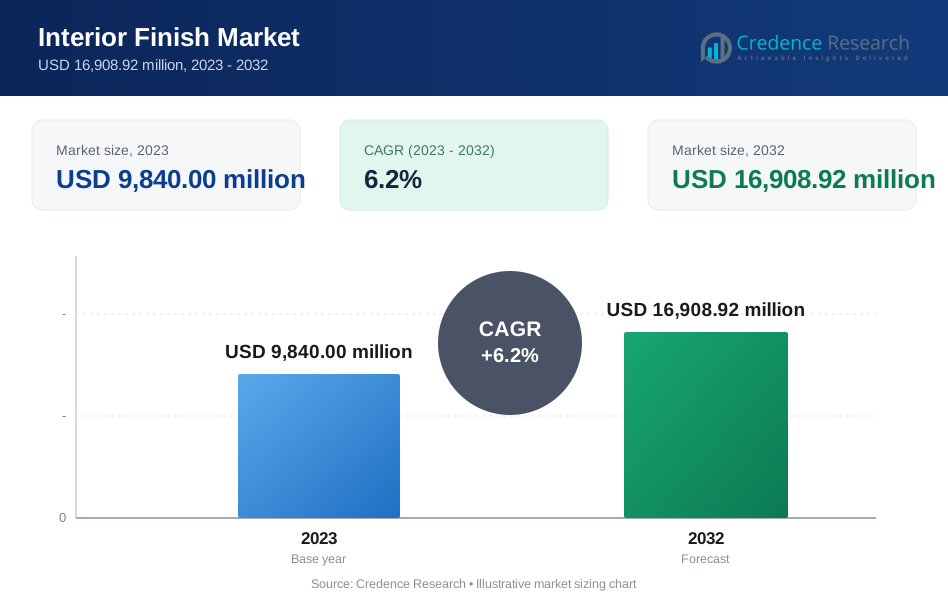
Global Interior Finish Market size was valued at USD 9,840.00 million in 2023 and is anticipated to reach USD 16,908.92 million by 2032, at a CAGR of 6.2% during the forecast period (2023-2032).
One of the primary drivers of the interior finish market is the booming construction industry, particularly in emerging economies. Rising urbanization and the expansion of smart cities have led to increased construction of residential and commercial properties, requiring high-quality interior finishes. Additionally, growing consumer preferences for customized and luxury interiors are pushing manufacturers to innovate with advanced materials such as sustainable wood, engineered stone, high-performance coatings, and decorative laminates. Sustainability and environmental regulations are also shaping the market, with increased adoption of low-VOC paints, energy-efficient flooring, and recycled materials. Technological advancements, such as 3D printing for decorative elements and modular interior components, have made customization and rapid installation more accessible. Moreover, the rise in home renovation and remodeling activities, driven by changing design trends and increased affordability, is further fueling demand. The influence of digital platforms and e-commerce has also made interior finishing materials more accessible to a broader consumer base, enabling them to explore a variety of design options.
North America leads the interior finish market, driven by high demand for modern and sustainable solutions, with the U.S. and Canada witnessing strong renovation and remodeling activity supported by rising incomes. Europe follows, emphasizing eco-friendly and smart interior finishes, led by Germany, the UK, and France, where green-certified materials are gaining traction. The Asia-Pacific region is the fastest-growing market, fueled by rapid urbanization, a rising middle class, and government-backed housing projects, with strong demand in China, India, and Japan for cost-effective yet high-quality finishes. In Latin America and the Middle East & Africa, growth is steady due to infrastructure expansion and hospitality sector investments, with luxury finishes gaining popularity in urban areas and affordable solutions driving demand in emerging regions.
Market Insights:
- The Global Interior Finish Market was valued at USD 9,840.00 million in 2023 and is expected to reach USD 16,908.92 million by 2032, growing at a CAGR of 6.2% due to rising construction activities and urbanization.
- Rapid urbanization and smart city developments are driving demand for high-quality, durable interior finishes, especially in emerging economies with growing residential and commercial infrastructure projects.
- Consumer demand for luxury and customized interiors is increasing, encouraging manufacturers to innovate with engineered stone, decorative laminates, and modular interior solutions.
- Sustainability and eco-friendly materials are gaining traction, with a growing shift toward low-VOC paints, energy-efficient flooring, and recyclable materials, particularly in Europe and North America.
- Technological advancements, including 3D printing and smart interior solutions, are revolutionizing the industry, enhancing customization, efficiency, and ease of installation.
- Supply chain disruptions and rising material costs pose challenges, impacting affordability and pushing businesses toward localized sourcing and alternative materials.
- North America leads the market with strong demand for modern and sustainable solutions, while Asia-Pacific is the fastest-growing region, fueled by government-backed housing projects and a rising middle class.
Market Drivers:
Rapid Urbanization and Expanding Construction Sector
The Global Interior Finish Market is significantly driven by rapid urbanization and the expansion of the construction industry. The increasing global population and migration to urban centers have led to a surge in residential and commercial construction activities, requiring high-quality interior finishing materials. For instance, Vicaima, a leading European manufacturer of doors and panels, has developed new finish options that meet global trends and professional needs, ensuring cohesive and elegant spaces through seamless design integration. Governments across emerging economies are investing heavily in infrastructure projects, including smart cities, affordable housing, and commercial developments, which directly contribute to market growth. The demand for premium flooring, wall coverings, decorative ceilings, and functional interior elements continues to rise as urbanization fuels a shift toward modernized living spaces. Additionally, the increasing number of high-rise buildings, co-living spaces, and mixed-use developments has elevated the need for innovative and durable interior finishes that enhance aesthetics and functionality.
Growing Consumer Preference for Aesthetics and Customization
Changing consumer preferences toward personalized and aesthetically appealing interiors are another key driver of the market. The rising influence of digital media, home improvement shows, and social media platforms has increased awareness about contemporary design trends, leading to greater demand for customized interior finishes. Consumers are now more inclined toward modular kitchens, decorative wallpapers, engineered wood flooring, and high-quality paint finishes that align with their lifestyle and design aspirations. For instance, companies like Amenify India use AI to analyze customer preferences and create personalized furniture pieces that reflect individual styles and needs. This approach ensures that each piece is tailored to enhance the aesthetic and functional appeal of a space. The increasing disposable income in developing economies has also enabled consumers to invest in premium materials and smart interior solutions that offer durability, functionality, and visual appeal. Furthermore, the growing popularity of do-it-yourself (DIY) home improvement projects and e-commerce platforms offering diverse interior finish options has expanded market accessibility and product availability.
Sustainability and Demand for Eco-Friendly Solutions
Sustainability has become a crucial factor influencing the interior finish market, with consumers and industry stakeholders emphasizing the adoption of environmentally friendly, energy-efficient, and recyclable materials. Government regulations and industry standards promoting low-VOC paints, sustainable wood alternatives, and energy-efficient insulation materials have pushed manufacturers to innovate and introduce greener solutions. For instance, innovations in laminate technology have led to the development of advanced surface textures and durable finishes that are both aesthetically pleasing and environmentally friendly. The demand for eco-friendly products is particularly strong in Europe and North America, where stringent environmental regulations and corporate sustainability initiatives have reshaped market dynamics. Additionally, the growing preference for biodegradable wall coverings, bamboo flooring, and water-based coatings reflects a shift toward sustainable interior solutions. The integration of circular economy principles, where materials are designed for long-term use and recyclability, is further strengthening the market for sustainable interior finishes.
Technological Advancements and Smart Interior Solutions
The interior finish industry is witnessing continuous technological advancements, leading to the development of high-performance materials, smart home-compatible finishes, and automation-driven interior solutions. Innovations such as 3D-printed decorative elements, antimicrobial coatings, and self-healing surfaces are gaining traction in both residential and commercial applications. The increasing adoption of Internet of Things (IoT)-enabled interior solutions, such as smart lighting controls, adaptive thermal insulation, and interactive wall panels, is revolutionizing modern interior design. Additionally, the use of augmented reality (AR) and virtual reality (VR) technologies in interior planning and design allows consumers and architects to visualize spaces before execution, enhancing decision-making and customization. For instance, companies like Houzz and Modsy are leading the charge in this area, offering platforms that use AR and VR to help consumers visualize and plan their spaces. These technological innovations are reshaping the industry by improving efficiency, reducing maintenance requirements, and offering personalized interior finishing solutions.
Market Trends:
Rise of Smart and Adaptive Interior Finishes
The increasing integration of smart technologies into interior finishes is transforming modern living and commercial spaces. Advanced materials that adapt to environmental conditions, such as temperature-responsive flooring, self-healing wall coatings, and sound-absorbing panels, are gaining traction. For instance, BASF has developed self-healing coatings that can repair scratches and damage autonomously, using microcapsules filled with healing agents that release upon damage. The growing demand for IoT-enabled interior solutions, including smart glass, motion-sensing lighting, and interactive surfaces, is reshaping how interior spaces function. These innovations cater to evolving consumer expectations for efficiency, comfort, and automation, particularly in high-end residential and commercial developments. The convergence of interior design with artificial intelligence (AI) and augmented reality (AR) is also influencing how consumers plan and personalize their interiors.
Sustainable and Circular Economy Practices
Sustainability remains a dominant trend, with manufacturers and consumers increasingly prioritizing eco-friendly interior solutions. The shift toward a circular economy is driving the use of recycled and biodegradable materials, such as reclaimed wood, upcycled metal, and plant-based wall coverings. Innovations in low-carbon and energy-efficient materials, including solar-absorbing paints and thermally insulated flooring, are gaining widespread adoption. For example, Sherwin-Williams offers low-VOC paints that not only reduce indoor air pollution but also contribute to LEED certification, aligning with green building standards. Businesses are also incorporating carbon-neutral production methods and zero-waste manufacturing, ensuring that sustainability extends beyond just material choices. Government incentives and stricter regulations on non-renewable resources and emissions are accelerating the adoption of environmentally responsible interior finishes across residential, commercial, and industrial projects.
Influence of Minimalist and Biophilic Design Trends
Modern interior aesthetics are shifting toward minimalist and biophilic designs, reflecting a growing preference for simplicity, functionality, and nature-inspired elements. Minimalist interiors emphasize neutral color palettes, seamless surfaces, and multifunctional materials, driving demand for sleek, high-performance finishes such as matte coatings, integrated storage solutions, and concealed lighting systems. The biophilic design movement, which incorporates natural materials, indoor plants, and daylight optimization, is becoming mainstream in both residential and corporate spaces. For instance, companies like Reclaim Design specialize in using reclaimed wood to create unique furniture pieces that not only add aesthetic appeal but also support sustainable practices by reducing waste and promoting resource conservation. The rising focus on well-being and mental health has influenced interior design choices, with consumers and businesses favoring organic textures, sustainable wood alternatives, and green walls to create healthier indoor environments.
Expansion of Modular and Prefabricated Interior Solutions
The rising popularity of modular interiors is revolutionizing the way spaces are designed and constructed. Prefabricated walls, ceilings, and flooring systems enable rapid installation, cost efficiency, and reduced material waste, making them attractive for both commercial and residential projects. The adoption of plug-and-play interior components, such as pre-assembled cabinetry, acoustic panels, and modular partitions, is streamlining construction processes while maintaining design flexibility. For instance, IKEA offers modular kitchen systems that can be easily customized and installed, reducing construction time compared to traditional methods. These solutions are particularly beneficial in urban housing developments, co-working spaces, and hospitality projects, where speed and adaptability are key factors. With growing urbanization and the need for scalable design solutions, modular interior finishes are expected to become a critical component of modern construction practices.
Market Challenges Analysis:
High Material Costs and Supply Chain Disruptions
The Global Interior Finish Market faces significant challenges due to rising raw material costs and supply chain disruptions. The increasing prices of wood, ceramics, polymers, and metal components, driven by inflation, fluctuating demand, and geopolitical instability, are impacting production costs and profit margins. Additionally, global supply chain constraints, including shipping delays, raw material shortages, and logistical bottlenecks, have led to extended project timelines and increased expenses for manufacturers and consumers. The reliance on imported materials in many regions further complicates cost efficiency, particularly in developing economies where affordability remains a key purchasing factor. These economic pressures are forcing businesses to explore alternative materials and localized sourcing strategies to maintain competitiveness.
Regulatory Compliance and Environmental Constraints
Stringent environmental regulations and sustainability mandates are adding complexity to the interior finish industry. Governments across North America, Europe, and Asia-Pacific are imposing strict guidelines on VOC emissions, waste disposal, and carbon footprints, requiring manufacturers to invest in costly eco-friendly production processes and material innovations. While sustainability remains a growth driver, achieving regulatory compliance increases operational costs and limits product availability in certain markets. Additionally, consumer awareness of green building certifications is shifting demand toward environmentally sustainable interior finishes, pressuring traditional manufacturers to adapt. The challenge lies in balancing aesthetic appeal, durability, and sustainability while keeping products cost-effective and compliant with evolving industry standards.
Market Opportunities:
The Global Interior Finish Market presents significant growth opportunities, driven by rising urbanization, increasing disposable incomes, and evolving consumer preferences for high-quality, sustainable, and technologically advanced interior solutions. The expansion of the real estate and construction sectors, particularly in emerging economies, is fueling demand for premium flooring, decorative wall panels, and modular ceilings. Additionally, the growing trend of home renovations and remodeling in developed regions is creating lucrative opportunities for manufacturers and service providers. The rising influence of digital platforms and e-commerce has further enhanced market accessibility, allowing consumers to explore and purchase a wide range of interior finish products with greater convenience.
Sustainability and eco-friendly innovations offer a major market opportunity, with increasing demand for low-VOC paints, recyclable materials, and energy-efficient finishes. As governments and corporations adopt green building initiatives, the need for certified sustainable interior solutions continues to grow. Furthermore, technological advancements, including smart interior solutions, AI-driven customization, and 3D-printed decorative elements, are reshaping consumer expectations and driving industry transformation. The rise of co-living and shared workspaces also presents new avenues for growth, as businesses seek cost-effective, durable, and easily adaptable interior finishes. With innovation, sustainability, and digitalization at the forefront, the Global Interior Finish Market is well-positioned for sustained expansion in the coming years.
Market Segmentation Analysis:
By Type
The Global Interior Finish Market is segmented into Personalized Customization and Standardized Package, catering to diverse consumer preferences and project requirements. Personalized Customization holds a significant share as consumers increasingly seek unique and tailored interior solutions that reflect their personal aesthetics and functional needs. This segment is particularly strong in luxury residential projects, high-end commercial spaces, and hospitality interiors, where demand for bespoke flooring, custom wall finishes, and exclusive ceiling designs is high. The integration of smart technologies, eco-friendly materials, and advanced craftsmanship is further driving growth in this segment. The Standardized Package segment, on the other hand, is gaining traction due to its cost efficiency, ease of installation, and wide applicability. Developers and contractors favor standardized interior finishes for large-scale housing projects, commercial buildings, and institutional spaces, ensuring consistent quality, durability, and streamlined project execution. This segment benefits from prefabricated components, modular interior solutions, and factory-finished materials, making it a preferred choice for rapid urban development projects.
By Application
Based on application, the market is segmented into Residential, Commercial Indoor, and Public Space. The residential sector dominates the market, driven by the growing trend of home renovations, smart home integrations, and sustainable interior preferences. Consumers are investing in energy-efficient flooring, aesthetic wall treatments, and smart lighting systems to enhance living environments. The commercial indoor segment, including offices, retail spaces, and hospitality, is expanding due to rising urbanization and the increasing need for modern, functional, and visually appealing interiors. Meanwhile, the public space segment, covering government buildings, educational institutions, and healthcare facilities, is witnessing growth as authorities emphasize durable, cost-effective, and environmentally friendly interior finishes to meet regulatory standards and improve public infrastructure aesthetics.
Segmentation:
By Type
- Personalized Customization
- Standardized Package
By Application
- Residential
- Commercial Indoor
- Public Space
- North America
- The U.S.
- Canada
- Mexico
- Europe
- Germany
- France
- The U.K.
- Italy
- Spain
- Rest of Europe
- Asia Pacific
- China
- Japan
- India
- South Korea
- South-east Asia
- Rest of Asia Pacific
- Latin America
- Brazil
- Argentina
- Rest of Latin America
- Middle East & Africa
- GCC Countries
- South Africa
- Rest of the Middle East and Africa
Regional Analysis:
North America: Market Leader with Strong Demand for Sustainable Interiors
North America dominates the Global Interior Finish Market, accounting for approximately 35% of the total market share. The region's growth is driven by rising home renovations, remodeling activities, and increasing demand for sustainable interior solutions. The United States and Canada are key contributors, with a strong focus on eco-friendly materials, smart home integrations, and high-end interior aesthetics. The commercial sector, including hospitality, corporate offices, and retail spaces, is also fueling demand for modular ceilings, advanced wall finishes, and energy-efficient flooring. Favorable mortgage policies, increasing disposable incomes, and the rapid adoption of digital interior design solutions further strengthen market expansion in this region.
Europe: Leading in Sustainable and High-Performance Interior Solutions
Europe holds a 28% market share, characterized by stringent environmental regulations, high consumer awareness, and demand for green-certified interior finishes. Countries such as Germany, the United Kingdom, and France are at the forefront of sustainability-driven interior design, with a growing emphasis on low-emission coatings, recycled wood alternatives, and energy-efficient insulation. The commercial sector, particularly hospitality and co-working spaces, is adopting biophilic design principles, which integrate natural materials and improved air quality solutions. Europe’s commitment to zero-carbon construction and energy-efficient buildings is pushing manufacturers to innovate in sustainable interior finishing materials.
Asia-Pacific: Fastest-Growing Market with Expanding Construction Activities
Asia-Pacific is the fastest-growing region, capturing 24% of the market share, fueled by rapid urbanization, growing middle-class incomes, and government initiatives promoting affordable housing. China, India, and Japan are leading the demand for cost-effective yet high-quality interior finishes, including engineered wood flooring, decorative wallpapers, and modular ceilings. Increasing foreign investments in residential and commercial real estate, coupled with the expansion of the hospitality and retail sectors, are further propelling market growth. Additionally, the rising influence of e-commerce and digital interior design platforms is making premium interior finish products more accessible across the region.
Latin America, Middle East & Africa: Emerging Markets with Infrastructure Growth
Latin America and the Middle East & Africa (MEA) regions collectively account for approximately 13% of the market share, with steady growth driven by infrastructure development, tourism expansion, and luxury housing projects. In Latin America, Brazil and Mexico are witnessing a rise in demand for modern, durable, and affordable interior finishes, especially in urban areas. Meanwhile, GCC countries in the Middle East are investing heavily in luxury real estate and hospitality projects, driving the demand for high-end, premium interior solutions. Government-backed housing initiatives and increasing disposable incomes in these regions are further supporting market penetration.
Key Player Analysis:
- Saint-gobain
- Tristan Group
- ALGEDRA
- ARCH-INTERIORS Design Group
- Mimar Interiors
- B&B Italia
- Korte Company
- Tri-State Installation Services
- Stamhuis Group
- Pella Corporation
- Company 11
- Company 12
- Company 13
- Company 14
Competitive Analysis:
The Global Interior Finish Market is characterized by intense competition, with major multinational corporations and regional players competing to meet diverse consumer demands. Leading companies focus on product innovation, sustainable materials, and smart interior solutions to gain a competitive edge. The increasing emphasis on eco-friendly finishes, energy-efficient materials, and digital customization tools has prompted manufacturers to invest in research and development (R&D) to stay ahead. Market competition is further intensified by the rise of modular and prefabricated interior solutions, which enable faster installations and cost-effective designs. Key players are leveraging strategic partnerships, acquisitions, and geographic expansions to strengthen their market position. Additionally, the growing influence of e-commerce and direct-to-consumer sales is reshaping competitive strategies, allowing companies to reach a broader customer base. As sustainability and technology continue to evolve, companies that integrate innovation with affordability and quality are likely to maintain a dominant presence in the industry. For instance, companies like Buildwell are pioneering sustainable practices with their recyclable gypsum boards, which are not only fire-resistant and moisture-resistant but also lightweight, making them ideal for multi-functional spaces.
Recent Developments:
- In February 2024, Saint-Gobain signed a definitive agreement to acquire CSR Limited, a leading building products company in Australia. This acquisition aims to strengthen Saint-Gobain's presence in the Australian construction market, particularly in light and sustainable construction. CSR's portfolio includes iconic brands in Australia, aligning well with Saint-Gobain's global offerings.
- American Industrial Partners (AIP) is set to acquire PPG's architectural coatings business in the United States and Canada. The transaction, expected to close in late 2024 or early 2025, involves a business that generated approximately $2 billion in revenue in 2023.
- On February 8, 2024, Owens Corning announced its acquisition of Masonite International Corporation for $3.9 billion. This move is expected to expand Owens Corning's position in branded residential building products.
- On April 23, 2024, JD Sports Fashion Plc announced the proposed acquisition of Hibbett, Inc., a US-based sports retailer. The acquisition aims to enhance JD Sports Fashion's presence in North America and strengthen its brand.
- On February 6, 2025, CertaPro Painters acquired a majority interest in CertaPro Painters of San Francisco.CertaPro Painters is North America's Most Referred Painting Company
- In February 2, 2024,Saint-Gobain acquired International Cellulose Corporation (ICC), a manufacturer of specialty insulation products, including spray-on thermal and acoustical finishing system
Market Concentration & Characteristics:
The Global Interior Finish Market is moderately fragmented, with a mix of large multinational corporations and regional manufacturers competing across various segments. While established players dominate high-end and commercial interior solutions, smaller firms and local suppliers cater to cost-sensitive and customized segments, creating a diverse and competitive landscape. The market is witnessing consolidation through mergers, acquisitions, and strategic partnerships, as leading companies seek to expand their geographic reach and product portfolios. Key market characteristics include a strong focus on sustainability, technological advancements, and design customization. The integration of smart materials, energy-efficient solutions, and eco-friendly alternatives is reshaping consumer preferences and industry dynamics. Additionally, the rise of modular and prefabricated interior solutions is streamlining construction processes, offering faster installations and cost savings. The growing influence of digital platforms and e-commerce is further transforming the market, making interior finish products more accessible to a global consumer base.
Report Coverage:
The research report offers an in-depth analysis based on By Type and By Application It details leading market players, providing an overview of their business, product offerings, investments, revenue streams, and key applications. Additionally, the report includes insights into the competitive environment, SWOT analysis, current market trends, as well as the primary drivers and constraints. Furthermore, it discusses various factors that have driven market expansion in recent years. The report also explores market dynamics, regulatory scenarios, and technological advancements that are shaping the industry. It assesses the impact of external factors and global economic changes on market growth. Lastly, it provides strategic recommendations for new entrants and established companies to navigate the complexities of the market.
Future Outlook:
- The Global Interior Finish Market is expected to witness sustained growth, driven by increasing demand for premium, durable, and aesthetically appealing materials across residential and commercial sectors.
- Urbanization and infrastructure expansion will fuel demand, particularly in emerging economies where housing and commercial developments are accelerating.
- Sustainability and eco-friendly innovations will shape market trends, with growing adoption of low-VOC paints, recycled materials, and energy-efficient finishes.
- Technological advancements, including smart surfaces, 3D-printed decor, and IoT-integrated interior solutions, will drive product differentiation and innovation.
- The modular and prefabricated interior segment will expand as developers prioritize cost efficiency, quick installation, and scalable solutions.
- Consumer-driven customization will gain momentum, with digital platforms enabling personalized interior designs, virtual planning tools, and on-demand manufacturing.
- Government regulations on sustainability and emissions will encourage industry players to adopt green-certified products and circular economy practices.
- E-commerce and direct-to-consumer sales will reshape distribution channels, increasing accessibility to diverse and high-quality interior finish products.
- Rising investments in luxury and hospitality interiors will drive demand for premium materials, high-end aesthetics, and smart design elements.
- Strategic mergers, acquisitions, and partnerships among key players will enhance market consolidation, innovation, and global expansion efforts.
Request a Free Sample
Fill in your details and we'll send you a free sample report.
- Sample data tables & charts
- Research methodology
Need a Custom Version of This Report?
Tailor the scope, geography, or segments to your exact requirements.
- Custom geography or segment scope
- Direct access to our analyst team
Frequently Asked Questions
What is the current size of the Global Interior Finish Market?
What factors are driving the growth of the Global Interior Finish Market?
What are the key segments within the Global Interior Finish Market?
What are some challenges faced by the Global Interior Finish Market?
Which region is leading the Global Interior Finish Market?
Table of Content
Chapter 1. Report Introduction
- 1.1 Report Description & Purpose
- 1.1.1 Report Title & Market Definition
- 1.1.2 Unique Selling Propositions (USP) & Key Differentiators
- 1.1.3 Value Proposition for Stakeholders
- 1.2 Research Objectives
- 1.2.1 Market Sizing Objectives (Volume & Revenue)
- 1.2.2 Segmentation Objectives
- 1.2.3 Competitive Intelligence Objectives
- 1.2.4 Forecast & Scenario Objectives
- 1.3 Report Scope
- 1.3.1 Interior Finish Scope – Types & Subtypes Covered
- 1.3.2 Geographic Scope – Regions & Countries Covered
- 1.3.3 Historical Period, Base Year & Forecast Period (2023; forecast to 2032)
- 1.3.4 Inclusions & Exclusions
- 1.4 HS Code & Classification Framework
- 1.5 Currency, Units & Pricing Basis
- 1.6 Target Stakeholders
- 1.7 Limitations & Assumptions
Chapter 2. Executive Summary
- 2.1 Global Interior Finish Market Snapshot
- 2.1.1 Market Size – Historical (2023) & Forecast (2023-2032) (2023: USD 9,840.00 million → 2032: USD 16,908.92 million)
- 2.1.2 Volume & Revenue – Global Totals
- 2.1.3 Key Market Highlights – Top Five Facts
- 2.2 Interior Finish Market Segmentation Snapshot
- 2.2.1 Market Split by Region – 2023 vs. 2032
- 2.3 Competitive Snapshot
- 2.3.1 Top 10 Players by Revenue Share – 2023
- 2.3.2 Top 10 Players by Volume Share – 2023
- 2.3.3 Recent Strategic Developments (18-Month Summary)
- 2.4 Key Investment Highlights & Strategic Conclusions
Chapter 3. Interior Finish Market Dynamics & Industry Analysis
- 3.1 Market Overview & Context
- 3.1.1 Interior Finish Market Position in the Broader Automotive Value Chain
- 3.1.2 OEM vs. Replacement Market Dynamics
- 3.1.3 Market Maturity & Development Stage by Region
- 3.2 Interior Finish Market Drivers
- 3.3 Interior Finish Market Restraints & Challenges
- 3.4 Interior Finish Market Opportunities
- 3.5 Porter's Five Forces Analysis
- 3.5.1 Threat of New Entrants
- 3.5.2 Bargaining Power of Suppliers
- 3.5.3 Bargaining Power of Buyers
- 3.5.4 Threat of Substitutes
- 3.5.5 Competitive Rivalry – Intensity Assessment
- 3.6 Interior Finish Value Chain Analysis
- 3.6.1 Upstream – Raw Material/Input Suppliers
- 3.6.1.1 Raw Material/Input 1
- 3.6.1.2 Raw Material/Input 2
- 3.6.1.3 Raw Material/Input 3
- 3.6.2 Midstream – Production/Manufacturing/Service Delivery
- 3.6.2.1 Production/Process Overview
- 3.6.2.2 Key Facility Locations & Capacity by Manufacturer
- 3.6.3 Downstream – Distribution & End Consumer
- 3.6.3.1 Primary Channel – B2B/OEM
- 3.6.3.2 Secondary Channels – Dealer, Retail, Online, Direct
- 3.6.4 Value Chain Profitability Analysis
- 3.6.1 Upstream – Raw Material/Input Suppliers
- 3.7 PESTEL Analysis
- 3.7.1 Political Factors
- 3.7.2 Economic Factors
- 3.7.3 Social Factors
- 3.7.4 Technological Factors
- 3.7.5 Environmental Factors
- 3.7.6 Legal Factors
- 3.8 Interior Finish Supply Chain Analysis
- 3.8.1 Raw Material/Input Supply Risk Assessment
- 3.8.2 Manufacturing Concentration Risk (Geographic Exposure)
- 3.8.3 Trade Disruption Impact Analysis
- 3.9 Regulatory & Policy Landscape
Note: The regulatory and policy landscape section covers regulations based on their applicability to the market, Interior Finish category, geography, and scope of the study. Only regulatory frameworks with a material impact on operations, compliance, trade, sustainability, or market access are analyzed in detail.
Chapter 4. Key Investment Pockets & Opportunity Analysis
- 4.1 Interior Finish Market Attractiveness Analysis
- 4.1.1 By Region – Investment Attractiveness Matrix (Volume × CAGR)
- 4.2 Absolute Revenue Growth Opportunity
- 4.2.1 By Region – Absolute USD Growth Through 2032
- 4.3 Incremental Volume Opportunity
- 4.3.1 By Region – Incremental Volume Through 2032
- 4.3.2 Segment – Incremental Volume
- 4.4 Emerging Submarket Opportunity Deep Dive (Subject to Applicability)
- 4.5 Emerging Market Opportunity Scorecards
- 4.5.1 United States
- 4.5.2 Europe
- 4.5.3 Asia
- 4.5.4 Middle East & Africa
Note: Emerging Market Opportunity Scorecards will be included based on relevance and strategic importance. Regions listed are indicative and may vary depending on data availability and market dynamics.
Chapter 5. Interior Finish Import-Export Analysis & Trade Flows
- 5.1 Global Trade Overview
- 5.1.1 Global Export Value by Country (2023)
- 5.1.2 Global Export Volume by Country (2023)
- 5.1.3 Global Import Value by Country (2023)
- 5.1.4 Global Import Volume by Country (2023)
- 5.1.5 Net Trade Balance by Country (2023)
- 5.2 Export Analysis – Segment
- 5.2.1 Type 1 (HS Code)
- 5.2.2 Type 2 (HS Code)
- 5.2.3 Type 3 (HS Code)
- 5.2.4 Type 4 (HS Code)
- 5.2.5 Type 5 (HS Code)
- 5.3 Import Analysis – Segment
- 5.3.1 Type 1 (HS Code)
- 5.3.2 Type 2 (HS Code)
- 5.3.3 Type 3 (HS Code)
- 5.3.4 Type 4 (HS Code)
- 5.3.5 Type 5 (HS Code)
- 5.4 Average Unit Trade Prices
- 5.4.1 Average Export Price – Segment & Country
- 5.4.2 Average Import Price – Segment & Source Country
- 5.4.3 Price Trends (2023)
- 5.5 Key Trade Route Analysis
- 5.5.1 Trade Route 1
- 5.5.2 Trade Route 2
- 5.5.3 Trade Route 3
- 5.5.4 Trade Route 4
- 5.5.5 Trade Route 5
- 5.6 Trade Policy Impact Assessment
- 5.6.1 US Anti-Dumping & Section 301 Tariffs
- 5.6.2 EU Customs Union Impact
- 5.6.3 Major Free Trade Agreements
- 5.6.4 USMCA Rules of Origin
Note: Trade policy analysis will be included only where relevant to the Interior Finish market.
Chapter 6. Competitive Landscape & Company Benchmarking
- 6.1 Interior Finish Market Concentration & Structure
- 6.1.1 Herfindahl-Hirschman Index (HHI) – vs. 2023
- 6.1.2 Tier 1, Tier 2 & Tier 3 Market Structure
- 6.1.3 Global, Regional & Local Player Dynamics
- 6.2 Interior Finish Market Share Analysis – 2023
- 6.2.1 Global Revenue Share by Company
- 6.2.2 Global Volume Share by Company
- 6.2.3 Regional Revenue Share
- 6.2.4 Market Share Evolution ( vs. 2023)
- 6.2.5 OEM Segment Share by Company
- 6.2.6 Replacement Segment Share by Company
- 6.3 Production/Delivery Capacity & Facility Analysis
- 6.3.1 Global Installed Capacity
- 6.3.2 Capacity Utilization Rates
- 6.3.3 Production/Output Volume
- 6.3.4 Facility Locations & Capacity Map
- 6.3.5 Planned Capacity Additions
- 6.4 Interior Finish Competitive Benchmarking Matrix
- 6.4.1 Revenue, Volume, CAGR & Profitability Comparison
- 6.4.2 Channel Revenue Mix
- 6.4.3 Geographic Revenue Exposure
- 6.4.4 R&D Intensity
- 6.4.5 Sustainability Maturity
- 6.5 Strategic Developments in Interior Finish (Last 24 Months)
- 6.5.1 Mergers, Acquisitions & Divestments
- 6.5.2 New Interior Finish Launches
- 6.5.3 Facility Expansions
- 6.5.4 Strategic Alliances, Joint Ventures & Partnerships
- 6.5.5 Distribution Expansion & Market Entry
- 6.5.6 Sustainability & ESG Initiatives
- 6.6 Competitive Strategy Mapping
- 6.6.1 Leader, Challenger, Follower & Niche Classification
- 6.6.2 Pricing Strategy Comparison
- 6.6.3 Channel Strategy Matrix
Note: Strategic developments are included based on their materiality and the availability of reliable information.
Chapter 7. Global Interior Finish Market – By Distribution Channel
- 7.1 Segment Overview
- 7.1.1 Volume & Revenue Split by Channel (2023 & 2032)
- 7.1.2 Channel Mix Evolution (2023-2032)
Chapter 8. Regional Market Analysis – Global Overview
- 8.1 Global Regional Overview
- 8.1.1 Regional Volume Share
- 8.1.2 Regional Revenue Share
- 8.1.3 Regional Volume by Region
- 8.1.4 Regional Revenue by Region
- 8.1.5 Regional Forecast Through 2032
- 8.2 Cross-Regional Segment Analysis
- 8.2.1 By Distribution Channel
- 8.2.2 By Brand/Price Tier
Chapter 9. North America Interior Finish Market
- 9.1 United States
- 9.2 Canada
- 9.3 Mexico
Chapter 10. Europe Interior Finish Market
- 10.1 Germany
- 10.2 France
- 10.3 Italy
- 10.4 United Kingdom
- 10.5 Spain
- 10.6 Poland
- 10.7 Russia
- 10.8 Netherlands
- 10.9 Belgium
- 10.10 Sweden
- 10.11 Denmark
- 10.12 Norway
- 10.13 Rest of Europe
Chapter 11. Asia Pacific Interior Finish Market
- 11.1 China
- 11.2 India
- 11.3 Japan
- 11.4 South Korea
- 11.5 Thailand
- 11.6 Indonesia
- 11.7 Vietnam
- 11.8 Malaysia
- 11.9 Australia
- 11.10 Rest of Asia Pacific
Chapter 12. Latin America Interior Finish Market
- 12.1 Brazil
- 12.2 Argentina
- 12.3 Colombia
- 12.4 Chile
- 12.5 Rest of Latin America
Chapter 13. Middle East Interior Finish Market
- 13.1 Saudi Arabia
- 13.2 United Arab Emirates
- 13.3 Turkey
- 13.4 Israel
- 13.5 Iran
- 13.6 Rest of the Middle East
Chapter 14. Africa Interior Finish Market
- 14.1 South Africa
- 14.2 Egypt
- 14.3 Nigeria
- 14.4 Morocco
- 14.5 Rest of Africa
Chapter 15. Interior Finish Company Profiles
- 15.1 [Company 01]
- 15.1.1 Company Overview
- 15.1.2 Key Management Personnel
- 15.1.3 Products & Services Portfolio
- 15.1.4 Financial Performance
- 15.1.5 Key Market Focus & Geographic Presence
- 15.1.6 Recent Developments & Strategic Initiatives
Note: The company profile list is preliminary and may change based on research findings, market developments, data availability, and client requirements.
Chapter 16. Appendices
- Appendix A – List of Abbreviations & Acronyms
- Appendix B – Industry Classification Code Reference – Full Series
- Appendix C – Production & Capacity Data Tables
- Appendix D – End-Use & Demand Base Tables
- Appendix E – Consumption & Replacement Rate Assumptions
- Appendix F – ASP Reference Tables
- Appendix G – Manufacturing & Facility Database
- Appendix H – Import-Export Data Tables
- Appendix I – Regulatory Summary Tables
- Appendix J – Primary Research Participant List (Anonymized)
- Appendix K – Primary Research Questionnaire Framework
- Appendix L – Data Sources & Bibliography
- Appendix M – Market Size Divergence & Source Comparison
Chapter 17. Research Methodology
- 17.1 Research Framework & Philosophy
- 17.2 Secondary Research – Sources, Hierarchy & Data Extraction
- 17.3 Data Modeling – Bottom-Up & Top-Down Market Sizing
- 17.4 Primary Research – Stakeholder Framework, LOI & Sample Sizes
- 17.5 Forecast Methodology – Regression, Scenario & Sensitivity Analysis
- 17.6 Quality Control – Four-Layer Validation Framework
- 17.7 Limitations & Standard Assumptions
- 17.8 Disclaimer
