| REPORT ATTRIBUTE | DETAILS |
|---|---|
| Historical Period | 2020-2023 |
| Base Year | 2024 |
| Forecast Period | 2025-2032 |
| Latin America Water Pump Market Size 2023 | USD 2,828.15 Million |
| Latin America Water Pump Market, CAGR | 3.13% |
| Latin America Water Pump Market Size 2032 | USD 3,734.18 Million |
Market Overview:
Latin America Water Pump Market size was valued at USD 2,828.15 million in 2023 and is anticipated to reach USD 3,734.18 million by 2032, at a CAGR of 3.13% during the forecast period (2023-2032).
Several factors are propelling the demand for water pumps in Latin America. The region's increasing urbanization and population growth necessitate enhanced water supply and wastewater management systems. Additionally, the agricultural sector's expansion, driven by the need for efficient irrigation systems to support crop production, further fuels the demand for water pumps. Technological advancements in pump efficiency and energy-saving designs also contribute to market growth, as industries seek cost-effective and sustainable solutions. Moreover, government initiatives aimed at improving water infrastructure and addressing water scarcity issues are pivotal in driving market expansion. Increased industrialization across various sectors, such as mining and construction, further enhances the demand for water pumps in the region.
Brazil stands as the dominant player in the Latin American water pump market, accounting for over 40% of the regional market share. The country's robust oil and gas industry, coupled with significant investments in water and wastewater infrastructure, bolsters the demand for water pumps. Following Brazil, Mexico and Argentina exhibit substantial market potential, driven by their growing industrial sectors and agricultural activities. Countries like Colombia, Chile, and Peru are also witnessing increased adoption of water pumps, particularly in irrigation and industrial applications, supported by government-led infrastructure projects and modernization efforts. The Latin American region's diverse geography and varying climate conditions also lead to tailored solutions, promoting greater adoption of water pumps in various applications, from agriculture to urban water management.
Market Insights:
- The Latin America water pump market is projected to grow from USD 2,828.15 million in 2023 to USD 3,734.18 million by 2032, driven by urbanization, population growth, and expanding industrial activities.
- The global water pump market was valued at USD 55,454.00 million in 2023 and is projected to reach USD 80,304.96 million by 2032, growing at a CAGR of 4.2% during the forecast period.
- Growing urbanization across cities like São Paulo, Mexico City, and Buenos Aires increases the demand for efficient water supply systems and wastewater management, boosting the market.
- The agricultural sector's expansion, particularly in Brazil, Argentina, and Mexico, propels demand for advanced irrigation solutions, including modern water pump technologies for efficient water management.
- Technological advancements, including energy-efficient designs and smart IoT-enabled pumps, contribute significantly to market growth, offering cost-effective and sustainable solutions.
- Government initiatives in Latin America, aimed at improving water infrastructure and addressing water scarcity, provide a substantial boost to the demand for advanced water pump systems.
- The high initial investment costs associated with advanced water pump technologies present challenges for widespread adoption, particularly in rural and smaller-scale operations.
- Political and economic instability in certain Latin American countries can disrupt supply chains and delay water infrastructure projects, posing challenges to consistent market growth.
Market Drivers:
Growing Urbanization and Population Growth
The Latin American water pump market is significantly influenced by the rapid urbanization and population growth across the region. As urban centers continue to expand, the demand for reliable water supply systems becomes more critical. Cities require efficient water pumping solutions for the distribution of clean water, sewage management, and wastewater treatment. This trend is especially pronounced in densely populated areas such as São Paulo, Mexico City, and Buenos Aires, where infrastructure development is a key focus. For instance, in Mexico, the government has announced a historic investment of 122.6 billion pesos (over €5.6 billion) for 2025–2030, targeting 17 strategic water infrastructure projects to benefit 36 million inhabitants, including major urban areas like Mexico City and the State of Mexico. Governments are investing heavily in the modernization of water supply systems to meet the growing needs of urban populations, which further drives the demand for water pumps in the region.
Agricultural Sector Expansion
The agriculture sector in Latin America is a vital driver of the water pump market. Agriculture remains one of the largest sectors in countries like Brazil, Argentina, and Mexico, with extensive reliance on irrigation to support crop production. With the growing pressure to improve agricultural productivity and cope with varying weather conditions, water pumps are becoming essential for efficient water management in irrigation systems. The increased adoption of modern irrigation technologies such as drip and sprinkler systems, which require advanced pumping solutions, fuels market growth. Additionally, the need for water conservation and efficient use of water resources further accelerates the demand for pumps in agriculture.
Technological Advancements in Water Pump Solutions
Technological innovation plays a significant role in driving the Latin American water pump market. For instance, companies like Wilo have introduced products such as the Wilo-Medana CH1-L, a non-self-priming multistage pump for industrial irrigation and potable water applications, and the Wilo Actun-OPTI series of submersible solar electric pumps for groundwater extraction. Advances in pump design and functionality, particularly in terms of energy efficiency, have made water pumps more cost-effective and environmentally friendly. Manufacturers are increasingly integrating smart technologies, such as sensors and automation systems, into pumps to optimize performance and reduce operational costs. These pumps can automatically adjust flow rates, monitor system efficiency, and detect potential maintenance issues, leading to lower energy consumption and increased pump lifespan. As industries across various sectors seek sustainable and efficient solutions, the adoption of technologically advanced water pumps continues to rise, particularly in industries such as manufacturing, mining, and oil and gas.
Government Initiatives and Infrastructure Development
Governments across Latin America are placing a greater emphasis on water infrastructure as part of broader efforts to improve water accessibility and sustainability. Several countries in the region have initiated large-scale projects aimed at improving water distribution systems, wastewater treatment, and flood control measures. For example, Brazil's investments in its water supply infrastructure and Mexico's projects aimed at tackling water scarcity issues directly benefit the water pump market. In addition, policies focusing on water conservation, environmental sustainability, and the reduction of water waste are prompting industries and municipalities to adopt more efficient pumping solutions. The region's focus on building resilient and sustainable water infrastructure continues to be a key driver in the growth of the water pump market.
Market Trends:
Adoption of Solar-Powered Water Pumps
A notable trend in the Latin American water pump market is the increasing adoption of solar-powered water pumps, particularly in remote and rural areas. For instance, Lorentz, a leading solar pump manufacturer, has reported significant uptake of its solar-powered pumps in Latin America, especially in agricultural regions of Brazil, Chile, and Argentina, where grid electricity is often inaccessible or unreliable. Given the region’s abundant sunlight, solar-powered pumps provide an efficient and cost-effective solution for water extraction and irrigation. These pumps are gaining traction in countries like Mexico, Brazil, and Argentina, where the agricultural sector is highly reliant on irrigation. Solar-powered pumps offer significant cost savings over time by eliminating electricity costs, which is particularly beneficial in areas with unreliable or expensive power grids. The growing interest in renewable energy solutions also aligns with regional sustainability goals, further driving the market for solar-powered water pumps.
Integration of IoT and Smart Technologies
The integration of Internet of Things (IoT) technologies in water pump systems is another emerging trend in Latin America. IoT-enabled pumps allow for remote monitoring, data collection, and predictive maintenance, improving operational efficiency and reducing downtime. This technology enables users to track key performance indicators such as flow rate, pressure, and energy consumption, providing valuable insights for optimization. In industries like mining, agriculture, and municipal water management, IoT-enabled pumps are being used to streamline processes and enhance water conservation efforts. The growing demand for automation and real-time data in water management systems is expected to accelerate the adoption of IoT-enabled water pumps in the region.
Increased Demand for Energy-Efficient Pumps
Energy efficiency continues to be a driving force in the Latin American water pump market. As energy costs rise and environmental regulations become more stringent, industries and municipalities are prioritizing the purchase of energy-efficient pumps. These pumps are designed to consume less power while delivering the same performance, resulting in significant cost savings over time. Energy-efficient pumps are particularly popular in sectors like agriculture, where water usage is high, and in industries such as manufacturing, where reducing operational costs is a key focus. The trend towards energy-efficient pumping solutions is likely to continue, spurred by both regulatory requirements and the growing awareness of the need for sustainability in water management.
Focus on Wastewater Treatment and Desalination
The demand for water pumps in wastewater treatment and desalination applications is increasing as Latin American countries address water scarcity and environmental concerns. With water availability becoming an issue in certain regions, such as the northern parts of Mexico and coastal areas in Brazil, there is a rising need for advanced water treatment systems. For instance, the La Chira Wastewater Treatment Plant in Lima, Peru, is operated by Acciona and treats a significant amount of wastewater from the Lima metropolitan area. The plant is designed to treat an average of 6.3 cubic meters per second. Pumps play a critical role in both desalination plants and wastewater treatment facilities, where they are used to move water through filtration and purification processes. This trend is supported by both government initiatives and private investments in water infrastructure projects. As Latin America continues to grapple with water scarcity, the growth of wastewater treatment and desalination technologies will remain a key trend in the water pump market.
Market Challenges Analysis:
High Initial Investment Costs
One of the significant challenges facing the Latin American water pump market is the high initial investment costs associated with advanced pumping systems, particularly energy-efficient and IoT-enabled pumps. Although these technologies offer long-term cost savings and operational efficiencies, the upfront expenses can be prohibitive for smaller businesses and municipalities, particularly in developing areas. This financial barrier can limit the widespread adoption of more advanced water pump solutions, especially in rural regions and smaller industrial operations where budget constraints are more pronounced.
Lack of Infrastructure and Maintenance Issues
In several Latin American countries, outdated infrastructure and limited maintenance capabilities pose a significant challenge for the water pump market. Many regions still rely on older, less efficient pump systems that require frequent repairs and upgrades. The lack of robust infrastructure and reliable maintenance services in remote or rural areas often leads to system breakdowns, inefficient operations, and increased downtime. For example, the South America Water Pump Market report highlights that aging infrastructure leads to inefficiencies, frequent breakdowns, and increased operational costs, which hinder effective water management and limit the adoption of advanced pumping technologies. The inability to maintain or replace aging water pump systems can hinder overall market growth, especially in regions where the demand for water management solutions is highest.
Regulatory and Environmental Constraints
Regulatory and environmental constraints can also pose challenges to the water pump market in Latin America. Governments in the region are increasingly focusing on water conservation, environmental protection, and sustainable energy solutions, which can impose limitations on certain types of water pump systems. While these regulations are essential for long-term sustainability, they can present challenges for manufacturers and businesses in meeting stringent standards, particularly in areas with less access to advanced technologies. The challenge of aligning with these regulations, combined with varying enforcement across countries, may slow market growth and adoption.
Political and Economic Instability
Political and economic instability in certain Latin American countries can also impact the water pump market. Economic downturns, currency fluctuations, and changes in government policies can lead to disruptions in the supply chain, delays in infrastructure projects, and reduced investment in new technologies. Political instability in some regions can also result in uncertainty, making it difficult for businesses to plan for long-term investments in water pump systems and infrastructure development.
Market Opportunities:
The growing emphasis on renewable energy sources presents significant opportunities for the Latin American water pump market. Solar-powered pumps, in particular, are gaining traction across the region, especially in rural and off-grid areas where access to electricity is limited or unreliable. With Latin America’s vast solar potential, countries such as Mexico, Brazil, and Argentina are increasingly adopting solar-powered water pumps to meet agricultural and industrial water demands. These energy-efficient systems not only reduce long-term operational costs but also align with the region's broader sustainability goals. As government incentives and subsidies for renewable energy projects continue to expand, the demand for solar-powered and other renewable energy-based water pumps is expected to rise, creating a strong growth opportunity for market players.
Another significant opportunity lies in the growing need for advanced water management systems driven by infrastructure development and water scarcity issues across Latin America. As urban populations rise, particularly in cities like São Paulo and Mexico City, the demand for reliable water supply systems and wastewater treatment solutions is increasing. Additionally, the region’s ongoing challenges with water scarcity, particularly in the northern parts of Mexico and arid regions of Brazil, create a need for desalination plants, wastewater treatment facilities, and efficient irrigation systems. These infrastructure projects present ample opportunities for water pump manufacturers, as pumps play a critical role in all stages of water distribution, treatment, and recycling. By providing innovative and energy-efficient pumping solutions, companies can capitalize on these infrastructure demands and contribute to addressing water management challenges in the region.
Market Segmentation Analysis:
By Type Segment
In the Latin American water pump market, the centrifugal pumps segment holds a significant share due to its widespread use in various industries. Centrifugal pumps are commonly employed for water distribution, irrigation, and wastewater treatment, making them essential for both municipal and industrial applications. Their ability to handle large volumes of water with minimal maintenance has driven their adoption across multiple sectors. On the other hand, positive displacement pumps, though accounting for a smaller share, are highly valued in applications requiring precise flow control, such as in the oil and gas and chemical sectors. These pumps are ideal for high-viscosity liquids and challenging environments, which contributes to their demand in specialized industries.
By End-User Segment
The agriculture sector is a dominant consumer of water pumps in Latin America, driven by the need for efficient irrigation systems to sustain crop production. With the region's vast agricultural activities, water pumps are critical for irrigation, enhancing productivity while conserving water. The water and wastewater sector also contributes significantly to the market, as municipalities invest in pumping systems for drinking water supply and wastewater treatment. Mining, oil & gas, and infrastructure applications further support the demand for water pumps, as these industries rely on efficient water management for operational processes and environmental sustainability.
By Technology Segment
The electric-driven pumps segment is growing steadily in Latin America due to its energy efficiency and suitability for urban and industrial applications. As power supply systems improve in the region, electric-driven pumps are increasingly preferred for water supply and treatment. Meanwhile, engine-driven pumps remain essential in remote areas with limited access to electricity, as well as in sectors like agriculture and construction where mobility and flexibility are crucial. These pumps continue to serve as reliable solutions in areas that require standalone water pumping capabilities.
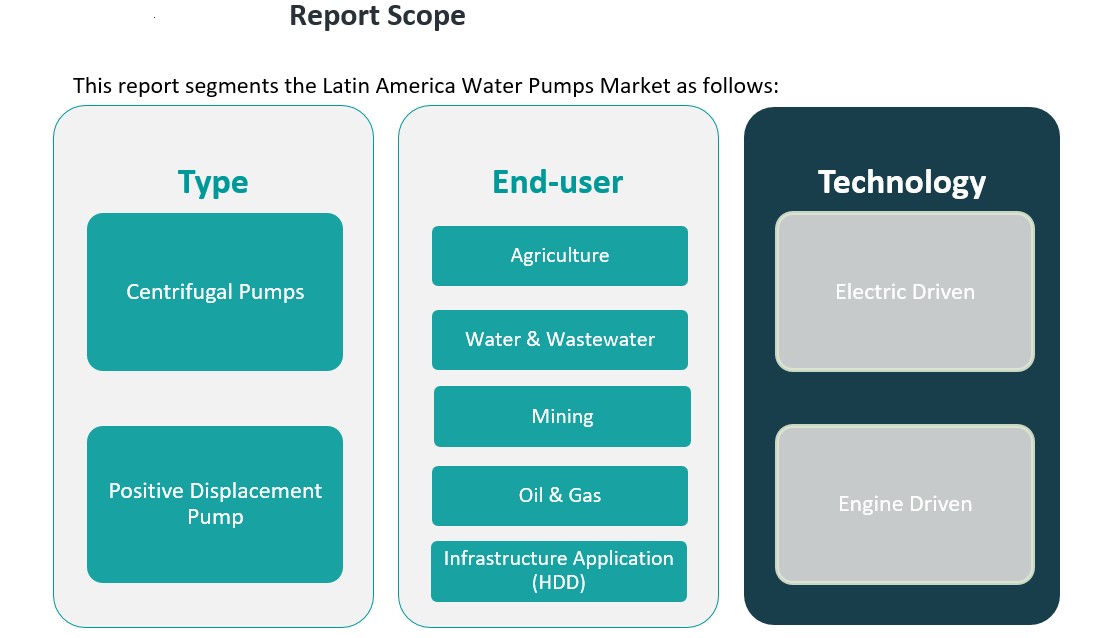
Segmentation:
By Type Segment:
- Centrifugal Pumps
- Positive Displacement Pumps
By End-User Segment:
- Agriculture
- Water & Wastewater
- Mining
- Oil & Gas
- Infrastructure Application (HDD)
By Technology Segment:
- Electric Driven
- Engine Driven
Regional Analysis:
The Latin American water pump market is poised for steady growth, driven by regional economic developments, infrastructure investments, and sector-specific demands. The market is segmented into key regions: Brazil, Mexico, Argentina, Chile, and other countries in Central and South America. Brazil dominates the market, accounting for approximately 45% of the region's total market share. This is largely due to its strong industrial base, extensive agricultural activities, and significant infrastructure projects that require advanced water pumping solutions. As one of the largest economies in Latin America, Brazil's investments in water infrastructure, agriculture, and industrial sectors continue to support its position as the leading market for water pumps in the region.
Brazil
Brazil’s agricultural sector is a key contributor to the water pump market, as efficient irrigation systems are essential for the country’s vast crop production. The country also faces challenges related to water scarcity, particularly in the northeastern region, making water management systems crucial for sustainable development. Additionally, urbanization and infrastructure development in cities like São Paulo and Rio de Janeiro further drive the demand for water pumps in municipal water supply and wastewater management systems. The increasing adoption of solar-powered pumps, especially in rural and off-grid areas, further propels market growth in Brazil.
Mexico
Mexico is another significant player in the Latin American water pump market, holding approximately 25% of the market share. The country’s demand for water pumps is driven by its expanding industrial base, particularly in mining, agriculture, and oil & gas sectors. Water management is a critical issue in Mexico due to the increasing frequency of droughts and the growing demand for water in urban areas. Mexico's investments in desalination plants and wastewater treatment facilities create opportunities for water pump manufacturers, as these systems require high-efficiency pumps to meet the country's water supply needs.
Argentina and Chile
Argentina and Chile collectively account for around 20% of the regional market share. In Argentina, agriculture is a major driver, with a high demand for water pumps for irrigation purposes. The country is increasingly investing in energy-efficient and sustainable water pump technologies to optimize water usage. Chile, on the other hand, has a burgeoning mining industry that relies heavily on water pumps for its operations. Both countries are also seeing a rise in the use of smart and IoT-enabled pumps for enhanced water management.
Rest of Latin America
The remaining 10% of the market share is divided among other Latin American countries such as Colombia, Peru, and Venezuela. These countries are gradually adopting water pump technologies to address infrastructure challenges, urbanization, and agricultural needs. As water scarcity becomes a growing concern in some of these nations, demand for water pumps is expected to increase, especially in irrigation and wastewater management applications.
Key Player Analysis:
- SLB
- Ingersoll Rand
- The Weir Group PLC
- Vaughan Company
- KSB SE & Co. KGaA
- Pentair
- Grundfos Holding A/S
- Xylem
- Flowserve Corporation
- ITT Inc.
- EBARA Corporation
Competitive Analysis:
The Latin America water pump market is competitive, with a mix of global and regional players offering a wide range of solutions to cater to the diverse needs of industries such as agriculture, mining, oil and gas, and infrastructure. Key international players include Grundfos, Xylem, and KSB, which dominate the market with their advanced pumping technologies, energy-efficient systems, and strong regional distribution networks. These companies benefit from their established brand presence and extensive product portfolios that serve both industrial and municipal water management sectors. Local players, such as WEG and Sulzer, also hold a significant share, leveraging their regional expertise and ability to offer customized solutions at competitive prices. Furthermore, the rise of solar-powered and IoT-enabled pumps has created opportunities for both established players and new entrants to innovate and capture market share. As the demand for sustainable and energy-efficient solutions grows, competition will intensify, prompting further technological advancements.
Recent Developments:
- Servotech Power Systems Ltd.launched solar pump controllers on October 28, 2024, designed for 2HP to 10HP water pumps. This aligns with initiatives like PM-KUSUM to promote sustainable farming practices through water-efficient solutions.
- Roto Pumps Ltd.announced the launch of its subsidiary, Roto Energy Systems Ltd., in Feb 2024. This new division focuses on solar-powered water pumping solutions, including submersible and surface pumps, catering to eco-friendly water management needs.
- Grundfos' commitment to the Water Resilience Coalition in March 2025 aligns with the water pump market's focus on sustainability and efficient water management. The coalition’s goals include measurable improvements in global water sustainability by 2030.
- On February 28, 2025, KSB launched the MultiTec Plus pump series, specifically optimized for drinking water transport. This product integrates energy-saving technologies and real-time monitoring capabilities, emphasizing advancements in smart and sustainable water pumping solutions.
Market Concentration & Characteristics:
The Latin America water pump market exhibits a moderate level of market concentration, with several global and regional players holding significant shares. Large multinational corporations like Grundfos, Xylem, and KSB dominate the market, offering a wide range of technologically advanced pumps, including centrifugal, positive displacement, and energy-efficient models. These players benefit from economies of scale, strong brand recognition, and expansive distribution networks across the region. However, the market also features a substantial number of regional players, such as WEG and Sulzer, which focus on localized manufacturing and providing tailored solutions to meet specific market demands. The competitive landscape is characterized by a growing shift towards energy-efficient, sustainable technologies, such as solar-powered and IoT-enabled pumps. Additionally, price sensitivity in some segments, particularly in rural and agricultural applications, encourages innovation in cost-effective solutions. As demand for advanced water management solutions increases, the market will likely see further fragmentation and specialization.
Report Coverage:
The research report offers an in-depth analysis based on Type Segment, End-User Segment and Technology Segment. It details leading market players, providing an overview of their business, product offerings, investments, revenue streams, and key applications. Additionally, the report includes insights into the competitive environment, SWOT analysis, current market trends, as well as the primary drivers and constraints. Furthermore, it discusses various factors that have driven market expansion in recent years. The report also explores market dynamics, regulatory scenarios, and technological advancements that are shaping the industry. It assesses the impact of external factors and global economic changes on market growth. Lastly, it provides strategic recommendations for new entrants and established companies to navigate the complexities of the market.
Future Outlook:
- The Latin America water pump market is expected to grow steadily due to increasing urbanization and infrastructure development.
- Solar-powered pumps will experience significant adoption as cost-effective and sustainable solutions for rural and off-grid areas.
- Demand for energy-efficient pumps will rise as industries seek to reduce operational costs and meet environmental regulations.
- The agricultural sector will continue to drive growth, with greater adoption of irrigation systems to improve crop yields.
- Investments in wastewater treatment and desalination plants will create opportunities for advanced water pumping solutions.
- IoT-enabled water pumps will see increased adoption for real-time monitoring and predictive maintenance.
- Regulatory pressures on water conservation and efficiency will drive the development of advanced pumping technologies.
- The mining and oil & gas sectors will remain key contributors to the demand for high-performance pumps in challenging environments.
- Increasing government focus on water scarcity and resource management will stimulate market growth across the region.
- The rise of local players offering tailored solutions will intensify competition, promoting innovation and cost efficiency.

Request a Free Sample
Fill in your details and we'll send you a free sample report.
- Sample data tables & charts
- Research methodology
Market Dynamics
Urbanization and Population Growth
Rapid urbanization and increasing population in Latin American cities are driving the need for robust water supply and wastewater management systems, directly increasing demand for water pumps in municipal and residential applications.
Agricultural Sector Expansion
The growth of agriculture in countries like Brazil, Argentina, and Mexico requires efficient irrigation systems, fueling demand for advanced water pumps to support higher crop yields and water conservation.
Technological Advancements and Energy Efficiency
The introduction of energy-efficient, IoT-enabled, and solar-powered pumps is attracting industries and municipalities seeking cost-effective, sustainable, and reliable water management solutions, accelerating market adoption.
Government Infrastructure Initiatives
Significant government investments in water infrastructure, including large-scale projects for water distribution, wastewater treatment, and desalination, are boosting the adoption of advanced water pump technologies across the region.
Water Scarcity and Resource Management
Increasing concerns over water scarcity, especially in arid regions and urban centers, are prompting investments in modern water management systems, including pumps for desalination and wastewater treatment, to ensure sustainable water supply.
Need a Custom Version of This Report?
Tailor the scope, geography, or segments to your exact requirements.
- Custom geography or segment scope
- Direct access to our analyst team
Frequently Asked Questions
What is the current size of the Latin America Water Pump Market?
What factors are driving the growth of the Latin America Water Pump Market?
What are the key segments within the Latin America Water Pump Market?
What are some challenges faced by the Latin America Water Pump Market?
Who are the major players in the Latin America Water Pump Market?
Table of Content
Chapter 1 Market Segmentation
- 1.1 Segmentation Framework
- 1.1.1 Product and Service Classification
- 1.1.2 Application and End-Use Classification
- 1.1.3 Technology and Solution Classification
- 1.1.4 Customer and Distribution Channel Classification
- 1.1.5 Geographic Segmentation
- 1.1.6 Market Segment Definitions and Boundaries
- 1.2 By Type
- 1.2.1 Centrifugal Pumps
- 1.2.2 Positive Displacement Pumps
- 1.3 By Country
- 1.3.1 Brazil
- 1.3.2 Mexico
- 1.3.3 Argentina
- 1.3.4 Chile
- 1.3.5 Rest of Latin America
- 1.4 By End-User
- 1.4.1 Agriculture
- 1.4.2 Water & Wastewater
- 1.4.3 Mining
- 1.4.4 Oil & Gas
- 1.4.5 Infrastructure Application (HDD)
- 1.5 By Technology
- 1.5.1 Electric Driven
- 1.5.2 Engine Driven
Chapter 2 Introduction
- 2.1 Report Objectives and Scope
- 2.2 Product Definition and Industry Terminology
- 2.3 Market Inclusions and Exclusions
- 2.4 Research Process
- 2.4.1 Primary Research and Expert Interviews
- 2.4.2 Secondary Research and Source Review
- 2.4.3 Top-Down and Bottom-Up Estimation
- 2.4.4 Data Triangulation and Verification
- 2.5 Market Size Measurement Basis
- 2.5.1 2023: USD 2,828.15 million → 2032: USD 3,734.18 million
- 2.6 Historical and Forecast Reference Periods
- 2.6.1 Base Year: 2023
- 2.6.2 Forecast Period: 2023-2032
- 2.7 Research Assumptions and Limitations
Chapter 3 Executive Summary
- 3.1 Market Snapshot and Key Findings
- 3.2 Base-Year Market Size, 2023
- 3.3 Forecast Market Size, 2032
- 3.4 Revenue and Volume Growth Outlook
- 3.5 Key Demand and Supply Indicators
- 3.6 Leading Market Segments
- 3.7 Fastest-Growing Market Opportunities
- 3.8 Regional Performance Highlights
- 3.9 Technology and Industry Transformation
- 3.10 Competitive Landscape Summary
- 3.11 Analyst View and Strategic Implications
Chapter 4 Latin America Water Pump Market Trends and Developments
- 4.1 Historical Industry Development
- 4.2 Recent Market Trends and Developments
- 4.3 Demand and Customer Behavior Trends
- 4.4 Technology and Product Innovation
- 4.5 Artificial Intelligence, Automation and Digitalization
- 4.6 Local Manufacturing and Supply Chain Realignment
- 4.7 Industry Partnerships, Mergers and Acquisitions
- 4.8 Sustainability and Circular Economy Developments
- 4.9 Government and Private Sector Investment Trends
- 4.10 Emerging Business Models and Commercialization
- 4.11 Industry Developments and Announcements
Chapter 5 Latin America Water Pump Market Production, Supply and Demand Analysis
- 5.1 Demand Trend and Consumption Analysis
- 5.2 Demand Forecast, 2023-2032
- 5.3 Production and Output Trend
- 5.4 Production and Output Forecast, 2023-2032
- 5.5 Installed Capacity and Capacity Utilization
- 5.6 Company-Wise Production Plants and Statistics
- 5.6.1 Installed Production Capacity
- 5.6.2 Actual Production
- 5.6.3 Planned Capacity and Expansion Targets
- 5.7 Supply Chain Structure and Procurement Trends
- 5.8 Supply-Demand Gap and Bottlenecks
- 5.9 Import Dependence and Sourcing Structure
- 5.10 Contract Manufacturing and Outsourcing
- 5.11 Regional Supply and Demand Concentration
Chapter 6 Latin America Water Pump Market Pricing Analysis
- 6.1 Pricing Structure and Measurement
- 6.2 Historical Pricing Trends
- 6.3 Pricing Outlook, 2023-2032
- 6.4 Average Selling Price and Unit Economics
- 6.5 Pricing by Product and Market Segment
- 6.6 Geographic Pricing Differences
- 6.7 Key Input, Energy, Labor and Logistics Costs
- 6.8 Contract Pricing and Purchasing Models
- 6.9 Pricing Sensitivity and Competitive Positioning
- 6.10 Price, Margin and Profitability Implications
Chapter 7 Latin America Water Pump Market Dynamics
- 7.1 Market Growth Drivers
- 7.1.1 Demand-Side Drivers
- 7.1.2 Technology and Innovation Drivers
- 7.1.3 Infrastructure and Investment Drivers
- 7.1.4 Regulatory and Policy Drivers
- 7.2 Market Restraints
- 7.2.1 Cost and Affordability Constraints
- 7.2.2 Technology and Adoption Barriers
- 7.2.3 Supply Chain and Operational Constraints
- 7.3 Market Challenges
- 7.3.1 Competitive Pressure and Margin Erosion
- 7.3.2 Skills, Infrastructure and Implementation Gaps
- 7.4 Emerging Market Opportunities
- 7.5 Market Dynamics Impact and Time-Horizon Assessment
Chapter 8 Latin America Water Pump Value Chain Analysis
- 8.1 Industry Value Chain Overview
- 8.2 Upstream Suppliers and Critical Inputs
- 8.3 Technology and Component Providers
- 8.4 Manufacturing or Service Delivery
- 8.5 Distribution, Channel Partners and Integrators
- 8.6 Downstream Applications and End Users
- 8.7 Value Addition and Profit Pools
- 8.8 Vertical Integration and Outsourcing
- 8.9 Supplier Concentration and Risk
- 8.10 Supply Chain Localization and Resilience
Chapter 9 Latin America Water Pump Market Regulations and Policies
- 9.1 Relevant Laws, Standards and Compliance Frameworks
- 9.2 Product, Service, Safety and Quality Requirements
- 9.3 Government Policies, Incentives and Subsidies
- 9.4 Imports, Exports and Trade Barriers
- 9.5 Public Procurement and Local Content Requirements
- 9.6 Environmental and Sustainability Compliance
- 9.7 Upcoming Policy Changes and Market Implications
Chapter 10 Latin America Water Pump Market Hotspots and Opportunities
- 10.1 Market Opportunity Mapping and Growth Hotspots
- 10.2 High-Growth Applications and Customer Groups
- 10.3 Underserved Markets and White-Space Opportunities
- 10.4 Emerging Technology and Product Opportunities
- 10.5 New Capacity and Investment Hotspots
- 10.6 Market Entry and Expansion Opportunities
- 10.7 Distribution and Partnership Opportunities
- 10.8 Near-Term and Long-Term Commercial Potential
- 10.9 Opportunity Attractiveness and Execution Risks
Chapter 11 Latin America Water Pump Market Outlook, 2023-2032
- 11.1 Market Size and Analysis
- 11.1.1 Revenue (Market Measurement: 2023: USD 2,828.15 million → 2032: USD 3,734.18 million)
- 11.1.2 Market Volume and Quantity Sold
- 11.1.3 Historical Market Size
- 11.1.4 Base-Year Market Size, 2023
- 11.2 Market Forecast, 2023-2032
- 11.2.1 Revenue Forecast to 2032
- 11.2.2 Volume Forecast to 2032
- 11.2.3 CAGR and Year-on-Year Growth
- 11.2.4 Incremental Revenue Opportunity
- 11.3 Forecast Assumptions and Scenario Analysis
- 11.3.1 Base-Case Forecast
- 11.3.2 Optimistic and Conservative Scenarios
- 11.3.3 Technology, Pricing and Policy Sensitivities
- 11.4 Market Attractiveness and Growth Outlook
Chapter 12 Latin America Water Pump Market Segmentation and Outlook
- 12.1 Segmentation Summary and Market Shares, 2023
- 12.2 Largest and Fastest-Growing Segments
- 12.3 By Type - Market Size and Forecast, 2023-2032
- 12.3.1 Segment Definition and Scope
- 12.3.2 Historical Market Size
- 12.3.3 Revenue Forecast, 2023-2032
- 12.3.4 Volume Forecast, 2023-2032
- 12.3.5 Base-Year Market Share, 2023
- 12.3.6 Segment CAGR and Growth Drivers
- 12.3.7 Subsegment Market Size and Forecast
- 12.3.7.1 Centrifugal Pumps
- 12.3.7.2 Positive Displacement Pumps
- 12.3.8 Subsegment Pricing and Adoption Trends
- 12.3.9 Leading Suppliers and Competition
- 12.3.10 Regional Demand and Opportunities
- 12.4 By Country - Market Size and Forecast, 2023-2032
- 12.4.1 Segment Definition and Scope
- 12.4.2 Historical Market Size
- 12.4.3 Revenue Forecast, 2023-2032
- 12.4.4 Volume Forecast, 2023-2032
- 12.4.5 Base-Year Market Share, 2023
- 12.4.6 Segment CAGR and Growth Drivers
- 12.4.7 Subsegment Market Size and Forecast
- 12.4.7.1 Brazil
- 12.4.7.2 Mexico
- 12.4.7.3 Argentina
- 12.4.7.4 Chile
- 12.4.7.5 Rest of Latin America
- 12.4.8 Subsegment Pricing and Adoption Trends
- 12.4.9 Leading Suppliers and Competition
- 12.4.10 Regional Demand and Opportunities
- 12.5 By End-User - Market Size and Forecast, 2023-2032
- 12.5.1 Segment Definition and Scope
- 12.5.2 Historical Market Size
- 12.5.3 Revenue Forecast, 2023-2032
- 12.5.4 Volume Forecast, 2023-2032
- 12.5.5 Base-Year Market Share, 2023
- 12.5.6 Segment CAGR and Growth Drivers
- 12.5.7 Subsegment Market Size and Forecast
- 12.5.7.1 Agriculture
- 12.5.7.2 Water & Wastewater
- 12.5.7.3 Mining
- 12.5.7.4 Oil & Gas
- 12.5.7.5 Infrastructure Application (HDD)
- 12.5.8 Subsegment Pricing and Adoption Trends
- 12.5.9 Leading Suppliers and Competition
- 12.5.10 Regional Demand and Opportunities
- 12.6 By Technology - Market Size and Forecast, 2023-2032
- 12.6.1 Segment Definition and Scope
- 12.6.2 Historical Market Size
- 12.6.3 Revenue Forecast, 2023-2032
- 12.6.4 Volume Forecast, 2023-2032
- 12.6.5 Base-Year Market Share, 2023
- 12.6.6 Segment CAGR and Growth Drivers
- 12.6.7 Subsegment Market Size and Forecast
- 12.6.7.1 Electric Driven
- 12.6.7.2 Engine Driven
- 12.6.8 Subsegment Pricing and Adoption Trends
- 12.6.9 Leading Suppliers and Competition
- 12.6.10 Regional Demand and Opportunities
- 12.7 Segment Growth Comparison
- 12.8 Segment Attractiveness and Priority Matrix
Chapter 13 Latin America Water Pump End-Use and Application Market Outlook
- 13.1 End-Use Industry and Customer Demand Structure
- 13.2 Leading Applications and Customer Groups
- 13.3 End-Use Market Size, Share and Forecast
- 13.4 Major End-Use Industry Deep Dives
- 13.4.1 Customer Requirements and Use Cases
- 13.4.2 Demand and Replacement Cycles
- 13.4.3 Technical and Regulatory Considerations
- 13.4.4 Purchasing and Procurement Models
- 13.4.5 Leading Vendors and Distribution Channels
- 13.4.6 Forecast and Commercial Opportunities
- 13.5 Emerging Applications and Cross-Segment Demand
- 13.6 End-Use Industry Investment Priorities
Chapter 14 Latin America Water Pump Geographic Market Outlook, 2023-2032
- 14.1 Regional Market Size and Country-Level Shares, 2023
- 14.2 Country Market Size Comparison, 2023
- 14.3 Country Market Forecasts, 2023-2032
- 14.4 Subregional Industrial and Demand Clusters
- 14.5 Intra-Regional Pricing and Cost Differences
- 14.6 Cross-Border Trade and Supply Networks
- 14.7 Regional Supply and Demand Balances
- 14.8 Country Opportunity Comparison and Prioritization
Note: Every listed country is covered on the structure shown under the first country.
Chapter 15 Latin America Water Pump Technology, Innovation and Sustainability Outlook
- 15.1 Technology Landscape and Maturity
- 15.2 Product, Process and Service Innovation
- 15.3 AI, Automation and Digital Tools in the Industry
- 15.4 Technology Adoption and Performance Benchmarking
- 15.5 Innovation Pipeline and R&D Investment
- 15.6 Patent and Intellectual Property Trends
- 15.7 Energy Efficiency and Resource Management
- 15.8 Sustainability, Recycling and Circularity
- 15.9 Technology Roadmap, 2023-2032
- 15.10 Risks of Obsolescence and Technology Substitution
Chapter 16 Latin America Water Pump Market Key Strategic Imperatives
- 16.1 Growth and Market Entry Priorities
- 16.2 High-Return Products and Segments
- 16.3 Pricing, Profitability and Cost Optimization
- 16.4 Technology Investment and Product Differentiation
- 16.5 Supply Chain Localization and Resilience
- 16.6 Distribution and Customer Acquisition
- 16.7 Partnership, Acquisition and Capacity Strategy
- 16.8 Regional Expansion Priorities
- 16.9 Short-, Medium- and Long-Term Actions
Chapter 17 Competition Outlook
- 17.1 Industry Competition Characteristics
- 17.2 Market Structure and Concentration
- 17.3 Market Share and Competitive Positioning, 2023
- 17.4 Company-Wise Revenue and Product Benchmarking
- 17.5 Production and Service Capacity Benchmarking
- 17.6 Technology, Pricing and Differentiation
- 17.7 Regional Footprint and Distribution Strength
- 17.8 Mergers, Acquisitions and Strategic Alliances
- 17.9 New Entrants and Competitive Threats
- 17.10 Porter's Five Forces and Industry Attractiveness
- 17.11 Competitive Outlook, 2023-2032
Chapter 18 Company Profiles
- 18.1 Company Coverage and Selection Criteria
- 18.2 Grundfos Holding A/S
- 18.2.1 Business Description
- 18.2.2 Company Ownership and Geographic Presence
- 18.2.3 Product and Service Portfolio
- 18.2.4 Manufacturing and Operating Footprint
- 18.2.5 Production Capacity and Expansion Plans
- 18.2.6 Financial Performance and Investment
- 18.2.7 Market Share and Competitive Position
- 18.2.8 Technology and Innovation Capabilities
- 18.2.9 Strategic Alliances or Partnerships
- 18.2.10 Recent Developments
- 18.2.11 Growth Strategy and Outlook
- 18.3 Xylem
- 18.4 KSB SE & Co. KGaA
- 18.5 Flowserve Corporation
- 18.6 Pentair
- 18.7 EBARA Corporation
- 18.8 ITT Inc.
- 18.9 The Weir Group PLC
- 18.10 Ingersoll Rand
- 18.11 SLB
- 18.12 Other Relevant Market Participants
Note: Every listed company is profiled on the structure shown under the first company. The company list is preliminary and may change based on research findings, market developments, data availability and client requirements.
Chapter 19 Disclaimer
- 19.1 Research and Forecast Disclaimer
- 19.2 Data Source and Estimation Limitations
Note: The depth of individual sections depends on data availability for this market. Volume, capacity, trade and other unit-based metrics are included where applicable.