| REPORT ATTRIBUTE | DETAILS |
|---|---|
| Historical Period | 2020-2023 |
| Base Year | 2024 |
| Forecast Period | 2025-2032 |
| Leisure Centre Market Size 2024 | USD 38,516.22 million |
| Leisure Centre Market, CAGR | 7.45% |
| Leisure Centre Market Size 2032 | USD 71,269.95 million |
Market Overview:
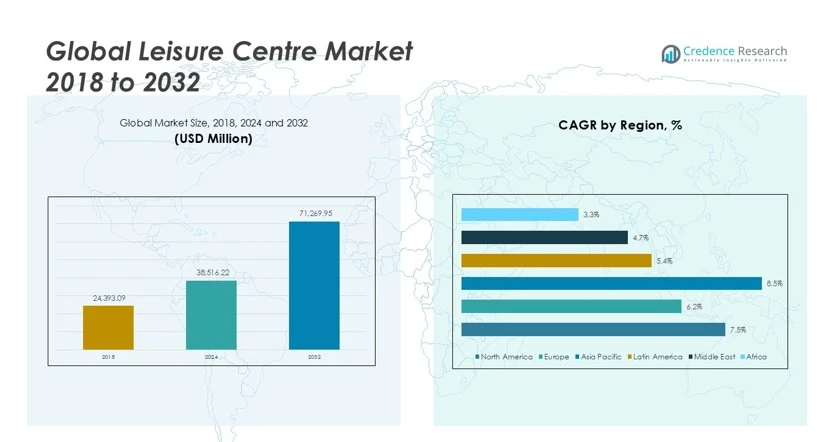
The Leisure Centre market size was valued at USD 24,393.09 million in 2018, increased to USD 38,516.22 million in 2024, and is anticipated to reach USD 71,269.95 million by 2032, at a CAGR of 7.45% during the forecast period.
The Leisure Centre market is characterized by the presence of prominent players such as Birtley Leisure Centre, Blaydon Leisure Centre, Bourne Leisure, Castle Leisure, Fairfield Leisure Centre, Heworth Leisure Centre, INOX Leisure, Kallang Leisure Centre, Lakeside Leisure Centre, and Merlin Entertainments. These companies maintain strong competitive positions through comprehensive service portfolios, modern facility upgrades, and targeted marketing strategies. North America leads the global market, holding a 41% share in 2024, fueled by advanced infrastructure and high consumer participation. Asia Pacific ranks second with a 33% market share, driven by rapid urbanization and a rising middle class, while Europe follows with a 19% share, supported by mature health and wellness trends.
Market Insights
- The Leisure Centre market is valued at USD 38,516.22 million in 2024 and is projected to reach USD 71,269.95 million by 2032, with a CAGR of 7.45% during the forecast period.
- Growing urbanization, rising health awareness, and demand for integrated fitness and recreational amenities are primary drivers fueling sustained growth in both mature and emerging markets.
- Market trends highlight the dominance of indoor leisure facilities, which account for about 58% of revenue, and the continued popularity of swimming activities, leading with a 34% segment share due to broad demographic appeal.
- Key players such as Birtley Leisure Centre, Merlin Entertainments, Bourne Leisure, and INOX Leisure compete by investing in facility upgrades, digital engagement, and localized programming to strengthen market presence.
- North America leads with a 41% regional market share, followed by Asia Pacific at 33% and Europe at 19%, while high operational costs and regulatory compliance present ongoing restraints for operators.
Market Segmentation Analysis:
By Facility Type:
Indoor leisure facilities dominate the facility type segment, accounting for approximately 58% of the total market share. Their popularity stems from the ability to offer consistent, year-round services regardless of weather, attracting urban consumers seeking accessible fitness, wellness, and entertainment options. Urbanization, changing work patterns, and demand for integrated recreational spaces drive continued growth in indoor venues. While outdoor leisure facilities and other types contribute to the market, they primarily address niche or seasonal demand.
- For instance, Merlin Entertainments operates 147 indoor attractions worldwide, with its SEA LIFE venues alone welcoming more than 22 million visitors annually.
By Activity Type:
Swimming is the leading activity type, holding about 34% market share in the Leisure Centre market. This segment’s dominance is driven by its broad appeal to all age groups and its strong linkage with health, rehabilitation, and family recreation. Investment in modern aquatic centers and varied swimming programs supports high utilization rates. Indoor and outdoor sports, as well as gym and personal training, continue to see growth, but swimming remains the primary draw due to its inclusivity and year-round relevance.
- For instance, Birtley Leisure Centre recorded 87,459 individual swim attendances in its main pool during 2023, supported by 32 weekly swim sessions.
By Demographic:
Young adults represent the dominant demographic sub-segment, making up nearly 45% of total participation and revenue. Their strong interest in fitness, flexible membership options, and social wellness experiences drive market growth. Age segmentation highlights varying needs, with youth and families seeking diverse recreational programs and seniors engaging in wellness-focused offerings. Gender balance remains steady across activities, and family size drives uptake of bundled services, reinforcing the market’s focus on adaptable, inclusive programming.
Market Overview
Key Growth Drivers
Urbanization and Changing Lifestyles
Rapid urbanization and evolving consumer lifestyles drive strong demand for leisure centres, especially in metropolitan areas where people seek convenient options for fitness and recreation. Rising disposable income and busy schedules motivate individuals to join facilities that offer integrated wellness, entertainment, and social activities. This shift toward healthier, active living directly contributes to increased memberships and the steady expansion of new leisure centre developments.
- For instance, INOX Leisure opened 81 new locations between 2020 and 2023, bringing its total operational sites to 722 screens in 74 cities.
Technological Advancements in Facility Management
Adoption of advanced technologies such as digital booking platforms, smart equipment, and AI-driven member engagement tools enhances customer experience and operational efficiency. Facilities now use data analytics to personalize services and track usage patterns, resulting in improved retention and higher customer satisfaction. These innovations streamline management, enable flexible programming, and attract tech-savvy users seeking modern amenities.
- For instance, David Lloyd Leisure’s mobile app processed 1.6 million class and court bookings in July 2023 alone across its 132 clubs.
Focus on Health and Wellness
Growing health awareness and preventive healthcare trends position leisure centres as essential community hubs. Consumers are increasingly prioritizing regular exercise, stress management, and holistic wellness, boosting demand for facilities that offer diverse fitness programs and wellness services. Corporate wellness partnerships and public health initiatives further support the sector, driving sustained participation across varied demographic groups.
Key Trends & Opportunities
Expansion of Family-Oriented and Inclusive Programs
Leisure centres are broadening their service offerings to include family-friendly, multi-generational, and inclusive programming. Demand for children’s activities, group classes, and accessible facilities creates opportunities for differentiation. Operators investing in adaptable spaces and inclusive wellness experiences appeal to a wider audience and foster community engagement.
- For instance, Bourne Leisure’s Haven division hosted more than 850,000 family holidaymakers in 2023, offering 650 activity sessions per week across 38 UK parks.
Integration of Digital and Hybrid Membership Models
Digital transformation is reshaping the industry, with leisure centres now offering hybrid memberships that seamlessly combine on-site participation with virtual programming. Members expect easy digital access to services, real-time class bookings, tailored fitness content, and personalized wellness plans, whether attending in person or online. Operators have responded by investing in advanced management platforms and mobile applications, enabling flexible scheduling, live-streamed workouts, and member progress tracking.
- For instance, Kallang Leisure Centre’s Sports Hub app registered 120,000 active users in 2023, providing access to 180 live-streamed classes and real-time bookings for 25 facilities.
Key Challenges
Rising Operational Costs
Escalating costs for energy, staffing, and facility maintenance pressure profit margins, especially for operators in highly competitive urban markets. Balancing investment in modern amenities with affordable membership pricing remains a persistent challenge, prompting facilities to seek efficiency improvements and alternative revenue sources.
Regulatory and Safety Compliance
Adherence to evolving health, safety, and accessibility regulations requires continual investment in training and infrastructure. Operators face challenges in meeting stringent standards for hygiene, emergency preparedness, and inclusivity, especially following heightened expectations post-pandemic. Non-compliance risks both reputational damage and financial penalties.
Seasonal and Economic Volatility
The Leisure Centre market is vulnerable to economic downturns and seasonal fluctuations in membership activity. Economic instability can reduce discretionary spending on recreational services, while demand may drop during certain periods due to holidays or adverse weather. Operators must implement flexible pricing and marketing strategies to maintain steady utilization and revenue.
Regional Analysis
North America
North America leads the Leisure Centre market, with revenue rising from USD 10,104.45 million in 2018 to USD 15,780.06 million in 2024, and expected to reach USD 29,284.75 million by 2032. The region claims the largest share at approximately 41% of the 2024 global market. A CAGR of 7.5% reflects strong momentum, driven by high urbanization, an established fitness culture, and ongoing investment in digital and physical leisure infrastructure. Robust consumer spending and widespread adoption of wellness initiatives ensure continuous growth, with operators expanding offerings to meet diverse urban and suburban needs.
Europe
Europe recorded a market value of USD 4,816.42 million in 2018, rising to USD 7,211.11 million in 2024 and projected to reach USD 12,203.03 million by 2032. Representing about 19% of global market share in 2024, Europe enjoys a CAGR of 6.2%. Growth is driven by strong public health policies, urban development, and consumer demand for both indoor and outdoor recreational spaces. Leading economies such as Germany, the UK, and France benefit from mature leisure infrastructure and well-established health and fitness trends, supporting steady participation across various age groups and communities.
Asia Pacific
Asia Pacific demonstrates rapid expansion, with the market increasing from USD 7,665.04 million in 2018 to USD 12,724.41 million in 2024, and forecast to reach USD 25,515.00 million by 2032. Holding a 33% market share in 2024, the region boasts the highest CAGR at 8.5%. Rising disposable incomes, urbanization, and a growing health-conscious population propel demand for modern leisure and fitness centers. Major economies such as China, India, and Japan lead this momentum, with strong government and private sector investment accelerating facility upgrades and the adoption of smart, technology-driven leisure experiences.
Latin America
Latin America’s market grew from USD 935.23 million in 2018 to USD 1,454.09 million in 2024, with projections reaching USD 2,308.63 million by 2032. The region accounts for about 4% of the global market share in 2024 and a CAGR of 5.4%. Market expansion is supported by urban growth, increasing health awareness, and targeted investments in new leisure infrastructure. Brazil and Mexico anchor regional growth, benefiting from fitness-focused campaigns and the introduction of community-centered programs. While growth is moderate, improved infrastructure and broader wellness adoption underpin the region’s steady upward trend.
Middle East
The Middle East Leisure Centre market increased from USD 591.14 million in 2018 to USD 840.71 million in 2024, with expectations of reaching USD 1,270.56 million by 2032. The region captures around 2% of the global market share in 2024, growing at a CAGR of 4.7%. Expansion is largely fueled by mixed-use developments, government-driven wellness tourism, and premium facility investments, particularly in the UAE and Saudi Arabia. Demand for luxury and family-friendly offerings continues to grow, while the sector responds to the needs of both affluent local populations and a rising expatriate community.
Africa
Africa’s Leisure Centre market expanded from USD 280.81 million in 2018 to USD 505.84 million in 2024 and is anticipated to reach USD 687.97 million by 2032. With about 1% market share in 2024 and a CAGR of 3.3%, Africa remains an emerging market. Growth is fueled by gradual urbanization, economic improvement, and efforts to build community-based recreational spaces. South Africa leads the region, with increasing investments in public infrastructure and youth wellness initiatives. The market’s future will rely on continued infrastructure development and rising middle-class engagement in health and fitness activities.
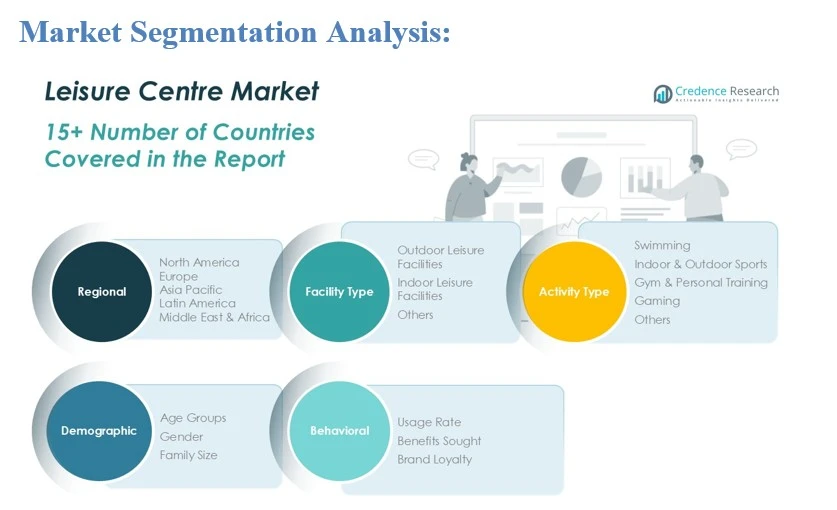
Market Segmentations:
By Facility Type:
- Outdoor Leisure Facilities
- Indoor Leisure Facilities
- Others
By Activity Type:
- Swimming
- Indoor & Outdoor Sports
- Gym & Personal Training
- Gaming
- Others
By Demographic:
- Age Groups
- Gender
- Family Size
By Behavioral:
- Usage Rate
- Benefits Sought
- Brand Loyalty
By Geography:
- North America
- Europe
- Asia Pacific
- Latin America
- Middle East
- Africa
Competitive Landscape
The competitive landscape of the Leisure Centre market features a diverse mix of established operators, regional players, and international brands, each vying for increased market share through innovation, service quality, and strategic expansion. Leading entities such as Birtley Leisure Centre, Blaydon Leisure Centre, and Merlin Entertainments leverage strong brand reputations and extensive product portfolios to attract a broad customer base. Companies focus on differentiating through unique amenities, technology integration, and diversified offerings tailored to evolving consumer preferences. The market also sees active investment in facility upgrades, digital booking solutions, and member engagement platforms to enhance user experience and retention. Strategic partnerships, mergers, and acquisitions remain prominent, enabling operators to scale services and enter new markets. The emphasis on sustainable practices and inclusive programming further shapes competition, while regional players compete by targeting local needs and building strong community connections. Continuous innovation and customer-centric approaches are critical for maintaining competitive advantage in this dynamic sector.
Key Player Analysis
- Birtley Leisure Centre
- Blaydon Leisure Centre
- Bourne Leisure
- Castle Leisure
- Fairfield Leisure Centre
- Heworth Leisure Centre
- INOX Leisure
- Kallang Leisure Centre
- Lakeside Leisure Centre
- Merlin Entertainments
Recent Developments
- In February 2025, David Lloyd Leisure practiced significant growth because of the popularity of racket sports alongside addition of spa facilities. The companies reported adjusted profits of USD 298.87 million for 2024 and are marking a 33% increase from the previous year, and plan to open 20 additional padel courts and four new clubs in 2025.
- In January 2025, plans were approved to replace the Castle Sports Complex in Spalding with a new £26 million leisure hub. The new centre will feature two swimming pools, a gym, outdoor sports facilities, and wellness spaces. Construction is set to begin in spring 2025, with completion expected by autumn 2026.
- In October 2024, there is a growing trend in the U.K. in competitive socializing, where people engage in activities. This sector has seen a 40% increase in revenues since 2018, caused by changes in behavior experiences over goods.
- In September 2024, Guinness World Records planned to inaugurate its first permanent entertainment venue in central London by early 2026. For this opening there is an investment of USD 64.69 million over five years. They intended to feature over 60 games and competitions designed to persuade record-breaking attempts by children and adults.
- In May 2024, Birtley Swimming Centre (part of Birtley Leisure Centre) was transferred from Gateshead Council to the community group Birtley Aquatics. The centre, closed since July 2023, is set to reopen as a community-run facility in September 2024, following essential repairs and equipment upgrades.
Market Concentration & Characteristics
The Leisure Centre Market demonstrates moderate market concentration, with a mix of established international operators, regional leaders, and independent centers shaping a competitive environment. It features several prominent players with significant market share in key regions, while local facilities maintain a strong presence in smaller cities and communities. The market exhibits high differentiation through diverse service offerings, facility innovations, and tailored programs that address evolving consumer preferences across age groups and lifestyles. It benefits from strong urban demand, a rising focus on wellness, and investment in advanced digital and fitness solutions. Barriers to entry include substantial capital requirements, regulatory compliance, and the need for continuous upgrades to maintain relevance. The Leisure Centre Market is characterized by flexible business models, hybrid membership options, and increasing integration of technology to enhance user experience. Regional growth dynamics, demographic trends, and a strong shift toward holistic wellness experiences shape the overall competitive landscape and long-term market trajectory.
Report Coverage
The research report offers an in-depth analysis based on Facility Type, Activity Type, Demographic, Behavioral and Geography. It details leading market players, providing an overview of their business, product offerings, investments, revenue streams, and key applications. Additionally, the report includes insights into the competitive environment, SWOT analysis, current market trends, as well as the primary drivers and constraints. Furthermore, it discusses various factors that have driven market expansion in recent years. The report also explores market dynamics, regulatory scenarios, and technological advancements that are shaping the industry. It assesses the impact of external factors and global economic changes on market growth. Lastly, it provides strategic recommendations for new entrants and established companies to navigate the complexities of the market.
Future Outlook
- Expansion of hybrid membership models combining on-site access and virtual programming will widen consumer reach.
- Adoption of smart facility management systems will enhance operational efficiency and reduce energy costs.
- Integration of wearable technology and data analytics will support personalized fitness and wellness experiences.
- Rise in demand for family‑oriented and multi‑generational programming will align with changing consumer lifestyles.
- Investment in sustainable infrastructure and eco-friendly facility upgrades will improve brand reputation and reduce costs.
- Partnerships with corporate wellness programs and healthcare providers will create new revenue channels.
- Flexible pricing strategies and dynamic membership offerings will support retention during economic fluctuations.
- Development of inclusive and accessible facilities will broaden appeal to diverse demographic groups.
- Expansion into emerging markets will offer growth opportunities as disposable incomes rise and urbanization continues.
- Emphasis on community‑centric events and engagement programs will foster local loyalty and increase utilization.

Request a Free Sample
Fill in your details and we'll send you a free sample report.
- Sample data tables & charts
- Research methodology
Market Dynamics
Urbanization and Changing Lifestyles
Rapid urbanization and evolving consumer lifestyles are increasing demand for leisure centres, particularly in metropolitan areas where consumers seek convenient, integrated options for fitness, recreation, and social activities.
Technological Advancements in Facility Management
The adoption of digital booking platforms, smart equipment, and AI-driven engagement tools is enhancing customer experience and operational efficiency, attracting tech-savvy users and improving retention rates.
Focus on Health and Wellness
Growing health awareness and preventive healthcare trends are positioning leisure centres as essential community hubs, with consumers prioritizing regular exercise, stress management, and holistic wellness programs.
Expansion of Family-Oriented and Inclusive Programs
Leisure centres are broadening their offerings to include family-friendly, multi-generational, and inclusive programming, appealing to a wider demographic and fostering community engagement.
Integration of Digital and Hybrid Membership Models
The rise of hybrid memberships that combine on-site and virtual participation is expanding consumer reach, offering flexibility and personalized experiences that align with modern consumer expectations.
Need a Custom Version of This Report?
Tailor the scope, geography, or segments to your exact requirements.
- Custom geography or segment scope
- Direct access to our analyst team
Frequently Asked Questions
What is the current size of the Leisure Centre Market?
What factors are driving the growth of the Leisure Centre Market?
What are the key segments within the Leisure Centre Market?
What are some challenges faced by the Leisure Centre Market?
Who are the major players in the Leisure Centre Market?
Table of Content
Chapter 1 Market Segmentation
- 1.1 Segmentation Framework
- 1.1.1 Product and Service Classification
- 1.1.2 Application and End-Use Classification
- 1.1.3 Technology and Solution Classification
- 1.1.4 Customer and Distribution Channel Classification
- 1.1.5 Geographic Segmentation
- 1.1.6 Market Segment Definitions and Boundaries
- 1.2 By Demographic
- 1.2.1 Age Groups
- 1.2.2 Gender
- 1.2.3 Family Size
- 1.3 By Activity Type
- 1.3.1 Swimming
- 1.3.2 Indoor & Outdoor Sports
- 1.3.3 Gym & Personal Training
- 1.3.4 Gaming
- 1.3.5 Others
- 1.4 By Facility Type
- 1.4.1 Indoor Leisure Facilities
- 1.4.2 Outdoor Leisure Facilities
- 1.4.3 Others
Chapter 2 Introduction
- 2.1 Report Objectives and Scope
- 2.2 Product Definition and Industry Terminology
- 2.3 Market Inclusions and Exclusions
- 2.4 Research Process
- 2.4.1 Primary Research and Expert Interviews
- 2.4.2 Secondary Research and Source Review
- 2.4.3 Top-Down and Bottom-Up Estimation
- 2.4.4 Data Triangulation and Verification
- 2.5 Market Size Measurement Basis
- 2.5.1 2024: USD 38,516.22 million → 2032: USD 71,269.95 million
- 2.6 Historical and Forecast Reference Periods
- 2.6.1 Base Year: 2024
- 2.6.2 Forecast Period: 2024-2032
- 2.7 Research Assumptions and Limitations
Chapter 3 Executive Summary
- 3.1 Market Snapshot and Key Findings
- 3.2 Base-Year Market Size, 2024
- 3.3 Forecast Market Size, 2032
- 3.4 Revenue and Volume Growth Outlook
- 3.5 Key Demand and Supply Indicators
- 3.6 Leading Market Segments
- 3.7 Fastest-Growing Market Opportunities
- 3.8 Regional Performance Highlights
- 3.9 Technology and Industry Transformation
- 3.10 Competitive Landscape Summary
- 3.11 Analyst View and Strategic Implications
Chapter 4 Global Leisure Centre Market Trends and Developments
- 4.1 Historical Industry Development
- 4.2 Recent Market Trends and Developments
- 4.3 Demand and Customer Behavior Trends
- 4.4 Technology and Product Innovation
- 4.5 Artificial Intelligence, Automation and Digitalization
- 4.6 Local Manufacturing and Supply Chain Realignment
- 4.7 Industry Partnerships, Mergers and Acquisitions
- 4.8 Sustainability and Circular Economy Developments
- 4.9 Government and Private Sector Investment Trends
- 4.10 Emerging Business Models and Commercialization
- 4.11 Industry Developments and Announcements
Chapter 5 Global Leisure Centre Market Production, Supply and Demand Analysis
- 5.1 Demand Trend and Consumption Analysis
- 5.2 Demand Forecast, 2024-2032
- 5.3 Production and Output Trend
- 5.4 Production and Output Forecast, 2024-2032
- 5.5 Installed Capacity and Capacity Utilization
- 5.6 Company-Wise Production Plants and Statistics
- 5.6.1 Installed Production Capacity
- 5.6.2 Actual Production
- 5.6.3 Planned Capacity and Expansion Targets
- 5.7 Supply Chain Structure and Procurement Trends
- 5.8 Supply-Demand Gap and Bottlenecks
- 5.9 Import Dependence and Sourcing Structure
- 5.10 Contract Manufacturing and Outsourcing
- 5.11 Regional Supply and Demand Concentration
Chapter 6 Global Leisure Centre Market Pricing Analysis
- 6.1 Pricing Structure and Measurement
- 6.2 Historical Pricing Trends
- 6.3 Pricing Outlook, 2024-2032
- 6.4 Average Selling Price and Unit Economics
- 6.5 Pricing by Product and Market Segment
- 6.6 Geographic Pricing Differences
- 6.7 Key Input, Energy, Labor and Logistics Costs
- 6.8 Contract Pricing and Purchasing Models
- 6.9 Pricing Sensitivity and Competitive Positioning
- 6.10 Price, Margin and Profitability Implications
Chapter 7 Global Leisure Centre Market Dynamics
- 7.1 Market Growth Drivers
- 7.1.1 Demand-Side Drivers
- 7.1.2 Technology and Innovation Drivers
- 7.1.3 Infrastructure and Investment Drivers
- 7.1.4 Regulatory and Policy Drivers
- 7.2 Market Restraints
- 7.2.1 Cost and Affordability Constraints
- 7.2.2 Technology and Adoption Barriers
- 7.2.3 Supply Chain and Operational Constraints
- 7.3 Market Challenges
- 7.3.1 Competitive Pressure and Margin Erosion
- 7.3.2 Skills, Infrastructure and Implementation Gaps
- 7.4 Emerging Market Opportunities
- 7.5 Market Dynamics Impact and Time-Horizon Assessment
Chapter 8 Global Leisure Centre Value Chain Analysis
- 8.1 Industry Value Chain Overview
- 8.2 Upstream Suppliers and Critical Inputs
- 8.3 Technology and Component Providers
- 8.4 Manufacturing or Service Delivery
- 8.5 Distribution, Channel Partners and Integrators
- 8.6 Downstream Applications and End Users
- 8.7 Value Addition and Profit Pools
- 8.8 Vertical Integration and Outsourcing
- 8.9 Supplier Concentration and Risk
- 8.10 Supply Chain Localization and Resilience
Chapter 9 Global Leisure Centre Market Regulations and Policies
- 9.1 Relevant Laws, Standards and Compliance Frameworks
- 9.2 Product, Service, Safety and Quality Requirements
- 9.3 Government Policies, Incentives and Subsidies
- 9.4 Imports, Exports and Trade Barriers
- 9.5 Public Procurement and Local Content Requirements
- 9.6 Environmental and Sustainability Compliance
- 9.7 Upcoming Policy Changes and Market Implications
Chapter 10 Global Leisure Centre Market Hotspots and Opportunities
- 10.1 Market Opportunity Mapping and Growth Hotspots
- 10.2 High-Growth Applications and Customer Groups
- 10.3 Underserved Markets and White-Space Opportunities
- 10.4 Emerging Technology and Product Opportunities
- 10.5 New Capacity and Investment Hotspots
- 10.6 Market Entry and Expansion Opportunities
- 10.7 Distribution and Partnership Opportunities
- 10.8 Near-Term and Long-Term Commercial Potential
- 10.9 Opportunity Attractiveness and Execution Risks
Chapter 11 Global Leisure Centre Market Outlook, 2024-2032
- 11.1 Market Size and Analysis
- 11.1.1 Revenue (Market Measurement: 2024: USD 38,516.22 million → 2032: USD 71,269.95 million)
- 11.1.2 Market Volume and Quantity Sold
- 11.1.3 Historical Market Size
- 11.1.4 Base-Year Market Size, 2024
- 11.2 Market Forecast, 2024-2032
- 11.2.1 Revenue Forecast to 2032
- 11.2.2 Volume Forecast to 2032
- 11.2.3 CAGR and Year-on-Year Growth
- 11.2.4 Incremental Revenue Opportunity
- 11.3 Forecast Assumptions and Scenario Analysis
- 11.3.1 Base-Case Forecast
- 11.3.2 Optimistic and Conservative Scenarios
- 11.3.3 Technology, Pricing and Policy Sensitivities
- 11.4 Market Attractiveness and Growth Outlook
Chapter 12 Global Leisure Centre Market Segmentation and Outlook
- 12.1 Segmentation Summary and Market Shares, 2024
- 12.2 Largest and Fastest-Growing Segments
- 12.3 By Demographic - Market Size and Forecast, 2024-2032
- 12.3.1 Segment Definition and Scope
- 12.3.2 Historical Market Size
- 12.3.3 Revenue Forecast, 2024-2032
- 12.3.4 Volume Forecast, 2024-2032
- 12.3.5 Base-Year Market Share, 2024
- 12.3.6 Segment CAGR and Growth Drivers
- 12.3.7 Subsegment Market Size and Forecast
- 12.3.7.1 Age Groups
- 12.3.7.2 Gender
- 12.3.7.3 Family Size
- 12.3.8 Subsegment Pricing and Adoption Trends
- 12.3.9 Leading Suppliers and Competition
- 12.3.10 Regional Demand and Opportunities
- 12.4 By Activity Type - Market Size and Forecast, 2024-2032
- 12.4.1 Segment Definition and Scope
- 12.4.2 Historical Market Size
- 12.4.3 Revenue Forecast, 2024-2032
- 12.4.4 Volume Forecast, 2024-2032
- 12.4.5 Base-Year Market Share, 2024
- 12.4.6 Segment CAGR and Growth Drivers
- 12.4.7 Subsegment Market Size and Forecast
- 12.4.7.1 Swimming
- 12.4.7.2 Indoor & Outdoor Sports
- 12.4.7.3 Gym & Personal Training
- 12.4.7.4 Gaming
- 12.4.7.5 Others
- 12.4.8 Subsegment Pricing and Adoption Trends
- 12.4.9 Leading Suppliers and Competition
- 12.4.10 Regional Demand and Opportunities
- 12.5 By Facility Type - Market Size and Forecast, 2024-2032
- 12.5.1 Segment Definition and Scope
- 12.5.2 Historical Market Size
- 12.5.3 Revenue Forecast, 2024-2032
- 12.5.4 Volume Forecast, 2024-2032
- 12.5.5 Base-Year Market Share, 2024
- 12.5.6 Segment CAGR and Growth Drivers
- 12.5.7 Subsegment Market Size and Forecast
- 12.5.7.1 Indoor Leisure Facilities
- 12.5.7.2 Outdoor Leisure Facilities
- 12.5.7.3 Others
- 12.5.8 Subsegment Pricing and Adoption Trends
- 12.5.9 Leading Suppliers and Competition
- 12.5.10 Regional Demand and Opportunities
- 12.6 Segment Growth Comparison
- 12.7 Segment Attractiveness and Priority Matrix
Chapter 13 Global Leisure Centre Geographic Market Outlook, 2024-2032
- 13.1 Regional Market Size and Share, 2024
- 13.2 Regional Market Forecast, 2024-2032
- 13.3 Regional Pricing, Production and Demand Differences
- 13.4 North America
- 13.4.1 United States
- 13.4.2 Canada
- 13.4.3 Mexico
- 13.5 Europe
- 13.5.1 Germany
- 13.5.2 France
- 13.5.3 Italy
- 13.5.4 United Kingdom
- 13.5.5 Spain
- 13.5.6 Poland
- 13.5.7 Russia
- 13.5.8 Netherlands
- 13.5.9 Belgium
- 13.5.10 Sweden
- 13.5.11 Denmark
- 13.5.12 Norway
- 13.5.13 Rest of Europe
- 13.6 Asia Pacific
- 13.6.1 China
- 13.6.2 India
- 13.6.3 Japan
- 13.6.4 South Korea
- 13.6.5 Thailand
- 13.6.6 Indonesia
- 13.6.7 Vietnam
- 13.6.8 Malaysia
- 13.6.9 Australia
- 13.6.10 Rest of Asia Pacific
- 13.7 Latin America
- 13.7.1 Brazil
- 13.7.2 Argentina
- 13.7.3 Colombia
- 13.7.4 Chile
- 13.7.5 Rest of Latin America
- 13.8 Middle East
- 13.8.1 Saudi Arabia
- 13.8.2 United Arab Emirates
- 13.8.3 Turkey
- 13.8.4 Israel
- 13.8.5 Iran
- 13.8.6 Rest of the Middle East
- 13.9 Africa
- 13.9.1 South Africa
- 13.9.2 Egypt
- 13.9.3 Nigeria
- 13.9.4 Morocco
- 13.9.5 Rest of Africa
- 13.10 Regional Investment, Policy and Supply Chain Differences
- 13.11 Regional Competitive Landscape
- 13.12 Geographic Growth Hotspots
Chapter 14 Global Leisure Centre Technology, Innovation and Sustainability Outlook
- 14.1 Technology Landscape and Maturity
- 14.2 Product, Process and Service Innovation
- 14.3 AI, Automation and Digital Tools in the Industry
- 14.4 Technology Adoption and Performance Benchmarking
- 14.5 Innovation Pipeline and R&D Investment
- 14.6 Patent and Intellectual Property Trends
- 14.7 Energy Efficiency and Resource Management
- 14.8 Sustainability, Recycling and Circularity
- 14.9 Technology Roadmap, 2024-2032
- 14.10 Risks of Obsolescence and Technology Substitution
Chapter 15 Global Leisure Centre Market Key Strategic Imperatives
- 15.1 Growth and Market Entry Priorities
- 15.2 High-Return Products and Segments
- 15.3 Pricing, Profitability and Cost Optimization
- 15.4 Technology Investment and Product Differentiation
- 15.5 Supply Chain Localization and Resilience
- 15.6 Distribution and Customer Acquisition
- 15.7 Partnership, Acquisition and Capacity Strategy
- 15.8 Regional Expansion Priorities
- 15.9 Short-, Medium- and Long-Term Actions
Chapter 16 Competition Outlook
- 16.1 Industry Competition Characteristics
- 16.2 Market Structure and Concentration
- 16.3 Market Share and Competitive Positioning, 2024
- 16.4 Company-Wise Revenue and Product Benchmarking
- 16.5 Production and Service Capacity Benchmarking
- 16.6 Technology, Pricing and Differentiation
- 16.7 Regional Footprint and Distribution Strength
- 16.8 Mergers, Acquisitions and Strategic Alliances
- 16.9 New Entrants and Competitive Threats
- 16.10 Porter's Five Forces and Industry Attractiveness
- 16.11 Competitive Outlook, 2024-2032
Chapter 17 Company Profiles
- 17.1 Company Coverage and Selection Criteria
- 17.2 Birtley Leisure Centre
- 17.2.1 Business Description
- 17.2.2 Company Ownership and Geographic Presence
- 17.2.3 Product and Service Portfolio
- 17.2.4 Manufacturing and Operating Footprint
- 17.2.5 Production Capacity and Expansion Plans
- 17.2.6 Financial Performance and Investment
- 17.2.7 Market Share and Competitive Position
- 17.2.8 Technology and Innovation Capabilities
- 17.2.9 Strategic Alliances or Partnerships
- 17.2.10 Recent Developments
- 17.2.11 Growth Strategy and Outlook
- 17.3 Blaydon Leisure Centre
- 17.4 Bourne Leisure
- 17.5 Castle Leisure
- 17.6 Fairfield Leisure Centre
- 17.7 Heworth Leisure Centre
- 17.8 INOX Leisure
- 17.9 Kallang Leisure Centre
- 17.10 Lakeside Leisure Centre
- 17.11 Merlin Entertainments
- 17.12 Other Relevant Market Participants
Note: Every listed company is profiled on the structure shown under the first company. The company list is preliminary and may change based on research findings, market developments, data availability and client requirements.
Chapter 18 Disclaimer
- 18.1 Research and Forecast Disclaimer
- 18.2 Data Source and Estimation Limitations
Note: The depth of individual sections depends on data availability for this market. Volume, capacity, trade and other unit-based metrics are included where applicable.