
Market overview
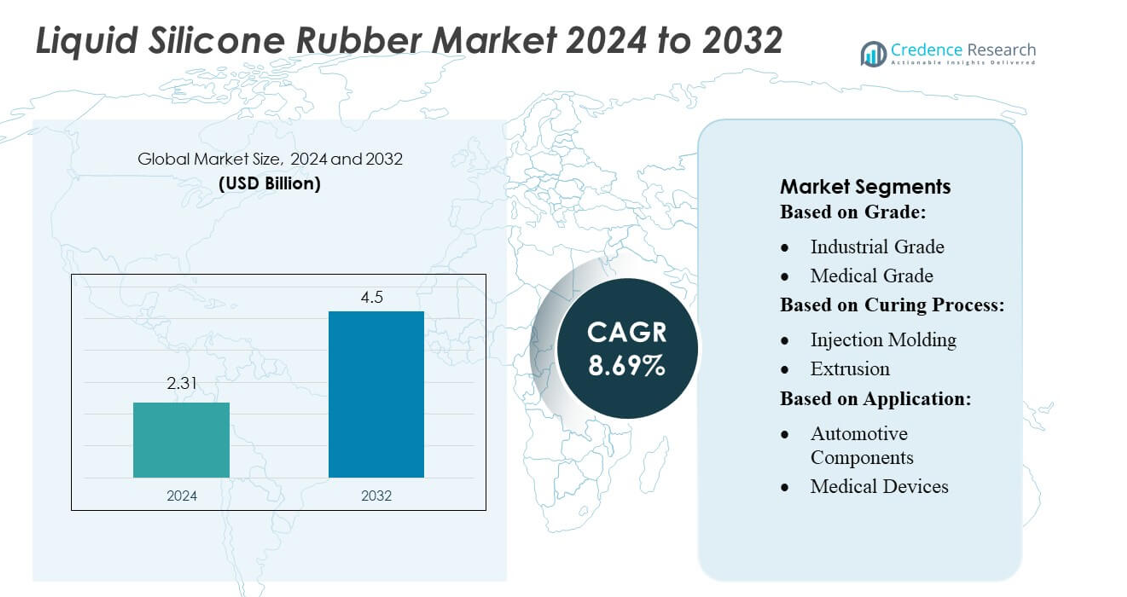
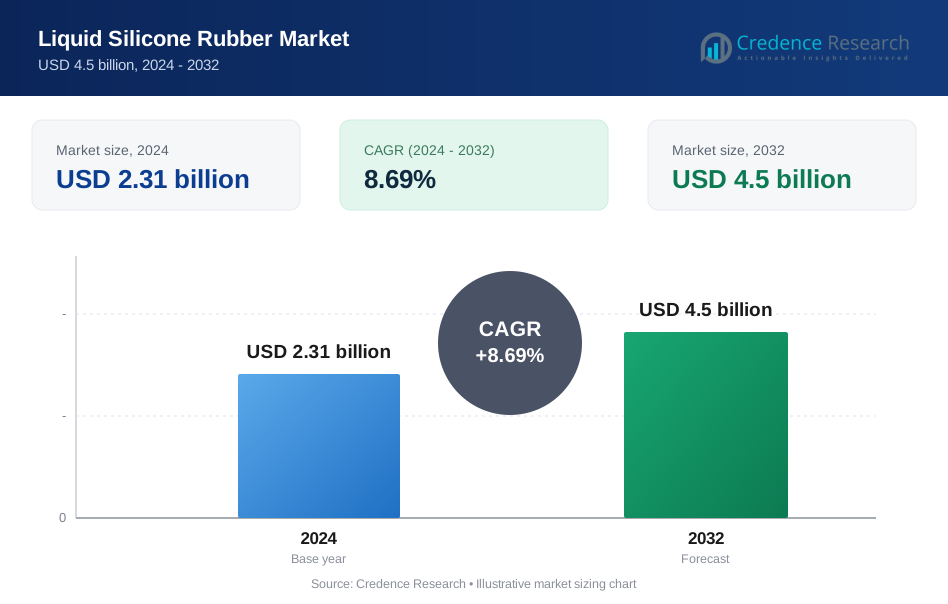
Liquid Silicone Rubber Market size was valued USD 2.31 billion in 2024 and is anticipated to reach USD 4.5 billion by 2032, at a CAGR of 8.69% during the forecast period.
| REPORT ATTRIBUTE | DETAILS |
|---|---|
| Historical Period | 2020-2023 |
| Base Year | 2024 |
| Forecast Period | 2025-2032 |
| Liquid Silicone Rubber Market Size 2024 | USD 2.31 billion |
| Liquid Silicone Rubber Market, CAGR | 8.69% |
| Liquid Silicone Rubber Market Size 2032 | USD 4.5 billion |
The Liquid Silicone Rubber Market is supported by a diverse group of global manufacturers that focus on producing high-purity formulations, precision-molded components, and application-specific LSR grades for medical, automotive, electronics, and industrial sectors. These companies strengthen competitiveness through advanced injection molding technologies, material innovations, and expanded manufacturing footprints across high-growth regions. Asia-Pacific leads the global market with approximately 38% share, driven by large-scale electronics production, rapid industrialization, and strong demand from automotive and medical device manufacturing hubs. Continuous investment in automated LSR processing and rising consumption of high-performance elastomer components reinforce the region’s long-term dominance.
Market Insights
- The Liquid Silicone Rubber Market was valued at USD 2.31 billion in 2024 and is projected to reach USD 4.5 billion by 2032, expanding at a CAGR of 8.69%, reflecting strong demand across medical, automotive, electronics, and industrial applications.
- Market growth is driven by rising adoption of medical-grade LSR for biocompatible devices, increasing EV-related component production, and expanding use of high-precision LSR parts in wearable electronics and industrial automation.
- Advancements in automated injection molding, ultra-pure formulations, and micro-molding technologies continue shaping key market trends, supporting larger production volumes and improved design flexibility.
- Competitive intensity increases as manufacturers invest in new material grades, regional manufacturing expansions, and customized LSR solutions, although high production costs and equipment investments remain key restraints.
- Asia-Pacific leads with 38% share, supported by strong electronics and automotive manufacturing, while the medical devices segment maintains the largest application share due to stringent performance and purity requirements.
Market Segmentation Analysis:
By Grade
The Liquid Silicone Rubber Market by grade is led by Industrial Grade, holding over 55% share, driven by its broad use in automotive seals, electronics insulation, kitchenware, and industrial components requiring high thermal stability and durability. Medical Grade remains a fast-growing segment due to rising demand for biocompatible materials in implants and wearable sensors, while Food Grade finds niche adoption in baking molds and dispensing components. Continuous formulation improvements, compliance with regulatory standards, and rising precision molding needs reinforce the dominance of Industrial Grade across diversified manufacturing environments.
- For instance, Silopren™ LSR 7000 series delivers faster cure rates and maintains mechanical stability at temperatures from –50°C to 200°C, enhancing throughput for automotive and electronics manufacturers.
By Curing Process
Injection Molding dominates the curing process segment with nearly 60% market share, supported by its high throughput, reduced cycle time, and suitability for complex geometries widely required in automotive, electronics, and medical applications. Extrusion continues expanding due to increasing output of hoses, tubes, and profiles, while Compression Molding remains relevant for low-volume industrial components. Emerging 3D Printing applications leverage LSR’s elasticity and heat resistance to support prototyping and customized device production. The dominance of Injection Molding is driven by automation compatibility and ability to maintain dimensional consistency at large production scales.
- For instance, WACKER’s ELASTOSIL® LR 5040 series, for example, enables faster cycle times through ultra-fast platinum-catalyzed curing and eliminates post-curing, which ensures high dimensional stability and low volatile content below 0.5% for precision micro-components.
By Application
Medical Devices represent the dominant application segment, accounting for around 35% market share, propelled by increasing use of hypoallergenic, sterilizable, and biocompatible LSR in catheters, valves, respiratory masks, and implantable components. Automotive Components follow closely as OEMs utilize LSR for gaskets, connectors, and vibration-dampening parts. Consumer Products gain steady adoption due to rising demand for durable kitchenware and wearable accessories. Electronics materials benefit from LSR’s dielectric properties, while industrial products and other categories expand gradually. The leadership of Medical Devices stems from stringent safety standards and growing global healthcare device consumption.
Key Growth Drivers
Rising Demand from Medical and Healthcare Applications
The Liquid Silicone Rubber Market benefits strongly from increasing adoption of biocompatible and hypoallergenic materials in medical devices. Manufacturers use LSR for catheters, seals, valves, respiratory masks, infant care products, and implantable components that require durability, sterilization compatibility, and high purity. Growing investment in minimally invasive procedures and wearable health monitoring devices boosts the demand for medical-grade LSR. Regulatory compliance with ISO 10993 and FDA standards further reinforces its penetration in clinical applications, making healthcare a consistent driver of long-term market expansion.
- For instance, Trelleborg facilities utilize cleanrooms that conform to ISO 14644-1 standards, including Class 100,000 (ISO 8) for production and Class 10,000 (ISO 7) for post-production processing like washing and double-bagging.
Expanding Use in Automotive and Electric Vehicle Components
Growing vehicle electrification and demand for high-performance sealing materials drive the adoption of LSR across automotive applications. Its temperature resistance, electrical insulation properties, and vibration-dampening capabilities make it essential for connectors, gaskets, sensors, battery components, and under-the-hood parts. Automakers prioritize LSR for components exposed to heat and harsh environments, while EV manufacturers increasingly require silicone-based materials to ensure thermal stability and long operational life. The shift toward advanced driver-assistance systems and higher electronic integration further strengthens the role of LSR in modern vehicle platforms.
- For instance, Elkem Silicones won the Ringier Technology Innovation Award for its BLUESIL™ LSR 3935 product. This product is designed for high-voltage EV connector sealing and offers Shore-A hardness from ShA 20 to ShA 60 while delivering long-term waterproofing, self-lubrication, and improved thermal stability.
Increased Adoption in Consumer Electronics and Industrial Applications
The market experiences significant growth due to rising demand for LSR in electronic encapsulation, keypads, wearables, and high-precision industrial components. LSR provides excellent dielectric strength, moisture resistance, and flexibility, making it ideal for protecting circuits and producing durable touch interfaces. Industrial automation expands the need for LSR parts resistant to chemicals and mechanical stress. Growth in smart devices, IoT hardware, and compact electronic housing supports broader application of LSR in precision-molded engineering components. Manufacturers also invest in automated molding technologies to enhance production reliability and reduce cycle times.
Key Trends & Opportunities
Advancements in LSR Injection Molding and Automation
A major trend shaping the market is the rapid advancement of automated LSR injection molding systems designed to improve throughput, accuracy, and material efficiency. Fully automated dosing, mixing, and molding units significantly reduce labor dependency, defects, and cycle times. This trend opens new opportunities for high-volume production of medical, automotive, and electronics components with complex geometries. Increasing integration of digital monitoring and closed-loop control enhances process stability, enabling consistent quality assurance. These advancements encourage manufacturers to scale operations and meet growing demand for high-precision LSR parts.
- For instance, Shin-Etsu’s FE-201-U series (hardness ShA 25-80) and FE-301-U series (hardness ShA 40-80) demonstrate superior oil resistance under high heat, which is a critical performance characteristic for fluorosilicone rubber (FSR) applications.
Growing Opportunity in Wearable Devices and Soft Robotics
Rising consumer adoption of smart wearables, flexible sensors, and soft robotic systems creates strong opportunities for LSR materials due to their elasticity, skin compatibility, and long-term durability. Companies develop ultra-soft LSR formulations for skin-contact applications such as fitness trackers, therapeutic patches, and continuous monitoring devices. Soft robotics manufacturers increasingly use LSR to produce grippers, actuators, and cushioning components that require biomechanical flexibility. The convergence of medical-grade silicone, electronics miniaturization, and human-machine interaction is accelerating material innovations across both consumer and industrial domains.
- For instance, Avantor’s NuSil™ MED-6015 is a low consistency medical-grade silicone elastomer suitable for applications such as encapsulation and injection molded parts, which has a typical hardness of 50 Shore A and an elongation of 100%.
Expansion of 3D Printing Technologies for Customized LSR Components
The development of additive manufacturing technologies capable of processing Liquid Silicone Rubber presents a notable emerging opportunity. Advanced 3D printers enable manufacturers to create customized, low-volume, and complex elastomeric components that are difficult to achieve through traditional molding. Industries such as healthcare, electronics, and prototyping benefit from rapid design iterations and personalized geometries. This trend supports the growth of patient-specific medical implants, wearable interface components, and engineering prototypes. As LSR-compatible printing systems become more affordable, demand for customized silicone products is expected to accelerate.
Key Challenges
High Production Costs and Need for Advanced Processing Equipment
A major challenge for the Liquid Silicone Rubber Market is the high capital investment required for advanced injection molding machines, precision dosing systems, and automated production setups. LSR processing demands specialized equipment and tight control over temperature, curing, and material mixing, which raises operational costs for manufacturers. The initial investment becomes a constraint for small-scale producers and limits adoption in cost-sensitive applications. Material costs also remain relatively high compared to conventional elastomers, affecting price competitiveness and slowing adoption in low-margin product categories.
Technical Limitations in Processing Complex Multimaterial and Hybrid Components
Despite its versatility, LSR faces challenges in applications that require strong bonding with dissimilar materials such as certain plastics or metals. Achieving reliable adhesion often demands surface treatments, primers, or specialized co-molding techniques, increasing production complexity. Some hybrid components require compatibility with high-temperature processes that may degrade silicone properties. These limitations constrain the integration of LSR in advanced electronic assemblies and structural automotive parts. The development of improved adhesion technologies and multimaterial processing capabilities remains essential to broaden LSR’s usability in emerging high-performance applications.
Regional Analysis
North America
North America holds around 32% share of the Liquid Silicone Rubber Market, driven by strong adoption of LSR in medical devices, automotive systems, and high-performance electronics. The U.S. leads consumption due to its advanced healthcare manufacturing ecosystem, strict regulatory standards, and high demand for biocompatible components. Automotive suppliers increasingly use LSR for connectors, gaskets, and thermal-resistant parts, while consumer electronics manufacturers integrate LSR for keypad assemblies and encapsulation. Continuous innovation in injection molding and rising investment in medical wearables strengthen the region’s growth momentum, supporting consistent long-term demand for premium LSR formulations.
Europe
Europe accounts for roughly 28% share, supported by strong industrial automation, mature automotive production, and stringent safety regulations across medical and electronics sectors. Germany, France, and Italy dominate LSR consumption, especially in high-precision molded components for electric vehicles, medical consumables, and electronic encapsulation. Increased focus on sustainable manufacturing and compliance with REACH and ISO standards reinforces the adoption of high-purity LSR grades. Demand rises further as European OEMs integrate LSR into EV battery systems, charging connectors, and sensors. Continuous advancements in material science and strong R&D capabilities maintain Europe’s competitive position in the market.
Asia-Pacific
Asia-Pacific leads the Liquid Silicone Rubber Market with about 38% share, driven by rapid industrialization, expanding automotive manufacturing, and large-scale electronics production across China, Japan, South Korea, and India. The region benefits from high-volume LSR molding operations supporting consumer products, wearable devices, and electrical components. Strong demand for medical-grade LSR grows with rising healthcare investments and increased production of disposable devices. Cost-efficient manufacturing ecosystems and growing EV adoption accelerate market expansion. Local players invest in automated LSR injection systems to meet OEM quality requirements, reinforcing Asia-Pacific’s role as the fastest-growing and most dominant global market.
Latin America
Latin America holds an estimated 7% share, with gradual growth supported by increasing demand for automotive sealing systems, healthcare devices, and industrial components across Brazil, Mexico, and Argentina. Regional manufacturers are adopting LSR for high-temperature gaskets, electrical insulation parts, and consumer product applications as industries modernize production lines. Healthcare expenditure increases the use of medical-grade LSR in respiratory equipment and diagnostic accessories. Although adoption is slower compared to developed markets, expanding electronics assembly and rising vehicle production present steady opportunities. Investments in local molding capabilities are improving supply chain reliability and supporting long-term market development.
Middle East & Africa
The Middle East & Africa represent about 5% share, characterized by growing industrial manufacturing, expanding medical device imports, and rising investment in infrastructure and consumer goods. The UAE, Saudi Arabia, and South Africa lead adoption as manufacturers incorporate LSR in electrical insulation, industrial seals, and consumer product applications. Healthcare modernization drives increased use of biocompatible silicone materials for hospital equipment and diagnostic components. While production capacity remains limited, rising demand for high-durability materials in harsh environments and an expanding electronics assembly ecosystem contribute to continuous but moderate market growth across the region.
Market Segmentations:
By Grade:
- Industrial Grade
- Medical Grade
By Curing Process:
- Injection Molding
- Extrusion
By Application:
- Automotive Components
- Medical Devices
By Geography
- North America
- U.S.
- Canada
- Mexico
- Europe
- Germany
- France
- U.K.
- Italy
- Spain
- Rest of Europe
- Asia Pacific
- China
- Japan
- India
- South Korea
- South-east Asia
- Rest of Asia Pacific
- Latin America
- Brazil
- Argentina
- Rest of Latin America
- Middle East & Africa
- GCC Countries
- South Africa
- Rest of the Middle East and Africa
Competitive Landscape
The Liquid Silicone Rubber Market features a competitive environment led by global manufacturers such as Stockwell Elastomerics, Momentive Performance Materials, Wacker Chemie AG, Trelleborg AB, Wynca Tinyo Silicone Co. Ltd, Elkem ASA, SIMTEC Silicone Parts, LLC, Shin-Etsu Chemical Co. Ltd, Avantor Inc., and Dow. The Liquid Silicone Rubber Market is shaped by continuous advancements in material science, precision molding technologies, and application-specific product development. Manufacturers focus on producing high-purity, high-consistency LSR grades optimized for medical devices, automotive components, and electronics encapsulation, where durability, biocompatibility, and thermal stability are essential. Competition intensifies as companies invest in automated injection molding, multi-cavity tooling, and real-time process control systems to enhance throughput and dimensional accuracy. The market also sees rising innovation in ultra-soft formulations for wearable devices and low-viscosity grades for micro-molding applications. Sustainability initiatives, such as energy-efficient curing processes and reduced-waste production, further influence strategic differentiation.
Key Player Analysis
- Stockwell Elastomerics
- Momentive Performance Materials
- Wacker Chemie AG
- Trelleborg AB
- Wynca Tinyo Silicone Co. Ltd
- Elkem ASA
- SIMTEC Silicone Parts, LLC
- Shin-Etsu Chemical Co. Ltd
- Avantor Inc.
- Dow
Recent Developments
- In November 2024, Alcon launched Precision7, a 1-week silicone hydrogel replacement contact lens containing a new technology that provides up to 16 hours of comfort and accurate vision in both sphere and toric designs.
- In September 2024, Shin-Etsu Chemical Co., Ltd. introduced its new product, the ST-OR Type heat-shrinkable silicone rubber tubing for busbar protection.
- In July 2024, Trelleborg Group, through its Sealing Solutions division, completed its acquisition of the Baron Group, an Australian-Chinese manufacturer of advanced precision silicone components
Report Coverage
The research report offers an in-depth analysis based on Grade, Curing Process, Application and Geography. It details leading market players, providing an overview of their business, product offerings, investments, revenue streams, and key applications. Additionally, the report includes insights into the competitive environment, SWOT analysis, current market trends, as well as the primary drivers and constraints. Furthermore, it discusses various factors that have driven market expansion in recent years. The report also explores market dynamics, regulatory scenarios, and technological advancements that are shaping the industry. It assesses the impact of external factors and global economic changes on market growth. Lastly, it provides strategic recommendations for new entrants and established companies to navigate the complexities of the market.
Future Outlook
- The market will expand steadily as medical-grade LSR gains wider adoption in advanced therapeutic and diagnostic devices.
- Demand for high-performance LSR will rise with growing production of electric vehicles and next-generation automotive electronics.
- Manufacturers will invest more in automated injection molding systems to improve efficiency and reduce production variability.
- Use of LSR in wearable electronics and soft robotics will accelerate due to rising need for flexible and skin-safe materials.
- The market will benefit from increasing development of ultra-pure and low-volatile formulations for sensitive healthcare applications.
- Additive manufacturing of LSR components will grow as 3D printing technologies become more precise and commercially viable.
- Electronics manufacturers will adopt LSR more widely for encapsulation and insulation of miniaturized components.
- Sustainability-driven production methods will expand as companies optimize curing processes and reduce material waste.
- Integration of LSR in consumer products will increase due to its durability, heat resistance, and design flexibility.
- Global suppliers will expand capacity in Asia-Pacific to address rising demand from industrial and electronics sectors.
Request a Free Sample
Fill in your details and we'll send you a free sample report.
- Sample data tables & charts
- Research methodology
Need a Custom Version of This Report?
Tailor the scope, geography, or segments to your exact requirements.
- Custom geography or segment scope
- Direct access to our analyst team
Frequently Asked Questions
What is the current market size for the Liquid Silicone Rubber Market, and what is its projected size in 2032?
At what Compound Annual Growth Rate is the Liquid Silicone Rubber Market projected to grow between 2025 and 2032?
Which is the leading region of the market for liquid silicone rubber?
What are the key drivers for the growth of the liquid silicone rubber market?
Who are the leading companies in the Liquid Silicone Rubber Market?
Table of Content
Chapter 1 Market Segmentation
- 1.1 Segmentation Framework
- 1.1.1 Product and Service Classification
- 1.1.2 Application and End-Use Classification
- 1.1.3 Technology and Solution Classification
- 1.1.4 Customer and Distribution Channel Classification
- 1.1.5 Geographic Segmentation
- 1.1.6 Market Segment Definitions and Boundaries
Chapter 2 Introduction
- 2.1 Report Objectives and Scope
- 2.2 Product Definition and Industry Terminology
- 2.3 Market Inclusions and Exclusions
- 2.4 Research Process
- 2.4.1 Primary Research and Expert Interviews
- 2.4.2 Secondary Research and Source Review
- 2.4.3 Top-Down and Bottom-Up Estimation
- 2.4.4 Data Triangulation and Verification
- 2.5 Market Size Measurement Basis
- 2.5.1 2024: USD 2.31 billion → 2032: USD 4.5 billion
- 2.6 Historical and Forecast Reference Periods
- 2.6.1 Base Year: 2024
- 2.6.2 Forecast Period: 2024-2032
- 2.7 Research Assumptions and Limitations
Chapter 3 Executive Summary
- 3.1 Market Snapshot and Key Findings
- 3.2 Base-Year Market Size, 2024
- 3.3 Forecast Market Size, 2032
- 3.4 Revenue and Volume Growth Outlook
- 3.5 Key Demand and Supply Indicators
- 3.6 Leading Market Segments
- 3.7 Fastest-Growing Market Opportunities
- 3.8 Regional Performance Highlights
- 3.9 Technology and Industry Transformation
- 3.10 Competitive Landscape Summary
- 3.11 Analyst View and Strategic Implications
Chapter 4 Global Liquid Silicone Rubber Market Trends and Developments
- 4.1 Historical Industry Development
- 4.2 Recent Market Trends and Developments
- 4.3 Demand and Customer Behavior Trends
- 4.4 Technology and Product Innovation
- 4.5 Artificial Intelligence, Automation and Digitalization
- 4.6 Local Manufacturing and Supply Chain Realignment
- 4.7 Industry Partnerships, Mergers and Acquisitions
- 4.8 Sustainability and Circular Economy Developments
- 4.9 Government and Private Sector Investment Trends
- 4.10 Emerging Business Models and Commercialization
- 4.11 Industry Developments and Announcements
Chapter 5 Global Liquid Silicone Rubber Market Production, Supply and Demand Analysis
- 5.1 Demand Trend and Consumption Analysis
- 5.2 Demand Forecast, 2024-2032
- 5.3 Production and Output Trend
- 5.4 Production and Output Forecast, 2024-2032
- 5.5 Installed Capacity and Capacity Utilization
- 5.6 Company-Wise Production Plants and Statistics
- 5.6.1 Installed Production Capacity
- 5.6.2 Actual Production
- 5.6.3 Planned Capacity and Expansion Targets
- 5.7 Supply Chain Structure and Procurement Trends
- 5.8 Supply-Demand Gap and Bottlenecks
- 5.9 Import Dependence and Sourcing Structure
- 5.10 Contract Manufacturing and Outsourcing
- 5.11 Regional Supply and Demand Concentration
Chapter 6 Global Liquid Silicone Rubber Market Pricing Analysis
- 6.1 Pricing Structure and Measurement
- 6.2 Historical Pricing Trends
- 6.3 Pricing Outlook, 2024-2032
- 6.4 Average Selling Price and Unit Economics
- 6.5 Pricing by Product and Market Segment
- 6.6 Geographic Pricing Differences
- 6.7 Key Input, Energy, Labor and Logistics Costs
- 6.8 Contract Pricing and Purchasing Models
- 6.9 Pricing Sensitivity and Competitive Positioning
- 6.10 Price, Margin and Profitability Implications
Chapter 7 Global Liquid Silicone Rubber Market Dynamics
- 7.1 Market Growth Drivers
- 7.1.1 Demand-Side Drivers
- 7.1.2 Technology and Innovation Drivers
- 7.1.3 Infrastructure and Investment Drivers
- 7.1.4 Regulatory and Policy Drivers
- 7.2 Market Restraints
- 7.2.1 Cost and Affordability Constraints
- 7.2.2 Technology and Adoption Barriers
- 7.2.3 Supply Chain and Operational Constraints
- 7.3 Market Challenges
- 7.3.1 Competitive Pressure and Margin Erosion
- 7.3.2 Skills, Infrastructure and Implementation Gaps
- 7.4 Emerging Market Opportunities
- 7.5 Market Dynamics Impact and Time-Horizon Assessment
Chapter 8 Global Liquid Silicone Rubber Value Chain Analysis
- 8.1 Industry Value Chain Overview
- 8.2 Upstream Suppliers and Critical Inputs
- 8.3 Technology and Component Providers
- 8.4 Manufacturing or Service Delivery
- 8.5 Distribution, Channel Partners and Integrators
- 8.6 Downstream Applications and End Users
- 8.7 Value Addition and Profit Pools
- 8.8 Vertical Integration and Outsourcing
- 8.9 Supplier Concentration and Risk
- 8.10 Supply Chain Localization and Resilience
Chapter 9 Global Liquid Silicone Rubber Market Regulations and Policies
- 9.1 Relevant Laws, Standards and Compliance Frameworks
- 9.2 Product, Service, Safety and Quality Requirements
- 9.3 Government Policies, Incentives and Subsidies
- 9.4 Imports, Exports and Trade Barriers
- 9.5 Public Procurement and Local Content Requirements
- 9.6 Environmental and Sustainability Compliance
- 9.7 Upcoming Policy Changes and Market Implications
Chapter 10 Global Liquid Silicone Rubber Market Hotspots and Opportunities
- 10.1 Market Opportunity Mapping and Growth Hotspots
- 10.2 High-Growth Applications and Customer Groups
- 10.3 Underserved Markets and White-Space Opportunities
- 10.4 Emerging Technology and Product Opportunities
- 10.5 New Capacity and Investment Hotspots
- 10.6 Market Entry and Expansion Opportunities
- 10.7 Distribution and Partnership Opportunities
- 10.8 Near-Term and Long-Term Commercial Potential
- 10.9 Opportunity Attractiveness and Execution Risks
Chapter 11 Global Liquid Silicone Rubber Market Outlook, 2024-2032
- 11.1 Market Size and Analysis
- 11.1.1 Revenue (Market Measurement: 2024: USD 2.31 billion → 2032: USD 4.5 billion)
- 11.1.2 Market Volume and Quantity Sold
- 11.1.3 Historical Market Size
- 11.1.4 Base-Year Market Size, 2024
- 11.2 Market Forecast, 2024-2032
- 11.2.1 Revenue Forecast to 2032
- 11.2.2 Volume Forecast to 2032
- 11.2.3 CAGR and Year-on-Year Growth
- 11.2.4 Incremental Revenue Opportunity
- 11.3 Forecast Assumptions and Scenario Analysis
- 11.3.1 Base-Case Forecast
- 11.3.2 Optimistic and Conservative Scenarios
- 11.3.3 Technology, Pricing and Policy Sensitivities
- 11.4 Market Attractiveness and Growth Outlook
Chapter 12 Global Liquid Silicone Rubber Market Segmentation and Outlook
- 12.1 Segmentation Summary and Market Shares, 2024
- 12.2 Largest and Fastest-Growing Segments
- 12.3 Segment Growth Comparison
- 12.4 Segment Attractiveness and Priority Matrix
Chapter 13 Global Liquid Silicone Rubber Geographic Market Outlook, 2024-2032
- 13.1 Regional Market Size and Share, 2024
- 13.2 Regional Market Forecast, 2024-2032
- 13.3 Regional Pricing, Production and Demand Differences
- 13.4 North America
- 13.4.1 United States
- 13.4.2 Canada
- 13.4.3 Mexico
- 13.5 Europe
- 13.5.1 Germany
- 13.5.2 France
- 13.5.3 Italy
- 13.5.4 United Kingdom
- 13.5.5 Spain
- 13.5.6 Poland
- 13.5.7 Russia
- 13.5.8 Netherlands
- 13.5.9 Belgium
- 13.5.10 Sweden
- 13.5.11 Denmark
- 13.5.12 Norway
- 13.5.13 Rest of Europe
- 13.6 Asia Pacific
- 13.6.1 China
- 13.6.2 India
- 13.6.3 Japan
- 13.6.4 South Korea
- 13.6.5 Thailand
- 13.6.6 Indonesia
- 13.6.7 Vietnam
- 13.6.8 Malaysia
- 13.6.9 Australia
- 13.6.10 Rest of Asia Pacific
- 13.7 Latin America
- 13.7.1 Brazil
- 13.7.2 Argentina
- 13.7.3 Colombia
- 13.7.4 Chile
- 13.7.5 Rest of Latin America
- 13.8 Middle East
- 13.8.1 Saudi Arabia
- 13.8.2 United Arab Emirates
- 13.8.3 Turkey
- 13.8.4 Israel
- 13.8.5 Iran
- 13.8.6 Rest of the Middle East
- 13.9 Africa
- 13.9.1 South Africa
- 13.9.2 Egypt
- 13.9.3 Nigeria
- 13.9.4 Morocco
- 13.9.5 Rest of Africa
- 13.10 Regional Investment, Policy and Supply Chain Differences
- 13.11 Regional Competitive Landscape
- 13.12 Geographic Growth Hotspots
Chapter 14 Global Liquid Silicone Rubber Technology, Innovation and Sustainability Outlook
- 14.1 Technology Landscape and Maturity
- 14.2 Product, Process and Service Innovation
- 14.3 AI, Automation and Digital Tools in the Industry
- 14.4 Technology Adoption and Performance Benchmarking
- 14.5 Innovation Pipeline and R&D Investment
- 14.6 Patent and Intellectual Property Trends
- 14.7 Energy Efficiency and Resource Management
- 14.8 Sustainability, Recycling and Circularity
- 14.9 Technology Roadmap, 2024-2032
- 14.10 Risks of Obsolescence and Technology Substitution
Chapter 15 Global Liquid Silicone Rubber Market Key Strategic Imperatives
- 15.1 Growth and Market Entry Priorities
- 15.2 High-Return Products and Segments
- 15.3 Pricing, Profitability and Cost Optimization
- 15.4 Technology Investment and Product Differentiation
- 15.5 Supply Chain Localization and Resilience
- 15.6 Distribution and Customer Acquisition
- 15.7 Partnership, Acquisition and Capacity Strategy
- 15.8 Regional Expansion Priorities
- 15.9 Short-, Medium- and Long-Term Actions
Chapter 16 Competition Outlook
- 16.1 Industry Competition Characteristics
- 16.2 Market Structure and Concentration
- 16.3 Market Share and Competitive Positioning, 2024
- 16.4 Company-Wise Revenue and Product Benchmarking
- 16.5 Production and Service Capacity Benchmarking
- 16.6 Technology, Pricing and Differentiation
- 16.7 Regional Footprint and Distribution Strength
- 16.8 Mergers, Acquisitions and Strategic Alliances
- 16.9 New Entrants and Competitive Threats
- 16.10 Porter's Five Forces and Industry Attractiveness
- 16.11 Competitive Outlook, 2024-2032
Chapter 17 Company Profiles
- 17.1 Company Coverage and Selection Criteria
- 17.2 Leading Market Participants – Standard Profile Structure
- 17.2.1 Business Description
- 17.2.2 Company Ownership and Geographic Presence
- 17.2.3 Product and Service Portfolio
- 17.2.4 Manufacturing and Operating Footprint
- 17.2.5 Production Capacity and Expansion Plans
- 17.2.6 Financial Performance and Investment
- 17.2.7 Market Share and Competitive Position
- 17.2.8 Technology and Innovation Capabilities
- 17.2.9 Strategic Alliances or Partnerships
- 17.2.10 Recent Developments
- 17.2.11 Growth Strategy and Outlook
- 17.3 Other Relevant Market Participants
Note: Every listed company is profiled on the structure shown under the first company. The company list is preliminary and may change based on research findings, market developments, data availability and client requirements.
Chapter 18 Disclaimer
- 18.1 Research and Forecast Disclaimer
- 18.2 Data Source and Estimation Limitations
Note: The depth of individual sections depends on data availability for this market. Volume, capacity, trade and other unit-based metrics are included where applicable.
