Key Highlights of the Report
The global lobster market is divided into four sections: species, product category, distribution channel, and region. Spiny lobsters are the most popular, with whole lobster and lobster meat being the two most common product types. Food Service is predicted to hold the biggest market share, with North America dominating industry growth.
The global lobster industry is driven by various factors, including an increase in the use of lobster in a variety of cuisines, the appeal of lobster in luxury restaurants and food service establishments, as well as innovation and sustainability. Climate change, as well as economic and political factors, is also included. However, the market confronts substantial obstacles, such as the environmental impact of the lobster industry and the loss of wild lobster populations.
Nonetheless, the worldwide lobster industry has substantial growth potential, including environmentally friendly aquaculture and seafood, which are becoming increasingly popular in health and wellness diets. Furthermore, technological and transportation advances
Market Overview
The global lobster market has witnessed steady growth in recent years and is expected to continue growing at a CAGR of 9.60% between 2023 and 2030. The market was valued at USD 6.8 billion in 2022 and is expected to reach USD 12.9 billion in 2030.
What Are the Main Drivers of the Global Lobster Market?
Several reasons drive the worldwide lobster market, including increased use of lobster in a variety of cuisines, as well as lobster's popularity in premium restaurants and food service establishments, as well as Innovation and Sustainability.
What Are The Major Challenges Facing The Global Lobster Market?
The global lobster market also confronts various obstacles, including the growing popularity of The Lobster Industry's Impact on the Environment and the loss of wild lobster populations.
What Are the Growth opportunity for the Global Lobster Market?
The global lobster industry has enormous growth potential, including environmentally friendly aquaculture and seafood, which are growing increasingly popular in health and wellness diets.
Executive Summary
Overview of the Global Lobster Market
The lobster market consists of the harvesting, processing, and distribution of lobsters for human consumption, and it is influenced by variables such as the need for sustainable and high-quality seafood, as well as the popularity of lobster in high-end restaurants and food service establishments. However, the sector is facing issues such as falling wild lobster numbers as a result of climate change and environmental damage, raising worries about the company's long-term viability. Despite these obstacles, the business is predicted to expand as customers become more interested in gourmet and specialty foods and as the industry adjusts to satisfy the demand for sustainable and ecologically friendly methods.
Market Definition
A lobster is a type of marine crustacean with a hard, spiny exoskeleton, two huge claws, and long antennae. Protein, omega-3 fatty acids, vitamins, minerals, zinc, selenium, copper, magnesium, phosphorus, calcium, and other vital nutrients are abundant. It helps to increase metabolism, promote weight loss, improve mental health, reduce oxidative stress in the body, reduce inflammation, prevent heart disease and stroke, and treat lupus, eczema, and rheumatoid arthritis. It also reduces cholesterol levels in the body and helps to prevent the onset of numerous chronic degenerative disorders.
Market Insights
- The global demand for lobsters was valued at USD 6.8 Billion in 2022 and is expected to reach USD 12.9 Billion in 2030, growing at a CAGR of 9.60% between 2023 and 2030.
- The Spiny Lobster segment will likely exhibit the fastest CAGR during the forecast period.
- The Whole Lobster sector is expected to account for the largest market share, while the Lobster Meat segment contributes the rest to the demand for lobsters.
- The Food Service segment is expected to have the largest market share.
- In 2022, North America will account for more than 48% of the market.
- The European lobster market is the world's second largest..
- The increased use of lobster in a variety of cuisines, as well as the popularity of lobster in luxury restaurants and food service establishments, as well as Innovation and Sustainability, are the primary market drivers.
- At the same time, the key constraints are climate change, as well as economic and political factors.
- Environmentally friendly aquaculture and seafood are growing more popular in health and wellness diets, which are the market's significant opportunities..
Segmentation by Species
- The American Lobster sector is expected to have the largest market share in 2022.
- The Spiny Lobster segment will likely exhibit the fastest CAGR during the forecast period.
Segmentation by Product Type
- The Whole Lobster sector is expected to account for the largest market share.
- The Lobster Meat segment contributes the rest to the demand for lobsters.
Segmentation by Distribution Channel
- The Food Service segment is expected to have the largest market share.
- Retail segment also contribute to the demand for lobsters market
Segmentation by Region
- In 2022, North America will account for more than 48% of the market.
- The European lobster market is the world's second largest.
- The rest of the World, including Latin America, The Middle East, and Africa, contributes the remainder to the demand for lobsters.
The increasing demand for lobsters can be ascribed to the increased use of lobster in a variety of cuisines, as well as lobster's appeal in luxury restaurants and food service establishments, as well as Innovation and Sustainability. However, the market is constrained by climate change, as well as economic and political reasons.
The North American lobster market is the world's largest, with the United States and Canada producing the most lobster. The market is characterized by rising domestic and international demand, notably in Asia, where lobster is gaining popularity. Furthermore, the market is seeing greater investment in technology and innovation to improve efficiency, reduce waste, and increase traceability.
The European lobster industry is the world's second largest, with a significant demand for high-quality, responsibly procured seafood, particularly in high-end restaurants and other foodservice businesses. The market is supplied by both indigenous production and imports from other regions, such as North America. The Asia-Pacific lobster market is being driven by factors such as expanding demand for premium seafood items, rising incomes, and shifting dietary choices. China, Japan, and South Korea are key markets for North American and European lobster. The Latin American lobster market is characterized by rising demand for high-quality seafood products, notably in countries such as Brazil and Mexico.
Overall, the increasing demand for lobsters can be attributed to the Increased Use of Lobster in a Variety of Cuisines, as well as Lobster's popularity in luxury restaurants and food service establishments, as well as Innovation and Sustainability
Increased Use of Lobster in a Variety of Cuisines
Lobster is a versatile cuisine that can be prepared in a variety of ways and is used in a wide range of recipes, from conventional lobster rolls and bisques to more imaginative and exotic preparations. As a result, lobster is becoming increasingly popular in a range of cuisines, including Asian, Mediterranean, and Latin American, among others. This has produced a tremendous demand for high-quality, sustainably sourced lobster, driving innovation and competition in the industry.
Overall, the increasing use of lobster in various cuisines is a big driver of the lobster market's growth, and it is projected to continue to fuel the industry's rise in the coming years.
Lobster is popular in upscale restaurants and food service establishments
Lobster is a highly sought-after culinary item due to its distinct flavour, texture, and appearance, and it is frequently linked with luxury and indulgence. As a result, lobster is regularly featured on the menus of high-end restaurants and food service facilities, where it can command high pricing and contribute to the establishment's reputation and brand image. This has produced a tremendous demand for high-quality, sustainably sourced lobster, driving innovation and competition in the industry.
Innovation has also played an important influence in the expansion of the lobster business. Because of technological advances, it is now possible to export live lobster all over the world, opening up new markets in Asia and Europe. Furthermore, new processing techniques have simplified the extraction of meat from lobster, making it more accessible to customers. Lobster has also grown in popularity as a high-end culinary item, with chefs experimenting with novel recipes and techniques.
Innovation and sustainability
As people become more concerned about the environmental impact of their food choices, there has been an increase in demand for sustainably sourced seafood, such as lobster. Lobstermen have responded to this demand by implementing more sustainable fishing tactics, such as employing bycatch-reducing traps and releasing undersized lobsters back into the water. This emphasis on sustainability has not only aided in the conservation of lobster populations, but it has also created new markets for ethically obtained lobster.
Changes in the Climate
While the lobster business has expanded significantly in recent years, climate change continues to be a key impediment to the industry. Lobster populations are extremely susceptible to changes in water temperature and acidity, and rising temperatures and acidification of the oceans are causing severe population losses. In many regions, this has resulted in shorter fishing seasons and stiffer limits on lobster harvesting. Furthermore, climate change is hurting lobster meat quality, with warmer waters resulting in softer shells and lower meat yields.
Climate change is also influencing lobster population distribution, with some places experiencing reductions while others experiencing increases. This can cause supply and demand mismatches, leading prices to vary and making it difficult for lobstermen to forecast future market trends.
Economic and political considerations
Economic and political reasons might also limit the expansion of the lobster market. Tariffs and trade conflicts, for example, can have an influence on lobster exports to major countries, resulting in less demand and reduced prices. Currency exchange rate fluctuations can also have an impact on the profitability of exporting lobster to different nations.
Furthermore, economic downturns and recessions can cause a fall in consumer spending on luxury commodities like as lobster, resulting in a decrease in demand and reduced pricing. This was especially noticeable during the COVID-19 pandemic, when the closure of restaurants and other food service enterprises resulted in a considerable drop in lobster demand.
Finally, political unrest in lobster-producing areas might have an impact on the sector. Political turmoil, for example, in Maine, one of the main lobster-producing states in the United States, has raised concerns about the impact on the local lobster sector.
Aquaculture that is environmentally friendly
As wild lobster populations continue to fall as a result of climate change and other factors, there is an increased interest in rearing lobsters in captivity. This can aid in ensuring a consistent supply of lobster while also lowering the impact of fishing on wild populations. Concerns regarding the environmental impact of the lobster industry can also be addressed through sustainable aquaculture. Lobster producers may help to limit their influence on the surrounding ecology and lower their carbon footprint by employing sustainable farming practices and eliminating waste.
Furthermore, sustainable aquaculture can assist in meeting the increasing demand for sustainably derived seafood. Consumers are becoming increasingly concerned about the environmental impact of their food choices, and they are willing to pay a premium for ecologically friendly items.
Seafood is becoming increasingly popular in health and wellness diets
The increased popularity of seafood in health and wellness diets is another possibility for the lobster business. As customers become more health-conscious and seek out high-protein, low-fat diets, seafood has become an increasingly popular option. Lobster is well-positioned to meet this demand due to its reputation as a high-protein, low-fat food item. Many lobster business stakeholders are now investing in marketing and distribution networks to promote lobster's health benefits to health-conscious consumers.
Competitive Landscape
Key Players
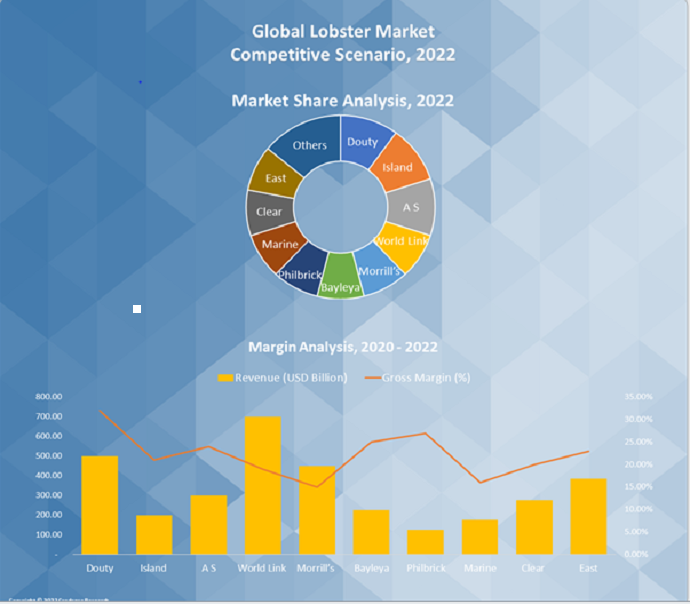
The global lobster market is highly competitive, with the presence of several key players. Some of the major players in the market and their market share are as follows:
- Douty Bros Inc.
- Island Seafood
- A S Francis Lobster
- World Link Food Distributors Inc.
- Cap Morrill’s Inc.
- Bayleya Lobster Pound
- Philbrick Lobster Company
- East Coast Seafood
- Clearwater Seafoods
- Others
These companies focus on product innovation, expanding their distribution channels, and mergers and acquisitions to stay ahead in the market.
The major players in the global lobster market are constantly striving to stay ahead by introducing new products and innovations.
Clearwater Seafoods: Clearwater Seafoods opened a new lobster processing factory in Canada in 2019. The facility is anticipated to assist the corporation in meeting Asia's expanding demand for lobster.
East Coast Seafood bought Garbo Lobster, a top lobster supplier in the United States, in 2020. East Coast Seafood expects the acquisition to help it increase its presence in the US market.
The Maine Lobster Marketing Collaborative started a new marketing campaign to promote the health advantages of lobster in 2022. The promotion targets health-conscious consumers looking for high-protein, low-fat foods.
Summary of Key Findings
- G Increased Use of Lobster in a Variety of Cuisines, as well as Lobster's popularity in luxury restaurants and food service establishments, as well as Innovation and Sustainability driving market growth
- Market segmented by species, product type, distribution channel, and region.
- The Spiny Lobster segment will likely exhibit the fastest CAGR during the forecast period.
- The Food Service segment is expected to have the largest market share.
- In 2022, North America will account for more than 48% of the market.
Future Outlook
- Demand for sustainable seafood is increasing.
- Popularity of lobster in high-end restaurants and food service facilities
- Technological and transportation advancements
- Expansion of the lobster market
- Opportunities for lobstermen and other industry players
Segmentation
- Lobster Market, By Species
-
- American Lobster
- Spiny Lobster
- Rock Lobster
- European Lobster
- By Product Type
-
- Whole Lobster
- Lobster Tail
- Lobster Meat
- Lobster Claw
- By Distribution Channel
-
- Food Service
- Retail
- By Region
- North America
- Canada
- Mexico
- Europe
- Germany
- France
- U.K.
- Italy
- Spain
- Rest of Europe
- Asia Pacific
- China
- Japan
- India
- South Korea
- South-east Asia
- Rest of Asia Pacific
- Latin America
- Brazil
- Argentina
- Rest of Latin America
- Middle East & Africa
- GCC Countries
- South Africa
- Rest of Middle East and Africa

Request a Free Sample
Fill in your details and we'll send you a free sample report.
- Sample data tables & charts
- Research methodology
Market Dynamics
Increased Use of Lobster in Diverse Cuisines
Lobster is being incorporated into a wide range of global cuisines, including Asian, Mediterranean, and Latin American dishes, which is expanding its consumer base and driving demand for high-quality, sustainably sourced lobster.
Popularity in Luxury Restaurants and Food Service
Lobster's association with luxury and indulgence makes it a staple in high-end restaurants and food service establishments, where it commands premium prices and enhances brand reputation, fueling market growth.
Innovation and Sustainability
Advances in processing, packaging, and transportation have enabled global distribution of live and processed lobster, while sustainable fishing and aquaculture practices are attracting environmentally conscious consumers and opening new market opportunities.
Health and Wellness Trends
As consumers seek high-protein, low-fat foods for health and wellness diets, lobster's nutritional profile is being actively promoted, increasing its appeal among health-conscious buyers.
Expansion of Sustainable Aquaculture
With wild lobster populations under pressure from climate change, the growth of environmentally friendly lobster aquaculture is ensuring a stable supply and meeting rising demand for sustainably sourced seafood.
Need a Custom Version of This Report?
Tailor the scope, geography, or segments to your exact requirements.
- Custom geography or segment scope
- Direct access to our analyst team
Frequently Asked Questions
What is the current size of the global lobster market?
What is the current size of the global lobster market? The global lobster market was valued at USD 6.8 Billion in 2022.
Which segment have largest market share in terms of product tyep?
Which distribution Channel segment governs the demand for lobsters in the world?
Which segment is expected to post the highest CAGR during the forecast period?
Which region is fueling the growth of the lobster industry?
Who are the major players in the global lobster market?
What is the primary market forces driving the lobster industry?
What are the primary market constraints affecting the lobster industry?
What are the lobster industry's primary market opportunities?
Table of Content
Chapter 1 Market Segmentation
- 1.1 Segmentation Framework
- 1.1.1 Product and Service Classification
- 1.1.2 Application and End-Use Classification
- 1.1.3 Technology and Solution Classification
- 1.1.4 Customer and Distribution Channel Classification
- 1.1.5 Geographic Segmentation
- 1.1.6 Market Segment Definitions and Boundaries
- 1.2 By Species
- 1.2.1 American Lobster
- 1.2.2 Spiny Lobster
- 1.2.3 Rock Lobster
- 1.2.4 European Lobster
- 1.3 By Product Type
- 1.3.1 Whole Lobster
- 1.3.2 Lobster Tail
- 1.3.3 Lobster Meat
- 1.3.4 Lobster Claw
Chapter 2 Introduction
- 2.1 Report Objectives and Scope
- 2.2 Product Definition and Industry Terminology
- 2.3 Market Inclusions and Exclusions
- 2.4 Research Process
- 2.4.1 Primary Research and Expert Interviews
- 2.4.2 Secondary Research and Source Review
- 2.4.3 Top-Down and Bottom-Up Estimation
- 2.4.4 Data Triangulation and Verification
- 2.5 Market Size Measurement Basis
- 2.5.1 2022: USD 6.8 Billion → Forecast year: -
- 2.6 Historical and Forecast Reference Periods
- 2.6.1 Base Year: 2022
- 2.7 Research Assumptions and Limitations
Chapter 3 Executive Summary
- 3.1 Market Snapshot and Key Findings
- 3.2 Base-Year Market Size, 2022
- 3.3 Forecast Market Size
- 3.4 Revenue and Volume Growth Outlook
- 3.5 Key Demand and Supply Indicators
- 3.6 Leading Market Segments
- 3.7 Fastest-Growing Market Opportunities
- 3.8 Regional Performance Highlights
- 3.9 Technology and Industry Transformation
- 3.10 Competitive Landscape Summary
- 3.11 Analyst View and Strategic Implications
Chapter 4 Global Lobster Market Trends and Developments
- 4.1 Historical Industry Development
- 4.2 Recent Market Trends and Developments
- 4.3 Demand and Customer Behavior Trends
- 4.4 Technology and Product Innovation
- 4.5 Artificial Intelligence, Automation and Digitalization
- 4.6 Local Manufacturing and Supply Chain Realignment
- 4.7 Industry Partnerships, Mergers and Acquisitions
- 4.8 Sustainability and Circular Economy Developments
- 4.9 Government and Private Sector Investment Trends
- 4.10 Emerging Business Models and Commercialization
- 4.11 Industry Developments and Announcements
Chapter 5 Global Lobster Market Production, Supply and Demand Analysis
- 5.1 Demand Trend and Consumption Analysis
- 5.2 Demand Forecast
- 5.3 Production and Output Trend
- 5.4 Production and Output Forecast
- 5.5 Installed Capacity and Capacity Utilization
- 5.6 Company-Wise Production Plants and Statistics
- 5.6.1 Installed Production Capacity
- 5.6.2 Actual Production
- 5.6.3 Planned Capacity and Expansion Targets
- 5.7 Supply Chain Structure and Procurement Trends
- 5.8 Supply-Demand Gap and Bottlenecks
- 5.9 Import Dependence and Sourcing Structure
- 5.10 Contract Manufacturing and Outsourcing
- 5.11 Regional Supply and Demand Concentration
Chapter 6 Global Lobster Market Pricing Analysis
- 6.1 Pricing Structure and Measurement
- 6.2 Historical Pricing Trends
- 6.3 Pricing Outlook
- 6.4 Average Selling Price and Unit Economics
- 6.5 Pricing by Product and Market Segment
- 6.6 Geographic Pricing Differences
- 6.7 Key Input, Energy, Labor and Logistics Costs
- 6.8 Contract Pricing and Purchasing Models
- 6.9 Pricing Sensitivity and Competitive Positioning
- 6.10 Price, Margin and Profitability Implications
Chapter 7 Global Lobster Market Dynamics
- 7.1 Market Growth Drivers
- 7.1.1 Demand-Side Drivers
- 7.1.2 Technology and Innovation Drivers
- 7.1.3 Infrastructure and Investment Drivers
- 7.1.4 Regulatory and Policy Drivers
- 7.2 Market Restraints
- 7.2.1 Cost and Affordability Constraints
- 7.2.2 Technology and Adoption Barriers
- 7.2.3 Supply Chain and Operational Constraints
- 7.3 Market Challenges
- 7.3.1 Competitive Pressure and Margin Erosion
- 7.3.2 Skills, Infrastructure and Implementation Gaps
- 7.4 Emerging Market Opportunities
- 7.5 Market Dynamics Impact and Time-Horizon Assessment
Chapter 8 Global Lobster Value Chain Analysis
- 8.1 Industry Value Chain Overview
- 8.2 Upstream Suppliers and Critical Inputs
- 8.3 Technology and Component Providers
- 8.4 Manufacturing or Service Delivery
- 8.5 Distribution, Channel Partners and Integrators
- 8.6 Downstream Applications and End Users
- 8.7 Value Addition and Profit Pools
- 8.8 Vertical Integration and Outsourcing
- 8.9 Supplier Concentration and Risk
- 8.10 Supply Chain Localization and Resilience
Chapter 9 Global Lobster Market Regulations and Policies
- 9.1 Relevant Laws, Standards and Compliance Frameworks
- 9.2 Product, Service, Safety and Quality Requirements
- 9.3 Government Policies, Incentives and Subsidies
- 9.4 Imports, Exports and Trade Barriers
- 9.5 Public Procurement and Local Content Requirements
- 9.6 Environmental and Sustainability Compliance
- 9.7 Upcoming Policy Changes and Market Implications
Chapter 10 Global Lobster Market Hotspots and Opportunities
- 10.1 Market Opportunity Mapping and Growth Hotspots
- 10.2 High-Growth Applications and Customer Groups
- 10.3 Underserved Markets and White-Space Opportunities
- 10.4 Emerging Technology and Product Opportunities
- 10.5 New Capacity and Investment Hotspots
- 10.6 Market Entry and Expansion Opportunities
- 10.7 Distribution and Partnership Opportunities
- 10.8 Near-Term and Long-Term Commercial Potential
- 10.9 Opportunity Attractiveness and Execution Risks
Chapter 11 Global Lobster Market Outlook
- 11.1 Market Size and Analysis
- 11.1.1 Revenue (Market Measurement: 2022: USD 6.8 Billion → Forecast year: - )
- 11.1.2 Market Volume and Quantity Sold
- 11.1.3 Historical Market Size
- 11.1.4 Base-Year Market Size, 2022
- 11.2 Market Forecast
- 11.2.1 Revenue Forecast
- 11.2.2 Volume Forecast
- 11.2.3 CAGR and Year-on-Year Growth
- 11.2.4 Incremental Revenue Opportunity
- 11.3 Forecast Assumptions and Scenario Analysis
- 11.3.1 Base-Case Forecast
- 11.3.2 Optimistic and Conservative Scenarios
- 11.3.3 Technology, Pricing and Policy Sensitivities
- 11.4 Market Attractiveness and Growth Outlook
Chapter 12 Global Lobster Market Segmentation and Outlook
- 12.1 Segmentation Summary and Market Shares, 2022
- 12.2 Largest and Fastest-Growing Segments
- 12.3 By Species - Market Size and Forecast
- 12.3.1 Segment Definition and Scope
- 12.3.2 Historical Market Size
- 12.3.3 Revenue Forecast
- 12.3.4 Volume Forecast
- 12.3.5 Base-Year Market Share, 2022
- 12.3.6 Segment CAGR and Growth Drivers
- 12.3.7 Subsegment Market Size and Forecast
- 12.3.7.1 American Lobster
- 12.3.7.2 Spiny Lobster
- 12.3.7.3 Rock Lobster
- 12.3.7.4 European Lobster
- 12.3.8 Subsegment Pricing and Adoption Trends
- 12.3.9 Leading Suppliers and Competition
- 12.3.10 Regional Demand and Opportunities
- 12.4 By Product Type - Market Size and Forecast
- 12.4.1 Segment Definition and Scope
- 12.4.2 Historical Market Size
- 12.4.3 Revenue Forecast
- 12.4.4 Volume Forecast
- 12.4.5 Base-Year Market Share, 2022
- 12.4.6 Segment CAGR and Growth Drivers
- 12.4.7 Subsegment Market Size and Forecast
- 12.4.7.1 Whole Lobster
- 12.4.7.2 Lobster Tail
- 12.4.7.3 Lobster Meat
- 12.4.7.4 Lobster Claw
- 12.4.8 Subsegment Pricing and Adoption Trends
- 12.4.9 Leading Suppliers and Competition
- 12.4.10 Regional Demand and Opportunities
- 12.5 Segment Growth Comparison
- 12.6 Segment Attractiveness and Priority Matrix
Chapter 13 Global Lobster Geographic Market Outlook
- 13.1 Regional Market Size and Share, 2022
- 13.2 Regional Market Forecast
- 13.3 Regional Pricing, Production and Demand Differences
- 13.4 North America
- 13.4.1 United States
- 13.4.2 Canada
- 13.4.3 Mexico
- 13.5 Europe
- 13.5.1 Germany
- 13.5.2 France
- 13.5.3 Italy
- 13.5.4 United Kingdom
- 13.5.5 Spain
- 13.5.6 Poland
- 13.5.7 Russia
- 13.5.8 Netherlands
- 13.5.9 Belgium
- 13.5.10 Sweden
- 13.5.11 Denmark
- 13.5.12 Norway
- 13.5.13 Rest of Europe
- 13.6 Asia Pacific
- 13.6.1 China
- 13.6.2 India
- 13.6.3 Japan
- 13.6.4 South Korea
- 13.6.5 Thailand
- 13.6.6 Indonesia
- 13.6.7 Vietnam
- 13.6.8 Malaysia
- 13.6.9 Australia
- 13.6.10 Rest of Asia Pacific
- 13.7 Latin America
- 13.7.1 Brazil
- 13.7.2 Argentina
- 13.7.3 Colombia
- 13.7.4 Chile
- 13.7.5 Rest of Latin America
- 13.8 Middle East
- 13.8.1 Saudi Arabia
- 13.8.2 United Arab Emirates
- 13.8.3 Turkey
- 13.8.4 Israel
- 13.8.5 Iran
- 13.8.6 Rest of the Middle East
- 13.9 Africa
- 13.9.1 South Africa
- 13.9.2 Egypt
- 13.9.3 Nigeria
- 13.9.4 Morocco
- 13.9.5 Rest of Africa
- 13.10 Regional Investment, Policy and Supply Chain Differences
- 13.11 Regional Competitive Landscape
- 13.12 Geographic Growth Hotspots
Chapter 14 Global Lobster Technology, Innovation and Sustainability Outlook
- 14.1 Technology Landscape and Maturity
- 14.2 Product, Process and Service Innovation
- 14.3 AI, Automation and Digital Tools in the Industry
- 14.4 Technology Adoption and Performance Benchmarking
- 14.5 Innovation Pipeline and R&D Investment
- 14.6 Patent and Intellectual Property Trends
- 14.7 Energy Efficiency and Resource Management
- 14.8 Sustainability, Recycling and Circularity
- 14.9 Technology Roadmap
- 14.10 Risks of Obsolescence and Technology Substitution
Chapter 15 Global Lobster Market Key Strategic Imperatives
- 15.1 Growth and Market Entry Priorities
- 15.2 High-Return Products and Segments
- 15.3 Pricing, Profitability and Cost Optimization
- 15.4 Technology Investment and Product Differentiation
- 15.5 Supply Chain Localization and Resilience
- 15.6 Distribution and Customer Acquisition
- 15.7 Partnership, Acquisition and Capacity Strategy
- 15.8 Regional Expansion Priorities
- 15.9 Short-, Medium- and Long-Term Actions
Chapter 16 Competition Outlook
- 16.1 Industry Competition Characteristics
- 16.2 Market Structure and Concentration
- 16.3 Market Share and Competitive Positioning, 2022
- 16.4 Company-Wise Revenue and Product Benchmarking
- 16.5 Production and Service Capacity Benchmarking
- 16.6 Technology, Pricing and Differentiation
- 16.7 Regional Footprint and Distribution Strength
- 16.8 Mergers, Acquisitions and Strategic Alliances
- 16.9 New Entrants and Competitive Threats
- 16.10 Porter's Five Forces and Industry Attractiveness
- 16.11 Competitive Outlook
Chapter 17 Company Profiles
- 17.1 Company Coverage and Selection Criteria
- 17.2 Clearwater Seafoods
- 17.2.1 Business Description
- 17.2.2 Company Ownership and Geographic Presence
- 17.2.3 Product and Service Portfolio
- 17.2.4 Manufacturing and Operating Footprint
- 17.2.5 Production Capacity and Expansion Plans
- 17.2.6 Financial Performance and Investment
- 17.2.7 Market Share and Competitive Position
- 17.2.8 Technology and Innovation Capabilities
- 17.2.9 Strategic Alliances or Partnerships
- 17.2.10 Recent Developments
- 17.2.11 Growth Strategy and Outlook
- 17.3 East Coast Seafood
- 17.4 Douty Bros Inc.
- 17.5 Island Seafood
- 17.6 A S Francis Lobster
- 17.7 World Link Food Distributors Inc.
- 17.8 Cap Morrill’s Inc.
- 17.9 Bayleya Lobster Pound
- 17.10 Philbrick Lobster Company
- 17.11 Garbo Lobster
- 17.12 Other Relevant Market Participants
Note: Every listed company is profiled on the structure shown under the first company. The company list is preliminary and may change based on research findings, market developments, data availability and client requirements.
Chapter 18 Disclaimer
- 18.1 Research and Forecast Disclaimer
- 18.2 Data Source and Estimation Limitations
Note: The depth of individual sections depends on data availability for this market. Volume, capacity, trade and other unit-based metrics are included where applicable.