Market Overview
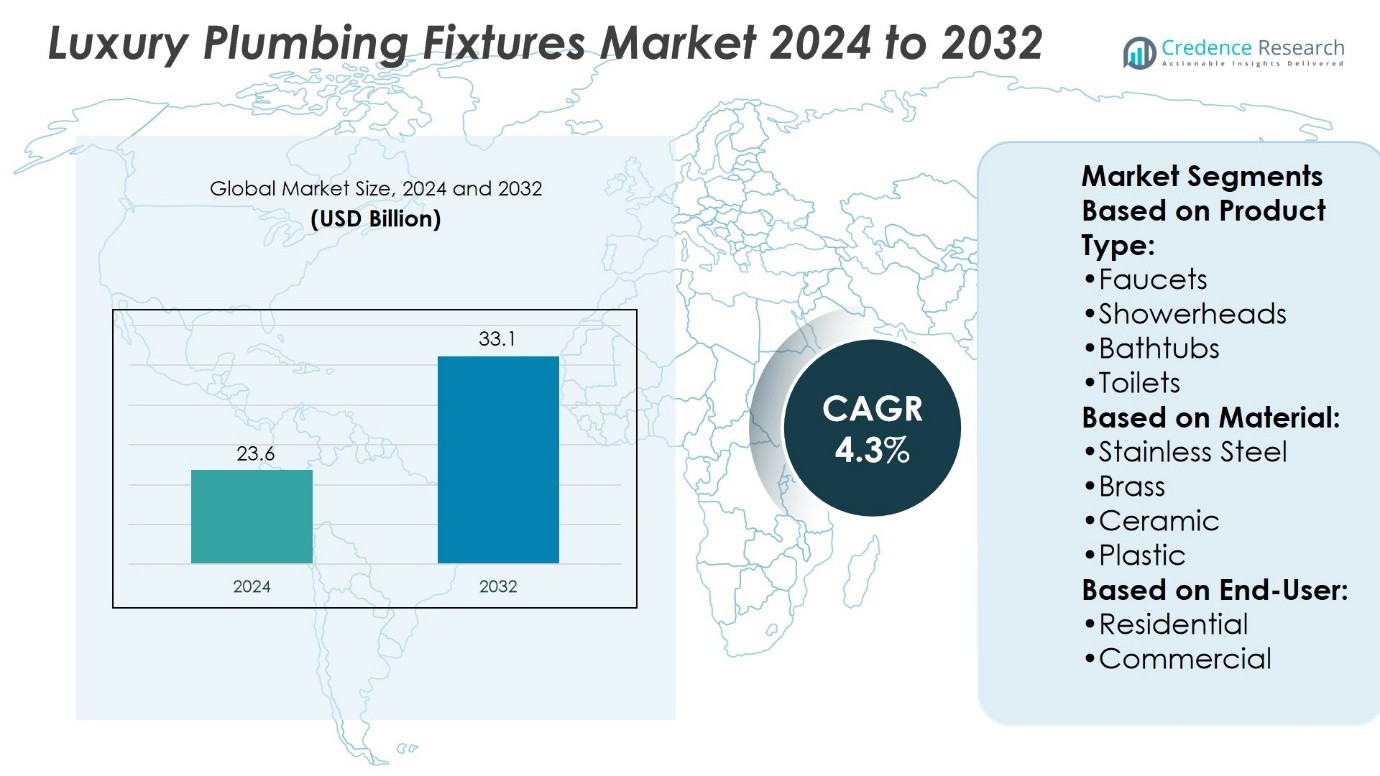
Luxury Plumbing Fixtures Market size was valued at USD 23.6 billion in 2024 and is anticipated to reach USD 33.1 billion by 2032, at a CAGR of 4.3% during the forecast period.
| REPORT ATTRIBUTE | DETAILS |
|---|---|
| Historical Period | 2020-2024 |
| Base Year | 2024 |
| Forecast Period | 2025-2032 |
| Luxury Plumbing Fixtures Market Size 2024 | USD 23.6 Billion |
| Luxury Plumbing Fixtures Market, CAGR | 4.3% |
| Luxury Plumbing Fixtures Market Size 2032 | USD 33.1 Billion |
The Luxury Plumbing Fixtures Market is driven by rising consumer preference for premium home and commercial spaces, supported by increasing disposable incomes and urbanization. Demand for stylish, durable, and sustainable fixtures continues to strengthen as consumers prioritize modern living standards. Growing focus on water conservation and eco-friendly solutions fuels adoption of advanced designs. Technological innovations, including touchless faucets, digital temperature control, and smart shower systems, enhance convenience and hygiene. Interior design trends and remodeling projects further accelerate market growth. Expanding e-commerce platforms and omni-channel retail strategies also contribute to accessibility, making luxury fixtures more appealing to a wider consumer base.
The Luxury Plumbing Fixtures Market shows strong presence across North America, Europe, Asia Pacific, Latin America, and the Middle East & Africa. North America and Europe lead with high adoption driven by premium housing and advanced technologies, while Asia Pacific records the fastest growth supported by urbanization and rising incomes. Latin America and MEA witness gradual adoption through luxury real estate projects. Key players driving innovation and competition include Kohler, Grohe, Moen, American Standard, Delta, Bradley Corporation, and Cera Sanitaryware Limited.
Market Insights
- Luxury Plumbing Fixtures Market size was valued at USD 23.6 billion in 2024 and is projected to reach USD 33.1 billion by 2032, at a CAGR of 4.3%.
- Rising disposable incomes and urbanization drive demand for premium plumbing solutions.
- Growing preference for sustainable and water-efficient fixtures shapes consumer choices.
- Technological trends like touchless faucets and smart shower systems enhance hygiene and convenience.
- Competitive landscape remains strong with continuous innovation and product diversification by leading brands.
- High installation costs and limited awareness in developing regions act as restraints.
- North America and Europe lead adoption, Asia Pacific grows fastest, while Latin America and MEA show gradual progress.
Market Drivers
Rising Consumer Preference for Premium Home Aesthetics
The Luxury Plumbing Fixtures Market benefits from growing demand for stylish home interiors. Consumers prioritize products that match modern architecture and upscale living standards. High-end sinks, faucets, bathtubs, and showers are chosen for both design and durability. Brands focus on elegant finishes like brushed gold, matte black, and chrome to meet expectations. Luxury buyers seek personalized solutions that reflect lifestyle choices. It creates opportunities for manufacturers to offer tailored product lines.
- For instance, a WaterSense-certified bathroom sink faucet uses no more than 1.5 gallons per minute (gpm) at a flowing water pressure of 60 psi, delivering efficient performance within strict eco-design standards set by the Environmental Protection Agency (EPA).
Increasing Focus on Water Efficiency and Smart Technology
Sustainability drives major changes in the Luxury Plumbing Fixtures Market. Consumers demand advanced water-saving faucets, low-flow showerheads, and eco-friendly flushing systems. Smart digital controls for temperature and pressure provide convenience and reduce waste. Companies invest in sensor-based and voice-activated solutions for modern homes. Rising awareness of environmental responsibility pushes adoption of energy-efficient fixtures. It strengthens the market by aligning luxury with green innovation.
- For instance, the Bradley Verge™ faucet series offers sensor-activated models with selectable flow rates of 0.35 or 0.50 gallons per minute (GPM) for water, as well as options for soap dispensers that use 0.09 gallons per cycle (GPC).
Expansion of Residential and Commercial Infrastructure
The Luxury Plumbing Fixtures Market gains support from rapid development in residential and commercial real estate. Urbanization drives construction of premium apartments, villas, and luxury hotels. Developers install branded fixtures to enhance value and attract high-income buyers. Growing investment in tourism and hospitality strengthens demand for premium bathroom solutions. Renovation projects in mature markets also create significant replacement needs. It sustains consistent growth across multiple end-user segments.
Strong Influence of Brand Value and Distribution Networks
Brand reputation plays a critical role in shaping the Luxury Plumbing Fixtures Market. Consumers trust established names that deliver performance, durability, and design excellence. Luxury brands invest in exclusive showrooms, partnerships, and online retail platforms. Designers and architects recommend fixtures from trusted manufacturers for premium projects. Marketing strategies highlight craftsmanship and innovation to build strong customer loyalty. It reinforces demand through global retail channels and expanding e-commerce penetration.
Market Trends
Growing Adoption of Smart and Connected Fixtures
The Luxury Plumbing Fixtures Market experiences strong momentum from integration of digital technologies. Consumers demand smart faucets, showers, and toilets with touchless or app-based controls. Voice-activated features align with smart home ecosystems and offer convenience. Brands expand product portfolios to include Bluetooth-enabled mirrors and water management systems. It supports lifestyle upgrades while improving hygiene and comfort. Manufacturers use digital platforms to connect consumers with maintenance and usage insights.
- For instance, Little Giant offers the VCMA-20 condensate removal pump, which moves condensate from HVAC or refrigeration units and achieves a flow rate of 80 gallons per hour at a 1-foot head. The pump is powered by a 115 V, 60 Hz motor that draws 1.5 amps.
Rising Popularity of Sustainable and Eco-Friendly Products
Eco-consciousness drives a strong trend in the Luxury Plumbing Fixtures Market. Consumers prefer water-efficient faucets, dual-flush toilets, and low-flow showerheads. Manufacturers develop fixtures using recyclable metals and lead-free components. Finishes that resist corrosion extend product lifespan and reduce replacement needs. It enhances the appeal of luxury fixtures by blending sustainability with design. Regulations on water use further accelerate the trend across developed markets.
- For instance, Selectronic® Cast Touchless Metering Faucet (model 6055104.002) features a 0.35 gpm (1.3 L/min) spray, an integrated auto purge function for stagnant water, a safety timer that shuts off after 55 seconds, and operates on a 4‑year CR‑P2 lithium battery.
Increasing Customization and Personalization of Designs
Personalization becomes a major trend within the Luxury Plumbing Fixtures Market. Consumers request custom finishes, unique textures, and tailored shapes. High-net-worth buyers demand exclusive collections aligned with interior themes. Leading brands respond with made-to-order solutions and advanced design flexibility. It ensures differentiation and strengthens the premium value of the fixtures. Collaboration with architects and designers boosts adoption in luxury real estate projects.
Expanding Role of Omni-Channel Retail and Online Presence
The Luxury Plumbing Fixtures Market advances through stronger digital and retail integration. Premium brands invest in flagship stores, showrooms, and interactive online platforms. Virtual reality tools help customers visualize products within home settings. Online sales channels expand access to wider audiences across urban markets. It creates a seamless buying experience for both individual buyers and commercial clients. Stronger distribution networks reinforce global presence and strengthen competitive positioning.
Market Challenges Analysis
High Product Costs and Limited Affordability in Developing Markets
The Luxury Plumbing Fixtures Market faces challenges due to the premium pricing of products. Consumers in price-sensitive regions hesitate to invest in high-end faucets, bathtubs, and shower systems. Limited affordability restricts adoption outside urban centers and luxury housing projects. Manufacturers struggle to balance innovation with cost efficiency while maintaining brand value. It creates barriers for wider penetration across mid-tier households. Currency fluctuations and import tariffs further add to pricing difficulties in emerging economies.
Supply Chain Constraints and Intense Competitive Pressure
The Luxury Plumbing Fixtures Market also faces challenges from global supply chain disruptions. Shortages of raw materials such as brass and stainless steel impact production timelines. Rising transportation costs and delays in logistics add further strain. Intense competition among established players and regional brands increases pricing pressure. It pushes manufacturers to invest heavily in design, marketing, and sustainability to stay competitive. Dependence on global sourcing networks makes the industry vulnerable to economic and geopolitical shifts.
Market Opportunities
Rising Demand from Luxury Real Estate and Hospitality Projects
The Luxury Plumbing Fixtures Market holds strong opportunities in premium housing and hospitality sectors. Urban development projects in major cities drive adoption of high-end faucets, showers, and bathtubs. Luxury hotels and resorts upgrade bathrooms to enhance guest experience and brand value. Architects and developers prefer branded fixtures to attract high-income buyers and travelers. It creates long-term opportunities for suppliers to partner with large-scale construction projects. Growing investment in smart cities further expands the demand for advanced plumbing solutions.
Expansion Potential in Eco-Friendly and Smart Product Segments
The Luxury Plumbing Fixtures Market also benefits from rising interest in sustainable and connected technologies. Consumers seek water-efficient solutions supported by smart monitoring systems. Manufacturers introducing sensor-based and voice-enabled fixtures tap into new customer segments. Eco-conscious buyers prefer recyclable and durable materials that align with modern lifestyles. It supports innovation and differentiation for brands in a competitive environment. Strong alignment with environmental regulations provides a clear path for global expansion.
Market Segmentation Analysis:
By Product Type
The Luxury Plumbing Fixtures Market is segmented into faucets, showerheads, bathtubs, and toilets. Faucets hold strong importance as they combine design with water efficiency. Advanced models with touchless features and sensor-based controls increase consumer preference. Showerheads gain traction due to rising demand for spa-like experiences in premium bathrooms. Bathtubs remain a symbol of luxury and are increasingly adopted in high-end residential and hospitality projects. Toilets see innovation through smart flushing systems, heated seats, and integrated cleaning technologies. It reflects a balanced demand across both functional and aesthetic categories.
- For instance, Elkay LK 2500LS Pursuit™ Laundry/Utility Faucet offers a flow rate of 1.5 gallons per minute and includes a ceramic disc valve in a brass body for enhanced durability.
By Material
The market is classified into stainless steel, brass, ceramic, plastic, and glass. Stainless steel leads due to durability, corrosion resistance, and premium finishes. Brass is favored for its strength and suitability for intricate designs in faucets and showerheads. Ceramic holds a strong position in toilets and sinks, valued for hygiene and easy maintenance. Plastic remains limited to cost-sensitive applications but is evolving with advanced polymer finishes. Glass gains traction in premium shower enclosures, basins, and decorative fixtures. It highlights the diversity of materials catering to both performance and design needs.
- For instance, Roca Avant In-Tank® toilet (electric version) requires a minimum water pressure of 2 bar and supplies a flow rate of 14 litres per minute, using an integrated cistern based on the Venturi effect to boost flushing performance and hygiene.
By End-user
The Luxury Plumbing Fixtures Market is segmented into residential and commercial end-users. Residential demand is fueled by rising investment in luxury housing, villas, and high-end apartments. Homeowners prioritize design, smart functionality, and water efficiency. Commercial demand is strong in hotels, resorts, and office spaces that require premium fixtures to enhance brand image and customer experience. Hospitality projects create consistent opportunities for bathtubs, showerheads, and luxury toilets. It reflects the importance of both residential upgrades and commercial infrastructure in driving market growth.
Segments:
Based on Product Type:
- Faucets
- Showerheads
- Bathtubs
- Toilets
Based on Material:
- Stainless Steel
- Brass
- Ceramic
- Plastic
Based on End-User:
- Residential
- Commercial
Based on the Geography:
- North America
- U.S.
- Canada
- Mexico
- Europe
- UK
- France
- Germany
- Italy
- Spain
- Russia
- Belgium
- Netherlands
- Austria
- Sweden
- Poland
- Denmark
- Switzerland
- Rest of Europe
- Asia Pacific
- China
- Japan
- South Korea
- India
- Australia
- Thailand
- Indonesia
- Vietnam
- Malaysia
- Philippines
- Taiwan
- Rest of Asia Pacific
- Latin America
- Brazil
- Argentina
- Peru
- Chile
- Colombia
- Rest of Latin America
- Middle East
- UAE
- KSA
- Israel
- Turkey
- Iran
- Rest of Middle East
- Africa
- Egypt
- Nigeria
- Algeria
- Morocco
- Rest of Africa
Regional Analysis
North America
North America accounts for around 32% of the Luxury Plumbing Fixtures Market share, making it one of the most significant regions. The market here is driven by strong demand for upscale residential projects and the hospitality industry. Consumers prefer premium faucets, smart toilets, and advanced showerheads that align with evolving smart home ecosystems. Leading brands maintain a strong foothold through collaborations with builders and retail distributors. The United States dominates regional growth due to rising investments in luxury apartments, urban housing projects, and large-scale renovations. Canada follows with notable adoption supported by eco-friendly regulations on water efficiency. It shows that North America remains a hub for innovation, particularly in digital and sustainable plumbing solutions.
Europe
Europe holds nearly 28% of the global market share and remains an established region for luxury bathroom products. The region benefits from consumer awareness of design aesthetics and strong emphasis on sustainability. Germany, Italy, and the United Kingdom lead in demand for premium fixtures, supported by advanced manufacturing capabilities. European consumers favor brass and ceramic-based fixtures due to durability and design sophistication. The renovation of historic properties and investments in luxury hotels boost the market further. Companies strengthen their presence with eco-labeled and recyclable product lines to meet environmental regulations. It positions Europe as a region where sustainability and design value coexist to shape long-term adoption.
Asia Pacific
Asia Pacific contributes to nearly 26% of the Luxury Plumbing Fixtures Market share, making it a rapidly growing region. Rising urbanization in China, India, and Southeast Asian economies creates large-scale demand for modern housing and commercial spaces. The hospitality sector expands strongly with new hotels and resorts requiring premium bathtubs, toilets, and faucets. Consumers in metropolitan areas show preference for branded and customizable solutions. Japan and South Korea contribute through advanced product technologies, particularly in smart toilets and sensor-based fixtures. Luxury brands invest in retail expansion and e-commerce to tap into rising disposable incomes. It highlights Asia Pacific as a dynamic growth region where rising middle-class wealth drives premium fixture adoption.
Latin America
Latin America accounts for nearly 8% of the global market share, supported mainly by urban development in Brazil and Mexico. The luxury housing sector and hospitality industry are key contributors to demand. Consumers in this region prefer stylish yet durable fixtures that enhance property value. Import reliance shapes much of the market, with global brands dominating distribution channels. Renovation and modernization of older housing stock also add opportunities. Regional challenges include currency volatility and affordability, which limit penetration outside major cities. It remains a market where targeted investment can expand long-term opportunities.
Middle East & Africa
The Middle East & Africa collectively hold about 6% of the Luxury Plumbing Fixtures Market share. The market is fueled by large-scale infrastructure projects, luxury hotels, and residential developments, especially in the UAE, Saudi Arabia, and South Africa. Premium villas and smart city initiatives drive adoption of advanced bathtubs, shower systems, and water-efficient faucets. Consumers in the Gulf countries prioritize branded products that emphasize durability and aesthetics. Africa presents gradual growth potential, mainly centered on urban construction in South Africa and Nigeria. International companies expand partnerships with developers to secure long-term projects. It highlights the region as an emerging yet strategic opportunity for luxury plumbing fixture manufacturers.
Key Player Analysis
- Gerber
- Natphil
- Moen
- Bradley Corporation
- Kohler
- Cera Sanitaryware Limited
- Grohe
- Little Giant
- American Standard
- Delta
Competitive Analysis
The Luxury Plumbing Fixtures Market players such as Kohler, Moen, Grohe, American Standard, Delta, Bradley Corporation, Cera Sanitaryware Limited, Gerber, Little Giant, and Natphil. The Luxury Plumbing Fixtures Market continues to grow as consumers increasingly seek high-quality, stylish, and functional products for both residential and commercial spaces. Rising urbanization, premium housing projects, and greater emphasis on modern lifestyle standards drive strong demand for advanced plumbing solutions. Consumers are also showing preference for products that combine luxury with sustainability, such as water-efficient faucets, eco-friendly showerheads, and smart sensor-based fixtures. Growing awareness of hygiene, coupled with technological advancements like touchless operation and digital temperature control, further supports market expansion. Additionally, the influence of interior design trends and higher disposable incomes is fueling wider adoption of luxury plumbing products across global markets.
Recent Developments
- In 2025, Kohler introduced its at-home sauna line crafted from Scandinavian spruce and featuring ambient lighting, touchscreen thermostat, advanced ventilation, and ergonomic headrest, positioning bathroom as wellness sanctuaries with spa-like aesthetics and smart design integration.
- In April 2025, Gravity Bath Pvt. Ltd. opened its first company-owned stores in Delhi and Mumbai, showcasing premium plumbing fixtures like faucets, showers, and kitchen sinks through immersive mock-up bathrooms.
- In September 2024, Hindware's Italian Collection launched the Automate Imperial Smart Toilet, a modern and sleek toilet featuring advanced technology, including a presence-sensing lid and seat, oscillating water spray, and foot-touch flush.
- In February 2024, TOTO unveiled new luxury products at the KBIS 2024, including the NEOREST WX Smart Bidet Toilet, SOIRÉE WASHLET+ S7A, and matte black finish, showcasing its commitment to quality and customer satisfaction.
Report Coverage
The research report offers an in-depth analysis based on Product Type, Material, End-User and Geography. It details leading market players, providing an overview of their business, product offerings, investments, revenue streams, and key applications. Additionally, the report includes insights into the competitive environment, SWOT analysis, current market trends, as well as the primary drivers and constraints. Furthermore, it discusses various factors that have driven market expansion in recent years. The report also explores market dynamics, regulatory scenarios, and technological advancements that are shaping the industry. It assesses the impact of external factors and global economic changes on market growth. Lastly, it provides strategic recommendations for new entrants and established companies to navigate the complexities of the market.
Future Outlook
- The market will expand with rising demand for premium housing projects.
- Smart and sensor-based fixtures will see higher adoption in urban markets.
- Sustainability will remain a key focus with eco-friendly product innovations.
- Digital features like temperature control and touchless operation will gain traction.
- Growth in renovation and remodeling projects will boost product demand.
- Online retail and omni-channel sales will play a stronger role in distribution.
- Luxury hotels and commercial spaces will increase their investments in premium fixtures.
- Advancements in materials such as stainless steel and ceramics will drive durability.
- Consumer preference for stylish and customizable designs will influence product development.
- Emerging economies will provide significant growth opportunities through rising disposable incomes.

Request a Free Sample
Fill in your details and we'll send you a free sample report.
- Sample data tables & charts
- Research methodology
Market Dynamics
Rising Consumer Preference for Premium Home Aesthetics
Consumers are increasingly seeking luxury plumbing fixtures that complement modern architecture and upscale living standards, driving demand for high-end sinks, faucets, bathtubs, and showers with elegant finishes and personalized design options.
Increasing Focus on Water Efficiency and Smart Technology
The market is propelled by consumer demand for advanced water-saving and eco-friendly fixtures, including smart faucets and digital controls, as sustainability and environmental responsibility become central to purchasing decisions.
Expansion of Residential and Commercial Infrastructure
Rapid urbanization and the development of premium residential and commercial real estate, such as luxury hotels and high-end apartments, are boosting the installation of branded, luxury plumbing fixtures to enhance property value and attract affluent buyers.
Strong Influence of Brand Value and Distribution Networks
Established brands with strong reputations and extensive distribution networks are favored by consumers and professionals, reinforcing market growth through exclusive showrooms, partnerships, and omni-channel retail strategies.
Growing Adoption of Smart and Connected Fixtures
Technological innovations such as touchless faucets, app-based controls, and voice-activated systems are gaining traction, enhancing hygiene, convenience, and integration with smart home ecosystems, which further accelerates market expansion.
Need a Custom Version of This Report?
Tailor the scope, geography, or segments to your exact requirements.
- Custom geography or segment scope
- Direct access to our analyst team
Frequently Asked Questions
What is the current market size for Luxury Plumbing Fixtures Market, and what is its projected size in 2032?
At what Compound Annual Growth Rate is the Luxury Plumbing Fixtures Market projected to grow between 2025 and 2032?
Which Luxury Plumbing Fixtures Market segment held the largest share in 2024?
What are the primary factors fueling the growth of the Luxury Plumbing Fixtures Market?
Who are the leading companies in the Luxury Plumbing Fixtures Market?
Which region commanded the largest share of the Luxury Plumbing Fixtures Market in 2024?
Table of Content
Chapter 1 Market Segmentation
- 1.1 Segmentation Framework
- 1.1.1 Product and Service Classification
- 1.1.2 Application and End-Use Classification
- 1.1.3 Technology and Solution Classification
- 1.1.4 Customer and Distribution Channel Classification
- 1.1.5 Geographic Segmentation
- 1.1.6 Market Segment Definitions and Boundaries
- 1.2 By End-User
- 1.2.1 Residential
- 1.2.2 Commercial
- 1.3 By Material
- 1.3.1 Stainless Steel
- 1.3.2 Brass
- 1.3.3 Ceramic
- 1.3.4 Plastic
- 1.3.5 Glass
- 1.4 By Product Type
- 1.4.1 Faucets
- 1.4.2 Showerheads
- 1.4.3 Bathtubs
- 1.4.4 Toilets
Chapter 2 Introduction
- 2.1 Report Objectives and Scope
- 2.2 Product Definition and Industry Terminology
- 2.3 Market Inclusions and Exclusions
- 2.4 Research Process
- 2.4.1 Primary Research and Expert Interviews
- 2.4.2 Secondary Research and Source Review
- 2.4.3 Top-Down and Bottom-Up Estimation
- 2.4.4 Data Triangulation and Verification
- 2.5 Market Size Measurement Basis
- 2.5.1 2024: USD 23.6 billion → 2032: USD 33.1 billion
- 2.6 Historical and Forecast Reference Periods
- 2.6.1 Base Year: 2024
- 2.6.2 Forecast Period: 2024-2032
- 2.7 Research Assumptions and Limitations
Chapter 3 Executive Summary
- 3.1 Market Snapshot and Key Findings
- 3.2 Base-Year Market Size, 2024
- 3.3 Forecast Market Size, 2032
- 3.4 Revenue and Volume Growth Outlook
- 3.5 Key Demand and Supply Indicators
- 3.6 Leading Market Segments
- 3.7 Fastest-Growing Market Opportunities
- 3.8 Regional Performance Highlights
- 3.9 Technology and Industry Transformation
- 3.10 Competitive Landscape Summary
- 3.11 Analyst View and Strategic Implications
Chapter 4 Global Luxury Plumbing Fixtures Market Trends and Developments
- 4.1 Historical Industry Development
- 4.2 Recent Market Trends and Developments
- 4.3 Demand and Customer Behavior Trends
- 4.4 Technology and Product Innovation
- 4.5 Artificial Intelligence, Automation and Digitalization
- 4.6 Local Manufacturing and Supply Chain Realignment
- 4.7 Industry Partnerships, Mergers and Acquisitions
- 4.8 Sustainability and Circular Economy Developments
- 4.9 Government and Private Sector Investment Trends
- 4.10 Emerging Business Models and Commercialization
- 4.11 Industry Developments and Announcements
Chapter 5 Global Luxury Plumbing Fixtures Market Production, Supply and Demand Analysis
- 5.1 Demand Trend and Consumption Analysis
- 5.2 Demand Forecast, 2024-2032
- 5.3 Production and Output Trend
- 5.4 Production and Output Forecast, 2024-2032
- 5.5 Installed Capacity and Capacity Utilization
- 5.6 Company-Wise Production Plants and Statistics
- 5.6.1 Installed Production Capacity
- 5.6.2 Actual Production
- 5.6.3 Planned Capacity and Expansion Targets
- 5.7 Supply Chain Structure and Procurement Trends
- 5.8 Supply-Demand Gap and Bottlenecks
- 5.9 Import Dependence and Sourcing Structure
- 5.10 Contract Manufacturing and Outsourcing
- 5.11 Regional Supply and Demand Concentration
Chapter 6 Global Luxury Plumbing Fixtures Market Pricing Analysis
- 6.1 Pricing Structure and Measurement
- 6.2 Historical Pricing Trends
- 6.3 Pricing Outlook, 2024-2032
- 6.4 Average Selling Price and Unit Economics
- 6.5 Pricing by Product and Market Segment
- 6.6 Geographic Pricing Differences
- 6.7 Key Input, Energy, Labor and Logistics Costs
- 6.8 Contract Pricing and Purchasing Models
- 6.9 Pricing Sensitivity and Competitive Positioning
- 6.10 Price, Margin and Profitability Implications
Chapter 7 Global Luxury Plumbing Fixtures Market Dynamics
- 7.1 Market Growth Drivers
- 7.1.1 Demand-Side Drivers
- 7.1.2 Technology and Innovation Drivers
- 7.1.3 Infrastructure and Investment Drivers
- 7.1.4 Regulatory and Policy Drivers
- 7.2 Market Restraints
- 7.2.1 Cost and Affordability Constraints
- 7.2.2 Technology and Adoption Barriers
- 7.2.3 Supply Chain and Operational Constraints
- 7.3 Market Challenges
- 7.3.1 Competitive Pressure and Margin Erosion
- 7.3.2 Skills, Infrastructure and Implementation Gaps
- 7.4 Emerging Market Opportunities
- 7.5 Market Dynamics Impact and Time-Horizon Assessment
Chapter 8 Global Luxury Plumbing Fixtures Value Chain Analysis
- 8.1 Industry Value Chain Overview
- 8.2 Upstream Suppliers and Critical Inputs
- 8.3 Technology and Component Providers
- 8.4 Manufacturing or Service Delivery
- 8.5 Distribution, Channel Partners and Integrators
- 8.6 Downstream Applications and End Users
- 8.7 Value Addition and Profit Pools
- 8.8 Vertical Integration and Outsourcing
- 8.9 Supplier Concentration and Risk
- 8.10 Supply Chain Localization and Resilience
Chapter 9 Global Luxury Plumbing Fixtures Market Regulations and Policies
- 9.1 Relevant Laws, Standards and Compliance Frameworks
- 9.2 Product, Service, Safety and Quality Requirements
- 9.3 Government Policies, Incentives and Subsidies
- 9.4 Imports, Exports and Trade Barriers
- 9.5 Public Procurement and Local Content Requirements
- 9.6 Environmental and Sustainability Compliance
- 9.7 Upcoming Policy Changes and Market Implications
Chapter 10 Global Luxury Plumbing Fixtures Market Hotspots and Opportunities
- 10.1 Market Opportunity Mapping and Growth Hotspots
- 10.2 High-Growth Applications and Customer Groups
- 10.3 Underserved Markets and White-Space Opportunities
- 10.4 Emerging Technology and Product Opportunities
- 10.5 New Capacity and Investment Hotspots
- 10.6 Market Entry and Expansion Opportunities
- 10.7 Distribution and Partnership Opportunities
- 10.8 Near-Term and Long-Term Commercial Potential
- 10.9 Opportunity Attractiveness and Execution Risks
Chapter 11 Global Luxury Plumbing Fixtures Market Outlook, 2024-2032
- 11.1 Market Size and Analysis
- 11.1.1 Revenue (Market Measurement: 2024: USD 23.6 billion → 2032: USD 33.1 billion)
- 11.1.2 Market Volume and Quantity Sold
- 11.1.3 Historical Market Size
- 11.1.4 Base-Year Market Size, 2024
- 11.2 Market Forecast, 2024-2032
- 11.2.1 Revenue Forecast to 2032
- 11.2.2 Volume Forecast to 2032
- 11.2.3 CAGR and Year-on-Year Growth
- 11.2.4 Incremental Revenue Opportunity
- 11.3 Forecast Assumptions and Scenario Analysis
- 11.3.1 Base-Case Forecast
- 11.3.2 Optimistic and Conservative Scenarios
- 11.3.3 Technology, Pricing and Policy Sensitivities
- 11.4 Market Attractiveness and Growth Outlook
Chapter 12 Global Luxury Plumbing Fixtures Market Segmentation and Outlook
- 12.1 Segmentation Summary and Market Shares, 2024
- 12.2 Largest and Fastest-Growing Segments
- 12.3 By End-User - Market Size and Forecast, 2024-2032
- 12.3.1 Segment Definition and Scope
- 12.3.2 Historical Market Size
- 12.3.3 Revenue Forecast, 2024-2032
- 12.3.4 Volume Forecast, 2024-2032
- 12.3.5 Base-Year Market Share, 2024
- 12.3.6 Segment CAGR and Growth Drivers
- 12.3.7 Subsegment Market Size and Forecast
- 12.3.7.1 Residential
- 12.3.7.2 Commercial
- 12.3.8 Subsegment Pricing and Adoption Trends
- 12.3.9 Leading Suppliers and Competition
- 12.3.10 Regional Demand and Opportunities
- 12.4 By Material - Market Size and Forecast, 2024-2032
- 12.4.1 Segment Definition and Scope
- 12.4.2 Historical Market Size
- 12.4.3 Revenue Forecast, 2024-2032
- 12.4.4 Volume Forecast, 2024-2032
- 12.4.5 Base-Year Market Share, 2024
- 12.4.6 Segment CAGR and Growth Drivers
- 12.4.7 Subsegment Market Size and Forecast
- 12.4.7.1 Stainless Steel
- 12.4.7.2 Brass
- 12.4.7.3 Ceramic
- 12.4.7.4 Plastic
- 12.4.7.5 Glass
- 12.4.8 Subsegment Pricing and Adoption Trends
- 12.4.9 Leading Suppliers and Competition
- 12.4.10 Regional Demand and Opportunities
- 12.5 By Product Type - Market Size and Forecast, 2024-2032
- 12.5.1 Segment Definition and Scope
- 12.5.2 Historical Market Size
- 12.5.3 Revenue Forecast, 2024-2032
- 12.5.4 Volume Forecast, 2024-2032
- 12.5.5 Base-Year Market Share, 2024
- 12.5.6 Segment CAGR and Growth Drivers
- 12.5.7 Subsegment Market Size and Forecast
- 12.5.7.1 Faucets
- 12.5.7.2 Showerheads
- 12.5.7.3 Bathtubs
- 12.5.7.4 Toilets
- 12.5.8 Subsegment Pricing and Adoption Trends
- 12.5.9 Leading Suppliers and Competition
- 12.5.10 Regional Demand and Opportunities
- 12.6 Segment Growth Comparison
- 12.7 Segment Attractiveness and Priority Matrix
Chapter 13 Global Luxury Plumbing Fixtures End-Use and Application Market Outlook
- 13.1 End-Use Industry and Customer Demand Structure
- 13.2 Leading Applications and Customer Groups
- 13.3 End-Use Market Size, Share and Forecast
- 13.4 Major End-Use Industry Deep Dives
- 13.4.1 Customer Requirements and Use Cases
- 13.4.2 Demand and Replacement Cycles
- 13.4.3 Technical and Regulatory Considerations
- 13.4.4 Purchasing and Procurement Models
- 13.4.5 Leading Vendors and Distribution Channels
- 13.4.6 Forecast and Commercial Opportunities
- 13.5 Emerging Applications and Cross-Segment Demand
- 13.6 End-Use Industry Investment Priorities
Chapter 14 Global Luxury Plumbing Fixtures Geographic Market Outlook, 2024-2032
- 14.1 Regional Market Size and Share, 2024
- 14.2 Regional Market Forecast, 2024-2032
- 14.3 Regional Pricing, Production and Demand Differences
- 14.4 North America
- 14.4.1 United States
- 14.4.2 Canada
- 14.4.3 Mexico
- 14.5 Europe
- 14.5.1 Germany
- 14.5.2 France
- 14.5.3 Italy
- 14.5.4 United Kingdom
- 14.5.5 Spain
- 14.5.6 Poland
- 14.5.7 Russia
- 14.5.8 Netherlands
- 14.5.9 Belgium
- 14.5.10 Sweden
- 14.5.11 Denmark
- 14.5.12 Norway
- 14.5.13 Rest of Europe
- 14.6 Asia Pacific
- 14.6.1 China
- 14.6.2 India
- 14.6.3 Japan
- 14.6.4 South Korea
- 14.6.5 Thailand
- 14.6.6 Indonesia
- 14.6.7 Vietnam
- 14.6.8 Malaysia
- 14.6.9 Australia
- 14.6.10 Rest of Asia Pacific
- 14.7 Latin America
- 14.7.1 Brazil
- 14.7.2 Argentina
- 14.7.3 Colombia
- 14.7.4 Chile
- 14.7.5 Rest of Latin America
- 14.8 Middle East
- 14.8.1 Saudi Arabia
- 14.8.2 United Arab Emirates
- 14.8.3 Turkey
- 14.8.4 Israel
- 14.8.5 Iran
- 14.8.6 Rest of the Middle East
- 14.9 Africa
- 14.9.1 South Africa
- 14.9.2 Egypt
- 14.9.3 Nigeria
- 14.9.4 Morocco
- 14.9.5 Rest of Africa
- 14.10 Regional Investment, Policy and Supply Chain Differences
- 14.11 Regional Competitive Landscape
- 14.12 Geographic Growth Hotspots
Chapter 15 Global Luxury Plumbing Fixtures Technology, Innovation and Sustainability Outlook
- 15.1 Technology Landscape and Maturity
- 15.2 Product, Process and Service Innovation
- 15.3 AI, Automation and Digital Tools in the Industry
- 15.4 Technology Adoption and Performance Benchmarking
- 15.5 Innovation Pipeline and R&D Investment
- 15.6 Patent and Intellectual Property Trends
- 15.7 Energy Efficiency and Resource Management
- 15.8 Sustainability, Recycling and Circularity
- 15.9 Technology Roadmap, 2024-2032
- 15.10 Risks of Obsolescence and Technology Substitution
Chapter 16 Global Luxury Plumbing Fixtures Market Key Strategic Imperatives
- 16.1 Growth and Market Entry Priorities
- 16.2 High-Return Products and Segments
- 16.3 Pricing, Profitability and Cost Optimization
- 16.4 Technology Investment and Product Differentiation
- 16.5 Supply Chain Localization and Resilience
- 16.6 Distribution and Customer Acquisition
- 16.7 Partnership, Acquisition and Capacity Strategy
- 16.8 Regional Expansion Priorities
- 16.9 Short-, Medium- and Long-Term Actions
Chapter 17 Competition Outlook
- 17.1 Industry Competition Characteristics
- 17.2 Market Structure and Concentration
- 17.3 Market Share and Competitive Positioning, 2024
- 17.4 Company-Wise Revenue and Product Benchmarking
- 17.5 Production and Service Capacity Benchmarking
- 17.6 Technology, Pricing and Differentiation
- 17.7 Regional Footprint and Distribution Strength
- 17.8 Mergers, Acquisitions and Strategic Alliances
- 17.9 New Entrants and Competitive Threats
- 17.10 Porter's Five Forces and Industry Attractiveness
- 17.11 Competitive Outlook, 2024-2032
Chapter 18 Company Profiles
- 18.1 Company Coverage and Selection Criteria
- 18.2 Kohler
- 18.2.1 Business Description
- 18.2.2 Company Ownership and Geographic Presence
- 18.2.3 Product and Service Portfolio
- 18.2.4 Manufacturing and Operating Footprint
- 18.2.5 Production Capacity and Expansion Plans
- 18.2.6 Financial Performance and Investment
- 18.2.7 Market Share and Competitive Position
- 18.2.8 Technology and Innovation Capabilities
- 18.2.9 Strategic Alliances or Partnerships
- 18.2.10 Recent Developments
- 18.2.11 Growth Strategy and Outlook
- 18.3 Grohe
- 18.4 Moen
- 18.5 American Standard
- 18.6 Delta
- 18.7 Bradley Corporation
- 18.8 Cera Sanitaryware Limited
- 18.9 Gerber
- 18.10 Little Giant
- 18.11 Natphil
- 18.12 Other Relevant Market Participants
Note: Every listed company is profiled on the structure shown under the first company. The company list is preliminary and may change based on research findings, market developments, data availability and client requirements.
Chapter 19 Disclaimer
- 19.1 Research and Forecast Disclaimer
- 19.2 Data Source and Estimation Limitations
Note: The depth of individual sections depends on data availability for this market. Volume, capacity, trade and other unit-based metrics are included where applicable.