Market Overview:
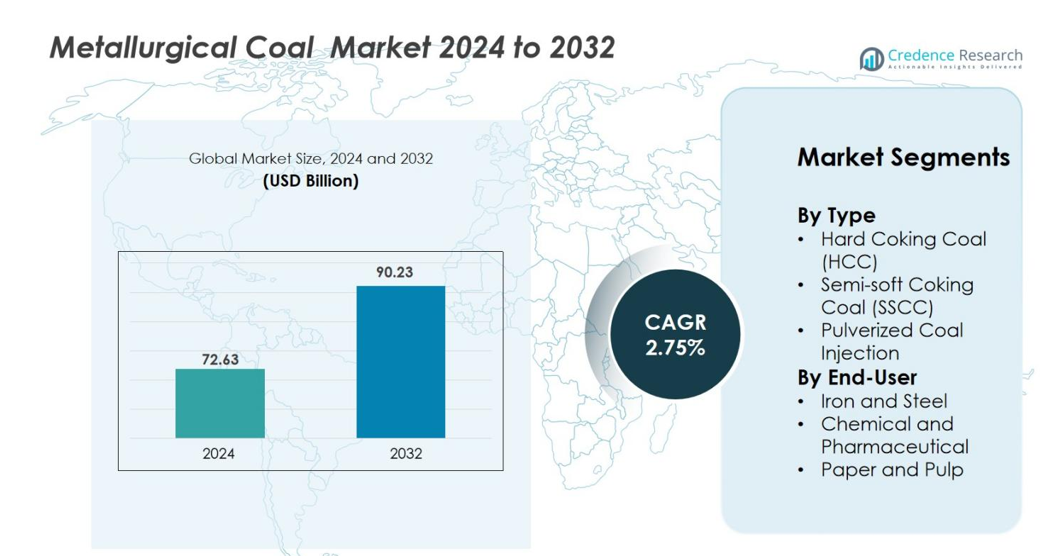
The Metallurgical Coal Market size was valued at USD 72.63 Billion in 2024 and is anticipated to reach USD 90.23 Billion by 2032, at a CAGR of 2.75% during the forecast period.
| REPORT ATTRIBUTE | DETAILS |
|---|---|
| Historical Period | 2020-2023 |
| Base Year | 2024 |
| Forecast Period | 2025-2032 |
| Metallurgical Coal Market Size 2024 | USD 72.63 Billion |
| Metallurgical Coal Market, CAGR | 2.75% |
| Metallurgical Coal Market Size 2032 | USD 90.23 Billion |
The Metallurgical Coal Market is led by prominent players such as Coal India Limited, China Shenhua Energy Company, Peabody Energy, Arch Coal, Inc., Anglo American, BHP Billiton and Alpha Natural Resources. These companies command leading coal‑mining assets, extensive global supply chains and long‑term relationships with steel manufacturers. Regionally, the market is dominated by Asia‑Pacific with a share of 60 %, supported by large steelmaking hubs in China and India. North America contributes 15 % of the market, while Europe holds 12 %, reflecting mature production and consumption bases.
Market Insights
- The Metallurgical Coal Market was valued at USD 72.63 Billion in 2024 and is projected to reach USD 90.23 Billion by 2032, growing at a CAGR of 2.75% during the forecast period.
- The primary driver for market growth is the rising demand from the steel industry, particularly in emerging economies like China and India, which are expanding their infrastructure and manufacturing sectors.
- Key trends include the shift toward sustainable steel production and technological advancements in coal mining, with increasing investments in carbon capture and cleaner mining techniques.
- The market is highly competitive with top players like Coal India, China Shenhua Energy, and Peabody Energy dominating, leveraging strong reserves and global distribution networks.
- Asia-Pacific holds the largest market share at over 60%, with North America and Europe following at 15% and 12%, respectively, driven by strong demand in steel production and industrialization efforts in these regions.
Market Segmentation Analysis
By Type
The Metallurgical Coal Market is categorized into Hard Coking Coal (HCC), Semi-soft Coking Coal (SSCC), and Pulverized Coal Injection (PCI). Among these, Hard Coking Coal (HCC) holds the dominant position, accounting for over 55% of the market share. HCC is highly sought after due to its superior carbon content and high coke quality, making it essential for blast furnaces in steel production. The demand for HCC is driven by the continued growth in the steel industry, particularly in regions like Asia-Pacific, where infrastructure and construction activities are booming.
- For instance, BHP’s steel‑making coal segment (via its BMA partnership) recorded 22.3 million tonnes of metallurgical coal production in the year ended 30 June 2024.
By End-User
The key end-users in the Metallurgical Coal Market include Iron and Steel, Chemical and Pharmaceutical, and Paper and Pulp industries. The Iron and Steel industry is the dominant end-user, representing nearly 70% of the market share. This is largely attributed to the critical role of metallurgical coal in steel production, where it is used in blast furnaces to produce coke. The growth in infrastructure and manufacturing activities, particularly in emerging markets, drives the demand for metallurgical coal within the iron and steel sector.
- For instance, China Baowu Group consumed approximately 68 million tonnes of coking coal in 2023 for its blast‑furnace steel operations.
Key Growth Drivers
Rising Demand from the Steel Industry
The primary driver for growth in the metallurgical coal market is the increasing demand from the steel industry. Metallurgical coal is a critical raw material used in the production of coke, which is a vital component in the production of steel through blast furnaces. The expansion of the construction, automotive, and manufacturing sectors in emerging economies, particularly in Asia-Pacific, has led to a surge in steel demand. China, India, and other developing nations are witnessing rapid urbanization and infrastructure development, directly contributing to higher steel production. As a result, the need for high-quality coking coal, particularly hard coking coal (HCC), is set to remain robust, driving the overall growth of the metallurgical coal market. Additionally, the ongoing industrialization of African and Latin American regions further supports this growth trajectory, ensuring sustained demand for metallurgical coal in the coming years.
- For instance, global steel production in 2022 used approximately 755 million tonnes of coking coal.
Increasing Steel Production in Emerging Economies
The industrialization of emerging economies is another significant growth driver for the metallurgical coal market. As countries like India, China, and other Southeast Asian nations continue their industrial transformation, steel production remains one of the key pillars of their economic growth. The demand for steel in these regions is driven by infrastructure development, urbanization, and the manufacturing of consumer goods. Consequently, the need for metallurgical coal, particularly for use in steel production, is expected to rise exponentially. China, which accounts for a major portion of the global steel production, continues to be the largest consumer of metallurgical coal. Furthermore, nations like India, Vietnam, and Indonesia are ramping up their steel production capacities, which will significantly contribute to the overall demand for metallurgical coal, pushing market growth over the forecast period.
- For instance, China Baowu Group produced over 130 million tonnes of crude steel in 2023, reinforcing its position as the world’s largest steelmaker and a major consumer of hard coking coal for its blast furnace operations.
Technological Advancements in Coal Mining and Processing
Technological advancements in mining and coal processing have significantly improved the efficiency of metallurgical coal extraction and utilization, further contributing to the market's growth. The development of advanced mining technologies, such as automation and remote-controlled operations, has enhanced the productivity and safety of coal mining operations. Additionally, improvements in coal beneficiation processes have allowed for the production of higher-quality metallurgical coal, which is essential for steel production. These advancements not only increase the yield of metallurgical coal but also reduce operational costs, making coal mining more economically viable. As a result, these technological innovations are expected to support an increase in supply, helping meet the growing demand for high-quality coal from the steel industry, thus propelling the overall growth of the metallurgical coal market.
Key Trends & Opportunities
Growing Focus on Sustainable Steel Production
A key trend in the metallurgical coal market is the increasing focus on sustainable steel production. As environmental regulations become more stringent, there is growing pressure on the steel industry to reduce its carbon footprint. This has led to the exploration of alternative technologies, such as hydrogen-based steelmaking, which may reduce reliance on traditional coal-powered blast furnaces. However, while the transition to cleaner technologies presents long-term opportunities, the current lack of widespread adoption means that metallurgical coal remains essential for the steel production process in the near term. Companies that can innovate and provide cleaner or more efficient coal technologies are poised to capitalize on this trend. Moreover, some coal producers are exploring carbon capture and storage (CCS) technologies, presenting a significant opportunity for companies to align with global sustainability goals while maintaining a competitive edge in the market.
- For instance, ArcelorMittal in partnership with Mitsubishi Heavy Industries Engineering (MHIENG) and BHP launched a pilot carbon‑capture unit at its Gent blast furnace site in Belgium in May 2024, aiming to test the feasibility of capturing a “significant portion” of CO₂ emissions over the next 1‑2 years.
Expansion of Steel Production Capacity in Emerging Markets
The expansion of steel production capacity in emerging markets presents a significant opportunity for the metallurgical coal market. As industrialization accelerates in regions such as India, Southeast Asia, and Africa, these regions are ramping up their steel production capacities to meet the demands of infrastructure development, urbanization, and industrial manufacturing. This growth in steel production is expected to drive the demand for metallurgical coal, particularly for use in blast furnaces. The availability of affordable coal, along with the increasing number of steel production plants in these regions, offers a lucrative opportunity for both coal producers and suppliers to capture a larger market share. As these economies continue to develop, the metallurgical coal market is poised to experience strong growth in both supply and demand.
- For instance, JSW Steel is expanding its steel production capacity from 27 million tonnes in 2023 to 37 million tonnes by FY 2025, which will increase its metallurgical coal demand
Key Challenges
Environmental Concerns and Regulatory Pressures
Environmental concerns and regulatory pressures represent significant challenges for the metallurgical coal market. As the global community becomes more focused on reducing greenhouse gas emissions and combating climate change, the coal industry faces increasing scrutiny. Metallurgical coal, used in coke production for steelmaking, is a major contributor to carbon emissions. Governments and regulatory bodies are implementing stricter environmental regulations, pushing for reductions in carbon footprints across industries, including steel production. This shift towards greener alternatives poses a challenge for coal producers, who may face higher operational costs due to compliance with environmental standards. The growing demand for cleaner production technologies, such as hydrogen-based steelmaking, further intensifies this challenge, as it could eventually reduce the market's reliance on metallurgical coal.
Volatility in Coal Prices and Supply Chain Disruptions
Volatility in coal prices and potential supply chain disruptions pose a significant challenge to the stability of the metallurgical coal market. The prices of coal are influenced by factors such as geopolitical tensions, transportation issues, and fluctuations in demand from key markets like China and India. Recent events, such as the global COVID-19 pandemic, highlighted the vulnerability of global supply chains, with disruptions in mining operations, transportation, and trade. Furthermore, environmental disasters or policy changes in key coal-producing regions can impact coal availability and drive up costs. This volatility in prices creates uncertainty for coal producers and steel manufacturers, making long-term planning and investment decisions more difficult. The unpredictability of the coal market poses a challenge for both suppliers and end-users, affecting profitability and market dynamics.
Regional Analysis
Asia-Pacific
Asia-Pacific holds the dominant share of the metallurgical coal market, accounting for 60% of the global market in 2024. The region's growth is primarily driven by the steel production needs of countries like China and India, which are the largest consumers of metallurgical coal. China's rapidly expanding infrastructure and steel production capacities, along with India's ongoing industrialization, are significant contributors to demand. Additionally, Southeast Asian nations, such as Vietnam and Indonesia, are increasing their steel production, further fueling the demand for high-quality coking coal. This regional dominance is expected to continue as industrialization intensifies.
North America
North America holds a substantial share of the metallurgical coal market, estimated at 15% in 2024. The United States is the key driver in this region, with metallurgical coal being a crucial input for its steel industry. The country is one of the largest producers and exporters of metallurgical coal, with significant mining operations in states like West Virginia and Pennsylvania. Canada's demand for metallurgical coal is also increasing, primarily for steel production and industrial applications. Growth in both the U.S. and Canadian markets is supported by advanced mining technologies and strong regional industrial activities.
Europe
Europe is another important region in the metallurgical coal market, holding a market share of 12% in 2024. The demand for metallurgical coal in Europe is largely driven by the steel industry in countries like Germany, Italy, and Poland. As part of its efforts to transition toward more sustainable manufacturing, Europe is exploring alternative technologies like hydrogen-based steelmaking. However, metallurgical coal still plays a vital role in steel production. In addition, several European countries import metallurgical coal from countries like Russia and the U.S. to meet their industrial demands, although regional challenges related to emissions standards remain a concern.
Latin America
Latin America accounts for 5% of the global metallurgical coal market. Brazil is the key player in this region, with a large steel industry that requires significant amounts of metallurgical coal. The country's industrial sector, particularly in infrastructure and construction, drives steady demand. Additionally, emerging economies in the region, such as Mexico and Argentina, are also increasing their steel production capacities, further boosting the demand for coal. The region's future growth potential lies in expanding industrial activities, supported by increased demand for steel in the automotive and construction sectors.
Middle East & Africa
The Middle East and Africa region holds a smaller share of 3% of the global metallurgical coal market. However, the region is experiencing growth, primarily driven by the steel industries in countries like Turkey, South Africa, and Egypt. These nations are expanding their steel production capabilities to support infrastructural projects and industrial development. While the region's demand for metallurgical coal is currently lower compared to other regions, it is expected to grow steadily as countries like South Africa increase steel production and new projects emerge, supported by investments in local infrastructure.
Market Segmentations
By Type
- Hard Coking Coal (HCC)
- Semi-soft Coking Coal (SSCC)
- Pulverized Coal Injection
By End-User
- Iron and Steel
- Chemical and Pharmaceutical
- Paper and Pulp
By Geography
- North America
- U.S.
- Canada
- Mexico
- Europe
- Germany
- France
- U.K.
- Italy
- Spain
- Rest of Europe
- Asia Pacific
- China
- Japan
- India
- South Korea
- South-east Asia
- Rest of Asia Pacific
- Latin America
- Brazil
- Argentina
- Rest of Latin America
- Middle East & Africa
- GCC Countries
- South Africa
- Rest of the Middle East and Africa
Competitive Landscape
The competitive landscape of the global metallurgical coal market is characterized by a concentration of major mining companies that combine substantial production capacity with advanced logistical capabilities. Firms such as Coal India Limited, China Shenhua Energy Company, Peabody Energy, Anglo American plc, BHP Billiton and Alpha Natural Resources dominate the market through integrated mining‑to‑supply operations. These companies are leveraging strategic acquisitions, long‑term supply contracts with steel manufacturers, and regional diversification to strengthen their positions. The top players have secured key high‑quality coking coal reserves, optimized cost structures, and established global trade networks, enabling them to respond swiftly to changing demand dynamics in the steel and alloy industries. At the same time, smaller producers and niche players focus on specialized coal grades or regional markets to carve out their share. As the market evolves, partnerships, joint ventures, digitalisation of mining operations, and sustainability investments are emerging as differentiators among competitors, underlining the importance of operational agility and supply‑chain resilience in maintaining market leadership.
Key Player Analysis
- Anglo American
- Alpha Natural Resources
- China Shenhua Energy Company
- RWE AG
- BHP Billiton
- Peabody Energy
- Arch Coal, Inc.
- China National Coal Group Co., Ltd
- Coal India Limited
- Beijing Jingmei Group Co. Ltd
Recent Developments
- In September 2025, JSW Steel Limited announced that through its subsidiary it will increase its economic interest in M Res NSW to 83.33 %, thereby raising its effective stake in Illawarra Metallurgical Coal (Australia) from 20 % to 30 %.
- In August 2024, Arch Resources, Inc. and CONSOL Energy Inc. entered into a definitive all‑stock merger of equals to create Core Natural Resources, combining their high‑quality metallurgical coal portfolios.
- In August 2024, Whitehaven Coal Limited announced binding agreements to sell a combined 30% interest in its Blackwater Mine to Nippon Steel Corporation (20%) and JFE Steel Corporation (10%) for US $1.08 billion, with associated long‑term offtake contracts for the mine’s metallurgical coal.
Report Coverage
The research report offers an in-depth analysis based on Type, End-User and Geography. It details leading market players, providing an overview of their business, product offerings, investments, revenue streams, and key applications. Additionally, the report includes insights into the competitive environment, SWOT analysis, current market trends, as well as the primary drivers and constraints. Furthermore, it discusses various factors that have driven market expansion in recent years. The report also explores market dynamics, regulatory scenarios, and technological advancements that are shaping the industry. It assesses the impact of external factors and global economic changes on market growth. Lastly, it provides strategic recommendations for new entrants and established companies to navigate the complexities of the market.
Future Outlook
- Demand for high‑quality hard coking coal will continue to underpin the market’s growth as steel producers seek reliable supply.
- Emerging economies will expand blast furnace capacity, increasing reliance on metallurgical coal for the foreseeable future.
- Advances in mining automation and beneficiation technologies will improve yield and reduce cost, enhancing the competitiveness of coal supply.
- Suppliers that integrate carbon capture, utilization and storage (CCUS) will gain strategic advantage amid tightening climate regulations.
- The transition toward hydrogen and electric steelmaking will create niche demand for metallurgical coal in hybrid pathways, delaying full substitution.
- Trade flows will shift as Africa and Latin America ramp up production and export infrastructure, altering global supply‑chain dynamics.
- Steel producers will adopt longer‑term supply contracts for coal to mitigate price volatility and ensure feedstock security.
- Environmental policy reforms in key importing nations will prompt coal producers to enhance transparency and ESG compliance.
- The market share of semi‑soft coking coal and pulverised coal injection will gradually increase as steelmakers optimize fuel mixes.
- Investment in downstream value‑chains, such as integrated steel‑coal complexes, will grow as companies seek to control feedstock cost and quality.

Request a Free Sample
Fill in your details and we'll send you a free sample report.
- Sample data tables & charts
- Research methodology
Market Dynamics
Rising Demand from the Steel Industry
Metallurgical coal is a critical input for blast furnace steel production, and the expansion of infrastructure and manufacturing in emerging economies like China and India is driving robust demand for steel, thereby increasing the need for high-quality coking coal.
Expansion of Steel Production Capacity in Emerging Markets
Countries such as India, Vietnam, and Indonesia are rapidly increasing their steel production capacities to support urbanization and industrialization, which directly boosts the consumption of metallurgical coal for new and existing blast furnaces.
Technological Advancements in Mining and Processing
Innovations in mining automation, remote operations, and coal beneficiation are improving extraction efficiency and coal quality, reducing operational costs, and making metallurgical coal supply more competitive and reliable.
Shift Toward Sustainable Steel Production
While alternative steelmaking technologies are emerging, the current focus on carbon capture and cleaner mining techniques is allowing metallurgical coal producers to align with stricter environmental regulations, supporting continued demand in the near term.
Volatility in Coal Prices and Supply Chain Resilience
Fluctuations in coal prices and disruptions in global supply chains have prompted steelmakers to secure long-term contracts and diversify sources, sustaining demand for reliable metallurgical coal suppliers.
Need a Custom Version of This Report?
Tailor the scope, geography, or segments to your exact requirements.
- Custom geography or segment scope
- Direct access to our analyst team
Frequently Asked Questions
What is the current market size for Metallurgical Coal Market, and what is its projected size in 2032?
At what Compound Annual Growth Rate is the Metallurgical Coal Market projected to grow between 2025 and 2032?
Which is the leading region of the market for Metallurgical Coal?
What are the key drivers for the growth of the Metallurgical Coal market?
Which is the major segment in the Metallurgical Coal market by application?
Who are the leading companies in the Metallurgical Coal Market?
Table of Content
Chapter 1 Market Segmentation
- 1.1 Segmentation Framework
- 1.1.1 Product and Service Classification
- 1.1.2 Application and End-Use Classification
- 1.1.3 Technology and Solution Classification
- 1.1.4 Customer and Distribution Channel Classification
- 1.1.5 Geographic Segmentation
- 1.1.6 Market Segment Definitions and Boundaries
- 1.2 By Type
- 1.2.1 Hard Coking Coal (HCC)
- 1.2.2 Semi-soft Coking Coal (SSCC)
- 1.2.3 Pulverized Coal Injection (PCI)
- 1.3 By End-User
- 1.3.1 Iron and Steel
- 1.3.2 Chemical and Pharmaceutical
- 1.3.3 Paper and Pulp
Chapter 2 Introduction
- 2.1 Report Objectives and Scope
- 2.2 Product Definition and Industry Terminology
- 2.3 Market Inclusions and Exclusions
- 2.4 Research Process
- 2.4.1 Primary Research and Expert Interviews
- 2.4.2 Secondary Research and Source Review
- 2.4.3 Top-Down and Bottom-Up Estimation
- 2.4.4 Data Triangulation and Verification
- 2.5 Market Size Measurement Basis
- 2.5.1 2024: USD 72.63 Billion → 2032: USD 90.23 Billion
- 2.6 Historical and Forecast Reference Periods
- 2.6.1 Base Year: 2024
- 2.6.2 Forecast Period: 2024-2032
- 2.7 Research Assumptions and Limitations
Chapter 3 Executive Summary
- 3.1 Market Snapshot and Key Findings
- 3.2 Base-Year Market Size, 2024
- 3.3 Forecast Market Size, 2032
- 3.4 Revenue and Volume Growth Outlook
- 3.5 Key Demand and Supply Indicators
- 3.6 Leading Market Segments
- 3.7 Fastest-Growing Market Opportunities
- 3.8 Regional Performance Highlights
- 3.9 Technology and Industry Transformation
- 3.10 Competitive Landscape Summary
- 3.11 Analyst View and Strategic Implications
Chapter 4 Global Metallurgical Coal Market Trends and Developments
- 4.1 Historical Industry Development
- 4.2 Recent Market Trends and Developments
- 4.3 Demand and Customer Behavior Trends
- 4.4 Technology and Product Innovation
- 4.5 Artificial Intelligence, Automation and Digitalization
- 4.6 Local Manufacturing and Supply Chain Realignment
- 4.7 Industry Partnerships, Mergers and Acquisitions
- 4.8 Sustainability and Circular Economy Developments
- 4.9 Government and Private Sector Investment Trends
- 4.10 Emerging Business Models and Commercialization
- 4.11 Industry Developments and Announcements
Chapter 5 Global Metallurgical Coal Market Production, Supply and Demand Analysis
- 5.1 Demand Trend and Consumption Analysis
- 5.2 Demand Forecast, 2024-2032
- 5.3 Production and Output Trend
- 5.4 Production and Output Forecast, 2024-2032
- 5.5 Installed Capacity and Capacity Utilization
- 5.6 Company-Wise Production Plants and Statistics
- 5.6.1 Installed Production Capacity
- 5.6.2 Actual Production
- 5.6.3 Planned Capacity and Expansion Targets
- 5.7 Supply Chain Structure and Procurement Trends
- 5.8 Supply-Demand Gap and Bottlenecks
- 5.9 Import Dependence and Sourcing Structure
- 5.10 Contract Manufacturing and Outsourcing
- 5.11 Regional Supply and Demand Concentration
Chapter 6 Global Metallurgical Coal Market Pricing Analysis
- 6.1 Pricing Structure and Measurement
- 6.2 Historical Pricing Trends
- 6.3 Pricing Outlook, 2024-2032
- 6.4 Average Selling Price and Unit Economics
- 6.5 Pricing by Product and Market Segment
- 6.6 Geographic Pricing Differences
- 6.7 Key Input, Energy, Labor and Logistics Costs
- 6.8 Contract Pricing and Purchasing Models
- 6.9 Pricing Sensitivity and Competitive Positioning
- 6.10 Price, Margin and Profitability Implications
Chapter 7 Global Metallurgical Coal Market Dynamics
- 7.1 Market Growth Drivers
- 7.1.1 Demand-Side Drivers
- 7.1.2 Technology and Innovation Drivers
- 7.1.3 Infrastructure and Investment Drivers
- 7.1.4 Regulatory and Policy Drivers
- 7.2 Market Restraints
- 7.2.1 Cost and Affordability Constraints
- 7.2.2 Technology and Adoption Barriers
- 7.2.3 Supply Chain and Operational Constraints
- 7.3 Market Challenges
- 7.3.1 Competitive Pressure and Margin Erosion
- 7.3.2 Skills, Infrastructure and Implementation Gaps
- 7.4 Emerging Market Opportunities
- 7.5 Market Dynamics Impact and Time-Horizon Assessment
Chapter 8 Global Metallurgical Coal Value Chain Analysis
- 8.1 Industry Value Chain Overview
- 8.2 Upstream Suppliers and Critical Inputs
- 8.3 Technology and Component Providers
- 8.4 Manufacturing or Service Delivery
- 8.5 Distribution, Channel Partners and Integrators
- 8.6 Downstream Applications and End Users
- 8.7 Value Addition and Profit Pools
- 8.8 Vertical Integration and Outsourcing
- 8.9 Supplier Concentration and Risk
- 8.10 Supply Chain Localization and Resilience
Chapter 9 Global Metallurgical Coal Market Regulations and Policies
- 9.1 Relevant Laws, Standards and Compliance Frameworks
- 9.2 Product, Service, Safety and Quality Requirements
- 9.3 Government Policies, Incentives and Subsidies
- 9.4 Imports, Exports and Trade Barriers
- 9.5 Public Procurement and Local Content Requirements
- 9.6 Environmental and Sustainability Compliance
- 9.7 Upcoming Policy Changes and Market Implications
Chapter 10 Global Metallurgical Coal Market Hotspots and Opportunities
- 10.1 Market Opportunity Mapping and Growth Hotspots
- 10.2 High-Growth Applications and Customer Groups
- 10.3 Underserved Markets and White-Space Opportunities
- 10.4 Emerging Technology and Product Opportunities
- 10.5 New Capacity and Investment Hotspots
- 10.6 Market Entry and Expansion Opportunities
- 10.7 Distribution and Partnership Opportunities
- 10.8 Near-Term and Long-Term Commercial Potential
- 10.9 Opportunity Attractiveness and Execution Risks
Chapter 11 Global Metallurgical Coal Market Outlook, 2024-2032
- 11.1 Market Size and Analysis
- 11.1.1 Revenue (Market Measurement: 2024: USD 72.63 Billion → 2032: USD 90.23 Billion)
- 11.1.2 Market Volume and Quantity Sold
- 11.1.3 Historical Market Size
- 11.1.4 Base-Year Market Size, 2024
- 11.2 Market Forecast, 2024-2032
- 11.2.1 Revenue Forecast to 2032
- 11.2.2 Volume Forecast to 2032
- 11.2.3 CAGR and Year-on-Year Growth
- 11.2.4 Incremental Revenue Opportunity
- 11.3 Forecast Assumptions and Scenario Analysis
- 11.3.1 Base-Case Forecast
- 11.3.2 Optimistic and Conservative Scenarios
- 11.3.3 Technology, Pricing and Policy Sensitivities
- 11.4 Market Attractiveness and Growth Outlook
Chapter 12 Global Metallurgical Coal Market Segmentation and Outlook
- 12.1 Segmentation Summary and Market Shares, 2024
- 12.2 Largest and Fastest-Growing Segments
- 12.3 By Type - Market Size and Forecast, 2024-2032
- 12.3.1 Segment Definition and Scope
- 12.3.2 Historical Market Size
- 12.3.3 Revenue Forecast, 2024-2032
- 12.3.4 Volume Forecast, 2024-2032
- 12.3.5 Base-Year Market Share, 2024
- 12.3.6 Segment CAGR and Growth Drivers
- 12.3.7 Subsegment Market Size and Forecast
- 12.3.7.1 Hard Coking Coal (HCC)
- 12.3.7.2 Semi-soft Coking Coal (SSCC)
- 12.3.7.3 Pulverized Coal Injection (PCI)
- 12.3.8 Subsegment Pricing and Adoption Trends
- 12.3.9 Leading Suppliers and Competition
- 12.3.10 Regional Demand and Opportunities
- 12.4 By End-User - Market Size and Forecast, 2024-2032
- 12.4.1 Segment Definition and Scope
- 12.4.2 Historical Market Size
- 12.4.3 Revenue Forecast, 2024-2032
- 12.4.4 Volume Forecast, 2024-2032
- 12.4.5 Base-Year Market Share, 2024
- 12.4.6 Segment CAGR and Growth Drivers
- 12.4.7 Subsegment Market Size and Forecast
- 12.4.7.1 Iron and Steel
- 12.4.7.2 Chemical and Pharmaceutical
- 12.4.7.3 Paper and Pulp
- 12.4.8 Subsegment Pricing and Adoption Trends
- 12.4.9 Leading Suppliers and Competition
- 12.4.10 Regional Demand and Opportunities
- 12.5 Segment Growth Comparison
- 12.6 Segment Attractiveness and Priority Matrix
Chapter 13 Global Metallurgical Coal End-Use and Application Market Outlook
- 13.1 End-Use Industry and Customer Demand Structure
- 13.2 Leading Applications and Customer Groups
- 13.3 End-Use Market Size, Share and Forecast
- 13.4 Major End-Use Industry Deep Dives
- 13.4.1 Customer Requirements and Use Cases
- 13.4.2 Demand and Replacement Cycles
- 13.4.3 Technical and Regulatory Considerations
- 13.4.4 Purchasing and Procurement Models
- 13.4.5 Leading Vendors and Distribution Channels
- 13.4.6 Forecast and Commercial Opportunities
- 13.5 Emerging Applications and Cross-Segment Demand
- 13.6 End-Use Industry Investment Priorities
Chapter 14 Global Metallurgical Coal Geographic Market Outlook, 2024-2032
- 14.1 Regional Market Size and Share, 2024
- 14.2 Regional Market Forecast, 2024-2032
- 14.3 Regional Pricing, Production and Demand Differences
- 14.4 North America
- 14.4.1 United States
- 14.4.2 Canada
- 14.4.3 Mexico
- 14.5 Europe
- 14.5.1 Germany
- 14.5.2 France
- 14.5.3 Italy
- 14.5.4 United Kingdom
- 14.5.5 Spain
- 14.5.6 Poland
- 14.5.7 Russia
- 14.5.8 Netherlands
- 14.5.9 Belgium
- 14.5.10 Sweden
- 14.5.11 Denmark
- 14.5.12 Norway
- 14.5.13 Rest of Europe
- 14.6 Asia Pacific
- 14.6.1 China
- 14.6.2 India
- 14.6.3 Japan
- 14.6.4 South Korea
- 14.6.5 Thailand
- 14.6.6 Indonesia
- 14.6.7 Vietnam
- 14.6.8 Malaysia
- 14.6.9 Australia
- 14.6.10 Rest of Asia Pacific
- 14.7 Latin America
- 14.7.1 Brazil
- 14.7.2 Argentina
- 14.7.3 Colombia
- 14.7.4 Chile
- 14.7.5 Rest of Latin America
- 14.8 Middle East
- 14.8.1 Saudi Arabia
- 14.8.2 United Arab Emirates
- 14.8.3 Turkey
- 14.8.4 Israel
- 14.8.5 Iran
- 14.8.6 Rest of the Middle East
- 14.9 Africa
- 14.9.1 South Africa
- 14.9.2 Egypt
- 14.9.3 Nigeria
- 14.9.4 Morocco
- 14.9.5 Rest of Africa
- 14.10 Regional Investment, Policy and Supply Chain Differences
- 14.11 Regional Competitive Landscape
- 14.12 Geographic Growth Hotspots
Chapter 15 Global Metallurgical Coal Technology, Innovation and Sustainability Outlook
- 15.1 Technology Landscape and Maturity
- 15.2 Product, Process and Service Innovation
- 15.3 AI, Automation and Digital Tools in the Industry
- 15.4 Technology Adoption and Performance Benchmarking
- 15.5 Innovation Pipeline and R&D Investment
- 15.6 Patent and Intellectual Property Trends
- 15.7 Energy Efficiency and Resource Management
- 15.8 Sustainability, Recycling and Circularity
- 15.9 Technology Roadmap, 2024-2032
- 15.10 Risks of Obsolescence and Technology Substitution
Chapter 16 Global Metallurgical Coal Market Key Strategic Imperatives
- 16.1 Growth and Market Entry Priorities
- 16.2 High-Return Products and Segments
- 16.3 Pricing, Profitability and Cost Optimization
- 16.4 Technology Investment and Product Differentiation
- 16.5 Supply Chain Localization and Resilience
- 16.6 Distribution and Customer Acquisition
- 16.7 Partnership, Acquisition and Capacity Strategy
- 16.8 Regional Expansion Priorities
- 16.9 Short-, Medium- and Long-Term Actions
Chapter 17 Competition Outlook
- 17.1 Industry Competition Characteristics
- 17.2 Market Structure and Concentration
- 17.3 Market Share and Competitive Positioning, 2024
- 17.4 Company-Wise Revenue and Product Benchmarking
- 17.5 Production and Service Capacity Benchmarking
- 17.6 Technology, Pricing and Differentiation
- 17.7 Regional Footprint and Distribution Strength
- 17.8 Mergers, Acquisitions and Strategic Alliances
- 17.9 New Entrants and Competitive Threats
- 17.10 Porter's Five Forces and Industry Attractiveness
- 17.11 Competitive Outlook, 2024-2032
Chapter 18 Company Profiles
- 18.1 Company Coverage and Selection Criteria
- 18.2 Coal India Limited
- 18.2.1 Business Description
- 18.2.2 Company Ownership and Geographic Presence
- 18.2.3 Product and Service Portfolio
- 18.2.4 Manufacturing and Operating Footprint
- 18.2.5 Production Capacity and Expansion Plans
- 18.2.6 Financial Performance and Investment
- 18.2.7 Market Share and Competitive Position
- 18.2.8 Technology and Innovation Capabilities
- 18.2.9 Strategic Alliances or Partnerships
- 18.2.10 Recent Developments
- 18.2.11 Growth Strategy and Outlook
- 18.3 China Shenhua Energy Company
- 18.4 Peabody Energy
- 18.5 Arch Coal, Inc.
- 18.6 Anglo American
- 18.7 BHP Billiton
- 18.8 Alpha Natural Resources
- 18.9 China National Coal Group Co., Ltd
- 18.10 RWE AG
- 18.11 Beijing Jingmei Group Co. Ltd
- 18.12 Other Relevant Market Participants
Note: Every listed company is profiled on the structure shown under the first company. The company list is preliminary and may change based on research findings, market developments, data availability and client requirements.
Chapter 19 Disclaimer
- 19.1 Research and Forecast Disclaimer
- 19.2 Data Source and Estimation Limitations
Note: The depth of individual sections depends on data availability for this market. Volume, capacity, trade and other unit-based metrics are included where applicable.