
Market Overview:
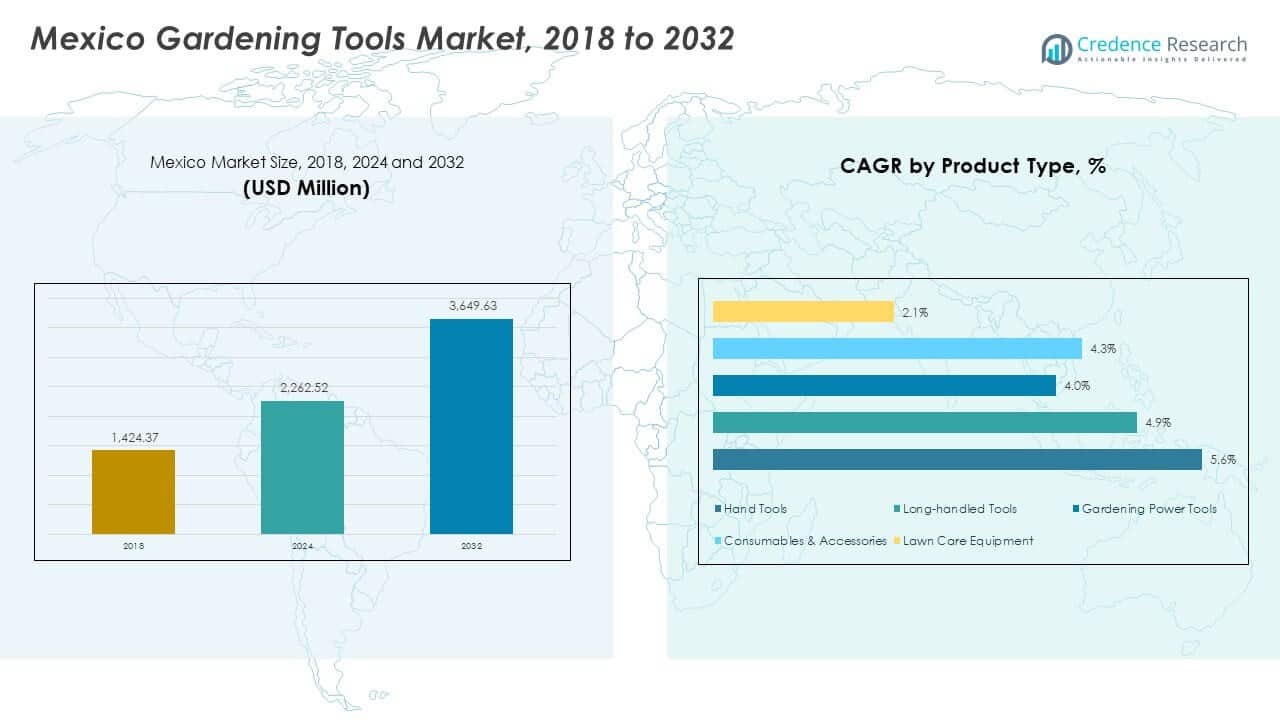
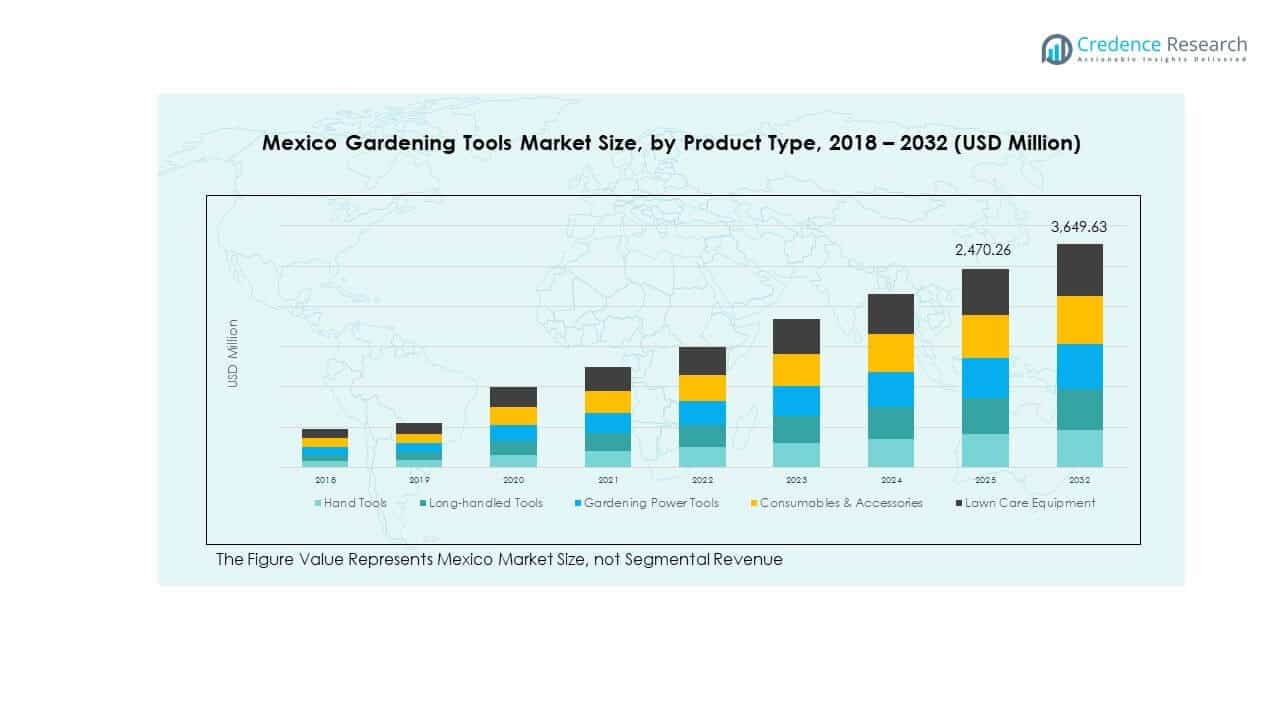
The Mexico Gardening Tools Market size was valued at USD 1,424.37 million in 2018, reached USD 2,262.52 million in 2024, and is anticipated to attain USD 3,649.63 million by 2032, at a CAGR of 5.73% during the forecast period.
| REPORT ATTRIBUTE | DETAILS |
|---|---|
| Historical Period | 2020-2023 |
| Base Year | 2024 |
| Forecast Period | 2025-2032 |
| Mexico Gardening Tools Market Size 2024 | USD 2,262.52 Million |
| Mexico Gardening Tools Market, CAGR | 5.73% |
| Mexico Gardening Tools Market Size 2032 | USD 3,649.63 Million |
The market expands due to the growing popularity of home gardening and landscaping among urban households. Rising disposable incomes and lifestyle improvements encourage consumers to invest in ergonomic and durable tools. Strong retail growth and the increasing availability of cordless and battery-powered equipment boost product adoption. Manufacturers focus on innovation to enhance performance, efficiency, and sustainability across residential and commercial segments.
Geographically, Central Mexico dominates due to high urbanization, expanding residential zones, and well-developed retail networks. Northern Mexico shows steady growth with industrial and suburban developments driving landscaping needs. Southern regions emerge as promising markets supported by agricultural diversification and improving access to modern retail and e-commerce channels. Each region contributes uniquely to the overall expansion of the Mexico Gardening Tools Market.
Market Insights
- The Mexico Gardening Tools Market was valued at USD 1,424.37 million in 2018, reached USD 2,262.52 million in 2024, and is projected to attain USD 3,649.63 million by 2032, growing at a CAGR of 5.73%.
- Central Mexico leads with 40% share due to high urbanization, strong retail infrastructure, and expanding residential landscaping projects.
- Northern Mexico follows with 35% share, driven by industrial and suburban growth that supports steady landscaping and outdoor maintenance demand.
- Southern Mexico, holding 25% share, is the fastest-growing region, supported by agricultural diversification and growing adoption of modern gardening tools through e-commerce and retail expansion.
- In product segmentation, hand tools account for about 30%, while lawn care equipment represents roughly 25%, reflecting strong demand from both household users and commercial landscapers.
Market Drivers
Rising Popularity of Home Gardening and Landscaping
The Mexico Gardening Tools Market benefits from increasing consumer interest in home gardening and landscaping activities. Urban households invest in gardens, patios, and green rooftops to enhance living environments. Rising awareness about sustainability and air purification encourages the use of manual and power tools. Retail chains expand product lines to meet consumer preference for ergonomically designed equipment. E-commerce platforms support easy access to a wide range of gardening tools. Young homeowners treat gardening as a leisure and wellness activity, driving consistent tool demand. Landscaping businesses also grow to serve residential and commercial clients. The expansion of home improvement culture strengthens long-term sales growth.
Technological Advancements in Power and Smart Gardening Tools
Manufacturers introduce advanced battery-operated and smart gardening tools that improve user efficiency. Cordless equipment reduces noise and emission levels while offering portability for small urban spaces. The adoption of IoT-enabled devices enables better control and monitoring of gardening tasks. It supports sustainability goals by optimizing energy use and water management. Product lines now feature lightweight designs and quick charging systems to improve convenience. Leading brands invest in innovation to meet Mexico’s growing preference for eco-friendly products. Smart irrigation systems and robotic lawn mowers also gain traction. These developments redefine product performance and consumer expectations across the sector.
- For instance, Husqvarna's Automower robotic lawn mower models such as the 450XJ can autonomously manage up to 5,000 square meters and feature GPS navigation with precision mapping, as documented in their technical specifications and product literature for 2025.
Growing Urbanization and Expanding Residential Infrastructure
The Mexico Gardening Tools Market benefits from rapid urbanization and new residential construction projects. Expansion of suburban housing increases the number of private gardens and landscaped areas. Rising disposable incomes encourage property owners to maintain outdoor spaces using quality tools. Developers include green zones in new complexes, promoting demand for regular maintenance tools. Construction of hotels and office spaces with landscaped surroundings boosts commercial tool purchases. The popularity of gated communities with shared gardens strengthens local market activity. Tool suppliers collaborate with real estate firms to reach these new customer bases. It enhances the scope of distribution and after-sales services nationwide.
- For instance, Bosch released sensor-based irrigation systems that optimize water use, reducing consumption by around 25% according to field trials and case studies published on the Bosch website and in environmental technology journals in 2024-2025.
Government Initiatives and Sustainability Programs Supporting Green Spaces
Government efforts to increase green coverage in cities contribute to higher tool demand. Local programs promote tree planting and urban farming projects, raising equipment usage. Municipalities partner with private firms for park maintenance, creating steady procurement cycles. It fosters collaboration between manufacturers and local authorities. Environmental awareness campaigns further strengthen consumer preference for sustainable gardening. Educational institutions and NGOs conduct drives to promote home gardening and composting. These initiatives expand the overall gardening culture across Mexico. The market benefits from supportive policies that encourage ecological and lifestyle improvements simultaneously.
Market Trends
Shift Toward Battery-Powered and Cordless Tools for Better Efficiency
The Mexico Gardening Tools Market experiences strong adoption of cordless tools replacing traditional wired models. Consumers prefer battery-powered trimmers, blowers, and lawn mowers for greater mobility. Lithium-ion technology enables longer operational time and faster recharging. Manufacturers expand compact tool categories to target urban homes with limited space. It supports flexible usage without dependence on fuel or heavy maintenance. Brands focus on introducing quick-swap battery systems to improve tool continuity. Noise-free and emission-free features make these tools attractive for eco-conscious users. This shift aligns with Mexico’s rising awareness of sustainability and comfort.
- For instance, STIHL’s GTA 26 cordless pruner weighs just 1.45 kg including the battery, runs on a 10.8V lithium-ion battery providing up to 25 minutes runtime, and has a 4-inch guide bar that can cut branches up to 4 cm thick. It features a rapid charging system and ergonomic rubberized grips for user comfort.
Rising Penetration of Online Retail and Omni-Channel Distribution Models
Online marketplaces play a vital role in expanding tool accessibility and price competition. E-commerce platforms provide detailed comparisons, reviews, and discounts that influence purchase behavior. The Mexico Gardening Tools Market witnesses collaboration between retailers and digital partners. It allows brands to reach rural and urban buyers efficiently. Companies adopt omni-channel approaches, combining physical stores with digital convenience. The trend supports real-time inventory checks and doorstep delivery services. Gardening enthusiasts increasingly prefer online tutorials linked to product purchases. This retail transformation enhances market transparency and buyer engagement.
Increasing Demand for Ergonomic and Multi-Functional Tool Designs
Users demand lighter, comfortable, and multi-purpose tools to ease prolonged usage. Manufacturers integrate ergonomic grips, adjustable handles, and low-vibration mechanisms. The Mexico Gardening Tools Market evolves toward designs that reduce fatigue and improve precision. It supports both professional landscapers and household users seeking efficiency. Companies invest in R&D to create durable materials resistant to rust and impact. Compact tool sets become popular among urban gardeners with limited storage. Aesthetic appeal and design innovation influence brand loyalty. This trend improves product usability and consumer satisfaction in key segments.
- For instance, Black+Decker offers a diverse lineup of gardening tools with ergonomic features such as adjustable handles and vibration reduction technology. Their 20V MAX Lithium string trimmer is lightweight and designed to reduce user fatigue during extended use. The tools incorporate durable rust-resistant materials, balancing functionality and aesthetics tailored for professional and household users.
Rising Interest in Sustainable and Locally Produced Tools
Sustainability drives greater attention to locally made and recyclable tools. Regional manufacturers focus on reducing imports and promoting Mexican-made gardening solutions. The Mexico Gardening Tools Market aligns with green production standards and ethical sourcing. It encourages innovation in biodegradable materials and energy-efficient manufacturing. Consumers prefer brands emphasizing minimal packaging and repairable designs. Partnerships between government agencies and local workshops enhance product variety. It reinforces the domestic supply chain and reduces environmental footprint. Growing support for local craftsmanship strengthens brand identity and consumer trust.
Market Challenges Analysis
High Dependence on Imported Raw Materials and Rising Costs
The Mexico Gardening Tools Market faces cost pressures due to dependency on imported metals and components. Currency fluctuations impact procurement and pricing stability. It limits small manufacturers’ ability to maintain competitive margins. Global disruptions in logistics further strain delivery schedules. Rising freight charges increase final retail prices, affecting demand elasticity. Domestic sourcing remains limited, slowing industrial self-reliance. Local producers struggle to match quality consistency of international brands. These cost challenges hinder large-scale expansion for smaller industry participants.
Limited Awareness and Seasonal Demand Variability
Consumer awareness about advanced gardening tools remains low outside major cities. Seasonal demand peaks during specific months, creating uneven revenue cycles. It restricts stable production planning and inventory management for suppliers. Retailers face challenges maintaining stock turnover during off-seasons. Lack of structured training on tool maintenance reduces product lifespan. The market also struggles with inadequate promotional campaigns in rural areas. Companies must invest in education and brand visibility to drive awareness. Overcoming these constraints can unlock consistent year-round demand growth.
Market Opportunities
Expansion of Urban Farming and Indoor Gardening Solutions
The Mexico Gardening Tools Market gains new prospects from the rise of urban farming and indoor gardens. Compact and modular gardening systems appeal to apartment dwellers. It creates a growing need for smaller, efficient, and easy-to-store tools. Retailers develop dedicated product lines for balcony gardens and hydroponic setups. Innovation in vertical gardening equipment enhances commercial opportunities. Educational campaigns promoting home-grown produce expand product demand. Local startups entering this niche segment strengthen industry diversity. This expansion supports sustainable living and healthier urban lifestyles.
Investment in Local Manufacturing and Export Development
Local tool producers explore opportunities to scale exports to nearby Latin markets. It reduces dependency on imported brands while promoting domestic capabilities. Government incentives encourage industrial expansion in durable goods manufacturing. Companies invest in automation and material innovation to boost production efficiency. Regional collaborations open pathways to international certifications and trade. Focus on high-quality, low-cost tools enhances Mexico’s export competitiveness. The shift supports job creation and strengthens national supply chain resilience. These strategies create long-term growth potential within the market.
Market Segmentation Analysis
By Product Type
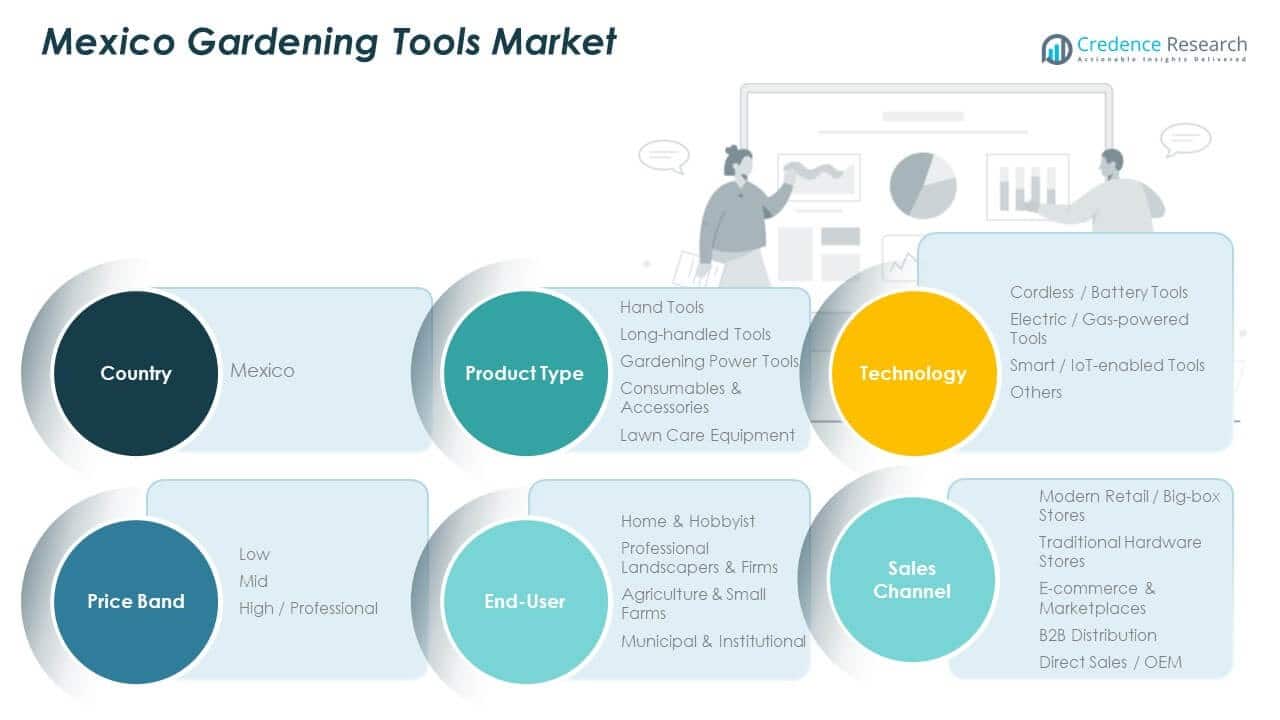
The Mexico Gardening Tools Market features a diverse mix of hand tools, long-handled tools, gardening power tools, consumables, and lawn care equipment. Hand tools dominate due to broad use in household and small-scale gardening. Long-handled tools gain popularity for ergonomic benefits. Power tools grow fast as electric and cordless options improve accessibility. Consumables such as blades and accessories sustain recurring demand. Lawn care equipment remains vital for residential and commercial landscaping. It continues to evolve toward higher efficiency and precision across all product categories.
- For instance, Fiskars' Power-Lever® Lopper features a compound lever technology that doubles cutting power compared to traditional loppers, has a cutting capacity of up to 1-3/4 inches (4.45 cm) diameter branches, and includes telescoping handles from 25 to 37 inches for ergonomic reach and reduced strain.
By Technology
Cordless and battery-powered tools lead technological growth in the Mexico Gardening Tools Market. Users prefer these solutions for mobility and low maintenance. Electric and gas-powered tools serve professional landscapers needing consistent power output. Smart and IoT-enabled devices enhance control and resource efficiency. Other mechanical models still cater to cost-sensitive buyers. Manufacturers innovate across these segments to balance sustainability, performance, and affordability. It reflects the shift toward advanced and eco-conscious gardening solutions nationwide.
- For example, Husqvarna’s professional-grade battery-powered trimmers are authentically recognized for being more durable and powerful than homeowner models. They feature brushless motors and advanced battery systems that deliver extended runtimes suitable for commercial landscaping use.
By Price Band
Low and mid-priced tools dominate consumer spending due to accessibility and affordability. Professional-grade tools attract contractors seeking durability and precision. The Mexico Gardening Tools Market benefits from this mix, serving both casual and commercial buyers. It encourages local production to fill mid-tier price gaps and reduce import dependency. Price differentiation allows brands to target varied customer segments efficiently.
By End-User
Home and hobbyist gardeners form the largest share with expanding urban green initiatives. Professional landscapers and firms invest in power equipment for large-scale maintenance. Agriculture and small farms contribute steady rural demand. Municipal and institutional buyers drive recurring purchases for public parks and facilities. It ensures consistent consumption across both private and public sectors.
By Sales Channel
Modern retail and big-box stores anchor strong physical distribution. Traditional hardware stores maintain relevance in local markets. E-commerce platforms drive rapid digital adoption and product discovery. B2B distribution supports bulk procurement for professionals. Direct sales and OEM partnerships expand brand reach. The Mexico Gardening Tools Market benefits from this balanced, multi-channel sales network.
Segmentation
By Product Type
- Hand Tools
- Long-handled Tools
- Gardening Power Tools
- Consumables & Accessories
- Lawn Care Equipment
By Technology
- Cordless / Battery Tools
- Electric / Gas-powered Tools
- Smart / IoT-enabled Tools
- Others
By Price Band
- Low
- Mid
- High / Professional
By End-User
- Home & Hobbyist
- Professional Landscapers & Firms
- Agriculture & Small Farms
- Municipal & Institutional
By Sales Channel
- Modern Retail / Big-box Stores
- Traditional Hardware Stores
- E-commerce & Marketplaces
- B2B Distribution
- Direct Sales / OEM
Regional Analysis
In Northern Mexico, the Mexico Gardening Tools Market holds roughly 35% of national share. It benefits from industrial zones and higher housing density. Distribution channels and product availability remain strong in this zone. Urban homeowners drive demand for handheld and long-handled tools. Manufacturers maintain supply partnerships with local distributors in this region. It presents stable growth potential backed by infrastructure and consumer spending.
Central Mexico accounts for about 40% of the market share. It includes major metropolitan areas where landscaping and residential outdoor spaces grow rapidly. It supports demand for power tools, smart devices, and lawn-care equipment. Retail presence and e-commerce coverage perform well in these cities. Manufacturers invest in marketing and service networks to capture premium segments. This region acts as the primary revenue engine for the market.
Southern Mexico contributes close to 25% of the market share. It covers emerging urban zones and rural outskirts where gardening tools usage is rising. It offers growth opportunities in agriculture and small-farm end-user segments of the market. Distribution infrastructure lags compared to north and central, yet penetration improves via online platforms. It receives increasing attention from brands seeking to expand footprint. The region’s growth reflects shifting consumer preferences and improving access.
Key Player Analysis
Competitive Analysis
The Mexico Gardening Tools Market features several international and domestic players competing on technology, price and distribution reach. Global brands leverage advanced cordless and IoT-enabled tool lines to command premium pricing. Local manufacturers focus on affordable mid-tier and entry-level segments to capture volume in residential markets. Some companies build strong relationships with modern retail chains and e-commerce platforms to enhance market access. Others concentrate on B2B distribution for professional landscapers, farms and municipal contracts. It results in a competitive landscape where product differentiation, brand equity and service support become key success factors. Companies that invest in local manufacturing, aftermarket service and smart tools stand to strengthen their positions and gain market share.
Recent Developments
- In September 2025, SENIX Tools showcased its full product line of cordless power tools and outdoor power equipment at Expo Nacional Ferretera in Guadalajara, Mexico. This event, one of the largest hardware and tool trade shows, reaffirmed SENIX Tools’ commitment to the Mexican and broader Latin American market, positioning the brand for long-term growth.
Report Coverage
The research report offers an in-depth analysis based on Product Type, Technology, Price Band, End-User and Sales Channel. It details leading market players, providing an overview of their business, product offerings, investments, revenue streams, and key applications. Additionally, the report includes insights into the competitive environment, SWOT analysis, current market trends, as well as the primary drivers and constraints. Furthermore, it discusses various factors that have driven market expansion in recent years. The report also explores market dynamics, regulatory scenarios, and technological advancements that are shaping the industry. It assesses the impact of external factors and global economic changes on market growth. Lastly, it provides strategic recommendations for new entrants and established companies to navigate the complexities of the market.
Future Outlook
- The Mexico Gardening Tools Market is expected to expand steadily with increasing focus on urban greening and lifestyle gardening across residential communities.
- Growth in construction and real estate will sustain demand for outdoor landscaping equipment in upcoming years.
- Manufacturers will emphasize ergonomic designs and lightweight tools that enhance user comfort and operational efficiency.
- The market will see wider adoption of cordless and smart tools as consumers prioritize flexibility and convenience.
- E-commerce and digital retail will emerge as primary sales channels, improving accessibility in remote regions.
- Government-backed sustainability initiatives will strengthen local production and eco-friendly tool innovation.
- Partnerships between retailers and service firms will enhance after-sales support and customer retention.
- Localization of supply chains will reduce dependency on imports and stabilize pricing across key categories.
- Rising disposable incomes will boost sales in mid- and premium price bands, driving brand differentiation.
- Continuous investment in R&D will foster product innovation, ensuring competitiveness in a maturing market.

Request a Free Sample
Fill in your details and we'll send you a free sample report.
- Sample data tables & charts
- Research methodology
Market Dynamics
Rising Popularity of Home Gardening and Landscaping
Urban households in Mexico are increasingly investing in gardens, patios, and green rooftops, driving demand for a wide range of gardening tools. This trend is supported by lifestyle improvements, higher disposable incomes, and a growing culture of home improvement and wellness.
Technological Advancements in Power and Smart Gardening Tools
Manufacturers are introducing battery-operated, cordless, and smart gardening tools that offer greater efficiency, portability, and sustainability. The adoption of IoT-enabled devices and ergonomic designs is attracting both residential and commercial users seeking convenience and eco-friendly solutions.
Growing Urbanization and Expanding Residential Infrastructure
Rapid urbanization and new residential construction projects are increasing the number of private gardens and landscaped areas, boosting the need for gardening tools. Developers and property owners are investing in outdoor spaces, which sustains demand for both manual and power equipment.
Government Initiatives and Sustainability Programs
Government-backed programs promoting urban greening, tree planting, and sustainability are increasing the use of gardening tools in public and private spaces. These initiatives, along with educational campaigns, are expanding the gardening culture and supporting long-term market growth.
Expansion of E-commerce and Omni-Channel Distribution
The rise of online retail and omni-channel strategies is making gardening tools more accessible across Mexico, including remote and rural areas. E-commerce platforms offer product variety, competitive pricing, and convenience, accelerating market penetration and consumer engagement.
Need a Custom Version of This Report?
Tailor the scope, geography, or segments to your exact requirements.
- Custom geography or segment scope
- Direct access to our analyst team
Frequently Asked Questions
What is the current market size for Mexico Gardening Tools Market, and what is its projected size in 2032?
At what Compound Annual Growth Rate is the Mexico Gardening Tools Market projected to grow between 2024 and 2032?
Which Mexico Gardening Tools Market segment held the largest share in 2024?
What are the primary factors fueling the growth of the Mexico Gardening Tools Market?
Who are the leading companies in the Mexico Gardening Tools Market?
Which region commanded the largest share of the Mexico Gardening Tools Market in 2024?
Table of Content
Chapter 1 Market Segmentation
- 1.1 Segmentation Framework
- 1.1.1 Product and Service Classification
- 1.1.2 Application and End-Use Classification
- 1.1.3 Technology and Solution Classification
- 1.1.4 Customer and Distribution Channel Classification
- 1.1.5 Geographic Segmentation
- 1.1.6 Market Segment Definitions and Boundaries
- 1.2 By End-User
- 1.2.1 Home & Hobbyist
- 1.2.2 Professional Landscapers & Firms
- 1.2.3 Agriculture & Small Farms
- 1.2.4 Municipal & Institutional
- 1.3 By Technology
- 1.3.1 Cordless / Battery Tools
- 1.3.2 Electric / Gas-powered Tools
- 1.3.3 Smart / IoT-enabled Tools
- 1.3.4 Others
- 1.4 By Product Type
- 1.4.1 Hand Tools
- 1.4.2 Long-handled Tools
- 1.4.3 Gardening Power Tools
- 1.4.4 Consumables & Accessories
- 1.4.5 Lawn Care Equipment
- 1.5 By Sales Channel
- 1.5.1 Modern Retail / Big-box Stores
- 1.5.2 Traditional Hardware Stores
- 1.5.3 E-commerce & Marketplaces
- 1.5.4 B2B Distribution
- 1.5.5 Direct Sales / OEM
Chapter 2 Introduction
- 2.1 Report Objectives and Scope
- 2.2 Product Definition and Industry Terminology
- 2.3 Market Inclusions and Exclusions
- 2.4 Research Process
- 2.4.1 Primary Research and Expert Interviews
- 2.4.2 Secondary Research and Source Review
- 2.4.3 Top-Down and Bottom-Up Estimation
- 2.4.4 Data Triangulation and Verification
- 2.5 Market Size Measurement Basis
- 2.5.1 2024: USD 2,262.52 million → 2032: USD 3,649.63 million
- 2.6 Historical and Forecast Reference Periods
- 2.6.1 Base Year: 2024
- 2.6.2 Forecast Period: 2024-2032
- 2.7 Research Assumptions and Limitations
Chapter 3 Executive Summary
- 3.1 Market Snapshot and Key Findings
- 3.2 Base-Year Market Size, 2024
- 3.3 Forecast Market Size, 2032
- 3.4 Revenue and Volume Growth Outlook
- 3.5 Key Demand and Supply Indicators
- 3.6 Leading Market Segments
- 3.7 Fastest-Growing Market Opportunities
- 3.8 Regional Performance Highlights
- 3.9 Technology and Industry Transformation
- 3.10 Competitive Landscape Summary
- 3.11 Analyst View and Strategic Implications
Chapter 4 Mexico Gardening Tools Market Trends and Developments
- 4.1 Historical Industry Development
- 4.2 Recent Market Trends and Developments
- 4.3 Demand and Customer Behavior Trends
- 4.4 Technology and Product Innovation
- 4.5 Artificial Intelligence, Automation and Digitalization
- 4.6 Local Manufacturing and Supply Chain Realignment
- 4.7 Industry Partnerships, Mergers and Acquisitions
- 4.8 Sustainability and Circular Economy Developments
- 4.9 Government and Private Sector Investment Trends
- 4.10 Emerging Business Models and Commercialization
- 4.11 Industry Developments and Announcements
Chapter 5 Mexico Gardening Tools Market Production, Supply and Demand Analysis
- 5.1 Demand Trend and Consumption Analysis
- 5.2 Demand Forecast, 2024-2032
- 5.3 Production and Output Trend
- 5.4 Production and Output Forecast, 2024-2032
- 5.5 Installed Capacity and Capacity Utilization
- 5.6 Company-Wise Production Plants and Statistics
- 5.6.1 Installed Production Capacity
- 5.6.2 Actual Production
- 5.6.3 Planned Capacity and Expansion Targets
- 5.7 Supply Chain Structure and Procurement Trends
- 5.8 Supply-Demand Gap and Bottlenecks
- 5.9 Import Dependence and Sourcing Structure
- 5.10 Contract Manufacturing and Outsourcing
- 5.11 Regional Supply and Demand Concentration
Chapter 6 Mexico Gardening Tools Market Pricing Analysis
- 6.1 Pricing Structure and Measurement
- 6.2 Historical Pricing Trends
- 6.3 Pricing Outlook, 2024-2032
- 6.4 Average Selling Price and Unit Economics
- 6.5 Pricing by Product and Market Segment
- 6.6 Geographic Pricing Differences
- 6.7 Key Input, Energy, Labor and Logistics Costs
- 6.8 Contract Pricing and Purchasing Models
- 6.9 Pricing Sensitivity and Competitive Positioning
- 6.10 Price, Margin and Profitability Implications
Chapter 7 Mexico Gardening Tools Market Dynamics
- 7.1 Market Growth Drivers
- 7.1.1 Demand-Side Drivers
- 7.1.2 Technology and Innovation Drivers
- 7.1.3 Infrastructure and Investment Drivers
- 7.1.4 Regulatory and Policy Drivers
- 7.2 Market Restraints
- 7.2.1 Cost and Affordability Constraints
- 7.2.2 Technology and Adoption Barriers
- 7.2.3 Supply Chain and Operational Constraints
- 7.3 Market Challenges
- 7.3.1 Competitive Pressure and Margin Erosion
- 7.3.2 Skills, Infrastructure and Implementation Gaps
- 7.4 Emerging Market Opportunities
- 7.5 Market Dynamics Impact and Time-Horizon Assessment
Chapter 8 Mexico Gardening Tools Value Chain Analysis
- 8.1 Industry Value Chain Overview
- 8.2 Upstream Suppliers and Critical Inputs
- 8.3 Technology and Component Providers
- 8.4 Manufacturing or Service Delivery
- 8.5 Distribution, Channel Partners and Integrators
- 8.6 Downstream Applications and End Users
- 8.7 Value Addition and Profit Pools
- 8.8 Vertical Integration and Outsourcing
- 8.9 Supplier Concentration and Risk
- 8.10 Supply Chain Localization and Resilience
Chapter 9 Mexico Gardening Tools Market Regulations and Policies
- 9.1 Relevant Laws, Standards and Compliance Frameworks
- 9.2 Product, Service, Safety and Quality Requirements
- 9.3 Government Policies, Incentives and Subsidies
- 9.4 Imports, Exports and Trade Barriers
- 9.5 Public Procurement and Local Content Requirements
- 9.6 Environmental and Sustainability Compliance
- 9.7 Upcoming Policy Changes and Market Implications
Chapter 10 Mexico Gardening Tools Market Hotspots and Opportunities
- 10.1 Market Opportunity Mapping and Growth Hotspots
- 10.2 High-Growth Applications and Customer Groups
- 10.3 Underserved Markets and White-Space Opportunities
- 10.4 Emerging Technology and Product Opportunities
- 10.5 New Capacity and Investment Hotspots
- 10.6 Market Entry and Expansion Opportunities
- 10.7 Distribution and Partnership Opportunities
- 10.8 Near-Term and Long-Term Commercial Potential
- 10.9 Opportunity Attractiveness and Execution Risks
Chapter 11 Mexico Gardening Tools Market Outlook, 2024-2032
- 11.1 Market Size and Analysis
- 11.1.1 Revenue (Market Measurement: 2024: USD 2,262.52 million → 2032: USD 3,649.63 million)
- 11.1.2 Market Volume and Quantity Sold
- 11.1.3 Historical Market Size
- 11.1.4 Base-Year Market Size, 2024
- 11.2 Market Forecast, 2024-2032
- 11.2.1 Revenue Forecast to 2032
- 11.2.2 Volume Forecast to 2032
- 11.2.3 CAGR and Year-on-Year Growth
- 11.2.4 Incremental Revenue Opportunity
- 11.3 Forecast Assumptions and Scenario Analysis
- 11.3.1 Base-Case Forecast
- 11.3.2 Optimistic and Conservative Scenarios
- 11.3.3 Technology, Pricing and Policy Sensitivities
- 11.4 Market Attractiveness and Growth Outlook
Chapter 12 Mexico Gardening Tools Market Segmentation and Outlook
- 12.1 Segmentation Summary and Market Shares, 2024
- 12.2 Largest and Fastest-Growing Segments
- 12.3 By End-User - Market Size and Forecast, 2024-2032
- 12.3.1 Segment Definition and Scope
- 12.3.2 Historical Market Size
- 12.3.3 Revenue Forecast, 2024-2032
- 12.3.4 Volume Forecast, 2024-2032
- 12.3.5 Base-Year Market Share, 2024
- 12.3.6 Segment CAGR and Growth Drivers
- 12.3.7 Subsegment Market Size and Forecast
- 12.3.7.1 Home & Hobbyist
- 12.3.7.2 Professional Landscapers & Firms
- 12.3.7.3 Agriculture & Small Farms
- 12.3.7.4 Municipal & Institutional
- 12.3.8 Subsegment Pricing and Adoption Trends
- 12.3.9 Leading Suppliers and Competition
- 12.3.10 Regional Demand and Opportunities
- 12.4 By Technology - Market Size and Forecast, 2024-2032
- 12.4.1 Segment Definition and Scope
- 12.4.2 Historical Market Size
- 12.4.3 Revenue Forecast, 2024-2032
- 12.4.4 Volume Forecast, 2024-2032
- 12.4.5 Base-Year Market Share, 2024
- 12.4.6 Segment CAGR and Growth Drivers
- 12.4.7 Subsegment Market Size and Forecast
- 12.4.7.1 Cordless / Battery Tools
- 12.4.7.2 Electric / Gas-powered Tools
- 12.4.7.3 Smart / IoT-enabled Tools
- 12.4.7.4 Others
- 12.4.8 Subsegment Pricing and Adoption Trends
- 12.4.9 Leading Suppliers and Competition
- 12.4.10 Regional Demand and Opportunities
- 12.5 By Product Type - Market Size and Forecast, 2024-2032
- 12.5.1 Segment Definition and Scope
- 12.5.2 Historical Market Size
- 12.5.3 Revenue Forecast, 2024-2032
- 12.5.4 Volume Forecast, 2024-2032
- 12.5.5 Base-Year Market Share, 2024
- 12.5.6 Segment CAGR and Growth Drivers
- 12.5.7 Subsegment Market Size and Forecast
- 12.5.7.1 Hand Tools
- 12.5.7.2 Long-handled Tools
- 12.5.7.3 Gardening Power Tools
- 12.5.7.4 Consumables & Accessories
- 12.5.7.5 Lawn Care Equipment
- 12.5.8 Subsegment Pricing and Adoption Trends
- 12.5.9 Leading Suppliers and Competition
- 12.5.10 Regional Demand and Opportunities
- 12.6 By Sales Channel - Market Size and Forecast, 2024-2032
- 12.6.1 Segment Definition and Scope
- 12.6.2 Historical Market Size
- 12.6.3 Revenue Forecast, 2024-2032
- 12.6.4 Volume Forecast, 2024-2032
- 12.6.5 Base-Year Market Share, 2024
- 12.6.6 Segment CAGR and Growth Drivers
- 12.6.7 Subsegment Market Size and Forecast
- 12.6.7.1 Modern Retail / Big-box Stores
- 12.6.7.2 Traditional Hardware Stores
- 12.6.7.3 E-commerce & Marketplaces
- 12.6.7.4 B2B Distribution
- 12.6.7.5 Direct Sales / OEM
- 12.6.8 Subsegment Pricing and Adoption Trends
- 12.6.9 Leading Suppliers and Competition
- 12.6.10 Regional Demand and Opportunities
- 12.7 Segment Growth Comparison
- 12.8 Segment Attractiveness and Priority Matrix
Chapter 13 Mexico Gardening Tools End-Use and Application Market Outlook
- 13.1 End-Use Industry and Customer Demand Structure
- 13.2 Leading Applications and Customer Groups
- 13.3 End-Use Market Size, Share and Forecast
- 13.4 Major End-Use Industry Deep Dives
- 13.4.1 Customer Requirements and Use Cases
- 13.4.2 Demand and Replacement Cycles
- 13.4.3 Technical and Regulatory Considerations
- 13.4.4 Purchasing and Procurement Models
- 13.4.5 Leading Vendors and Distribution Channels
- 13.4.6 Forecast and Commercial Opportunities
- 13.5 Emerging Applications and Cross-Segment Demand
- 13.6 End-Use Industry Investment Priorities
Chapter 14 Mexico Gardening Tools Geographic Market Outlook, 2024-2032
- 14.1 Domestic Market Distribution and Demand Clusters
- 14.2 State- or Province-Wise Market Size and Forecast, 2024-2032
- 14.3 City and Metropolitan Market Outlook
- 14.4 Industrial, Manufacturing and Commercial Clusters
- 14.5 Geographic Concentration of Key End Users
- 14.6 Local Pricing and Purchasing Differences
- 14.7 Domestic Production Facilities and Capacity Map
- 14.8 Local Infrastructure and Project Pipeline
- 14.9 State-Level Policy and Incentive Differences
- 14.10 Subnational Investment Hotspots and Opportunities
- 14.11 Distribution and Logistics Networks
- 14.12 Domestic Competitive Footprint
Chapter 15 Mexico Gardening Tools Technology, Innovation and Sustainability Outlook
- 15.1 Technology Landscape and Maturity
- 15.2 Product, Process and Service Innovation
- 15.3 AI, Automation and Digital Tools in the Industry
- 15.4 Technology Adoption and Performance Benchmarking
- 15.5 Innovation Pipeline and R&D Investment
- 15.6 Patent and Intellectual Property Trends
- 15.7 Energy Efficiency and Resource Management
- 15.8 Sustainability, Recycling and Circularity
- 15.9 Technology Roadmap, 2024-2032
- 15.10 Risks of Obsolescence and Technology Substitution
Chapter 16 Mexico Gardening Tools Market Key Strategic Imperatives
- 16.1 Growth and Market Entry Priorities
- 16.2 High-Return Products and Segments
- 16.3 Pricing, Profitability and Cost Optimization
- 16.4 Technology Investment and Product Differentiation
- 16.5 Supply Chain Localization and Resilience
- 16.6 Distribution and Customer Acquisition
- 16.7 Partnership, Acquisition and Capacity Strategy
- 16.8 Regional Expansion Priorities
- 16.9 Short-, Medium- and Long-Term Actions
Chapter 17 Competition Outlook
- 17.1 Industry Competition Characteristics
- 17.2 Market Structure and Concentration
- 17.3 Market Share and Competitive Positioning, 2024
- 17.4 Company-Wise Revenue and Product Benchmarking
- 17.5 Production and Service Capacity Benchmarking
- 17.6 Technology, Pricing and Differentiation
- 17.7 Regional Footprint and Distribution Strength
- 17.8 Mergers, Acquisitions and Strategic Alliances
- 17.9 New Entrants and Competitive Threats
- 17.10 Porter's Five Forces and Industry Attractiveness
- 17.11 Competitive Outlook, 2024-2032
Chapter 18 Company Profiles
- 18.1 Company Coverage and Selection Criteria
- 18.2 Truper
- 18.2.1 Business Description
- 18.2.2 Company Ownership and Geographic Presence
- 18.2.3 Product and Service Portfolio
- 18.2.4 Manufacturing and Operating Footprint
- 18.2.5 Production Capacity and Expansion Plans
- 18.2.6 Financial Performance and Investment
- 18.2.7 Market Share and Competitive Position
- 18.2.8 Technology and Innovation Capabilities
- 18.2.9 Strategic Alliances or Partnerships
- 18.2.10 Recent Developments
- 18.2.11 Growth Strategy and Outlook
- 18.3 Corona Tools
- 18.4 Fiskars
- 18.5 Husqvarna
- 18.6 STIHL
- 18.7 Armadillo Garden Tools
- 18.8 Black+Decker
- 18.9 Bosch
- 18.10 SENIX Tools
- 18.11 Gardena
- 18.12 Other Relevant Market Participants
Note: Every listed company is profiled on the structure shown under the first company. The company list is preliminary and may change based on research findings, market developments, data availability and client requirements.
Chapter 19 Disclaimer
- 19.1 Research and Forecast Disclaimer
- 19.2 Data Source and Estimation Limitations
Note: The depth of individual sections depends on data availability for this market. Volume, capacity, trade and other unit-based metrics are included where applicable.

