
| REPORT ATTRIBUTE | DETAILS |
|---|---|
| Historical Period | 2019-2022 |
| Base Year | 2023 |
| Forecast Period | 2024-2032 |
| Middle East Artificial Intelligence in Retail Market Size 2023 | USD 200.08 million |
| Middle East Artificial Intelligence in Retail Market, CAGR | 28.04% |
| Middle East Artificial Intelligence in Retail Market Size 2032 | USD 1,445.09 million |
Market Overview
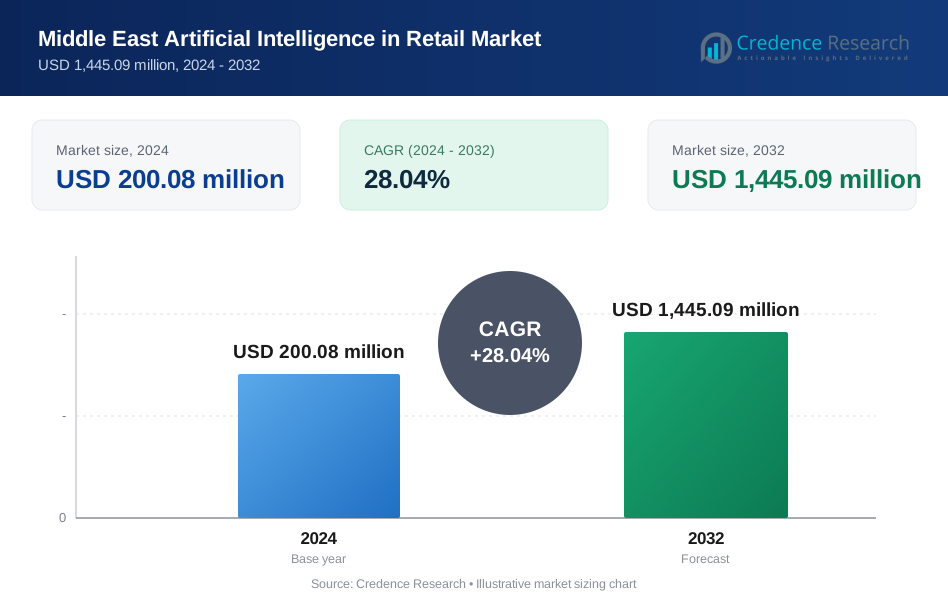
The Middle East Artificial Intelligence in Retail market is projected to grow from USD 200.08 million in 2024 to USD 1,445.09 million by 2032, at a remarkable CAGR of 28.04% during the forecast period.
The growth of Artificial Intelligence (AI) in the Middle East retail market is driven by the rising adoption of AI-powered technologies to enhance customer experiences, optimize inventory management, and improve operational efficiency. Retailers increasingly leverage AI for personalized marketing, demand forecasting, and automated customer support, fueling market expansion. The region's rapid digital transformation, supported by government initiatives and significant investments in smart technologies, further propels AI adoption in retail. Additionally, the growing e-commerce sector and the integration of AI with advanced analytics and IoT devices are reshaping the retail landscape. Trends such as the use of AI-driven chatbots, virtual shopping assistants, and dynamic pricing strategies highlight the sector's innovative approach. Retailers are also prioritizing AI-based visual recognition tools and sentiment analysis to offer customized solutions, creating a competitive edge in the market. These factors collectively underscore the robust growth potential of AI in the Middle East retail sector.
The Middle East Artificial Intelligence in Retail market is witnessing significant growth across various regions, with key players driving innovation and adoption. In the UAE and Saudi Arabia, major technology companies like Microsoft, IBM, and Amazon are partnering with local retailers to implement AI solutions for customer personalization, inventory management, and operational efficiency. Israel, known for its AI innovation, is home to startups such as Syte and Shopic, which focus on AI-powered visual recognition and personalized shopping experiences. Additionally, global firms like Accenture and Capgemini play a crucial role in helping retail businesses integrate advanced AI technologies. In Turkey, local and international players are expanding AI applications to optimize e-commerce and retail operations. As the demand for AI solutions increases, the collaborative efforts of these companies are shaping the future of AI in retail across the Middle East.
Market Insights
- The Middle East Artificial Intelligence in Retail market is expected to grow from USD 200.08 million in 2024 to USD 1,445.09 million by 2032, with a CAGR of 28.04%.
- Rising adoption of AI-powered technologies is enhancing customer experience, optimizing operations, and driving market growth.
- The e-commerce boom and integration of AI for personalized marketing and automation are key market trends.
- Retailers are increasingly using AI-driven solutions like chatbots, predictive analytics, and dynamic pricing strategies to stay competitive.
- High implementation costs and data privacy concerns remain significant market restraints for AI adoption in retail.
- The UAE and Saudi Arabia lead the market, with increasing investments in AI and government support for digital transformation.
- Companies like Microsoft, Amazon, IBM, and Accenture are key players driving innovation and adoption of AI solutions in the region.
Market Drivers
Rising Adoption of AI-Powered Customer Experience Enhancements
The Middle East retail sector is rapidly embracing AI-powered solutions to elevate customer experiences. For instance, Majid Al Futtaim has implemented the Omega conversational AI platform in its Carrefour and VOX Cinemas stores, allowing customers to purchase cinema tickets and groceries using an AI voice assistant. Retailers leverage AI technologies such as chatbots, virtual assistants, and recommendation engines to deliver personalized shopping experiences tailored to individual preferences. AI-driven sentiment analysis and predictive analytics allow businesses to anticipate customer needs and improve satisfaction, thereby fostering brand loyalty. As customer-centric strategies become increasingly vital, the integration of AI to enhance user engagement and satisfaction has emerged as a key growth driver for the market.
Increasing Focus on Operational Efficiency and Cost Optimization
Retailers in the Middle East are turning to AI to streamline operations and achieve cost efficiency. For example, the Kingdom of Saudi Arabia is making significant investments in AI to optimize inventory management and enhance operational efficiency as part of its Vision 2030 initiative. AI-powered inventory management systems enable real-time tracking and forecasting, reducing the risk of overstocking or stockouts. Moreover, AI-driven automation in logistics, supply chain management, and workforce planning significantly enhances efficiency while minimizing operational costs. This focus on operational excellence, combined with the region's ongoing digital transformation, is accelerating the adoption of AI in retail operations.
Supportive Government Initiatives and Investments in AI
Governments in the Middle East are actively promoting AI adoption across industries, including retail, through strategic initiatives and funding. For example, the UAE and Saudi Arabia have launched ambitious AI strategies and are investing heavily in AI-driven projects to foster innovation. These efforts, coupled with partnerships between governments and private entities, are creating a conducive environment for AI adoption in the retail sector. This supportive ecosystem is expected to significantly contribute to the market's growth trajectory in the coming years.
Expanding E-Commerce Sector and Advanced Analytics Integration
The booming e-commerce sector in the Middle East is driving the demand for AI technologies in retail. Online retailers utilize AI for personalized marketing campaigns, dynamic pricing, and fraud detection to enhance their competitive edge. The integration of AI with advanced analytics and Internet of Things (IoT) devices enables data-driven decision-making, improving overall business performance. As consumers increasingly shift toward online shopping, AI adoption among e-commerce players is set to rise, further bolstering market growth.
Market Trends
Rising Adoption of AI-Driven Visual and Voice Recognition Technologies
The adoption of AI-based visual and voice recognition technologies is reshaping the Middle East retail landscape. For example, Sephora Middle East uses AI-powered visual recognition tools to enable virtual try-ons, allowing customers to see how products will look on them before making a purchase. Visual recognition tools are enabling seamless self-checkout experiences, accurate inventory tracking, and enhanced security measures in physical stores. Meanwhile, voice recognition technologies integrated into virtual assistants and smart devices are streamlining the shopping experience by enabling hands-free searches, product recommendations, and order placements. These technologies not only improve operational efficiency but also enhance customer convenience, making them pivotal to modern retail strategies.
Growing Implementation of AI-Powered Personalization
Retailers in the Middle East are increasingly utilizing AI to deliver personalized shopping experiences, marking a significant trend in the industry. By analyzing customer data such as purchase history, browsing behavior, and preferences, AI-driven algorithms recommend tailored products and services. Advanced personalization strategies, including dynamic content and customized marketing campaigns, are enhancing customer engagement and retention. This trend is gaining traction across both physical and online retail channels as businesses aim to offer unique, customer-centric experiences.
Increased Integration of AI with IoT and Advanced Analytics
The convergence of AI, IoT, and advanced analytics is emerging as a transformative trend in the Middle East retail market. IoT-enabled devices provide real-time data on inventory levels, store traffic, and customer behavior, while AI processes this data to derive actionable insights. This integration facilitates efficient supply chain management, improved demand forecasting, and targeted marketing efforts. Retailers leveraging these interconnected technologies are better equipped to optimize operations and deliver value-driven solutions, reinforcing their competitive edge.
Focus on AI-Enhanced Fraud Detection and Cybersecurity
As digital transformation accelerates, retailers in the Middle East are prioritizing AI-powered fraud detection and cybersecurity solutions. AI technologies analyze transaction patterns to detect anomalies, mitigating risks associated with fraudulent activities. Additionally, machine learning algorithms identify potential cybersecurity threats, ensuring data protection and compliance with regulatory standards. This focus on robust security measures is becoming essential as online retail expands, fostering consumer trust and safeguarding business integrity in the competitive retail landscape.
Market Challenges Analysis
High Implementation Costs and Limited Access to Skilled Workforce
One of the significant challenges faced by the Middle East AI in retail market is the high cost associated with implementing AI technologies. Advanced AI solutions often require substantial investments in infrastructure, software, and hardware, making them inaccessible to small and medium-sized retailers. Additionally, the ongoing maintenance and updates required for AI systems further strain financial resources. Another critical hurdle is the limited availability of skilled professionals with expertise in AI and data analytics. The shortage of trained personnel capable of managing and optimizing AI systems delays adoption and reduces the efficiency of implementation, particularly for retailers in emerging markets within the region.
Data Privacy Concerns and Resistance to Change
Data privacy and security concerns pose another challenge for the adoption of AI in the Middle East retail sector. For example, a survey by Gulf Business Machines found that 31% of organizations in the region prioritize data privacy as their top concern amid AI adoption. With AI systems heavily reliant on customer data, there is growing apprehension about data breaches and misuse, leading to hesitancy among consumers and retailers. Stricter data protection regulations across the region require businesses to invest in compliance measures, adding to operational complexities. Furthermore, cultural and organizational resistance to change remains a barrier to AI adoption. Many traditional retailers are hesitant to transition from conventional methods to AI-driven solutions due to concerns over costs, complexity, and workforce adaptation. Overcoming these challenges requires focused efforts in training, awareness, and building trust in AI technologies.
Market Opportunities
Expansion of E-Commerce and Omni-Channel Retail Strategies
The rapid growth of e-commerce in the Middle East presents significant opportunities for AI adoption in the retail sector. With an increasing number of consumers shifting toward online shopping, retailers are leveraging AI to enhance personalized marketing, optimize pricing strategies, and streamline logistics. Additionally, the integration of AI-powered chatbots and virtual assistants enables seamless customer interactions, improving satisfaction and retention. The rise of omni-channel retail strategies, combining physical and online shopping experiences, further amplifies the need for AI technologies to provide consistent and customized experiences across all touchpoints. This trend opens avenues for retailers to harness AI-driven insights to stay competitive and capture a larger market share.
Supportive Government Policies and Technological Advancements
Government initiatives promoting digital transformation and AI adoption across the Middle East create a conducive environment for the growth of AI in retail. Countries like the UAE and Saudi Arabia are investing heavily in AI research, innovation hubs, and infrastructure development, encouraging businesses to integrate advanced technologies. Additionally, advancements in AI capabilities, such as real-time data processing and predictive analytics, enable retailers to enhance operational efficiency and customer experiences. The growing collaboration between technology providers and retail businesses further accelerates AI integration. These factors collectively highlight a promising landscape for expanding AI adoption, offering substantial opportunities for retailers to innovate and thrive in a competitive market.
Market Segmentation Analysis:
By Component:
The Middle East Artificial Intelligence in Retail market is segmented into solutions and services, each playing a pivotal role in the sector's growth. AI solutions encompass a wide range of technologies, including predictive analytics, chatbots, and recommendation engines, enabling retailers to deliver personalized customer experiences, optimize inventory, and enhance operational efficiency. These solutions are increasingly being integrated into both e-commerce platforms and physical retail stores to improve decision-making and drive sales. Meanwhile, services such as consulting, implementation, and support are gaining prominence as retailers seek expert guidance to adopt and optimize AI technologies. The growing complexity of AI systems and the need for seamless integration have fueled the demand for professional services, making this segment a critical enabler of AI adoption in the retail industry.
By Business Function:
AI adoption in the Middle East retail sector is transforming various business functions, including marketing and sales, operations, and cybersecurity. Marketing and sales benefit significantly from AI-driven personalization, targeted campaigns, and customer engagement tools. In operations, AI technologies streamline supply chain management, demand forecasting, and workforce optimization, enhancing efficiency and reducing costs. Cybersecurity is another vital area where AI is employed to detect and prevent fraud, ensuring data protection and regulatory compliance. Additionally, human resources and finance functions leverage AI for talent management, payroll automation, and financial planning. This segmentation highlights the versatility of AI in driving innovation and operational excellence across retail functions.
Segments:
Based on Component:
- Solution
- Services
Based on Business Function:
- Marketing & Sales
- Human Resources
- Finance & Accounting
- Operations
- Cybersecurity
Based on Technology:
- Machine Learning
- Natural Language Processing
- Chatbots
- Image and Video Analytics
- Swarm Intelligence
Based on Sales Channel:
- Omnichannel
- Brick and Mortar
Based on the Geography:
- UAE
- KSA
- Israel
- Turkey
- Iran
- Rest of Middle East
Regional Analysis
UAE
The UAE holds the largest market share in the Middle East Artificial Intelligence in Retail market, accounting for over 35% in 2024. The country’s advanced digital infrastructure, coupled with government initiatives like the UAE AI Strategy 2031, has positioned it as a leader in AI adoption. Retailers in the UAE leverage AI technologies to enhance customer experiences, optimize supply chains, and improve operational efficiency. The rapid expansion of e-commerce platforms and the widespread use of AI-powered tools such as chatbots, virtual assistants, and predictive analytics have driven growth in the region. Additionally, partnerships between retail companies and global technology providers are accelerating AI deployment, further strengthening the UAE’s dominance in the regional market.
KSA
Saudi Arabia ranks second in the Middle East AI in Retail market, with a market share of approximately 28% in 2024. The Kingdom’s Vision 2030 initiative emphasizes technological innovation and digital transformation across industries, including retail. AI adoption in the retail sector is fueled by investments in smart city projects like NEOM and the development of AI-driven e-commerce platforms. Retailers in Saudi Arabia are focusing on AI-enabled personalization, real-time inventory management, and automation to meet evolving consumer demands. Moreover, the government’s focus on fostering AI research and development, alongside financial support for local businesses, has created a conducive environment for AI-driven retail innovations.
Israel
Israel has emerged as a key player in the Middle East Artificial Intelligence in Retail market, contributing significantly to the region’s technological advancements. With a market share of over 15% in 2024, Israel is leveraging its reputation as a global hub for AI innovation and startups. Retailers in Israel benefit from cutting-edge AI solutions, such as machine learning algorithms, computer vision, and natural language processing, to enhance customer experiences and streamline operations. The country’s robust ecosystem of AI-focused startups and research institutions fosters innovation, enabling retailers to stay ahead in the competitive market. Additionally, Israel’s strong collaboration between academia, industry, and government has positioned it as a leader in AI-driven retail transformations.
Turkey
Turkey accounts for around 12% of the Middle East AI in Retail market share in 2024, driven by its growing e-commerce sector and increasing investment in digital transformation. Retailers in Turkey are integrating AI technologies to improve customer engagement, optimize inventory management, and enhance supply chain efficiency. The adoption of AI-powered tools, such as recommendation engines and dynamic pricing systems, is helping businesses cater to a tech-savvy consumer base. Furthermore, government initiatives to support AI research and innovation, coupled with a growing number of partnerships between Turkish retailers and global technology providers, are boosting AI adoption across the country’s retail landscape.
Key Player Analysis
- Shopic
- Syte
- Capgemini
- Microsoft Corporation
- IBM Corporation
- Google LLC
- Amazon
- Salesforce
- Accenture
- TCS
- Infosys
- Company 12
- Company 13
- Company 14
- Others
Competitive Analysis
The competitive landscape of the Middle East Artificial Intelligence in Retail market is shaped by global and regional players, each contributing to the adoption and integration of AI technologies in retail operations. Leading players in the market include Microsoft Corporation, IBM Corporation, Amazon, Accenture, Capgemini, Google LLC, Salesforce, TCS, Infosys, Syte, Shopic, and several others. For instance, Majid Al Futtaim has implemented the Omega conversational AI platform in its Carrefour and VOX Cinemas stores, allowing customers to purchase cinema tickets and groceries using an AI voice assistant. These companies offer a wide range of AI-powered solutions, from customer personalization and predictive analytics to inventory management and supply chain optimization. These companies are differentiating themselves by offering customized solutions that meet the diverse needs of retail businesses, from personalized marketing and targeted promotions to efficient inventory management and supply chain optimization. As the market grows, there is a strong focus on partnerships and collaborations, as retailers and AI solution providers work together to integrate AI seamlessly into the retail ecosystem. With significant investments in AI research and development, companies are continuously innovating to stay ahead of the competition. Furthermore, regional players are focusing on localization of AI solutions to address the unique needs and challenges of the Middle East retail market, further intensifying the competitive environment. This combination of technological advancements, tailored offerings, and strategic partnerships is shaping the future of the AI-driven retail landscape in the Middle East.
Recent Developments
- In January 2025, NVIDIA announced the NVIDIA AI Blueprint for retail shopping assistants, designed to transform shopping experiences both online and in stores. This blueprint helps developers create AI-powered digital assistants that can deliver personalized shopping experiences, drive higher conversion rates, and lower product return rates.
- In April 2024, Oracle introduced new AI capabilities within Oracle Fusion Cloud Customer Experience (CX) to help marketers, sellers, and service agents accelerate deal cycles. These capabilities automate time-consuming tasks and enable more precise targeting, engagement, and service of buyers.
- In January 2024, Microsoft unveiled new generative AI and data solutions at NRF 2024 to transform shopping experiences. These solutions span the retail shopper journey, from personalized shopping experiences to empowering store associates and unifying retail data.
- In January 2024, Salesforce announced new data and AI-powered tools at NRF 2024 to transform shopping experiences. These tools, powered by the Einstein 1 Platform, include AI content creation, digital storefronts, and shopper insights to enhance customer interactions, increase loyalty, and drive revenue.
- In January 2024, IBM reported at NRF 2024 that generative AI can bridge the consumer expectation gap by creating unified, integrated shopping experiences. The study showed dissatisfaction with current retail experiences and emphasized the role of AI in meeting consumer demands.
Market Concentration & Characteristics
The Middle East Artificial Intelligence in Retail market exhibits a moderate to high level of concentration, with both global tech giants and regional players competing for market share. Large multinational corporations, with their extensive resources and advanced AI technologies, dominate the market, offering comprehensive solutions that address a wide range of retail needs, from customer personalization to supply chain optimization. However, the market also sees the rise of specialized regional startups and SMEs that focus on niche AI applications, such as visual recognition and customer sentiment analysis, catering to the unique demands of local retailers.
The characteristics of the market are shaped by rapid technological advancements, with continuous innovation driving competition. AI solutions in the retail sector are becoming increasingly tailored to meet the diverse requirements of the Middle East’s varied retail landscape, including both online and offline channels. There is a growing emphasis on AI’s role in enhancing customer experiences, improving operational efficiency, and optimizing marketing efforts. Additionally, the market is marked by a collaborative environment, with retailers partnering with AI solution providers to integrate advanced technologies seamlessly into their operations. This blend of large, established players and agile, niche-focused companies results in a competitive and rapidly evolving market, fueling the widespread adoption of AI in the retail sector across the region.
Report Coverage
The research report offers an in-depth analysis based on Component, Business Function, Technology, Sales Channel and Geography. It details leading market players, providing an overview of their business, product offerings, investments, revenue streams, and key applications. Additionally, the report includes insights into the competitive environment, SWOT analysis, current market trends, as well as the primary drivers and constraints. Furthermore, it discusses various factors that have driven market expansion in recent years. The report also explores market dynamics, regulatory scenarios, and technological advancements that are shaping the industry. It assesses the impact of external factors and global economic changes on market growth. Lastly, it provides strategic recommendations for new entrants and established companies to navigate the complexities of the market.
Future Outlook
- The Middle East Artificial Intelligence in Retail market is expected to continue growing at a strong pace, driven by increasing adoption of AI technologies across retail operations.
- E-commerce growth will further accelerate the demand for AI-powered personalization and automation tools in the retail sector.
- AI-driven customer experience enhancements, such as personalized recommendations and chatbots, will become more prevalent in both online and offline stores.
- Retailers will increasingly leverage AI for optimizing inventory management, supply chain operations, and demand forecasting.
- The expansion of smart cities and digital transformation initiatives in the region will create more opportunities for AI integration in retail.
- Governments in the UAE, Saudi Arabia, and other Middle Eastern countries will continue to invest in AI innovation, further fueling market growth.
- The use of AI for fraud detection and cybersecurity will gain more importance as retailers prioritize data security and regulatory compliance.
- Collaboration between global AI solution providers and regional retailers will intensify, fostering rapid AI adoption.
- The rise of AI-powered visual search and image recognition technologies will transform product discovery and shopping experiences.
- As AI technology becomes more affordable, small and medium-sized retailers in the region will increasingly adopt AI solutions to compete in the market.
Request a Free Sample
Fill in your details and we'll send you a free sample report.
- Sample data tables & charts
- Research methodology
Need a Custom Version of This Report?
Tailor the scope, geography, or segments to your exact requirements.
- Custom geography or segment scope
- Direct access to our analyst team
Frequently Asked Questions
What is the current size of the Middle East Artificial Intelligence in Retail market?
What factors are driving the growth of the Middle East Artificial Intelligence in Retail market?
What are the key segments within the Middle East Artificial Intelligence in Retail market?
What are some challenges faced by the Middle East Artificial Intelligence in Retail market?
Table of Content
Chapter 1 Market Segmentation
- 1.1 Segmentation Framework
- 1.1.1 Product and Service Classification
- 1.1.2 Application and End-Use Classification
- 1.1.3 Technology and Solution Classification
- 1.1.4 Customer and Distribution Channel Classification
- 1.1.5 Geographic Segmentation
- 1.1.6 Market Segment Definitions and Boundaries
Chapter 2 Introduction
- 2.1 Report Objectives and Scope
- 2.2 Product Definition and Industry Terminology
- 2.3 Market Inclusions and Exclusions
- 2.4 Research Process
- 2.4.1 Primary Research and Expert Interviews
- 2.4.2 Secondary Research and Source Review
- 2.4.3 Top-Down and Bottom-Up Estimation
- 2.4.4 Data Triangulation and Verification
- 2.5 Market Size Measurement Basis
- 2.5.1 2024: USD 200.08 million → 2032: USD 1,445.09 million
- 2.6 Historical and Forecast Reference Periods
- 2.6.1 Base Year: 2024
- 2.6.2 Forecast Period: 2024-2032
- 2.7 Research Assumptions and Limitations
Chapter 3 Executive Summary
- 3.1 Market Snapshot and Key Findings
- 3.2 Base-Year Market Size, 2024
- 3.3 Forecast Market Size, 2032
- 3.4 Revenue and Volume Growth Outlook
- 3.5 Key Demand and Supply Indicators
- 3.6 Leading Market Segments
- 3.7 Fastest-Growing Market Opportunities
- 3.8 Regional Performance Highlights
- 3.9 Technology and Industry Transformation
- 3.10 Competitive Landscape Summary
- 3.11 Analyst View and Strategic Implications
Chapter 4 Middle East Artificial Intelligence in Retail Market Trends and Developments
- 4.1 Historical Industry Development
- 4.2 Recent Market Trends and Developments
- 4.3 Demand and Customer Behavior Trends
- 4.4 Technology and Product Innovation
- 4.5 Artificial Intelligence, Automation and Digitalization
- 4.6 Local Manufacturing and Supply Chain Realignment
- 4.7 Industry Partnerships, Mergers and Acquisitions
- 4.8 Sustainability and Circular Economy Developments
- 4.9 Government and Private Sector Investment Trends
- 4.10 Emerging Business Models and Commercialization
- 4.11 Industry Developments and Announcements
Chapter 5 Middle East Artificial Intelligence in Retail Market Production, Supply and Demand Analysis
- 5.1 Demand Trend and Consumption Analysis
- 5.2 Demand Forecast, 2024-2032
- 5.3 Production and Output Trend
- 5.4 Production and Output Forecast, 2024-2032
- 5.5 Installed Capacity and Capacity Utilization
- 5.6 Company-Wise Production Plants and Statistics
- 5.6.1 Installed Production Capacity
- 5.6.2 Actual Production
- 5.6.3 Planned Capacity and Expansion Targets
- 5.7 Supply Chain Structure and Procurement Trends
- 5.8 Supply-Demand Gap and Bottlenecks
- 5.9 Import Dependence and Sourcing Structure
- 5.10 Contract Manufacturing and Outsourcing
- 5.11 Regional Supply and Demand Concentration
Chapter 6 Middle East Artificial Intelligence in Retail Market Pricing Analysis
- 6.1 Pricing Structure and Measurement
- 6.2 Historical Pricing Trends
- 6.3 Pricing Outlook, 2024-2032
- 6.4 Average Selling Price and Unit Economics
- 6.5 Pricing by Product and Market Segment
- 6.6 Geographic Pricing Differences
- 6.7 Key Input, Energy, Labor and Logistics Costs
- 6.8 Contract Pricing and Purchasing Models
- 6.9 Pricing Sensitivity and Competitive Positioning
- 6.10 Price, Margin and Profitability Implications
Chapter 7 Middle East Artificial Intelligence in Retail Market Dynamics
- 7.1 Market Growth Drivers
- 7.1.1 Demand-Side Drivers
- 7.1.2 Technology and Innovation Drivers
- 7.1.3 Infrastructure and Investment Drivers
- 7.1.4 Regulatory and Policy Drivers
- 7.2 Market Restraints
- 7.2.1 Cost and Affordability Constraints
- 7.2.2 Technology and Adoption Barriers
- 7.2.3 Supply Chain and Operational Constraints
- 7.3 Market Challenges
- 7.3.1 Competitive Pressure and Margin Erosion
- 7.3.2 Skills, Infrastructure and Implementation Gaps
- 7.4 Emerging Market Opportunities
- 7.5 Market Dynamics Impact and Time-Horizon Assessment
Chapter 8 Middle East Artificial Intelligence in Retail Value Chain Analysis
- 8.1 Industry Value Chain Overview
- 8.2 Upstream Suppliers and Critical Inputs
- 8.3 Technology and Component Providers
- 8.4 Manufacturing or Service Delivery
- 8.5 Distribution, Channel Partners and Integrators
- 8.6 Downstream Applications and End Users
- 8.7 Value Addition and Profit Pools
- 8.8 Vertical Integration and Outsourcing
- 8.9 Supplier Concentration and Risk
- 8.10 Supply Chain Localization and Resilience
Chapter 9 Middle East Artificial Intelligence in Retail Market Regulations and Policies
- 9.1 Relevant Laws, Standards and Compliance Frameworks
- 9.2 Product, Service, Safety and Quality Requirements
- 9.3 Government Policies, Incentives and Subsidies
- 9.4 Imports, Exports and Trade Barriers
- 9.5 Public Procurement and Local Content Requirements
- 9.6 Environmental and Sustainability Compliance
- 9.7 Data Protection, AI and Cybersecurity Compliance
- 9.8 Upcoming Policy Changes and Market Implications
Chapter 10 Middle East Artificial Intelligence in Retail Market Hotspots and Opportunities
- 10.1 Market Opportunity Mapping and Growth Hotspots
- 10.2 High-Growth Applications and Customer Groups
- 10.3 Underserved Markets and White-Space Opportunities
- 10.4 Emerging Technology and Product Opportunities
- 10.5 New Capacity and Investment Hotspots
- 10.6 Market Entry and Expansion Opportunities
- 10.7 Distribution and Partnership Opportunities
- 10.8 Near-Term and Long-Term Commercial Potential
- 10.9 Opportunity Attractiveness and Execution Risks
Chapter 11 Middle East Artificial Intelligence in Retail Market Outlook, 2024-2032
- 11.1 Market Size and Analysis
- 11.1.1 Revenue (Market Measurement: 2024: USD 200.08 million → 2032: USD 1,445.09 million)
- 11.1.2 Market Volume and Quantity Sold
- 11.1.3 Historical Market Size
- 11.1.4 Base-Year Market Size, 2024
- 11.2 Market Forecast, 2024-2032
- 11.2.1 Revenue Forecast to 2032
- 11.2.2 Volume Forecast to 2032
- 11.2.3 CAGR and Year-on-Year Growth
- 11.2.4 Incremental Revenue Opportunity
- 11.3 Forecast Assumptions and Scenario Analysis
- 11.3.1 Base-Case Forecast
- 11.3.2 Optimistic and Conservative Scenarios
- 11.3.3 Technology, Pricing and Policy Sensitivities
- 11.4 Market Attractiveness and Growth Outlook
Chapter 12 Middle East Artificial Intelligence in Retail Market Segmentation and Outlook
- 12.1 Segmentation Summary and Market Shares, 2024
- 12.2 Largest and Fastest-Growing Segments
- 12.3 Segment Growth Comparison
- 12.4 Segment Attractiveness and Priority Matrix
Chapter 13 Middle East Artificial Intelligence in Retail Geographic Market Outlook, 2024-2032
- 13.1 Regional Market Size and Country-Level Shares, 2024
- 13.2 Country Market Size Comparison, 2024
- 13.3 Country Market Forecasts, 2024-2032
- 13.4 Subregional Industrial and Demand Clusters
- 13.5 Intra-Regional Pricing and Cost Differences
- 13.6 Cross-Border Trade and Supply Networks
- 13.7 Regional Supply and Demand Balances
- 13.8 Country Opportunity Comparison and Prioritization
Note: Every listed country is covered on the structure shown under the first country.
Chapter 14 Middle East Artificial Intelligence in Retail Technology, Innovation and Sustainability Outlook
- 14.1 Technology Landscape and Maturity
- 14.2 Product, Process and Service Innovation
- 14.3 AI, Automation and Digital Tools in the Industry
- 14.4 Technology Adoption and Performance Benchmarking
- 14.5 Innovation Pipeline and R&D Investment
- 14.6 Patent and Intellectual Property Trends
- 14.7 Energy Efficiency and Resource Management
- 14.8 Sustainability, Recycling and Circularity
- 14.9 Technology Roadmap, 2024-2032
- 14.10 Risks of Obsolescence and Technology Substitution
Chapter 15 Middle East Artificial Intelligence in Retail Market Key Strategic Imperatives
- 15.1 Growth and Market Entry Priorities
- 15.2 High-Return Products and Segments
- 15.3 Pricing, Profitability and Cost Optimization
- 15.4 Technology Investment and Product Differentiation
- 15.5 Supply Chain Localization and Resilience
- 15.6 Distribution and Customer Acquisition
- 15.7 Partnership, Acquisition and Capacity Strategy
- 15.8 Regional Expansion Priorities
- 15.9 Short-, Medium- and Long-Term Actions
Chapter 16 Competition Outlook
- 16.1 Industry Competition Characteristics
- 16.2 Market Structure and Concentration
- 16.3 Market Share and Competitive Positioning, 2024
- 16.4 Company-Wise Revenue and Product Benchmarking
- 16.5 Production and Service Capacity Benchmarking
- 16.6 Technology, Pricing and Differentiation
- 16.7 Regional Footprint and Distribution Strength
- 16.8 Mergers, Acquisitions and Strategic Alliances
- 16.9 New Entrants and Competitive Threats
- 16.10 Porter's Five Forces and Industry Attractiveness
- 16.11 Competitive Outlook, 2024-2032
Chapter 17 Company Profiles
- 17.1 Company Coverage and Selection Criteria
- 17.2 Leading Market Participants – Standard Profile Structure
- 17.2.1 Business Description
- 17.2.2 Company Ownership and Geographic Presence
- 17.2.3 Product and Service Portfolio
- 17.2.4 Manufacturing and Operating Footprint
- 17.2.5 Production Capacity and Expansion Plans
- 17.2.6 Financial Performance and Investment
- 17.2.7 Market Share and Competitive Position
- 17.2.8 Technology and Innovation Capabilities
- 17.2.9 Strategic Alliances or Partnerships
- 17.2.10 Recent Developments
- 17.2.11 Growth Strategy and Outlook
- 17.3 Other Relevant Market Participants
Note: Every listed company is profiled on the structure shown under the first company. The company list is preliminary and may change based on research findings, market developments, data availability and client requirements.
Chapter 18 Disclaimer
- 18.1 Research and Forecast Disclaimer
- 18.2 Data Source and Estimation Limitations
Note: The depth of individual sections depends on data availability for this market. Volume, capacity, trade and other unit-based metrics are included where applicable.
