
Market Overview
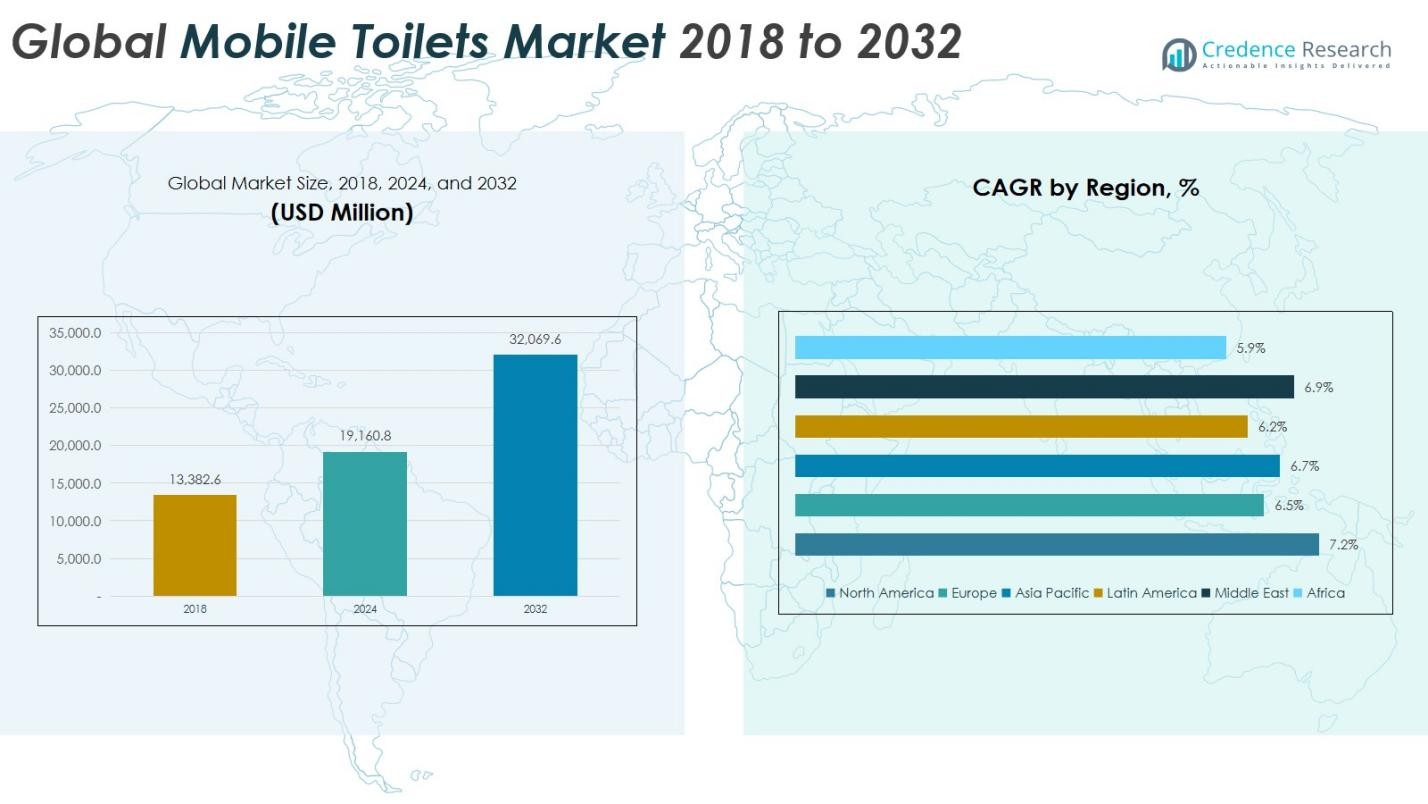
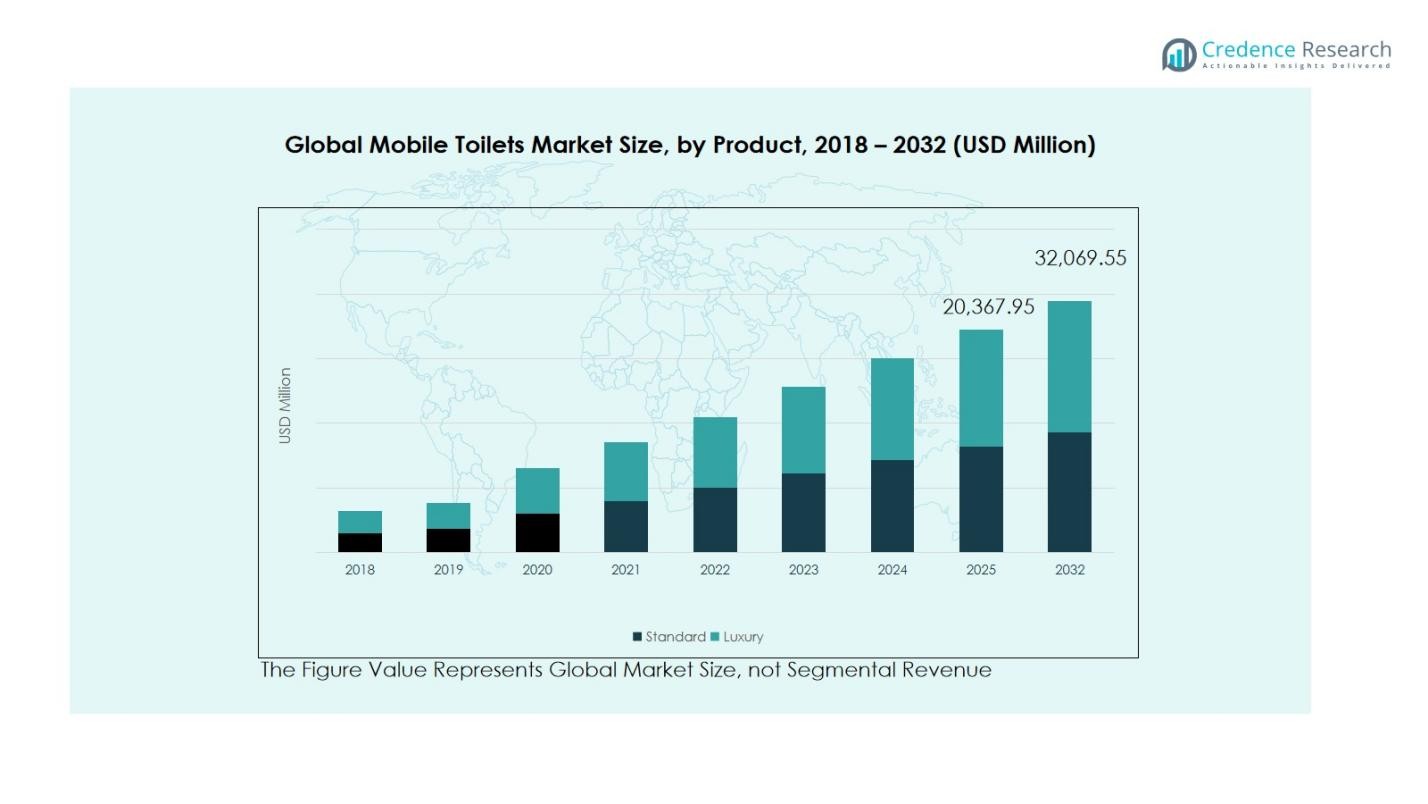
The Global Mobile Toilets Market size was valued at USD 13,382.6 million in 2018, increasing to USD 19,160.8 million in 2024, and is anticipated to reach USD 32,069.6 million by 2032, growing at a CAGR of 6.70% during the forecast period.
| REPORT ATTRIBUTE | DETAILS |
|---|---|
| Historical Period | 2020-2023 |
| Base Year | 2024 |
| Forecast Period | 2025-2032 |
| Mobile Toilets Market Size 2024 | USD 19,160.8 Million |
| Mobile Toilets Market, CAGR | 6.70% |
| Mobile Toilets Market Size 2032 | USD 32,069.6 Million |
The Global Mobile Toilets Market is characterized by strong competition among major players such as Thetford, Deluxe Loos, Satellite Industries, PolyJohn Enterprises Corporation, GLOBAL Fliegenschmidt GmbH, Kazema General Trading L.L.C., Camco Manufacturing Inc., and ADCO Holdings Inc. These companies focus on innovation, product durability, and eco-friendly sanitation solutions to enhance their market position. Strategic initiatives such as partnerships, product diversification, and rental service expansion further strengthen their global presence. Asia Pacific emerged as the leading region in 2024, commanding approximately 34% of the global market share, driven by rapid urbanization, infrastructure growth, and increasing government investments in sanitation facilities.
Market Insights
- The Global Mobile Toilets Market was valued at USD 19,160.8 million in 2024 and is projected to reach USD 32,069.6 million by 2032, growing at a CAGR of 6.7% during the forecast period.
- Market growth is driven by increasing infrastructure projects, sanitation awareness, and the rising use of portable units across construction, public places, and outdoor events.
- Key trends include the adoption of eco-friendly, smart, and luxury portable toilets, along with growing demand for rental-based sanitation services.
- The market is moderately competitive, with major players such as Thetford, Deluxe Loos, Satellite Industries, PolyJohn Enterprises Corporation, and Kazema General Trading L.L.C. focusing on sustainable innovation and regional expansion.
- Asia Pacific dominates the market with about 34% share, followed by Europe (28%) and North America (23%), while the standard toilet segment holds nearly 65% of total market share
Market Segmentation Analysis:
By Product Type:
The global mobile toilets market by product type is dominated by the standard mobile toilets segment, accounting for 65% of total market share in 2024. Their wide adoption in public places, construction sites, and events due to cost-effectiveness, easy mobility, and low maintenance drives this dominance. The luxury mobile toilets segment, holding 35% share, is witnessing steady growth driven by rising demand in premium outdoor events and commercial setups. Increasing hygiene awareness, along with the expansion of urban infrastructure projects, continues to strengthen the market position of standard mobile units globally.
For instance, PolyJohn Enterprises Corporation supplies tens of thousands of standard units annually, especially to construction sites and disaster-relief operations in North America, emphasizing widespread practical use.
By Mechanism:
The recirculating chemical toilets segment leads the market with 52% share in 2024, attributed to their efficiency in water conservation, odor control, and ease of waste management. These systems are extensively used at large public gatherings and construction sites where water supply is limited. The flushing toilets segment holds about 30%, favored for improved sanitation and comfort, while the compost toilets segment, with 18% share, is expanding steadily due to the growing preference for eco-friendly and sustainable waste management solutions across developed markets.
For instance, PolyJohn offers a flushing model PJN3 with a 39-gallon tank capacity, which can provide over 150 flushes per service cycle, depending on usage. The PJN3 is widely used across construction sites and at special events.
By End User:
The construction sites segment dominates the market, representing 40% of total market share in 2024, driven by stringent labor safety standards and the growing number of infrastructure and industrial projects worldwide. Public places and infrastructure applications account for 25%, supported by government initiatives to improve sanitation access. Special events and recreational places collectively capture 20%, reflecting rising demand for portable sanitation in tourism and entertainment. The commercial and other segments share the remaining 15%, benefiting from increasing corporate and institutional installations for employee and visitor convenience.
Key Growth Drivers
Rising Infrastructure and Construction Activities
The expanding construction and infrastructure sector remains a major growth driver for the global mobile toilets market. Ongoing urban development projects, highway expansions, and industrial site constructions generate consistent demand for temporary sanitation solutions. Governments in developing regions are investing heavily in large-scale public infrastructure, which directly boosts the installation of mobile sanitation units. These toilets ensure worker hygiene compliance and operational efficiency, positioning them as essential assets for project sites and fueling steady market growth across both developed and emerging economies.
For instance, John To Go offers durable portable toilet units specifically designed for construction sites, enhancing worker comfort and hygiene while boosting productivity by reducing breaks and travel time for restroom use.
Growing Awareness of Sanitation and Hygiene
Increasing public awareness regarding sanitation and personal hygiene is significantly influencing the adoption of mobile toilets worldwide. Government-led initiatives promoting clean environments, particularly under programs like “Clean India Mission” and global WASH efforts, are improving acceptance in both rural and urban areas. Event organizers, municipalities, and construction firms are adopting portable solutions to maintain hygiene standards. This shift in behavior, combined with stricter sanitation regulations, is accelerating the demand for innovative and eco-friendly mobile toilet solutions globally.
For instance, the Swachh Bharat initiative facilitated the installation of more than 110 million individual household toilets by 2022, boosting public engagement with sanitation solutions
Expansion of Outdoor Events and Recreational Activities
The rapid rise in outdoor events, festivals, sports gatherings, and tourism activities has created a strong demand for mobile sanitation infrastructure. Event organizers increasingly prefer portable toilet units for convenience and quick setup, ensuring visitor comfort and compliance with hygiene standards. The luxury and eco-friendly portable toilet segments are particularly benefiting from this trend, driven by premium event markets in Europe and North America. As global tourism recovers and outdoor recreational spending increases, mobile toilet providers are witnessing robust growth opportunities.
Key Trends & Opportunities
Adoption of Eco-Friendly and Smart Toilets
Sustainability is emerging as a key trend, with rising adoption of compost-based and solar-powered mobile toilets. Manufacturers are integrating smart monitoring systems to track waste levels, water usage, and maintenance schedules. These advancements enhance operational efficiency and support global environmental goals. The growing preference for green sanitation solutions among municipalities and event organizers presents lucrative opportunities for innovation, enabling companies to align with regulatory requirements while appealing to eco-conscious consumers across both developed and emerging markets.
For instance, a solar-powered self-cleaning automatic flushing system developed in India incorporates IoT-based tracking to detect sewage blockages, helping to address sanitation challenges in crowded urban settings.
Rising Demand in Developing Economies
Developing regions in Asia-Pacific, Africa, and Latin America are witnessing rising demand for mobile toilets, driven by expanding construction, mining, and infrastructure projects. Governments are emphasizing improved sanitation facilities in remote and public areas, fueling large-scale procurement of mobile units. Additionally, the rise in public gatherings and tourism activities is creating new commercial opportunities. With lower penetration rates compared to developed markets, emerging economies represent untapped potential for manufacturers and service providers seeking long-term growth.
For instance, Satellite Industries, a global provider operating in Africa since the 1990s, supplies portable toilets for numerous construction and public event projects across the continent, emphasizing environmentally friendly solutions
Key Challenges
High Maintenance and Operational Costs
The mobile toilets market faces challenges due to significant maintenance requirements and associated operational costs. Regular waste disposal, cleaning, and chemical replenishment increase total service expenses, often discouraging smaller event organizers and contractors from adoption. Moreover, variations in local waste management regulations add logistical complexity for service providers operating across regions. These cost-intensive operations limit profitability, particularly in price-sensitive markets, compelling manufacturers to develop more cost-efficient and durable mobile sanitation solutions.
Limited Infrastructure and Regulatory Barriers
In several developing regions, inadequate waste disposal infrastructure and inconsistent sanitation policies hinder market expansion. The lack of proper sewage treatment facilities and unclear regulatory frameworks often delay deployment approvals for mobile units. Additionally, the absence of standardized sanitation guidelines creates disparities in product quality and safety compliance. These factors collectively restrain market penetration, especially in rural and underdeveloped areas, where demand exists but logistical and regulatory barriers limit widespread adoption.
Regional Analysis
North America:
The North America mobile toilets market was valued at USD 2,900.02 million in 2018 and is projected to reach USD 7,440.14 million by 2032, growing at a CAGR of 7.2%. The region accounts for nearly 23% of the global market share in 2024, driven by strong demand from construction, events, and recreational sectors. The United States leads the market, supported by strict sanitation regulations and widespread adoption in outdoor venues. Increasing infrastructure development and rising event-based sanitation needs continue to boost growth across the U.S., Canada, and Mexico.
Europe:
Europe’s mobile toilets market stood at USD 3,822.08 million in 2018 and is forecasted to reach USD 8,876.85 million by 2032, expanding at a CAGR of 6.5%. The region held around 28% market share in 2024, making it one of the leading contributors globally. Demand is primarily driven by large-scale public events, festivals, and tourism activities across countries like Germany, the UK, and France. Growing awareness of eco-friendly sanitation and advancements in luxury portable units are supporting sustainable market growth throughout Europe.
Asia Pacific:
The Asia Pacific mobile toilets market was valued at USD 4,564.82 million in 2018 and is anticipated to reach USD 10,903.65 million by 2032, growing at a CAGR of 6.7%. The region dominates with approximately 34% global market share in 2024, fueled by rapid urbanization, infrastructure development, and government initiatives promoting hygiene. China, India, and Japan are major contributors, supported by expanding construction and tourism sectors. Increasing public sanitation awareness and large-scale event activities continue to enhance market demand across emerging economies in this region.
Latin America:
The Latin America mobile toilets market accounted for USD 979.61 million in 2018 and is expected to reach USD 2,209.59 million by 2032, registering a CAGR of 6.2%. The region represents about 7% of the global market share in 2024, led by Brazil and Mexico. Growth is supported by rising investments in construction, mining, and public infrastructure. Additionally, the growing number of outdoor events and government sanitation initiatives are contributing to increased adoption. However, limited infrastructure and maintenance challenges moderately affect market expansion in rural areas.
Middle East:
The Middle East mobile toilets market was valued at USD 773.52 million in 2018 and is projected to reach USD 1,895.31 million by 2032, advancing at a CAGR of 6.9%. Holding approximately 5% of the global market share in 2024, the region’s growth is fueled by expanding construction projects, tourism, and large-scale events, especially in the GCC countries. Demand for luxury and climate-resilient mobile units is rising across Saudi Arabia, the UAE, and Qatar. Increasing investments in smart infrastructure and hospitality are expected to drive sustained market momentum.
Africa:
The Africa mobile toilets market was valued at USD 342.60 million in 2018 and is forecasted to reach USD 744.01 million by 2032, growing at a CAGR of 5.9%. The region holds around 3% of the global market share in 2024, with South Africa leading the market. Growth is driven by sanitation improvement programs and expanding construction activities across urban areas. However, limited waste management infrastructure and affordability constraints hinder rapid expansion. Government efforts toward rural sanitation and event-driven demand are gradually creating new opportunities for market participants.
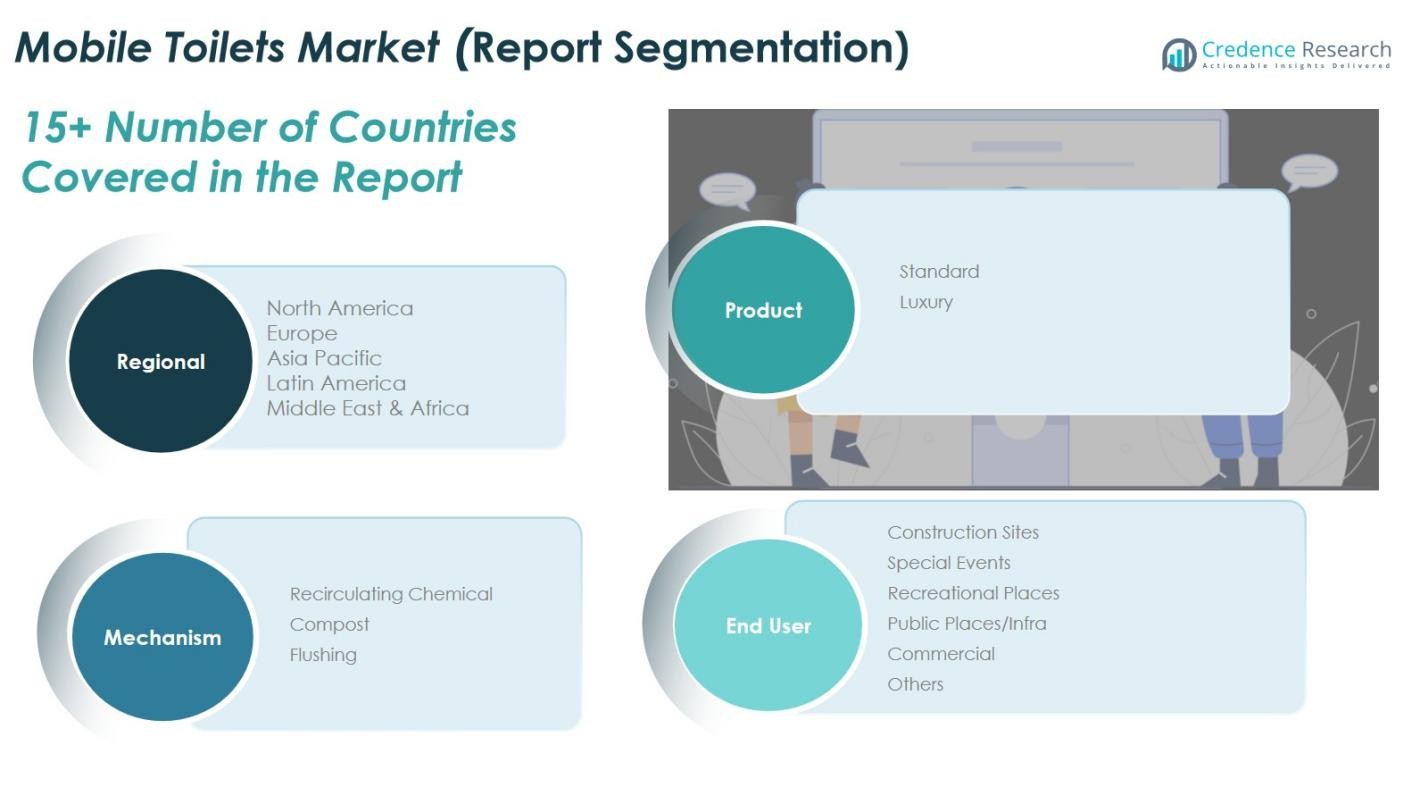
Market Segmentations:
By Product Type:
- Standard Mobile Toilets
- Luxury Mobile Toilets
By Mechanism:
- Recirculating Chemical Toilets
- Compost Toilets
- Flushing Toilets
By End User:
- Construction Sites
- Special Events
- Recreational Places
- Public Places / Infrastructure
- Commercial
- Others
By Region:
- North America
- U.S.
- Canada
- Mexico
- Europe
- Germany
- France
- U.K.
- Italy
- Spain
- Rest of Europe
- Asia Pacific
- China
- Japan
- India
- South Korea
- South-east Asia
- Rest of Asia Pacific
- Latin America
- Brazil
- Argentina
- Rest of Latin America
- Middle East & Africa
- GCC Countries
- South Africa
- Rest of the Middle East and Africa
Competitive Landscape
The competitive landscape of the Global Mobile Toilets Market features key players such as Thetford, Deluxe Loos, Satellite Industries, PolyJohn Enterprises Corporation, GLOBAL Fliegenschmidt GmbH, Kazema General Trading L.L.C., Camco Manufacturing Inc., and ADCO Holdings Inc. These companies focus on product innovation, sustainable designs, and expansion into emerging markets to strengthen their global footprint. Strategic initiatives such as mergers, partnerships, and new product launches are driving competition and enhancing technological capabilities. Market leaders are investing in eco-friendly and smart portable toilet solutions to meet rising environmental standards and consumer expectations. Additionally, service-based models emphasizing rental and maintenance offerings are gaining traction across events and construction sectors. Regional players are also entering the market with cost-effective products tailored to local sanitation needs, intensifying competition. Overall, innovation, durability, and regulatory compliance remain the core differentiators shaping competitiveness within the mobile toilets industry worldwide.
Key Player Analysis
- Thetford
- Deluxe Loos
- Satellite Industries
- PolyJohn Enterprises Corporation
- GLOBAL Fliegenschmidt GmbH
- Kazema General Trading L.L.C.
- Camco Manufacturing Inc.
- ADCO Holdings Inc.
- Other Key Players
Recent Developments
- In May 2023, WC Loc expanded its European footprint by acquiring Toi Toi Italia, strengthening its presence across 13 agencies in Italy and enhancing its service network for construction and event sanitation.
- In June 2024, Pit Stop Portables completed the acquisition of Handi-Can Toilets & Fence Rentals, broadening its portfolio and operational reach within the mobile sanitation sector in Canada.
- In May 2023, EcoFab, Dubai's top portable toilet provider, announced the launch of its new line of vacuum toilets, ideal for huge events.
- In October 2024,Kunrui Peng's AirPot, a lightweight inflatable toilet designed for outdoor use, offers a portable and eco-friendly solution for waste management. It includes biodegradable toilet bags to reduce environmental impact. The AirPot targets outdoor enthusiasts seeking sustainable and convenient sanitation options.
Report Coverage
The research report offers an in-depth analysis based on Product Type, Mechanism, End User and Geography. It details leading market players, providing an overview of their business, product offerings, investments, revenue streams, and key applications. Additionally, the report includes insights into the competitive environment, SWOT analysis, current market trends, as well as the primary drivers and constraints. Furthermore, it discusses various factors that have driven market expansion in recent years. The report also explores market dynamics, regulatory scenarios, and technological advancements that are shaping the industry. It assesses the impact of external factors and global economic changes on market growth. Lastly, it provides strategic recommendations for new entrants and established companies to navigate the complexities of the market.
Future Outlook
- The global mobile toilets market will witness steady growth driven by rising urban infrastructure and construction projects.
- Increasing public hygiene awareness will continue to boost adoption across developing and developed regions.
- Eco-friendly and biodegradable sanitation technologies will gain significant traction among consumers and municipalities.
- Luxury and smart mobile toilet segments will expand due to demand from premium events and tourism sectors.
- Rental-based service models will dominate due to cost efficiency and ease of deployment.
- Government initiatives promoting sanitation in rural and remote areas will support market expansion.
- Manufacturers will focus on lightweight, durable, and water-efficient designs to enhance portability and performance.
- The Asia Pacific region will remain the fastest-growing market due to rapid urbanization and large population base.
- Technological integration, including IoT monitoring systems, will improve maintenance and operational efficiency.
- Strategic partnerships and global supply chain expansion will strengthen the competitive positioning of key players.

Request a Free Sample
Fill in your details and we'll send you a free sample report.
- Sample data tables & charts
- Research methodology
Market Dynamics
Rising Infrastructure and Construction Activities
Ongoing urban development, highway expansions, and industrial projects are fueling demand for temporary sanitation solutions at construction sites, making mobile toilets essential for worker hygiene and regulatory compliance.
Growing Awareness of Sanitation and Hygiene
Government initiatives and public campaigns are increasing awareness about the importance of sanitation, leading to higher adoption of mobile toilets in both urban and rural areas for events, public spaces, and workplaces.
Expansion of Outdoor Events and Recreational Activities
The surge in outdoor festivals, sports events, and tourism is driving the need for portable sanitation infrastructure, with event organizers and municipalities increasingly relying on mobile toilets to ensure visitor comfort and hygiene.
Adoption of Eco-Friendly and Smart Toilet Solutions
Demand for compost-based, solar-powered, and IoT-enabled mobile toilets is rising as municipalities and event organizers seek sustainable, efficient, and regulatory-compliant sanitation options.
Rental-Based Service Model Growth
The cost efficiency and flexibility of rental-based mobile toilet services are attracting construction firms and event organizers, supporting market expansion and recurring revenue streams for providers.
Need a Custom Version of This Report?
Tailor the scope, geography, or segments to your exact requirements.
- Custom geography or segment scope
- Direct access to our analyst team
Frequently Asked Questions
What is the current market size for the Global Mobile Toilets Market, and what is its projected size in 2032?
At what Compound Annual Growth Rate is the Global Mobile Toilets Market projected to grow between 2025 and 2032?
Which Global Mobile Toilets Market segment held the largest share in 2024?
What are the primary factors fueling the growth of the Global Mobile Toilets Market?
Who are the leading companies in the Global Mobile Toilets Market?
Which region commanded the largest share of the Global Mobile Toilets Market in 2024?
Table of Content
Chapter 1 Market Segmentation
- 1.1 Segmentation Framework
- 1.1.1 Product and Service Classification
- 1.1.2 Application and End-Use Classification
- 1.1.3 Technology and Solution Classification
- 1.1.4 Customer and Distribution Channel Classification
- 1.1.5 Geographic Segmentation
- 1.1.6 Market Segment Definitions and Boundaries
- 1.2 By End User
- 1.2.1 Construction Sites
- 1.2.2 Special Events
- 1.2.3 Recreational Places
- 1.2.4 Public Places / Infrastructure
- 1.2.5 Commercial
- 1.2.6 Others
- 1.3 By Mechanism
- 1.3.1 Recirculating Chemical Toilets
- 1.3.2 Compost Toilets
- 1.3.3 Flushing Toilets
- 1.4 By Product Type
- 1.4.1 Standard Mobile Toilets
- 1.4.2 Luxury Mobile Toilets
Chapter 2 Introduction
- 2.1 Report Objectives and Scope
- 2.2 Product Definition and Industry Terminology
- 2.3 Market Inclusions and Exclusions
- 2.4 Research Process
- 2.4.1 Primary Research and Expert Interviews
- 2.4.2 Secondary Research and Source Review
- 2.4.3 Top-Down and Bottom-Up Estimation
- 2.4.4 Data Triangulation and Verification
- 2.5 Market Size Measurement Basis
- 2.5.1 2024: USD 19,160.8 million → 2032: USD 32,069.6 million
- 2.6 Historical and Forecast Reference Periods
- 2.6.1 Base Year: 2024
- 2.6.2 Forecast Period: 2024-2032
- 2.7 Research Assumptions and Limitations
Chapter 3 Executive Summary
- 3.1 Market Snapshot and Key Findings
- 3.2 Base-Year Market Size, 2024
- 3.3 Forecast Market Size, 2032
- 3.4 Revenue and Volume Growth Outlook
- 3.5 Key Demand and Supply Indicators
- 3.6 Leading Market Segments
- 3.7 Fastest-Growing Market Opportunities
- 3.8 Regional Performance Highlights
- 3.9 Technology and Industry Transformation
- 3.10 Competitive Landscape Summary
- 3.11 Analyst View and Strategic Implications
Chapter 4 Global Mobile Toilets Market Trends and Developments
- 4.1 Historical Industry Development
- 4.2 Recent Market Trends and Developments
- 4.3 Demand and Customer Behavior Trends
- 4.4 Technology and Product Innovation
- 4.5 Artificial Intelligence, Automation and Digitalization
- 4.6 Local Manufacturing and Supply Chain Realignment
- 4.7 Industry Partnerships, Mergers and Acquisitions
- 4.8 Sustainability and Circular Economy Developments
- 4.9 Government and Private Sector Investment Trends
- 4.10 Emerging Business Models and Commercialization
- 4.11 Industry Developments and Announcements
Chapter 5 Global Mobile Toilets Market Production, Supply and Demand Analysis
- 5.1 Demand Trend and Consumption Analysis
- 5.2 Demand Forecast, 2024-2032
- 5.3 Production and Output Trend
- 5.4 Production and Output Forecast, 2024-2032
- 5.5 Installed Capacity and Capacity Utilization
- 5.6 Company-Wise Production Plants and Statistics
- 5.6.1 Installed Production Capacity
- 5.6.2 Actual Production
- 5.6.3 Planned Capacity and Expansion Targets
- 5.7 Supply Chain Structure and Procurement Trends
- 5.8 Supply-Demand Gap and Bottlenecks
- 5.9 Import Dependence and Sourcing Structure
- 5.10 Contract Manufacturing and Outsourcing
- 5.11 Regional Supply and Demand Concentration
Chapter 6 Global Mobile Toilets Market Pricing Analysis
- 6.1 Pricing Structure and Measurement
- 6.2 Historical Pricing Trends
- 6.3 Pricing Outlook, 2024-2032
- 6.4 Average Selling Price and Unit Economics
- 6.5 Pricing by Product and Market Segment
- 6.6 Geographic Pricing Differences
- 6.7 Key Input, Energy, Labor and Logistics Costs
- 6.8 Contract Pricing and Purchasing Models
- 6.9 Pricing Sensitivity and Competitive Positioning
- 6.10 Price, Margin and Profitability Implications
Chapter 7 Global Mobile Toilets Market Dynamics
- 7.1 Market Growth Drivers
- 7.1.1 Demand-Side Drivers
- 7.1.2 Technology and Innovation Drivers
- 7.1.3 Infrastructure and Investment Drivers
- 7.1.4 Regulatory and Policy Drivers
- 7.2 Market Restraints
- 7.2.1 Cost and Affordability Constraints
- 7.2.2 Technology and Adoption Barriers
- 7.2.3 Supply Chain and Operational Constraints
- 7.3 Market Challenges
- 7.3.1 Competitive Pressure and Margin Erosion
- 7.3.2 Skills, Infrastructure and Implementation Gaps
- 7.4 Emerging Market Opportunities
- 7.5 Market Dynamics Impact and Time-Horizon Assessment
Chapter 8 Global Mobile Toilets Value Chain Analysis
- 8.1 Industry Value Chain Overview
- 8.2 Upstream Suppliers and Critical Inputs
- 8.3 Technology and Component Providers
- 8.4 Manufacturing or Service Delivery
- 8.5 Distribution, Channel Partners and Integrators
- 8.6 Downstream Applications and End Users
- 8.7 Value Addition and Profit Pools
- 8.8 Vertical Integration and Outsourcing
- 8.9 Supplier Concentration and Risk
- 8.10 Supply Chain Localization and Resilience
Chapter 9 Global Mobile Toilets Market Regulations and Policies
- 9.1 Relevant Laws, Standards and Compliance Frameworks
- 9.2 Product, Service, Safety and Quality Requirements
- 9.3 Government Policies, Incentives and Subsidies
- 9.4 Imports, Exports and Trade Barriers
- 9.5 Public Procurement and Local Content Requirements
- 9.6 Environmental and Sustainability Compliance
- 9.7 Upcoming Policy Changes and Market Implications
Chapter 10 Global Mobile Toilets Market Hotspots and Opportunities
- 10.1 Market Opportunity Mapping and Growth Hotspots
- 10.2 High-Growth Applications and Customer Groups
- 10.3 Underserved Markets and White-Space Opportunities
- 10.4 Emerging Technology and Product Opportunities
- 10.5 New Capacity and Investment Hotspots
- 10.6 Market Entry and Expansion Opportunities
- 10.7 Distribution and Partnership Opportunities
- 10.8 Near-Term and Long-Term Commercial Potential
- 10.9 Opportunity Attractiveness and Execution Risks
Chapter 11 Global Mobile Toilets Market Outlook, 2024-2032
- 11.1 Market Size and Analysis
- 11.1.1 Revenue (Market Measurement: 2024: USD 19,160.8 million → 2032: USD 32,069.6 million)
- 11.1.2 Market Volume and Quantity Sold
- 11.1.3 Historical Market Size
- 11.1.4 Base-Year Market Size, 2024
- 11.2 Market Forecast, 2024-2032
- 11.2.1 Revenue Forecast to 2032
- 11.2.2 Volume Forecast to 2032
- 11.2.3 CAGR and Year-on-Year Growth
- 11.2.4 Incremental Revenue Opportunity
- 11.3 Forecast Assumptions and Scenario Analysis
- 11.3.1 Base-Case Forecast
- 11.3.2 Optimistic and Conservative Scenarios
- 11.3.3 Technology, Pricing and Policy Sensitivities
- 11.4 Market Attractiveness and Growth Outlook
Chapter 12 Global Mobile Toilets Market Segmentation and Outlook
- 12.1 Segmentation Summary and Market Shares, 2024
- 12.2 Largest and Fastest-Growing Segments
- 12.3 By End User - Market Size and Forecast, 2024-2032
- 12.3.1 Segment Definition and Scope
- 12.3.2 Historical Market Size
- 12.3.3 Revenue Forecast, 2024-2032
- 12.3.4 Volume Forecast, 2024-2032
- 12.3.5 Base-Year Market Share, 2024
- 12.3.6 Segment CAGR and Growth Drivers
- 12.3.7 Subsegment Market Size and Forecast
- 12.3.7.1 Construction Sites
- 12.3.7.2 Special Events
- 12.3.7.3 Recreational Places
- 12.3.7.4 Public Places / Infrastructure
- 12.3.7.5 Commercial
- 12.3.7.6 Others
- 12.3.8 Subsegment Pricing and Adoption Trends
- 12.3.9 Leading Suppliers and Competition
- 12.3.10 Regional Demand and Opportunities
- 12.4 By Mechanism - Market Size and Forecast, 2024-2032
- 12.4.1 Segment Definition and Scope
- 12.4.2 Historical Market Size
- 12.4.3 Revenue Forecast, 2024-2032
- 12.4.4 Volume Forecast, 2024-2032
- 12.4.5 Base-Year Market Share, 2024
- 12.4.6 Segment CAGR and Growth Drivers
- 12.4.7 Subsegment Market Size and Forecast
- 12.4.7.1 Recirculating Chemical Toilets
- 12.4.7.2 Compost Toilets
- 12.4.7.3 Flushing Toilets
- 12.4.8 Subsegment Pricing and Adoption Trends
- 12.4.9 Leading Suppliers and Competition
- 12.4.10 Regional Demand and Opportunities
- 12.5 By Product Type - Market Size and Forecast, 2024-2032
- 12.5.1 Segment Definition and Scope
- 12.5.2 Historical Market Size
- 12.5.3 Revenue Forecast, 2024-2032
- 12.5.4 Volume Forecast, 2024-2032
- 12.5.5 Base-Year Market Share, 2024
- 12.5.6 Segment CAGR and Growth Drivers
- 12.5.7 Subsegment Market Size and Forecast
- 12.5.7.1 Standard Mobile Toilets
- 12.5.7.2 Luxury Mobile Toilets
- 12.5.8 Subsegment Pricing and Adoption Trends
- 12.5.9 Leading Suppliers and Competition
- 12.5.10 Regional Demand and Opportunities
- 12.6 Segment Growth Comparison
- 12.7 Segment Attractiveness and Priority Matrix
Chapter 13 Global Mobile Toilets End-Use and Application Market Outlook
- 13.1 End-Use Industry and Customer Demand Structure
- 13.2 Leading Applications and Customer Groups
- 13.3 End-Use Market Size, Share and Forecast
- 13.4 Major End-Use Industry Deep Dives
- 13.4.1 Customer Requirements and Use Cases
- 13.4.2 Demand and Replacement Cycles
- 13.4.3 Technical and Regulatory Considerations
- 13.4.4 Purchasing and Procurement Models
- 13.4.5 Leading Vendors and Distribution Channels
- 13.4.6 Forecast and Commercial Opportunities
- 13.5 Emerging Applications and Cross-Segment Demand
- 13.6 End-Use Industry Investment Priorities
Chapter 14 Global Mobile Toilets Geographic Market Outlook, 2024-2032
- 14.1 Regional Market Size and Share, 2024
- 14.2 Regional Market Forecast, 2024-2032
- 14.3 Regional Pricing, Production and Demand Differences
- 14.4 North America
- 14.4.1 United States
- 14.4.2 Canada
- 14.4.3 Mexico
- 14.5 Europe
- 14.5.1 Germany
- 14.5.2 France
- 14.5.3 Italy
- 14.5.4 United Kingdom
- 14.5.5 Spain
- 14.5.6 Poland
- 14.5.7 Russia
- 14.5.8 Netherlands
- 14.5.9 Belgium
- 14.5.10 Sweden
- 14.5.11 Denmark
- 14.5.12 Norway
- 14.5.13 Rest of Europe
- 14.6 Asia Pacific
- 14.6.1 China
- 14.6.2 India
- 14.6.3 Japan
- 14.6.4 South Korea
- 14.6.5 Thailand
- 14.6.6 Indonesia
- 14.6.7 Vietnam
- 14.6.8 Malaysia
- 14.6.9 Australia
- 14.6.10 Rest of Asia Pacific
- 14.7 Latin America
- 14.7.1 Brazil
- 14.7.2 Argentina
- 14.7.3 Colombia
- 14.7.4 Chile
- 14.7.5 Rest of Latin America
- 14.8 Middle East
- 14.8.1 Saudi Arabia
- 14.8.2 United Arab Emirates
- 14.8.3 Turkey
- 14.8.4 Israel
- 14.8.5 Iran
- 14.8.6 Rest of the Middle East
- 14.9 Africa
- 14.9.1 South Africa
- 14.9.2 Egypt
- 14.9.3 Nigeria
- 14.9.4 Morocco
- 14.9.5 Rest of Africa
- 14.10 Regional Investment, Policy and Supply Chain Differences
- 14.11 Regional Competitive Landscape
- 14.12 Geographic Growth Hotspots
Chapter 15 Global Mobile Toilets Technology, Innovation and Sustainability Outlook
- 15.1 Technology Landscape and Maturity
- 15.2 Product, Process and Service Innovation
- 15.3 AI, Automation and Digital Tools in the Industry
- 15.4 Technology Adoption and Performance Benchmarking
- 15.5 Innovation Pipeline and R&D Investment
- 15.6 Patent and Intellectual Property Trends
- 15.7 Energy Efficiency and Resource Management
- 15.8 Sustainability, Recycling and Circularity
- 15.9 Technology Roadmap, 2024-2032
- 15.10 Risks of Obsolescence and Technology Substitution
Chapter 16 Global Mobile Toilets Market Key Strategic Imperatives
- 16.1 Growth and Market Entry Priorities
- 16.2 High-Return Products and Segments
- 16.3 Pricing, Profitability and Cost Optimization
- 16.4 Technology Investment and Product Differentiation
- 16.5 Supply Chain Localization and Resilience
- 16.6 Distribution and Customer Acquisition
- 16.7 Partnership, Acquisition and Capacity Strategy
- 16.8 Regional Expansion Priorities
- 16.9 Short-, Medium- and Long-Term Actions
Chapter 17 Competition Outlook
- 17.1 Industry Competition Characteristics
- 17.2 Market Structure and Concentration
- 17.3 Market Share and Competitive Positioning, 2024
- 17.4 Company-Wise Revenue and Product Benchmarking
- 17.5 Production and Service Capacity Benchmarking
- 17.6 Technology, Pricing and Differentiation
- 17.7 Regional Footprint and Distribution Strength
- 17.8 Mergers, Acquisitions and Strategic Alliances
- 17.9 New Entrants and Competitive Threats
- 17.10 Porter's Five Forces and Industry Attractiveness
- 17.11 Competitive Outlook, 2024-2032
Chapter 18 Company Profiles
- 18.1 Company Coverage and Selection Criteria
- 18.2 Thetford
- 18.2.1 Business Description
- 18.2.2 Company Ownership and Geographic Presence
- 18.2.3 Product and Service Portfolio
- 18.2.4 Manufacturing and Operating Footprint
- 18.2.5 Production Capacity and Expansion Plans
- 18.2.6 Financial Performance and Investment
- 18.2.7 Market Share and Competitive Position
- 18.2.8 Technology and Innovation Capabilities
- 18.2.9 Strategic Alliances or Partnerships
- 18.2.10 Recent Developments
- 18.2.11 Growth Strategy and Outlook
- 18.3 Deluxe Loos
- 18.4 Satellite Industries
- 18.5 PolyJohn Enterprises Corporation
- 18.6 GLOBAL Fliegenschmidt GmbH
- 18.7 Kazema General Trading L.L.C.
- 18.8 Camco Manufacturing Inc.
- 18.9 ADCO Holdings Inc.
- 18.10 EcoFab
- 18.11 WC Loc
- 18.12 Other Relevant Market Participants
Note: Every listed company is profiled on the structure shown under the first company. The company list is preliminary and may change based on research findings, market developments, data availability and client requirements.
Chapter 19 Disclaimer
- 19.1 Research and Forecast Disclaimer
- 19.2 Data Source and Estimation Limitations
Note: The depth of individual sections depends on data availability for this market. Volume, capacity, trade and other unit-based metrics are included where applicable.

