
| REPORT ATTRIBUTE | DETAILS |
|---|---|
| Historical Period | 2020-2023 |
| Base Year | 2024 |
| Forecast Period | 2025-2032 |
| Nanocrystal Market Size 2024 | USD 3,749.85 Million |
| Nanocrystal Market CAGR | 9.28% |
| Nanocrystal Market Size 2032 | USD 7,609.71 Million |
Market Overview
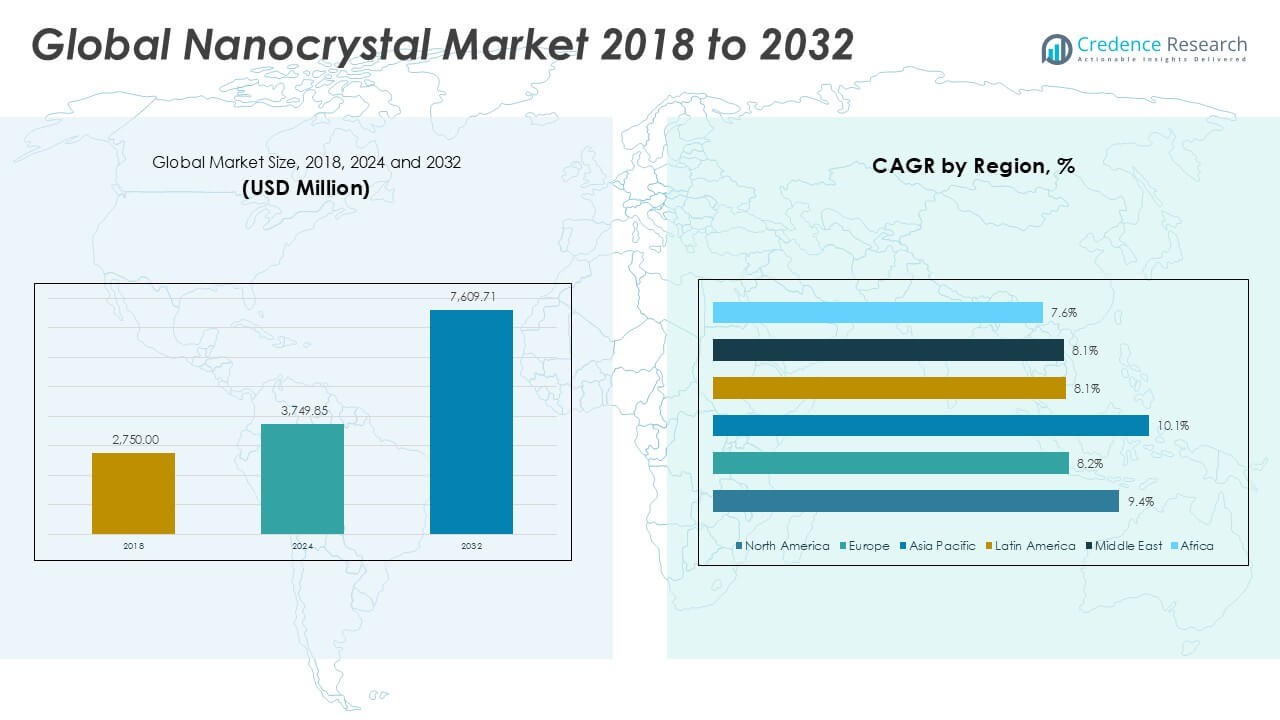
The Global Nanocrystal Market is projected to grow from USD 3,749.85 million in 2024 to an estimated USD 7,609.71 million by 2032, expanding at a compound annual growth rate (CAGR) of 9.28% from 2025 to 2032.
The market is being propelled by several key drivers, including the rising interest in nanocrystal-based drug delivery systems that offer higher solubility and targeted therapy. Additionally, the growing use of nanocrystals in semiconductors, solar cells, and LED displays is enhancing product performance and energy efficiency, which is attracting significant investments. The increasing awareness regarding sustainable and advanced material solutions is also fueling the adoption of nanocrystals in industrial and environmental applications. Trends indicate that ongoing research and development activities will continue to introduce innovative uses for nanocrystals in the coming years.
Geographically, North America holds a dominant position in the market, driven by extensive research initiatives, strong pharmaceutical and electronics sectors, and supportive regulatory frameworks. Asia-Pacific is expected to witness the fastest growth during the forecast period, supported by expanding manufacturing bases and rising healthcare investments in countries like China, Japan, and India. Key players in the Global Nanocrystal Market include NanoComposix, Pfizer Inc., BASF SE, Evonik Industries, and Nanophase Technologies Corporation.
Market Insights
- The Global Nanocrystal Market is projected to nearly double from USD 3,749.85 million in 2024 to USD 7,609.71 million by 2032, with a CAGR of 9.28%.
- Increasing applications in pharmaceuticals, electronics, and renewable energy sectors drive demand for nanocrystals due to their enhanced performance and efficiency.
- The rising adoption of nanocrystal-based drug delivery systems boosts market growth by improving drug solubility and targeted therapy.
- High production complexity, costly manufacturing processes, and regulatory uncertainties limit market expansion and pose challenges for new entrants.
- North America dominates the market owing to its advanced research infrastructure and strong pharmaceutical and electronics industries.
- Asia-Pacific is the fastest-growing region, supported by expanding manufacturing hubs and increasing healthcare investments in China, India, and Japan.
- Continuous R\&D and technological advancements enable new applications of nanocrystals, enhancing their use in sustainable industrial and environmental solutions.
Market Drivers
Growing Demand for Enhanced Drug Delivery Systems Boosts Market Expansion
The Global Nanocrystal Market is experiencing significant growth due to the rising demand for advanced drug delivery systems. Nanocrystals improve the solubility and bioavailability of poorly water-soluble drugs, making them highly attractive in pharmaceutical applications. It supports faster absorption and targeted drug release, which enhances therapeutic outcomes. The increasing prevalence of chronic diseases such as cancer, cardiovascular disorders, and diabetes is driving pharmaceutical companies to adopt nanocrystal-based formulations. Companies are investing heavily in nanocrystal technologies to develop more effective treatments. It is positioning nanocrystals as a critical solution to address unmet medical needs.
- For instance, over 250 nanocrystal-based drug formulations were in various stages of clinical development worldwide as of 2023, reflecting the pharmaceutical industry's strong commitment to this technology.
Rising Adoption in Electronics and Semiconductor Applications Fuels Market Growth
The Global Nanocrystal Market benefits from the growing incorporation of nanocrystals in electronics and semiconductor devices. Nanocrystals enable superior electrical conductivity, enhanced display brightness, and energy-efficient performance in consumer electronics. The rapid advancement in smart devices, LED displays, and solar panels is increasing the demand for nanocrystal materials. It contributes to improved product efficiency and miniaturization of components. The electronics industry actively explores nanocrystal applications to meet evolving consumer expectations. Manufacturers are integrating nanocrystals to deliver high-performance solutions in an increasingly competitive market.
- For instance, according to the Semiconductor Industry Association, over 1,800,000 semiconductor wafers incorporating nanocrystal-enhanced materials were produced globally in 2023, supporting the demand for higher-performance electronic components.
Increased Focus on Sustainable Energy Solutions Drives Nanocrystal Demand
The Global Nanocrystal Market is supported by the increasing focus on sustainable energy storage and generation solutions. Nanocrystals play a vital role in improving the efficiency of batteries, fuel cells, and photovoltaic systems. It enhances energy density, charge retention, and conversion rates, making renewable energy technologies more viable. Governments and private investors are prioritizing clean energy projects, accelerating the need for high-performance materials. The integration of nanocrystals into energy storage solutions is becoming essential to meet growing energy demands. This shift strengthens the market position of nanocrystals in the global energy landscape.
Advancements in Cosmetic and Industrial Applications Expand Market Scope
The Global Nanocrystal Market is witnessing growth through its expanding use in cosmetics and industrial processes. Nanocrystals offer improved texture, stability, and absorption in cosmetic formulations, supporting the development of high-quality skincare and personal care products. It enhances the effectiveness of sunscreens and anti-aging products by providing uniform particle distribution. The market also sees increased application in coatings, paints, and catalysts, where nanocrystals improve durability and performance. Industries prefer nanocrystals for their ability to deliver advanced functional properties. Companies across sectors are exploring these versatile applications to gain a competitive edge.
Market Trends
Increasing Pharmaceutical Innovations Shape the Nanocrystal Development Landscape
The Global Nanocrystal Market is witnessing a growing trend of pharmaceutical companies focusing on nanocrystal-based drug formulations. It helps to address solubility challenges and enhances drug absorption rates, especially for poorly soluble compounds. Companies are investing in research to introduce nanocrystal drugs that offer faster onset of action and improved patient compliance. The trend reflects the rising interest in precision medicine and targeted therapies, where nanocrystals support customized treatment approaches. The pharmaceutical sector is adopting nanocrystal technology to improve the efficacy of both existing and new drug molecules. Regulatory bodies are also supporting these innovations by approving more nanocrystal-based drugs for commercial use.
- For instance, according to the U.S. Food and Drug Administration (FDA), more than 40 nanocrystal-based drug products have received regulatory approval for commercial use in the United States as of 2024, highlighting the growing acceptance of this technology in mainstream pharmaceuticals.
Advancements in Nanocrystal Production Technologies Drive Market Growth
The Global Nanocrystal Market is seeing rapid advancements in production technologies that enable more controlled particle size and enhanced material stability. It supports scalable and cost-effective manufacturing processes, making nanocrystal applications more feasible across industries. Companies are adopting wet milling, high-pressure homogenization, and precipitation techniques to achieve uniform nanocrystal quality. New equipment and processing solutions are helping manufacturers maintain product consistency while reducing production time. These technological improvements are expanding the possibilities for nanocrystal integration into pharmaceuticals, electronics, and energy systems. The trend points toward greater industrial uptake due to increased reliability and efficiency in nanocrystal production.
- For instance, Evonik Industries reported in 2023 that its nanocrystal production facilities processed over 1,400 metric tons of nanocrystal materials for pharmaceutical and electronics clients, reflecting the scale and industrialization of advanced nanocrystal manufacturing technologies.
Rising Use of Nanocrystals in Energy Storage and Conversion Applications
The Global Nanocrystal Market is moving toward wider application in energy storage, solar energy, and fuel cells. It contributes to enhancing the performance of batteries and photovoltaic systems by offering improved charge retention and faster energy conversion rates. Research institutions and companies are focusing on developing nanocrystal-based electrodes and coatings for next-generation energy solutions. This trend aligns with global efforts to strengthen renewable energy capacity and develop energy-efficient technologies. The use of nanocrystals is helping to overcome limitations in conventional energy materials. Industries are actively pursuing nanocrystal-enhanced solutions to meet increasing energy efficiency demands.
Expanding Adoption in Cosmetics and Consumer Products Diversifies Market Applications
The Global Nanocrystal Market is gaining attention in cosmetics and personal care segments due to its ability to improve product texture, absorption, and overall performance. It enables the creation of lightweight formulations with superior stability and extended shelf life. Cosmetic brands are integrating nanocrystals to enhance the delivery of active ingredients and provide uniform application. Consumer demand for high-performance skincare and sun protection products is influencing this trend. The versatility of nanocrystals allows companies to develop innovative products that meet evolving consumer preferences. It is driving the market toward broader applications in everyday consumer goods.
Market Challenges
Complex Manufacturing Processes and High Production Costs Restrain Market Growth
The Global Nanocrystal Market faces challenges due to complex manufacturing processes and high production costs. It requires advanced equipment, precise control, and specialized techniques to achieve the desired particle size and stability. Companies often encounter difficulties in scaling up production while maintaining product quality and consistency. The need for stringent handling procedures and costly raw materials increases operational expenses. Smaller manufacturers find it difficult to compete due to the high capital investment required. These factors limit the widespread adoption of nanocrystal technologies across various industries.
- For instance, according to a 2024 industry survey by Nanotechnology World Association, the average cost of setting up a commercial-scale nanocrystal production facility exceeds $8,000,000, with annual operational expenses ranging from $1,200,000 to $2,500,000, posing a significant barrier for small and medium-sized enterprises.
Regulatory Uncertainty and Limited Long-Term Safety Data Create Barriers
The Global Nanocrystal Market is also constrained by regulatory uncertainties and limited availability of long-term safety data. It raises concerns about the environmental and health impacts of nanocrystal materials, particularly in pharmaceutical and cosmetic applications. Regulatory bodies have not yet established uniform global standards for nanomaterials, leading to compliance challenges. Companies must conduct extensive testing and risk assessments to satisfy approval requirements, which can delay product launches. The lack of clear guidelines creates hesitation among manufacturers and end-users. These regulatory and safety concerns can slow market expansion and innovation.
Market Opportunities
Expanding Pharmaceutical Applications Present Strong Growth Potential
The Global Nanocrystal Market offers significant opportunities through the growing demand for advanced pharmaceutical solutions. It supports the development of drug formulations that improve solubility, bioavailability, and targeted delivery. Companies can focus on creating nanocrystal-based therapies for complex diseases where conventional drugs show limited effectiveness. Rising investments in precision medicine open new pathways for nanocrystal applications in personalized treatments. The pharmaceutical sector actively seeks technologies that enhance drug performance and patient outcomes. Nanocrystals provide a competitive edge in developing next-generation therapeutics.
Emerging Use in Renewable Energy and Consumer Products Creates New Avenues
The Global Nanocrystal Market holds strong opportunities in renewable energy and consumer product applications. It can significantly improve battery performance, solar energy efficiency, and energy storage capacity. Growing global interest in sustainable solutions increases the relevance of nanocrystals in energy projects. Consumer product manufacturers are exploring nanocrystals for developing high-performance cosmetics, coatings, and electronics. The versatility of nanocrystals allows companies to create innovative products that meet rising quality and sustainability demands. These emerging sectors provide wide growth possibilities for nanocrystal-based technologies.
Market Segmentation Analysis
By Type
The Global Nanocrystal Market is segmented by type into metal nanocrystals, semiconductor nanocrystals, ceramic nanocrystals, and others. Metal nanocrystals hold a significant share due to their excellent electrical and catalytic properties, which support applications in energy, electronics, and environmental technologies. Semiconductor nanocrystals are gaining traction in display technologies, sensors, and solar panels due to their optical and electronic advantages. Ceramic nanocrystals contribute to medical and industrial uses because of their mechanical strength and thermal stability. The other segment includes polymer-based and hybrid nanocrystals that serve niche markets. It shows steady growth driven by specialized applications across multiple industries.
- For instance, according to a 2024 report by the National Renewable Energy Laboratory (NREL), more than 420,000 kilograms of semiconductor nanocrystals were used in the production of advanced display panels and solar cells globally in 2023, highlighting their growing adoption in high-tech applications.
By End-User
The Global Nanocrystal Market is categorized by end-user into consumer electronics, medical devices, renewable energy, automotive, and others. Consumer electronics dominate the market with extensive use in displays, sensors, and conductive components. Medical devices present growth potential due to rising adoption of nanocrystal-based drug delivery systems and imaging solutions. The renewable energy sector is increasing its use of nanocrystals to improve energy storage, battery performance, and solar panel efficiency. The automotive industry applies nanocrystals in coatings, sensors, and energy solutions. It continues to expand its relevance across these diverse sectors.
- For instance, a 2023 survey by the Consumer Technology Association found that over 85,000,000 televisions with nanocrystal-enhanced (quantum dot) displays were shipped globally in 2023, underscoring the technology’s widespread adoption in the consumer electronics sector.
By Application
The Global Nanocrystal Market is segmented by application into electronics, healthcare, energy, environment, and others. Electronics lead the segment with strong demand for nanocrystals in semiconductors, displays, and advanced circuitry. Healthcare applications grow with nanocrystal-enabled drug formulations and diagnostic tools improving patient outcomes. Energy applications see rising interest for boosting battery life, fuel cell performance, and solar efficiency. Environmental applications focus on pollution control and catalytic processes where nanocrystals improve operational effectiveness. It finds increasing applications across industries seeking high-performance materials.
Segments
Based on Type
- Metal Nanocrystals
- Semiconductor Nanocrystals
- Ceramic Nanocrystals
- Others
Based on End-user
- Consumer Electronics
- Medical Devices
- Renewable Energy
- Automotive
- Others
Based on Application
- Electronics
- Healthcare
- Energy
- Environment
- Others
Based on Region
- North America
- U.S.
- Canada
- Mexico
- Europe
- UK
- France
- Germany
- Italy
- Spain
- Russia
- Belgium
- Netherlands
- Austria
- Sweden
- Poland
- Denmark
- Switzerland
- Rest of Europe
- Asia Pacific
- China
- Japan
- South Korea
- India
- Australia
- Thailand
- Indonesia
- Vietnam
- Malaysia
- Philippines
- Taiwan
- Rest of Asia Pacific
- Latin America
- Brazil
- Argentina
- Peru
- Chile
- Colombia
- Rest of Latin America
- Middle East
- UAE
- KSA
- Israel
- Turkey
- Iran
- Rest of Middle East
- Africa
- Egypt
- Nigeria
- Algeria
- Morocco
- Rest of Africa
Regional Analysis
North America Nanocrystal Market
The North America Nanocrystal Market reached USD 1,015.18 million in 2024 and is projected to grow to USD 2,074.07 million by 2032, registering a CAGR of 9.4% from 2025 to 2032. It holds approximately 27.1% of the global market share in 2024. Strong demand from the pharmaceutical and consumer electronics sectors drives market growth in the United States and Canada. It benefits from advanced research facilities, significant investment in nanotechnology, and favorable regulatory environments. The region continues to lead in nanocrystal drug development and energy storage applications. Companies in North America actively pursue product innovations and collaborations to strengthen their market presence.
Europe Nanocrystal Market
The Europe Nanocrystal Market was valued at USD 805.36 million in 2024 and is expected to reach USD 1,512.60 million by 2032, growing at a CAGR of 8.2%. It accounts for 21.5% of the global market share in 2024. Germany, France, and the United Kingdom are key contributors due to their strong automotive, healthcare, and renewable energy sectors. The region focuses on sustainable technologies and high-performance materials where nanocrystals play an essential role. It continues to expand in energy storage, coatings, and medical device applications. European companies emphasize eco-friendly nanocrystal solutions to meet stringent environmental regulations.
Asia Pacific Nanocrystal Market
The Asia Pacific Nanocrystal Market reached USD 1,518.11 million in 2024 and is forecast to grow to USD 3,265.65 million by 2032 at a CAGR of 10.1%. It represents the largest share, 40.5% of the global market in 2024. China, Japan, and India lead growth through expanding electronics, pharmaceutical manufacturing, and renewable energy projects. It shows strong momentum due to rising healthcare investments and rapid industrialization. Governments support nanotechnology research, further boosting regional development. Asia Pacific remains the fastest-growing region with a diverse application base for nanocrystals.
Latin America Nanocrystal Market
The Latin America Nanocrystal Market was valued at USD 181.08 million in 2024 and is projected to reach USD 336.88 million by 2032, with a CAGR of 8.1%. It contributes 4.8% to the global market share in 2024. Brazil and Mexico drive demand, particularly in consumer products, automotive, and energy storage solutions. It gains attention from companies focusing on emerging markets and cost-efficient manufacturing. The pharmaceutical industry in the region increasingly adopts nanocrystal-based drug formulations. Rising energy projects create additional opportunities for nanocrystal applications in batteries and solar panels.
Middle East Nanocrystal Market
The Middle East Nanocrystal Market is estimated at USD 129.72 million in 2024 and is expected to reach USD 240.42 million by 2032, growing at a CAGR of 8.1%. It holds 3.5% of the global market share in 2024. Countries like the United Arab Emirates and Saudi Arabia show growing interest in high-performance materials for energy and medical applications. It supports regional innovation in renewable energy projects and advanced coatings. Nanocrystal adoption increases in industrial processing and environmental management. Companies in the Middle East are expanding partnerships to integrate nanocrystals into diversified industries.
Africa Nanocrystal Market
The Africa Nanocrystal Market reached USD 100.39 million in 2024 and is projected to grow to USD 180.09 million by 2032, registering a CAGR of 7.6%. It accounts for 2.7% of the global market share in 2024. South Africa leads the region with growing interest in healthcare and renewable energy sectors. It shows steady demand for nanocrystal-based products in consumer goods and environmental technologies. Regional initiatives encourage the adoption of nanotechnology in industrial applications. Africa’s market growth is supported by international investments and increasing awareness of advanced material benefits.
Key players
- Samsung Electronics Co., Ltd.
- LG Chem Ltd.
- Nanosys, Inc.
- QD Vision, Inc.
- Nanoco Group PLC
- NN-Labs, LLC
- Ocean NanoTech LLC
- Quantum Materials Corp.
- Crystalplex Corporation
- QD Laser, Inc.
- Nanophase Technologies Corporation
- Evident Technologies, Inc.
- CAN GmbH
- InVisage Technologies, Inc.
- UbiQD, Inc.
- NNCrystal US Corporation
- Pixelligent Technologies LLC
- NanoPhotonica, Inc.
- QD Solar Inc.
- Avantama AG
Competitive Analysis
The Global Nanocrystal Market is highly competitive with a strong presence of international and regional players. It features companies that actively invest in product innovation, strategic partnerships, and technological advancements to maintain their market position. Key players focus on expanding their type portfolios and strengthening their presence in emerging applications like renewable energy and healthcare. Companies such as Samsung Electronics Co., Ltd., Nanosys, Inc., and Nanoco Group PLC lead with advanced nanocrystal technologies and scalable production capabilities. Smaller firms compete by offering specialized solutions and collaborating with research institutions. It drives continuous product development and competitive pricing in the market.
Recent Developments
- In April 2025, Samsung Display unveiled cadmium-free quantum dot NanoLED (EL-QD) prototypes, including an 18-inch display, signaling a significant advancement in their research and development towards commercializing next-generation QD-LED TVs. The prototypes, showcased at Display Week 2025, achieved a brightness of 400 nits and a resolution of 264 PPI, with Samsung emphasizing the increased lifetime of the blue quantum dot emitting material. This technology uses quantum dots as the emissive material, directly converting electricity into light, potentially leading to a new era of nano-level display technology.
- In January-February 2025, Nanoco Group PLC announced significant advancements in its cadmium-free quantum dot technology, including the commercialization of their HEATWAVE infrared QDs for sensing and expansion of production facilities. This progress included the launch of their HEATWAVE infrared quantum dots (QDs) for sensing applications, alongside the expansion of their wafer fabrication and quality control (QC) facilities.
Market Concentration and Characteristics
The Global Nanocrystal Market shows a moderate to high market concentration with several leading players controlling significant revenue shares. It is characterized by rapid technological advancements, strong research orientation, and high entry barriers due to complex production processes and regulatory challenges. The market attracts both multinational corporations and specialized companies focused on niche applications. It demands continuous innovation, precision manufacturing, and significant capital investment to remain competitive. Companies differentiate themselves through advanced product portfolios, strategic collaborations, and efficient scalability. It evolves with growing application diversity across pharmaceuticals, electronics, energy, and consumer products, creating dynamic competition and steady product advancements.
Report Coverage
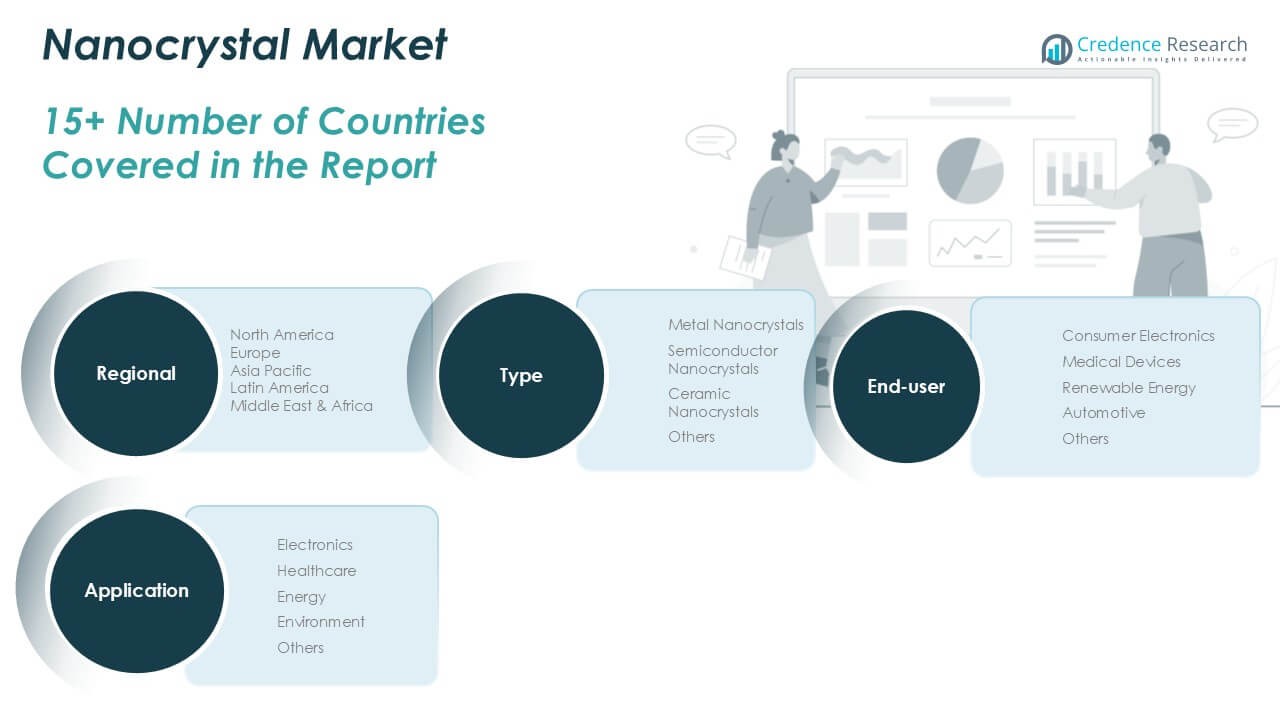
The research report offers an in-depth analysis based on Type, End-user, Application and Region. It details leading market players, providing an overview of their business, product offerings, investments, revenue streams, and key applications. Additionally, the report includes insights into the competitive environment, SWOT analysis, current market trends, as well as the primary drivers and constraints. Furthermore, it discusses various factors that have driven market expansion in recent years. The report also explores market dynamics, regulatory scenarios, and technological advancements that are shaping the industry. It assesses the impact of external factors and global economic changes on market growth. Lastly, it provides strategic recommendations for new entrants and established companies to navigate the complexities of the market.
Future Outlook
- The Global Nanocrystal Market will experience sustained growth driven by increasing applications in pharmaceuticals, electronics, and renewable energy sectors.
- Advancements in nanocrystal synthesis and manufacturing technologies will improve product consistency and reduce production costs.
- Pharmaceutical companies will expand nanocrystal-based drug formulations to enhance solubility and targeted delivery, boosting market demand.
- Growth in consumer electronics will fuel demand for nanocrystals in displays, sensors, and semiconductors due to their superior optical and electrical properties.
- The renewable energy sector will increasingly adopt nanocrystals to enhance battery efficiency, solar cells, and fuel cell technologies.
- Emerging economies in Asia Pacific will drive market expansion with rising investments in healthcare, electronics, and clean energy projects.
- Regulatory frameworks will evolve, providing clearer guidelines for nanomaterial safety and encouraging wider adoption across industries.
- Environmental applications of nanocrystals will grow, focusing on pollution control, water treatment, and sustainable industrial processes.
- Strategic collaborations and mergers among key players will accelerate innovation and market penetration globally.
- Continuous research and development will unlock new applications and improve the functional performance of nanocrystals, ensuring long-term market resilience.

Request a Free Sample
Fill in your details and we'll send you a free sample report.
- Sample data tables & charts
- Research methodology
Market Dynamics
Expansion of Nanocrystal-Based Drug Delivery Systems
Nanocrystals significantly improve the solubility and bioavailability of poorly water-soluble drugs, enabling more effective and targeted therapies. This is driving pharmaceutical companies to invest in nanocrystal technologies to address unmet medical needs and enhance therapeutic outcomes.
Rising Adoption in Electronics and Semiconductor Devices
Nanocrystals are increasingly used in displays, sensors, and semiconductors due to their superior optical and electrical properties, supporting the development of high-performance consumer electronics and energy-efficient devices.
Growth in Renewable Energy Applications
Nanocrystals enhance the efficiency of batteries, solar cells, and fuel cells by improving energy density and conversion rates, making them essential for next-generation renewable energy solutions and supporting global sustainability initiatives.
Advancements in Nanocrystal Manufacturing Technologies
Innovations in production methods such as wet milling and high-pressure homogenization are enabling more consistent, scalable, and cost-effective manufacturing of nanocrystals, broadening their industrial adoption.
Increasing Use in Cosmetics and Industrial Applications
Nanocrystals improve the texture, stability, and absorption of cosmetic products and enhance the performance of coatings, paints, and catalysts, driving their adoption across diverse consumer and industrial sectors.
Need a Custom Version of This Report?
Tailor the scope, geography, or segments to your exact requirements.
- Custom geography or segment scope
- Direct access to our analyst team
Frequently Asked Questions
What is the current size of the Global Nanocrystal Market, and what is its projected growth?
What are the primary factors driving growth in the Global Nanocrystal Market?
Which industries are the major consumers of nanocrystals?
Which regions dominate the Global Nanocrystal Market?
Who are some of the key players in the Global Nanocrystal Market?
Table of Content
Chapter 1 Market Segmentation
- 1.1 Segmentation Framework
- 1.1.1 Product and Service Classification
- 1.1.2 Application and End-Use Classification
- 1.1.3 Technology and Solution Classification
- 1.1.4 Customer and Distribution Channel Classification
- 1.1.5 Geographic Segmentation
- 1.1.6 Market Segment Definitions and Boundaries
- 1.2 By Type
- 1.2.1 Metal Nanocrystals
- 1.2.2 Semiconductor Nanocrystals
- 1.2.3 Ceramic Nanocrystals
- 1.2.4 Others
- 1.3 By End-user
- 1.3.1 Consumer Electronics
- 1.3.2 Medical Devices
- 1.3.3 Renewable Energy
- 1.3.4 Automotive
- 1.3.5 Others
- 1.4 By Application
- 1.4.1 Electronics
- 1.4.2 Healthcare
- 1.4.3 Energy
- 1.4.4 Environment
- 1.4.5 Others
Chapter 2 Introduction
- 2.1 Report Objectives and Scope
- 2.2 Product Definition and Industry Terminology
- 2.3 Market Inclusions and Exclusions
- 2.4 Research Process
- 2.4.1 Primary Research and Expert Interviews
- 2.4.2 Secondary Research and Source Review
- 2.4.3 Top-Down and Bottom-Up Estimation
- 2.4.4 Data Triangulation and Verification
- 2.5 Market Size Measurement Basis
- 2.5.1 2024: USD 3,749.85 million → 2032: USD 7,609.71 million
- 2.6 Historical and Forecast Reference Periods
- 2.6.1 Base Year: 2024
- 2.6.2 Forecast Period: 2024-2032
- 2.7 Research Assumptions and Limitations
Chapter 3 Executive Summary
- 3.1 Market Snapshot and Key Findings
- 3.2 Base-Year Market Size, 2024
- 3.3 Forecast Market Size, 2032
- 3.4 Revenue and Volume Growth Outlook
- 3.5 Key Demand and Supply Indicators
- 3.6 Leading Market Segments
- 3.7 Fastest-Growing Market Opportunities
- 3.8 Regional Performance Highlights
- 3.9 Technology and Industry Transformation
- 3.10 Competitive Landscape Summary
- 3.11 Analyst View and Strategic Implications
Chapter 4 Global Nanocrystal Market Trends and Developments
- 4.1 Historical Industry Development
- 4.2 Recent Market Trends and Developments
- 4.3 Demand and Customer Behavior Trends
- 4.4 Technology and Product Innovation
- 4.5 Artificial Intelligence, Automation and Digitalization
- 4.6 Local Manufacturing and Supply Chain Realignment
- 4.7 Industry Partnerships, Mergers and Acquisitions
- 4.8 Sustainability and Circular Economy Developments
- 4.9 Government and Private Sector Investment Trends
- 4.10 Emerging Business Models and Commercialization
- 4.11 Industry Developments and Announcements
Chapter 5 Global Nanocrystal Market Production, Supply and Demand Analysis
- 5.1 Demand Trend and Consumption Analysis
- 5.2 Demand Forecast, 2024-2032
- 5.3 Production and Output Trend
- 5.4 Production and Output Forecast, 2024-2032
- 5.5 Installed Capacity and Capacity Utilization
- 5.6 Company-Wise Production Plants and Statistics
- 5.6.1 Installed Production Capacity
- 5.6.2 Actual Production
- 5.6.3 Planned Capacity and Expansion Targets
- 5.7 Supply Chain Structure and Procurement Trends
- 5.8 Supply-Demand Gap and Bottlenecks
- 5.9 Import Dependence and Sourcing Structure
- 5.10 Contract Manufacturing and Outsourcing
- 5.11 Regional Supply and Demand Concentration
Chapter 6 Global Nanocrystal Market Pricing Analysis
- 6.1 Pricing Structure and Measurement
- 6.2 Historical Pricing Trends
- 6.3 Pricing Outlook, 2024-2032
- 6.4 Average Selling Price and Unit Economics
- 6.5 Pricing by Product and Market Segment
- 6.6 Geographic Pricing Differences
- 6.7 Key Input, Energy, Labor and Logistics Costs
- 6.8 Contract Pricing and Purchasing Models
- 6.9 Pricing Sensitivity and Competitive Positioning
- 6.10 Price, Margin and Profitability Implications
Chapter 7 Global Nanocrystal Market Dynamics
- 7.1 Market Growth Drivers
- 7.1.1 Demand-Side Drivers
- 7.1.2 Technology and Innovation Drivers
- 7.1.3 Infrastructure and Investment Drivers
- 7.1.4 Regulatory and Policy Drivers
- 7.2 Market Restraints
- 7.2.1 Cost and Affordability Constraints
- 7.2.2 Technology and Adoption Barriers
- 7.2.3 Supply Chain and Operational Constraints
- 7.3 Market Challenges
- 7.3.1 Competitive Pressure and Margin Erosion
- 7.3.2 Skills, Infrastructure and Implementation Gaps
- 7.4 Emerging Market Opportunities
- 7.5 Market Dynamics Impact and Time-Horizon Assessment
Chapter 8 Global Nanocrystal Value Chain Analysis
- 8.1 Industry Value Chain Overview
- 8.2 Upstream Suppliers and Critical Inputs
- 8.3 Technology and Component Providers
- 8.4 Manufacturing or Service Delivery
- 8.5 Distribution, Channel Partners and Integrators
- 8.6 Downstream Applications and End Users
- 8.7 Value Addition and Profit Pools
- 8.8 Vertical Integration and Outsourcing
- 8.9 Supplier Concentration and Risk
- 8.10 Supply Chain Localization and Resilience
Chapter 9 Global Nanocrystal Market Regulations and Policies
- 9.1 Relevant Laws, Standards and Compliance Frameworks
- 9.2 Product, Service, Safety and Quality Requirements
- 9.3 Government Policies, Incentives and Subsidies
- 9.4 Imports, Exports and Trade Barriers
- 9.5 Public Procurement and Local Content Requirements
- 9.6 Environmental and Sustainability Compliance
- 9.7 Upcoming Policy Changes and Market Implications
Chapter 10 Global Nanocrystal Market Hotspots and Opportunities
- 10.1 Market Opportunity Mapping and Growth Hotspots
- 10.2 High-Growth Applications and Customer Groups
- 10.3 Underserved Markets and White-Space Opportunities
- 10.4 Emerging Technology and Product Opportunities
- 10.5 New Capacity and Investment Hotspots
- 10.6 Market Entry and Expansion Opportunities
- 10.7 Distribution and Partnership Opportunities
- 10.8 Near-Term and Long-Term Commercial Potential
- 10.9 Opportunity Attractiveness and Execution Risks
Chapter 11 Global Nanocrystal Market Outlook, 2024-2032
- 11.1 Market Size and Analysis
- 11.1.1 Revenue (Market Measurement: 2024: USD 3,749.85 million → 2032: USD 7,609.71 million)
- 11.1.2 Market Volume and Quantity Sold
- 11.1.3 Historical Market Size
- 11.1.4 Base-Year Market Size, 2024
- 11.2 Market Forecast, 2024-2032
- 11.2.1 Revenue Forecast to 2032
- 11.2.2 Volume Forecast to 2032
- 11.2.3 CAGR and Year-on-Year Growth
- 11.2.4 Incremental Revenue Opportunity
- 11.3 Forecast Assumptions and Scenario Analysis
- 11.3.1 Base-Case Forecast
- 11.3.2 Optimistic and Conservative Scenarios
- 11.3.3 Technology, Pricing and Policy Sensitivities
- 11.4 Market Attractiveness and Growth Outlook
Chapter 12 Global Nanocrystal Market Segmentation and Outlook
- 12.1 Segmentation Summary and Market Shares, 2024
- 12.2 Largest and Fastest-Growing Segments
- 12.3 By Type - Market Size and Forecast, 2024-2032
- 12.3.1 Segment Definition and Scope
- 12.3.2 Historical Market Size
- 12.3.3 Revenue Forecast, 2024-2032
- 12.3.4 Volume Forecast, 2024-2032
- 12.3.5 Base-Year Market Share, 2024
- 12.3.6 Segment CAGR and Growth Drivers
- 12.3.7 Subsegment Market Size and Forecast
- 12.3.7.1 Metal Nanocrystals
- 12.3.7.2 Semiconductor Nanocrystals
- 12.3.7.3 Ceramic Nanocrystals
- 12.3.7.4 Others
- 12.3.8 Subsegment Pricing and Adoption Trends
- 12.3.9 Leading Suppliers and Competition
- 12.3.10 Regional Demand and Opportunities
- 12.4 By End-user - Market Size and Forecast, 2024-2032
- 12.4.1 Segment Definition and Scope
- 12.4.2 Historical Market Size
- 12.4.3 Revenue Forecast, 2024-2032
- 12.4.4 Volume Forecast, 2024-2032
- 12.4.5 Base-Year Market Share, 2024
- 12.4.6 Segment CAGR and Growth Drivers
- 12.4.7 Subsegment Market Size and Forecast
- 12.4.7.1 Consumer Electronics
- 12.4.7.2 Medical Devices
- 12.4.7.3 Renewable Energy
- 12.4.7.4 Automotive
- 12.4.7.5 Others
- 12.4.8 Subsegment Pricing and Adoption Trends
- 12.4.9 Leading Suppliers and Competition
- 12.4.10 Regional Demand and Opportunities
- 12.5 By Application - Market Size and Forecast, 2024-2032
- 12.5.1 Segment Definition and Scope
- 12.5.2 Historical Market Size
- 12.5.3 Revenue Forecast, 2024-2032
- 12.5.4 Volume Forecast, 2024-2032
- 12.5.5 Base-Year Market Share, 2024
- 12.5.6 Segment CAGR and Growth Drivers
- 12.5.7 Subsegment Market Size and Forecast
- 12.5.7.1 Electronics
- 12.5.7.2 Healthcare
- 12.5.7.3 Energy
- 12.5.7.4 Environment
- 12.5.7.5 Others
- 12.5.8 Subsegment Pricing and Adoption Trends
- 12.5.9 Leading Suppliers and Competition
- 12.5.10 Regional Demand and Opportunities
- 12.6 Segment Growth Comparison
- 12.7 Segment Attractiveness and Priority Matrix
Chapter 13 Global Nanocrystal End-Use and Application Market Outlook
- 13.1 End-Use Industry and Customer Demand Structure
- 13.2 Leading Applications and Customer Groups
- 13.3 End-Use Market Size, Share and Forecast
- 13.4 Major End-Use Industry Deep Dives
- 13.4.1 Customer Requirements and Use Cases
- 13.4.2 Demand and Replacement Cycles
- 13.4.3 Technical and Regulatory Considerations
- 13.4.4 Purchasing and Procurement Models
- 13.4.5 Leading Vendors and Distribution Channels
- 13.4.6 Forecast and Commercial Opportunities
- 13.5 Emerging Applications and Cross-Segment Demand
- 13.6 End-Use Industry Investment Priorities
Chapter 14 Global Nanocrystal Geographic Market Outlook, 2024-2032
- 14.1 Regional Market Size and Share, 2024
- 14.2 Regional Market Forecast, 2024-2032
- 14.3 Regional Pricing, Production and Demand Differences
- 14.4 North America
- 14.4.1 United States
- 14.4.2 Canada
- 14.4.3 Mexico
- 14.5 Europe
- 14.5.1 Germany
- 14.5.2 France
- 14.5.3 Italy
- 14.5.4 United Kingdom
- 14.5.5 Spain
- 14.5.6 Poland
- 14.5.7 Russia
- 14.5.8 Netherlands
- 14.5.9 Belgium
- 14.5.10 Sweden
- 14.5.11 Denmark
- 14.5.12 Norway
- 14.5.13 Rest of Europe
- 14.6 Asia Pacific
- 14.6.1 China
- 14.6.2 India
- 14.6.3 Japan
- 14.6.4 South Korea
- 14.6.5 Thailand
- 14.6.6 Indonesia
- 14.6.7 Vietnam
- 14.6.8 Malaysia
- 14.6.9 Australia
- 14.6.10 Rest of Asia Pacific
- 14.7 Latin America
- 14.7.1 Brazil
- 14.7.2 Argentina
- 14.7.3 Colombia
- 14.7.4 Chile
- 14.7.5 Rest of Latin America
- 14.8 Middle East
- 14.8.1 Saudi Arabia
- 14.8.2 United Arab Emirates
- 14.8.3 Turkey
- 14.8.4 Israel
- 14.8.5 Iran
- 14.8.6 Rest of the Middle East
- 14.9 Africa
- 14.9.1 South Africa
- 14.9.2 Egypt
- 14.9.3 Nigeria
- 14.9.4 Morocco
- 14.9.5 Rest of Africa
- 14.10 Regional Investment, Policy and Supply Chain Differences
- 14.11 Regional Competitive Landscape
- 14.12 Geographic Growth Hotspots
Chapter 15 Global Nanocrystal Technology, Innovation and Sustainability Outlook
- 15.1 Technology Landscape and Maturity
- 15.2 Product, Process and Service Innovation
- 15.3 AI, Automation and Digital Tools in the Industry
- 15.4 Technology Adoption and Performance Benchmarking
- 15.5 Innovation Pipeline and R&D Investment
- 15.6 Patent and Intellectual Property Trends
- 15.7 Energy Efficiency and Resource Management
- 15.8 Sustainability, Recycling and Circularity
- 15.9 Technology Roadmap, 2024-2032
- 15.10 Risks of Obsolescence and Technology Substitution
Chapter 16 Global Nanocrystal Market Key Strategic Imperatives
- 16.1 Growth and Market Entry Priorities
- 16.2 High-Return Products and Segments
- 16.3 Pricing, Profitability and Cost Optimization
- 16.4 Technology Investment and Product Differentiation
- 16.5 Supply Chain Localization and Resilience
- 16.6 Distribution and Customer Acquisition
- 16.7 Partnership, Acquisition and Capacity Strategy
- 16.8 Regional Expansion Priorities
- 16.9 Short-, Medium- and Long-Term Actions
Chapter 17 Competition Outlook
- 17.1 Industry Competition Characteristics
- 17.2 Market Structure and Concentration
- 17.3 Market Share and Competitive Positioning, 2024
- 17.4 Company-Wise Revenue and Product Benchmarking
- 17.5 Production and Service Capacity Benchmarking
- 17.6 Technology, Pricing and Differentiation
- 17.7 Regional Footprint and Distribution Strength
- 17.8 Mergers, Acquisitions and Strategic Alliances
- 17.9 New Entrants and Competitive Threats
- 17.10 Porter's Five Forces and Industry Attractiveness
- 17.11 Competitive Outlook, 2024-2032
Chapter 18 Company Profiles
- 18.1 Company Coverage and Selection Criteria
- 18.2 Samsung Electronics Co., Ltd.
- 18.2.1 Business Description
- 18.2.2 Company Ownership and Geographic Presence
- 18.2.3 Product and Service Portfolio
- 18.2.4 Manufacturing and Operating Footprint
- 18.2.5 Production Capacity and Expansion Plans
- 18.2.6 Financial Performance and Investment
- 18.2.7 Market Share and Competitive Position
- 18.2.8 Technology and Innovation Capabilities
- 18.2.9 Strategic Alliances or Partnerships
- 18.2.10 Recent Developments
- 18.2.11 Growth Strategy and Outlook
- 18.3 LG Chem Ltd.
- 18.4 Nanosys, Inc.
- 18.5 Nanoco Group PLC
- 18.6 Nanophase Technologies Corporation
- 18.7 QD Vision, Inc.
- 18.8 Quantum Materials Corp.
- 18.9 Pixelligent Technologies LLC
- 18.10 QD Solar Inc.
- 18.11 Avantama AG
- 18.12 Other Relevant Market Participants
Note: Every listed company is profiled on the structure shown under the first company. The company list is preliminary and may change based on research findings, market developments, data availability and client requirements.
Chapter 19 Disclaimer
- 19.1 Research and Forecast Disclaimer
- 19.2 Data Source and Estimation Limitations
Note: The depth of individual sections depends on data availability for this market. Volume, capacity, trade and other unit-based metrics are included where applicable.

