
| REPORT ATTRIBUTE | DETAILS |
|---|---|
| Historical Period | 2019-2022 |
| Base Year | 2023 |
| Forecast Period | 2024-2032 |
| Netherlands Dark Fiber Network Market Size 2023 | USD 68.34 million |
| Netherlands Dark Fiber Network Market, CAGR | 11.66% |
| Netherlands Dark Fiber Network Market Size 2032 | USD 186.02 million |
Market Overview
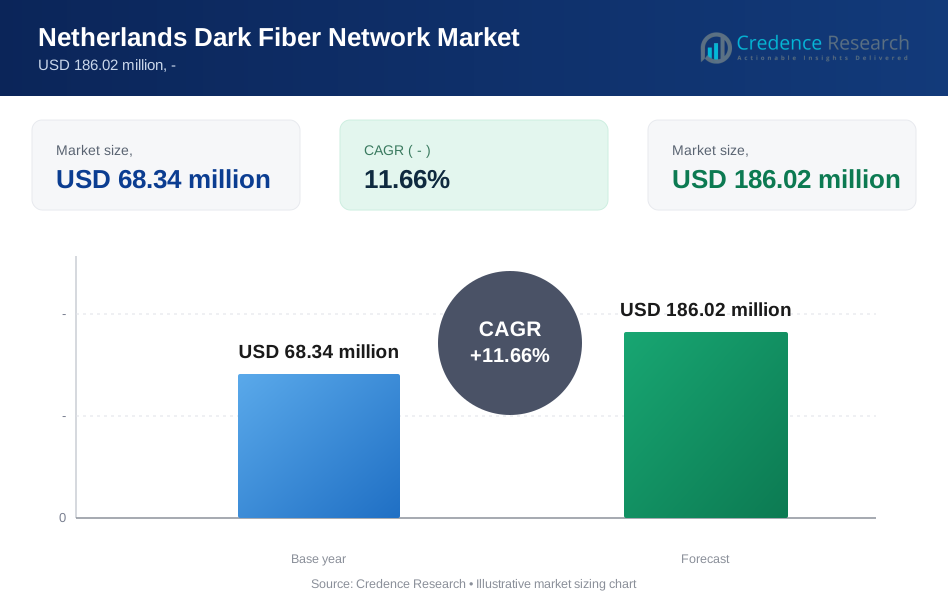
The Netherlands Dark Fiber Network Market is projected to grow from USD 68.34 million in 2023 to an estimated USD 186.02 million by 2032, with a compound annual growth rate (CAGR) of 11.66% from 2024 to 2032. This significant growth can be attributed to the increasing demand for high-speed and reliable internet connectivity, driven by the expanding digital economy and the growing adoption of cloud-based services.
Key market drivers include the rising demand for data centers, the proliferation of 5G technology, and the increasing trend toward smart city initiatives. Additionally, the market is witnessing a surge in investments from both public and private sectors to enhance the country's telecommunications infrastructure. The growing emphasis on cybersecurity and data privacy is also encouraging the adoption of dark fiber networks, as they offer enhanced security features compared to traditional networks
Geographically, the market is expected to be dominated by urban areas such as Amsterdam, Rotterdam, and The Hague, where the demand for high-speed internet and advanced telecommunications infrastructure is most pronounced. Key players in the Netherlands Dark Fiber Network Market include Eurofiber, Relined Fiber Network, and Cellnex Telecom, who are leading the market by offering innovative solutions and expanding their fiber network coverage across the country.
Market Drivers
Rising Demand for High-Speed Internet and Data Transmission
The Netherlands is experiencing a surge in demand for high-speed internet and data transmission, driven by rapid digitalization across various sectors. Businesses and consumers are generating and consuming vast amounts of data, necessitating a robust and efficient network infrastructure. Dark fiber networks offer an ideal solution by providing dedicated, high-capacity channels that can handle increasing data loads without the risk of congestion typically associated with shared networks. According to a recent survey conducted by the Dutch government, over 80% of businesses in the Netherlands reported an increased need for higher bandwidth and faster internet speeds to support their operations. This demand is particularly strong in urban areas and among enterprises that require uninterrupted connectivity for mission-critical operations. For instance, a study by the Dutch Digital Infrastructure Association found that data traffic in the Netherlands has been doubling every 18 months, with projections indicating this trend will continue in the coming years. The expansion of e-commerce, online education, and remote work further accelerates this trend, making dark fiber networks an essential component of the Netherlands' digital infrastructure.
Expansion of Data Centers and Cloud Computing Services
The proliferation of data centers and the growing adoption of cloud computing services are key drivers propelling the growth of the Netherlands Dark Fiber Network Market. The country has established itself as a critical hub for data centers due to its strategic location, robust power grid, and favorable climate conditions. These data centers require high-bandwidth, low-latency connections to operate efficiently, making dark fiber networks the preferred choice for many operators. A report by the Dutch Data Center Association revealed that the Netherlands hosts over 200 data centers, with a significant concentration in the Amsterdam metropolitan area. Additionally, cloud service providers are increasingly relying on dark fiber to ensure seamless data transfer between their facilities and end-users. For instance, a major cloud service provider recently announced plans to invest in a new dark fiber network connecting its data centers across the Netherlands, citing the need for increased capacity and improved performance. The shift towards cloud-based services has also heightened the need for secure and reliable network infrastructures, as enterprises migrate their workloads to the cloud and demand uninterrupted access to their data.
Advancement of 5G Technology and Smart City Initiatives
The advancement of 5G technology and the implementation of smart city initiatives are significant factors driving the demand for dark fiber networks in the Netherlands. 5G technology promises to deliver ultra-fast internet speeds, lower latency, and increased connectivity for a myriad of devices, ranging from smartphones to IoT (Internet of Things) sensors. To achieve these benefits, a dense and high-capacity fiber network is required to support the backhaul of data generated by 5G networks. According to a report by the Netherlands Authority for Consumers and Markets, the rollout of 5G networks in the country has led to a substantial increase in demand for dark fiber connections. Furthermore, the Netherlands is actively pursuing smart city projects that integrate advanced technologies to improve urban living conditions, enhance public services, and optimize resource management. For instance, the city of Amsterdam has implemented a smart lighting system that relies on a dark fiber network to control and monitor over 150,000 street lights, resulting in significant energy savings and improved maintenance efficiency. These initiatives rely heavily on a robust telecommunications infrastructure, where dark fiber plays a crucial role in enabling real-time data collection, analysis, and decision-making.
Increasing Focus on Cybersecurity and Data Privacy
In today's digital age, cybersecurity and data privacy have become paramount concerns for both businesses and individuals. The Netherlands, like many other countries, is experiencing a rise in cyber threats, prompting organizations to invest in more secure and resilient network infrastructures. Dark fiber networks offer enhanced security features compared to traditional shared networks, as they provide a dedicated communication channel that is not exposed to external traffic. This isolation significantly reduces the risk of data breaches, making dark fiber an attractive option for organizations that prioritize data protection. Moreover, regulatory requirements such as the General Data Protection Regulation (GDPR) have heightened the focus on data privacy, compelling companies to adopt secure network solutions to comply with legal standards. The growing emphasis on cybersecurity and data privacy is driving the adoption of dark fiber networks in sectors such as finance, healthcare, and government, where the protection of sensitive information is critical. As the threat landscape continues to evolve, the demand for secure and private communication channels is expected to increase, fueling the growth of the Netherlands Dark Fiber Network Market.
Market Trends
Increasing Adoption of Dark Fiber by Small and Medium Enterprises (SMEs)
A notable trend in the Netherlands Dark Fiber Network Market is the increasing adoption of dark fiber by small and medium enterprises (SMEs). Traditionally, dark fiber networks were predominantly utilized by large corporations and telecommunications providers due to the high costs associated with deploying and managing such infrastructure. However, as the digital economy expands and the need for reliable, high-speed connectivity becomes critical for businesses of all sizes, SMEs are recognizing the benefits of dark fiber networks. These networks offer SMEs the ability to control their own infrastructure, enabling greater flexibility, scalability, and security compared to shared networks. Additionally, with the growing availability of managed dark fiber services, where third-party providers handle the technical complexities, SMEs can now access these advanced network solutions without the need for extensive in-house expertise. This trend is expected to continue as SMEs increasingly digitalize their operations and require robust network infrastructures to support their growth and competitiveness in the market.
Strategic Partnerships and Collaborations to Expand Fiber Network Coverage
Another significant trend in the Netherlands Dark Fiber Network Market is the rise of strategic partnerships and collaborations aimed at expanding fiber network coverage across the country. As the demand for high-speed internet and data transmission grows, telecommunications companies, data center operators, and infrastructure providers are increasingly joining forces to build and extend dark fiber networks. These partnerships often involve sharing resources, expertise, and investments, allowing for more efficient and widespread deployment of fiber infrastructure. For instance, collaborations between municipalities and private companies are becoming more common as local governments seek to enhance digital connectivity in their regions, particularly in underserved areas. These initiatives are not only helping to bridge the digital divide but are also driving the proliferation of dark fiber networks in both urban and rural areas. Additionally, these partnerships are facilitating the development of new services and applications that leverage dark fiber's high bandwidth and low latency, further solidifying its importance in the Netherlands' telecommunications landscape.
Market Restraints and Challenges
High Initial Capital Expenditure and Maintenance Costs
One of the primary restraints in the Netherlands Dark Fiber Network Market is the high initial capital expenditure required for the deployment of dark fiber infrastructure. Installing dark fiber networks involves significant investment in laying fiber-optic cables, acquiring necessary permits, and ensuring compliance with regulatory standards. These costs can be prohibitive, particularly for smaller companies and new market entrants, limiting their ability to participate in or expand within the market. Additionally, maintaining and upgrading the network to meet evolving technological standards adds further financial burden. The need for specialized equipment and skilled personnel to manage and operate these networks also contributes to the overall cost, making dark fiber a less accessible option for some organizations. This financial barrier can slow down the widespread adoption of dark fiber, particularly in less densely populated or rural areas where the return on investment may not justify the expenditure. For instance, data from the Dutch Central Bureau of Statistics shows that the cost of laying fiber-optic cables in rural areas can be significantly higher than in urban centers, impacting the expansion of dark fiber networks in these regions.
Regulatory and Environmental Challenges
The Netherlands Dark Fiber Network Market also faces significant regulatory and environmental challenges that can hinder the deployment and expansion of fiber networks. Stringent regulations related to land use, construction permits, and environmental impact assessments can delay or complicate the installation of dark fiber infrastructure. Navigating the complex regulatory landscape requires substantial time and resources, which can be a deterrent for companies looking to expand their network coverage. Additionally, environmental concerns, such as the impact of digging and laying fiber cables on local ecosystems, can lead to further delays and increased costs. These challenges are particularly pronounced in urban areas, where existing infrastructure, historical sites, and densely populated neighborhoods can create additional obstacles. Moreover, the need to comply with national and European Union regulations can add layers of bureaucracy, slowing down the pace of development. For instance, a survey conducted by the Netherlands Authority for Consumers and Markets revealed that obtaining necessary permits for fiber deployment can take up to 18 months in some municipalities, significantly impacting project timelines and costs.
Market Segmentation Analysis
By Type
Single-mode fibers dominate the Netherlands Dark Fiber Network Market due to their superior long-distance transmission capabilities and minimal signal loss. For instance, a survey conducted by the Dutch Fiber Optic Association found that over 70% of dark fiber deployments in the country utilize single-mode fibers. This prevalence is particularly evident in metro and long-haul networks, where high-bandwidth applications are critical. The widespread adoption of single-mode fibers in data centers and telecommunications infrastructure has been a key driver of market growth. Step-index multimode fibers, while less prevalent, play a significant role in short-distance communication systems. For instance, a government report on enterprise connectivity revealed that these fibers are commonly used in local area networks (LANs) and intra-building connections across various industries. Their cost-efficiency makes them an attractive option for businesses looking to optimize their internal network infrastructure without compromising on performance. Graded-index multimode fibers are gaining traction in the market, particularly in enterprise networks and data centers. A recent industry survey conducted by a leading telecommunications company in the Netherlands showed a growing trend of businesses upgrading their internal network infrastructures to support higher data rates. This shift is driving the adoption of graded-index multimode fibers, which offer enhanced performance by reducing modal dispersion.
By Application
Data transmission and networking infrastructure are the primary application segments in the Netherlands Dark Fiber Network Market. For instance, a government-sponsored study on digital infrastructure revealed that the demand for high-speed and reliable internet services has led to a substantial increase in dark fiber deployments for data transmission purposes. This trend is particularly evident in sectors such as telecommunications, finance, and cloud computing, where data integrity and speed are paramount. The networking infrastructure segment is experiencing significant growth, driven by the need for robust and scalable network backbones. A survey conducted by a leading Dutch telecom operator found that the expansion of 5G networks and smart city projects has been a major catalyst for dark fiber adoption in networking infrastructure. For instance, several municipalities in the Netherlands have reported increased investments in fiber-optic networks to support their smart city initiatives, highlighting the crucial role of dark fiber in enabling advanced urban technologies.
Segments
Based on Type
- Single Mode Fiber
- Step-Index Multimode Fiber
- Graded-Index Multimode Fiber
Based on Application
- Data Transmission
- Networking Infrastructure
Based on End User
- Telecom
- Oil & Gas
- Military & Aerospace
- BFSI
- Others
Based on Network Type
- Metro
- Long-Haul
Based on Material
- Glass
- Plastic
Based on Region
- Amsterdam
- Rotterdam
- The Hague
Regional Analysis
Amsterdam (35%)
Amsterdam holds the largest market share in the Netherlands Dark Fiber Network Market. The city's prominence as a major financial and technology hub makes it a key center for dark fiber deployment. For instance, a survey by the Dutch Data Center Association found that Amsterdam hosts over 70% of the country's data centers, driving significant demand for dark fiber connectivity. Amsterdam is home to numerous telecommunications companies and international businesses, all of which require high-speed and reliable connectivity. The presence of major network exchange points, such as the Amsterdam Internet Exchange (AMS-IX), further enhances the demand for dark fiber infrastructure. The city's role in supporting the digital economy, including e-commerce, cloud computing, and data-intensive applications, drives the continued expansion of dark fiber networks.
Rotterdam (25%)
Rotterdam is another critical region for dark fiber networks. The city's status as a leading port and industrial hub necessitates robust network infrastructure to support its extensive logistics, transportation, and manufacturing sectors. For instance, a report by the Port of Rotterdam Authority highlighted that over 80% of port-related companies rely on high-speed fiber connections for their operations. The growing number of industrial facilities and logistics companies in Rotterdam generates substantial demand for high-bandwidth connectivity to facilitate real-time data exchange and operational efficiency. The city's ongoing investments in digital infrastructure and smart port technologies contribute to the strong market presence of dark fiber networks.
Key players
- KPN Telecom B.V.
- VodafoneZiggo (Liberty Global)
- T-Mobile Netherlands (Deutsche Telekom)
- Eurofiber Group
- Relined Fiber Network B.V.
- Colt Technology Services BV
- DELTA Fiber Netherlands (DELTA)
- Proximus Group
- Dutch IT-channel
- NL-ix (Neutral Internet Exchange)
Competitive Analysis
The Netherlands Dark Fiber Network Market is highly competitive, with several key players vying for market dominance. KPN Telecom B.V., VodafoneZiggo, and T-Mobile Netherlands lead the market, leveraging their extensive network infrastructures and strong customer bases to capture significant market share. These telecom giants offer comprehensive dark fiber solutions that support both enterprise and consumer needs. Eurofiber Group and Relined Fiber Network B.V. are prominent players focusing on providing high-capacity dark fiber networks to data centers and large enterprises. Colt Technology Services BV and DELTA Fiber Netherlands also contribute to the market with tailored solutions for specific sectors and regional needs. Proximus Group and Dutch IT-channel offer niche services and specialized solutions, while NL-ix, as a neutral internet exchange, enhances connectivity and interconnection options. The competitive landscape is characterized by innovation, with players investing in infrastructure and expanding their service offerings to meet the growing demand for high-speed and reliable connectivity.
Recent Developments
- In May 2024, VodafoneZiggo reported solid first quarter results for 2024. The company saw a 1.6% year-on-year revenue growth and an 8.8% increase in Adjusted EBITDA compared to Q1 2023. VodafoneZiggo also announced that from August 2024, Ziggo Sport will have exclusive broadcasting rights for the UEFA Champions League, UEFA Europa League, and UEFA Conference League for three years.
- In June 2024, Proximus Group shared its vision to become a worldwide leader in digital communications following its acquisition of Route Mobile. The acquisition, completed in May 2024, significantly reinforced Proximus's position in the global CPaaS market. Proximus expects the International segment to bring an annual revenue between EUR 2 billion and EUR 2.5 billion by 2026.
- In November 2023, Colt completed the $1.8 billion acquisition of Lumen EMEA. This acquisition expanded Colt's reach to new markets across Eastern Europe, the UAE, and parts of Africa. The transaction elevated Colt to one of the world's largest business-to-business-only telecoms companies.
- In April 2024, KPN acquired Youfone, with the transaction closing on April 4, 2024. This acquisition contributed to KPN's positive net adds in Consumer postpaid (+540k, of which 499k related to Youfone acquisition) and broadband (+59k, of which 56k related to Youfone acquisition). Additionally, in July 2024, KPN announced a strategic partnership with ABP to jointly create a leading Tower Company in the Netherlands.
- In December 2021, EQT and Stonepeak completed the takeover of Delta Fiber. Following this acquisition, Delta Fiber set an ambitious target to offer access to its fiber network to 2 million Dutch addresses by 2025.
Market Concentration and Characteristics
The Netherlands Dark Fiber Network Market is characterized by moderate to high market concentration, with a few major players commanding significant shares due to their extensive network infrastructure and broad service portfolios. Dominant telecom operators such as KPN Telecom B.V., VodafoneZiggo, and T-Mobile Netherlands lead the market, leveraging their established networks and substantial investments in dark fiber infrastructure. These key players are complemented by specialized providers like Eurofiber Group and Relined Fiber Network B.V., who cater to niche segments such as data centers and enterprise networks. The market features a mix of large telecom operators and niche players, creating a competitive environment where innovation and strategic investments in network expansion and technology are crucial. This diverse competitive landscape ensures a range of offerings, from high-capacity solutions for large enterprises to tailored services for specific applications, meeting the varied needs of the Netherlands' digital economy.
Report Coverage
The research report offers an in-depth analysis based on Type, Application, End User, Network Type, Material and Region. It details leading market players, providing an overview of their business, product offerings, investments, revenue streams, and key applications. Additionally, the report includes insights into the competitive environment, SWOT analysis, current market trends, as well as the primary drivers and constraints. Furthermore, it discusses various factors that have driven market expansion in recent years. The report also explores market dynamics, regulatory scenarios, and technological advancements that are shaping the industry. It assesses the impact of external factors and global economic changes on market growth. Lastly, it provides strategic recommendations for new entrants and established companies to navigate the complexities of the market.
Future Outlook
- The demand for high-speed and low-latency internet will continue to drive the expansion of dark fiber networks, particularly with the increasing use of cloud computing and big data applications.
- The rollout of 5G technology will necessitate the deployment of more dark fiber to support the high-bandwidth and low-latency requirements of next-generation mobile networks.
- As smart city initiatives gain momentum, there will be a heightened need for robust dark fiber infrastructure to support IoT devices, smart grids, and other connected systems.
- The proliferation of data centers, driven by the growing need for data storage and processing, will lead to increased investments in dark fiber networks for efficient data transmission.
- The market will likely see the entry of new players and the expansion of existing niche providers, enhancing competition and driving innovation in dark fiber solutions.
- As cybersecurity threats become more sophisticated, the demand for dark fiber networks will rise due to their inherent security advantages over shared networks.
- Efforts to extend high-speed internet access to underserved and rural areas will boost the adoption of dark fiber networks across more regions of the Netherlands.
- Technological advancements in fiber-optic technology will improve the performance and cost-efficiency of dark fiber networks, making them more accessible and attractive.
- Strategic collaborations between telecom operators, infrastructure providers, and local governments will facilitate the expansion of dark fiber networks and enhance connectivity.
- Evolving regulations and government policies aimed at promoting digital infrastructure investment will support the growth of the dark fiber market by easing deployment challenges and fostering innovation.
Request a Free Sample
Fill in your details and we'll send you a free sample report.
- Sample data tables & charts
- Research methodology
Need a Custom Version of This Report?
Tailor the scope, geography, or segments to your exact requirements.
- Custom geography or segment scope
- Direct access to our analyst team
Frequently Asked Questions
What is the projected growth of the Netherlands Dark Fiber Network Market?
What are the primary drivers of growth in this market?
Which regions are expected to dominate the Netherlands Dark Fiber Network Market?
Who are the leading players in the Netherlands Dark Fiber Network Market?
Table of Content
Chapter 1. Report Introduction
- 1.1 Report Description & Purpose
- 1.1.1 Report Title & Market Definition
- 1.1.2 Unique Selling Propositions (USP) & Key Differentiators
- 1.1.3 Value Proposition for Stakeholders
- 1.2 Research Objectives
- 1.2.1 Market Sizing Objectives (Volume & Revenue)
- 1.2.2 Segmentation Objectives
- 1.2.3 Competitive Intelligence Objectives
- 1.2.4 Forecast & Scenario Objectives
- 1.3 Report Scope
- 1.3.1 Netherlands Dark Fiber Network Scope – Types & Subtypes Covered
- 1.3.2 Geographic Scope – Regions & Countries Covered
- 1.3.3 Historical Period, Base Year & Forecast Period (the historical period; forecast to the forecast period)
- 1.3.4 Inclusions & Exclusions
- 1.4 HS Code & Classification Framework
- 1.5 Currency, Units & Pricing Basis
- 1.6 Target Stakeholders
- 1.7 Limitations & Assumptions
Chapter 2. Executive Summary
- 2.1 Global Netherlands Dark Fiber Network Market Snapshot
- 2.1.1 Market Size – Historical (the historical period) & Forecast (the forecast period) (base year: USD 68.34 million → forecast year: USD 186.02 million)
- 2.1.2 Volume & Revenue – Global Totals
- 2.1.3 Key Market Highlights – Top Five Facts
- 2.2 Netherlands Dark Fiber Network Market Segmentation Snapshot
- 2.2.1 Market Split by Region – vs.
- 2.3 Competitive Snapshot
- 2.3.1 Top 10 Players by Revenue Share –
- 2.3.2 Top 10 Players by Volume Share –
- 2.3.3 Recent Strategic Developments (18-Month Summary)
- 2.4 Key Investment Highlights & Strategic Conclusions
Chapter 3. Netherlands Dark Fiber Network Market Dynamics & Industry Analysis
- 3.1 Market Overview & Context
- 3.1.1 Netherlands Dark Fiber Network Market Position in the Broader Automotive Value Chain
- 3.1.2 OEM vs. Replacement Market Dynamics
- 3.1.3 Market Maturity & Development Stage by Region
- 3.2 Netherlands Dark Fiber Network Market Drivers
- 3.3 Netherlands Dark Fiber Network Market Restraints & Challenges
- 3.4 Netherlands Dark Fiber Network Market Opportunities
- 3.5 Porter's Five Forces Analysis
- 3.5.1 Threat of New Entrants
- 3.5.2 Bargaining Power of Suppliers
- 3.5.3 Bargaining Power of Buyers
- 3.5.4 Threat of Substitutes
- 3.5.5 Competitive Rivalry – Intensity Assessment
- 3.6 Netherlands Dark Fiber Network Value Chain Analysis
- 3.6.1 Upstream – Raw Material/Input Suppliers
- 3.6.1.1 Raw Material/Input 1
- 3.6.1.2 Raw Material/Input 2
- 3.6.1.3 Raw Material/Input 3
- 3.6.2 Midstream – Production/Manufacturing/Service Delivery
- 3.6.2.1 Production/Process Overview
- 3.6.2.2 Key Facility Locations & Capacity by Manufacturer
- 3.6.3 Downstream – Distribution & End Consumer
- 3.6.3.1 Primary Channel – B2B/OEM
- 3.6.3.2 Secondary Channels – Dealer, Retail, Online, Direct
- 3.6.4 Value Chain Profitability Analysis
- 3.6.1 Upstream – Raw Material/Input Suppliers
- 3.7 PESTEL Analysis
- 3.7.1 Political Factors
- 3.7.2 Economic Factors
- 3.7.3 Social Factors
- 3.7.4 Technological Factors
- 3.7.5 Environmental Factors
- 3.7.6 Legal Factors
- 3.8 Netherlands Dark Fiber Network Supply Chain Analysis
- 3.8.1 Raw Material/Input Supply Risk Assessment
- 3.8.2 Manufacturing Concentration Risk (Geographic Exposure)
- 3.8.3 Trade Disruption Impact Analysis
- 3.9 Regulatory & Policy Landscape
Note: The regulatory and policy landscape section covers regulations based on their applicability to the market, Netherlands Dark Fiber Network category, geography, and scope of the study. Only regulatory frameworks with a material impact on operations, compliance, trade, sustainability, or market access are analyzed in detail.
Chapter 4. Key Investment Pockets & Opportunity Analysis
- 4.1 Netherlands Dark Fiber Network Market Attractiveness Analysis
- 4.1.1 By Region – Investment Attractiveness Matrix (Volume × CAGR)
- 4.2 Absolute Revenue Growth Opportunity
- 4.2.1 By Region – Absolute USD Growth Through the forecast period
- 4.3 Incremental Volume Opportunity
- 4.3.1 By Region – Incremental Volume Through the forecast period
- 4.3.2 Segment – Incremental Volume
- 4.4 Emerging Submarket Opportunity Deep Dive (Subject to Applicability)
- 4.5 Emerging Market Opportunity Scorecards
- 4.5.1 United States
- 4.5.2 Europe
- 4.5.3 Asia
- 4.5.4 Middle East & Africa
Note: Emerging Market Opportunity Scorecards will be included based on relevance and strategic importance. Regions listed are indicative and may vary depending on data availability and market dynamics.
Chapter 5. Netherlands Dark Fiber Network Import-Export Analysis & Trade Flows
- 5.1 Global Trade Overview
- 5.1.1 Global Export Value by Country (the historical period)
- 5.1.2 Global Export Volume by Country (the historical period)
- 5.1.3 Global Import Value by Country (the historical period)
- 5.1.4 Global Import Volume by Country (the historical period)
- 5.1.5 Net Trade Balance by Country (the historical period)
- 5.2 Export Analysis – Segment
- 5.2.1 Type 1 (HS Code)
- 5.2.2 Type 2 (HS Code)
- 5.2.3 Type 3 (HS Code)
- 5.2.4 Type 4 (HS Code)
- 5.2.5 Type 5 (HS Code)
- 5.3 Import Analysis – Segment
- 5.3.1 Type 1 (HS Code)
- 5.3.2 Type 2 (HS Code)
- 5.3.3 Type 3 (HS Code)
- 5.3.4 Type 4 (HS Code)
- 5.3.5 Type 5 (HS Code)
- 5.4 Average Unit Trade Prices
- 5.4.1 Average Export Price – Segment & Country
- 5.4.2 Average Import Price – Segment & Source Country
- 5.4.3 Price Trends (the historical period)
- 5.5 Key Trade Route Analysis
- 5.5.1 Trade Route 1
- 5.5.2 Trade Route 2
- 5.5.3 Trade Route 3
- 5.5.4 Trade Route 4
- 5.5.5 Trade Route 5
- 5.6 Trade Policy Impact Assessment
- 5.6.1 US Anti-Dumping & Section 301 Tariffs
- 5.6.2 EU Customs Union Impact
- 5.6.3 Major Free Trade Agreements
- 5.6.4 USMCA Rules of Origin
Note: Trade policy analysis will be included only where relevant to the Netherlands Dark Fiber Network market.
Chapter 6. Competitive Landscape & Company Benchmarking
- 6.1 Netherlands Dark Fiber Network Market Concentration & Structure
- 6.1.1 Herfindahl-Hirschman Index (HHI) – vs.
- 6.1.2 Tier 1, Tier 2 & Tier 3 Market Structure
- 6.1.3 Global, Regional & Local Player Dynamics
- 6.2 Netherlands Dark Fiber Network Market Share Analysis –
- 6.2.1 Global Revenue Share by Company
- 6.2.2 Global Volume Share by Company
- 6.2.3 Regional Revenue Share
- 6.2.4 Market Share Evolution ( vs. )
- 6.2.5 OEM Segment Share by Company
- 6.2.6 Replacement Segment Share by Company
- 6.3 Production/Delivery Capacity & Facility Analysis
- 6.3.1 Global Installed Capacity
- 6.3.2 Capacity Utilization Rates
- 6.3.3 Production/Output Volume
- 6.3.4 Facility Locations & Capacity Map
- 6.3.5 Planned Capacity Additions
- 6.4 Netherlands Dark Fiber Network Competitive Benchmarking Matrix
- 6.4.1 Revenue, Volume, CAGR & Profitability Comparison
- 6.4.2 Channel Revenue Mix
- 6.4.3 Geographic Revenue Exposure
- 6.4.4 R&D Intensity
- 6.4.5 Sustainability Maturity
- 6.5 Strategic Developments in Netherlands Dark Fiber Network (Last 24 Months)
- 6.5.1 Mergers, Acquisitions & Divestments
- 6.5.2 New Netherlands Dark Fiber Network Launches
- 6.5.3 Facility Expansions
- 6.5.4 Strategic Alliances, Joint Ventures & Partnerships
- 6.5.5 Distribution Expansion & Market Entry
- 6.5.6 Sustainability & ESG Initiatives
- 6.6 Competitive Strategy Mapping
- 6.6.1 Leader, Challenger, Follower & Niche Classification
- 6.6.2 Pricing Strategy Comparison
- 6.6.3 Channel Strategy Matrix
Note: Strategic developments are included based on their materiality and the availability of reliable information.
Chapter 7. Global Netherlands Dark Fiber Network Market – By Distribution Channel
- 7.1 Segment Overview
- 7.1.1 Volume & Revenue Split by Channel ( & )
- 7.1.2 Channel Mix Evolution (the forecast period)
Chapter 8. Regional Market Analysis – Global Overview
- 8.1 Global Regional Overview
- 8.1.1 Regional Volume Share
- 8.1.2 Regional Revenue Share
- 8.1.3 Regional Volume by Region
- 8.1.4 Regional Revenue by Region
- 8.1.5 Regional Forecast Through the forecast period
- 8.2 Cross-Regional Segment Analysis
- 8.2.1 By Distribution Channel
- 8.2.2 By Brand/Price Tier
Chapter 9. North America Netherlands Dark Fiber Network Market
- 9.1 United States
- 9.2 Canada
- 9.3 Mexico
Chapter 10. Europe Netherlands Dark Fiber Network Market
- 10.1 Germany
- 10.2 France
- 10.3 Italy
- 10.4 United Kingdom
- 10.5 Spain
- 10.6 Poland
- 10.7 Russia
- 10.8 Netherlands
- 10.9 Belgium
- 10.10 Sweden
- 10.11 Denmark
- 10.12 Norway
- 10.13 Rest of Europe
Chapter 11. Asia Pacific Netherlands Dark Fiber Network Market
- 11.1 China
- 11.2 India
- 11.3 Japan
- 11.4 South Korea
- 11.5 Thailand
- 11.6 Indonesia
- 11.7 Vietnam
- 11.8 Malaysia
- 11.9 Australia
- 11.10 Rest of Asia Pacific
Chapter 12. Latin America Netherlands Dark Fiber Network Market
- 12.1 Brazil
- 12.2 Argentina
- 12.3 Colombia
- 12.4 Chile
- 12.5 Rest of Latin America
Chapter 13. Middle East Netherlands Dark Fiber Network Market
- 13.1 Saudi Arabia
- 13.2 United Arab Emirates
- 13.3 Turkey
- 13.4 Israel
- 13.5 Iran
- 13.6 Rest of the Middle East
Chapter 14. Africa Netherlands Dark Fiber Network Market
- 14.1 South Africa
- 14.2 Egypt
- 14.3 Nigeria
- 14.4 Morocco
- 14.5 Rest of Africa
Chapter 15. Netherlands Dark Fiber Network Company Profiles
- 15.1 [Company 01]
- 15.1.1 Company Overview
- 15.1.2 Key Management Personnel
- 15.1.3 Products & Services Portfolio
- 15.1.4 Financial Performance
- 15.1.5 Key Market Focus & Geographic Presence
- 15.1.6 Recent Developments & Strategic Initiatives
Note: The company profile list is preliminary and may change based on research findings, market developments, data availability, and client requirements.
Chapter 16. Appendices
- Appendix A – List of Abbreviations & Acronyms
- Appendix B – Industry Classification Code Reference – Full Series
- Appendix C – Production & Capacity Data Tables
- Appendix D – End-Use & Demand Base Tables
- Appendix E – Consumption & Replacement Rate Assumptions
- Appendix F – ASP Reference Tables
- Appendix G – Manufacturing & Facility Database
- Appendix H – Import-Export Data Tables
- Appendix I – Regulatory Summary Tables
- Appendix J – Primary Research Participant List (Anonymized)
- Appendix K – Primary Research Questionnaire Framework
- Appendix L – Data Sources & Bibliography
- Appendix M – Market Size Divergence & Source Comparison
Chapter 17. Research Methodology
- 17.1 Research Framework & Philosophy
- 17.2 Secondary Research – Sources, Hierarchy & Data Extraction
- 17.3 Data Modeling – Bottom-Up & Top-Down Market Sizing
- 17.4 Primary Research – Stakeholder Framework, LOI & Sample Sizes
- 17.5 Forecast Methodology – Regression, Scenario & Sensitivity Analysis
- 17.6 Quality Control – Four-Layer Validation Framework
- 17.7 Limitations & Standard Assumptions
- 17.8 Disclaimer
