Market Overview
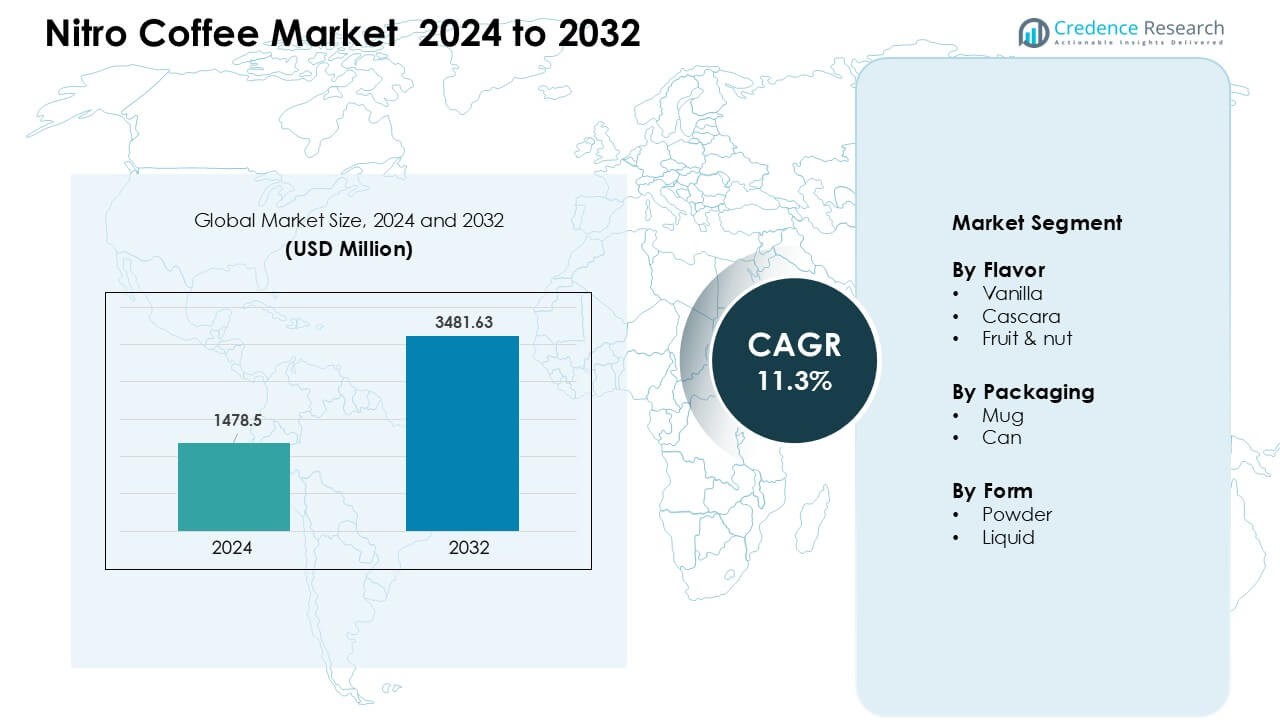
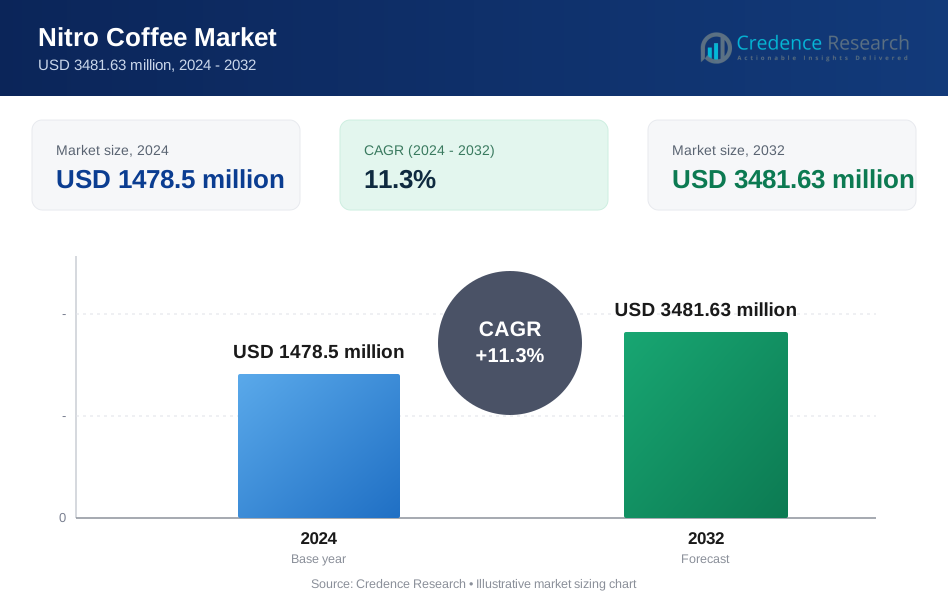
Nitro Coffee Market was valued at USD 1478.5 million in 2024 and is anticipated to reach USD 3481.63 million by 2032, growing at a CAGR of 11.3% during the forecast period.
| REPORT ATTRIBUTE | DETAILS |
|---|---|
| Historical Period | 2020-2023 |
| Base Year | 2024 |
| Forecast Period | 2025-2032 |
| Nitro Coffee Market Size 2024 | USD 1478.5 Million |
| Nitro Coffee Market, CAGR | 11.3% |
| Nitro Coffee Market Size 2032 | USD 3481.63 Million |
The Nitro Coffee Market features strong competition from leading brands such as Rise Brewing Co, Nitro Beverage Co., Left Hand Brewing Co., Quivr, Monster Energy Company, Lucky Jack Coffee, Caveman Coffee Co., PepsiCo Inc., Starbucks Corporation, and Bona Fide Nitro Coffee and Tea. These companies drive growth through expanded ready-to-drink portfolios, nitrogen-stable can technology, and cleaner ingredient profiles that appeal to health-focused buyers. Many brands strengthen reach through retail partnerships and café collaborations, while social media marketing boosts visibility among younger consumers. North America leads the global market with about 42% share, supported by mature café culture and high adoption of premium cold coffee beverages.
Market Insights
- The Nitro Coffee Market was valued at USD 1478.5 million in 2024 and is projected to reach USD 3481.63 million by 2032, growing at a CAGR of 11.3% during the forecast period.
- Demand grew as consumers shifted toward ready-to-drink cold beverages, with vanilla flavor holding about 46% share and cans leading packaging with nearly 71% share.
- Trends centered on flavored nitro variants, nitrogen-stable cans, and clean-label formulations that appealed to younger buyers seeking smoother, dairy-free options.
- Competition intensified as major brands expanded retail presence; players focused on innovation in flavors, packaging, and distribution to strengthen market reach.
- North America led with about 42% share, followed by Europe at 28%, Asia-Pacific at 22%, Latin America at 5%, and Middle East & Africa at 3%, supported by strong café culture and growing demand for premium cold coffee.
 Market Segmentation Analysis:
By Flavor
Vanilla led the Nitro Coffee Market in 2024 with about 46% share. The flavor gained strong traction due to wide consumer acceptance and its smooth taste profile, which pairs well with nitrogen infusion. Brands pushed vanilla-based variants in ready-to-drink lines, boosting visibility across retail and cafés. Cascara and fruit & nut flavors grew at a steady pace as younger buyers explored bolder options. Rising interest in flavored functional beverages further supported the demand shift toward specialty blends.
- For instance, The Starbucks Nitro Cold Brew Vanilla canned product is a ready-to-drink coffee that is indeed nitrogen-infused for a creamy texture.
By Packaging
Cans dominated the market in 2024 with nearly 71% share. Their lead came from longer shelf stability, easy distribution, and strong adoption in ready-to-drink coffee formats. Retail chains and online platforms favored canned nitro coffee because the packaging supported consistent pressure retention, which is crucial for maintaining texture. Mugs held a smaller share and stayed more common in cafés offering fresh nitro pours. Growth in on-the-go consumption pushed brands to expand canned products across global markets.
- For instance, La Colombe’s Draft Latte is sold in 9 fl oz cans with nitrogen pressurization to maintain creaminess and texture, enabling consistent quality in retail and online channels.
By Form
Liquid nitro coffee held the dominant share in 2024 with about 64%. The format remained popular due to its smooth mouthfeel, quick consumption, and high suitability for cafés and ready-to-drink lines. Manufacturers expanded cold-chain distribution to maintain product quality, which strengthened liquid sales. Powder forms grew slowly as homebrewing trends increased, offering longer shelf life and easier storage. Interest in convenient café-style beverages supported innovation in both formats.
Key Growth Drivers
Growing Demand for Ready-to-Drink Cold Coffee
Demand for ready-to-drink cold beverages continues to rise as busy consumers look for quick, premium options. Nitro coffee benefits from this shift because the drink offers a creamy texture without added dairy and fits well with on-the-go habits. Retail chains expanded cold brew shelves, which increased exposure for nitro formats. Younger buyers prefer chilled coffee over traditional hot drinks, and this trend strengthened the category’s reach across convenience stores and cafés. Brands also introduced flavored nitro lines to widen appeal among new users. The growing link between cold coffee and lifestyle beverages supports long-term market expansion.
- For instance, Stumptown Coffee Roasters’ Nitro Cold Brew in 10.3 fl oz cans combines ready-to-drink convenience with nitrogen infusion, supporting growth in retail channels and on-the-go consumption among younger buyers.
Rise of Specialty Coffee Culture Worldwide
Specialty coffee culture expanded across major cities, and nitro coffee gained traction as a premium craft option. Cafés promoted nitrogen-infused blends as smoother and richer, which helped attract curious consumers. Baristas used nitro taps to highlight product uniqueness, driving more foot traffic and higher customer engagement. Social media visibility increased interest as videos showcasing cascading foam spread widely. Roasters introduced single-origin nitro variants to tap into premium preferences. Growing awareness of quality-focused brewing strengthened demand for nitro coffee within artisanal and modern café chains, supporting steady global growth.
- For instance, La Colombe’s Draft Latte, served in cafés and retail outlets, uses nitrogen infusion to create a cascading foam effect that enhances visual appeal and premium experience, driving higher engagement on social media.
Innovation in Flavors and Packaging Formats
Continuous product innovation boosted nitro coffee acceptance across retail and foodservice. Companies launched new flavored options, which broadened the drink’s consumer base beyond traditional cold brew users. Packaging upgrades such as pressure-stable cans improved shelf life and preserved the signature creamy texture. Producers also invested in sustainable packaging to meet rising eco-friendly expectations. The entry of new brands accelerated innovation, as companies competed through differentiated tastes and convenient distribution. Such advancements made nitro coffee more accessible and appealing across markets.
Key Trends & Opportunities
Expansion of RTD Coffee in Retail and E-commerce
Retail expansion and online availability created new opportunities for nitro coffee brands. Supermarkets increased shelf space for cold brew and nitro beverages as demand for chilled drinks surged. E-commerce platforms offered wider flavor choices and subscription models, drawing repeat customers. Digital ads and influencer-driven promotions improved product visibility. This push toward multi-channel distribution helped brands reach consumers who prefer home delivery or bulk buying. The trend also encouraged companies to release travel-friendly packaging, boosting convenience and widening reach across regions.
- For instance, Starbucks Ready-to-Drink Nitro Cold Brew Vanilla Latte is available in 9.6 fl oz cans across supermarkets, convenience stores, and online platforms with subscription options, increasing accessibility for home consumption.
Growing Focus on Functional and Clean-Label Beverages
Consumers showed rising interest in clean-label coffee options with fewer additives. Nitro coffee fit this preference because the drink relies on nitrogen for texture rather than cream or sweeteners. Brands promoted low-calorie and dairy-free attributes, strengthening appeal among health-conscious buyers. Some producers added functional elements such as antioxidants or natural flavor infusions to target wellness-focused users. The combination of clean labels and premium experience created a strong opportunity for nitro variants in both retail and cafés.
- For Instance, Califia Farms Nitro Cold Brews are plant-based, using almond or oat milk, and are certified vegan and dairy-free.
Key Challenges
High Production and Cold-Chain Distribution Costs
Nitro coffee requires specialized equipment, consistent pressure control, and cold storage across the supply chain. These needs raise production costs compared to regular cold brew or traditional coffee formats. Smaller brands often struggle to manage nitrogen infusion systems and chilled distribution, which limits market entry. Retailers also expect stable shelf life and consistent foam quality, adding pressure on manufacturers to maintain high standards. These operational challenges slow expansion in regions with weak cold-chain infrastructure.
Limited Consumer Awareness in Emerging Markets
Awareness of nitro coffee remains low outside major urban centers and developed markets. Many consumers are unfamiliar with nitrogen-infused beverages, which reduces trial rates. Cafés in emerging economies often avoid nitro systems due to high equipment costs and limited demand. Marketing efforts must focus on education to explain the product’s texture and taste benefits. Slow adoption in these regions restricts overall market penetration despite rising interest in cold coffee formats.
Regional Analysis
North America
North America held the dominant share of about 42% in the Nitro Coffee Market in 2024. Strong café culture, high acceptance of premium cold beverages, and wide availability of ready-to-drink nitro cans supported leadership. Major brands expanded distribution through supermarkets, convenience stores, and online platforms, increasing consumer reach. Younger buyers drove demand through preference for chilled, smooth-texture coffee. The region also benefited from strong adoption of specialty brewing equipment in cafés, which boosted fresh nitro tap sales. Innovation in flavors and packaging continued to strengthen North America’s leading position.
Europe
Europe accounted for nearly 28% share in 2024, supported by rising specialty coffee culture across major countries. Demand increased as consumers sought premium cold brews with clean-label profiles. Café chains introduced nitro taps to attract younger customers and widen their beverage portfolios. Ready-to-drink formats gained momentum through retail and online channels, especially in the UK, Germany, and the Nordics. The region’s growing interest in healthier, low-sugar drinks also lifted nitro coffee adoption. Expanding artisanal café networks further strengthened Europe’s market position.
Asia-Pacific
Asia-Pacific held about 22% share in 2024, driven by rapid urbanization and rising café penetration in countries such as Japan, South Korea, China, and Australia. Younger consumers embraced nitro coffee as a trendy premium beverage, often influenced by social media and global café chains. Retailers expanded cold brew sections, which increased the presence of canned nitro formats. Local brands introduced unique flavor profiles to match regional tastes, supporting faster trial and adoption. Growth in specialty coffee shops and rising disposable incomes positioned Asia-Pacific as a fast-growing regional market.
Latin America Latin America captured nearly 5% share in 2024, with gradual adoption centered in urban café hubs. Countries such as Brazil, Mexico, and Colombia saw early demand due to a strong coffee culture and rising interest in cold brew variations. Nitro taps appeared in select specialty cafés targeting younger consumers seeking premium experiences. Retail presence remained limited but expanded slowly through imported ready-to-drink products. Growing tourism and exposure to global beverage trends supported awareness. Market growth remained moderate due to limited cold-chain distribution.
Middle East & Africa
The Middle East & Africa region accounted for around 3% share in 2024, marked by early-stage adoption and concentrated demand in premium café chains. Urban centers such as Dubai, Riyadh, and Johannesburg showed growing interest in cold brew and nitro-infused beverages. Café culture expansion, tourism growth, and rising disposable incomes supported initial traction. Ready-to-drink nitro formats remained niche due to limited distribution networks and higher pricing. Brands focused on educating consumers about flavor and texture benefits to improve awareness in the region.
Market Segmentations:
By Flavor
- Vanilla
- Cascara
- Fruit & nut
By Packaging
- Mug
- Can
By Form
- Powder
- Liquid
By Geography
- North America
- U.S.
- Canada
- Mexico
- Europe
- Germany
- France
- U.K.
- Italy
- Spain
- Rest of Europe
- Asia Pacific
- China
- Japan
- India
- South Korea
- South-east Asia
- Rest of Asia Pacific
- Latin America
- Brazil
- Argentina
- Rest of Latin America
- Middle East & Africa
- GCC Countries
- South Africa
- Rest of the Middle East and Africa
Competitive Landscape
The competitive landscape of the Nitro Coffee Market features established beverage companies and fast-growing specialty brands competing through flavor innovation, packaging upgrades, and broader retail placement. Key players such as Rise Brewing Co, Nitro Beverage Co., Left Hand Brewing Co., Quivr, Monster Energy Company, Lucky Jack Coffee, Caveman Coffee Co., PepsiCo Inc., Starbucks Corporation, and Bona Fide Nitro Coffee and Tea focus on expanding ready-to-drink nitro lines to strengthen visibility across supermarkets, cafés, and online platforms. Companies invest in nitrogen-stable can technology to preserve texture and extend shelf life, which helps improve product consistency. Many brands also highlight clean-label ingredients to match growing demand for low-calorie and dairy-free cold beverages. Partnerships with café chains and distributors support wider adoption, while social media-driven marketing boosts engagement with younger buyers. Innovation in flavors and sustainable packaging remains central to shaping competitive strategies in this expanding market.
Key Player Analysis
- Rise Brewing Co
- Nitro Beverage Co.
- Left Hand Brewing Co.
- Quivr
- Monster Energy Company
- Lucky Jack Coffee
- Caveman Coffee Co.
- PepsiCo Inc.
- Starbucks Corporation
- Bona Fide Nitro Coffee and Tea
Recent Developments
- In December 2023, Left Hand launched a new beer Belgian White Nitro a nitro-infused brew with a smooth, crisp profile (4.8% ABV) combining orange peel and coriander.
- In June 2023, Lucky Jack Coffee was acquired by private-label manufacturer Magnum Coffee Roastery.
Report Coverage
The research report offers an in-depth analysis based on Flavor, Packaging, Form and Geography. It details leading market players, providing an overview of their business, product offerings, investments, revenue streams, and key applications. Additionally, the report includes insights into the competitive environment, SWOT analysis, current market trends, as well as the primary drivers and constraints. Furthermore, it discusses various factors that have driven market expansion in recent years. The report also explores market dynamics, regulatory scenarios, and technological advancements that are shaping the industry. It assesses the impact of external factors and global economic changes on market growth. Lastly, it provides strategic recommendations for new entrants and established companies to navigate the complexities of the market.
Future Outlook
- Nitro coffee will gain wider global adoption as cold brew demand rises.
- Ready-to-drink variants will expand across retail and online channels.
- Flavor innovation will increase as brands target broader consumer groups.
- Sustainable and recyclable packaging will become a core focus for producers.
- Café chains will install more nitro taps to attract younger customers.
- Clean-label and low-calorie formulations will strengthen buyer interest.
- Premium single-origin nitro products will grow within specialty coffee segments.
- Companies will expand distribution networks to improve cold-chain efficiency.
- Marketing will rely more on digital engagement and influencer partnerships.
- Emerging markets will show faster adoption as café culture continues to expand.
Request a Free Sample
Fill in your details and we'll send you a free sample report.
- Sample data tables & charts
- Research methodology
Market Dynamics
Growing Demand for Ready-to-Drink Cold Coffee
Consumers are increasingly seeking convenient, premium cold beverages, and nitro coffee fits this trend with its creamy texture and on-the-go packaging. Retailers are expanding cold brew shelves, and younger buyers are driving demand for chilled coffee options.
Rise of Specialty Coffee Culture Worldwide
The expansion of specialty coffee culture in urban centers has made nitro coffee a sought-after premium craft beverage. Cafés and roasters are leveraging nitro taps and single-origin variants to attract consumers interested in unique, high-quality coffee experiences.
Innovation in Flavors and Packaging Formats
Continuous product innovation, including new flavors and nitrogen-stable can technology, is broadening nitro coffee’s appeal and improving shelf life. Sustainable and travel-friendly packaging is making nitro coffee more accessible across retail and online channels.
Expansion of RTD Coffee in Retail and E-commerce
Supermarkets and e-commerce platforms are increasing shelf space and flavor variety for nitro coffee, making it easier for consumers to access and try new products. Subscription models and digital marketing are further boosting repeat purchases and brand visibility.
Growing Focus on Functional and Clean-Label Beverages
Health-conscious consumers are drawn to nitro coffee’s clean-label, low-calorie, and dairy-free attributes. Brands are responding by promoting natural ingredients and adding functional benefits, which strengthens appeal among wellness-focused buyers.
Need a Custom Version of This Report?
Tailor the scope, geography, or segments to your exact requirements.
- Custom geography or segment scope
- Direct access to our analyst team
Frequently Asked Questions
What is the current market size for Nitro Coffee Market, and what is its projected size in 2032?
At what Compound Annual Growth Rate is Nitro Coffee Market projected to grow between 2024 and 2032?
Which Nitro Coffee Market segment held the largest share in 2024?
What are the primary factors fueling the growth of Nitro Coffee Market?
Who are the leading companies in Nitro Coffee Market?
Which region commanded the largest share of Nitro Coffee Market?
Table of Content
Chapter 1 Market Segmentation
- 1.1 Segmentation Framework
- 1.1.1 Product and Service Classification
- 1.1.2 Application and End-Use Classification
- 1.1.3 Technology and Solution Classification
- 1.1.4 Customer and Distribution Channel Classification
- 1.1.5 Geographic Segmentation
- 1.1.6 Market Segment Definitions and Boundaries
- 1.2 By Form
- 1.2.1 Powder
- 1.2.2 Liquid
- 1.3 By Flavor
- 1.3.1 Vanilla
- 1.3.2 Cascara
- 1.3.3 Fruit & Nut
- 1.4 By Packaging
- 1.4.1 Mug
- 1.4.2 Can
Chapter 2 Introduction
- 2.1 Report Objectives and Scope
- 2.2 Product Definition and Industry Terminology
- 2.3 Market Inclusions and Exclusions
- 2.4 Research Process
- 2.4.1 Primary Research and Expert Interviews
- 2.4.2 Secondary Research and Source Review
- 2.4.3 Top-Down and Bottom-Up Estimation
- 2.4.4 Data Triangulation and Verification
- 2.5 Market Size Measurement Basis
- 2.5.1 2024: USD 1478.5 million → 2032: USD 3481.63 million
- 2.6 Historical and Forecast Reference Periods
- 2.6.1 Base Year: 2024
- 2.6.2 Forecast Period: 2024-2032
- 2.7 Research Assumptions and Limitations
Chapter 3 Executive Summary
- 3.1 Market Snapshot and Key Findings
- 3.2 Base-Year Market Size, 2024
- 3.3 Forecast Market Size, 2032
- 3.4 Revenue and Volume Growth Outlook
- 3.5 Key Demand and Supply Indicators
- 3.6 Leading Market Segments
- 3.7 Fastest-Growing Market Opportunities
- 3.8 Regional Performance Highlights
- 3.9 Technology and Industry Transformation
- 3.10 Competitive Landscape Summary
- 3.11 Analyst View and Strategic Implications
Chapter 4 Global Nitro Coffee Market Trends and Developments
- 4.1 Historical Industry Development
- 4.2 Recent Market Trends and Developments
- 4.3 Demand and Customer Behavior Trends
- 4.4 Technology and Product Innovation
- 4.5 Artificial Intelligence, Automation and Digitalization
- 4.6 Local Manufacturing and Supply Chain Realignment
- 4.7 Industry Partnerships, Mergers and Acquisitions
- 4.8 Sustainability and Circular Economy Developments
- 4.9 Government and Private Sector Investment Trends
- 4.10 Emerging Business Models and Commercialization
- 4.11 Industry Developments and Announcements
Chapter 5 Global Nitro Coffee Market Production, Supply and Demand Analysis
- 5.1 Demand Trend and Consumption Analysis
- 5.2 Demand Forecast, 2024-2032
- 5.3 Production and Output Trend
- 5.4 Production and Output Forecast, 2024-2032
- 5.5 Installed Capacity and Capacity Utilization
- 5.6 Company-Wise Production Plants and Statistics
- 5.6.1 Installed Production Capacity
- 5.6.2 Actual Production
- 5.6.3 Planned Capacity and Expansion Targets
- 5.7 Supply Chain Structure and Procurement Trends
- 5.8 Supply-Demand Gap and Bottlenecks
- 5.9 Import Dependence and Sourcing Structure
- 5.10 Contract Manufacturing and Outsourcing
- 5.11 Regional Supply and Demand Concentration
Chapter 6 Global Nitro Coffee Market Pricing Analysis
- 6.1 Pricing Structure and Measurement
- 6.2 Historical Pricing Trends
- 6.3 Pricing Outlook, 2024-2032
- 6.4 Average Selling Price and Unit Economics
- 6.5 Pricing by Product and Market Segment
- 6.6 Geographic Pricing Differences
- 6.7 Key Input, Energy, Labor and Logistics Costs
- 6.8 Contract Pricing and Purchasing Models
- 6.9 Pricing Sensitivity and Competitive Positioning
- 6.10 Price, Margin and Profitability Implications
Chapter 7 Global Nitro Coffee Market Dynamics
- 7.1 Market Growth Drivers
- 7.1.1 Demand-Side Drivers
- 7.1.2 Technology and Innovation Drivers
- 7.1.3 Infrastructure and Investment Drivers
- 7.1.4 Regulatory and Policy Drivers
- 7.2 Market Restraints
- 7.2.1 Cost and Affordability Constraints
- 7.2.2 Technology and Adoption Barriers
- 7.2.3 Supply Chain and Operational Constraints
- 7.3 Market Challenges
- 7.3.1 Competitive Pressure and Margin Erosion
- 7.3.2 Skills, Infrastructure and Implementation Gaps
- 7.4 Emerging Market Opportunities
- 7.5 Market Dynamics Impact and Time-Horizon Assessment
Chapter 8 Global Nitro Coffee Value Chain Analysis
- 8.1 Industry Value Chain Overview
- 8.2 Upstream Suppliers and Critical Inputs
- 8.3 Technology and Component Providers
- 8.4 Manufacturing or Service Delivery
- 8.5 Distribution, Channel Partners and Integrators
- 8.6 Downstream Applications and End Users
- 8.7 Value Addition and Profit Pools
- 8.8 Vertical Integration and Outsourcing
- 8.9 Supplier Concentration and Risk
- 8.10 Supply Chain Localization and Resilience
Chapter 9 Global Nitro Coffee Market Regulations and Policies
- 9.1 Relevant Laws, Standards and Compliance Frameworks
- 9.2 Product, Service, Safety and Quality Requirements
- 9.3 Government Policies, Incentives and Subsidies
- 9.4 Imports, Exports and Trade Barriers
- 9.5 Public Procurement and Local Content Requirements
- 9.6 Environmental and Sustainability Compliance
- 9.7 Upcoming Policy Changes and Market Implications
Chapter 10 Global Nitro Coffee Market Hotspots and Opportunities
- 10.1 Market Opportunity Mapping and Growth Hotspots
- 10.2 High-Growth Applications and Customer Groups
- 10.3 Underserved Markets and White-Space Opportunities
- 10.4 Emerging Technology and Product Opportunities
- 10.5 New Capacity and Investment Hotspots
- 10.6 Market Entry and Expansion Opportunities
- 10.7 Distribution and Partnership Opportunities
- 10.8 Near-Term and Long-Term Commercial Potential
- 10.9 Opportunity Attractiveness and Execution Risks
Chapter 11 Global Nitro Coffee Market Outlook, 2024-2032
- 11.1 Market Size and Analysis
- 11.1.1 Revenue (Market Measurement: 2024: USD 1478.5 million → 2032: USD 3481.63 million)
- 11.1.2 Market Volume and Quantity Sold
- 11.1.3 Historical Market Size
- 11.1.4 Base-Year Market Size, 2024
- 11.2 Market Forecast, 2024-2032
- 11.2.1 Revenue Forecast to 2032
- 11.2.2 Volume Forecast to 2032
- 11.2.3 CAGR and Year-on-Year Growth
- 11.2.4 Incremental Revenue Opportunity
- 11.3 Forecast Assumptions and Scenario Analysis
- 11.3.1 Base-Case Forecast
- 11.3.2 Optimistic and Conservative Scenarios
- 11.3.3 Technology, Pricing and Policy Sensitivities
- 11.4 Market Attractiveness and Growth Outlook
Chapter 12 Global Nitro Coffee Market Segmentation and Outlook
- 12.1 Segmentation Summary and Market Shares, 2024
- 12.2 Largest and Fastest-Growing Segments
- 12.3 By Form - Market Size and Forecast, 2024-2032
- 12.3.1 Segment Definition and Scope
- 12.3.2 Historical Market Size
- 12.3.3 Revenue Forecast, 2024-2032
- 12.3.4 Volume Forecast, 2024-2032
- 12.3.5 Base-Year Market Share, 2024
- 12.3.6 Segment CAGR and Growth Drivers
- 12.3.7 Subsegment Market Size and Forecast
- 12.3.7.1 Powder
- 12.3.7.2 Liquid
- 12.3.8 Subsegment Pricing and Adoption Trends
- 12.3.9 Leading Suppliers and Competition
- 12.3.10 Regional Demand and Opportunities
- 12.4 By Flavor - Market Size and Forecast, 2024-2032
- 12.4.1 Segment Definition and Scope
- 12.4.2 Historical Market Size
- 12.4.3 Revenue Forecast, 2024-2032
- 12.4.4 Volume Forecast, 2024-2032
- 12.4.5 Base-Year Market Share, 2024
- 12.4.6 Segment CAGR and Growth Drivers
- 12.4.7 Subsegment Market Size and Forecast
- 12.4.7.1 Vanilla
- 12.4.7.2 Cascara
- 12.4.7.3 Fruit & Nut
- 12.4.8 Subsegment Pricing and Adoption Trends
- 12.4.9 Leading Suppliers and Competition
- 12.4.10 Regional Demand and Opportunities
- 12.5 By Packaging - Market Size and Forecast, 2024-2032
- 12.5.1 Segment Definition and Scope
- 12.5.2 Historical Market Size
- 12.5.3 Revenue Forecast, 2024-2032
- 12.5.4 Volume Forecast, 2024-2032
- 12.5.5 Base-Year Market Share, 2024
- 12.5.6 Segment CAGR and Growth Drivers
- 12.5.7 Subsegment Market Size and Forecast
- 12.5.7.1 Mug
- 12.5.7.2 Can
- 12.5.8 Subsegment Pricing and Adoption Trends
- 12.5.9 Leading Suppliers and Competition
- 12.5.10 Regional Demand and Opportunities
- 12.6 Segment Growth Comparison
- 12.7 Segment Attractiveness and Priority Matrix
Chapter 13 Global Nitro Coffee Geographic Market Outlook, 2024-2032
- 13.1 Regional Market Size and Share, 2024
- 13.2 Regional Market Forecast, 2024-2032
- 13.3 Regional Pricing, Production and Demand Differences
- 13.4 North America
- 13.4.1 United States
- 13.4.2 Canada
- 13.4.3 Mexico
- 13.5 Europe
- 13.5.1 Germany
- 13.5.2 France
- 13.5.3 Italy
- 13.5.4 United Kingdom
- 13.5.5 Spain
- 13.5.6 Poland
- 13.5.7 Russia
- 13.5.8 Netherlands
- 13.5.9 Belgium
- 13.5.10 Sweden
- 13.5.11 Denmark
- 13.5.12 Norway
- 13.5.13 Rest of Europe
- 13.6 Asia Pacific
- 13.6.1 China
- 13.6.2 India
- 13.6.3 Japan
- 13.6.4 South Korea
- 13.6.5 Thailand
- 13.6.6 Indonesia
- 13.6.7 Vietnam
- 13.6.8 Malaysia
- 13.6.9 Australia
- 13.6.10 Rest of Asia Pacific
- 13.7 Latin America
- 13.7.1 Brazil
- 13.7.2 Argentina
- 13.7.3 Colombia
- 13.7.4 Chile
- 13.7.5 Rest of Latin America
- 13.8 Middle East
- 13.8.1 Saudi Arabia
- 13.8.2 United Arab Emirates
- 13.8.3 Turkey
- 13.8.4 Israel
- 13.8.5 Iran
- 13.8.6 Rest of the Middle East
- 13.9 Africa
- 13.9.1 South Africa
- 13.9.2 Egypt
- 13.9.3 Nigeria
- 13.9.4 Morocco
- 13.9.5 Rest of Africa
- 13.10 Regional Investment, Policy and Supply Chain Differences
- 13.11 Regional Competitive Landscape
- 13.12 Geographic Growth Hotspots
Chapter 14 Global Nitro Coffee Technology, Innovation and Sustainability Outlook
- 14.1 Technology Landscape and Maturity
- 14.2 Product, Process and Service Innovation
- 14.3 AI, Automation and Digital Tools in the Industry
- 14.4 Technology Adoption and Performance Benchmarking
- 14.5 Innovation Pipeline and R&D Investment
- 14.6 Patent and Intellectual Property Trends
- 14.7 Energy Efficiency and Resource Management
- 14.8 Sustainability, Recycling and Circularity
- 14.9 Technology Roadmap, 2024-2032
- 14.10 Risks of Obsolescence and Technology Substitution
Chapter 15 Global Nitro Coffee Market Key Strategic Imperatives
- 15.1 Growth and Market Entry Priorities
- 15.2 High-Return Products and Segments
- 15.3 Pricing, Profitability and Cost Optimization
- 15.4 Technology Investment and Product Differentiation
- 15.5 Supply Chain Localization and Resilience
- 15.6 Distribution and Customer Acquisition
- 15.7 Partnership, Acquisition and Capacity Strategy
- 15.8 Regional Expansion Priorities
- 15.9 Short-, Medium- and Long-Term Actions
Chapter 16 Competition Outlook
- 16.1 Industry Competition Characteristics
- 16.2 Market Structure and Concentration
- 16.3 Market Share and Competitive Positioning, 2024
- 16.4 Company-Wise Revenue and Product Benchmarking
- 16.5 Production and Service Capacity Benchmarking
- 16.6 Technology, Pricing and Differentiation
- 16.7 Regional Footprint and Distribution Strength
- 16.8 Mergers, Acquisitions and Strategic Alliances
- 16.9 New Entrants and Competitive Threats
- 16.10 Porter's Five Forces and Industry Attractiveness
- 16.11 Competitive Outlook, 2024-2032
Chapter 17 Company Profiles
- 17.1 Company Coverage and Selection Criteria
- 17.2 Rise Brewing Co
- 17.2.1 Business Description
- 17.2.2 Company Ownership and Geographic Presence
- 17.2.3 Product and Service Portfolio
- 17.2.4 Manufacturing and Operating Footprint
- 17.2.5 Production Capacity and Expansion Plans
- 17.2.6 Financial Performance and Investment
- 17.2.7 Market Share and Competitive Position
- 17.2.8 Technology and Innovation Capabilities
- 17.2.9 Strategic Alliances or Partnerships
- 17.2.10 Recent Developments
- 17.2.11 Growth Strategy and Outlook
- 17.3 Nitro Beverage Co.
- 17.4 Left Hand Brewing Co.
- 17.5 Quivr
- 17.6 Monster Energy Company
- 17.7 Lucky Jack Coffee
- 17.8 Caveman Coffee Co.
- 17.9 PepsiCo Inc.
- 17.10 Starbucks Corporation
- 17.11 Bona Fide Nitro Coffee and Tea
- 17.12 Other Relevant Market Participants
Note: Every listed company is profiled on the structure shown under the first company. The company list is preliminary and may change based on research findings, market developments, data availability and client requirements.
Chapter 18 Disclaimer
- 18.1 Research and Forecast Disclaimer
- 18.2 Data Source and Estimation Limitations
Note: The depth of individual sections depends on data availability for this market. Volume, capacity, trade and other unit-based metrics are included where applicable.