Market Overview
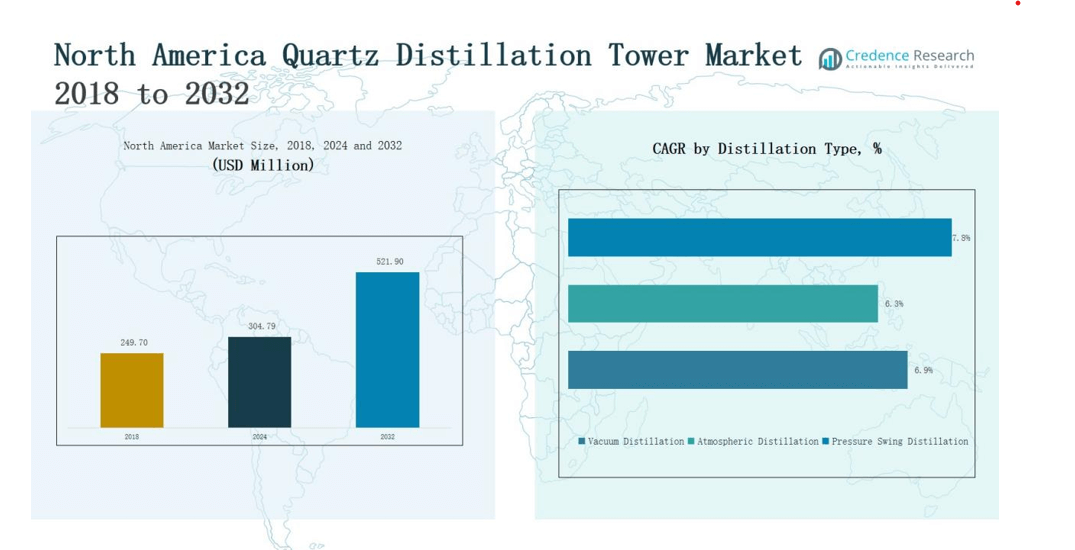
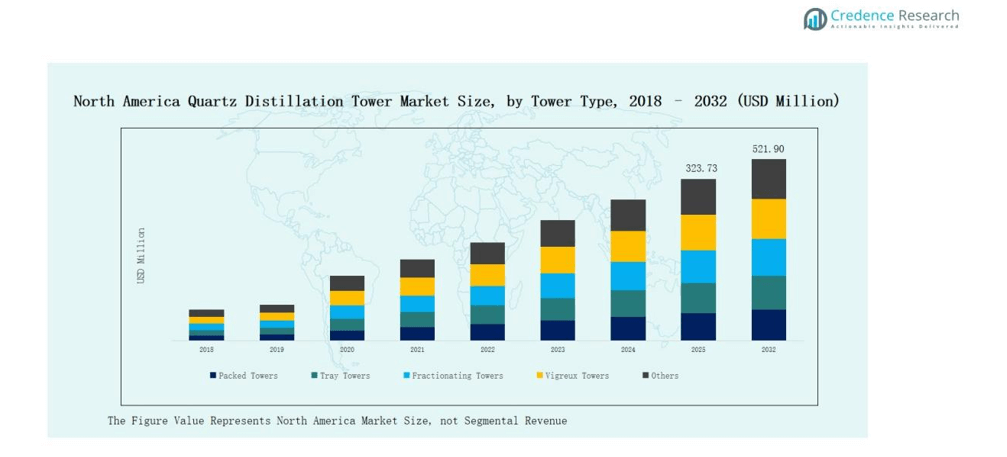
The North America Quartz Distillation Tower Market was valued at USD 249.70 million in 2018, increased to USD 304.79 million in 2024, and is projected to reach USD 521.90 million by 2032, growing at a CAGR of 7.1% during the forecast period.
| REPORT ATTRIBUTE | DETAILS |
|---|---|
| Historical Period | 2020-2023 |
| Base Year | 2024 |
| Forecast Period | 2025-2032 |
| North America Quartz Distillation Tower Market Size 2024 | USD 304.79 million |
| North America Quartz Distillation Tower Market, CAGR | 7.1% |
| North America Quartz Distillation Tower Market Size 2032 | USD 521.90 million |
The North America Quartz Distillation Tower Market is characterized by the presence of key players such as Saint-Gobain, Heraeus, Pall Corporation, Koch-Glitsch, Sulzer Ltd., Tosoh Quartz, Inc., Fenix Process Technologies, HAT International Ltd., Ferrotec, Hoya Corporation, Glassco, and Nikon Corporation. These companies emphasize precision engineering, advanced material development, and automation to enhance purity and process reliability. Continuous R&D investments and strategic collaborations with semiconductor and pharmaceutical manufacturers strengthen their market positions. The United States emerged as the leading region, holding a 58% share in 2024, driven by its robust semiconductor ecosystem, advanced industrial infrastructure, and increasing demand for high-performance quartz distillation systems.
Market Insights
- The North America Quartz Distillation Tower Market grew from USD 249.70 million in 2018 to USD 304.79 million in 2024 and is projected to reach USD 521.90 million by 2032, registering a 7.1% CAGR.
- The Packed Towers segment dominated with a 36.8% share in 2024, driven by superior efficiency, corrosion resistance, and wide use in semiconductor and pharmaceutical industries.
- The Vacuum Distillation segment led with a 41.5% share due to its capability to handle heat-sensitive compounds and ensure high material purity under reduced pressure.
- The Stainless Steel segment accounted for 44.2% share, supported by strong demand from high-temperature and corrosive process environments across industrial and pharmaceutical applications.
- The United States led the regional market with a 58% share in 2024, followed by Canada at 25% and Mexico at 17%, driven by advanced infrastructure, automation adoption, and growing semiconductor production.
Market Segment Insights
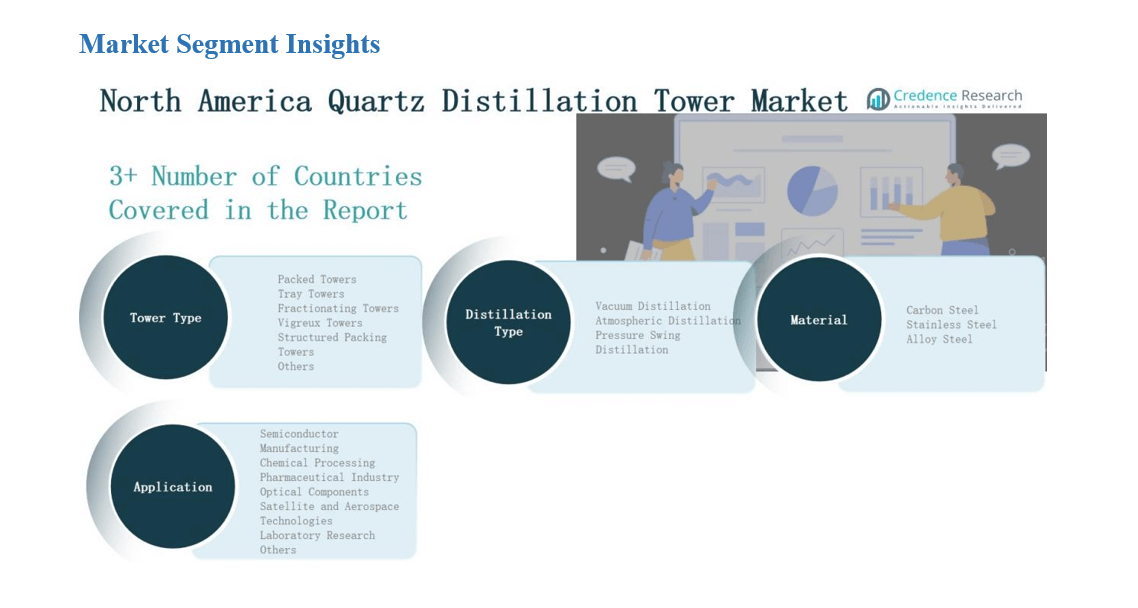
By Tower Type
The Packed Towers segment dominated the North America Quartz Distillation Tower Market in 2024, holding a 36.8% share. These towers are preferred for their superior mass transfer efficiency, corrosion resistance, and operational flexibility. Growing semiconductor and pharmaceutical applications requiring high-purity separation processes are boosting demand. Continuous advancements in structured packing materials and automation systems further strengthen their adoption, especially in facilities focusing on high-performance, energy-efficient distillation operations across the U.S. and Canada.
- For instance, PPG Industries has developed automated systems, such as the MoonWalk paint mixing system, for its coatings business to improve precision and efficiency.
By Distillation Type
The Vacuum Distillation segment led the market with a 41.5% share in 2024. Its dominance stems from its ability to process heat-sensitive compounds under reduced pressure, ensuring material purity and thermal stability. The technology is widely used in semiconductor and specialty chemical production. Increasing demand for high-purity quartz distillation systems and integration of automated pressure control mechanisms are enhancing process efficiency and sustainability across North America’s advanced manufacturing industries.
- For instance, Edwards has expanded its manufacturing and service capabilities in North America to support the local semiconductor market, with new facilities in Arizona and Massachusetts.
By Material
The Stainless Steel segment accounted for a 44.2% share of the North America Quartz Distillation Tower Market in 2024. Its strong mechanical strength, corrosion resistance, and compatibility with quartz components make it ideal for demanding chemical and pharmaceutical applications. The growing preference for stainless-steel towers in high-temperature and corrosive environments, coupled with ongoing R&D to improve structural durability and longevity, continues to drive segment growth across industrial manufacturing and semiconductor processing sectors.
Key Growth Drivers
Expanding Semiconductor and Electronics Manufacturing
The growing semiconductor and electronics industry in North America is a major driver of the quartz distillation tower market. These towers are essential for producing ultra-pure materials used in chip fabrication and microelectronics. Increasing investment by leading companies in cleanroom technologies and wafer processing facilities enhances the demand for precision-engineered quartz distillation systems. Government support for domestic semiconductor production further boosts adoption, especially in the U.S., where purity standards and process accuracy remain critical.
- For example, U.S.-based companies have increased capital expenditure on wafer processing infrastructure, enhancing the requirement for quartz components that ensure process accuracy.
Rising Demand from Chemical and Pharmaceutical Industries
The chemical and pharmaceutical sectors increasingly rely on high-purity distillation systems for refining and separation applications. Quartz distillation towers offer superior corrosion resistance and thermal stability, making them ideal for handling aggressive chemicals and sensitive compounds. The push toward cleaner, contamination-free production environments drives their integration in large-scale facilities. The adoption of advanced automation and digital monitoring solutions further improves efficiency, supporting steady market growth across the region’s chemical processing hubs.
- For instance, Nanjing Hjchem Equipment Co., Ltd. supplies short path molecular distillation systems specifically designed for pharmaceuticals and chemicals, ensuring consistent API quality that meets international regulatory standards while preserving the integrity of thermally sensitive compounds.
Technological Advancements and Material Innovation
Continuous innovation in tower design, material composition, and manufacturing precision fuels market expansion. Integration of structured packing technology and automated process control systems enhances operational efficiency and throughput. Manufacturers are also investing in hybrid designs combining quartz with stainless steel for improved durability and cost optimization. These technological improvements allow end users to achieve higher separation accuracy, lower maintenance costs, and improved energy performance, positioning North America as a leader in advanced distillation technologies.
Key Trends & Opportunities
Integration of Smart Process Automation
Automation is emerging as a key trend, enabling real-time monitoring, pressure control, and temperature optimization in distillation operations. Smart sensors and IoT-enabled control systems enhance safety and process consistency while reducing downtime. Companies adopting digital twins and predictive maintenance solutions gain a competitive edge in efficiency and sustainability. This shift toward Industry 4.0 integration represents a major opportunity for manufacturers to offer intelligent, energy-efficient, and adaptive quartz distillation systems.
- For instance, AquaClove integrates an ESP32 microcontroller with ultrasonic sensors and solenoid valves, achieving a 32% reduction in distillation time and a 66.7% decrease in labor needs during essential oil distillation.
Growing Focus on Sustainable Manufacturing Practices
Sustainability initiatives are shaping investment decisions across the North American process industry. Companies are prioritizing energy-efficient distillation designs and recyclable materials to minimize carbon footprints. The use of eco-friendly manufacturing techniques and optimized waste recovery systems enhances operational sustainability. This trend aligns with regional regulations promoting cleaner production methods, creating opportunities for quartz distillation tower producers that emphasize low-emission designs and green process innovation.
- For instance, Kennecott Utah Copper Refinery installed a combined heat and power system supplying over half the plant's electricity needs and recycled waste heat for steam turbines, cutting CO2 emissions by 36,000 tonnes
Key Challenges
High Capital and Maintenance Costs
Quartz distillation towers require significant upfront investment and ongoing maintenance, posing a challenge for small and mid-sized enterprises. The precision materials and specialized fabrication processes involved increase overall system costs. Maintenance of high-purity systems also demands skilled technicians and cleanroom environments, further raising operational expenses. These cost barriers limit wider adoption, particularly in industries with constrained budgets or lower production volumes.
Limited Skilled Workforce and Technical Expertise
Operating and maintaining quartz distillation systems require specialized technical expertise in materials handling, process automation, and vacuum operations. A shortage of trained professionals across North America hampers efficient system implementation. The gap in technical knowledge can lead to process inefficiencies and reduced equipment lifespan. To address this, companies must invest in workforce training programs and partnerships with technical institutions to sustain long-term operational reliability.
Supply Chain Constraints and Material Availability
Dependence on high-purity quartz and precision-engineered components exposes manufacturers to supply chain disruptions. Limited availability of raw materials, especially quartz of semiconductor-grade purity, creates production bottlenecks. Import dependencies and fluctuating transportation costs further increase lead times. These factors affect timely project execution and pricing stability, compelling companies to diversify sourcing strategies and invest in local material processing capabilities to mitigate long-term supply risks.
Regional Analysis
U.S.
The North America Quartz Distillation Tower Market is primarily led by the United States, capturing 58% share in 2024. It benefits from the strong presence of semiconductor and electronics manufacturing hubs that require high-purity distillation systems. The country’s advanced chemical and pharmaceutical sectors also drive consistent demand. Continuous R&D investments and adoption of automated and vacuum-based distillation processes enhance system efficiency. The growing focus on domestic chip production under federal initiatives supports large-scale deployment of precision-engineered quartz towers. Manufacturers are expanding production capabilities to meet rising requirements for high-performance and energy-efficient equipment.
Canada
Canada accounted for 25% share of the regional market in 2024, supported by its growing chemical processing and pharmaceutical industries. The country’s investments in sustainable industrial infrastructure and laboratory research facilities foster adoption of corrosion-resistant quartz towers. It is witnessing increased use of vacuum distillation technology across biotechnology and analytical applications. Favorable regulatory standards promoting clean production and environmental safety strengthen local demand. Canadian manufacturers focus on developing energy-efficient designs and advanced tower components to improve operational performance. Rising partnerships with U.S. technology firms enhance innovation and cross-border product development.
Mexico
Mexico held 17% share of the regional market in 2024, driven by expanding industrial manufacturing and electronics assembly sectors. The country’s competitive labor cost and proximity to major North American supply chains encourage investment in modern distillation systems. It is increasingly using stainless steel and alloy steel-based quartz towers for process reliability and durability. Government efforts to boost pharmaceutical and specialty chemical production further elevate demand. Local distributors collaborate with global suppliers to introduce high-purity and cost-effective solutions. Growing industrial automation and infrastructure modernization will continue strengthening Mexico’s position in the regional market.
Market Segmentations:
By Tower Type
- Packed Towers
- Tray Towers
- Fractionating Towers
- Vigreux Towers
- Structured Packing Towers
- Others
By Distillation Type
- Vacuum Distillation
- Atmospheric Distillation
- Pressure Swing Distillation
By Material
- Carbon Steel
- Stainless Steel
- Alloy Steel
By Application
- Semiconductor Manufacturing
- Chemical Processing
- Pharmaceutical Industry
- Optical Components
- Satellite and Aerospace Technologies
- Laboratory Research
- Others
By Region
- S.
- Canada
- Mexico
Competitive Landscape
The North America Quartz Distillation Tower Market features strong competition among global and regional manufacturers focusing on precision engineering, material innovation, and process automation. Leading companies such as Saint-Gobain, Heraeus, Pall Corporation, Koch-Glitsch, Sulzer Ltd., and Tosoh Quartz, Inc. dominate the market through advanced product portfolios and high-purity manufacturing capabilities. These firms emphasize R&D investment to improve energy efficiency, corrosion resistance, and operational longevity of their distillation systems. Partnerships with semiconductor and pharmaceutical producers further strengthen their regional presence. Emerging players, including Fenix Process Technologies and HAT International Ltd., are expanding production capacity and offering customized designs to cater to diverse industrial needs. Strategic collaborations, acquisitions, and technological integration remain central to maintaining competitiveness. Continuous innovation in structured packing towers and automation-driven monitoring systems is enabling suppliers to meet rising demand for high-performance, sustainable, and cost-efficient quartz distillation solutions across North America’s advanced industrial sectors.
Key Players
- Saint-Gobain
- Heraeus
- Glassco
- Koch-Glitsch
- Sulzer Ltd.
- Pall Corporation
- Fenix Process Technologies
- HAT International Ltd.
- Ferrotec
- Hoya Corporation
- Tosoh Quartz, Inc.
- Nikon Corporation
Recent Developments
- In February 2025, DXP Enterprises acquired Arroyo Process Equipment, strengthening its portfolio in advanced process and distillation systems across North America.
- In May 2024, KCC Corporation completed the acquisition of Momentive Performance Materials, expanding its capabilities in high-purity quartz and ceramic solutions used in distillation tower manufacturing.
- In January 2025, SCHOTT AG finalized the acquisition of QSIL GmbH Quarzschmelze Ilmenau, enhancing its capabilities in high-purity quartz glass production across.
- In May 2025, Sinova Global reopened its high-purity quartz quarry in British Columbia to strengthen domestic supply for advanced distillation and semiconductor applications.
Report Coverage
The research report offers an in-depth analysis based on Tower Type, Distillation Type, Material, Application and Region. It details leading market players, providing an overview of their business, product offerings, investments, revenue streams, and key applications. Additionally, the report includes insights into the competitive environment, SWOT analysis, current market trends, as well as the primary drivers and constraints. Furthermore, it discusses various factors that have driven market expansion in recent years. The report also explores market dynamics, regulatory scenarios, and technological advancements that are shaping the industry. It assesses the impact of external factors and global economic changes on market growth. Lastly, it provides strategic recommendations for new entrants and established companies to navigate the complexities of the market.
Future Outlook
- Demand for high-purity quartz distillation systems will rise with semiconductor production expansion.
- Adoption of automated and digital monitoring technologies will enhance operational precision.
- Manufacturers will focus on sustainable designs and energy-efficient tower configurations.
- Integration of AI-driven process control will improve productivity and system reliability.
- Regional players will strengthen partnerships with pharmaceutical and chemical producers.
- Material innovation in stainless steel and hybrid quartz structures will gain traction.
- Investments in local manufacturing and R&D facilities will reduce supply chain dependency.
- Custom-designed towers for aerospace and optical industries will witness growing adoption.
- Government support for advanced manufacturing will accelerate technological innovation.
- Competition will intensify as global firms expand presence through mergers and collaborations.

Request a Free Sample
Fill in your details and we'll send you a free sample report.
- Sample data tables & charts
- Research methodology
Need a Custom Version of This Report?
Tailor the scope, geography, or segments to your exact requirements.
- Custom geography or segment scope
- Direct access to our analyst team
Frequently Asked Questions
What is the current market size for the North America Quartz Distillation Tower Market, and what is its projected size in 2032?
At what Compound Annual Growth Rate is the North America Quartz Distillation Tower Market projected to grow between 2025 and 2032?
Which North America Quartz Distillation Tower Market segment held the largest share in 2024?
What are the primary factors fueling the growth of the North America Quartz Distillation Tower Market?
Who are the leading companies in the North America Quartz Distillation Tower Market?
Table of Content
Chapter 1 Market Segmentation
- 1.1 Segmentation Framework
- 1.1.1 Product and Service Classification
- 1.1.2 Application and End-Use Classification
- 1.1.3 Technology and Solution Classification
- 1.1.4 Customer and Distribution Channel Classification
- 1.1.5 Geographic Segmentation
- 1.1.6 Market Segment Definitions and Boundaries
Chapter 2 Introduction
- 2.1 Report Objectives and Scope
- 2.2 Product Definition and Industry Terminology
- 2.3 Market Inclusions and Exclusions
- 2.4 Research Process
- 2.4.1 Primary Research and Expert Interviews
- 2.4.2 Secondary Research and Source Review
- 2.4.3 Top-Down and Bottom-Up Estimation
- 2.4.4 Data Triangulation and Verification
- 2.5 Market Size Measurement Basis
- 2.5.1 2024: USD 304.79 million → 2032: USD 521.90 million
- 2.6 Historical and Forecast Reference Periods
- 2.6.1 Base Year: 2024
- 2.6.2 Forecast Period: 2024-2032
- 2.7 Research Assumptions and Limitations
Chapter 3 Executive Summary
- 3.1 Market Snapshot and Key Findings
- 3.2 Base-Year Market Size, 2024
- 3.3 Forecast Market Size, 2032
- 3.4 Revenue and Volume Growth Outlook
- 3.5 Key Demand and Supply Indicators
- 3.6 Leading Market Segments
- 3.7 Fastest-Growing Market Opportunities
- 3.8 Regional Performance Highlights
- 3.9 Technology and Industry Transformation
- 3.10 Competitive Landscape Summary
- 3.11 Analyst View and Strategic Implications
Chapter 4 North America Quartz Distillation Tower Market Trends and Developments
- 4.1 Historical Industry Development
- 4.2 Recent Market Trends and Developments
- 4.3 Demand and Customer Behavior Trends
- 4.4 Technology and Product Innovation
- 4.5 Artificial Intelligence, Automation and Digitalization
- 4.6 Local Manufacturing and Supply Chain Realignment
- 4.7 Industry Partnerships, Mergers and Acquisitions
- 4.8 Sustainability and Circular Economy Developments
- 4.9 Government and Private Sector Investment Trends
- 4.10 Emerging Business Models and Commercialization
- 4.11 Industry Developments and Announcements
Chapter 5 North America Quartz Distillation Tower Market Production, Supply and Demand Analysis
- 5.1 Demand Trend and Consumption Analysis
- 5.2 Demand Forecast, 2024-2032
- 5.3 Production and Output Trend
- 5.4 Production and Output Forecast, 2024-2032
- 5.5 Installed Capacity and Capacity Utilization
- 5.6 Company-Wise Production Plants and Statistics
- 5.6.1 Installed Production Capacity
- 5.6.2 Actual Production
- 5.6.3 Planned Capacity and Expansion Targets
- 5.7 Supply Chain Structure and Procurement Trends
- 5.8 Supply-Demand Gap and Bottlenecks
- 5.9 Import Dependence and Sourcing Structure
- 5.10 Contract Manufacturing and Outsourcing
- 5.11 Regional Supply and Demand Concentration
Chapter 6 North America Quartz Distillation Tower Market Pricing Analysis
- 6.1 Pricing Structure and Measurement
- 6.2 Historical Pricing Trends
- 6.3 Pricing Outlook, 2024-2032
- 6.4 Average Selling Price and Unit Economics
- 6.5 Pricing by Product and Market Segment
- 6.6 Geographic Pricing Differences
- 6.7 Key Input, Energy, Labor and Logistics Costs
- 6.8 Contract Pricing and Purchasing Models
- 6.9 Pricing Sensitivity and Competitive Positioning
- 6.10 Price, Margin and Profitability Implications
Chapter 7 North America Quartz Distillation Tower Market Dynamics
- 7.1 Market Growth Drivers
- 7.1.1 Demand-Side Drivers
- 7.1.2 Technology and Innovation Drivers
- 7.1.3 Infrastructure and Investment Drivers
- 7.1.4 Regulatory and Policy Drivers
- 7.2 Market Restraints
- 7.2.1 Cost and Affordability Constraints
- 7.2.2 Technology and Adoption Barriers
- 7.2.3 Supply Chain and Operational Constraints
- 7.3 Market Challenges
- 7.3.1 Competitive Pressure and Margin Erosion
- 7.3.2 Skills, Infrastructure and Implementation Gaps
- 7.4 Emerging Market Opportunities
- 7.5 Market Dynamics Impact and Time-Horizon Assessment
Chapter 8 North America Quartz Distillation Tower Value Chain Analysis
- 8.1 Industry Value Chain Overview
- 8.2 Upstream Suppliers and Critical Inputs
- 8.3 Technology and Component Providers
- 8.4 Manufacturing or Service Delivery
- 8.5 Distribution, Channel Partners and Integrators
- 8.6 Downstream Applications and End Users
- 8.7 Value Addition and Profit Pools
- 8.8 Vertical Integration and Outsourcing
- 8.9 Supplier Concentration and Risk
- 8.10 Supply Chain Localization and Resilience
Chapter 9 North America Quartz Distillation Tower Market Regulations and Policies
- 9.1 Relevant Laws, Standards and Compliance Frameworks
- 9.2 Product, Service, Safety and Quality Requirements
- 9.3 Government Policies, Incentives and Subsidies
- 9.4 Imports, Exports and Trade Barriers
- 9.5 Public Procurement and Local Content Requirements
- 9.6 Environmental and Sustainability Compliance
- 9.7 Upcoming Policy Changes and Market Implications
Chapter 10 North America Quartz Distillation Tower Market Hotspots and Opportunities
- 10.1 Market Opportunity Mapping and Growth Hotspots
- 10.2 High-Growth Applications and Customer Groups
- 10.3 Underserved Markets and White-Space Opportunities
- 10.4 Emerging Technology and Product Opportunities
- 10.5 New Capacity and Investment Hotspots
- 10.6 Market Entry and Expansion Opportunities
- 10.7 Distribution and Partnership Opportunities
- 10.8 Near-Term and Long-Term Commercial Potential
- 10.9 Opportunity Attractiveness and Execution Risks
Chapter 11 North America Quartz Distillation Tower Market Outlook, 2024-2032
- 11.1 Market Size and Analysis
- 11.1.1 Revenue (Market Measurement: 2024: USD 304.79 million → 2032: USD 521.90 million)
- 11.1.2 Market Volume and Quantity Sold
- 11.1.3 Historical Market Size
- 11.1.4 Base-Year Market Size, 2024
- 11.2 Market Forecast, 2024-2032
- 11.2.1 Revenue Forecast to 2032
- 11.2.2 Volume Forecast to 2032
- 11.2.3 CAGR and Year-on-Year Growth
- 11.2.4 Incremental Revenue Opportunity
- 11.3 Forecast Assumptions and Scenario Analysis
- 11.3.1 Base-Case Forecast
- 11.3.2 Optimistic and Conservative Scenarios
- 11.3.3 Technology, Pricing and Policy Sensitivities
- 11.4 Market Attractiveness and Growth Outlook
Chapter 12 North America Quartz Distillation Tower Market Segmentation and Outlook
- 12.1 Segmentation Summary and Market Shares, 2024
- 12.2 Largest and Fastest-Growing Segments
- 12.3 Segment Growth Comparison
- 12.4 Segment Attractiveness and Priority Matrix
Chapter 13 North America Quartz Distillation Tower Geographic Market Outlook, 2024-2032
- 13.1 Regional Market Size and Country-Level Shares, 2024
- 13.2 Country Market Size Comparison, 2024
- 13.3 Country Market Forecasts, 2024-2032
- 13.4 Subregional Industrial and Demand Clusters
- 13.5 Intra-Regional Pricing and Cost Differences
- 13.6 Cross-Border Trade and Supply Networks
- 13.7 Regional Supply and Demand Balances
- 13.8 Country Opportunity Comparison and Prioritization
Note: Every listed country is covered on the structure shown under the first country.
Chapter 14 North America Quartz Distillation Tower Technology, Innovation and Sustainability Outlook
- 14.1 Technology Landscape and Maturity
- 14.2 Product, Process and Service Innovation
- 14.3 AI, Automation and Digital Tools in the Industry
- 14.4 Technology Adoption and Performance Benchmarking
- 14.5 Innovation Pipeline and R&D Investment
- 14.6 Patent and Intellectual Property Trends
- 14.7 Energy Efficiency and Resource Management
- 14.8 Sustainability, Recycling and Circularity
- 14.9 Technology Roadmap, 2024-2032
- 14.10 Risks of Obsolescence and Technology Substitution
Chapter 15 North America Quartz Distillation Tower Market Key Strategic Imperatives
- 15.1 Growth and Market Entry Priorities
- 15.2 High-Return Products and Segments
- 15.3 Pricing, Profitability and Cost Optimization
- 15.4 Technology Investment and Product Differentiation
- 15.5 Supply Chain Localization and Resilience
- 15.6 Distribution and Customer Acquisition
- 15.7 Partnership, Acquisition and Capacity Strategy
- 15.8 Regional Expansion Priorities
- 15.9 Short-, Medium- and Long-Term Actions
Chapter 16 Competition Outlook
- 16.1 Industry Competition Characteristics
- 16.2 Market Structure and Concentration
- 16.3 Market Share and Competitive Positioning, 2024
- 16.4 Company-Wise Revenue and Product Benchmarking
- 16.5 Production and Service Capacity Benchmarking
- 16.6 Technology, Pricing and Differentiation
- 16.7 Regional Footprint and Distribution Strength
- 16.8 Mergers, Acquisitions and Strategic Alliances
- 16.9 New Entrants and Competitive Threats
- 16.10 Porter's Five Forces and Industry Attractiveness
- 16.11 Competitive Outlook, 2024-2032
Chapter 17 Company Profiles
- 17.1 Company Coverage and Selection Criteria
- 17.2 Leading Market Participants – Standard Profile Structure
- 17.2.1 Business Description
- 17.2.2 Company Ownership and Geographic Presence
- 17.2.3 Product and Service Portfolio
- 17.2.4 Manufacturing and Operating Footprint
- 17.2.5 Production Capacity and Expansion Plans
- 17.2.6 Financial Performance and Investment
- 17.2.7 Market Share and Competitive Position
- 17.2.8 Technology and Innovation Capabilities
- 17.2.9 Strategic Alliances or Partnerships
- 17.2.10 Recent Developments
- 17.2.11 Growth Strategy and Outlook
- 17.3 Other Relevant Market Participants
Note: Every listed company is profiled on the structure shown under the first company. The company list is preliminary and may change based on research findings, market developments, data availability and client requirements.
Chapter 18 Disclaimer
- 18.1 Research and Forecast Disclaimer
- 18.2 Data Source and Estimation Limitations
Note: The depth of individual sections depends on data availability for this market. Volume, capacity, trade and other unit-based metrics are included where applicable.