
Market Overview:
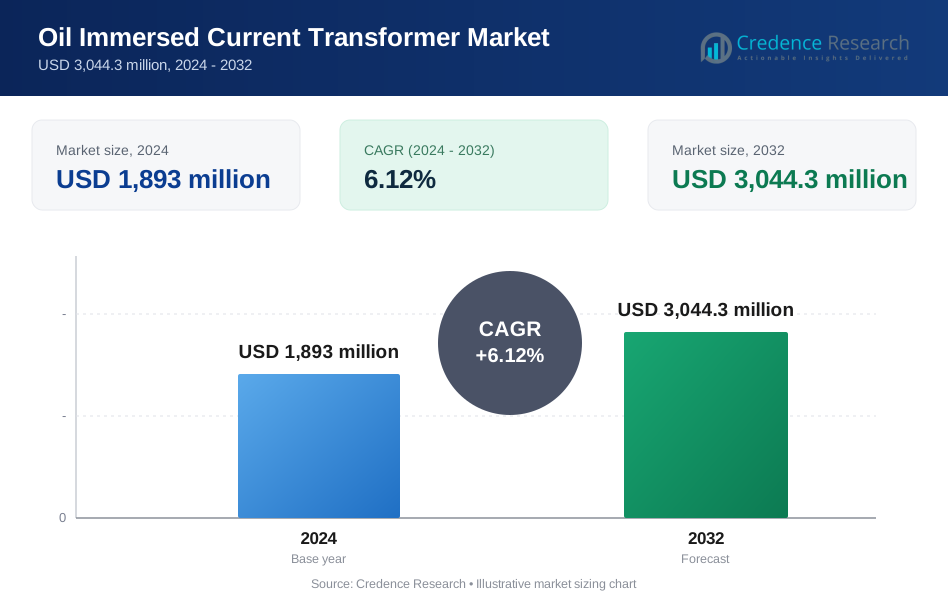
The Oil immersed current transformer market was valued at USD 1,893 million in 2024. The market is projected to reach USD 3,044.3 million by 2032. This growth reflects a compound annual growth rate of 6.12% during the forecast period.
| REPORT ATTRIBUTE | DETAILS |
|---|---|
| Historical Period | 2020-2023 |
| Base Year | 2024 |
| Forecast Period | 2025-2032 |
| Oil Immersed Current Transformer Market Size 2024 | USD 1,893 million |
| Oil Immersed Current Transformer Market, CAGR | 6.12% |
| Oil Immersed Current Transformer Market Size 2032 | USD 3,044.3 million |
Market growth is driven by rising electricity demand and grid reliability needs. Utilities upgrade aging substations to improve measurement accuracy. Oil immersed designs offer stable insulation under high load conditions. Power utilities favor proven technology for critical installations. Expansion of renewable power increases substation installations. Industrial plants require precise current monitoring for protection systems. Urbanization raises electricity consumption levels. Grid modernization programs accelerate procurement cycles. Reliability standards strengthen adoption across voltage classes.
Asia Pacific leads due to large-scale grid expansion projects. China and India invest heavily in transmission upgrades. Rapid urban growth supports new substation development. North America remains strong due to replacement of aging infrastructure. Utilities focus on grid resilience and outage reduction. Europe shows steady demand driven by renewable integration. Emerging regions include the Middle East and Africa. These regions expand power networks to support industrial growth. Stable policy support improves long-term adoption prospects.

Market Insights:
- The Oil immersed current transformer market was valued at USD 1,893 million in 2024 and is projected to reach USD 3,044.3 million by 2032, registering a CAGR of 6.12% during the forecast period.
- Asia-Pacific leads with about 42% share due to large grid expansion projects, followed by North America at around 26% driven by replacement demand, and Europe with nearly 18% supported by renewable-linked grid upgrades.
- Asia-Pacific also remains the fastest-growing region, holding about 42% share, supported by urbanization, rising electricity demand, and sustained transmission investments in China and India.
- By application, power distribution accounts for nearly 55% share due to extensive substation deployment, while manufacturing holds around 30% driven by industrial power monitoring needs.
- By voltage rating, ≤ 33 kV systems represent about 46% share for distribution networks, while 33 kV to ≤ 66 kV accounts for nearly 34% due to sub-transmission usage.
Market Drivers:
Expansion Of High Voltage Transmission And Substation Infrastructure Worldwide
Rising electricity demand drives new transmission projects across regions. Utilities expand high voltage substations to support load growth. The Oil immersed current transformer market benefits from these upgrades. Oil insulation ensures accuracy in high current environments. Grid operators prefer proven designs for safety reasons. Long operational life reduces maintenance frequency. Utilities value stable performance under peak loads. Infrastructure funding programs support procurement cycles.
- For instance, ABB supplies oil immersed current transformers rated up to 800 kV with accuracy class 0.2S, supporting extra-high-voltage substations worldwide.
Rising Focus On Grid Reliability And Accurate Power Measurement Systems
Power utilities prioritize accurate current measurement for protection systems. Fault detection relies on precise transformer performance. The Oil immersed current transformer market gains from this priority. Oil insulation supports consistent dielectric strength. Utilities deploy these units in critical nodes. Stable output improves relay coordination accuracy. Grid reliability standards raise technical requirements. Compliance needs support sustained demand.
- For instance, Siemens Energy reports its oil-immersed current transformers achieve metering accuracy within ±0.2% (Class 0.2/0.2S) under rated conditions, while dedicated protection cores are designed to ensure reliability with a composite error of 5% to 10% (e.g., Class 5P or 10P) during high-fault currents in utility transmission networks.
Growth In Industrial Power Consumption And Heavy Electrical Equipment Usage
Industrial facilities require reliable power monitoring solutions. Heavy machinery depends on stable current measurement. The Oil immersed current transformer market supports these applications. Oil cooled designs handle high thermal stress. Industrial users value durability under continuous loads. Process industries depend on accurate protection systems. Power quality control supports productivity goals. Industrial expansion sustains transformer demand.
Replacement Demand From Aging Electrical Infrastructure Across Mature Markets
Many substations operate beyond design life. Utilities replace legacy transformers to reduce failure risks. The Oil immersed current transformer market benefits from retrofit activity. Oil filled units fit existing substation layouts. Replacement projects reduce outage risks. Utilities favor familiar technology during upgrades. Asset renewal programs gain regulatory backing. Long replacement cycles ensure steady demand.
Market Trends:
Integration Of Digital Monitoring Interfaces With Conventional Transformer Designs
Utilities adopt digital monitoring for asset health tracking. Sensors support condition-based maintenance strategies. The Oil immersed current transformer market reflects this shift. Hybrid designs combine oil insulation with smart features. Operators gain real-time performance visibility. Predictive alerts reduce unplanned downtime. Digital integration improves lifecycle planning. Technology adoption enhances operational control.
- For instance, Hitachi Energy integrates digital temperature and partial discharge sensors that enable continuous monitoring and extend maintenance intervals beyond ten years.
Preference For Compact Designs To Support Space Constrained Substations
Urban substations face space limitations. Utilities seek compact transformer footprints. The Oil immersed current transformer market adapts through optimized designs. Manufacturers reduce size without performance loss. Compact units ease installation challenges. Space efficiency supports urban grid expansion. Design innovation improves layout flexibility. Urbanization drives this preference.
- For instance, ARTECHE offers compact oil-immersed current transformers (CA Series) that feature a sustainable design reducing its carbon footprint by 14% and significantly lowering weight for easier installation, all while maintaining high IEC 61869 accuracy compliance (up to 0.1%).
Rising Use Of Standardized Designs To Simplify Utility Procurement Processes
Utilities streamline procurement through standard specifications. Standardization reduces engineering complexity. The Oil immersed current transformer market aligns with this trend. Manufacturers offer modular product ranges. Standard units shorten delivery timelines. Simplified designs lower installation risks. Utilities gain cost predictability. Procurement efficiency supports wider adoption.
Growing Emphasis On Long Service Life And Lifecycle Cost Optimization
Utilities evaluate total ownership cost carefully. Long service life reduces capital replacement needs. The Oil immersed current transformer market aligns with lifecycle focus. Oil insulation supports extended operational stability. Utilities value reduced maintenance interventions. Predictable performance aids asset planning. Lifecycle optimization guides purchase decisions. Reliability remains a key trend.
Market Challenges Analysis:
Environmental And Safety Concerns Related To Oil Based Insulation Systems
Oil leakage poses environmental risks for utilities. Regulatory scrutiny increases compliance requirements. The Oil immersed current transformer market faces these concerns. Utilities must invest in containment systems. Fire safety standards raise installation costs. Environmental approvals slow project timelines. Public scrutiny affects project planning. Compliance complexity challenges adoption decisions.
Competition From Alternative Insulation Technologies In Specific Applications
Dry type and gas insulated solutions gain interest. These options suit indoor or compact substations. The Oil immersed current transformer market faces selective competition. Utilities compare safety profiles across technologies. Alternative systems reduce oil handling risks. Technology choice depends on application needs. Competitive pressure affects pricing strategies. Market positioning requires clear value demonstration.
Market Opportunities:
Expansion Of Power Transmission Networks In Emerging Economies
Emerging economies invest heavily in grid expansion. Electrification programs drive new substations. The Oil immersed current transformer market gains from this growth. Utilities prefer proven solutions for new grids. Oil based designs suit outdoor installations. Infrastructure funding supports large scale deployment. Power access goals accelerate demand. Long term projects create steady opportunities.
Upgrades Linked To Renewable Energy Integration And Grid Modernization
Renewable power adds complexity to grid operations. Accurate current measurement supports grid stability. The Oil immersed current transformer market aligns with modernization needs. Utilities upgrade substations near renewable plants. Oil insulated units handle fluctuating loads well. Grid balancing requires reliable measurement systems. Modernization programs support equipment upgrades. Energy transition strengthens future demand.
Market Segmentation Analysis:
Product Segments
Wound type transformers dominate due to high accuracy in protection circuits. Toroidal designs support compact layouts and uniform magnetic flux. Bar type units suit high current applications in substations. Other designs serve niche and customized installations. The Oil immersed current transformer market benefits from this product diversity. Utilities select designs based on space, accuracy, and load needs. Proven oil insulation supports long service life. Product choice aligns with system design priorities.
- For instance, CG Power manufactures wound and bar type oil immersed current transformers tested for continuous thermal stability above rated current levels.
Voltage Rating Segments
Units rated ≤ 33 kV see strong use in distribution networks. The 33 kV to ≤ 66 kV range supports sub-transmission systems. High voltage units above 66 kV serve bulk power transfer. Each voltage class meets distinct grid requirements. Utilities match ratings with network stress levels. Oil insulation ensures dielectric stability across ranges. Voltage segmentation guides procurement planning. Performance reliability remains critical.
- For instance, General Electric delivers oil immersed current transformers for 400 kV and above networks, meeting IEC insulation and short-time current withstand standards.
Application Segments
Power distribution leads demand due to wide grid coverage. Manufacturing facilities require precise current measurement for protection. Other applications include utilities and infrastructure projects. It supports accurate fault detection and load monitoring. Industrial users value durability under continuous operation. Distribution utilities rely on stable measurement output. Application needs shape specification choices. Sector diversity sustains demand balance.
Segmentation:
Product Segments
- Wound type
- Toroidal
- Bar type
- Others
Voltage Rating Segments
- ≤ 33 kV
- 33 kV to ≤ 66 kV
- 66 kV
Application Segments
- Power distribution
- Manufacturing
- Others
Region Segments
- North America
- U.S.
- Canada
- Mexico
- Europe
- Germany
- France
- U.K.
- Italy
- Spain
- Rest of Europe
- Asia Pacific
- China
- Japan
- India
- South Korea
- South-east Asia
- Rest of Asia Pacific
- Latin America
- Brazil
- Argentina
- Rest of Latin America
- Middle East & Africa
- GCC Countries
- South Africa
- Rest of the Middle East and Africa
Regional Analysis:
Asia-Pacific And North America
Asia-Pacific holds the largest share at nearly 42% of global demand. China and India drive expansion through transmission and substation investments. Urban growth increases electricity consumption across major cities. Utilities favor oil immersed designs for outdoor reliability. Manufacturing expansion also supports steady equipment demand. The Oil immersed current transformer market gains scale from these projects. North America accounts for around 26% share due to grid replacement programs.
Europe And Latin America
Europe represents about 18% of the global market share. Utilities focus on grid upgrades tied to renewable integration. Aging substations require reliable measurement equipment. Oil based designs remain preferred for high voltage nodes. Latin America holds nearly 8% share across the region. Power infrastructure expansion supports moderate growth. Industrial electrification improves adoption across key economies.
Middle East & Africa
Middle East & Africa contribute close to 6% of total demand. Power network expansion supports new transformer installations. Gulf countries invest in transmission capacity for energy security. African nations focus on electrification and grid access. Oil immersed designs suit harsh outdoor environments. The Oil immersed current transformer market benefits from long-term infrastructure plans. Stable policy support improves procurement visibility.
Key Player Analysis:
- ABB
- General Electric
- Hitachi Energy
- Siemens Energy
- CG Power and Industrial Solutions
- ARTECHE
- Automatic Electric
Competitive Analysis:
The Oil immersed current transformer market features strong competition among global electrical equipment manufacturers. Large players compete on product reliability, accuracy, and long service life. Companies invest in advanced insulation design and quality testing. Portfolio breadth helps suppliers serve multiple voltage classes. Regional manufacturing presence supports faster delivery cycles. It favors firms with long utility relationships. After-sales support strengthens customer retention. Pricing remains competitive in large tenders. Technology trust influences purchase decisions.
Recent Developments:
- In December 2025, ABB successfully completed its acquisition of Gamesa Electric's power electronics business from Siemens Gamesa, marking a significant expansion into the renewable energy conversion sector. The acquired business generated approximately €145 million in annual revenues during the fiscal year ended September 30, 2025, and encompasses a comprehensive portfolio of power conversion products, including doubly-fed induction generator wind converters, industrial battery energy storage systems, and utility-scale solar inverters. The transaction brought onboard approximately 400 employees across multiple countries, including India, China, the United States, and Australia, along with two production facilities located in Madrid and Valencia. This acquisition enhances ABB's serviceable installed base of wind converters by approximately 46 gigawatts, positioning the company to capitalize on the global renewable energy expansion anticipated to supply 43% of global electricity by 2030. Additionally, ABB secured a Rs 173.55 crore order from Siemens Gamesa for wind turbine converters and cabinets in India and is investing Rs 140 crore to expand its low voltage motor production capacity while launching its new IE5 efficiency motors in the Indian market.
- GE Vernova announced in October 2025 its acquisition of the remaining 50% stake in Prolec GE from Xignux for $5.275 billion, a transformative deal expected to close by mid-2026 pending regulatory approvals. Prolec GE, a leading supplier of grid equipment including transformers, projects 2025 revenues of approximately $3 billion with a robust adjusted EBITDA margin of around 25%. The acquisition is funded through a balanced approach of approximately 50% cash and 50% debt, with GE Vernova projecting between $60 million and $120 million in cost synergies by 2028. With seven global manufacturing sites, including five in the United States, Prolec GE is uniquely positioned to serve the rapidly growing North American transformer market, particularly addressing demand from data center expansion, renewable energy integration, and grid modernization initiatives. This strategic move significantly strengthens GE Vernova's Electrification segment, which is experiencing accelerated growth driven by transformative shifts in the energy landscape and grid infrastructure needs.
- Hitachi Energy has undertaken multiple strategic initiatives to strengthen its transformer business globally. In May 2025, the company unveiled TXellence, its world-class portfolio of transformers specifically engineered for the evolving requirements of nuclear power generation. The company achieved a technological breakthrough by successfully testing a 765-kV / 400-kV single-phase, 250 MVA natural ester-filled oil transformer-the first of its kind at this voltage and power level-offering biodegradable and safety-by-design insulation properties for ultra-high-voltage AC grid operations. In June 2025, Hitachi Energy secured a substantial contract to supply 30 units of 765 kV 500 MVA single-phase transformers for grid infrastructure expansion in India, with manufacturing carried out at its Maneja facility in Vadodara, Gujarat. The company signed a Memorandum of Understanding with HD Hyundai Electric in October 2025 to collaborate on HVDC projects supporting Korea's clean energy transition and Energy Expressway strategy, with HD Hyundai Electric leveraging its new Ulsan facility for HVDC transformer manufacturing. Furthermore, Hitachi Energy committed an additional CAD $270 million investment in September 2025 to expand its Varennes facility in Canada, one of the world's largest HVDC transformer manufacturers, with improvements including a state-of-the-art assembly line and two additional flexible core and winding feeding lines to significantly enhance production capacity and meet the unprecedented demand driven by nuclear power expansion, grid interconnection projects, and data center growth.
- Siemens Energy is executing a dual-continent expansion strategy to address surging global transformer demand. In September 2025, the company announced a €220 million ($256.2 million) investment to expand its historic Nuremberg transformer factory in Germany, with the foundation stone ceremony attended by Bavaria's Minister President Dr. Markus Söder. This expansion will increase the facility's footprint by approximately 16,000 square meters and boost production capacity by roughly 50%, creating 350 modern jobs while manufacturing continues. The Bavarian government is supporting the project with up to €20 million in technology and R&D funding, with new production areas expected to become operational by 2028. Complementing this European expansion, Siemens Energy announced in February 2024 its commitment to establish its first transformer production facility in the United States, specifically in Charlotte, North Carolina, with a $150 million investment projected to create 600 local jobs. The company's first batch of power transformers from this facility is expected to arrive in early 2026, addressing the critical supply deficit in the North American market where transformer demand has surged 116% since 2019.
Report Coverage:
The research report offers an in-depth analysis based on product type, voltage rating, application, and region. It details leading market players, providing an overview of their business, product offerings, investments, revenue streams, and key applications. Additionally, the report includes insights into the competitive environment, SWOT analysis, current market trends, as well as the primary drivers and constraints. Furthermore, it discusses various factors that have driven market expansion in recent years. The report also explores market dynamics, regulatory scenarios, and technological advancements that are shaping the industry. It assesses the impact of external factors and global economic changes on market growth. Lastly, it provides strategic recommendations for new entrants and established companies to navigate the complexities of the market.
Future Outlook:
- Grid expansion projects will continue to support steady demand across transmission and distribution networks.
- Utilities will prioritize proven oil insulated designs to ensure accuracy and operational safety.
- Replacement demand will rise as aging substations undergo modernization programs.
- Renewable energy integration will increase the need for precise current measurement systems.
- Industrial power consumption will sustain application growth across manufacturing sectors.
- Digital monitoring features will gain adoption to improve asset management efficiency.
- Standardized utility specifications will influence transformer design and procurement.
- Emerging economies will invest in new transmission capacity to support electrification goals.
- Reliability and safety standards will remain strict across regulated markets.
- Long service life will support repeat adoption and long-term supplier relationships.
Request a Free Sample
Fill in your details and we'll send you a free sample report.
- Sample data tables & charts
- Research methodology
Need a Custom Version of This Report?
Tailor the scope, geography, or segments to your exact requirements.
- Custom geography or segment scope
- Direct access to our analyst team
Frequently Asked Questions
What is the current market size for Oil immersed current transformer market, and what is its projected size in 2032?
At what Compound Annual Growth Rate is the Oil immersed current transformer market projected to grow between 2025 and 2032?
Which Oil immersed current transformer market segment held the largest share in 2024?
What are the primary factors fueling the growth of the Oil immersed current transformer market?
Who are the leading companies in the Oil immersed current transformer market?
Which region commanded the largest share of the Oil immersed current transformer market in 2024?
Table of Content
Chapter 1 Market Segmentation
- 1.1 Segmentation Framework
- 1.1.1 Product and Service Classification
- 1.1.2 Application and End-Use Classification
- 1.1.3 Technology and Solution Classification
- 1.1.4 Customer and Distribution Channel Classification
- 1.1.5 Geographic Segmentation
- 1.1.6 Market Segment Definitions and Boundaries
Chapter 2 Introduction
- 2.1 Report Objectives and Scope
- 2.2 Product Definition and Industry Terminology
- 2.3 Market Inclusions and Exclusions
- 2.4 Research Process
- 2.4.1 Primary Research and Expert Interviews
- 2.4.2 Secondary Research and Source Review
- 2.4.3 Top-Down and Bottom-Up Estimation
- 2.4.4 Data Triangulation and Verification
- 2.5 Market Size Measurement Basis
- 2.5.1 2024: USD 1,893 million → 2032: USD 3,044.3 million
- 2.6 Historical and Forecast Reference Periods
- 2.6.1 Base Year: 2024
- 2.6.2 Forecast Period: 2024-2032
- 2.7 Research Assumptions and Limitations
Chapter 3 Executive Summary
- 3.1 Market Snapshot and Key Findings
- 3.2 Base-Year Market Size, 2024
- 3.3 Forecast Market Size, 2032
- 3.4 Revenue and Volume Growth Outlook
- 3.5 Key Demand and Supply Indicators
- 3.6 Leading Market Segments
- 3.7 Fastest-Growing Market Opportunities
- 3.8 Regional Performance Highlights
- 3.9 Technology and Industry Transformation
- 3.10 Competitive Landscape Summary
- 3.11 Analyst View and Strategic Implications
Chapter 4 Global Oil Immersed Current Transformer Market Trends and Developments
- 4.1 Historical Industry Development
- 4.2 Recent Market Trends and Developments
- 4.3 Demand and Customer Behavior Trends
- 4.4 Technology and Product Innovation
- 4.5 Artificial Intelligence, Automation and Digitalization
- 4.6 Local Manufacturing and Supply Chain Realignment
- 4.7 Industry Partnerships, Mergers and Acquisitions
- 4.8 Sustainability and Circular Economy Developments
- 4.9 Government and Private Sector Investment Trends
- 4.10 Emerging Business Models and Commercialization
- 4.11 Industry Developments and Announcements
Chapter 5 Global Oil Immersed Current Transformer Market Production, Supply and Demand Analysis
- 5.1 Demand Trend and Consumption Analysis
- 5.2 Demand Forecast, 2024-2032
- 5.3 Production and Output Trend
- 5.4 Production and Output Forecast, 2024-2032
- 5.5 Installed Capacity and Capacity Utilization
- 5.6 Company-Wise Production Plants and Statistics
- 5.6.1 Installed Production Capacity
- 5.6.2 Actual Production
- 5.6.3 Planned Capacity and Expansion Targets
- 5.7 Supply Chain Structure and Procurement Trends
- 5.8 Supply-Demand Gap and Bottlenecks
- 5.9 Import Dependence and Sourcing Structure
- 5.10 Contract Manufacturing and Outsourcing
- 5.11 Regional Supply and Demand Concentration
Chapter 6 Global Oil Immersed Current Transformer Market Pricing Analysis
- 6.1 Pricing Structure and Measurement
- 6.2 Historical Pricing Trends
- 6.3 Pricing Outlook, 2024-2032
- 6.4 Average Selling Price and Unit Economics
- 6.5 Pricing by Product and Market Segment
- 6.6 Geographic Pricing Differences
- 6.7 Key Input, Energy, Labor and Logistics Costs
- 6.8 Contract Pricing and Purchasing Models
- 6.9 Pricing Sensitivity and Competitive Positioning
- 6.10 Price, Margin and Profitability Implications
Chapter 7 Global Oil Immersed Current Transformer Market Dynamics
- 7.1 Market Growth Drivers
- 7.1.1 Demand-Side Drivers
- 7.1.2 Technology and Innovation Drivers
- 7.1.3 Infrastructure and Investment Drivers
- 7.1.4 Regulatory and Policy Drivers
- 7.2 Market Restraints
- 7.2.1 Cost and Affordability Constraints
- 7.2.2 Technology and Adoption Barriers
- 7.2.3 Supply Chain and Operational Constraints
- 7.3 Market Challenges
- 7.3.1 Competitive Pressure and Margin Erosion
- 7.3.2 Skills, Infrastructure and Implementation Gaps
- 7.4 Emerging Market Opportunities
- 7.5 Market Dynamics Impact and Time-Horizon Assessment
Chapter 8 Global Oil Immersed Current Transformer Value Chain Analysis
- 8.1 Industry Value Chain Overview
- 8.2 Upstream Suppliers and Critical Inputs
- 8.3 Technology and Component Providers
- 8.4 Manufacturing or Service Delivery
- 8.5 Distribution, Channel Partners and Integrators
- 8.6 Downstream Applications and End Users
- 8.7 Value Addition and Profit Pools
- 8.8 Vertical Integration and Outsourcing
- 8.9 Supplier Concentration and Risk
- 8.10 Supply Chain Localization and Resilience
Chapter 9 Global Oil Immersed Current Transformer Market Regulations and Policies
- 9.1 Relevant Laws, Standards and Compliance Frameworks
- 9.2 Product, Service, Safety and Quality Requirements
- 9.3 Government Policies, Incentives and Subsidies
- 9.4 Imports, Exports and Trade Barriers
- 9.5 Public Procurement and Local Content Requirements
- 9.6 Environmental and Sustainability Compliance
- 9.7 Upcoming Policy Changes and Market Implications
Chapter 10 Global Oil Immersed Current Transformer Market Hotspots and Opportunities
- 10.1 Market Opportunity Mapping and Growth Hotspots
- 10.2 High-Growth Applications and Customer Groups
- 10.3 Underserved Markets and White-Space Opportunities
- 10.4 Emerging Technology and Product Opportunities
- 10.5 New Capacity and Investment Hotspots
- 10.6 Market Entry and Expansion Opportunities
- 10.7 Distribution and Partnership Opportunities
- 10.8 Near-Term and Long-Term Commercial Potential
- 10.9 Opportunity Attractiveness and Execution Risks
Chapter 11 Global Oil Immersed Current Transformer Market Outlook, 2024-2032
- 11.1 Market Size and Analysis
- 11.1.1 Revenue (Market Measurement: 2024: USD 1,893 million → 2032: USD 3,044.3 million)
- 11.1.2 Market Volume and Quantity Sold
- 11.1.3 Historical Market Size
- 11.1.4 Base-Year Market Size, 2024
- 11.2 Market Forecast, 2024-2032
- 11.2.1 Revenue Forecast to 2032
- 11.2.2 Volume Forecast to 2032
- 11.2.3 CAGR and Year-on-Year Growth
- 11.2.4 Incremental Revenue Opportunity
- 11.3 Forecast Assumptions and Scenario Analysis
- 11.3.1 Base-Case Forecast
- 11.3.2 Optimistic and Conservative Scenarios
- 11.3.3 Technology, Pricing and Policy Sensitivities
- 11.4 Market Attractiveness and Growth Outlook
Chapter 12 Global Oil Immersed Current Transformer Market Segmentation and Outlook
- 12.1 Segmentation Summary and Market Shares, 2024
- 12.2 Largest and Fastest-Growing Segments
- 12.3 Segment Growth Comparison
- 12.4 Segment Attractiveness and Priority Matrix
Chapter 13 Global Oil Immersed Current Transformer Geographic Market Outlook, 2024-2032
- 13.1 Regional Market Size and Share, 2024
- 13.2 Regional Market Forecast, 2024-2032
- 13.3 Regional Pricing, Production and Demand Differences
- 13.4 North America
- 13.4.1 United States
- 13.4.2 Canada
- 13.4.3 Mexico
- 13.5 Europe
- 13.5.1 Germany
- 13.5.2 France
- 13.5.3 Italy
- 13.5.4 United Kingdom
- 13.5.5 Spain
- 13.5.6 Poland
- 13.5.7 Russia
- 13.5.8 Netherlands
- 13.5.9 Belgium
- 13.5.10 Sweden
- 13.5.11 Denmark
- 13.5.12 Norway
- 13.5.13 Rest of Europe
- 13.6 Asia Pacific
- 13.6.1 China
- 13.6.2 India
- 13.6.3 Japan
- 13.6.4 South Korea
- 13.6.5 Thailand
- 13.6.6 Indonesia
- 13.6.7 Vietnam
- 13.6.8 Malaysia
- 13.6.9 Australia
- 13.6.10 Rest of Asia Pacific
- 13.7 Latin America
- 13.7.1 Brazil
- 13.7.2 Argentina
- 13.7.3 Colombia
- 13.7.4 Chile
- 13.7.5 Rest of Latin America
- 13.8 Middle East
- 13.8.1 Saudi Arabia
- 13.8.2 United Arab Emirates
- 13.8.3 Turkey
- 13.8.4 Israel
- 13.8.5 Iran
- 13.8.6 Rest of the Middle East
- 13.9 Africa
- 13.9.1 South Africa
- 13.9.2 Egypt
- 13.9.3 Nigeria
- 13.9.4 Morocco
- 13.9.5 Rest of Africa
- 13.10 Regional Investment, Policy and Supply Chain Differences
- 13.11 Regional Competitive Landscape
- 13.12 Geographic Growth Hotspots
Chapter 14 Global Oil Immersed Current Transformer Technology, Innovation and Sustainability Outlook
- 14.1 Technology Landscape and Maturity
- 14.2 Product, Process and Service Innovation
- 14.3 AI, Automation and Digital Tools in the Industry
- 14.4 Technology Adoption and Performance Benchmarking
- 14.5 Innovation Pipeline and R&D Investment
- 14.6 Patent and Intellectual Property Trends
- 14.7 Energy Efficiency and Resource Management
- 14.8 Sustainability, Recycling and Circularity
- 14.9 Technology Roadmap, 2024-2032
- 14.10 Risks of Obsolescence and Technology Substitution
Chapter 15 Global Oil Immersed Current Transformer Market Key Strategic Imperatives
- 15.1 Growth and Market Entry Priorities
- 15.2 High-Return Products and Segments
- 15.3 Pricing, Profitability and Cost Optimization
- 15.4 Technology Investment and Product Differentiation
- 15.5 Supply Chain Localization and Resilience
- 15.6 Distribution and Customer Acquisition
- 15.7 Partnership, Acquisition and Capacity Strategy
- 15.8 Regional Expansion Priorities
- 15.9 Short-, Medium- and Long-Term Actions
Chapter 16 Competition Outlook
- 16.1 Industry Competition Characteristics
- 16.2 Market Structure and Concentration
- 16.3 Market Share and Competitive Positioning, 2024
- 16.4 Company-Wise Revenue and Product Benchmarking
- 16.5 Production and Service Capacity Benchmarking
- 16.6 Technology, Pricing and Differentiation
- 16.7 Regional Footprint and Distribution Strength
- 16.8 Mergers, Acquisitions and Strategic Alliances
- 16.9 New Entrants and Competitive Threats
- 16.10 Porter's Five Forces and Industry Attractiveness
- 16.11 Competitive Outlook, 2024-2032
Chapter 17 Company Profiles
- 17.1 Company Coverage and Selection Criteria
- 17.2 Leading Market Participants – Standard Profile Structure
- 17.2.1 Business Description
- 17.2.2 Company Ownership and Geographic Presence
- 17.2.3 Product and Service Portfolio
- 17.2.4 Manufacturing and Operating Footprint
- 17.2.5 Production Capacity and Expansion Plans
- 17.2.6 Financial Performance and Investment
- 17.2.7 Market Share and Competitive Position
- 17.2.8 Technology and Innovation Capabilities
- 17.2.9 Strategic Alliances or Partnerships
- 17.2.10 Recent Developments
- 17.2.11 Growth Strategy and Outlook
- 17.3 Other Relevant Market Participants
Note: Every listed company is profiled on the structure shown under the first company. The company list is preliminary and may change based on research findings, market developments, data availability and client requirements.
Chapter 18 Disclaimer
- 18.1 Research and Forecast Disclaimer
- 18.2 Data Source and Estimation Limitations
Note: The depth of individual sections depends on data availability for this market. Volume, capacity, trade and other unit-based metrics are included where applicable.

