
Market Overview
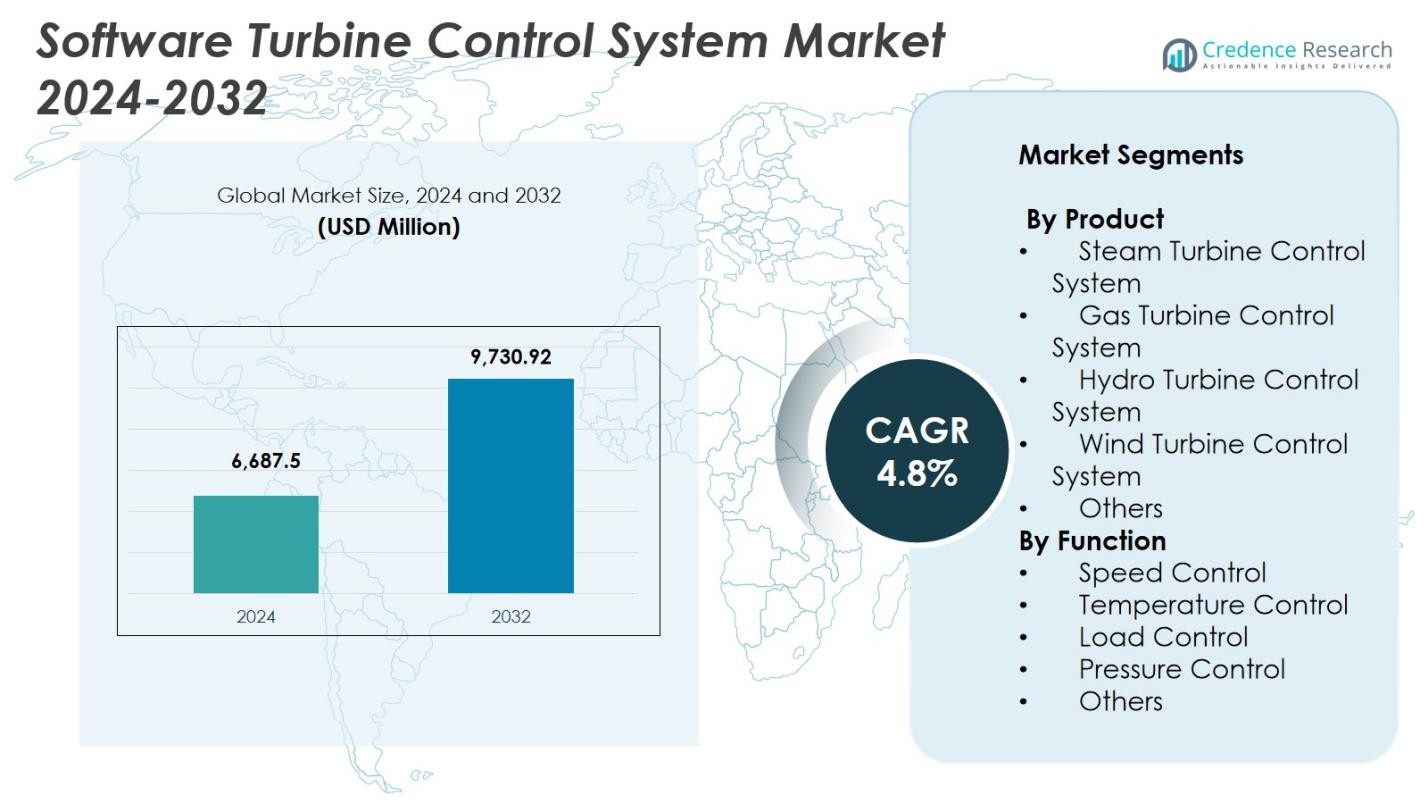
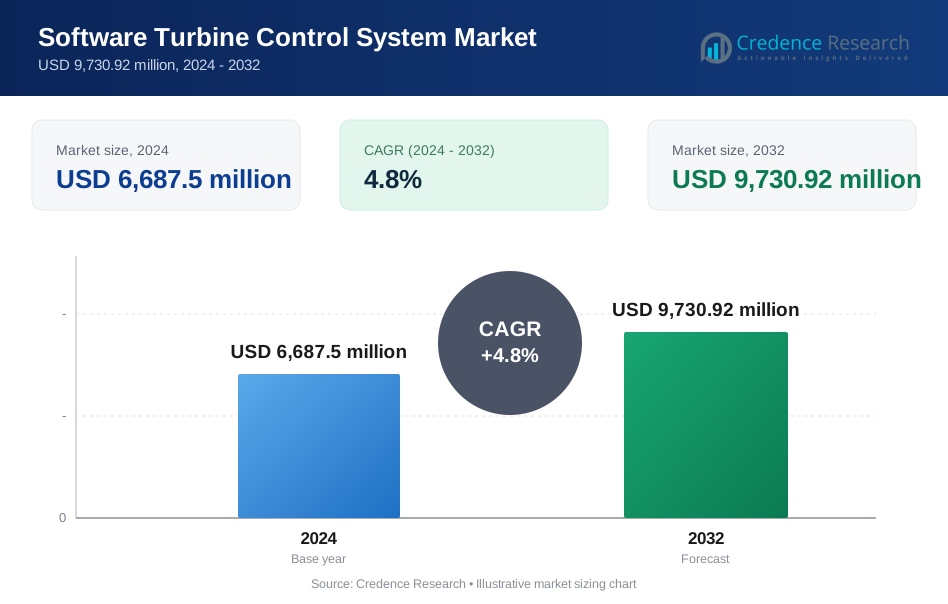
Software Turbine Control System market size was valued at USD 6,687.5 Million in 2024 and is anticipated to reach USD 9,730.92 Million by 2032, at a CAGR of 4.8% during the forecast period.
| REPORT ATTRIBUTE | DETAILS |
|---|---|
| Historical Period | 2020-2023 |
| Base Year | 2024 |
| Forecast Period | 2025-2032 |
| Software Turbine Control System market Size 2024 | USD 6,687.5 Million |
| Software Turbine Control System market, CAGR | 4.8% |
| Software Turbine Control System market Size 2032 | USD 9,730.92 Million |
Software Turbine Control System market is characterized by strong participation from leading automation and turbine solution providers such as ABB, ANDRITZ, Danfoss, DEIF, Eaton, Emerson Electric, Ethos Energy Group, General Electric, Heinzmann, and Honeywell International. These companies focus on advanced digital control architectures, predictive maintenance capabilities, and integrated monitoring platforms to enhance turbine efficiency and reliability across power generation and industrial applications. Regionally, North America led the market in 2024 with 32.6% share, driven by modernization of gas turbine fleets and rapid digitalization initiatives. Europe and Asia Pacific followed, supported by renewable energy expansion, grid optimization programs, and widespread adoption of automation technologies.
Market Insights
- The Software Turbine Control System market was valued at USD 6,687.5 million in 2024 and is projected to reach USD 9,730.92 million by 2032, registering a CAGR of 4.8% during the forecast period.
- Market growth is driven by rising demand for high-efficiency turbine operations, digital modernization of aging power plants, and increasing adoption of predictive maintenance and real-time monitoring systems.
- Key trends include the integration of AI, IoT, digital twins, and cloud-based platforms that enhance turbine performance, reduce downtime, and support remote fleet management across gas, steam, hydro, and wind turbines.
- The market features strong activity from players such as ABB, Emerson Electric, Eaton, General Electric, Honeywell International, and others, focusing on advanced automation solutions and retrofitting services to strengthen their presence.
- Regionally, North America held 32.6% share in 2024, followed by Europe at 28.4% and Asia Pacific at 30.2%; gas turbine control systems dominated the product segment with over 38.4% share.
Market Segmentation Analysis
By Product
The Software Turbine Control System market by product is led by gas turbine control systems, accounting for 38.4% share in 2024, driven by their widespread use in power generation, oil & gas, and industrial cogeneration plants. Their strong adoption stems from the increasing demand for high-efficiency, low-emission power solutions and rapid-cycle operations. Steam turbine control systems follow, supported by the modernization of thermal plants and retrofitting activities. Wind and hydro turbine control systems gain traction due to renewable integration, while advanced digital monitoring and predictive maintenance capabilities further encourage system upgrades across all product categories.
- For Instance, ABB offers integrated automation and “digital-package” control solutions for gas, steam, and hydro turbines including predictive-maintenance tools that can cut maintenance costs by 15–30%.
By Function
In terms of function, speed control dominated the Software Turbine Control System market in 2024 with 36.7% share, primarily due to its critical role in ensuring turbine stability, operational safety, and optimal energy conversion across steam, gas, and hydro units. The increasing deployment of automated speed governors and real-time monitoring solutions accelerates demand. Temperature and load control segments also grow steadily as operators focus on efficiency optimization, emissions management, and extended turbine lifespan. Pressure control and other niche functions expand with the rise of digital twin technologies and AI-based predictive algorithms.
- For instance, GE’s Mark VIe control platform incorporates high-precision speed-governing algorithms that enable millisecond-level response to load fluctuations, improving grid stability in combined-cycle plants.
Key Growth Drivers
Increasing Demand for Efficient and Reliable Power Generation
The Software Turbine Control System market expands significantly as industries and utilities prioritize reliable, high-efficiency power generation. Modern turbine operations require precise, real-time control to ensure optimal performance, minimize downtime, and maintain safety across steam, gas, hydro, and wind turbines. Rising global electricity consumption and the transition toward cleaner, more efficient energy sources accelerate investments in advanced digital turbine controls. Real-time monitoring, automated tuning, and condition-based maintenance improve stability and asset performance. Utilities increasingly replace outdated analog systems with intelligent digital platforms to meet stricter efficiency and emissions standards, reinforcing growth for turbine control software.
- For instance, Mitsubishi Power’s TOMONI intelligent monitoring suite supports condition-based maintenance, helping utilities extend inspection intervals and reduce maintenance-related downtime.
Rapid Digitalization and Integration of AI, IoT, and Predictive Maintenance
Digitalization strengthens the market as AI algorithms, IoT sensors, and digital twins transform turbine monitoring and control practices. These technologies provide predictive maintenance insights, fault forecasting, and autonomous performance optimization, helping operators reduce unexpected outages, lower maintenance expenses, and prolong turbine lifespan. Remote monitoring tools and cloud-based analytics enable centralized supervision, especially beneficial for complex gas turbines and dispersed wind assets. As industries adopt Industry 4.0 frameworks, demand rises for intelligent software capable of real-time decision-making and enhanced responsiveness, driving widespread integration of digital turbine control solutions.
- For instance, Siemens Energy applies digital-twin models in its gas-turbine fleet to simulate real-time component behavior, allowing operators to identify anomalies days in advance and optimize turbine firing conditions.
Upgradation of Aging Power Infrastructure and Renewables Expansion
Aging power assets across global markets create substantial demand for modern turbine control systems that offer improved efficiency, automation, and emissions compliance. Retrofit and modernization initiatives in thermal, hydro, and industrial power plants support the need for advanced digital controls that enable real-time diagnostics and load balancing. Simultaneously, the expansion of renewable energy especially wind and hydro drives adoption of turbine control platforms tailored for variable energy profiles and grid stability requirements. As renewable penetration rises, utilities prioritize flexible, intelligent control systems that ensure consistent performance and seamless grid integration.
Key Trends & Opportunities
Growing Adoption of Predictive Analytics and Digital Twin Technologies
Predictive analytics and digital twin technologies play an increasingly central role in enhancing turbine performance and operational reliability. Digital twins replicate real-world turbine conditions, helping operators test scenarios, forecast failures, and optimize efficiency without interrupting operations. This trend offers strong opportunities for vendors to deliver advanced simulation tools, AI-driven diagnostic platforms, and integrated performance modeling solutions. Industries such as energy, oil & gas, and utilities use these technologies to reduce operational risks, extend turbine life, and streamline maintenance planning, creating new avenues for value-added software solutions.
- For instance, Baker Hughes integrated digital twins into steam turbine controls for mechanical drive applications. The system records and analyzes real-time data to enable condition-based performance optimization across oil & gas and power generation.
Expansion of Cloud-Based and Remote Monitoring Solutions
Cloud-integrated control platforms and remote monitoring capabilities continue to gain traction as operators seek scalable, cost-efficient, and transparent turbine management. These systems enable centralized monitoring of multiple turbine assets, support real-time optimization, and enhance decision-making through continuous data analytics. Demand is particularly strong in wind energy and distributed power setups where remote supervision is essential. Cloud-based architectures improve interoperability, enable fast software updates, and reduce on-site maintenance needs. As the power sector shifts toward decentralized and flexible energy systems, cloud-powered control solutions represent a major growth opportunity.
- For instance, GE’s cloud-enabled Predix platform allows operators to remotely monitor gas and wind turbine performance, delivering analytics that support faster troubleshooting and reduced site visits.
Key Challenges
Cybersecurity Risks and Vulnerabilities in Digital Turbine Systems
Increasing digitization of turbine operations exposes critical power infrastructure to cybersecurity threats, including unauthorized access, data breaches, and ransomware attacks. IoT integration and remote-connectivity features expand potential entry points for cyber threats. Operators must enhance security frameworks through robust encryption, multi-layer authentication, and real-time threat detection. Failure to adequately secure turbine control systems could lead to operational disruptions, financial losses, and safety risks. Ensuring cybersecurity resilience becomes essential for maintaining system integrity and meeting evolving regulatory requirements.
High Implementation Costs and Complexity of System Integration
High installation costs, complex integration procedures, and potential downtime during system upgrades remain significant barriers to adoption. Many power plants operate legacy infrastructure that requires extensive retrofitting before deploying modern digital control systems. Integration with existing SCADA, PLC, and grid management platforms demands advanced engineering capabilities, increasing overall project complexity. Budget constraints especially among small and medium operators can delay modernization initiatives. Vendors must prioritize modular, scalable, and easily integrable solutions to overcome adoption resistance and support seamless transition from older systems.
Regional Analysis
North America North America held a leading position in the Software Turbine Control System market with 32.6% share in 2024, supported by strong investments in power modernization, widespread automation adoption, and the presence of major turbine OEMs and digital solution providers. The region benefits from accelerated upgrades in gas turbine fleets, growth in combined cycle plants, and increasing deployment of wind farms across the U.S. and Canada. Utilities focus heavily on digital optimization, predictive maintenance, and grid stability enhancements, driving the adoption of advanced turbine control platforms. Supportive regulatory frameworks and decarbonization initiatives further reinforce regional demand.
Europe
Europe captured 28.4% share in 2024, driven by aggressive renewable energy expansion, modernization of aging thermal plants, and strict efficiency and emissions regulations. Countries such as Germany, the U.K., and France continue to integrate advanced turbine control systems across wind, hydro, and gas assets to enhance operational reliability and meet clean energy targets. The region’s strong emphasis on digital transformation and grid flexibility boosts demand for predictive maintenance tools and real-time automation software. Ongoing investments in offshore wind and district energy systems further strengthen Europe’s market penetration and long-term adoption.
Asia Pacific
Asia Pacific dominated the growth landscape and accounted for 30.2% share in 2024, supported by large-scale power generation expansion, rapid industrialization, and significant renewable energy investments in China, India, and Southeast Asia. The region witnesses rising adoption of advanced turbine control software across newly built gas, steam, and hydro plants, alongside extensive wind energy installations. Government-led modernization programs and grid reliability initiatives further stimulate demand. Increasing digitalization, industrial automation, and a shift toward efficient, low-emission power systems position Asia Pacific as the fastest-growing regional market for turbine control technologies.
Latin America
Latin America held 5.3% share in 2024, with growth driven by expanding hydroelectric capacity, modernization of aging turbine infrastructure, and the rising integration of wind assets, particularly in Brazil and Chile. The region’s focus on improving energy reliability and operational efficiency supports the adoption of digital turbine control systems. Economic reforms and growing private-sector investments in power generation strengthen demand for advanced automation and monitoring solutions. Although adoption is gradual due to budget limitations, increasing renewable installations and regional grid upgrades create long-term opportunities for turbine control system suppliers.
Middle East & Africa
The Middle East & Africa accounted for 3.5% share in 2024, supported by expanding thermal power infrastructure, ongoing gas turbine installations, and rising industrial energy requirements. Countries like Saudi Arabia, the UAE, and South Africa invest in modernizing turbine fleets to improve efficiency and reduce operational downtime. The region’s shift toward diversification of energy sources, including wind and solar-hybrid projects, encourages adoption of advanced control platforms. However, slower digitalization and budget constraints in several countries moderate growth. Nevertheless, long-term infrastructure development and industrial expansion continue to create demand for next-generation turbine control systems.
Market Segmentations
By Product
- Steam Turbine Control System
- Gas Turbine Control System
- Hydro Turbine Control System
- Wind Turbine Control System
- Others
By Function
- Speed Control
- Temperature Control
- Load Control
- Pressure Control
- Others
By Geography
- North America
- U.S.
- Canada
- Mexico
- Europe
- Germany
- France
- U.K.
- Italy
- Spain
- Rest of Europe
- Asia Pacific
- China
- Japan
- India
- South Korea
- South-east Asia
- Rest of Asia Pacific
- Latin America
- Brazil
- Argentina
- Rest of Latin America
- Middle East & Africa
- GCC Countries
- South Africa
- Rest of the Middle East and Africa
Competitive Landscape
The Software Turbine Control System market features a strong lineup of global automation leaders, turbine manufacturers, and digital solution providers focused on enhancing operational efficiency, reliability, and predictive capabilities across diverse turbine applications. Key players such as ABB, ANDRITZ, Danfoss, DEIF, Eaton, Emerson Electric, Ethos Energy Group, General Electric, Heinzmann, and Honeywell International continue to invest in advanced control architectures, AI-driven diagnostics, IoT-enabled monitoring, and cloud-based optimization platforms. These companies emphasize product innovation, lifecycle service offerings, and integration of digital twins and predictive maintenance tools to strengthen their market position. Strategic partnerships with power utilities, EPC firms, and renewable energy developers support broader adoption of real-time automation software. Many vendors also focus on retrofitting aging infrastructure and delivering modular, scalable control solutions tailored for gas, steam, hydro, and wind turbines. As competition intensifies, differentiation increasingly depends on cybersecurity resilience, interoperability, and data-driven decision-support capabilities.
Key Player Analysis
- Honeywell International
- DEIF
- DANFOSS
- Heinzmann
- Emerson Electric
- Eaton
- General Electric
- ABB
- Ethos Energy Group
- ANDRITZ
Recent Developments
- In September 2024, ABB signed a joint-development agreement with Energy Control Technologies (ECT) to deliver an integrated turbomachinery controls solution, integrating compressor/turbomachinery controls into ABB’s ABB Ability™ System 800xA® distributed control system.
- In July 2025, GE Vernova and Crusoe announced a major deal: GE Vernova will deliver 29 units of its LM2500XPRESS aeroderivative gas turbines (with advanced control) to Crusoe’s AI data-centers indicating demand for turbine + control systems in data-center/energy infrastructure.
- In March 2025, Emerson Electric Co. completed the acquisition of AspenTech now operating as an independent business unit within Emerson’s Control Systems & Software division, signaling a shift toward greater software and control-system capabilities.
Report Coverage
The research report offers an in-depth analysis based on Product, Function and Geography. It details leading market players, providing an overview of their business, product offerings, investments, revenue streams, and key applications. Additionally, the report includes insights into the competitive environment, SWOT analysis, current market trends, as well as the primary drivers and constraints. Furthermore, it discusses various factors that have driven market expansion in recent years. The report also explores market dynamics, regulatory scenarios, and technological advancements that are shaping the industry. It assesses the impact of external factors and global economic changes on market growth. Lastly, it provides strategic recommendations for new entrants and established companies to navigate the complexities of the market.
Future Outlook
- The market will experience steady adoption as power producers continue modernizing turbine assets with advanced digital control platforms.
- Integration of AI, machine learning, and digital twins will enhance predictive maintenance and operational optimization.
- Demand for remote monitoring and cloud-based turbine management solutions will expand across distributed energy sites.
- Gas turbine control upgrades will remain a priority as industries focus on efficiency, flexibility, and reduced emissions.
- Wind and hydro turbine control systems will grow with accelerating renewable energy investments worldwide.
- Vendors will strengthen cybersecurity capabilities to address rising risks in connected turbine systems.
- Modular and scalable software architectures will gain traction for easier retrofitting of aging infrastructure.
- Emerging markets in Asia Pacific and Latin America will drive long-term growth through large-scale power development.
- Partnerships between OEMs, utilities, and digital solution providers will increase to support integrated automation ecosystems.
- Data-driven decision-making tools and real-time analytics will become standard features in next-generation turbine control solutions.
Request a Free Sample
Fill in your details and we'll send you a free sample report.
- Sample data tables & charts
- Research methodology
Need a Custom Version of This Report?
Tailor the scope, geography, or segments to your exact requirements.
- Custom geography or segment scope
- Direct access to our analyst team
Frequently Asked Questions
What is the current market size for Software Turbine Control System market, and what is its projected size in 2032?
At what Compound Annual Growth Rate is the Software Turbine Control System market projected to grow between 2024 and 2032?
Which Software Turbine Control System market segment held the largest share in 2024?
What are the primary factors fueling the growth of the Software Turbine Control System market?
Who are the leading companies in the Software Turbine Control System market?
Which region commanded the largest share of the Software Turbine Control System market in 2024?
Table of Content
Chapter 1. Report Introduction
- 1.1 Report Description & Purpose
- 1.1.1 Report Title & Market Definition
- 1.1.2 Unique Selling Propositions (USP) & Key Differentiators
- 1.1.3 Value Proposition for Stakeholders
- 1.2 Research Objectives
- 1.2.1 Market Sizing Objectives (Volume & Revenue) (Volume Where Applicable)
- 1.2.2 Segmentation Objectives
- 1.2.3 Competitive Intelligence Objectives
- 1.2.4 Forecast & Scenario Objectives
- 1.3 Report Scope
- 1.3.1 Software Turbine Control System Scope – Segments & Subsegments Covered
- 1.3.2 Geographic Scope – Regions & Countries Covered
- 1.3.3 Historical Period, Base Year & Forecast Period (2024; forecast to 2032)
- 1.3.4 Inclusions & Exclusions
- 1.4 Industry Classification & Applicable Codes
- 1.5 Currency, Measurement Units & Valuation Basis
- 1.6 Target Stakeholders
- 1.7 Limitations & Assumptions
Chapter 2. Executive Summary
- 2.1 Global Software Turbine Control System Market Snapshot
- 2.1.1 Market Size – Historical (2024) & Forecast (2024-2032) (2024: USD 6,687.5 million → 2032: USD 9,730.92 million)
- 2.1.2 Volume & Revenue – Global Totals (Volume Where Applicable)
- 2.1.3 Key Market Highlights – Top Five Facts
- 2.2 Software Turbine Control System Market Segmentation Snapshot
- 2.2.1 Market Split by Region – 2024 vs. 2032
- 2.3 Competitive Snapshot
- 2.3.1 Top 10 Players by Revenue Share – 2024
- 2.3.2 Top 10 Players by Volume Share – 2024 (Volume Where Applicable)
- 2.3.3 Recent Strategic Developments (18-Month Summary)
- 2.4 Key Investment Highlights & Strategic Conclusions
Chapter 3. Software Turbine Control System Market Dynamics & Industry Analysis
- 3.1 Market Overview & Context
- 3.1.1 Software Turbine Control System Market Position in the Broader Industry Value Chain
- 3.1.2 Demand Structure & Purchasing Dynamics
- 3.1.3 Market Maturity & Development Stage by Region
- 3.2 Software Turbine Control System Market Drivers
- 3.3 Software Turbine Control System Market Restraints & Challenges
- 3.4 Software Turbine Control System Market Opportunities
- 3.5 Porter's Five Forces Analysis
- 3.5.1 Threat of New Entrants
- 3.5.2 Bargaining Power of Suppliers
- 3.5.3 Bargaining Power of Buyers
- 3.5.4 Threat of Substitutes
- 3.5.5 Competitive Rivalry – Intensity Assessment
- 3.6 Software Turbine Control System Value Chain Analysis
- 3.6.1 Upstream – Key Inputs, Resources & Suppliers
- 3.6.1.1 Key Input/Resource 1
- 3.6.1.2 Key Input/Resource 2
- 3.6.1.3 Key Input/Resource 3
- 3.6.2 Midstream – Core Operations & Value Creation
- 3.6.2.1 Operating Model & Process Overview
- 3.6.2.2 Key Operating Locations & Capabilities by Company
- 3.6.3 Downstream – Market Channels & End Users
- 3.6.3.1 Direct Sales & Customer Engagement Channels
- 3.6.3.2 Indirect Sales, Intermediaries & Partner Channels
- 3.6.4 Value Chain Profitability Analysis
- 3.6.1 Upstream – Key Inputs, Resources & Suppliers
- 3.7 PESTEL Analysis
- 3.7.1 Political Factors
- 3.7.2 Economic Factors
- 3.7.3 Social Factors
- 3.7.4 Technological Factors
- 3.7.5 Environmental Factors
- 3.7.6 Legal Factors
- 3.8 Software Turbine Control System Supply Chain Analysis
- 3.8.1 Critical Input & Resource Availability Risk Assessment
- 3.8.2 Supplier & Operational Concentration Risk (Geographic Exposure)
- 3.8.3 Supply & Service Disruption Impact Analysis
- 3.9 Regulatory & Policy Landscape
Note: The regulatory and policy landscape section covers regulations based on their applicability to the market, Software Turbine Control System category, geography, and scope of the study. Only regulatory frameworks with a material impact on operations, compliance, trade, sustainability, or market access are analyzed in detail.
Chapter 4. Key Investment Pockets & Opportunity Analysis
- 4.1 Software Turbine Control System Market Attractiveness Analysis
- 4.1.1 By Region – Investment Attractiveness Matrix (Market Size × CAGR)
- 4.2 Absolute Revenue Growth Opportunity
- 4.2.1 By Region – Absolute Revenue Growth Through 2032
- 4.3 Incremental Demand Opportunity
- 4.3.1 By Region – Incremental Demand Through 2032
- 4.3.2 Segment – Incremental Demand
- 4.4 Emerging Submarket Opportunity Deep Dive (Subject to Applicability)
- 4.5 Priority Market Opportunity Scorecards
- 4.5.1 United States
- 4.5.2 Europe
- 4.5.3 Asia
- 4.5.4 Middle East & Africa
Note: Priority market opportunity scorecards reflect the geographic scope and strategic relevance of the study. Listed markets are indicative and may be adapted to the industry.
Chapter 5. Software Turbine Control System Cross-Border Trade & Market Access Analysis
- 5.1 International Trade & Cross-Border Activity Overview
- 5.1.1 Global Export Value by Country (2024)
- 5.1.2 Global Export Volume by Country (2024) (Volume Where Applicable)
- 5.1.3 Global Import Value by Country (2024)
- 5.1.4 Global Import Volume by Country (2024) (Volume Where Applicable)
- 5.1.5 Net Trade Balance by Country (2024)
- 5.2 Export Analysis – Segment
- 5.2.1 Category 1 (Applicable Classification Code)
- 5.2.2 Category 2 (Applicable Classification Code)
- 5.2.3 Category 3 (Applicable Classification Code)
- 5.2.4 Category 4 (Applicable Classification Code)
- 5.2.5 Category 5 (Applicable Classification Code)
- 5.3 Import Analysis – Segment
- 5.3.1 Category 1 (Applicable Classification Code)
- 5.3.2 Category 2 (Applicable Classification Code)
- 5.3.3 Category 3 (Applicable Classification Code)
- 5.3.4 Category 4 (Applicable Classification Code)
- 5.3.5 Category 5 (Applicable Classification Code)
- 5.4 Cross-Border Pricing & Transaction Benchmarks
- 5.4.1 Export Pricing – Segment & Country
- 5.4.2 Import Pricing – Segment & Source Country
- 5.4.3 Price Trends (2024)
- 5.5 Key Cross-Border Trade & Delivery Routes
- 5.5.1 Cross-Border Trade/Delivery Route 1
- 5.5.2 Cross-Border Trade/Delivery Route 2
- 5.5.3 Cross-Border Trade/Delivery Route 3
- 5.5.4 Cross-Border Trade/Delivery Route 4
- 5.5.5 Cross-Border Trade/Delivery Route 5
- 5.6 Trade Policy & Market Access Impact Assessment
- 5.6.1 Tariff & Non-Tariff Barriers
- 5.6.2 Regional Trade & Economic Integration Frameworks
- 5.6.3 Bilateral & Multilateral Trade Agreements
- 5.6.4 Cross-Border Operating, Licensing & Localization Requirements
Note: This chapter applies where cross-border trade or delivery is relevant to Software Turbine Control System. Goods, services, and digital offerings are assessed using applicable classifications and transaction measures. Import-export volumes, trade balances, and route analyses are included only where meaningful to the market.
Chapter 6. Competitive Landscape & Company Benchmarking
- 6.1 Software Turbine Control System Market Concentration & Structure
- 6.1.1 Herfindahl-Hirschman Index (HHI) – vs. 2024
- 6.1.2 Leading, Mid-Sized & Emerging Player Structure
- 6.1.3 Global, Regional & Local Player Dynamics
- 6.2 Software Turbine Control System Market Share Analysis – 2024
- 6.2.1 Global Revenue Share by Company
- 6.2.2 Global Volume Share by Company (Volume Where Applicable)
- 6.2.3 Regional Revenue Share
- 6.2.4 Market Share Evolution ( vs. 2024)
- 6.2.5 Company Market Share by Key Segment
- 6.2.6 Company Market Share by Customer Group
- 6.3 Operating Scale, Capacity & Infrastructure Analysis
- 6.3.1 Global Operating Scale & Supply Capacity
- 6.3.2 Resource Utilization & Operating Efficiency
- 6.3.3 Output, Service Delivery & Activity Metrics
- 6.3.4 Operating Footprint & Infrastructure Map
- 6.3.5 Planned Operational & Capacity Expansion
- 6.4 Software Turbine Control System Competitive Benchmarking Matrix
- 6.4.1 Revenue, Growth, Profitability & Operating Metric Comparison
- 6.4.2 Channel Revenue Mix
- 6.4.3 Geographic Revenue Exposure
- 6.4.4 R&D Intensity
- 6.4.5 Sustainability Maturity
- 6.5 Strategic Developments in Software Turbine Control System (Last 24 Months)
- 6.5.1 Mergers, Acquisitions & Divestments
- 6.5.2 New Products, Services & Solutions in Software Turbine Control System
- 6.5.3 Operational & Infrastructure Expansions
- 6.5.4 Strategic Alliances, Joint Ventures & Partnerships
- 6.5.5 Distribution Expansion & Market Entry
- 6.5.6 Sustainability & ESG Initiatives
- 6.6 Competitive Strategy Mapping
- 6.6.1 Leader, Challenger, Follower & Niche Classification
- 6.6.2 Pricing Strategy Comparison
- 6.6.3 Channel Strategy Matrix
Note: Strategic developments are included based on their materiality and the availability of reliable information.
Chapter 7. Global Software Turbine Control System Market – By Sales & Delivery Channel
- 7.1 Segment Overview
- 7.1.1 Volume & Revenue Split by Channel (2024 & 2032) (Volume Where Applicable)
- 7.1.2 Channel Mix Evolution (2024-2032)
Chapter 8. Regional Market Analysis – Global Overview
- 8.1 Global Regional Overview
- 8.1.1 Regional Volume Share (Volume Where Applicable)
- 8.1.2 Regional Revenue Share
- 8.1.3 Regional Volume by Region (Volume Where Applicable)
- 8.1.4 Regional Revenue by Region
- 8.1.5 Regional Forecast Through 2032
- 8.2 Cross-Regional Segment Analysis
- 8.2.1 By Sales & Delivery Channel
- 8.2.2 By Competitive Positioning & Price Tier
Chapter 9. North America Software Turbine Control System Market
- 9.1 United States
- 9.2 Canada
- 9.3 Mexico
Chapter 10. Europe Software Turbine Control System Market
- 10.1 Germany
- 10.2 France
- 10.3 Italy
- 10.4 United Kingdom
- 10.5 Spain
- 10.6 Poland
- 10.7 Russia
- 10.8 Netherlands
- 10.9 Belgium
- 10.10 Sweden
- 10.11 Denmark
- 10.12 Norway
- 10.13 Rest of Europe
Chapter 11. Asia Pacific Software Turbine Control System Market
- 11.1 China
- 11.2 India
- 11.3 Japan
- 11.4 South Korea
- 11.5 Thailand
- 11.6 Indonesia
- 11.7 Vietnam
- 11.8 Malaysia
- 11.9 Australia
- 11.10 Rest of Asia Pacific
Chapter 12. Latin America Software Turbine Control System Market
- 12.1 Brazil
- 12.2 Argentina
- 12.3 Colombia
- 12.4 Chile
- 12.5 Rest of Latin America
Chapter 13. Middle East Software Turbine Control System Market
- 13.1 Saudi Arabia
- 13.2 United Arab Emirates
- 13.3 Turkey
- 13.4 Israel
- 13.5 Iran
- 13.6 Rest of the Middle East
Chapter 14. Africa Software Turbine Control System Market
- 14.1 South Africa
- 14.2 Egypt
- 14.3 Nigeria
- 14.4 Morocco
- 14.5 Rest of Africa
Chapter 15. Software Turbine Control System Company Profiles
- 15.1 [Company 01]
- 15.1.1 Company Overview
- 15.1.2 Key Management Personnel
- 15.1.3 Products & Services Portfolio
- 15.1.4 Financial Performance
- 15.1.5 Key Market Focus & Geographic Presence
- 15.1.6 Recent Developments & Strategic Initiatives
Note: The company profile list is preliminary and may change based on research findings, market developments, data availability, and client requirements.
Chapter 16. Appendices
- Appendix A – List of Abbreviations & Acronyms
- Appendix B – Industry Classification Code Reference – Full Series
- Appendix C – Supply, Output & Operating Capacity Data Tables
- Appendix D – End-Use & Demand Base Tables
- Appendix E – Demand, Adoption & Usage Assumptions
- Appendix F – Pricing & Revenue Metric Reference Tables
- Appendix G – Company Operations & Infrastructure Database
- Appendix H – Cross-Border Trade & Activity Data Tables (Where Applicable)
- Appendix I – Regulatory Summary Tables
- Appendix J – Primary Research Participant List (Anonymized)
- Appendix K – Primary Research Questionnaire Framework
- Appendix L – Data Sources & Bibliography
- Appendix M – Market Size Divergence & Source Comparison
Chapter 17. Research Methodology
- 17.1 Research Framework & Philosophy
- 17.2 Secondary Research – Sources, Hierarchy & Data Extraction
- 17.3 Data Modeling – Bottom-Up & Top-Down Market Sizing
- 17.4 Primary Research – Stakeholder Framework, LOI & Sample Sizes
- 17.5 Forecast Methodology – Regression, Scenario & Sensitivity Analysis
- 17.6 Quality Control – Four-Layer Validation Framework
- 17.7 Limitations & Standard Assumptions
- 17.8 Disclaimer
