
Market Overview:
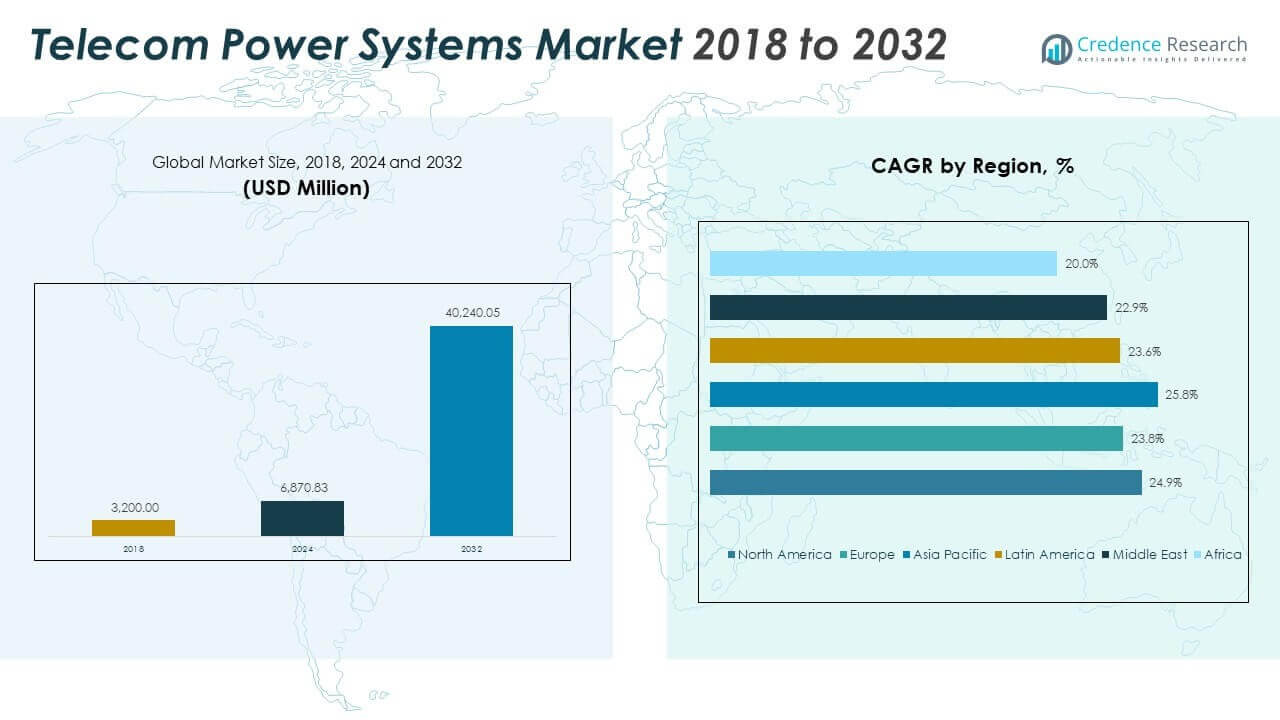
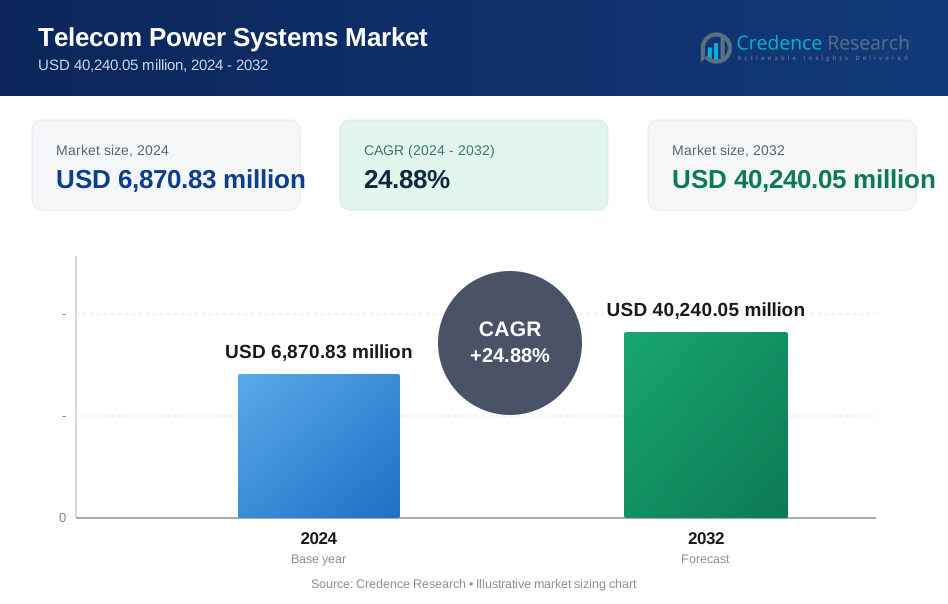
The Global Telecom Power Systems Market size was valued at USD 3,200.00 million in 2018 to USD 6,870.83 million in 2024 and is anticipated to reach USD 40,240.05 million by 2032, at a CAGR of 24.88% during the forecast period.| REPORT ATTRIBUTE | DETAILS |
|---|---|
| Historical Period | 2020-2023 |
| Base Year | 2024 |
| Forecast Period | 2025-2032 |
| Telecom Power Systems Market Size 2024 | USD 6,870.83 Million |
| Telecom Power Systems Market, CAGR | 24.88% |
| Telecom Power Systems Market Size 2032 | USD 40,240.05 Million |
Market Insights:
- The market expanded from USD 3,200.00 million in 2018 to USD 6,870.83 million in 2024 and is projected to reach USD 40,240.05 million by 2032, reflecting a CAGR of 24.88% driven by network expansion and power density growth.
- Asia Pacific leads with about 45.7% share, followed by North America at nearly 25.8% and Europe at around 19.3%, supported by large-scale tower deployment, advanced network upgrades, and strong infrastructure investment.
- Asia Pacific is also the fastest-growing region with a 25.8% CAGR, driven by rapid 5G rollout, rising subscriber bases, rural connectivity programs, and higher off-grid power demand.
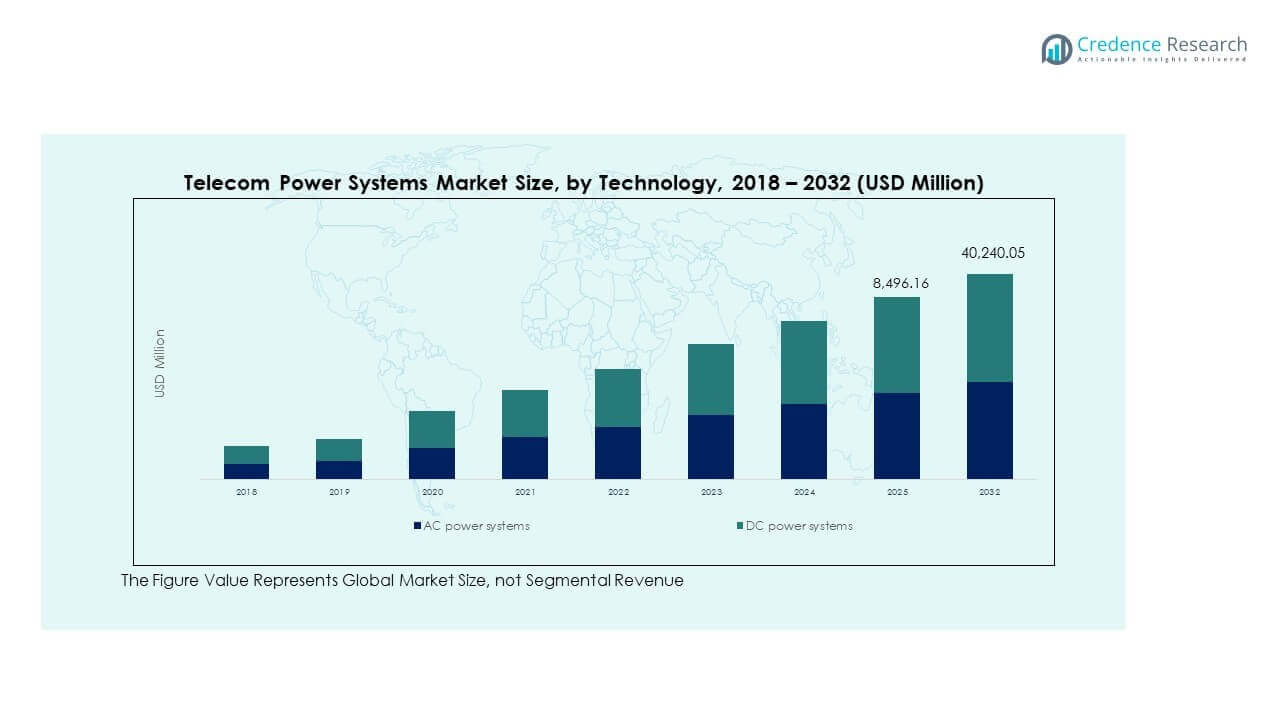
- By technology, DC power systems accounted for an estimated 58% share in 2024, reflecting preference for energy efficiency and compatibility with modern telecom equipment.
- DC power systems are projected to increase to nearly 62% share by 2032, while AC power systems retain about 38%, supported by legacy infrastructure and grid-based deployments.
Market Drivers:
Rising Mobile Network Expansion And Tower Density Growth The Global Telecom Power Systems Market gains strength from fast mobile network expansion. Operators deploy more base stations to improve coverage quality. Dense urban areas need higher tower counts. Each tower requires reliable primary and backup power. Network upgrades increase power load per site. Operators focus on uptime to avoid service disruption. Power systems support continuous data transmission. This driver sustains steady infrastructure investment.- For instance, Reliance Jio had deployed approximately 370,000 5G base transceiver stations (BTS) in India by March 2024, representing nearly 85% of the country’s total 5G infrastructure at that time. T
- For instance, AT&T states that its macro cell sites are engineered with battery backup lasting several hours, supported by generators, to meet public safety and emergency communication requirements.
Market Trends:
Shift Toward Smart And Digitally Managed Power Systems Operators adopt intelligent power management platforms. Digital monitoring improves fault detection speed. Predictive alerts reduce manual site visits. Data analytics supports proactive maintenance planning. Centralized dashboards enhance network visibility. Software integration improves operational control. Smart systems support scalability across sites. This trend reshapes power infrastructure design.- For instance, Ericsson reports that its Energy Smart Site solution reduced network energy consumption by up to 15% through AI-driven power optimization and remote monitoring.
- For instance, Bharti Airtel operates more than 10,000 telecom towers powered by solar or hybrid energy systems, cutting diesel usage and improving site sustainability.
Market Challenges Analysis:
High Capital Investment And Long Payback Cycles Power systems require significant upfront investment. Advanced batteries increase initial project cost. Renewable integration raises equipment complexity. Operators face budget allocation pressure. Return timelines extend for rural deployments. Capital planning demands careful cost assessment. Financing constraints slow large-scale upgrades. Cost sensitivity remains a major concern. Operational Complexity Across Diverse Geographic Conditions Telecom sites operate in harsh environments. Extreme temperatures affect battery performance. Fuel supply challenges impact generator reliability. Skilled maintenance staff remain limited in remote areas. Logistics costs increase for dispersed sites. Regulatory differences complicate standardization. Power system design must adapt locally. Operational complexity challenges long-term efficiency.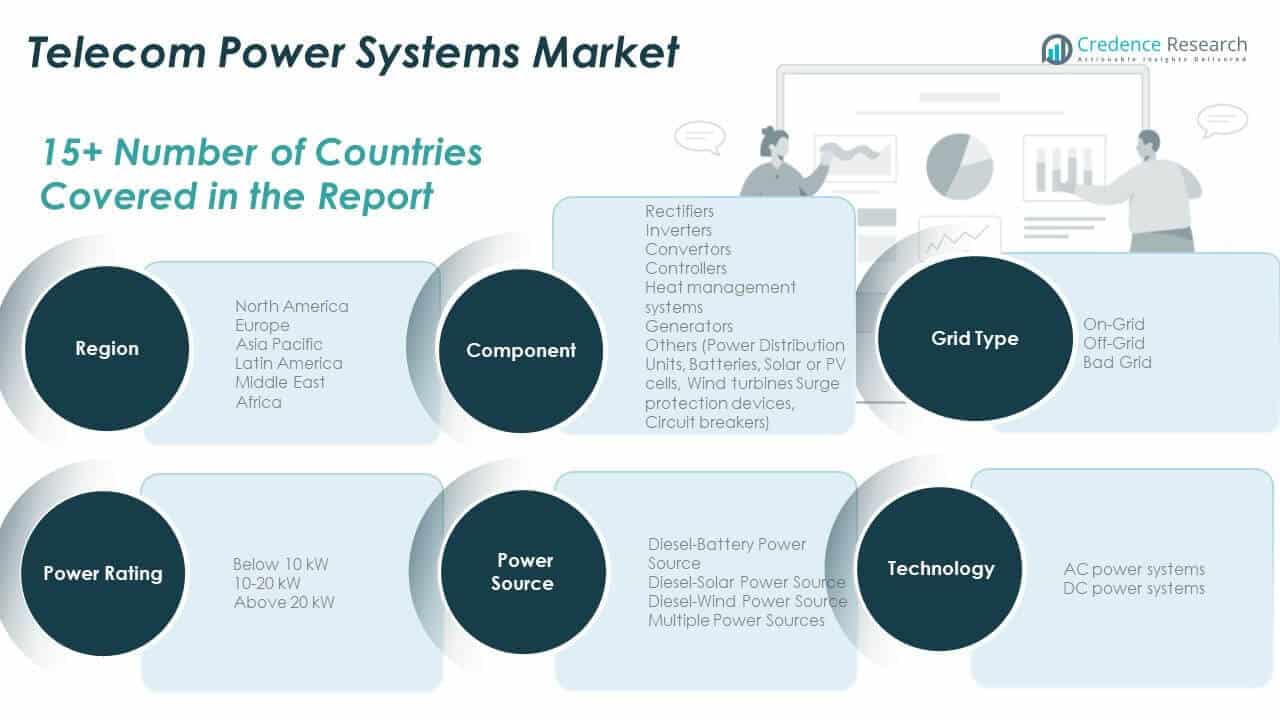
Market Opportunities:
Expansion Of Green Telecom And Carbon Reduction Initiatives Operators commit to sustainability targets. Green power systems support emission reduction goals. Renewable adoption enhances corporate responsibility image. Energy-efficient designs lower operational expenses. Policy incentives encourage clean energy use. Carbon reporting increases transparency requirements. Power suppliers align with sustainability demand. Green initiatives open new solution avenues. Growth Potential In Emerging Markets And Underserved Regions Emerging regions expand mobile connectivity rapidly. New network rollouts require fresh power infrastructure. Grid instability boosts backup system demand. Local manufacturing partnerships reduce deployment cost. Technology transfer supports regional capacity building. Telecom investments stimulate infrastructure development. Vendors gain early mover advantage. Underserved markets offer long-term growth scope.Market Segmentation Analysis:
By Component Rectifiers form the backbone of telecom power architecture by ensuring stable DC output. Inverters and convertors support voltage conversion needs across diverse equipment loads. Controllers enable system automation and remote supervision. Heat management systems protect equipment reliability under high thermal stress. Generators provide backup power during grid outages. The others segment includes power distribution units, batteries, solar or PV cells, wind turbines, surge protection devices, and circuit breakers. These elements enhance safety, energy storage, and renewable integration. Component diversity supports flexible site-level power design.- For instance, Delta Electronics supplies telecom rectifiers with efficiency levels above 96%, helping operators lower heat generation and reduce energy losses at high-density sites.
- For instance, Huawei has deployed hybrid solar-battery power solutions for thousands of off-grid and bad-grid telecom sites across Africa and Asia, ensuring reliable uptime despite unstable grid conditions.
Segmentation:
By Component- Rectifiers
- Inverters
- Convertors
- Controllers
- Heat Management Systems
- Generators
- Others
-
- Power Distribution Units
- Batteries
- Solar or PV Cells
- Wind Turbines
- Surge Protection Devices
- Circuit Breakers
-
- On-Grid
- Off-Grid
- Bad Grid
- Below 10 kW
- 10–20 kW
- Above 20 kW
- Diesel-Battery Power Source
- Diesel-Solar Power Source
- Diesel-Wind Power Source
- Multiple Power Sources
- AC Power Systems
- DC Power Systems
- North America
- U.S.
- Canada
- Mexico
- Europe
- UK
- France
- Germany
- Italy
- Spain
- Russia
- Rest of Europe
- Asia Pacific
- China
- Japan
- South Korea
- India
- Australia
- Southeast Asia
- Rest of Asia Pacific
- Latin America
- Brazil
- Argentina
- Rest of Latin America
- Middle East
- GCC Countries
- Israel
- Turkey
- Rest of Middle East
- Africa
- South Africa
- Egypt
- Rest of Africa
Regional Analysis:
North America The North America Global Telecom Power Systems Market size was valued at USD 841.60 million in 2018 to USD 1,776.76 million in 2024 and is anticipated to reach USD 10,386.03 million by 2032, at a CAGR of 24.9% during the forecast period. North America accounts for nearly 25.8% market share. The Global Telecom Power Systems Market in North America benefits from advanced network infrastructure. Operators focus on 5G densification across urban areas. Data traffic growth raises site power demand. Grid stability supports on-grid system dominance. Backup power remains critical for disaster resilience. The United States leads due to large tower density. Canada supports steady upgrades in rural regions. Mexico expands coverage through new deployments. Europe The Europe Global Telecom Power Systems Market size was valued at USD 696.00 million in 2018 to USD 1,424.14 million in 2024 and is anticipated to reach USD 7,776.50 million by 2032, at a CAGR of 23.8% during the forecast period. Europe represents around 19.3% market share. Europe emphasizes energy efficiency and carbon reduction. Operators upgrade legacy power infrastructure. Renewable integration gains strong policy support. Western Europe leads due to mature telecom networks. Germany, the UK, and France invest in grid optimization. Southern Europe expands rural connectivity. Power reliability standards remain strict. Technology upgrades sustain regional demand. Asia Pacific The Asia Pacific Global Telecom Power Systems Market size was valued at USD 1,344.64 million in 2018 to USD 2,961.64 million in 2024 and is anticipated to reach USD 18,409.86 million by 2032, at a CAGR of 25.8% during the forecast period. Asia Pacific holds about 45.7% market share. Asia Pacific leads global demand due to rapid network rollout. China and India drive large-scale tower deployment. Subscriber growth increases power load per site. Off-grid systems support rural expansion. Southeast Asia shows strong new installations. Japan and South Korea upgrade for advanced networks. Cost-efficient power solutions gain preference. Regional scale supports market dominance. Latin America The Latin America Global Telecom Power Systems Market size was valued at USD 185.60 million in 2018 to USD 394.32 million in 2024 and is anticipated to reach USD 2,127.49 million by 2032, at a CAGR of 23.6% during the forecast period. Latin America captures nearly 5.3% market share. Latin America expands mobile coverage steadily. Grid instability increases backup system demand. Brazil leads due to large geographic coverage. Argentina supports selective network upgrades. Rural connectivity programs raise off-grid adoption. Operators focus on cost control. Hybrid power systems gain acceptance. Infrastructure modernization supports growth. Middle East The Middle East Global Telecom Power Systems Market size was valued at USD 99.20 million in 2018 to USD 196.46 million in 2024 and is anticipated to reach USD 1,010.25 million by 2032, at a CAGR of 22.9% during the forecast period. The region holds about 2.5% market share. The Middle East invests in resilient telecom infrastructure. Harsh climate drives demand for reliable systems. GCC countries lead with urban network upgrades. Remote sites depend on backup power. Energy diversification supports hybrid systems. Smart city projects raise equipment needs. Network reliability remains a priority. Regional investment sustains demand. Africa The Africa Global Telecom Power Systems Market size was valued at USD 32.96 million in 2018 to USD 117.52 million in 2024 and is anticipated to reach USD 529.93 million by 2032, at a CAGR of 20.0% during the forecast period. Africa contributes nearly 1.3% market share. Africa focuses on basic connectivity expansion. Off-grid solutions dominate site deployment. Solar-based systems support remote towers. South Africa and Egypt lead regional demand. Grid challenges increase backup reliance. Operators seek low-maintenance systems. Infrastructure gaps shape power design. Long-term connectivity goals support gradual growth.Key Player Analysis:
- Delta Electronics
- Eaton Corporation
- Huawei Technologies
- Schneider Electric
- Cummins Inc.
- ZTE Corporation
- Alpha Technologies
- Emerson Network Power (Vertiv)
- ABB Group
- AEG Power Solutions
- GE Industrial Solutions
- Benning Power Solutions
- ACME Cleantech Solutions
- VMC Systems
- Pioneer Magnetics
- Dyna Hitech Power Systems
- Ascot Industrial S.r.l.
Competitive Analysis:
The Global Telecom Power Systems Market features strong competition among global and regional players. Major companies focus on product reliability and energy efficiency. Portfolio breadth supports varied grid and site conditions. Vendors invest in smart controllers and remote monitoring tools. Strategic partnerships strengthen telecom operator reach. Manufacturing scale supports cost control across regions. Technology upgrades protect long-term contracts. Service capability differentiates suppliers in remote markets. It remains innovation driven with focus on uptime and resilience.Recent Developments:
- In November 2025, Vertiv (successor to Emerson Network Power) unveiled the Vertiv PowerDirect 7100 Energy, a high‑efficiency hybrid‑ready DC power system for telecom and edge operators in EMEA that delivers up to 52 kW of scalable 48 V DC power, achieves up to 98% efficiency, and seamlessly integrates grid, generator, and renewable inputs such as solar or fuel cells to support on‑grid, bad‑grid, and off‑grid sites.
- In August 2025, Vertiv announced global availability of Vertiv OneCore, a scalable prefabricated infrastructure solution integrating power and thermal systems to support 5–50 MW blocks and high‑density rack configurations, enabling faster deployment of AI and data‑center capacity that underpins next‑generation telecom networks and edge computing.
- In June 2025, Eaton entered a strategic collaboration with Siemens Energy to provide modular, grid‑independent on‑site power solutions for fast‑track data center construction, under which Eaton will supply medium‑ and low‑voltage switchgear, UPS systems, busways, racks, and related electrical infrastructure to protect IT loads from grid to chip, supporting the growing power needs of telecom and AI‑driven data centers.
- In October 2025, Eaton announced a next‑generation 800 VDC reference architecture for AI data centers that aligns with NVIDIA’s 800 VDC platform and extends Eaton’s grid‑to‑chip strategy, enabling more efficient, high‑density power distribution and integration of backup and digital power management technologies for large‑scale compute environments that also serve telecom workloads.
- In March–September 2025, Schneider Electric and SK Telecom formalized an integrated procurement agreement and extended MoU under which Schneider Electric will supply key mechanical, electrical, and plumbing equipment including switchgear, UPS, transformers, and automated control systems for SK Telecom’s planned AI data center in Ulsan, while SK Telecom integrates Schneider’s ETAP digital‑twin power software into its AI DCIM platform to optimize power usage and support future UPS and energy‑storage cooperation across SK Group.
- In September 2025, Schneider Electric launched the Galaxy VXL, a next‑generation three‑phase UPS introduced at its “Secure Power Innovation Day,” featuring up to 99% efficiency in eConversion mode, a compact footprint that cuts floor space by more than half, and a “Live Swap” capability, making it suitable for data centers, cloud providers, and large critical infrastructure, including telecom facilities requiring high availability.
Report Coverage:
The research report offers an in-depth analysis based on Component and Grid Type segments. It details leading market players, providing an overview of their business, product offerings, investments, revenue streams, and key applications. Additionally, the report includes insights into the competitive environment, SWOT analysis, current market trends, as well as the primary drivers and constraints. Furthermore, it discusses various factors that have driven market expansion in recent years. The report also explores market dynamics, regulatory scenarios, and technological advancements that are shaping the industry. It assesses the impact of external factors and global economic changes on market growth. Lastly, it provides strategic recommendations for new entrants and established companies to navigate the complexities of the market.Future Outlook:
- Telecom operators will increase investment in high-capacity power systems to support dense 5G networks.
- Smart power management platforms will gain wider adoption to improve site efficiency and control.
- Renewable energy integration will expand to meet sustainability and emission reduction targets.
- Hybrid power architectures will become standard across grid and off-grid telecom sites.
- Rural and remote connectivity programs will drive demand for autonomous power solutions.
- Advanced battery technologies will improve backup duration and lifecycle performance.
- Modular power systems will support scalable and phased network expansion strategies.
- Energy efficiency requirements will influence power system design and component selection.
- Remote monitoring tools will reduce maintenance effort and operational risk.
- Emerging economies will contribute significantly to long-term market growth.
Request a Free Sample
Fill in your details and we'll send you a free sample report.
- Sample data tables & charts
- Research methodology
Need a Custom Version of This Report?
Tailor the scope, geography, or segments to your exact requirements.
- Custom geography or segment scope
- Direct access to our analyst team
Frequently Asked Questions
What is the current market size for Global Telecom Power Systems Market, and what is its projected size in 2032?
At what Compound Annual Growth Rate is the Global Telecom Power Systems Market projected to grow between 2025 and 2032?
Which Global Telecom Power Systems Market segment held the largest share in 2024?
What are the primary factors fueling the growth of the Global Telecom Power Systems Market?
Who are the leading companies in the Global Telecom Power Systems Market?
Which region commanded the largest share of the Global Telecom Power Systems Market in 2024?
Table of Content
Chapter 1. Report Introduction
- 1.1 Report Description & Purpose
- 1.1.1 Report Title & Market Definition
- 1.1.2 Unique Selling Propositions (USP) & Key Differentiators
- 1.1.3 Value Proposition for Stakeholders
- 1.2 Research Objectives
- 1.2.1 Market Sizing Objectives (Volume & Revenue) (Volume Where Applicable)
- 1.2.2 Segmentation Objectives
- 1.2.3 Competitive Intelligence Objectives
- 1.2.4 Forecast & Scenario Objectives
- 1.3 Report Scope
- 1.3.1 Telecom Power Systems Scope – Segments & Subsegments Covered
- 1.3.2 Geographic Scope – Regions & Countries Covered
- 1.3.3 Historical Period, Base Year & Forecast Period (2024; forecast to 2032)
- 1.3.4 Inclusions & Exclusions
- 1.4 Industry Classification & Applicable Codes
- 1.5 Currency, Measurement Units & Valuation Basis
- 1.6 Target Stakeholders
- 1.7 Limitations & Assumptions
Chapter 2. Executive Summary
- 2.1 Global Telecom Power Systems Market Snapshot
- 2.1.1 Market Size – Historical (2024) & Forecast (2024-2032) (2024: USD 6,870.83 million → 2032: USD 40,240.05 million)
- 2.1.2 Volume & Revenue – Global Totals (Volume Where Applicable)
- 2.1.3 Key Market Highlights – Top Five Facts
- 2.2 Telecom Power Systems Market Segmentation Snapshot
- 2.2.1 Market Split by Region – 2024 vs. 2032
- 2.3 Competitive Snapshot
- 2.3.1 Top 10 Players by Revenue Share – 2024
- 2.3.2 Top 10 Players by Volume Share – 2024 (Volume Where Applicable)
- 2.3.3 Recent Strategic Developments (18-Month Summary)
- 2.4 Key Investment Highlights & Strategic Conclusions
Chapter 3. Telecom Power Systems Market Dynamics & Industry Analysis
- 3.1 Market Overview & Context
- 3.1.1 Telecom Power Systems Market Position in the Broader Industry Value Chain
- 3.1.2 Demand Structure & Purchasing Dynamics
- 3.1.3 Market Maturity & Development Stage by Region
- 3.2 Telecom Power Systems Market Drivers
- 3.3 Telecom Power Systems Market Restraints & Challenges
- 3.4 Telecom Power Systems Market Opportunities
- 3.5 Porter's Five Forces Analysis
- 3.5.1 Threat of New Entrants
- 3.5.2 Bargaining Power of Suppliers
- 3.5.3 Bargaining Power of Buyers
- 3.5.4 Threat of Substitutes
- 3.5.5 Competitive Rivalry – Intensity Assessment
- 3.6 Telecom Power Systems Value Chain Analysis
- 3.6.1 Upstream – Key Inputs, Resources & Suppliers
- 3.6.1.1 Key Input/Resource 1
- 3.6.1.2 Key Input/Resource 2
- 3.6.1.3 Key Input/Resource 3
- 3.6.2 Midstream – Core Operations & Value Creation
- 3.6.2.1 Operating Model & Process Overview
- 3.6.2.2 Key Operating Locations & Capabilities by Company
- 3.6.3 Downstream – Market Channels & End Users
- 3.6.3.1 Direct Sales & Customer Engagement Channels
- 3.6.3.2 Indirect Sales, Intermediaries & Partner Channels
- 3.6.4 Value Chain Profitability Analysis
- 3.6.1 Upstream – Key Inputs, Resources & Suppliers
- 3.7 PESTEL Analysis
- 3.7.1 Political Factors
- 3.7.2 Economic Factors
- 3.7.3 Social Factors
- 3.7.4 Technological Factors
- 3.7.5 Environmental Factors
- 3.7.6 Legal Factors
- 3.8 Telecom Power Systems Supply Chain Analysis
- 3.8.1 Critical Input & Resource Availability Risk Assessment
- 3.8.2 Supplier & Operational Concentration Risk (Geographic Exposure)
- 3.8.3 Supply & Service Disruption Impact Analysis
- 3.9 Regulatory & Policy Landscape
Note: The regulatory and policy landscape section covers regulations based on their applicability to the market, Telecom Power Systems category, geography, and scope of the study. Only regulatory frameworks with a material impact on operations, compliance, trade, sustainability, or market access are analyzed in detail.
Chapter 4. Key Investment Pockets & Opportunity Analysis
- 4.1 Telecom Power Systems Market Attractiveness Analysis
- 4.1.1 By Region – Investment Attractiveness Matrix (Market Size × CAGR)
- 4.2 Absolute Revenue Growth Opportunity
- 4.2.1 By Region – Absolute Revenue Growth Through 2032
- 4.3 Incremental Demand Opportunity
- 4.3.1 By Region – Incremental Demand Through 2032
- 4.3.2 Segment – Incremental Demand
- 4.4 Emerging Submarket Opportunity Deep Dive (Subject to Applicability)
- 4.5 Priority Market Opportunity Scorecards
- 4.5.1 United States
- 4.5.2 Europe
- 4.5.3 Asia
- 4.5.4 Middle East & Africa
Note: Priority market opportunity scorecards reflect the geographic scope and strategic relevance of the study. Listed markets are indicative and may be adapted to the industry.
Chapter 5. Telecom Power Systems Cross-Border Trade & Market Access Analysis
- 5.1 International Trade & Cross-Border Activity Overview
- 5.1.1 Global Export Value by Country (2024)
- 5.1.2 Global Export Volume by Country (2024) (Volume Where Applicable)
- 5.1.3 Global Import Value by Country (2024)
- 5.1.4 Global Import Volume by Country (2024) (Volume Where Applicable)
- 5.1.5 Net Trade Balance by Country (2024)
- 5.2 Export Analysis – Segment
- 5.2.1 Category 1 (Applicable Classification Code)
- 5.2.2 Category 2 (Applicable Classification Code)
- 5.2.3 Category 3 (Applicable Classification Code)
- 5.2.4 Category 4 (Applicable Classification Code)
- 5.2.5 Category 5 (Applicable Classification Code)
- 5.3 Import Analysis – Segment
- 5.3.1 Category 1 (Applicable Classification Code)
- 5.3.2 Category 2 (Applicable Classification Code)
- 5.3.3 Category 3 (Applicable Classification Code)
- 5.3.4 Category 4 (Applicable Classification Code)
- 5.3.5 Category 5 (Applicable Classification Code)
- 5.4 Cross-Border Pricing & Transaction Benchmarks
- 5.4.1 Export Pricing – Segment & Country
- 5.4.2 Import Pricing – Segment & Source Country
- 5.4.3 Price Trends (2024)
- 5.5 Key Cross-Border Trade & Delivery Routes
- 5.5.1 Cross-Border Trade/Delivery Route 1
- 5.5.2 Cross-Border Trade/Delivery Route 2
- 5.5.3 Cross-Border Trade/Delivery Route 3
- 5.5.4 Cross-Border Trade/Delivery Route 4
- 5.5.5 Cross-Border Trade/Delivery Route 5
- 5.6 Trade Policy & Market Access Impact Assessment
- 5.6.1 Tariff & Non-Tariff Barriers
- 5.6.2 Regional Trade & Economic Integration Frameworks
- 5.6.3 Bilateral & Multilateral Trade Agreements
- 5.6.4 Cross-Border Operating, Licensing & Localization Requirements
Note: This chapter applies where cross-border trade or delivery is relevant to Telecom Power Systems. Goods, services, and digital offerings are assessed using applicable classifications and transaction measures. Import-export volumes, trade balances, and route analyses are included only where meaningful to the market.
Chapter 6. Competitive Landscape & Company Benchmarking
- 6.1 Telecom Power Systems Market Concentration & Structure
- 6.1.1 Herfindahl-Hirschman Index (HHI) – vs. 2024
- 6.1.2 Leading, Mid-Sized & Emerging Player Structure
- 6.1.3 Global, Regional & Local Player Dynamics
- 6.2 Telecom Power Systems Market Share Analysis – 2024
- 6.2.1 Global Revenue Share by Company
- 6.2.2 Global Volume Share by Company (Volume Where Applicable)
- 6.2.3 Regional Revenue Share
- 6.2.4 Market Share Evolution ( vs. 2024)
- 6.2.5 Company Market Share by Key Segment
- 6.2.6 Company Market Share by Customer Group
- 6.3 Operating Scale, Capacity & Infrastructure Analysis
- 6.3.1 Global Operating Scale & Supply Capacity
- 6.3.2 Resource Utilization & Operating Efficiency
- 6.3.3 Output, Service Delivery & Activity Metrics
- 6.3.4 Operating Footprint & Infrastructure Map
- 6.3.5 Planned Operational & Capacity Expansion
- 6.4 Telecom Power Systems Competitive Benchmarking Matrix
- 6.4.1 Revenue, Growth, Profitability & Operating Metric Comparison
- 6.4.2 Channel Revenue Mix
- 6.4.3 Geographic Revenue Exposure
- 6.4.4 R&D Intensity
- 6.4.5 Sustainability Maturity
- 6.5 Strategic Developments in Telecom Power Systems (Last 24 Months)
- 6.5.1 Mergers, Acquisitions & Divestments
- 6.5.2 New Products, Services & Solutions in Telecom Power Systems
- 6.5.3 Operational & Infrastructure Expansions
- 6.5.4 Strategic Alliances, Joint Ventures & Partnerships
- 6.5.5 Distribution Expansion & Market Entry
- 6.5.6 Sustainability & ESG Initiatives
- 6.6 Competitive Strategy Mapping
- 6.6.1 Leader, Challenger, Follower & Niche Classification
- 6.6.2 Pricing Strategy Comparison
- 6.6.3 Channel Strategy Matrix
Note: Strategic developments are included based on their materiality and the availability of reliable information.
Chapter 7. Global Telecom Power Systems Market – By Sales & Delivery Channel
- 7.1 Segment Overview
- 7.1.1 Volume & Revenue Split by Channel (2024 & 2032) (Volume Where Applicable)
- 7.1.2 Channel Mix Evolution (2024-2032)
Chapter 8. Regional Market Analysis – Global Overview
- 8.1 Global Regional Overview
- 8.1.1 Regional Volume Share (Volume Where Applicable)
- 8.1.2 Regional Revenue Share
- 8.1.3 Regional Volume by Region (Volume Where Applicable)
- 8.1.4 Regional Revenue by Region
- 8.1.5 Regional Forecast Through 2032
- 8.2 Cross-Regional Segment Analysis
- 8.2.1 By Sales & Delivery Channel
- 8.2.2 By Competitive Positioning & Price Tier
Chapter 9. North America Telecom Power Systems Market
- 9.1 United States
- 9.2 Canada
- 9.3 Mexico
Chapter 10. Europe Telecom Power Systems Market
- 10.1 Germany
- 10.2 France
- 10.3 Italy
- 10.4 United Kingdom
- 10.5 Spain
- 10.6 Poland
- 10.7 Russia
- 10.8 Netherlands
- 10.9 Belgium
- 10.10 Sweden
- 10.11 Denmark
- 10.12 Norway
- 10.13 Rest of Europe
Chapter 11. Asia Pacific Telecom Power Systems Market
- 11.1 China
- 11.2 India
- 11.3 Japan
- 11.4 South Korea
- 11.5 Thailand
- 11.6 Indonesia
- 11.7 Vietnam
- 11.8 Malaysia
- 11.9 Australia
- 11.10 Rest of Asia Pacific
Chapter 12. Latin America Telecom Power Systems Market
- 12.1 Brazil
- 12.2 Argentina
- 12.3 Colombia
- 12.4 Chile
- 12.5 Rest of Latin America
Chapter 13. Middle East Telecom Power Systems Market
- 13.1 Saudi Arabia
- 13.2 United Arab Emirates
- 13.3 Turkey
- 13.4 Israel
- 13.5 Iran
- 13.6 Rest of the Middle East
Chapter 14. Africa Telecom Power Systems Market
- 14.1 South Africa
- 14.2 Egypt
- 14.3 Nigeria
- 14.4 Morocco
- 14.5 Rest of Africa
Chapter 15. Telecom Power Systems Company Profiles
- 15.1 [Company 01]
- 15.1.1 Company Overview
- 15.1.2 Key Management Personnel
- 15.1.3 Products & Services Portfolio
- 15.1.4 Financial Performance
- 15.1.5 Key Market Focus & Geographic Presence
- 15.1.6 Recent Developments & Strategic Initiatives
Note: The company profile list is preliminary and may change based on research findings, market developments, data availability, and client requirements.
Chapter 16. Appendices
- Appendix A – List of Abbreviations & Acronyms
- Appendix B – Industry Classification Code Reference – Full Series
- Appendix C – Supply, Output & Operating Capacity Data Tables
- Appendix D – End-Use & Demand Base Tables
- Appendix E – Demand, Adoption & Usage Assumptions
- Appendix F – Pricing & Revenue Metric Reference Tables
- Appendix G – Company Operations & Infrastructure Database
- Appendix H – Cross-Border Trade & Activity Data Tables (Where Applicable)
- Appendix I – Regulatory Summary Tables
- Appendix J – Primary Research Participant List (Anonymized)
- Appendix K – Primary Research Questionnaire Framework
- Appendix L – Data Sources & Bibliography
- Appendix M – Market Size Divergence & Source Comparison
Chapter 17. Research Methodology
- 17.1 Research Framework & Philosophy
- 17.2 Secondary Research – Sources, Hierarchy & Data Extraction
- 17.3 Data Modeling – Bottom-Up & Top-Down Market Sizing
- 17.4 Primary Research – Stakeholder Framework, LOI & Sample Sizes
- 17.5 Forecast Methodology – Regression, Scenario & Sensitivity Analysis
- 17.6 Quality Control – Four-Layer Validation Framework
- 17.7 Limitations & Standard Assumptions
- 17.8 Disclaimer
