Market Overview:
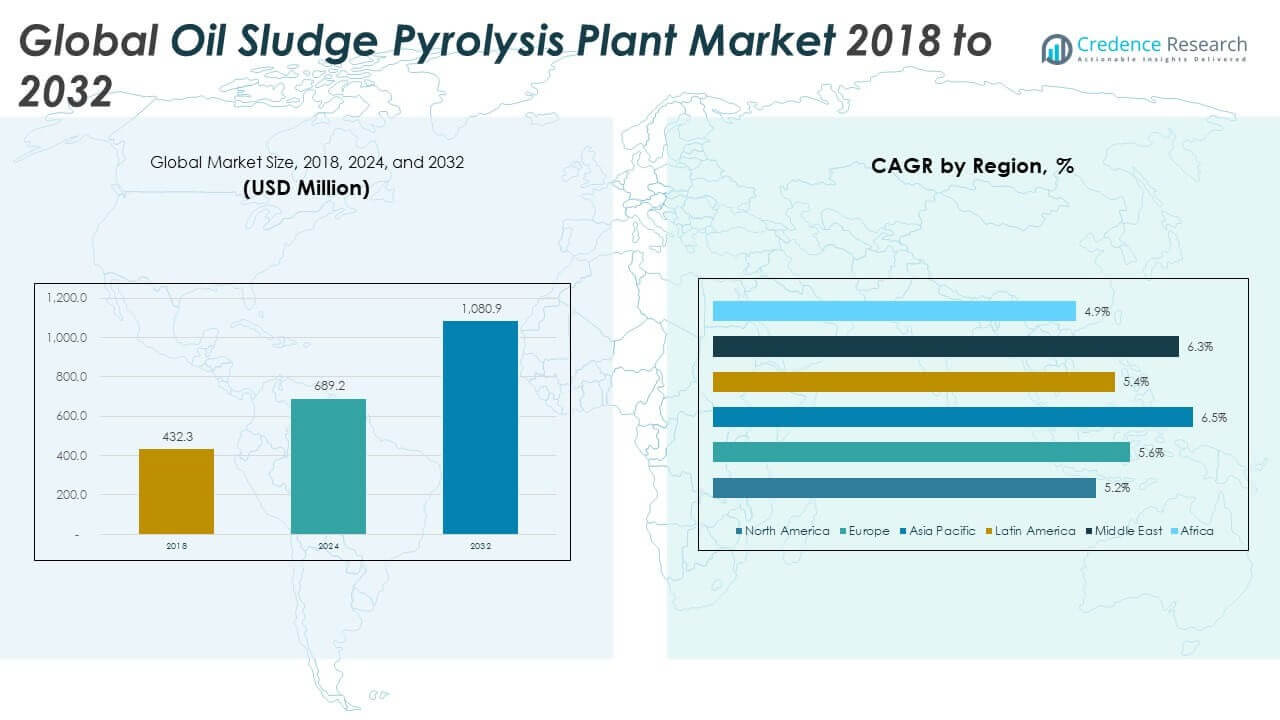
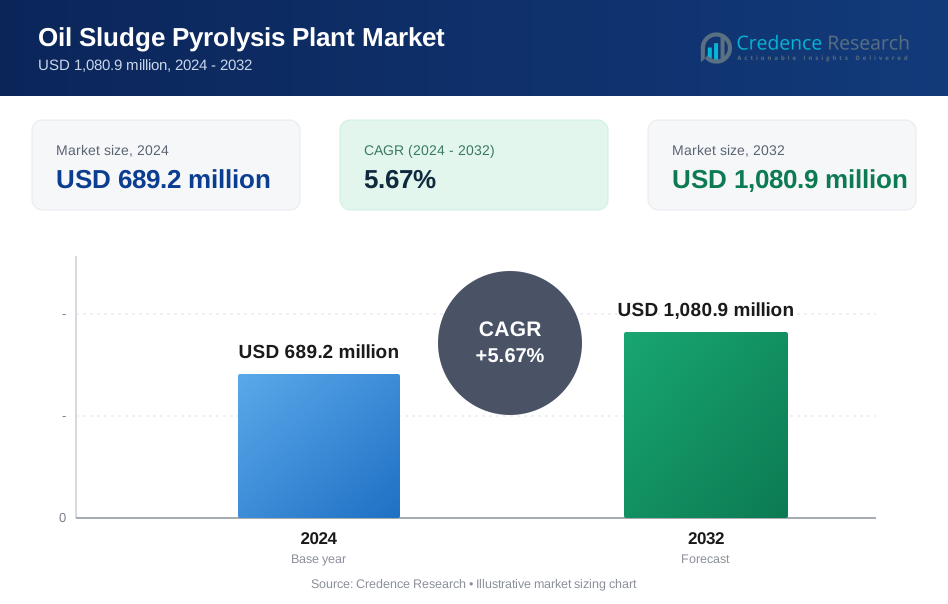
The Global Oil Sludge Pyrolysis Plant Market size was valued at USD 432.3 million in 2018 to USD 689.2 million in 2024 and is anticipated to reach USD 1,080.9 million by 2032, at a CAGR of 5.67% during the forecast period.
| REPORT ATTRIBUTE | DETAILS |
|---|---|
| Historical Period | 2020-2023 |
| Base Year | 2024 |
| Forecast Period | 2025-2032 |
| Oil Sludge Pyrolysis Plant Market Size 2024 | USD 689.2 million |
| Oil Sludge Pyrolysis Plant Market, CAGR | 5.67% |
| Oil Sludge Pyrolysis Plant Market Size 2032 | USD 1,080.9 million |
Stringent waste disposal regulations, rising sludge generation from expanding oil production, and growing emphasis on resource recovery are key forces driving market growth. Companies are shifting from traditional landfill and incineration methods to cleaner thermal treatment solutions. Pyrolysis offers an effective way to recover fuel oil, gas, and carbon residue while ensuring environmental compliance. High demand for continuous and automated systems across refinery clusters and drilling zones supports long-term industry adoption. Governments and private operators increasingly invest in sustainable waste technologies that reduce emissions and deliver operational value.
North America leads the market due to advanced refinery infrastructure and early regulatory enforcement, while Europe follows closely with strong policy backing and a mature waste recovery ecosystem. Asia Pacific is the fastest-growing region, driven by industrial growth and high oil sludge volumes in China and India. The Middle East and Latin America are emerging as national oil firms modernize waste treatment systems. Africa remains in early stages of adoption but shows future promise as waste legislation and environmental monitoring improve.
Market Insights:
- The Global Oil Sludge Pyrolysis Plant Market was valued at USD 432.3 million in 2018, reached USD 689.2 million in 2024, and is projected to hit USD 1,080.9 million by 2032, expanding at a CAGR of 5.67% over the forecast period.
- North America led in 2024 with about 31.2% share, supported by strict waste regulations, advanced refinery infrastructure, and early adoption of thermal treatment technologies.
- Europe followed with nearly 29.2% share, driven by strong circular economy policies, high compliance enforcement, and mature hazardous waste recovery systems across key economies.
- Asia Pacific held around 24.8% share and stands as the fastest-growing region, backed by rapid industrial growth, rising oil sludge volumes in China and India, and expanding refinery capacity.
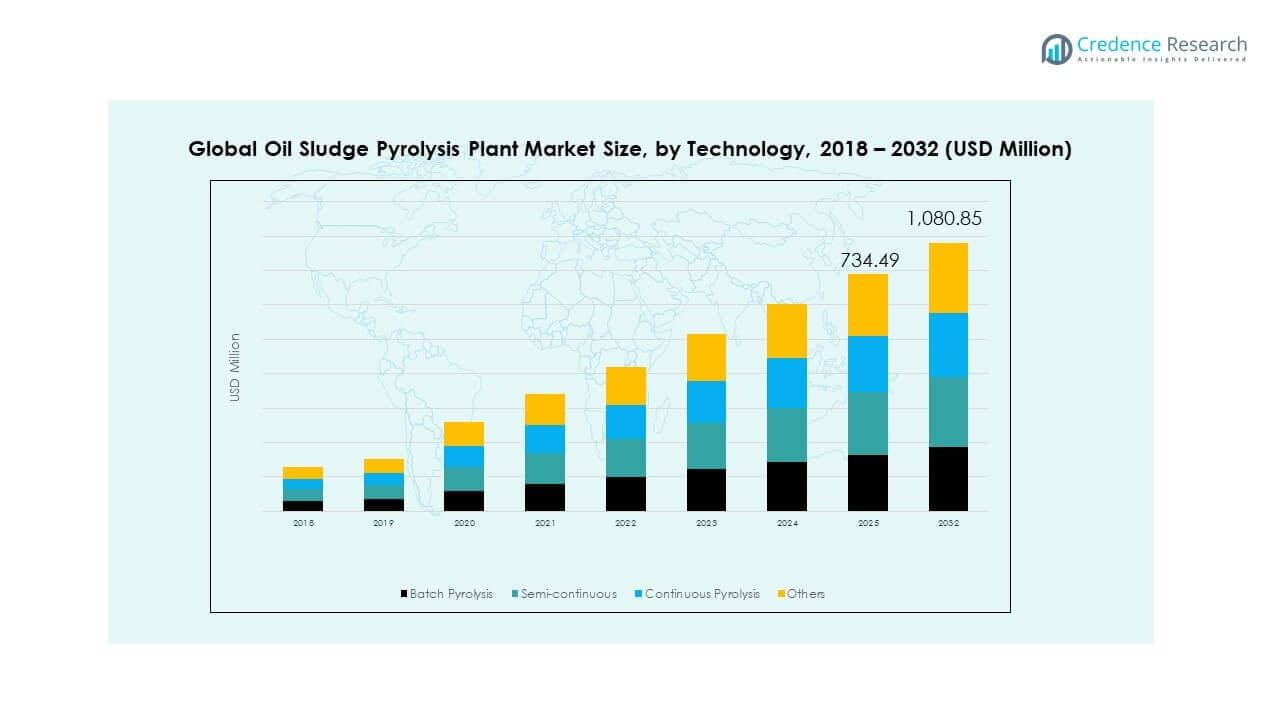
- By technology, continuous pyrolysis accounts for ~38% share, reflecting demand for high-throughput systems, while semi‑continuous (~30%), batch (~18%), and others (~14%) serve flexible, small-scale, and specialized applications.
Market Drivers
Strict Environmental Regulations and Growing Pressure on Waste Disposal Compliance
Governments across major oil-producing nations are enforcing tighter regulations on hazardous waste treatment. Oil sludge, being highly toxic, faces growing restrictions on landfilling and incineration. Companies must now adopt advanced technologies that reduce emissions and enable resource recovery. The Global Oil Sludge Pyrolysis Plant Market gains from this shift, offering a clean and efficient alternative. Pyrolysis helps meet compliance standards while recovering fuel oil and gas. Regulators promote such systems through incentives, especially in Asia and Europe. National oil companies and refineries face mounting scrutiny from environmental watchdogs. It creates sustained demand for safer disposal solutions.
Rising Oil Production and Refining Activities Increasing Sludge Volume
Expanding upstream and downstream operations in developing regions are generating high volumes of oily sludge. Increased refinery throughput and well drilling boost the frequency of waste generation. Sludge buildup directly impacts productivity and requires timely processing. The Global Oil Sludge Pyrolysis Plant Market supports plant operators in reducing environmental liability while monetizing waste. Larger oilfields in China, India, and the Middle East are deploying pyrolysis for continuous sludge handling. Refinery modernization projects also mandate upgraded waste treatment systems. Operators see value in turning sludge into usable fuel or carbon residue. It improves waste economics across all refining stages.
- For instance, GEMCO Energy specializes in biomass pellet production systems, offering rotary drum dryers and pellet mills for processing sawdust, crop straw, and other organic biomass materials in fuel pellet applications.
Higher Emphasis on Resource Recovery and Circular Waste Management
Oil sludge contains hydrocarbons that, when treated correctly, offer recoverable energy. Industry leaders are prioritizing solutions that combine sustainability with economic returns. The Global Oil Sludge Pyrolysis Plant Market responds by enabling circular resource flows. Recovered pyrolysis oil can supplement fuel needs in boilers or furnaces. Many setups also recover carbon black for industrial uses. This dual benefit of waste reduction and energy generation appeals to mid-sized refiners. Global focus on circular economy principles has made recovery-based systems more attractive. It drives installations in both private and public sector oil operations. Regional players are scaling solutions in modular formats.
- For instance, Beston Group’s oil sludge pyrolysis plants use thermal desorption units that preprocess oil sludge with heat and centrifuge‑like steps to reduce moisture and impurities, enabling the system to convert feedstock into pyrolysis oil, syngas, and solid residue.
Increased Government Funding and Public-Private Investments in Green Tech
Countries are deploying clean-tech funds to scale sustainable waste technologies. Public-private partnerships support localized pyrolysis units near oil fields or refineries. The Global Oil Sludge Pyrolysis Plant Market benefits from rising infrastructure grants and pilot deployments. Environmental ministries in emerging economies are underwriting capital costs. Local contractors and technology firms are forming consortia to execute EPC projects. This collaborative model reduces risk and ensures long-term waste management contracts. International development agencies also back eco-safe disposal systems through green bonds. It accelerates technology adoption across regions with legacy sludge disposal challenges.
Market Trends
Adoption of Fully Automated and Modular Skid-Based Pyrolysis Systems
End users demand compact, pre-assembled systems that reduce installation time and cost. Modular plants offer plug-and-play operation with faster commissioning. The Global Oil Sludge Pyrolysis Plant Market is shifting toward containerized solutions that fit constrained sites. Automation systems optimize feedstock processing and reduce manual labor. PLC-controlled units enable consistent temperature and pressure control. Operators prefer real-time monitoring for safe performance and yield tracking. It enhances reliability, especially in remote or mobile deployments. Energy-efficient designs also lower operating costs for mid-scale operators.
- For instance, Niutech Environment Technology Corporation manufactures oil sludge pyrolysis systems that feature integrated automatic control panels for regulating temperature and gas flow. The company’s product documentation highlights automated operation to support stable and controlled sludge treatment processes.
Integration with Sludge Dewatering, Filtration, and Oil Recovery Units
The industry is combining pre-treatment and post-treatment systems for better yield. Dewatering reduces sludge moisture, improving pyrolysis thermal performance. The Global Oil Sludge Pyrolysis Plant Market is seeing uptake in integrated treatment chains. Operators link decanter centrifuges, oil skimmers, and pyrolysis in a continuous loop. This reduces waste residue and maximizes recovered oil. Plants recover up to 30–40% usable oil, depending on sludge composition. It cuts external waste handling and improves resource utilization. End-to-end systems simplify compliance reporting and improve site safety.
Deployment in Offshore Platforms and Remote Oil Fields With Space Constraints
Space limitations and environmental sensitivity drive offshore adoption of compact units. Operators on FPSOs and offshore rigs seek low-footprint solutions for sludge. The Global Oil Sludge Pyrolysis Plant Market is innovating small-scale, enclosed systems with vapor control. Corrosion-resistant materials and anti-leak seals improve offshore suitability. These systems reduce transport of hazardous sludge to shore. They support continuous waste-to-energy conversion at remote wells. It boosts sustainability metrics of offshore E&P operations. Oil majors deploy these systems as part of broader environmental stewardship initiatives.
- For instance, DOING Group offers oil sludge pyrolysis plants in continuous and semi-continuous models that convert sludge into fuel oil, gas, and solid residues. The company has documented customer installations, including multiple 10 TPD stainless steel units operating in China for sludge-to-oil recovery.
Growth of Contracted Waste Management Services Among Refinery Clusters
Third-party service providers now offer sludge pyrolysis as an outsourced solution. Refineries and terminals prefer service-level agreements to manage waste liability. The Global Oil Sludge Pyrolysis Plant Market supports this model through mobile and semi-permanent units. Waste management firms bring in trained crews and manage compliance. It frees up internal resources for plant owners. Local vendors collaborate with OEMs for equipment leasing and maintenance. It creates a recurring revenue model tied to waste generation rates. Cluster-based deployments reduce logistics costs and support regional sludge recovery targets.
Market Challenges Analysis
High Initial Capital Cost and Long Payback Period for Full-Scale Installations
Full-scale pyrolysis plants demand significant upfront investment, especially for continuous processing lines. Costs cover feedstock handling, reactor systems, emission controls, and automation. For smaller refineries and independent operators, these capital needs remain a major deterrent. The Global Oil Sludge Pyrolysis Plant Market faces delay in adoption from firms with limited budgets. Financial viability depends on recovered oil value, utility prices, and regulatory incentives. Uncertain oil prices can impact return on investment calculations. Long payback periods stretch to several years in the absence of external subsidies. It impacts bankability of larger pyrolysis installations. Financing models often require credit guarantees or revenue assurances.
Complex Sludge Feedstock Variability and Process Optimization Issues
Oil sludge properties vary widely across wells, terminals, and refineries. Variations in water, solids, and oil content affect pyrolysis yield. The Global Oil Sludge Pyrolysis Plant Market must overcome issues related to inconsistent feed. Real-time adjustments in reactor temperature and residence time are essential. Failure to optimize can lead to low oil recovery or excess char formation. Operators require skilled personnel to monitor operations. Process optimization tools are still evolving for mixed-waste streams. Inaccurate feedstock pre-treatment also reduces system efficiency. Sludge variability remains a major challenge in scaling operations reliably.
Market Opportunities
Expansion of Oilfield Waste Management Policies in Asia and the Middle East
Governments in India, China, and Saudi Arabia are tightening industrial waste norms. Refineries and drilling operators must deploy in-house or regional sludge treatment systems. The Global Oil Sludge Pyrolysis Plant Market gains from these evolving regulatory mandates. Local OEMs are entering partnerships to deploy region-specific pyrolysis units. Modular units cater to scattered drilling locations. Regional opportunities rise as oil-producing nations push circular disposal practices. It builds vendor pipelines across tier-2 cities and national oil assets.
Emergence of Carbon Credit Incentives for Low-Emission Waste Processing
Policy frameworks are introducing carbon-offset rewards for non-incineration-based waste treatment. Oil sludge pyrolysis emits less CO₂ compared to combustion or landfilling. The Global Oil Sludge Pyrolysis Plant Market stands to benefit from carbon pricing and ESG-linked incentives. Waste processors can monetize carbon savings through verified credits. Investors and operators now explore such projects under green finance models. It supports higher profitability and wider commercial acceptance.
Market Segmentation Analysis:
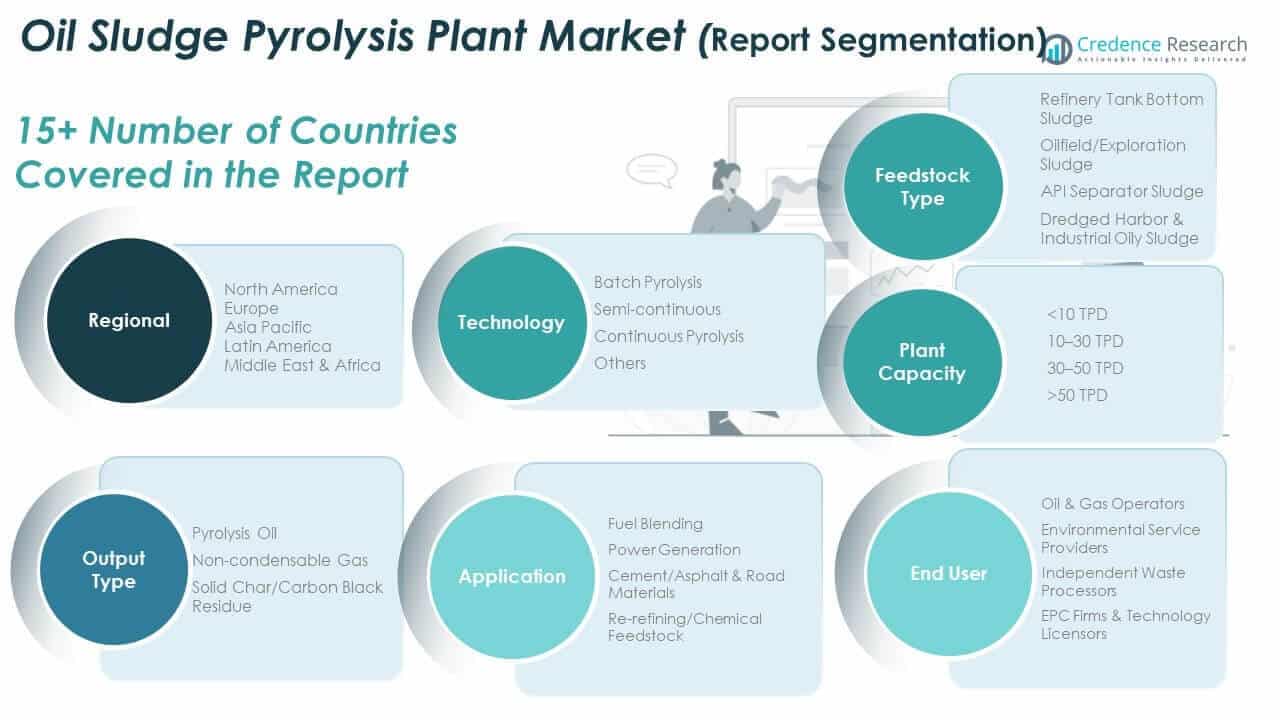
By Feedstock Type
The Global Oil Sludge Pyrolysis Plant Market sees highest demand from refinery tank bottom sludge due to its high oil yield and consistent availability. Oilfield and exploration sludge follows, supported by upstream drilling and production activities. API separator sludge remains critical in centralized treatment setups across refineries. Dredged harbor and industrial oily sludge is an emerging segment driven by environmental cleanup initiatives in coastal and industrial zones.
- For instance, Beston Group’s oil sludge pyrolysis systems are designed to convert processed sludge into fuel oil and syngas, as stated in its official product materials. The company highlights application potential across industrial waste types, including sludge from oil treatment and storage processes.
By Plant Capacity
In terms of capacity, 10–30 TPD units dominate the Global Oil Sludge Pyrolysis Plant Market due to their operational balance and modular design. Plants under 10 TPD serve localized, low-volume waste generators. The 30–50 TPD range appeals to operators scaling up operations. Large-scale systems above 50 TPD are mainly deployed at integrated refinery sites and government-led hazardous waste hubs.
- For instance, Beston Group officially lists the BLJ‑20 integrated pyrolysis–distillation plant as a modular solution combining thermal conversion and oil refining functions, suitable for oil-containing wastes such as sludge and waste lubricants.
By Output Type
Pyrolysis oil is the most valued output in the Global Oil Sludge Pyrolysis Plant Market due to its energy density and reuse in industrial burners and blending. Non-condensable gas supports internal heating within the system, enhancing energy efficiency. Solid char or carbon black residue finds application in filler materials, paving, and resource recovery initiatives.
By Application Fuel blending leads application usage, followed by power generation at waste-to-energy sites. The Global Oil Sludge Pyrolysis Plant Market also supports cement and asphalt plants using by-products for thermal substitution. Re-refining and chemical feedstock applications are increasing as refining techniques advance.
By End User
Oil and gas operators dominate demand, integrating these systems for internal waste treatment. Environmental service providers use mobile units for third-party projects. Independent waste processors target industrial clients. EPC firms and technology licensors deliver turnkey systems in compliance-led regions.
By Technology
Continuous pyrolysis holds the largest market share due to high throughput and automation. Semi-continuous systems offer operational flexibility. Batch pyrolysis plants remain relevant in pilot or small-scale operations. Other technologies include hybrid or containerized variants suited for remote field use.
Segmentation:
By Feedstock Type
- Refinery Tank Bottom Sludge
- Oilfield/Exploration Sludge
- API Separator Sludge
- Dredged Harbor & Industrial Oily Sludge
By Plant Capacity
- <10 TPD
- 10–30 TPD
- 30–50 TPD
- 50 TPD
By Output Type
- Pyrolysis Oil
- Non-condensable Gas
- Solid Char/Carbon Black Residue
By Application
- Fuel Blending
- Power Generation
- Cement/Asphalt & Road Materials
- Re-refining/Chemical Feedstock
By End User
- Oil & Gas Operators
- Environmental Service Providers
- Independent Waste Processors
- EPC Firms & Technology Licensors
By Technology
- Batch Pyrolysis
- Semi-continuous
- Continuous Pyrolysis
- Others
By Region
- North America (U.S., Canada, Mexico)
- Europe (UK, France, Germany, Italy, Spain, Russia, Rest of Europe)
- Asia Pacific (China, Japan, South Korea, India, Australia, Southeast Asia, Rest of Asia Pacific)
- Latin America (Brazil, Argentina, Rest of Latin America)
- Middle East (GCC Countries, Israel, Turkey, Rest of Middle East)
- Africa (South Africa, Egypt, Rest of Africa)
Regional Analysis:
North America
The North America Global Oil Sludge Pyrolysis Plant Market size was valued at USD 138.80 million in 2018 to USD 215.06 million in 2024 and is anticipated to reach USD 324.26 million by 2032, at a CAGR of 5.2% during the forecast period. North America accounts for approximately 31.2% of the global market share in 2024. It benefits from strong regulatory oversight and a well-established oil and gas industry. Major refiners in the U.S. and Canada deploy pyrolysis systems to manage tank bottom sludge and API separator waste efficiently. Investments in clean-tech and waste-to-energy solutions are rising across state and federal levels. Vendors gain traction through fixed-site and mobile installations for upstream and midstream operators. Large-scale projects near refineries and chemical hubs drive demand for high-capacity continuous pyrolysis units. The region also supports R&D efforts to enhance pyrolysis yields and automation. It remains a mature and innovation-driven market for sludge recovery technologies.
Europe
The Europe Global Oil Sludge Pyrolysis Plant Market size was valued at USD 126.83 million in 2018 to USD 201.50 million in 2024 and is anticipated to reach USD 314.53 million by 2032, at a CAGR of 5.6% during the forecast period. Europe holds around 29.2% of the global market share in 2024. Strict environmental rules and circular economy directives fuel adoption across major EU countries. Refineries and petrochemical plants are replacing older incineration units with cleaner pyrolysis-based setups. Countries like Germany, France, and the Netherlands lead installations, supported by favorable waste taxation policies. Local governments fund industrial decarbonization and resource recovery projects, accelerating plant deployment. Integrated waste processors serve both public and private clients through service-based models. Technology licensors and EPC firms actively target the region with turnkey installations. It remains highly regulated and technology-focused with a growing preference for fully automated systems.
Asia Pacific
The Asia Pacific Global Oil Sludge Pyrolysis Plant Market size was valued at USD 102.32 million in 2018 to USD 170.96 million in 2024 and is anticipated to reach USD 284.48 million by 2032, at a CAGR of 6.5% during the forecast period. Asia Pacific captures 24.8% of the global market share in 2024. Rapid industrialization and high sludge volumes in China, India, and Southeast Asia drive market growth. Government-backed waste management mandates and refinery expansions create strong demand for thermal treatment systems. China remains the largest adopter, with local manufacturers offering modular and scalable pyrolysis units. India is increasing investments in refinery waste handling infrastructure across public and private sectors. Southeast Asian nations are deploying pyrolysis solutions to reduce environmental contamination in industrial zones. Local players and OEMs form joint ventures to serve both domestic and export markets. It remains a high-growth region with a strong focus on low-cost, high-efficiency systems.
Latin America
The Latin America Global Oil Sludge Pyrolysis Plant Market size was valued at USD 39.34 million in 2018 to USD 61.77 million in 2024 and is anticipated to reach USD 94.90 million by 2032, at a CAGR of 5.4% during the forecast period. Latin America represents 9.0% of the global market share in 2024. Oil-producing nations like Brazil, Argentina, and Colombia seek effective sludge treatment options for aging infrastructure. Regional refineries face growing environmental enforcement and rising cleanup costs. Pyrolysis offers an alternative to landfill disposal, which faces restrictions in urban zones. Local waste contractors explore mobile and semi-continuous units to serve multiple industrial clients. Government agencies are beginning to integrate pyrolysis into national waste management frameworks. Cross-border partnerships with European and Asian equipment providers support technical upgrades. It offers steady long-term potential as infrastructure modernization gains pace across the region.
Middle East
The Middle East Global Oil Sludge Pyrolysis Plant Market size was valued at USD 13.96 million in 2018 to USD 23.06 million in 2024 and is anticipated to reach USD 37.83 million by 2032, at a CAGR of 6.3% during the forecast period. The region holds 3.3% of the global market share in 2024. National oil companies are driving adoption of pyrolysis plants to handle tank bottom and drilling sludge. Projects align with regional sustainability goals and environmental compliance mandates. Saudi Arabia and the UAE lead activity, with investments in integrated refinery waste recovery systems. Government contracts often include ESG targets that favor thermal conversion over landfilling. Technology licensors secure EPC partnerships for deployment across remote production fields. Modular systems are preferred to reduce logistics complexity in desert or offshore locations. It reflects a transition from conventional waste handling to resource-focused recovery models.
Africa
The Africa Global Oil Sludge Pyrolysis Plant Market size was valued at USD 11.02 million in 2018 to USD 16.84 million in 2024 and is anticipated to reach USD 24.86 million by 2032, at a CAGR of 4.9% during the forecast period. Africa accounts for 2.4% of the global market share in 2024. The market remains early-stage with adoption driven by a few pilot projects in Nigeria, Egypt, and South Africa. National waste policies are evolving to include oil sludge as a priority category. Donor-backed initiatives and public-private models support infrastructure creation in urban oil zones. Vendors focus on small-capacity, mobile systems to manage localized waste volumes. Refinery modernization and expansion projects create long-term demand for pyrolysis-based solutions. Training and technology transfer programs are key to developing local operational capabilities. It holds untapped growth potential as environmental enforcement and investment increase.
Key Player Analysis:
- Beston Group
- DOING Holdings
- Shangqiu Sihai Energy Technology Co., Ltd.
- Weibold
- Ecomation Oy
- Pyrocrat Systems LLP
- Niutech Environment Technology Corporation
- Henan Realtop Machinery Co., Ltd.
- Divya International
- Other Key Players
Competitive Analysis:
The Global Oil Sludge Pyrolysis Plant Market features a mix of global OEMs, regional manufacturers, and turnkey EPC solution providers. Leading players include Beston Group, DOING Holdings, Pyrocrat Systems LLP, and Niutech Environment Technology Corporation. It remains moderately fragmented, with intense competition in Asia and Europe. Companies compete on plant automation, energy efficiency, modularity, and feedstock flexibility. Many firms form partnerships with local waste processors and oil operators to expand market reach. New entrants focus on mobile and small-capacity systems for decentralized applications. Mergers and technology licensing agreements strengthen technical capabilities and international presence. The market continues to attract players aligned with sustainable waste treatment goals and circular economy models. It rewards innovation in continuous systems, integrated recovery solutions, and emission control technologies.
Recent Developments:
- In September 2025, the Beston Group globally launched the BLJ-20 pyrolysis plant, integrating pyrolysis and distillation to process oil sludge into naphtha and non-standard diesel with high capacity and safety.
- In June 2025, Beston Machinery launched the new-generation BLL-30 continuous oil sludge pyrolysis plant, capable of handling 12,000 tons annually to remediate contaminated soil and recover resources.
Report Coverage:
The research report offers an in-depth analysis based on Feedstock Type, Plant Capacity, Output Type, Application, End User, and Technology. It details leading market players, providing an overview of their business, product offerings, investments, revenue streams, and key applications. Additionally, the report includes insights into the competitive environment, SWOT analysis, current market trends, as well as the primary drivers and constraints. Furthermore, it discusses various factors that have driven market expansion in recent years. The report also explores market dynamics, regulatory scenarios, and technological advancements that are shaping the industry. It assesses the impact of external factors and global economic changes on market growth. Lastly, it provides strategic recommendations for new entrants and established companies to navigate the complexities of the market.
Future Outlook:
- Regulatory pressure on hazardous waste disposal will push wider adoption of thermal treatment systems across oil-producing and refining regions worldwide.
- Technology upgrades will focus on higher automation, better emission control, and stable performance across varied sludge compositions.
- Demand will rise for modular and mobile plants that support decentralized oilfields and remote industrial zones.
- Continuous pyrolysis systems will gain preference due to higher throughput, consistent output quality, and lower operational interruptions.
- Resource recovery emphasis will strengthen the role of pyrolysis oil and char in industrial fuel substitution strategies.
- EPC firms will expand turnkey offerings to address compliance, engineering, and long-term maintenance needs.
- Emerging economies will accelerate adoption through public-private waste infrastructure projects and refinery expansions.
- Service-based waste processing models will grow, reducing capital burden for oil and gas operators.
- Integration with pre-treatment and downstream recovery units will improve overall system efficiency and yield.
- Sustainability reporting and ESG mandates will position pyrolysis plants as strategic assets within oil and gas value chains.
Request a Free Sample
Fill in your details and we'll send you a free sample report.
- Sample data tables & charts
- Research methodology
Need a Custom Version of This Report?
Tailor the scope, geography, or segments to your exact requirements.
- Custom geography or segment scope
- Direct access to our analyst team
Frequently Asked Questions
What is the current market size for Global Oil Sludge Pyrolysis Plant Market, and what is its projected size in 2032?
At what Compound Annual Growth Rate is the Global Oil Sludge Pyrolysis Plant Market projected to grow between 2024 and 2032?
Which Global Oil Sludge Pyrolysis Plant Market segment held the largest share in 2024?
What are the primary factors fueling the growth of the Global Oil Sludge Pyrolysis Plant Market?
Who are the leading companies in the Global Oil Sludge Pyrolysis Plant Market?
Which region commanded the largest share of the Global Oil Sludge Pyrolysis Plant Market in 2024?
Table of Content
Chapter 1 Market Segmentation
- 1.1 Segmentation Framework
- 1.1.1 Product and Service Classification
- 1.1.2 Application and End-Use Classification
- 1.1.3 Technology and Solution Classification
- 1.1.4 Customer and Distribution Channel Classification
- 1.1.5 Geographic Segmentation
- 1.1.6 Market Segment Definitions and Boundaries
Chapter 2 Introduction
- 2.1 Report Objectives and Scope
- 2.2 Product Definition and Industry Terminology
- 2.3 Market Inclusions and Exclusions
- 2.4 Research Process
- 2.4.1 Primary Research and Expert Interviews
- 2.4.2 Secondary Research and Source Review
- 2.4.3 Top-Down and Bottom-Up Estimation
- 2.4.4 Data Triangulation and Verification
- 2.5 Market Size Measurement Basis
- 2.5.1 2024: USD 689.2 million → 2032: USD 1,080.9 million
- 2.6 Historical and Forecast Reference Periods
- 2.6.1 Base Year: 2024
- 2.6.2 Forecast Period: 2024-2032
- 2.7 Research Assumptions and Limitations
Chapter 3 Executive Summary
- 3.1 Market Snapshot and Key Findings
- 3.2 Base-Year Market Size, 2024
- 3.3 Forecast Market Size, 2032
- 3.4 Revenue and Volume Growth Outlook
- 3.5 Key Demand and Supply Indicators
- 3.6 Leading Market Segments
- 3.7 Fastest-Growing Market Opportunities
- 3.8 Regional Performance Highlights
- 3.9 Technology and Industry Transformation
- 3.10 Competitive Landscape Summary
- 3.11 Analyst View and Strategic Implications
Chapter 4 Global Oil Sludge Pyrolysis Plant Market Trends and Developments
- 4.1 Historical Industry Development
- 4.2 Recent Market Trends and Developments
- 4.3 Demand and Customer Behavior Trends
- 4.4 Technology and Product Innovation
- 4.5 Artificial Intelligence, Automation and Digitalization
- 4.6 Local Manufacturing and Supply Chain Realignment
- 4.7 Industry Partnerships, Mergers and Acquisitions
- 4.8 Sustainability and Circular Economy Developments
- 4.9 Government and Private Sector Investment Trends
- 4.10 Emerging Business Models and Commercialization
- 4.11 Industry Developments and Announcements
Chapter 5 Global Oil Sludge Pyrolysis Plant Market Production, Supply and Demand Analysis
- 5.1 Demand Trend and Consumption Analysis
- 5.2 Demand Forecast, 2024-2032
- 5.3 Production and Output Trend
- 5.4 Production and Output Forecast, 2024-2032
- 5.5 Installed Capacity and Capacity Utilization
- 5.6 Company-Wise Production Plants and Statistics
- 5.6.1 Installed Production Capacity
- 5.6.2 Actual Production
- 5.6.3 Planned Capacity and Expansion Targets
- 5.7 Supply Chain Structure and Procurement Trends
- 5.8 Supply-Demand Gap and Bottlenecks
- 5.9 Import Dependence and Sourcing Structure
- 5.10 Contract Manufacturing and Outsourcing
- 5.11 Regional Supply and Demand Concentration
Chapter 6 Global Oil Sludge Pyrolysis Plant Market Pricing Analysis
- 6.1 Pricing Structure and Measurement
- 6.2 Historical Pricing Trends
- 6.3 Pricing Outlook, 2024-2032
- 6.4 Average Selling Price and Unit Economics
- 6.5 Pricing by Product and Market Segment
- 6.6 Geographic Pricing Differences
- 6.7 Key Input, Energy, Labor and Logistics Costs
- 6.8 Contract Pricing and Purchasing Models
- 6.9 Pricing Sensitivity and Competitive Positioning
- 6.10 Price, Margin and Profitability Implications
Chapter 7 Global Oil Sludge Pyrolysis Plant Market Dynamics
- 7.1 Market Growth Drivers
- 7.1.1 Demand-Side Drivers
- 7.1.2 Technology and Innovation Drivers
- 7.1.3 Infrastructure and Investment Drivers
- 7.1.4 Regulatory and Policy Drivers
- 7.2 Market Restraints
- 7.2.1 Cost and Affordability Constraints
- 7.2.2 Technology and Adoption Barriers
- 7.2.3 Supply Chain and Operational Constraints
- 7.3 Market Challenges
- 7.3.1 Competitive Pressure and Margin Erosion
- 7.3.2 Skills, Infrastructure and Implementation Gaps
- 7.4 Emerging Market Opportunities
- 7.5 Market Dynamics Impact and Time-Horizon Assessment
Chapter 8 Global Oil Sludge Pyrolysis Plant Value Chain Analysis
- 8.1 Industry Value Chain Overview
- 8.2 Upstream Suppliers and Critical Inputs
- 8.3 Technology and Component Providers
- 8.4 Manufacturing or Service Delivery
- 8.5 Distribution, Channel Partners and Integrators
- 8.6 Downstream Applications and End Users
- 8.7 Value Addition and Profit Pools
- 8.8 Vertical Integration and Outsourcing
- 8.9 Supplier Concentration and Risk
- 8.10 Supply Chain Localization and Resilience
Chapter 9 Global Oil Sludge Pyrolysis Plant Market Regulations and Policies
- 9.1 Relevant Laws, Standards and Compliance Frameworks
- 9.2 Product, Service, Safety and Quality Requirements
- 9.3 Government Policies, Incentives and Subsidies
- 9.4 Imports, Exports and Trade Barriers
- 9.5 Public Procurement and Local Content Requirements
- 9.6 Environmental and Sustainability Compliance
- 9.7 Upcoming Policy Changes and Market Implications
Chapter 10 Global Oil Sludge Pyrolysis Plant Market Hotspots and Opportunities
- 10.1 Market Opportunity Mapping and Growth Hotspots
- 10.2 High-Growth Applications and Customer Groups
- 10.3 Underserved Markets and White-Space Opportunities
- 10.4 Emerging Technology and Product Opportunities
- 10.5 New Capacity and Investment Hotspots
- 10.6 Market Entry and Expansion Opportunities
- 10.7 Distribution and Partnership Opportunities
- 10.8 Near-Term and Long-Term Commercial Potential
- 10.9 Opportunity Attractiveness and Execution Risks
Chapter 11 Global Oil Sludge Pyrolysis Plant Market Outlook, 2024-2032
- 11.1 Market Size and Analysis
- 11.1.1 Revenue (Market Measurement: 2024: USD 689.2 million → 2032: USD 1,080.9 million)
- 11.1.2 Market Volume and Quantity Sold
- 11.1.3 Historical Market Size
- 11.1.4 Base-Year Market Size, 2024
- 11.2 Market Forecast, 2024-2032
- 11.2.1 Revenue Forecast to 2032
- 11.2.2 Volume Forecast to 2032
- 11.2.3 CAGR and Year-on-Year Growth
- 11.2.4 Incremental Revenue Opportunity
- 11.3 Forecast Assumptions and Scenario Analysis
- 11.3.1 Base-Case Forecast
- 11.3.2 Optimistic and Conservative Scenarios
- 11.3.3 Technology, Pricing and Policy Sensitivities
- 11.4 Market Attractiveness and Growth Outlook
Chapter 12 Global Oil Sludge Pyrolysis Plant Market Segmentation and Outlook
- 12.1 Segmentation Summary and Market Shares, 2024
- 12.2 Largest and Fastest-Growing Segments
- 12.3 Segment Growth Comparison
- 12.4 Segment Attractiveness and Priority Matrix
Chapter 13 Global Oil Sludge Pyrolysis Plant Geographic Market Outlook, 2024-2032
- 13.1 Regional Market Size and Share, 2024
- 13.2 Regional Market Forecast, 2024-2032
- 13.3 Regional Pricing, Production and Demand Differences
- 13.4 North America
- 13.4.1 United States
- 13.4.2 Canada
- 13.4.3 Mexico
- 13.5 Europe
- 13.5.1 Germany
- 13.5.2 France
- 13.5.3 Italy
- 13.5.4 United Kingdom
- 13.5.5 Spain
- 13.5.6 Poland
- 13.5.7 Russia
- 13.5.8 Netherlands
- 13.5.9 Belgium
- 13.5.10 Sweden
- 13.5.11 Denmark
- 13.5.12 Norway
- 13.5.13 Rest of Europe
- 13.6 Asia Pacific
- 13.6.1 China
- 13.6.2 India
- 13.6.3 Japan
- 13.6.4 South Korea
- 13.6.5 Thailand
- 13.6.6 Indonesia
- 13.6.7 Vietnam
- 13.6.8 Malaysia
- 13.6.9 Australia
- 13.6.10 Rest of Asia Pacific
- 13.7 Latin America
- 13.7.1 Brazil
- 13.7.2 Argentina
- 13.7.3 Colombia
- 13.7.4 Chile
- 13.7.5 Rest of Latin America
- 13.8 Middle East
- 13.8.1 Saudi Arabia
- 13.8.2 United Arab Emirates
- 13.8.3 Turkey
- 13.8.4 Israel
- 13.8.5 Iran
- 13.8.6 Rest of the Middle East
- 13.9 Africa
- 13.9.1 South Africa
- 13.9.2 Egypt
- 13.9.3 Nigeria
- 13.9.4 Morocco
- 13.9.5 Rest of Africa
- 13.10 Regional Investment, Policy and Supply Chain Differences
- 13.11 Regional Competitive Landscape
- 13.12 Geographic Growth Hotspots
Chapter 14 Global Oil Sludge Pyrolysis Plant Technology, Innovation and Sustainability Outlook
- 14.1 Technology Landscape and Maturity
- 14.2 Product, Process and Service Innovation
- 14.3 AI, Automation and Digital Tools in the Industry
- 14.4 Technology Adoption and Performance Benchmarking
- 14.5 Innovation Pipeline and R&D Investment
- 14.6 Patent and Intellectual Property Trends
- 14.7 Energy Efficiency and Resource Management
- 14.8 Sustainability, Recycling and Circularity
- 14.9 Technology Roadmap, 2024-2032
- 14.10 Risks of Obsolescence and Technology Substitution
Chapter 15 Global Oil Sludge Pyrolysis Plant Market Key Strategic Imperatives
- 15.1 Growth and Market Entry Priorities
- 15.2 High-Return Products and Segments
- 15.3 Pricing, Profitability and Cost Optimization
- 15.4 Technology Investment and Product Differentiation
- 15.5 Supply Chain Localization and Resilience
- 15.6 Distribution and Customer Acquisition
- 15.7 Partnership, Acquisition and Capacity Strategy
- 15.8 Regional Expansion Priorities
- 15.9 Short-, Medium- and Long-Term Actions
Chapter 16 Competition Outlook
- 16.1 Industry Competition Characteristics
- 16.2 Market Structure and Concentration
- 16.3 Market Share and Competitive Positioning, 2024
- 16.4 Company-Wise Revenue and Product Benchmarking
- 16.5 Production and Service Capacity Benchmarking
- 16.6 Technology, Pricing and Differentiation
- 16.7 Regional Footprint and Distribution Strength
- 16.8 Mergers, Acquisitions and Strategic Alliances
- 16.9 New Entrants and Competitive Threats
- 16.10 Porter's Five Forces and Industry Attractiveness
- 16.11 Competitive Outlook, 2024-2032
Chapter 17 Company Profiles
- 17.1 Company Coverage and Selection Criteria
- 17.2 Leading Market Participants – Standard Profile Structure
- 17.2.1 Business Description
- 17.2.2 Company Ownership and Geographic Presence
- 17.2.3 Product and Service Portfolio
- 17.2.4 Manufacturing and Operating Footprint
- 17.2.5 Production Capacity and Expansion Plans
- 17.2.6 Financial Performance and Investment
- 17.2.7 Market Share and Competitive Position
- 17.2.8 Technology and Innovation Capabilities
- 17.2.9 Strategic Alliances or Partnerships
- 17.2.10 Recent Developments
- 17.2.11 Growth Strategy and Outlook
- 17.3 Other Relevant Market Participants
Note: Every listed company is profiled on the structure shown under the first company. The company list is preliminary and may change based on research findings, market developments, data availability and client requirements.
Chapter 18 Disclaimer
- 18.1 Research and Forecast Disclaimer
- 18.2 Data Source and Estimation Limitations
Note: The depth of individual sections depends on data availability for this market. Volume, capacity, trade and other unit-based metrics are included where applicable.