
Market Overviews
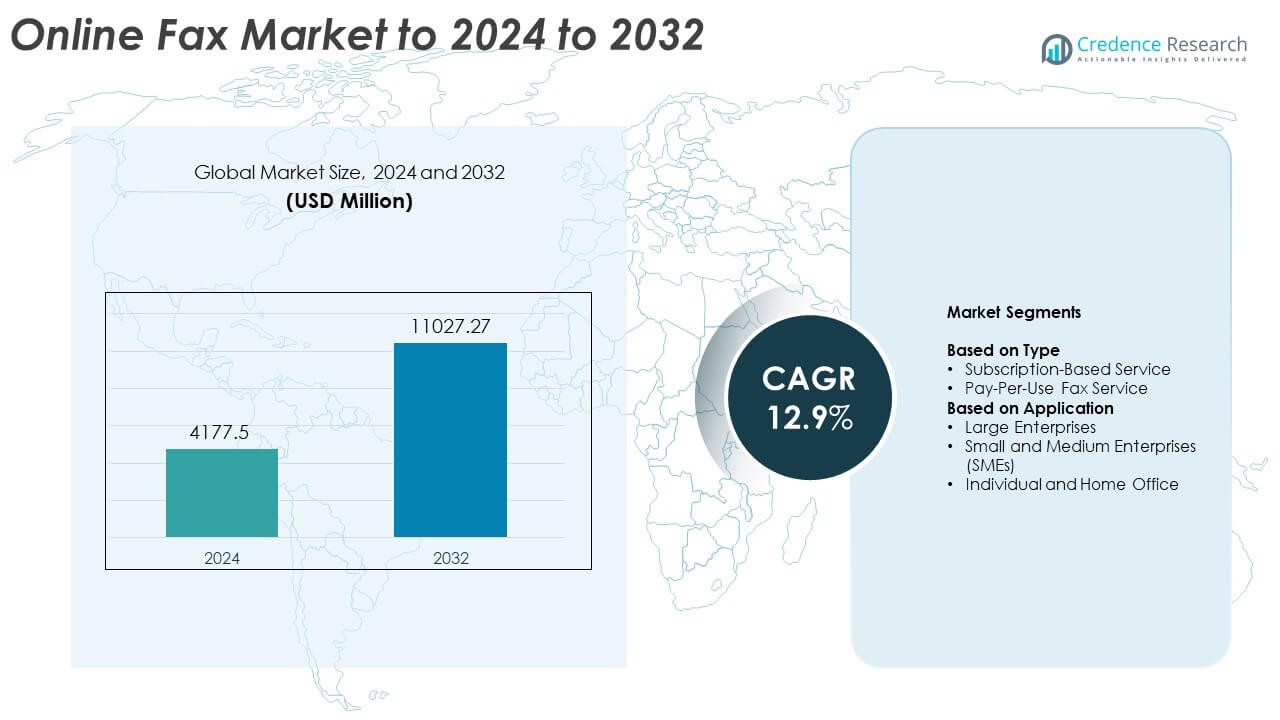
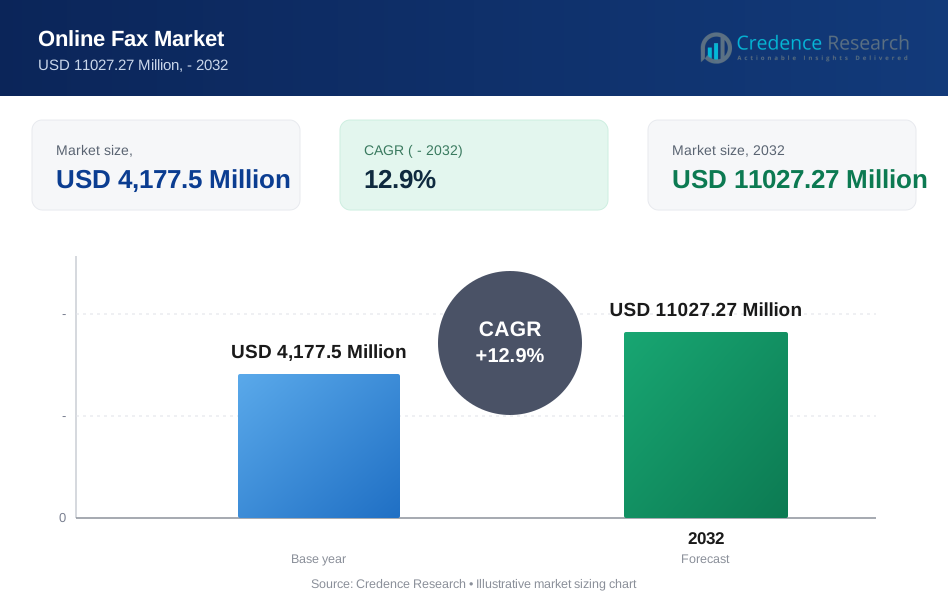
Online Fax Market size was valued at USD 4177.5 Million in 2024 and is anticipated to reach USD 11027.27 Million by 2032, at a CAGR of 12.9% during the forecast period.
| REPORT ATTRIBUTE | DETAILS |
|---|---|
| Historical Period | 2020-2023 |
| Base Year | 2024 |
| Forecast Period | 2025-2032 |
| Online Fax Market Size 2024 | USD 4177.5 Million |
| Online Fax Market, CAGR | 12.9% |
| Online Fax Market Size 2032 | USD 11027.27 Million |
The Online Fax Market is shaped by major providers that offer secure cloud-based fax platforms and integrated workflow features. These vendors focus on encryption, automation, remote access, and multi-device support to meet rising demand across regulated industries and hybrid workplaces. Adoption remains strongest in North America, which leads the market with about 37% share in 2024 due to advanced digital infrastructure and strict compliance needs in healthcare, finance, and government sectors. Europe follows with steady expansion supported by data protection regulations, while Asia Pacific grows rapidly as SMEs and enterprises shift to low-cost cloud fax solutions.
Market Insights
- The Online Fax Market reached USD 4177.5 Million in 2024 and is projected to hit USD 11027.27 Million by 2032, growing at a CAGR of 12.9% during the forecast period.
- Strong market drivers include rising cloud adoption, secure document exchange needs, and increasing demand from healthcare, BFSI, and government sectors that rely on encrypted and compliant workflows.
- Key trends include integration with CRM and workflow tools, AI-based automation, OCR enhancement, and rapid adoption among SMEs seeking low-cost digital communication models.
- Competition intensifies as vendors enhance encryption, API capabilities, and automation while offering flexible subscription plans to expand reach across enterprise and SME segments.
- North America leads with about 37% share in 2024, followed by Europe at 28%, while Asia Pacific grows fastest with 22%; by type, subscription-based services hold nearly 63% share, and large enterprises lead applications with about 52% share.
Market Segmentation Analysis:
By Type
Subscription-Based Service leads this segment with about 63% share in 2024. Companies prefer subscription plans because they offer predictable monthly billing, unlimited or high-volume faxing, and seamless integration with cloud platforms. Growth accelerates as enterprises shift from legacy fax servers to digital inbox solutions that support encryption and remote access. Pay-per-use services grow at a steady pace due to rising adoption among occasional users and freelancers, especially in markets where businesses send limited documents but still require secure transmission.
- For instance, eFax Corporate reports that it has securely faxed hundreds of millions of pages since 2000 for customers sending and receiving faxes directly from email and integrated business systems.
By Application
Large Enterprises dominate this segment with nearly 52% share in 2024. These organizations adopt online fax solutions to manage high document volumes, comply with data protection laws, and streamline communication across global offices. Adoption rises in industries such as healthcare, BFSI, and government where secure and traceable document workflows remain essential. Small and Medium Enterprises expand rapidly as cloud fax platforms reduce hardware costs. Individual and home office users maintain modest growth due to light usage and flexible digital alternatives.
- For instance, Retarus Cloud Fax Platform now carries more than 3 million fax pages per month for a top health insurance provider that retired over ten on-premises fax servers during its move to a compliant cloud fax environment.
Key Growth Drivers
Rising Shift Toward Cloud-Based Communication
Cloud deployment drives strong adoption as organizations replace traditional fax machines with online platforms that support remote access, encryption, and centralized storage. The model reduces hardware costs and maintenance, which motivates both enterprises and SMEs to transition. This shift expands further as regulated industries seek secure and compliant transmission systems for documents. Many companies also adopt cloud fax tools to simplify workflow integration with CRM, ERP, and email systems, which creates long-term demand.
- For instance, etherFAX supports the University of Illinois Hospital & Health Sciences System in sending more than 1 million faxes per year while cutting its legacy fax infrastructure footprint roughly in half through a cloud-connected architecture.
Increasing Compliance Needs in Regulated Sectors
Industries such as healthcare, finance, insurance, and government rely on online faxing to meet strict compliance rules related to document privacy and traceability. These platforms ensure encrypted transmission, detailed audit logs, and legally recognized document validation. Rising data protection mandates push organizations to abandon insecure methods and adopt certified fax solutions. Growth strengthens as global regulations widen, leading enterprises to prioritize secure communication frameworks across distributed teams and remote operations.
- For instance, a top-10 global investment bank upgraded its operations by centralizing its fax infrastructure with Upland AccuRoute CloudFAX, consolidating services from 6 disparate fax providers into one cloud system.
Growing Adoption of Remote and Hybrid Work Models
Remote work expansion fuels demand for online fax tools that enable employees to send and receive documents from any device without physical hardware. Hybrid teams need real-time access, multi-device synchronization, and seamless collaboration, which online fax services deliver. Companies choose digital faxing to maintain operational continuity and avoid delays caused by on-site equipment. As remote work policies become permanent, demand rises across sectors that require fast and secure document exchange.
Key Trends and Opportunities
Integration of Faxing with Business Workflow Tools
A major trend involves integrating fax services with workflow platforms such as email suites, document management tools, and enterprise applications. This improves process efficiency by allowing users to send documents directly from familiar systems. Automation features, such as scheduled faxing and auto-routing to cloud folders, create new opportunities for vendors. Businesses increasingly adopt these integrated systems to reduce manual work and speed up high-volume communication.
- For instance, H2O.ai reports that UCSF Health processes more than 1.4 million faxed documents annually with its Document AI platform, freeing clinicians and staff from over 25,000 hours of manual document review and routing work
Expanding Use of AI and Automation in Fax Processing
AI-based OCR, automated sorting, and intelligent routing transform how companies handle incoming fax documents. These tools reduce human error and accelerate document processing in sectors that manage large volumes, such as healthcare or insurance. Automation opens new opportunities for vendors to offer value-added services that enhance accuracy and cut operational costs. This trend gains momentum as enterprises shift toward digital transformation strategies.
- For instance, H2O.ai reports that UCSF Health processes more than 1.4 million faxed documents annually with its Document AI platform, freeing clinicians and staff from over 25,000 hours of manual document review and routing work.
Growing Opportunity in SME Digital Adoption
SMEs adopt online fax platforms as they move away from costly in-house fax servers and outdated machines. These businesses seek affordable, flexible plans that scale with their communication needs. Vendors find strong growth potential by offering simple interfaces, pay-as-you-go models, and integrated security features. Expansion in emerging markets further boosts this opportunity as SMEs increase their digital presence.
Key Challenges
Data Security Concerns and Cyber Risks
Despite secure protocols, some organizations remain cautious about transmitting sensitive documents over cloud-based systems. Concerns arise over unauthorized access, data breaches, and compliance with regional privacy rules. Vendors must invest heavily in encryption, multi-factor authentication, and secure storage to maintain trust. These requirements create operational challenges, especially when competing against low-cost providers with weaker security frameworks.
Resistance from Legacy System Users
A portion of businesses still depend on physical fax machines due to internal habits, workflow rigidity, or regulatory interpretations. Transitioning to digital faxing requires training, integration work, and policy updates. Some industries also face compatibility issues when aligning new systems with legacy infrastructure. This resistance slows market expansion and forces vendors to offer hybrid solutions that bridge traditional and digital fax environments.
Regional Analysis
North America
North America holds about 37% share of the Online Fax Market in 2024. Growth remains strong as enterprises in healthcare, finance, insurance, and government adopt secure faxing to meet regulatory demands. High cloud adoption and mature digital infrastructure support rapid upgrades from traditional machines to integrated cloud platforms. Remote and hybrid work policies further increase usage across the United States and Canada. Vendors expand encryption features and workflow automation to meet enterprise needs, helping the region maintain a leading position during the forecast period.
Europe
Europe accounts for nearly 28% share of the Online Fax Market. Strict data protection laws increase adoption in countries such as Germany, France, and the United Kingdom. Businesses shift to digital faxing to comply with GDPR and sector-specific requirements, especially in banking, legal, and public service environments. Cloud-based solutions grow as companies prioritize secure document workflows across distributed teams. Rising digital transformation programs in Western and Northern Europe continue to support steady market expansion.
Asia Pacific
Asia Pacific holds around 22% share and represents the fastest-growing region in the market. Expansion is driven by rising SME digital adoption, rapid cloud deployment, and growing demand from healthcare and manufacturing sectors. Companies in China, Japan, South Korea, and India choose online faxing to cut hardware costs and streamline communication across multi-location operations. Increasing internet penetration and digital business reforms fuel growth, while vendors introduce low-cost subscription models suited for emerging markets.
Latin America
Latin America captures about 8% share of the Online Fax Market. Adoption rises as businesses in Brazil, Mexico, and Chile upgrade from outdated fax machines to cloud platforms. SMEs drive much of the new demand due to flexible pricing models and reduced maintenance needs. Digital communication policies and stronger data protection frameworks also improve market readiness. Growth remains moderate but steady as enterprises adopt hybrid work models and seek secure document exchange systems.
Middle East and Africa
Middle East and Africa hold nearly 5% share of the market. Adoption increases gradually as government agencies, financial institutions, and healthcare providers explore digital faxing for secure document workflows. The United Arab Emirates and Saudi Arabia lead regional demand due to strong digital transformation efforts. Infrastructure limitations in some African markets slow adoption, but rising cloud investments and expansion of managed service providers create long-term potential. Vendors target the region with scalable cloud-based fax solutions suited for growing enterprises.
Market Segmentations:
By Type
- Subscription-Based Service
- Pay-Per-Use Fax Service
By Application
- Large Enterprises
- Small and Medium Enterprises (SMEs)
- Individual and Home Office
By Geography
- North America
- U.S.
- Canada
- Mexico
- Europe
- Germany
- France
- U.K.
- Italy
- Spain
- Rest of Europe
- Asia Pacific
- China
- Japan
- India
- South Korea
- South-east Asia
- Rest of Asia Pacific
- Latin America
- Brazil
- Argentina
- Rest of Latin America
- Middle East & Africa
- GCC Countries
- South Africa
- Rest of the Middle East and Africa
Competitive Landscape
The Online Fax Market features key players such as Softlinx Inc., Nextiva, RingCentral, Inc., Concord Technologies, Amplify Ventures Ltd., Ooma, Inc., RedSail Technologies, LLC, Cloud Worldwide Services, Open Text Corporation, and Consensus Cloud Solutions Inc. These companies compete by expanding cloud-based fax platforms that support secure document transmission and real-time access across devices. Vendors focus on encryption upgrades, workflow automation, and API integration to strengthen adoption among large enterprises and SMEs. Competitive intensity increases as providers introduce flexible subscription plans and AI-enabled processing tools to boost accuracy and reduce manual workloads. Many firms enhance compliance features to meet healthcare, finance, and government standards. Growth also accelerates through partnerships with software ecosystems, allowing fax systems to integrate with email, CRM, and document management platforms. Companies invest in scalable cloud infrastructure to support remote and hybrid teams, helping the market maintain strong momentum across global regions.
Key Player Analysis
- Softlinx Inc.
- Nextiva
- RingCentral, Inc.
- Concord Technologies
- Amplify Ventures Ltd.
- Ooma, Inc.
- RedSail Technologies, LLC
- Cloud Worldwide Services
- Open Text Corporation
- Consensus Cloud Solutions Inc.
Recent Developments
- In 2025, Concord Technologies introduced new AI-powered data capture and document management capabilities in its Cloud Fax service, enhancing the way organizations process and route incoming documents.
- In 2025, Cloud Worldwide Services continued to expand its online fax solutions, emphasizing integration with cloud platforms, improved security, and cross-platform support for remote and hybrid work environments.
- In 2023, Amplify Ventures Ltd., known simply as Amplify, operates a modern communications platform designed for regulated industries that includes a HIPAA-compliant cloud fax and document exchange solution.
Report Coverage
The research report offers an in-depth analysis based on Type, Application and Geography. It details leading market players, providing an overview of their business, product offerings, investments, revenue streams, and key applications. Additionally, the report includes insights into the competitive environment, SWOT analysis, current market trends, as well as the primary drivers and constraints. Furthermore, it discusses various factors that have driven market expansion in recent years. The report also explores market dynamics, regulatory scenarios, and technological advancements that are shaping the industry. It assesses the impact of external factors and global economic changes on market growth. Lastly, it provides strategic recommendations for new entrants and established companies to navigate the complexities of the market.
Future Outlook
- Online fax platforms will gain wider adoption as enterprises replace legacy fax machines.
- Cloud-based faxing will expand as companies prioritize secure and flexible document transmission.
- AI-driven automation will improve document sorting, extraction, and routing for high-volume sectors.
- Remote and hybrid work models will continue to boost demand for multi-device fax access.
- Compliance needs in healthcare, finance, and government will drive stronger security features.
- Integration with CRM, ERP, and workflow tools will become a standard expectation among users.
- SMEs will increasingly adopt cost-efficient digital fax plans as digital maturity rises.
- Global vendors will expand low-cost subscription models for emerging markets.
- Encryption and authentication upgrades will strengthen user confidence and reduce cyber risks.
- API-based faxing will grow as businesses automate larger parts of their communication workflows.
Request a Free Sample
Fill in your details and we'll send you a free sample report.
- Sample data tables & charts
- Research methodology
Need a Custom Version of This Report?
Tailor the scope, geography, or segments to your exact requirements.
- Custom geography or segment scope
- Direct access to our analyst team
Frequently Asked Questions
What is the current market size for Online Fax Market, and what is its projected size in 2032?
At what Compound Annual Growth Rate is the Online Fax Market projected to grow between 2025 and 2032?
Which Online Fax Market segment held the largest share in 2024?
What are the primary factors fueling the growth of the Online Fax Market?
Who are the leading companies in the Online Fax Market?
Which region commanded the largest share of the Online Fax Market in 2024?
Table of Content
Chapter 1. Report Introduction
- 1.1 Report Description & Purpose
- 1.1.1 Report Title & Market Definition
- 1.1.2 Unique Selling Propositions (USP) & Key Differentiators
- 1.1.3 Value Proposition for Stakeholders
- 1.2 Research Objectives
- 1.2.1 Market Sizing Objectives (Volume & Revenue)
- 1.2.2 Segmentation Objectives
- 1.2.3 Competitive Intelligence Objectives
- 1.2.4 Forecast & Scenario Objectives
- 1.3 Report Scope
- 1.3.1 Online Fax Scope – Types & Subtypes Covered
- 1.3.2 Geographic Scope – Regions & Countries Covered
- 1.3.3 Historical Period, Base Year & Forecast Period (the historical period; forecast to 2032)
- 1.3.4 Inclusions & Exclusions
- 1.4 HS Code & Classification Framework
- 1.5 Currency, Units & Pricing Basis
- 1.6 Target Stakeholders
- 1.7 Limitations & Assumptions
Chapter 2. Executive Summary
- 2.1 Global Online Fax Market Snapshot
- 2.1.1 Market Size – Historical (the historical period) & Forecast (2032) (base year: USD 4,177.5 Million → 2032: USD 11027.27 Million)
- 2.1.2 Volume & Revenue – Global Totals
- 2.1.3 Key Market Highlights – Top Five Facts
- 2.2 Online Fax Market Segmentation Snapshot
- 2.2.1 Market Split by Region – vs. 2032
- 2.3 Competitive Snapshot
- 2.3.1 Top 10 Players by Revenue Share –
- 2.3.2 Top 10 Players by Volume Share –
- 2.3.3 Recent Strategic Developments (18-Month Summary)
- 2.4 Key Investment Highlights & Strategic Conclusions
Chapter 3. Online Fax Market Dynamics & Industry Analysis
- 3.1 Market Overview & Context
- 3.1.1 Online Fax Market Position in the Broader Automotive Value Chain
- 3.1.2 OEM vs. Replacement Market Dynamics
- 3.1.3 Market Maturity & Development Stage by Region
- 3.2 Online Fax Market Drivers
- 3.3 Online Fax Market Restraints & Challenges
- 3.4 Online Fax Market Opportunities
- 3.5 Porter's Five Forces Analysis
- 3.5.1 Threat of New Entrants
- 3.5.2 Bargaining Power of Suppliers
- 3.5.3 Bargaining Power of Buyers
- 3.5.4 Threat of Substitutes
- 3.5.5 Competitive Rivalry – Intensity Assessment
- 3.6 Online Fax Value Chain Analysis
- 3.6.1 Upstream – Raw Material/Input Suppliers
- 3.6.1.1 Raw Material/Input 1
- 3.6.1.2 Raw Material/Input 2
- 3.6.1.3 Raw Material/Input 3
- 3.6.2 Midstream – Production/Manufacturing/Service Delivery
- 3.6.2.1 Production/Process Overview
- 3.6.2.2 Key Facility Locations & Capacity by Manufacturer
- 3.6.3 Downstream – Distribution & End Consumer
- 3.6.3.1 Primary Channel – B2B/OEM
- 3.6.3.2 Secondary Channels – Dealer, Retail, Online, Direct
- 3.6.4 Value Chain Profitability Analysis
- 3.6.1 Upstream – Raw Material/Input Suppliers
- 3.7 PESTEL Analysis
- 3.7.1 Political Factors
- 3.7.2 Economic Factors
- 3.7.3 Social Factors
- 3.7.4 Technological Factors
- 3.7.5 Environmental Factors
- 3.7.6 Legal Factors
- 3.8 Online Fax Supply Chain Analysis
- 3.8.1 Raw Material/Input Supply Risk Assessment
- 3.8.2 Manufacturing Concentration Risk (Geographic Exposure)
- 3.8.3 Trade Disruption Impact Analysis
- 3.9 Regulatory & Policy Landscape
Note: The regulatory and policy landscape section covers regulations based on their applicability to the market, Online Fax category, geography, and scope of the study. Only regulatory frameworks with a material impact on operations, compliance, trade, sustainability, or market access are analyzed in detail.
Chapter 4. Key Investment Pockets & Opportunity Analysis
- 4.1 Online Fax Market Attractiveness Analysis
- 4.1.1 By Region – Investment Attractiveness Matrix (Volume × CAGR)
- 4.2 Absolute Revenue Growth Opportunity
- 4.2.1 By Region – Absolute USD Growth Through 2032
- 4.3 Incremental Volume Opportunity
- 4.3.1 By Region – Incremental Volume Through 2032
- 4.3.2 Segment – Incremental Volume
- 4.4 Emerging Submarket Opportunity Deep Dive (Subject to Applicability)
- 4.5 Emerging Market Opportunity Scorecards
- 4.5.1 United States
- 4.5.2 Europe
- 4.5.3 Asia
- 4.5.4 Middle East & Africa
Note: Emerging Market Opportunity Scorecards will be included based on relevance and strategic importance. Regions listed are indicative and may vary depending on data availability and market dynamics.
Chapter 5. Online Fax Import-Export Analysis & Trade Flows
- 5.1 Global Trade Overview
- 5.1.1 Global Export Value by Country (the historical period)
- 5.1.2 Global Export Volume by Country (the historical period)
- 5.1.3 Global Import Value by Country (the historical period)
- 5.1.4 Global Import Volume by Country (the historical period)
- 5.1.5 Net Trade Balance by Country (the historical period)
- 5.2 Export Analysis – Segment
- 5.2.1 Type 1 (HS Code)
- 5.2.2 Type 2 (HS Code)
- 5.2.3 Type 3 (HS Code)
- 5.2.4 Type 4 (HS Code)
- 5.2.5 Type 5 (HS Code)
- 5.3 Import Analysis – Segment
- 5.3.1 Type 1 (HS Code)
- 5.3.2 Type 2 (HS Code)
- 5.3.3 Type 3 (HS Code)
- 5.3.4 Type 4 (HS Code)
- 5.3.5 Type 5 (HS Code)
- 5.4 Average Unit Trade Prices
- 5.4.1 Average Export Price – Segment & Country
- 5.4.2 Average Import Price – Segment & Source Country
- 5.4.3 Price Trends (the historical period)
- 5.5 Key Trade Route Analysis
- 5.5.1 Trade Route 1
- 5.5.2 Trade Route 2
- 5.5.3 Trade Route 3
- 5.5.4 Trade Route 4
- 5.5.5 Trade Route 5
- 5.6 Trade Policy Impact Assessment
- 5.6.1 US Anti-Dumping & Section 301 Tariffs
- 5.6.2 EU Customs Union Impact
- 5.6.3 Major Free Trade Agreements
- 5.6.4 USMCA Rules of Origin
Note: Trade policy analysis will be included only where relevant to the Online Fax market.
Chapter 6. Competitive Landscape & Company Benchmarking
- 6.1 Online Fax Market Concentration & Structure
- 6.1.1 Herfindahl-Hirschman Index (HHI) – vs.
- 6.1.2 Tier 1, Tier 2 & Tier 3 Market Structure
- 6.1.3 Global, Regional & Local Player Dynamics
- 6.2 Online Fax Market Share Analysis –
- 6.2.1 Global Revenue Share by Company
- 6.2.2 Global Volume Share by Company
- 6.2.3 Regional Revenue Share
- 6.2.4 Market Share Evolution ( vs. )
- 6.2.5 OEM Segment Share by Company
- 6.2.6 Replacement Segment Share by Company
- 6.3 Production/Delivery Capacity & Facility Analysis
- 6.3.1 Global Installed Capacity
- 6.3.2 Capacity Utilization Rates
- 6.3.3 Production/Output Volume
- 6.3.4 Facility Locations & Capacity Map
- 6.3.5 Planned Capacity Additions
- 6.4 Online Fax Competitive Benchmarking Matrix
- 6.4.1 Revenue, Volume, CAGR & Profitability Comparison
- 6.4.2 Channel Revenue Mix
- 6.4.3 Geographic Revenue Exposure
- 6.4.4 R&D Intensity
- 6.4.5 Sustainability Maturity
- 6.5 Strategic Developments in Online Fax (Last 24 Months)
- 6.5.1 Mergers, Acquisitions & Divestments
- 6.5.2 New Online Fax Launches
- 6.5.3 Facility Expansions
- 6.5.4 Strategic Alliances, Joint Ventures & Partnerships
- 6.5.5 Distribution Expansion & Market Entry
- 6.5.6 Sustainability & ESG Initiatives
- 6.6 Competitive Strategy Mapping
- 6.6.1 Leader, Challenger, Follower & Niche Classification
- 6.6.2 Pricing Strategy Comparison
- 6.6.3 Channel Strategy Matrix
Note: Strategic developments are included based on their materiality and the availability of reliable information.
Chapter 7. Global Online Fax Market – By Distribution Channel
- 7.1 Segment Overview
- 7.1.1 Volume & Revenue Split by Channel ( & 2032)
- 7.1.2 Channel Mix Evolution (2032)
Chapter 8. Regional Market Analysis – Global Overview
- 8.1 Global Regional Overview
- 8.1.1 Regional Volume Share
- 8.1.2 Regional Revenue Share
- 8.1.3 Regional Volume by Region
- 8.1.4 Regional Revenue by Region
- 8.1.5 Regional Forecast Through 2032
- 8.2 Cross-Regional Segment Analysis
- 8.2.1 By Distribution Channel
- 8.2.2 By Brand/Price Tier
Chapter 9. North America Online Fax Market
- 9.1 United States
- 9.2 Canada
- 9.3 Mexico
Chapter 10. Europe Online Fax Market
- 10.1 Germany
- 10.2 France
- 10.3 Italy
- 10.4 United Kingdom
- 10.5 Spain
- 10.6 Poland
- 10.7 Russia
- 10.8 Netherlands
- 10.9 Belgium
- 10.10 Sweden
- 10.11 Denmark
- 10.12 Norway
- 10.13 Rest of Europe
Chapter 11. Asia Pacific Online Fax Market
- 11.1 China
- 11.2 India
- 11.3 Japan
- 11.4 South Korea
- 11.5 Thailand
- 11.6 Indonesia
- 11.7 Vietnam
- 11.8 Malaysia
- 11.9 Australia
- 11.10 Rest of Asia Pacific
Chapter 12. Latin America Online Fax Market
- 12.1 Brazil
- 12.2 Argentina
- 12.3 Colombia
- 12.4 Chile
- 12.5 Rest of Latin America
Chapter 13. Middle East Online Fax Market
- 13.1 Saudi Arabia
- 13.2 United Arab Emirates
- 13.3 Turkey
- 13.4 Israel
- 13.5 Iran
- 13.6 Rest of the Middle East
Chapter 14. Africa Online Fax Market
- 14.1 South Africa
- 14.2 Egypt
- 14.3 Nigeria
- 14.4 Morocco
- 14.5 Rest of Africa
Chapter 15. Online Fax Company Profiles
- 15.1 [Company 01]
- 15.1.1 Company Overview
- 15.1.2 Key Management Personnel
- 15.1.3 Products & Services Portfolio
- 15.1.4 Financial Performance
- 15.1.5 Key Market Focus & Geographic Presence
- 15.1.6 Recent Developments & Strategic Initiatives
Note: The company profile list is preliminary and may change based on research findings, market developments, data availability, and client requirements.
Chapter 16. Appendices
- Appendix A – List of Abbreviations & Acronyms
- Appendix B – Industry Classification Code Reference – Full Series
- Appendix C – Production & Capacity Data Tables
- Appendix D – End-Use & Demand Base Tables
- Appendix E – Consumption & Replacement Rate Assumptions
- Appendix F – ASP Reference Tables
- Appendix G – Manufacturing & Facility Database
- Appendix H – Import-Export Data Tables
- Appendix I – Regulatory Summary Tables
- Appendix J – Primary Research Participant List (Anonymized)
- Appendix K – Primary Research Questionnaire Framework
- Appendix L – Data Sources & Bibliography
- Appendix M – Market Size Divergence & Source Comparison
Chapter 17. Research Methodology
- 17.1 Research Framework & Philosophy
- 17.2 Secondary Research – Sources, Hierarchy & Data Extraction
- 17.3 Data Modeling – Bottom-Up & Top-Down Market Sizing
- 17.4 Primary Research – Stakeholder Framework, LOI & Sample Sizes
- 17.5 Forecast Methodology – Regression, Scenario & Sensitivity Analysis
- 17.6 Quality Control – Four-Layer Validation Framework
- 17.7 Limitations & Standard Assumptions
- 17.8 Disclaimer
