Market Overview:
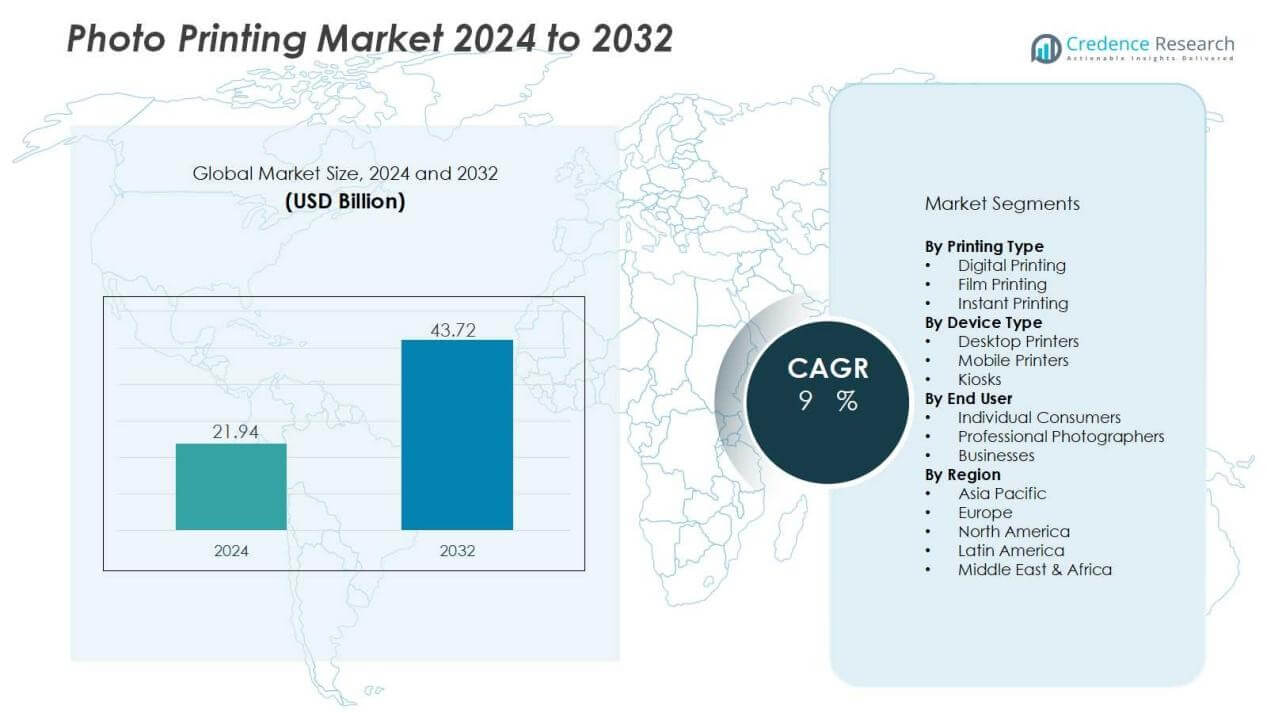
The photo printing market size was valued at USD 21.94 billion in 2024 and is anticipated to reach USD 43.72 billion by 2032, at a CAGR of 9% during the forecast period (2024-2032).
| REPORT ATTRIBUTE | DETAILS |
|---|---|
| Historical Period | 2020-2023 |
| Base Year | 2024 |
| Forecast Period | 2025-2032 |
| Photo Printing Market Size 2024 | USD 21.94 Billion |
| Photo Printing Market, CAGR | 9% |
| Photo Printing Market Size 2032 | USD 43.72 Billion |
Key drivers include rising interest in customized photo merchandise such as photo books, calendars, and canvases. The shift from traditional printing to digital and on-demand solutions has enhanced convenience and affordability for consumers. Advancements in printing technologies, including inkjet and dye-sublimation, deliver improved quality, while integration with social media platforms fuels higher order volumes. Businesses also leverage photo printing for marketing and branding, adding to demand.
Regionally, North America leads due to strong e-commerce penetration, advanced printing infrastructure, and high consumer spending on personalized products. Europe follows, supported by lifestyle trends emphasizing memory preservation and aesthetic displays. Asia-Pacific is the fastest-growing region, driven by rising disposable incomes, smartphone penetration, and expanding digital platforms in countries like China and India. Latin America and the Middle East & Africa show gradual adoption, fueled by growing online retail access and increasing digital literacy.
 Market Insights:
- The photo printing market was valued at USD 21.94 billion in 2024 and is expected to reach USD 43.72 billion by 2032 at a CAGR of 9%.
- Rising demand for personalized photo products such as books, calendars, and canvases continues to drive growth.
- Advancements in digital printing technologies including inkjet and dye-sublimation improve image quality, durability, and turnaround times.
- Integration with online platforms and mobile applications enhances accessibility and expands consumer adoption.
- The market benefits from expanding applications in branding, marketing campaigns, and corporate gifting.
- Rising competition from free digital storage and sharing services challenges physical print demand.
- North America leads with 35.6% market share in 2024, followed by Europe at 28.4% and Asia-Pacific at 27.1%, with Asia-Pacific growing fastest.
Market Drivers:
Rising Demand for Personalized and Tangible Products:
The photo printing market benefits from growing consumer preference for customized image products such as photo books, canvases, and calendars. Many individuals value physical keepsakes that capture personal memories, despite the digital alternatives available. Brands also use printed photos on merchandise to enhance consumer engagement and loyalty. This shift from standard prints to customized offerings continues to expand revenue opportunities.
- For instance, HP Indigo's collaboration with Printbox enables print service providers to deliver personalized photo books, canvases, and keepsakes with AI-driven e-commerce and digital printing solutions, supporting high-quality production scalability; HP Indigo presses facilitate up to 9,000 pages per hour with vivid color accuracy, driving growth in customized photo product production.
Advancements in Digital Printing Technologies:
The market gains strength from constant improvements in digital printing techniques. Modern solutions such as inkjet and dye-sublimation ensure sharper image quality, durability, and faster turnaround times. These advancements increase customer satisfaction and encourage repeat purchases. It also enables service providers to offer diverse product ranges with reliable quality standards.
- For instance, Seiko Epson Corporation launched its SureColor F9570 printer in August 2024, featuring an expanded ink set and delivering high-quality output on textiles and hard goods with print speeds supporting continuous 24/7 productivity.
Integration with Online Platforms and Mobile Applications:
The photo printing market grows steadily due to seamless integration with online and mobile platforms. Consumers can upload images directly from smartphones or social media accounts to place orders in minutes. This convenience drives adoption among younger demographics that rely heavily on digital tools. It also allows providers to reach larger audiences through app-based promotions and subscription models.
Expanding Applications Across Commercial and Business Segments:
Photo printing demand extends beyond personal use, supported by business adoption in branding and marketing activities. Companies frequently utilize custom photo products for promotional campaigns, events, and corporate gifts. It enhances brand visibility and strengthens customer connection through personalized engagement tools. The versatility of printed products across both consumer and commercial segments ensures steady market growth.
Market Trends:
Shift Toward Online and Mobile-Based Photo Printing Solutions:
The photo printing market is witnessing a major transition toward digital-first platforms. Consumers increasingly prefer mobile applications and online portals that simplify the ordering process and enable real-time customization. Social media integration allows seamless transfer of images from personal accounts to printing platforms. It enhances convenience and reduces the reliance on physical retail outlets. Subscription models and on-demand delivery services are also gaining traction, catering to customers seeking speed and flexibility. The trend reshapes consumer habits and creates stronger recurring revenue channels for providers.
- For instance, Shutterfly offers a popular mobile app that drives a substantial volume of photo printing orders through its user-friendly digital platform. As of 2019, Shutterfly served over 10 million customers and processed over 26 million orders annually across its entire business, highlighting its ability to attract and retain a large user base.
Growth of Premium and Sustainable Printing Offerings:
The market shows rising demand for premium-quality prints and environmentally responsible solutions. Consumers often prioritize high-resolution outputs, advanced finishes, and durable materials for personal and professional use. It supports higher margins for providers offering specialized services such as metallic prints or archival-grade products. Eco-friendly practices, including recyclable packaging and reduced waste processes, are becoming critical to attract sustainability-conscious buyers. Providers are investing in green printing methods and supply chains to differentiate themselves in a competitive environment. This trend reflects a broader shift in consumer values toward quality and responsibility.
- For instance, HP Indigo’s digital presses enable ultra-high resolution and short-run production of premium metallic and archival-grade prints, achieving high accuracy and consistent quality that meet the needs of luxury brands and collectors with precision down to 1200 dpi for archival-grade products.
Market Challenges Analysis:
Rising Competition from Digital Alternatives and Free Storage Services:
The photo printing market faces pressure from the widespread adoption of digital photo storage and sharing platforms. Consumers often choose free cloud services or social media archives over physical prints. It reduces the perceived need for tangible copies, particularly among younger generations. Streaming of digital memories through smart devices and home displays further challenges print adoption. Providers must emphasize value-added services, such as personalization and premium quality, to remain relevant. Without clear differentiation, the market risks losing share to purely digital alternatives.
High Operational Costs and Price Sensitivity Among Consumers:
The market also struggles with balancing quality, affordability, and operational efficiency. High costs for raw materials, advanced printing equipment, and sustainable packaging raise provider expenses. It becomes difficult to pass these costs on to price-sensitive consumers who often compare services online. Competition from low-cost providers further intensifies margin pressures. Service disruptions, including delays in delivery or inconsistent product quality, damage consumer trust. Addressing these challenges requires continuous investment in efficiency and customer-focused strategies.
Market Opportunities:
Expanding Demand for Personalized and Gift-Oriented Photo Products:
The photo printing market holds strong opportunities in the growing segment of personalized gifts. Consumers increasingly purchase customized items such as photo books, mugs, calendars, and wall art for special occasions. It creates a steady revenue stream during festive seasons and personal milestones. Younger demographics also prefer unique, personalized items over mass-produced alternatives, strengthening demand. Providers offering innovative design options and easy-to-use digital tools can capture this growth. Partnerships with e-commerce platforms and retail chains further enhance accessibility.
Adoption of Advanced Printing Technologies and Eco-Friendly Practices:
The market benefits from opportunities linked to advanced printing technologies and sustainable solutions. Consumers are showing rising interest in premium formats such as metallic prints, 3D photo products, and archival-grade outputs. It enables providers to differentiate through superior quality and specialized offerings. Eco-conscious buyers seek recyclable packaging and environmentally safe printing methods, creating scope for sustainable innovation. Companies adopting green practices can appeal to this segment while improving brand reputation. The combination of technology and sustainability positions providers for long-term market expansion.
Market Segmentation Analysis:
By Printing Type:
The photo printing market is segmented into digital printing, film printing, and instant printing. Digital printing holds the largest share due to superior quality, faster turnaround, and wide product variety. Film printing retains niche demand among enthusiasts valuing traditional aesthetics. Instant printing gains popularity through portable printers that connect with smartphones. It continues to grow among younger demographics seeking quick and personalized outputs.
- For instance, Kodak continues to innovate in film technology with products like the KODAK PROFESSIONAL PORTRA 400 Film, renowned for its fine grain and high-speed capabilities favored by professional photographers.
By Device Type:
Segmentation by device type includes desktop printers, mobile printers, and kiosks. Desktop printers remain popular for home and small business use. Mobile printers are expanding rapidly, supported by compact designs and compatibility with mobile devices. Kiosks dominate in retail spaces, providing convenient and accessible services for consumers. It allows instant delivery of photo products, strengthening the retail channel.
- For instance, Desktop Metal’s Studio System™, an office-friendly metal 3D printing system, began shipping in December 2017, enabled users to print large metal parts with complex geometries that could be easily removed by hand due to patented separable support technology.
By End User:
The photo printing market serves individual consumers, professional photographers, and businesses. Individual consumers drive demand for customized gifts and memory preservation products. Professional photographers rely on premium-quality outputs for clients and exhibitions. Businesses use photo printing for marketing materials, corporate gifts, and branding purposes. It broadens applications across both personal and commercial domains, sustaining steady growth.
Segmentations:
By Printing Type:
- Digital Printing
- Film Printing
- Instant Printing
By Device Type:
- Desktop Printers
- Mobile Printers
- Kiosks
By End User:
- Individual Consumers
- Professional Photographers
- Businesses
By Region:
- North America
- U.S.
- Canada
- Mexico
- Europe
- UK
- France
- Germany
- Italy
- Spain
- Russia
- Rest of Europe
- Asia Pacific
- China
- Japan
- South Korea
- India
- Australia
- Southeast Asia
- Rest of Asia Pacific
- Latin America
- Brazil
- Argentina
- Rest of Latin America
- Middle East
- GCC Countries
- Israel
- Turkey
- Rest of Middle East
- Africa
- South Africa
- Egypt
- Rest of Africa
Regional Analysis:
North America:
North America held 35.6% market share in 2024, maintaining its lead through strong consumer spending and digital adoption. The photo printing market in this region benefits from advanced printing infrastructure and a mature e-commerce ecosystem. It is supported by widespread use of smartphones and high internet penetration, which drive online and app-based printing services. Retail chains also provide integrated kiosks and pickup options, strengthening accessibility. Demand for personalized products such as wall décor and premium photo books continues to expand. Sustainability-driven innovations further align with consumer preferences in the region.
Europe:
Europe accounted for 28.4% market share in 2024, supported by high demand for lifestyle and personalized products. The photo printing market here benefits from strong cultural appreciation for physical photographs and memory preservation. It is reinforced by the popularity of premium offerings such as archival-grade prints and eco-friendly products. Digital platforms and retailers integrate advanced customization tools to meet consumer expectations. Demand rises further due to gifting traditions and consumer focus on design quality. Regional growth is also strengthened by innovation in sustainable packaging and reduced environmental impact practices.
Asia-Pacific:
Asia-Pacific captured 27.1% market share in 2024, emerging as the fastest-growing regional market. The photo printing market benefits from expanding smartphone penetration and rising disposable incomes in countries such as China and India. It is driven by growing online retail activity and consumer adoption of digital platforms. Affordable pricing models and wider product availability attract middle-income households. Local startups and global providers invest in innovative apps to serve this dynamic market. Continuous urbanization and the popularity of digital payments accelerate regional adoption.
Key Player Analysis:
- Cimpress
- Mpix
- Digitalab
- Shutterfly, Inc
- Perion Network Ltd
- Eastman Kodak Company
- Bay Photo Lab
- ProDPI
- Miller’s Professional Imaging
- AdorPix LLC
- Artifact Uprising LLC
- Mixbook
Competitive Analysis:
The photo printing market is highly competitive, with global and regional players investing in innovation and service expansion. Key companies include Cimpress, Mpix, Digitalab, Shutterfly, Inc., Perion Network Ltd., Eastman Kodak Company, Bay Photo Lab, and ProDPI. It is defined by strong product differentiation, where players emphasize quality, convenience, and affordability to retain customers. Online platforms and mobile apps strengthen accessibility, while retail partnerships expand distribution reach. Companies focus on premium offerings such as metallic finishes, archival prints, and eco-friendly packaging to capture niche demand. Strategic investments in digital integration, AI-driven personalization, and subscription-based models further support competitiveness. The intensity of rivalry encourages providers to innovate continuously and align with consumer preferences for sustainable and high-quality photo products.
Recent Developments:
- In May 2025 ,Cimpress announced its largest deal to install 10 to 20 new HP Indigo 120K or 18K digital presses globally during 2025 and 2026 to enhance print capacity and quality.
- In August 2025, Mpix integrated with Order Desk to streamline fulfillment processes for professional photo printing orders.
Report Coverage:
The research report offers an in-depth analysis based on Printing Type, Device Type, End User and Region. It details leading Market players, providing an overview of their business, product offerings, investments, revenue streams, and key applications. Additionally, the report includes insights into the competitive environment, SWOT analysis, current Market trends, as well as the primary drivers and constraints. Furthermore, it discusses various factors that have driven Market expansion in recent years. The report also explores Market dynamics, regulatory scenarios, and technological advancements that are shaping the industry. It assesses the impact of external factors and global economic changes on Market growth. Lastly, it provides strategic recommendations for new entrants and established companies to navigate the complexities of the Market.
Future Outlook:
- Personalization will continue to drive consumer demand with growth in photo books, wall art, and gifts.
- Online and mobile platforms will dominate ordering channels due to convenience and wide digital adoption.
- Integration with social media accounts will simplify image uploads and expand customer engagement opportunities.
- Premium printing formats such as metallic, 3D, and archival-quality products will gain traction.
- Sustainability initiatives will shape strategies through recyclable packaging and eco-friendly printing practices.
- Artificial intelligence will enhance editing, design automation, and personalized product recommendations for users.
- Retail partnerships will expand hybrid models, combining online ordering with in-store pickup options.
- Emerging markets in Asia-Pacific and Latin America will see faster adoption due to rising incomes.
- Subscription-based services will attract younger demographics seeking recurring photo merchandise deliveries.
- Business adoption will increase with custom photo products used in branding, marketing, and events.

Request a Free Sample
Fill in your details and we'll send you a free sample report.
- Sample data tables & charts
- Research methodology
Market Dynamics
Personalization and Customization Demand
Consumers increasingly seek personalized photo products such as photo books, calendars, and canvases, valuing tangible keepsakes for memory preservation and gifting. This trend is expanding revenue opportunities as brands and individuals opt for unique, customized offerings.
Advancements in Digital Printing Technologies
Continuous improvements in inkjet and dye-sublimation printing have enhanced image quality, durability, and turnaround times, making photo printing more attractive and accessible for both consumers and businesses.
Integration with Online and Mobile Platforms
Seamless integration with online portals and mobile apps allows users to easily upload and order prints directly from smartphones and social media, driving adoption among tech-savvy and younger demographics.
Business and Commercial Applications
Companies are increasingly leveraging photo printing for branding, marketing campaigns, and corporate gifting, broadening the market beyond personal use and supporting steady demand from commercial segments.
Growth of Premium and Sustainable Offerings
Rising consumer interest in high-quality, archival-grade, and eco-friendly photo products is pushing providers to innovate with premium finishes and sustainable practices, attracting quality- and sustainability-conscious buyers.
Need a Custom Version of This Report?
Tailor the scope, geography, or segments to your exact requirements.
- Custom geography or segment scope
- Direct access to our analyst team
Frequently Asked Questions
What is the current market size for the photo printing market, and what is its projected size in 2032?
At what Compound Annual Growth Rate is the photo printing market projected to grow between 2024 and 2032?
Which photo printing market segment held the largest share in 2024?
What are the primary factors fueling the growth of the photo printing market?
Who are the leading companies in the photo printing market?
Which region commanded the largest share of the photo printing market in 2024?
Table of Content
Chapter 1 Market Segmentation
- 1.1 Segmentation Framework
- 1.1.1 Product and Service Classification
- 1.1.2 Application and End-Use Classification
- 1.1.3 Technology and Solution Classification
- 1.1.4 Customer and Distribution Channel Classification
- 1.1.5 Geographic Segmentation
- 1.1.6 Market Segment Definitions and Boundaries
- 1.2 By End User
- 1.2.1 Individual Consumers
- 1.2.2 Professional Photographers
- 1.2.3 Businesses
- 1.3 By Device Type
- 1.3.1 Desktop Printers
- 1.3.2 Mobile Printers
- 1.3.3 Kiosks
- 1.4 By Printing Type
- 1.4.1 Digital Printing
- 1.4.2 Film Printing
- 1.4.3 Instant Printing
Chapter 2 Introduction
- 2.1 Report Objectives and Scope
- 2.2 Product Definition and Industry Terminology
- 2.3 Market Inclusions and Exclusions
- 2.4 Research Process
- 2.4.1 Primary Research and Expert Interviews
- 2.4.2 Secondary Research and Source Review
- 2.4.3 Top-Down and Bottom-Up Estimation
- 2.4.4 Data Triangulation and Verification
- 2.5 Market Size Measurement Basis
- 2.5.1 2024: USD 21.94 billion → 2032: USD 43.72 billion
- 2.6 Historical and Forecast Reference Periods
- 2.6.1 Base Year: 2024
- 2.6.2 Forecast Period: 2024-2032
- 2.7 Research Assumptions and Limitations
Chapter 3 Executive Summary
- 3.1 Market Snapshot and Key Findings
- 3.2 Base-Year Market Size, 2024
- 3.3 Forecast Market Size, 2032
- 3.4 Revenue and Volume Growth Outlook
- 3.5 Key Demand and Supply Indicators
- 3.6 Leading Market Segments
- 3.7 Fastest-Growing Market Opportunities
- 3.8 Regional Performance Highlights
- 3.9 Technology and Industry Transformation
- 3.10 Competitive Landscape Summary
- 3.11 Analyst View and Strategic Implications
Chapter 4 Global Photo Printing Market Trends and Developments
- 4.1 Historical Industry Development
- 4.2 Recent Market Trends and Developments
- 4.3 Demand and Customer Behavior Trends
- 4.4 Technology and Product Innovation
- 4.5 Artificial Intelligence, Automation and Digitalization
- 4.6 Local Manufacturing and Supply Chain Realignment
- 4.7 Industry Partnerships, Mergers and Acquisitions
- 4.8 Sustainability and Circular Economy Developments
- 4.9 Government and Private Sector Investment Trends
- 4.10 Emerging Business Models and Commercialization
- 4.11 Industry Developments and Announcements
Chapter 5 Global Photo Printing Market Production, Supply and Demand Analysis
- 5.1 Demand Trend and Consumption Analysis
- 5.2 Demand Forecast, 2024-2032
- 5.3 Production and Output Trend
- 5.4 Production and Output Forecast, 2024-2032
- 5.5 Installed Capacity and Capacity Utilization
- 5.6 Company-Wise Production Plants and Statistics
- 5.6.1 Installed Production Capacity
- 5.6.2 Actual Production
- 5.6.3 Planned Capacity and Expansion Targets
- 5.7 Supply Chain Structure and Procurement Trends
- 5.8 Supply-Demand Gap and Bottlenecks
- 5.9 Import Dependence and Sourcing Structure
- 5.10 Contract Manufacturing and Outsourcing
- 5.11 Regional Supply and Demand Concentration
Chapter 6 Global Photo Printing Market Pricing Analysis
- 6.1 Pricing Structure and Measurement
- 6.2 Historical Pricing Trends
- 6.3 Pricing Outlook, 2024-2032
- 6.4 Average Selling Price and Unit Economics
- 6.5 Pricing by Product and Market Segment
- 6.6 Geographic Pricing Differences
- 6.7 Key Input, Energy, Labor and Logistics Costs
- 6.8 Contract Pricing and Purchasing Models
- 6.9 Pricing Sensitivity and Competitive Positioning
- 6.10 Price, Margin and Profitability Implications
Chapter 7 Global Photo Printing Market Dynamics
- 7.1 Market Growth Drivers
- 7.1.1 Demand-Side Drivers
- 7.1.2 Technology and Innovation Drivers
- 7.1.3 Infrastructure and Investment Drivers
- 7.1.4 Regulatory and Policy Drivers
- 7.2 Market Restraints
- 7.2.1 Cost and Affordability Constraints
- 7.2.2 Technology and Adoption Barriers
- 7.2.3 Supply Chain and Operational Constraints
- 7.3 Market Challenges
- 7.3.1 Competitive Pressure and Margin Erosion
- 7.3.2 Skills, Infrastructure and Implementation Gaps
- 7.4 Emerging Market Opportunities
- 7.5 Market Dynamics Impact and Time-Horizon Assessment
Chapter 8 Global Photo Printing Value Chain Analysis
- 8.1 Industry Value Chain Overview
- 8.2 Upstream Suppliers and Critical Inputs
- 8.3 Technology and Component Providers
- 8.4 Manufacturing or Service Delivery
- 8.5 Distribution, Channel Partners and Integrators
- 8.6 Downstream Applications and End Users
- 8.7 Value Addition and Profit Pools
- 8.8 Vertical Integration and Outsourcing
- 8.9 Supplier Concentration and Risk
- 8.10 Supply Chain Localization and Resilience
Chapter 9 Global Photo Printing Market Regulations and Policies
- 9.1 Relevant Laws, Standards and Compliance Frameworks
- 9.2 Product, Service, Safety and Quality Requirements
- 9.3 Government Policies, Incentives and Subsidies
- 9.4 Imports, Exports and Trade Barriers
- 9.5 Public Procurement and Local Content Requirements
- 9.6 Environmental and Sustainability Compliance
- 9.7 Upcoming Policy Changes and Market Implications
Chapter 10 Global Photo Printing Market Hotspots and Opportunities
- 10.1 Market Opportunity Mapping and Growth Hotspots
- 10.2 High-Growth Applications and Customer Groups
- 10.3 Underserved Markets and White-Space Opportunities
- 10.4 Emerging Technology and Product Opportunities
- 10.5 New Capacity and Investment Hotspots
- 10.6 Market Entry and Expansion Opportunities
- 10.7 Distribution and Partnership Opportunities
- 10.8 Near-Term and Long-Term Commercial Potential
- 10.9 Opportunity Attractiveness and Execution Risks
Chapter 11 Global Photo Printing Market Outlook, 2024-2032
- 11.1 Market Size and Analysis
- 11.1.1 Revenue (Market Measurement: 2024: USD 21.94 billion → 2032: USD 43.72 billion)
- 11.1.2 Market Volume and Quantity Sold
- 11.1.3 Historical Market Size
- 11.1.4 Base-Year Market Size, 2024
- 11.2 Market Forecast, 2024-2032
- 11.2.1 Revenue Forecast to 2032
- 11.2.2 Volume Forecast to 2032
- 11.2.3 CAGR and Year-on-Year Growth
- 11.2.4 Incremental Revenue Opportunity
- 11.3 Forecast Assumptions and Scenario Analysis
- 11.3.1 Base-Case Forecast
- 11.3.2 Optimistic and Conservative Scenarios
- 11.3.3 Technology, Pricing and Policy Sensitivities
- 11.4 Market Attractiveness and Growth Outlook
Chapter 12 Global Photo Printing Market Segmentation and Outlook
- 12.1 Segmentation Summary and Market Shares, 2024
- 12.2 Largest and Fastest-Growing Segments
- 12.3 By End User - Market Size and Forecast, 2024-2032
- 12.3.1 Segment Definition and Scope
- 12.3.2 Historical Market Size
- 12.3.3 Revenue Forecast, 2024-2032
- 12.3.4 Volume Forecast, 2024-2032
- 12.3.5 Base-Year Market Share, 2024
- 12.3.6 Segment CAGR and Growth Drivers
- 12.3.7 Subsegment Market Size and Forecast
- 12.3.7.1 Individual Consumers
- 12.3.7.2 Professional Photographers
- 12.3.7.3 Businesses
- 12.3.8 Subsegment Pricing and Adoption Trends
- 12.3.9 Leading Suppliers and Competition
- 12.3.10 Regional Demand and Opportunities
- 12.4 By Device Type - Market Size and Forecast, 2024-2032
- 12.4.1 Segment Definition and Scope
- 12.4.2 Historical Market Size
- 12.4.3 Revenue Forecast, 2024-2032
- 12.4.4 Volume Forecast, 2024-2032
- 12.4.5 Base-Year Market Share, 2024
- 12.4.6 Segment CAGR and Growth Drivers
- 12.4.7 Subsegment Market Size and Forecast
- 12.4.7.1 Desktop Printers
- 12.4.7.2 Mobile Printers
- 12.4.7.3 Kiosks
- 12.4.8 Subsegment Pricing and Adoption Trends
- 12.4.9 Leading Suppliers and Competition
- 12.4.10 Regional Demand and Opportunities
- 12.5 By Printing Type - Market Size and Forecast, 2024-2032
- 12.5.1 Segment Definition and Scope
- 12.5.2 Historical Market Size
- 12.5.3 Revenue Forecast, 2024-2032
- 12.5.4 Volume Forecast, 2024-2032
- 12.5.5 Base-Year Market Share, 2024
- 12.5.6 Segment CAGR and Growth Drivers
- 12.5.7 Subsegment Market Size and Forecast
- 12.5.7.1 Digital Printing
- 12.5.7.2 Film Printing
- 12.5.7.3 Instant Printing
- 12.5.8 Subsegment Pricing and Adoption Trends
- 12.5.9 Leading Suppliers and Competition
- 12.5.10 Regional Demand and Opportunities
- 12.6 Segment Growth Comparison
- 12.7 Segment Attractiveness and Priority Matrix
Chapter 13 Global Photo Printing End-Use and Application Market Outlook
- 13.1 End-Use Industry and Customer Demand Structure
- 13.2 Leading Applications and Customer Groups
- 13.3 End-Use Market Size, Share and Forecast
- 13.4 Major End-Use Industry Deep Dives
- 13.4.1 Customer Requirements and Use Cases
- 13.4.2 Demand and Replacement Cycles
- 13.4.3 Technical and Regulatory Considerations
- 13.4.4 Purchasing and Procurement Models
- 13.4.5 Leading Vendors and Distribution Channels
- 13.4.6 Forecast and Commercial Opportunities
- 13.5 Emerging Applications and Cross-Segment Demand
- 13.6 End-Use Industry Investment Priorities
Chapter 14 Global Photo Printing Geographic Market Outlook, 2024-2032
- 14.1 Regional Market Size and Share, 2024
- 14.2 Regional Market Forecast, 2024-2032
- 14.3 Regional Pricing, Production and Demand Differences
- 14.4 North America
- 14.4.1 United States
- 14.4.2 Canada
- 14.4.3 Mexico
- 14.5 Europe
- 14.5.1 Germany
- 14.5.2 France
- 14.5.3 Italy
- 14.5.4 United Kingdom
- 14.5.5 Spain
- 14.5.6 Poland
- 14.5.7 Russia
- 14.5.8 Netherlands
- 14.5.9 Belgium
- 14.5.10 Sweden
- 14.5.11 Denmark
- 14.5.12 Norway
- 14.5.13 Rest of Europe
- 14.6 Asia Pacific
- 14.6.1 China
- 14.6.2 India
- 14.6.3 Japan
- 14.6.4 South Korea
- 14.6.5 Thailand
- 14.6.6 Indonesia
- 14.6.7 Vietnam
- 14.6.8 Malaysia
- 14.6.9 Australia
- 14.6.10 Rest of Asia Pacific
- 14.7 Latin America
- 14.7.1 Brazil
- 14.7.2 Argentina
- 14.7.3 Colombia
- 14.7.4 Chile
- 14.7.5 Rest of Latin America
- 14.8 Middle East
- 14.8.1 Saudi Arabia
- 14.8.2 United Arab Emirates
- 14.8.3 Turkey
- 14.8.4 Israel
- 14.8.5 Iran
- 14.8.6 Rest of the Middle East
- 14.9 Africa
- 14.9.1 South Africa
- 14.9.2 Egypt
- 14.9.3 Nigeria
- 14.9.4 Morocco
- 14.9.5 Rest of Africa
- 14.10 Regional Investment, Policy and Supply Chain Differences
- 14.11 Regional Competitive Landscape
- 14.12 Geographic Growth Hotspots
Chapter 15 Global Photo Printing Technology, Innovation and Sustainability Outlook
- 15.1 Technology Landscape and Maturity
- 15.2 Product, Process and Service Innovation
- 15.3 AI, Automation and Digital Tools in the Industry
- 15.4 Technology Adoption and Performance Benchmarking
- 15.5 Innovation Pipeline and R&D Investment
- 15.6 Patent and Intellectual Property Trends
- 15.7 Energy Efficiency and Resource Management
- 15.8 Sustainability, Recycling and Circularity
- 15.9 Technology Roadmap, 2024-2032
- 15.10 Risks of Obsolescence and Technology Substitution
Chapter 16 Global Photo Printing Market Key Strategic Imperatives
- 16.1 Growth and Market Entry Priorities
- 16.2 High-Return Products and Segments
- 16.3 Pricing, Profitability and Cost Optimization
- 16.4 Technology Investment and Product Differentiation
- 16.5 Supply Chain Localization and Resilience
- 16.6 Distribution and Customer Acquisition
- 16.7 Partnership, Acquisition and Capacity Strategy
- 16.8 Regional Expansion Priorities
- 16.9 Short-, Medium- and Long-Term Actions
Chapter 17 Competition Outlook
- 17.1 Industry Competition Characteristics
- 17.2 Market Structure and Concentration
- 17.3 Market Share and Competitive Positioning, 2024
- 17.4 Company-Wise Revenue and Product Benchmarking
- 17.5 Production and Service Capacity Benchmarking
- 17.6 Technology, Pricing and Differentiation
- 17.7 Regional Footprint and Distribution Strength
- 17.8 Mergers, Acquisitions and Strategic Alliances
- 17.9 New Entrants and Competitive Threats
- 17.10 Porter's Five Forces and Industry Attractiveness
- 17.11 Competitive Outlook, 2024-2032
Chapter 18 Company Profiles
- 18.1 Company Coverage and Selection Criteria
- 18.2 Cimpress
- 18.2.1 Business Description
- 18.2.2 Company Ownership and Geographic Presence
- 18.2.3 Product and Service Portfolio
- 18.2.4 Manufacturing and Operating Footprint
- 18.2.5 Production Capacity and Expansion Plans
- 18.2.6 Financial Performance and Investment
- 18.2.7 Market Share and Competitive Position
- 18.2.8 Technology and Innovation Capabilities
- 18.2.9 Strategic Alliances or Partnerships
- 18.2.10 Recent Developments
- 18.2.11 Growth Strategy and Outlook
- 18.3 Mpix
- 18.4 Digitalab
- 18.5 Shutterfly, Inc.
- 18.6 Perion Network Ltd.
- 18.7 Eastman Kodak Company
- 18.8 Bay Photo Lab
- 18.9 ProDPI
- 18.10 Miller’s Professional Imaging
- 18.11 Mixbook
- 18.12 Other Relevant Market Participants
Note: Every listed company is profiled on the structure shown under the first company. The company list is preliminary and may change based on research findings, market developments, data availability and client requirements.
Chapter 19 Disclaimer
- 19.1 Research and Forecast Disclaimer
- 19.2 Data Source and Estimation Limitations
Note: The depth of individual sections depends on data availability for this market. Volume, capacity, trade and other unit-based metrics are included where applicable.