
Market Overview:
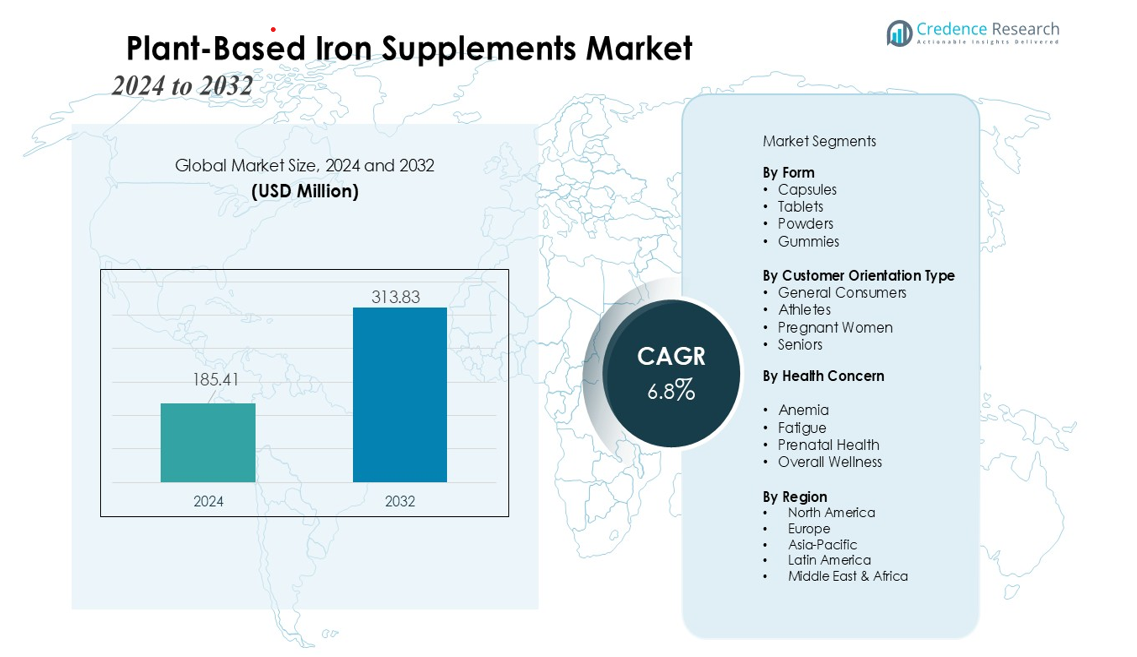
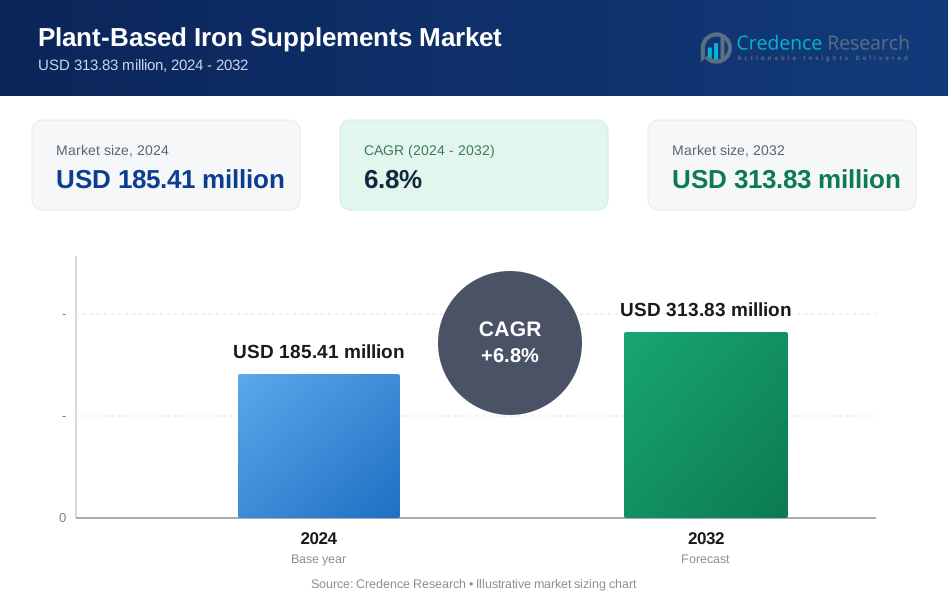
The Plant-Based Iron Supplements Market size was valued at USD 185.41 million in 2024 and is anticipated to reach USD 313.83 million by 2032, at a CAGR of 6.8% during the forecast period (2024-2032).
| REPORT ATTRIBUTE | DETAILS |
|---|---|
| Historical Period | 2020-2023 |
| Base Year | 2024 |
| Forecast Period | 2025-2032 |
| Plant-Based Iron Supplements Market Size 2024 | USD 185.41 million |
| Plant-Based Iron Supplements Market, CAGR | 6.8% |
| Plant-Based Iron Supplements Market Size 2032 | USD 313.83 million |
Rising consumer awareness about nutrition and the increasing global adoption of plant-based diets serve as key growth drivers. Concerns regarding animal welfare, environmental sustainability, and overall health are prompting many consumers to opt for plant-derived alternatives. Additionally, the widespread prevalence of iron deficiency—particularly among women of reproductive age, vegetarians, and individuals with dietary restrictions—fuels demand for natural, easily absorbed iron sources.
Geographically, North America leads the market, supported by a large population of health-conscious consumers and high adoption of plant-based nutrition. Europe follows closely, driven by strong vegan and clean-label trends. Meanwhile, Asia-Pacific is the fastest-growing region, propelled by rising health awareness, a growing vegetarian population, and increasing preference for natural supplements in countries such as India, Japan, and China.
Market Insights:
- The Plant-Based Iron Supplements Market was valued at USD 185.41 million in 2024 and is projected to reach USD 313.83 million by 2032, growing at a CAGR of 6.8% during the forecast period.
- Rising consumer awareness about nutrition and health benefits drives consistent demand for plant-derived iron supplements, particularly among individuals seeking natural and easily digestible sources.
- Increasing adoption of plant-based and vegan diets expands the target demographic, encouraging manufacturers to offer products aligned with ethical, environmental, and dietary preferences.
- High prevalence of iron deficiency, particularly among women of reproductive age, vegetarians, and individuals with restricted diets, sustains steady demand and market growth.
- Consumer preference for clean-label, organic, and non-GMO products strengthens market credibility and fosters repeat purchases for plant-based iron supplements.
- North America accounts for 35% of the market, supported by health-conscious consumers, widespread clean-label adoption, and established distribution networks that enhance product accessibility.
- Asia-Pacific represents 25% of the market and shows the fastest growth, driven by rising health awareness, increasing vegetarian populations, affordable supplement options, and expanding digital retail channels.
Market Drivers:
Rising Awareness of Nutritional Benefits and Health Consciousness
The Plant-Based Iron Supplements Market benefits from growing consumer awareness of nutrition and the health advantages of plant-derived supplements. People increasingly recognize the importance of iron in preventing anemia, improving energy levels, and supporting overall wellness. It appeals to individuals seeking natural and easily digestible sources of iron. The trend toward preventive healthcare encourages regular supplement intake, fueling consistent demand in the market.
- For instance, numerous studies have shown that iron and vitamin C supplementation can be an effective strategy for improving energy levels and reducing fatigue, particularly in individuals with iron deficiency. Vitamin C is well-known for significantly enhancing the absorption of plant-based (non-heme) iron in the body.
Growing Adoption of Plant-Based and Vegan Diets
The shift toward plant-based and vegan lifestyles drives demand for iron supplements derived from non-animal sources. Consumers are seeking alternatives that align with ethical, environmental, and dietary preferences. It allows manufacturers to target a diverse demographic that prioritizes sustainable consumption. The rise of plant-based diets in developed and emerging economies amplifies the market potential for iron supplements.
- For Instance, Himalayan Organics offers plant-based iron supplements using ingredients like curry leaves, lemon peel, spirulina, amla, beetroot, and spinach.
Prevalence of Iron Deficiency and Related Health Concerns
Widespread iron deficiency, especially among women of reproductive age, pregnant women, and individuals with restricted diets, significantly propels market growth. It offers a solution to combat anemia and improve hemoglobin levels without relying on synthetic iron products. Rising health awareness campaigns and government initiatives further highlight the need for iron supplementation. This underlying health concern ensures a stable and growing consumer base.
Increasing Focus on Clean-Label and Natural Products
Consumer preference for clean-label, organic, and non-GMO products strengthens the market position of plant-based iron supplements. It caters to the demand for transparency, safety, and chemical-free nutritional options. Manufacturers respond with innovative formulations that combine efficacy with natural ingredients. The market benefits from this trend, as it enhances consumer trust and encourages repeat purchases.
Market Trends:
Expansion of Product Innovation and Functional Formulations
The Plant-Based Iron Supplements Market experiences significant growth through innovative product development and functional formulations. Manufacturers focus on creating supplements that combine iron with vitamins and minerals to enhance absorption and bioavailability. It caters to diverse consumer preferences, including gummies, capsules, powders, and liquid forms, ensuring ease of consumption. Brands emphasize taste, digestibility, and natural ingredients to differentiate their offerings in a competitive market. Rising investment in research and development allows companies to introduce formulations tailored to specific age groups and dietary needs. This focus on innovation drives consumer engagement and loyalty, strengthening market presence globally.
- For instance, Ironic Biotech developed a plant-derived heme protein via precision fermentation that absorbs iron 65 times better than lactoferrin when combined with vitamin C.
Integration of E-Commerce and Digital Health Platforms
The increasing adoption of e-commerce and digital health platforms influences market trends significantly. It enables consumers to access a wide range of plant-based iron supplements conveniently and compare products efficiently. Online channels allow brands to engage directly with customers, provide detailed product information, and promote personalized recommendations. Social media and health-focused apps support awareness campaigns and build brand credibility. The shift toward digital retail also facilitates subscription-based models and recurring purchases, ensuring sustained demand. Growing digital penetration across developed and emerging markets further accelerates the market’s expansion and accessibility.
- For Instance, One particular business operating under the name Medistore has claimed to integrate e-commerce with health packages, reportedly enabling 1,200 monthly bookings for dietary supplement bundles via its digital storefront.
Market Challenges Analysis:
High Production Costs and Supply Chain Constraints
The Plant-Based Iron Supplements Market faces challenges due to high production costs and complex supply chain requirements. It relies on sourcing high-quality plant-derived iron and other natural ingredients, which can be expensive and subject to seasonal fluctuations. Maintaining product stability, bioavailability, and compliance with regulatory standards adds further cost pressures. Manufacturers must invest in specialized processing and quality assurance to meet consumer expectations. Limited availability of certain raw materials in specific regions can disrupt production schedules. These factors collectively affect pricing strategies and profit margins, creating hurdles for market expansion.
Regulatory Compliance and Consumer Skepticism
Strict regulatory requirements for dietary supplements present a significant challenge to the market. It must adhere to safety, labeling, and efficacy standards across different countries, which can delay product launches. Consumer skepticism regarding the effectiveness of plant-based iron compared to conventional sources can also limit adoption. Misconceptions about absorption rates and potency may affect market growth. Companies need to invest in education, clinical studies, and transparent communication to build trust. Ensuring consistent quality and addressing regulatory hurdles remain critical for sustaining market credibility and growth.
Market Opportunities:
Expansion into Emerging Markets with Rising Health Awareness
The Plant-Based Iron Supplements Market holds significant opportunities in emerging regions where health awareness is increasing. It can target populations in Asia-Pacific, Latin America, and Africa, where iron deficiency is prevalent and demand for natural supplements is growing. Rising disposable incomes and urbanization support the adoption of preventive healthcare products. Companies can introduce affordable and culturally tailored formulations to attract new consumers. Collaborations with local distributors and healthcare providers can enhance market penetration. Expanding education campaigns on the benefits of plant-based iron can further boost acceptance. This approach allows brands to establish a strong foothold in high-potential regions.
Innovation in Personalized Nutrition and Functional Supplements
Growing interest in personalized nutrition and functional supplements offers opportunities for market growth. It enables manufacturers to develop targeted iron formulations for specific demographics, such as pregnant women, athletes, or older adults. Integrating additional vitamins, minerals, and natural bioactive compounds can increase product appeal and effectiveness. Digital health platforms and wellness apps can support personalized recommendations and subscription models. Investing in clinical research and scientific validation enhances credibility and consumer trust. Leveraging these trends allows the market to differentiate offerings and expand consumer engagement globally.
Market Segmentation Analysis:
By Form
The Plant-Based Iron Supplements Market is offered in capsules, tablets, powders, and gummies. Capsules and tablets dominate due to convenience, precise dosage, and widespread acceptance among adults. Powders appeal to individuals seeking customizable intake or integration into meals, while gummies attract younger consumers and those preferring palatable, chewable formats. It drives manufacturers to develop diverse formulations that balance efficacy, taste, and absorption.
- For instance, Garden of Life offers a plant-based iron supplement in capsule form, known as Vitamin Code Raw Iron, that combines organic beetroot and spinach in a whole food blend to provide 22 mg of iron per serving, allowing users to obtain their daily dose through a single capsule.
By Customer Orientation Type
The market targets general consumers, athletes, pregnant women, and senior populations. General consumers seek preventive nutrition and energy support, while athletes require enhanced iron levels to maintain performance. Pregnant women and women of reproductive age represent a critical segment due to higher risk of iron deficiency. Seniors increasingly adopt plant-based iron supplements to support overall wellness and address age-related nutrient gaps. It allows companies to tailor marketing strategies and dosage formulations to specific demographics.
- For instance, NovaFerrum, an iron supplement company, has sold over 50 million bottles worldwide, supported by clinical proof of safety and effectiveness, appealing broadly to general consumers seeking reliable iron supplementation with minimal side effects.
By Health Concern
The market addresses anemia, fatigue, prenatal health, and overall wellness. Anemia remains the primary driver due to widespread prevalence among women and individuals with restricted diets. Supplements targeting fatigue and energy support attract working professionals and students, while prenatal formulations focus on maternal and fetal health. It enables manufacturers to create specialized, clinically validated products to meet precise health needs.
Segmentations:
By Form
- Capsules
- Tablets
- Powders
- Gummies
By Customer Orientation Type
- General Consumers
- Athletes
- Pregnant Women
- Seniors
By Health Concern
- Anemia
- Fatigue
- Prenatal Health
- Overall Wellness
By Region
- North America
- U.S.
- Canada
- Mexico
- Europe
- Germany
- France
- U.K.
- Italy
- Spain
- Rest of Europe
- Asia Pacific
- China
- Japan
- India
- South Korea
- South-east Asia
- Rest of Asia Pacific
- Latin America
- Brazil
- Argentina
- Rest of Latin America
- Middle East & Africa
- GCC Countries
- South Africa
- Rest of the Middle East and Africa
Regional Analysis:
North America Leads with High Health Consciousness and Plant-Based Adoption
North America accounts for 35% of the Plant-Based Iron Supplements Market, reflecting strong consumer preference for natural and plant-based nutrition. It benefits from high health awareness and widespread adoption of clean-label products among health-conscious populations. It also leverages well-established supplement manufacturers and advanced distribution networks to ensure product availability. Consumers prioritize non-GMO and highly bioavailable formulations, creating demand for innovative offerings. High disposable income and access to e-commerce channels further support adoption. Continuous investment in marketing and education strengthens brand loyalty and sustains market growth.
Europe Drives Growth Through Vegan Trends and Regulatory Support
Europe holds 28% of the Plant-Based Iron Supplements Market, driven by the growing vegan and vegetarian population and increasing demand for sustainable nutrition. It encourages manufacturers to develop supplements that comply with strict safety and quality standards. Countries like Germany, the UK, and France show high adoption of functional supplements and preventive healthcare products. Consumers prefer certified organic and clean-label options, reinforcing growth opportunities. Collaborations between brands and healthcare professionals enhance product credibility and awareness. This supportive environment fosters steady innovation and regional expansion.
Asia-Pacific Emerges as the Fastest-Growing Region
Asia-Pacific represents 25% of the Plant-Based Iron Supplements Market and shows the fastest growth due to rising health awareness and iron deficiency prevalence. It targets large populations in India, China, Japan, and Southeast Asia with tailored and affordable supplement options. Rapid urbanization, increasing disposable incomes, and expanding digital retail access accelerate adoption. Companies use online platforms to educate consumers and promote product benefits. The growing vegetarian and vegan population strengthens the demand base. These factors position Asia-Pacific as a key region for market expansion.
Key Player Analysis:
- Garden of Life
- Pure Encapsulations
- Pharmative
- Nutraceutical International Corporation
- Future Kind
- BioSynt Inc
- Himalayan Organics
- Holland and Barret
- SALUS Haus GmbH & Co. KG Ora Organic
- Advanced Orthomolecular Research
Competitive Analysis:
The Plant-Based Iron Supplements Market is highly competitive, with several key players focusing on product innovation, quality, and brand differentiation. It features established global supplement manufacturers alongside emerging regional brands, intensifying market rivalry. Companies invest in research and development to enhance bioavailability, taste, and formulation diversity, including gummies, powders, and capsules. Strong marketing strategies and digital engagement play a critical role in building brand recognition and consumer loyalty. Strategic partnerships with healthcare providers, retailers, and e-commerce platforms allow companies to expand distribution and reach new consumer segments. Maintaining regulatory compliance and ensuring product transparency further enhance competitiveness. The market rewards companies that successfully combine efficacy, natural ingredients, and sustainable sourcing, creating opportunities to capture market share and strengthen their presence across North America, Europe, and Asia-Pacific.
Recent Developments:
- In May 2025, Garden of Life launched the Dr. Formulated Hair Growth for Men supplement line, featuring clinically studied ingredients for hair and overall men's health.
- In March 2025, Garden of Life successfully recertified as a B Corporation with its highest B Impact Score yet (106.2), reflecting improvements in sustainability and social responsibility.
Report Coverage:
The research report offers an in-depth analysis based on Form, Customer Orientation Type, Health Concern and Region. It details leading market players, providing an overview of their business, product offerings, investments, revenue streams, and key applications. Additionally, the report includes insights into the competitive environment, SWOT analysis, current market trends, as well as the primary drivers and constraints. Furthermore, it discusses various factors that have driven market expansion in recent years. The report also explores market dynamics, regulatory scenarios, and technological advancements that are shaping the industry. It assesses the impact of external factors and ITALY economic changes on market growth. Lastly, it provides strategic recommendations for new entrants and established companies to navigate the complexities of the market.
Future Outlook:
- The Plant-Based Iron Supplements Market will continue to benefit from growing global awareness of nutrition and preventive healthcare.
- Rising adoption of plant-based and vegan diets will drive demand for non-animal-derived iron supplements.
- Companies will increasingly focus on innovative formulations, combining iron with vitamins and minerals for enhanced absorption.
- Expansion of e-commerce and digital health platforms will improve accessibility and direct engagement with consumers.
- Market growth will be supported by increased interest in clean-label, organic, and non-GMO products.
- Targeted supplementation for specific demographics, including pregnant women, athletes, and older adults, will create new product opportunities.
- Health education campaigns and awareness initiatives will reinforce consumer trust and adoption of plant-based iron supplements.
- Emerging markets in Asia-Pacific, Latin America, and Africa will offer significant growth potential due to rising health consciousness and vegetarian populations.
- Strategic collaborations between manufacturers, healthcare providers, and retail networks will enhance distribution and brand visibility.
- Continued research, scientific validation, and transparent communication will strengthen credibility and drive sustained market expansion globally.
Request a Free Sample
Fill in your details and we'll send you a free sample report.
- Sample data tables & charts
- Research methodology
Need a Custom Version of This Report?
Tailor the scope, geography, or segments to your exact requirements.
- Custom geography or segment scope
- Direct access to our analyst team
Frequently Asked Questions
What is the current market size for the Plant-Based Iron Supplements Market, and what is its projected size in 2032?
At what Compound Annual Growth Rate is the Plant-Based Iron Supplements Market projected to grow between 2024 and 2032?
Who are the major players in the global plant-based iron supplements market?
What are the major market drivers of the plant-based iron supplements industry?
What are the major market restraints of the plant-based iron supplements industry?
What are the major market opportunities of the plant-based iron supplements industry?
Who are the leading companies in the Plant-Based Iron Supplements Market?
Table of Content
Chapter 1. Report Introduction
- 1.1 Report Description & Purpose
- 1.1.1 Report Title & Market Definition
- 1.1.2 Unique Selling Propositions (USP) & Key Differentiators
- 1.1.3 Value Proposition for Stakeholders
- 1.2 Research Objectives
- 1.2.1 Market Sizing Objectives (Volume & Revenue)
- 1.2.2 Segmentation Objectives
- 1.2.3 Competitive Intelligence Objectives
- 1.2.4 Forecast & Scenario Objectives
- 1.3 Report Scope
- 1.3.1 Plant-Based Iron Supplements Scope – Types & Subtypes Covered
- 1.3.2 Geographic Scope – Regions & Countries Covered
- 1.3.3 Historical Period, Base Year & Forecast Period (2024; forecast to 2032)
- 1.3.4 Inclusions & Exclusions
- 1.4 HS Code & Classification Framework
- 1.5 Currency, Units & Pricing Basis
- 1.6 Target Stakeholders
- 1.7 Limitations & Assumptions
Chapter 2. Executive Summary
- 2.1 Global Plant-Based Iron Supplements Market Snapshot
- 2.1.1 Market Size – Historical (2024) & Forecast (2024-2032) (2024: USD 185.41 million → 2032: USD 313.83 million)
- 2.1.2 Volume & Revenue – Global Totals
- 2.1.3 Key Market Highlights – Top Five Facts
- 2.2 Plant-Based Iron Supplements Market Segmentation Snapshot
- 2.2.1 Market Split by Region – 2024 vs. 2032
- 2.3 Competitive Snapshot
- 2.3.1 Top 10 Players by Revenue Share – 2024
- 2.3.2 Top 10 Players by Volume Share – 2024
- 2.3.3 Recent Strategic Developments (18-Month Summary)
- 2.4 Key Investment Highlights & Strategic Conclusions
Chapter 3. Plant-Based Iron Supplements Market Dynamics & Industry Analysis
- 3.1 Market Overview & Context
- 3.1.1 Plant-Based Iron Supplements Market Position in the Broader Automotive Value Chain
- 3.1.2 OEM vs. Replacement Market Dynamics
- 3.1.3 Market Maturity & Development Stage by Region
- 3.2 Plant-Based Iron Supplements Market Drivers
- 3.3 Plant-Based Iron Supplements Market Restraints & Challenges
- 3.4 Plant-Based Iron Supplements Market Opportunities
- 3.5 Porter's Five Forces Analysis
- 3.5.1 Threat of New Entrants
- 3.5.2 Bargaining Power of Suppliers
- 3.5.3 Bargaining Power of Buyers
- 3.5.4 Threat of Substitutes
- 3.5.5 Competitive Rivalry – Intensity Assessment
- 3.6 Plant-Based Iron Supplements Value Chain Analysis
- 3.6.1 Upstream – Raw Material/Input Suppliers
- 3.6.1.1 Raw Material/Input 1
- 3.6.1.2 Raw Material/Input 2
- 3.6.1.3 Raw Material/Input 3
- 3.6.2 Midstream – Production/Manufacturing/Service Delivery
- 3.6.2.1 Production/Process Overview
- 3.6.2.2 Key Facility Locations & Capacity by Manufacturer
- 3.6.3 Downstream – Distribution & End Consumer
- 3.6.3.1 Primary Channel – B2B/OEM
- 3.6.3.2 Secondary Channels – Dealer, Retail, Online, Direct
- 3.6.4 Value Chain Profitability Analysis
- 3.6.1 Upstream – Raw Material/Input Suppliers
- 3.7 PESTEL Analysis
- 3.7.1 Political Factors
- 3.7.2 Economic Factors
- 3.7.3 Social Factors
- 3.7.4 Technological Factors
- 3.7.5 Environmental Factors
- 3.7.6 Legal Factors
- 3.8 Plant-Based Iron Supplements Supply Chain Analysis
- 3.8.1 Raw Material/Input Supply Risk Assessment
- 3.8.2 Manufacturing Concentration Risk (Geographic Exposure)
- 3.8.3 Trade Disruption Impact Analysis
- 3.9 Regulatory & Policy Landscape
Note: The regulatory and policy landscape section covers regulations based on their applicability to the market, Plant-Based Iron Supplements category, geography, and scope of the study. Only regulatory frameworks with a material impact on operations, compliance, trade, sustainability, or market access are analyzed in detail.
Chapter 4. Key Investment Pockets & Opportunity Analysis
- 4.1 Plant-Based Iron Supplements Market Attractiveness Analysis
- 4.1.1 By Region – Investment Attractiveness Matrix (Volume × CAGR)
- 4.2 Absolute Revenue Growth Opportunity
- 4.2.1 By Region – Absolute USD Growth Through 2032
- 4.3 Incremental Volume Opportunity
- 4.3.1 By Region – Incremental Volume Through 2032
- 4.3.2 Segment – Incremental Volume
- 4.4 Emerging Submarket Opportunity Deep Dive (Subject to Applicability)
- 4.5 Emerging Market Opportunity Scorecards
- 4.5.1 United States
- 4.5.2 Europe
- 4.5.3 Asia
- 4.5.4 Middle East & Africa
Note: Emerging Market Opportunity Scorecards will be included based on relevance and strategic importance. Regions listed are indicative and may vary depending on data availability and market dynamics.
Chapter 5. Plant-Based Iron Supplements Import-Export Analysis & Trade Flows
- 5.1 Global Trade Overview
- 5.1.1 Global Export Value by Country (2024)
- 5.1.2 Global Export Volume by Country (2024)
- 5.1.3 Global Import Value by Country (2024)
- 5.1.4 Global Import Volume by Country (2024)
- 5.1.5 Net Trade Balance by Country (2024)
- 5.2 Export Analysis – Segment
- 5.2.1 Type 1 (HS Code)
- 5.2.2 Type 2 (HS Code)
- 5.2.3 Type 3 (HS Code)
- 5.2.4 Type 4 (HS Code)
- 5.2.5 Type 5 (HS Code)
- 5.3 Import Analysis – Segment
- 5.3.1 Type 1 (HS Code)
- 5.3.2 Type 2 (HS Code)
- 5.3.3 Type 3 (HS Code)
- 5.3.4 Type 4 (HS Code)
- 5.3.5 Type 5 (HS Code)
- 5.4 Average Unit Trade Prices
- 5.4.1 Average Export Price – Segment & Country
- 5.4.2 Average Import Price – Segment & Source Country
- 5.4.3 Price Trends (2024)
- 5.5 Key Trade Route Analysis
- 5.5.1 Trade Route 1
- 5.5.2 Trade Route 2
- 5.5.3 Trade Route 3
- 5.5.4 Trade Route 4
- 5.5.5 Trade Route 5
- 5.6 Trade Policy Impact Assessment
- 5.6.1 US Anti-Dumping & Section 301 Tariffs
- 5.6.2 EU Customs Union Impact
- 5.6.3 Major Free Trade Agreements
- 5.6.4 USMCA Rules of Origin
Note: Trade policy analysis will be included only where relevant to the Plant-Based Iron Supplements market.
Chapter 6. Competitive Landscape & Company Benchmarking
- 6.1 Plant-Based Iron Supplements Market Concentration & Structure
- 6.1.1 Herfindahl-Hirschman Index (HHI) – vs. 2024
- 6.1.2 Tier 1, Tier 2 & Tier 3 Market Structure
- 6.1.3 Global, Regional & Local Player Dynamics
- 6.2 Plant-Based Iron Supplements Market Share Analysis – 2024
- 6.2.1 Global Revenue Share by Company
- 6.2.2 Global Volume Share by Company
- 6.2.3 Regional Revenue Share
- 6.2.4 Market Share Evolution ( vs. 2024)
- 6.2.5 OEM Segment Share by Company
- 6.2.6 Replacement Segment Share by Company
- 6.3 Production/Delivery Capacity & Facility Analysis
- 6.3.1 Global Installed Capacity
- 6.3.2 Capacity Utilization Rates
- 6.3.3 Production/Output Volume
- 6.3.4 Facility Locations & Capacity Map
- 6.3.5 Planned Capacity Additions
- 6.4 Plant-Based Iron Supplements Competitive Benchmarking Matrix
- 6.4.1 Revenue, Volume, CAGR & Profitability Comparison
- 6.4.2 Channel Revenue Mix
- 6.4.3 Geographic Revenue Exposure
- 6.4.4 R&D Intensity
- 6.4.5 Sustainability Maturity
- 6.5 Strategic Developments in Plant-Based Iron Supplements (Last 24 Months)
- 6.5.1 Mergers, Acquisitions & Divestments
- 6.5.2 New Plant-Based Iron Supplements Launches
- 6.5.3 Facility Expansions
- 6.5.4 Strategic Alliances, Joint Ventures & Partnerships
- 6.5.5 Distribution Expansion & Market Entry
- 6.5.6 Sustainability & ESG Initiatives
- 6.6 Competitive Strategy Mapping
- 6.6.1 Leader, Challenger, Follower & Niche Classification
- 6.6.2 Pricing Strategy Comparison
- 6.6.3 Channel Strategy Matrix
Note: Strategic developments are included based on their materiality and the availability of reliable information.
Chapter 7. Global Plant-Based Iron Supplements Market – By Distribution Channel
- 7.1 Segment Overview
- 7.1.1 Volume & Revenue Split by Channel (2024 & 2032)
- 7.1.2 Channel Mix Evolution (2024-2032)
Chapter 8. Regional Market Analysis – Global Overview
- 8.1 Global Regional Overview
- 8.1.1 Regional Volume Share
- 8.1.2 Regional Revenue Share
- 8.1.3 Regional Volume by Region
- 8.1.4 Regional Revenue by Region
- 8.1.5 Regional Forecast Through 2032
- 8.2 Cross-Regional Segment Analysis
- 8.2.1 By Distribution Channel
- 8.2.2 By Brand/Price Tier
Chapter 9. North America Plant-Based Iron Supplements Market
- 9.1 United States
- 9.2 Canada
- 9.3 Mexico
Chapter 10. Europe Plant-Based Iron Supplements Market
- 10.1 Germany
- 10.2 France
- 10.3 Italy
- 10.4 United Kingdom
- 10.5 Spain
- 10.6 Poland
- 10.7 Russia
- 10.8 Netherlands
- 10.9 Belgium
- 10.10 Sweden
- 10.11 Denmark
- 10.12 Norway
- 10.13 Rest of Europe
Chapter 11. Asia Pacific Plant-Based Iron Supplements Market
- 11.1 China
- 11.2 India
- 11.3 Japan
- 11.4 South Korea
- 11.5 Thailand
- 11.6 Indonesia
- 11.7 Vietnam
- 11.8 Malaysia
- 11.9 Australia
- 11.10 Rest of Asia Pacific
Chapter 12. Latin America Plant-Based Iron Supplements Market
- 12.1 Brazil
- 12.2 Argentina
- 12.3 Colombia
- 12.4 Chile
- 12.5 Rest of Latin America
Chapter 13. Middle East Plant-Based Iron Supplements Market
- 13.1 Saudi Arabia
- 13.2 United Arab Emirates
- 13.3 Turkey
- 13.4 Israel
- 13.5 Iran
- 13.6 Rest of the Middle East
Chapter 14. Africa Plant-Based Iron Supplements Market
- 14.1 South Africa
- 14.2 Egypt
- 14.3 Nigeria
- 14.4 Morocco
- 14.5 Rest of Africa
Chapter 15. Plant-Based Iron Supplements Company Profiles
- 15.1 [Company 01]
- 15.1.1 Company Overview
- 15.1.2 Key Management Personnel
- 15.1.3 Products & Services Portfolio
- 15.1.4 Financial Performance
- 15.1.5 Key Market Focus & Geographic Presence
- 15.1.6 Recent Developments & Strategic Initiatives
Note: The company profile list is preliminary and may change based on research findings, market developments, data availability, and client requirements.
Chapter 16. Appendices
- Appendix A – List of Abbreviations & Acronyms
- Appendix B – Industry Classification Code Reference – Full Series
- Appendix C – Production & Capacity Data Tables
- Appendix D – End-Use & Demand Base Tables
- Appendix E – Consumption & Replacement Rate Assumptions
- Appendix F – ASP Reference Tables
- Appendix G – Manufacturing & Facility Database
- Appendix H – Import-Export Data Tables
- Appendix I – Regulatory Summary Tables
- Appendix J – Primary Research Participant List (Anonymized)
- Appendix K – Primary Research Questionnaire Framework
- Appendix L – Data Sources & Bibliography
- Appendix M – Market Size Divergence & Source Comparison
Chapter 17. Research Methodology
- 17.1 Research Framework & Philosophy
- 17.2 Secondary Research – Sources, Hierarchy & Data Extraction
- 17.3 Data Modeling – Bottom-Up & Top-Down Market Sizing
- 17.4 Primary Research – Stakeholder Framework, LOI & Sample Sizes
- 17.5 Forecast Methodology – Regression, Scenario & Sensitivity Analysis
- 17.6 Quality Control – Four-Layer Validation Framework
- 17.7 Limitations & Standard Assumptions
- 17.8 Disclaimer
