
| REPORT ATTRIBUTE | DETAILS |
|---|---|
| Historical Period | 2019-2022 |
| Base Year | 2023 |
| Forecast Period | 2024-2032 |
| Plant Stem Cell Market Size 2023 | USD 385.2 Million |
| Plant Stem Cell Market, CAGR | 9.10% |
| Plant Stem Cell Market Size 2032 | USD 843.5 Million |
Market Insights
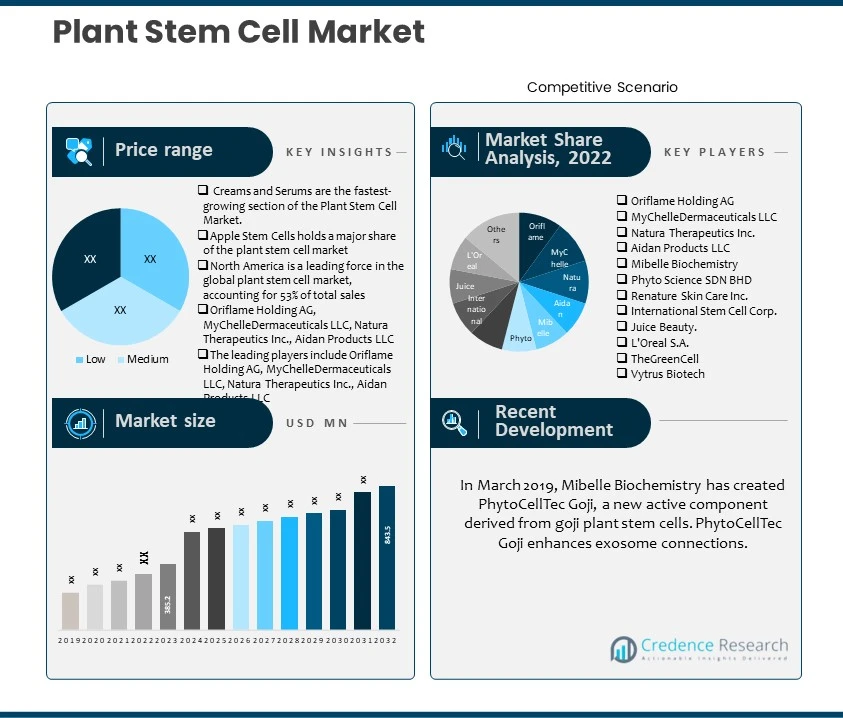
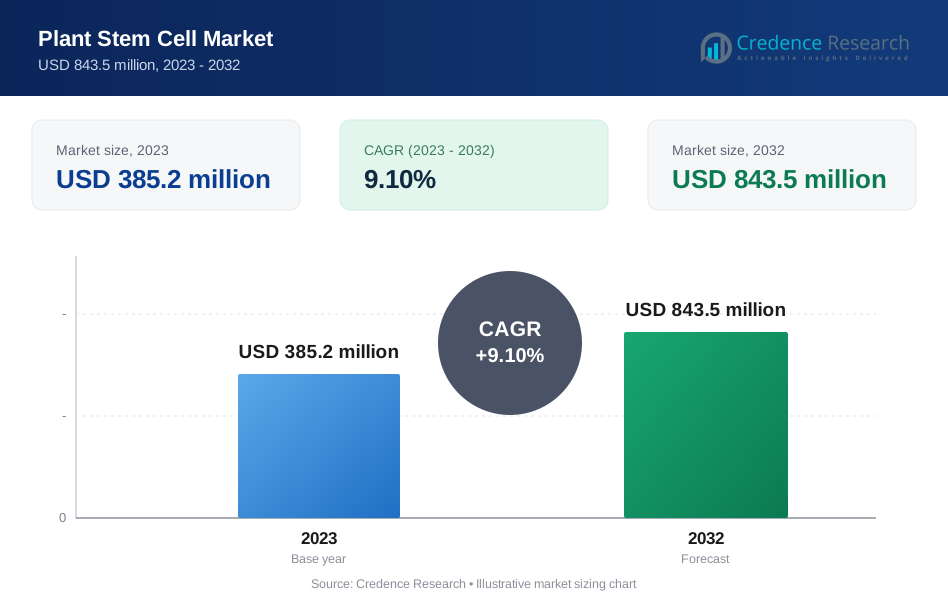
- The global demand for Plant Stem Cell was valued at USD 385.2 million in 2023 and is expected to reach USD 843.5 million in 2032, growing at a CAGR of 9.10% between 2024 and 2032.
- Creams and serums are the fastest-growing segments of the Plant Stem Cell Market, while powders play an essential role.
- Cosmetics and personal care are the leading segments of the plant stem cell market.
- Apple Stem Cells control a sizable portion of the plant stem cell market.
- The main category in the plant stem cell market is skincare products, while the second-largest segment is health supplements.
- Online retail is the most significant section of the plant stem cell industry, with pharmacies also playing an important role.
- The organic sector has the highest market demand.
- Fruits are the major category in the plant stem cell industry, while flowers are another important market area.
- Extraction from plants is the most prevalent market segment.
- North America dominates the worldwide plant stem cell market, accounting for 53% of total sales. At the same time, Asia Pacific is the world's second-largest market for plant stem cells, accounting for more than 23% of global income.
- Organ Transplantation Requirements Plant Stem Cells for the Future Driving Market Growth
- Regulatory barriers and compliance costs slow market growth.
Executive Summary
Market Definition
The Plant Stem Cell Market refers to the market for products derived from plant stem cells. Plant stem cells are undifferentiated cells found in various parts of plants, such as leaves, stems, and roots. These cells can regenerate and differentiate into different types of plant cells, allowing them to play a crucial role in plant growth, development, and repair. In the market, plant stem cells are used in various industries, including cosmetics, pharmaceuticals, and agriculture. They are valued for their potential benefits in skincare, anti-aging treatments, and plant breeding. The Plant Stem Cell Market is driven by the increasing demand for natural and sustainable ingredients in various industries.
Market Overview
The global Plant Stem Cell Market has witnessed steady growth in recent years and is expected to grow at a CAGR of 9.10% between 2024 and 2032. The market was valued at USD 385.2 million in 2023 and is expected to reach USD 843.5 million in 2032.
The Plant Stem Cell Market is experiencing significant growth and is expected to continue expanding in the coming years. This market is driven by the increasing demand for natural and sustainable ingredients in various industries, particularly in cosmetics and skincare. Plant stem cells offer unique properties and benefits, such as antioxidant and anti-inflammatory properties, which make them highly sought after in the development of skincare and beauty products. Additionally, the growing awareness and preference for organic and plant-based products further contribute to the market's growth. The market is also influenced by advancements in technology and research, which enhance the extraction and cultivation of plant stem cells.
Segmentation by Product Type
- Creams and Serums are the fastest-growing section of the Plant Stem Cell Market. These products have become popular in the skincare market due to their possible anti-aging and rejuvenating qualities.
- Powders are an important section of the Plant Stem Cell Market. Plant stem cell powders are commonly utilized in the production of dietary supplements and functional foods.
Segmentation by Application
- Cosmetics and Personal Care are the dominant segments of the Plant Stem Cell Market. Plant stem cells are widely used in the development of skincare and beauty products such as creams, serums, and masks. These items are in great demand as customers value natural and plant-based elements in their cosmetics and personal care regimens. The use of plant stem cells in cosmetics promotes skin health, regeneration, and anti-aging properties.
Segmentation by Source
- Apple Stem Cells hold a major share of the plant stem cell market. Apple stem cells have acquired appeal in the skincare sector due to their possible anti-aging and skin rejuvenation qualities. They are known for their capacity to protect and repair skin cells, resulting in a more young and bright complexion.
Segmentation by End-User
- Skincare Products are the leading category in the plant stem cell market. Plant stem cells are commonly used to develop skincare products such as creams, serums, and masks. These products provide numerous benefits, including hydration, rejuvenation, and anti-aging properties, making them highly sought after by consumers.
- Health Supplements are the second-largest segment in the plant stem cell industry.
Segmentation by Distribution Channel
- The most prominent segment of the plant stem cell market is online retail. Many customers prefer to purchase plant stem cell goods online, where they can compare options, read reviews, and have items delivered to their door. Online retail provides a diverse range of options and convenience, making it a popular method for obtaining plant stem cell goods.
- Pharmacies are another key component of the business. Pharmacies provide a reliable supply of health and wellness items, including plant stem cell products. Consumers frequently rely on pharmacists' experience to assist them in picking the best products for their needs.
Segmentation by Form
- In the plant stem cell market, the Organic sector has the most market demand. Consumers are becoming more sensitive to the things they use, preferring natural and organic alternatives. Organic plant stem cell products are considered as safer and more environmentally friendly, which drives demand in this market. However, traditional plant stem cell products have their market demand, as certain customers may prioritize other variables such as pricing or availability.
Segmentation by Plant Part
- Fruits are the dominant category in the plant stem cell industry. Fruit stem cells are commonly used in the production of plant stem cell products because of their high concentration of therapeutic chemicals and antioxidants. These stem cells provide numerous skincare and wellness benefits, making them highly desirable among consumers.
- Flowers are another key market category. Flower stem cells are also used to produce plant stem cell products. They are well-known for their calming and revitalizing characteristics, which make them popular in skincare and health products.
Segmentation by Extraction Technique
- Extraction from Plants is the most popular market sector for plant stem cells. This method entails harvesting stem cells from various plant sources and using them in the production of plant stem cell products. It is a popular and preferred strategy because it effectively harnesses the positive characteristics of plant stem cells. Extraction from plants provides a sustainable and natural supply of stem cells, which appeals to consumers seeking plant-based and ecologically friendly products.
Segmentation by Region
- North America is a leading force in the global plant stem cell market, accounting for 53% of total sales.
- Asia Pacific is the world's second-largest market for plant stem cells, accounting for more than 23% of global revenue
- The rest of the world, including Latin America, the Middle East, and Africa, supplies the remaining demand for Plant Stem cells.
North America, notably the United States, has emerged as a dominant force in the worldwide plant stem cell industry, accounting for 53% of total sales. North America has experienced significant investments in R&D over the last few years, with approximately $2.8 billion expected in 2022. This rigorous R&D focus has resulted in ground-breaking breakthroughs, particularly in the use of plant stem cells for esthetic and medicinal applications. According to a 2023 survey, around 65% of North American customers are interested in trying out new skincare and health products. Furthermore, North America has a robust regulatory framework that, while stringent, has earned consumer trust. In fact, about 70% of consumers in the region felt more confident in items that had successfully passed the tough regulatory landscape, thereby confirming their safety and efficacy.
Asia Pacific is the world's second-largest market for plant stem cells, accounting for more than 23% of global revenue, although its dynamics are very different from those in North America. The region, noted for its great biodiversity, provides a broad repository of plant species, allowing for adequate opportunity to source a variety of stem cells. The plant stem cell market in the Asia Pacific area has grown at a 9% annual pace, with China, South Korea, and India leading the way. The region's long history of botanical and herbal therapies has contributed significantly to its growth. According to a recent survey, 80% of the Asian population still uses traditional herbal treatments, and this cultural preference is driving acceptance of plant stem cell products.
Key Highlights of the Report
The global plant stem cell market is segmented based on product type, application, source, end-user, distribution channel, plant part, extraction technique, and region. The plant stem cell market is led by skincare products, while fruits dominate the market. In addition, creams and serums are the fastest-growing category, while the organic sector has the highest market demand. Also, plant extraction is the most popular market sector, and flowers are another important market category, with North America driving market growth.
The market is being driven by growing awareness of the benefits of plant-based components in skincare and cosmetics, as well as advancements in the extraction and cultivation of users for plant stem cells. Moreover, The primary limitations of the market are high production costs and sophisticated extraction procedures, limited availability of specific plant species for stem cell extraction, regulatory hurdles, and rigorous standards for product formulation and labeling.
North America, particularly the United States, has emerged as a major player in the global plant stem cell market, accounting for 53% of total sales. North America has seen major R&D spending in recent years, with an estimated $2.8 billion planned in 2022. Furthermore, Asia Pacific is the world's second-largest market for platelet stem cells, accounting for more than 23% of worldwide sales.
What Are The Main Drivers Of The Global Plant Stem Cell Market?
The Plant Stem Cell Market is driven by several factors that contribute to its growth and expansion. There is an increasing consumer demand for natural and organic products, including skincare and cosmetics. People are becoming more conscious about the ingredients they use on their skin and are seeking plant-based alternatives. Additionally, there is a growing awareness about the numerous benefits of plant stem cells in skincare and cosmetics. These cells possess antioxidant and anti-inflammatory properties, making them highly sought after in the beauty industry.
What Are The Major Challenges Faced By The Global Plant Stem Cell Market?
While the Plant Stem Cell Market shows great potential, certain restraints need to be considered. One of the main challenges is the high production costs and complex extraction processes associated with plant stem cells. The delicate nature of these cells requires specialized End-Users, which can be costly and time-consuming. Another restraint is the limited availability of certain plant species for stem cell extraction. Not all plants contain stem cells that are suitable for commercial use, creating a constraint in the market.
What Are The Growth Opportunities In The Global Plant Stem Cell Market?
The Plant Stem Cell Market presents several opportunities for growth and development. There is an opportunity to expand into new application areas, such as pharmaceuticals and nutraceuticals. The unique properties of plant stem cells make them potentially valuable in these industries for various therapeutic purposes. Moreover, collaborations and partnerships with research institutions can lead to further advancements in plant stem cell technology. By working together, companies can drive innovation and explore new possibilities in this field.
Market Drivers
Several factors drive the global Plant Stem Cell Market. The following are the key drivers of the global Plant Stem Cell Market:
Organ Transplant Requirements Plant Stem Cell for the Future
A prominent driver in the worldwide plant stem cells market is the increasing demand within the cosmetic and skincare industry. The global cosmetic industry was valued at more than $262 billion in 2022, with a 4.3% CAGR projected until 2030. Within this massive business, products infused with plant stem cell extracts have seen an increase in demand owing to their anti-aging and rejuvenating effects.
According to a recent poll, almost 70% of consumers worldwide are prepared to pay more for skincare products that claim rejuvenating effects, a category in which plant stem cell-based products are gaining popularity. Products in this category alone have grown at a pace of 9.5% per year, exceeding the cosmetic industry's average.
Furthermore, a predicted 50% of new skincare product launches in 2022 included plant stem cell components, indicating a shift in formulation strategy among major cosmetic companies.
Market Restraints
The global Plant Stem Cell Market faces some challenges that may hinder its growth. These include the following:
Regulatory Barriers and Compliance Costs
While the global plant stem cell market is trending upward, there is one major impediment that players must overcome: rising regulatory barriers and associated compliance costs. Given the market's fledgling and creative nature, regulatory organizations in many locations have taken proactive steps to assure safety and efficacy. In the European Union, for example, regulations require extensive clinical testing for goods containing novel constituents, such as plant stem cells. To meet such strict criteria, a single product may incur testing costs of up to $2 million before hitting the shelves. Across the Atlantic, the FDA has similarly established procedures to assure that plant stem cell-based products are safe for consumers.
By 2021, the global compliance cost for enterprises in the plant stem cell market would have reached $1.2 billion, a 30% increase over the previous year. This high increase is due not just to the testing procedures but also to the expenditures associated with adapting to rapidly changing rules. According to a poll of industry players, approximately 65% of organizations view regulatory issues and associated expenses as the key barrier to quick scalability. Given the rigorous rules, smaller competitors in the global plant stem cell market may find it especially difficult to establish a footing, with 20% of start-ups in this sector failing in 2021 due to an inability to satisfy compliance costs.
Opportunities
The global Plant Stem Cell Market offers significant growth opportunities. These include the following:
Ethical Sourcing and Biodiversity Conservation
With a rising global focus on sustainable practices, a 2022 survey found that approximately 63% of global customers were concerned about the origin of plant stem cells utilized in products and their environmental impact. As a result, several brands have begun to respond. As of 2022, the number of companies with ethically sourced ingredient certificates had increased by 25%. Furthermore, a separate study found that nearly 55% of consumers were willing to pay a premium for products that guaranteed ethical sourcing and helped to preserve biodiversity.
In the business, agreements between biotech companies and conservation organizations have increased by 40% in the last three years. These agreements prioritize sustainable harvesting methods to minimize environmental impact. In 2022, corporations invested over $260 million in projects and technology that aim to collect plant stem cells ethically while minimizing harm to ecosystems.
Competitive Landscape
Key Players
The global Plant Stem Cell Market is highly competitive, with several key players. Some of the major players in the market and their market share are as follows:
- Oriflame Holding AG
- MyChelleDermaceuticals LLC
- Natura Therapeutics Inc.
- Aidan Products LLC
- Mibelle Biochemistry
- Phyto Science SDN BHD
- Renature Skin Care Inc.
- International Stem Cell Corp.
- Juice Beauty.
- L'Oreal S.A.
- TheGreenCell
- Vytrus Biotech
These organizations prioritize product innovation, Service Provider expansion, and mergers and acquisitions to stay competitive.
The global Plant Stem Cell Market's key players continually seek to stay ahead by offering new products and developments.
In April 2022, Frownies, a natural skincare business, launched a new skin-renewing apple serum that incorporates plant-based stem cell technology. These stem cells have been shown to provide several skin benefits, especially around the eyes and lips. The newest skin serum is now available on the Frownies website.
In March 2022, Bayer and NutriLeads, a natural health ingredients firm, created a new and revolutionary immune product called Daily Immunity, which contains the award-winning substance BeniCaros. Groundbreaking clinical investigations support Stem and Root Daily Immunity.
Summary of Key Findings
- Ethical sourcing, biodiversity conservation
- Market segmentation by Product Type, Application, Source, End-User, Distribution Channel, Plant Part, Extraction Technique, and region.
- Apple Stem Cells command a sizable portion of the plant stem cell industry.
- Cosmetics and Personal Care are the leading categories of the Plant Stem Cell Market.
- North America is leading market growth. The market is highly competitive, with key players including Oriflame Holding AG, MyChelleDermaceuticals LLC, Natura Therapeutics Inc., Aidan Products LLC, and Others.
Future Outlook
- Continued growth and expansion
- Increasing demand for natural and sustainable ingredients
- Advancements in technology and research
- Rising awareness and preference for organic and plant-based products
- Opportunities for innovation and development in various industries
How CXOs Can Benefit from the Credence Research Plant Stem Cell Market Report
The Credence Research Plant Stem Cell Market Report provides CXOs with a comprehensive overview of the market, including:
- Market Product Type and growth forecast: The report provides detailed estimates of the global Plant Stem Cell Market Product Type, Application, Source, End-User, Distribution Channel, Plant Part, Extraction Technique, and region. It also includes forecasts for the market through 2032 based on key trends and drivers.
- Market segmentation: The report segments the Plant Stem Cell Market by Product Type, Application, Source, End-User, Distribution Channel, Plant Part, Extraction Technique, and region. This segmentation provides CXOs with a granular understanding of the market and the opportunities in each segment.
- Competitive Landscape: The report profiles the key players in the Plant Stem Cell Market and provides insights into their strategies, product offerings, and financial performance. This information can help CXOs to identify and assess their competition.
- Key trends and drivers: The report identifies and analyzes the key trends and drivers shaping the Plant Stem Cell Market. This information can help CXOs make informed decisions about their investments and strategies.
CXOs can use the insights from the Credence Research Plant Stem Cell Market Report to:
- Identify growth opportunities: The report can help CXOs identify new growth opportunities in the Plant Stem Cell Market by providing insights into market trends, the competitive landscape, and customer preferences.
- Make informed investment decisions: The report can help CXOs to make informed investment decisions about Plant Stem Cell. For example, it analyzes market trends, growth potential, and competitive landscape, allowing CXOs to assess the market's attractiveness and identify investment opportunities.
- Develop competitive strategies: The report can help CXOs develop competitive strategies for their Plant Stem Cell businesses. It provides valuable insights into market dynamics, customer preferences, and key competitors.
- Track market developments: The report can help CXOs track market developments and stay ahead of the curve. For example, it provides insights into the latest trends and innovations in the Plant Stem Cell Market.
Overall, the Credence Research Plant Stem Cell Market Report is a valuable resource for CXOs who want to gain a deeper understanding of the market and identify opportunities for growth.
Segmentation
By Product Type:- Powders
- Liquid Extracts
- Creams and Serums
- Others
- Cosmetics and Personal Care
- Pharmaceuticals
- Nutraceuticals
- Others
- Apple Stem Cells
- Grapes Stem Cells
- Rose Stem Cells
- Edelweiss Stem Cells
- Others
- Skincare Products
- Haircare Products
- Anti-Aging Products
- Health Supplements
- Others
- Online Retail
- Offline Retail
- Pharmacies
- Supermarkets and Hypermarkets
- Specialty Stores
- Others
- Organic
- Conventional
- Leaves
- Fruits
- Flowers
- Others
- Biotechnological Production
- Extraction from Plants
- Others
- North America
- The U.S.
- Canada
- Mexico
- Europe
- Germany
- France
- The U.K.
- Italy
- Spain
- Rest of Europe
- Asia Pacific
- China
- Japan
- India
- South Korea
- South-east Asia
- Rest of Asia Pacific
- Latin America
- Brazil
- Argentina
- Rest of Latin America
- Middle East & Africa
- GCC Countries
- South Africa
- Rest of the Middle East and Africa
Request a Free Sample
Fill in your details and we'll send you a free sample report.
- Sample data tables & charts
- Research methodology
Market Dynamics
Preference for Natural and Organic Ingredients
Consumers are increasingly seeking natural and organic ingredients in cosmetics and personal care products, driving demand for plant stem cell-based formulations due to their perceived safety and sustainability.
Advancements in Extraction and Cultivation Technologies
Innovations in plant stem cell extraction and cultivation have improved yield and efficacy, making it more feasible for manufacturers to incorporate these ingredients into a wider range of products.
Anti-Aging and Skin Rejuvenation Benefits
Plant stem cells, particularly from apples and other fruits, are recognized for their antioxidant and anti-aging properties, fueling their adoption in premium skincare and anti-aging product lines.
Expansion of Online Retail Channels
The growth of online retail platforms has made plant stem cell products more accessible to consumers globally, allowing for greater product variety, consumer education, and convenience in purchasing.
Need a Custom Version of This Report?
Tailor the scope, geography, or segments to your exact requirements.
- Custom geography or segment scope
- Direct access to our analyst team
Frequently Asked Questions
What is the current Product Type of the global Plant Stem Cell Market?
What is the expected growth rate of the Plant Stem Cell Market between 2024 and 2032?
Which segment is leading the market share in terms of Application?
Which Product Type segment is expected to post the fastest growth during the forecast period?
Who are the major players in the global Plant Stem Cell Market?
Table of Content
Chapter 1 Market Segmentation
- 1.1 Segmentation Framework
- 1.1.1 Product and Service Classification
- 1.1.2 Application and End-Use Classification
- 1.1.3 Technology and Solution Classification
- 1.1.4 Customer and Distribution Channel Classification
- 1.1.5 Geographic Segmentation
- 1.1.6 Market Segment Definitions and Boundaries
- 1.2 By Source
- 1.2.1 Apple Stem Cells
- 1.2.2 Grapes Stem Cells
- 1.2.3 Rose Stem Cells
- 1.2.4 Edelweiss Stem Cells
- 1.2.5 Others
- 1.3 By Application
- 1.3.1 Cosmetics and Personal Care
- 1.3.2 Pharmaceuticals
- 1.3.3 Nutraceuticals
- 1.3.4 Others
- 1.4 By Product Type
- 1.4.1 Powders
- 1.4.2 Liquid Extracts
- 1.4.3 Creams and Serums
- 1.4.4 Others
Chapter 2 Introduction
- 2.1 Report Objectives and Scope
- 2.2 Product Definition and Industry Terminology
- 2.3 Market Inclusions and Exclusions
- 2.4 Research Process
- 2.4.1 Primary Research and Expert Interviews
- 2.4.2 Secondary Research and Source Review
- 2.4.3 Top-Down and Bottom-Up Estimation
- 2.4.4 Data Triangulation and Verification
- 2.5 Market Size Measurement Basis
- 2.5.1 2023: USD 385.2 million → 2032: USD 843.5 million
- 2.6 Historical and Forecast Reference Periods
- 2.6.1 Base Year: 2023
- 2.6.2 Forecast Period: 2023-2032
- 2.7 Research Assumptions and Limitations
Chapter 3 Executive Summary
- 3.1 Market Snapshot and Key Findings
- 3.2 Base-Year Market Size, 2023
- 3.3 Forecast Market Size, 2032
- 3.4 Revenue and Volume Growth Outlook
- 3.5 Key Demand and Supply Indicators
- 3.6 Leading Market Segments
- 3.7 Fastest-Growing Market Opportunities
- 3.8 Regional Performance Highlights
- 3.9 Technology and Industry Transformation
- 3.10 Competitive Landscape Summary
- 3.11 Analyst View and Strategic Implications
Chapter 4 Global Plant Stem Cell Market Trends and Developments
- 4.1 Historical Industry Development
- 4.2 Recent Market Trends and Developments
- 4.3 Demand and Customer Behavior Trends
- 4.4 Technology and Product Innovation
- 4.5 Artificial Intelligence, Automation and Digitalization
- 4.6 Local Manufacturing and Supply Chain Realignment
- 4.7 Industry Partnerships, Mergers and Acquisitions
- 4.8 Sustainability and Circular Economy Developments
- 4.9 Government and Private Sector Investment Trends
- 4.10 Emerging Business Models and Commercialization
- 4.11 Industry Developments and Announcements
Chapter 5 Global Plant Stem Cell Market Production, Supply and Demand Analysis
- 5.1 Demand Trend and Consumption Analysis
- 5.2 Demand Forecast, 2023-2032
- 5.3 Production and Output Trend
- 5.4 Production and Output Forecast, 2023-2032
- 5.5 Installed Capacity and Capacity Utilization
- 5.6 Company-Wise Production Plants and Statistics
- 5.6.1 Installed Production Capacity
- 5.6.2 Actual Production
- 5.6.3 Planned Capacity and Expansion Targets
- 5.7 Supply Chain Structure and Procurement Trends
- 5.8 Supply-Demand Gap and Bottlenecks
- 5.9 Import Dependence and Sourcing Structure
- 5.10 Contract Manufacturing and Outsourcing
- 5.11 Regional Supply and Demand Concentration
Chapter 6 Global Plant Stem Cell Market Pricing Analysis
- 6.1 Pricing Structure and Measurement
- 6.2 Historical Pricing Trends
- 6.3 Pricing Outlook, 2023-2032
- 6.4 Average Selling Price and Unit Economics
- 6.5 Pricing by Product and Market Segment
- 6.6 Geographic Pricing Differences
- 6.7 Key Input, Energy, Labor and Logistics Costs
- 6.8 Contract Pricing and Purchasing Models
- 6.9 Pricing Sensitivity and Competitive Positioning
- 6.10 Price, Margin and Profitability Implications
Chapter 7 Global Plant Stem Cell Market Dynamics
- 7.1 Market Growth Drivers
- 7.1.1 Demand-Side Drivers
- 7.1.2 Technology and Innovation Drivers
- 7.1.3 Infrastructure and Investment Drivers
- 7.1.4 Regulatory and Policy Drivers
- 7.2 Market Restraints
- 7.2.1 Cost and Affordability Constraints
- 7.2.2 Technology and Adoption Barriers
- 7.2.3 Supply Chain and Operational Constraints
- 7.3 Market Challenges
- 7.3.1 Competitive Pressure and Margin Erosion
- 7.3.2 Skills, Infrastructure and Implementation Gaps
- 7.4 Emerging Market Opportunities
- 7.5 Market Dynamics Impact and Time-Horizon Assessment
Chapter 8 Global Plant Stem Cell Value Chain Analysis
- 8.1 Industry Value Chain Overview
- 8.2 Upstream Suppliers and Critical Inputs
- 8.3 Technology and Component Providers
- 8.4 Manufacturing or Service Delivery
- 8.5 Distribution, Channel Partners and Integrators
- 8.6 Downstream Applications and End Users
- 8.7 Value Addition and Profit Pools
- 8.8 Vertical Integration and Outsourcing
- 8.9 Supplier Concentration and Risk
- 8.10 Supply Chain Localization and Resilience
Chapter 9 Global Plant Stem Cell Market Regulations and Policies
- 9.1 Relevant Laws, Standards and Compliance Frameworks
- 9.2 Product, Service, Safety and Quality Requirements
- 9.3 Government Policies, Incentives and Subsidies
- 9.4 Imports, Exports and Trade Barriers
- 9.5 Public Procurement and Local Content Requirements
- 9.6 Environmental and Sustainability Compliance
- 9.7 Upcoming Policy Changes and Market Implications
Chapter 10 Global Plant Stem Cell Market Hotspots and Opportunities
- 10.1 Market Opportunity Mapping and Growth Hotspots
- 10.2 High-Growth Applications and Customer Groups
- 10.3 Underserved Markets and White-Space Opportunities
- 10.4 Emerging Technology and Product Opportunities
- 10.5 New Capacity and Investment Hotspots
- 10.6 Market Entry and Expansion Opportunities
- 10.7 Distribution and Partnership Opportunities
- 10.8 Near-Term and Long-Term Commercial Potential
- 10.9 Opportunity Attractiveness and Execution Risks
Chapter 11 Global Plant Stem Cell Market Outlook, 2023-2032
- 11.1 Market Size and Analysis
- 11.1.1 Revenue (Market Measurement: 2023: USD 385.2 million → 2032: USD 843.5 million)
- 11.1.2 Market Volume and Quantity Sold
- 11.1.3 Historical Market Size
- 11.1.4 Base-Year Market Size, 2023
- 11.2 Market Forecast, 2023-2032
- 11.2.1 Revenue Forecast to 2032
- 11.2.2 Volume Forecast to 2032
- 11.2.3 CAGR and Year-on-Year Growth
- 11.2.4 Incremental Revenue Opportunity
- 11.3 Forecast Assumptions and Scenario Analysis
- 11.3.1 Base-Case Forecast
- 11.3.2 Optimistic and Conservative Scenarios
- 11.3.3 Technology, Pricing and Policy Sensitivities
- 11.4 Market Attractiveness and Growth Outlook
Chapter 12 Global Plant Stem Cell Market Segmentation and Outlook
- 12.1 Segmentation Summary and Market Shares, 2023
- 12.2 Largest and Fastest-Growing Segments
- 12.3 By Source - Market Size and Forecast, 2023-2032
- 12.3.1 Segment Definition and Scope
- 12.3.2 Historical Market Size
- 12.3.3 Revenue Forecast, 2023-2032
- 12.3.4 Volume Forecast, 2023-2032
- 12.3.5 Base-Year Market Share, 2023
- 12.3.6 Segment CAGR and Growth Drivers
- 12.3.7 Subsegment Market Size and Forecast
- 12.3.7.1 Apple Stem Cells
- 12.3.7.2 Grapes Stem Cells
- 12.3.7.3 Rose Stem Cells
- 12.3.7.4 Edelweiss Stem Cells
- 12.3.7.5 Others
- 12.3.8 Subsegment Pricing and Adoption Trends
- 12.3.9 Leading Suppliers and Competition
- 12.3.10 Regional Demand and Opportunities
- 12.4 By Application - Market Size and Forecast, 2023-2032
- 12.4.1 Segment Definition and Scope
- 12.4.2 Historical Market Size
- 12.4.3 Revenue Forecast, 2023-2032
- 12.4.4 Volume Forecast, 2023-2032
- 12.4.5 Base-Year Market Share, 2023
- 12.4.6 Segment CAGR and Growth Drivers
- 12.4.7 Subsegment Market Size and Forecast
- 12.4.7.1 Cosmetics and Personal Care
- 12.4.7.2 Pharmaceuticals
- 12.4.7.3 Nutraceuticals
- 12.4.7.4 Others
- 12.4.8 Subsegment Pricing and Adoption Trends
- 12.4.9 Leading Suppliers and Competition
- 12.4.10 Regional Demand and Opportunities
- 12.5 By Product Type - Market Size and Forecast, 2023-2032
- 12.5.1 Segment Definition and Scope
- 12.5.2 Historical Market Size
- 12.5.3 Revenue Forecast, 2023-2032
- 12.5.4 Volume Forecast, 2023-2032
- 12.5.5 Base-Year Market Share, 2023
- 12.5.6 Segment CAGR and Growth Drivers
- 12.5.7 Subsegment Market Size and Forecast
- 12.5.7.1 Powders
- 12.5.7.2 Liquid Extracts
- 12.5.7.3 Creams and Serums
- 12.5.7.4 Others
- 12.5.8 Subsegment Pricing and Adoption Trends
- 12.5.9 Leading Suppliers and Competition
- 12.5.10 Regional Demand and Opportunities
- 12.6 Segment Growth Comparison
- 12.7 Segment Attractiveness and Priority Matrix
Chapter 13 Global Plant Stem Cell End-Use and Application Market Outlook
- 13.1 End-Use Industry and Customer Demand Structure
- 13.2 Leading Applications and Customer Groups
- 13.3 End-Use Market Size, Share and Forecast
- 13.4 Major End-Use Industry Deep Dives
- 13.4.1 Customer Requirements and Use Cases
- 13.4.2 Demand and Replacement Cycles
- 13.4.3 Technical and Regulatory Considerations
- 13.4.4 Purchasing and Procurement Models
- 13.4.5 Leading Vendors and Distribution Channels
- 13.4.6 Forecast and Commercial Opportunities
- 13.5 Emerging Applications and Cross-Segment Demand
- 13.6 End-Use Industry Investment Priorities
Chapter 14 Global Plant Stem Cell Geographic Market Outlook, 2023-2032
- 14.1 Regional Market Size and Share, 2023
- 14.2 Regional Market Forecast, 2023-2032
- 14.3 Regional Pricing, Production and Demand Differences
- 14.4 North America
- 14.4.1 United States
- 14.4.2 Canada
- 14.4.3 Mexico
- 14.5 Europe
- 14.5.1 Germany
- 14.5.2 France
- 14.5.3 Italy
- 14.5.4 United Kingdom
- 14.5.5 Spain
- 14.5.6 Poland
- 14.5.7 Russia
- 14.5.8 Netherlands
- 14.5.9 Belgium
- 14.5.10 Sweden
- 14.5.11 Denmark
- 14.5.12 Norway
- 14.5.13 Rest of Europe
- 14.6 Asia Pacific
- 14.6.1 China
- 14.6.2 India
- 14.6.3 Japan
- 14.6.4 South Korea
- 14.6.5 Thailand
- 14.6.6 Indonesia
- 14.6.7 Vietnam
- 14.6.8 Malaysia
- 14.6.9 Australia
- 14.6.10 Rest of Asia Pacific
- 14.7 Latin America
- 14.7.1 Brazil
- 14.7.2 Argentina
- 14.7.3 Colombia
- 14.7.4 Chile
- 14.7.5 Rest of Latin America
- 14.8 Middle East
- 14.8.1 Saudi Arabia
- 14.8.2 United Arab Emirates
- 14.8.3 Turkey
- 14.8.4 Israel
- 14.8.5 Iran
- 14.8.6 Rest of the Middle East
- 14.9 Africa
- 14.9.1 South Africa
- 14.9.2 Egypt
- 14.9.3 Nigeria
- 14.9.4 Morocco
- 14.9.5 Rest of Africa
- 14.10 Regional Investment, Policy and Supply Chain Differences
- 14.11 Regional Competitive Landscape
- 14.12 Geographic Growth Hotspots
Chapter 15 Global Plant Stem Cell Technology, Innovation and Sustainability Outlook
- 15.1 Technology Landscape and Maturity
- 15.2 Product, Process and Service Innovation
- 15.3 AI, Automation and Digital Tools in the Industry
- 15.4 Technology Adoption and Performance Benchmarking
- 15.5 Innovation Pipeline and R&D Investment
- 15.6 Patent and Intellectual Property Trends
- 15.7 Energy Efficiency and Resource Management
- 15.8 Sustainability, Recycling and Circularity
- 15.9 Technology Roadmap, 2023-2032
- 15.10 Risks of Obsolescence and Technology Substitution
Chapter 16 Global Plant Stem Cell Market Key Strategic Imperatives
- 16.1 Growth and Market Entry Priorities
- 16.2 High-Return Products and Segments
- 16.3 Pricing, Profitability and Cost Optimization
- 16.4 Technology Investment and Product Differentiation
- 16.5 Supply Chain Localization and Resilience
- 16.6 Distribution and Customer Acquisition
- 16.7 Partnership, Acquisition and Capacity Strategy
- 16.8 Regional Expansion Priorities
- 16.9 Short-, Medium- and Long-Term Actions
Chapter 17 Competition Outlook
- 17.1 Industry Competition Characteristics
- 17.2 Market Structure and Concentration
- 17.3 Market Share and Competitive Positioning, 2023
- 17.4 Company-Wise Revenue and Product Benchmarking
- 17.5 Production and Service Capacity Benchmarking
- 17.6 Technology, Pricing and Differentiation
- 17.7 Regional Footprint and Distribution Strength
- 17.8 Mergers, Acquisitions and Strategic Alliances
- 17.9 New Entrants and Competitive Threats
- 17.10 Porter's Five Forces and Industry Attractiveness
- 17.11 Competitive Outlook, 2023-2032
Chapter 18 Company Profiles
- 18.1 Company Coverage and Selection Criteria
- 18.2 Oriflame Holding AG
- 18.2.1 Business Description
- 18.2.2 Company Ownership and Geographic Presence
- 18.2.3 Product and Service Portfolio
- 18.2.4 Manufacturing and Operating Footprint
- 18.2.5 Production Capacity and Expansion Plans
- 18.2.6 Financial Performance and Investment
- 18.2.7 Market Share and Competitive Position
- 18.2.8 Technology and Innovation Capabilities
- 18.2.9 Strategic Alliances or Partnerships
- 18.2.10 Recent Developments
- 18.2.11 Growth Strategy and Outlook
- 18.3 MyChelle Dermaceuticals LLC
- 18.4 Natura Therapeutics Inc.
- 18.5 Aidan Products LLC
- 18.6 Mibelle Biochemistry
- 18.7 Phyto Science SDN BHD
- 18.8 Juice Beauty
- 18.9 L'Oreal S.A.
- 18.10 Vytrus Biotech
- 18.11 International Stem Cell Corp.
- 18.12 Other Relevant Market Participants
Note: Every listed company is profiled on the structure shown under the first company. The company list is preliminary and may change based on research findings, market developments, data availability and client requirements.
Chapter 19 Disclaimer
- 19.1 Research and Forecast Disclaimer
- 19.2 Data Source and Estimation Limitations
Note: The depth of individual sections depends on data availability for this market. Volume, capacity, trade and other unit-based metrics are included where applicable.
