Market Overview
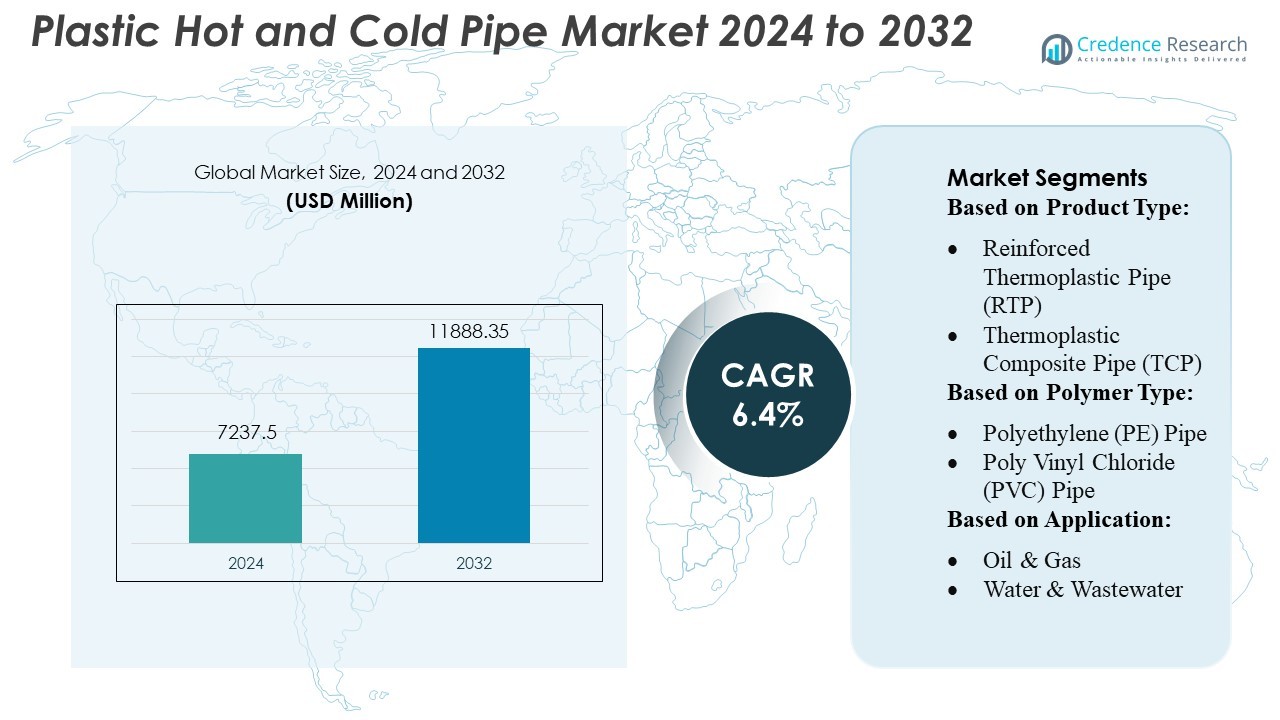
Plastic Hot and Cold Pipe Market size was valued USD 7237.5 million in 2024 and is anticipated to reach USD 11888.35 million by 2032, at a CAGR of 6.4% during the forecast period.
| REPORT ATTRIBUTE | DETAILS |
|---|---|
| Historical Period | 2020-2023 |
| Base Year | 2024 |
| Forecast Period | 2025-2032 |
| Plastic Hot & Cold Pipe Market Size 2024 | USD 7237.5 Million |
| Plastic Hot & Cold Pipe Market, CAGR | 6.4% |
| Plastic Hot & Cold Pipe Market Size 2032 | USD 11888.35 Million |
The Plastic Hot and Cold Pipe Market features a competitive landscape shaped by global manufacturers focused on enhancing product durability, thermal efficiency, and installation performance. Companies continue to invest in advanced polymer formulations, automated extrusion systems, and multilayer composite technologies to strengthen their market position. Strategic expansion into emerging economies and the development of climate-specific piping solutions further support competitiveness. Asia-Pacific leads the global market with a dominant 38% share, driven by rapid urbanization, extensive residential construction, and strong government investment in water infrastructure. This region’s large-scale adoption of PPR, CPVC, and multilayer pipes continues to reinforce its leadership in the industry.
Market Insights
- The Plastic Hot and Cold Pipe Market reached USD 7,237.5 million in 2024 and is projected to attain USD 11,888.35 million by 2032, expanding at a CAGR of 6.4%, supported by rising construction activity and increasing replacement demand.
- Growing use of PPR, CPVC, and multilayer composite pipes in residential and commercial plumbing systems drives market expansion, as consumers prioritize thermal stability, corrosion resistance, and long-term installation efficiency.
- Manufacturers strengthen competitiveness by investing in automated extrusion lines, advanced polymer blends, and region-specific product innovations, while expanding distribution networks across high-growth economies.
- Limited availability of skilled installers and fluctuating raw material prices restrain market adoption, particularly in developing regions where cost sensitivity remains high.
- Asia-Pacific leads with a 38% regional share, followed by North America and Europe, while the residential segment holds the largest share due to extensive urbanization and rising demand for energy-efficient piping solutions.
Market Segmentation Analysis:
By Product Type:
Reinforced Thermoplastic Pipe (RTP) dominated the market with an estimated 60–65% share, driven by its superior pressure resistance, rapid installation, and longer lifecycle in demanding environments. RTP adoption accelerated as operators prioritized corrosion-free and flexible pipe systems for high-temperature and high-pressure flows, particularly in oil and gas infrastructure upgrades. Thermoplastic Composite Pipe (TCP) continued to expand due to its reduced weight and suitability for deepwater applications, but RTP maintained leadership because of its wider field qualification, mature supply chain, and proven cost savings in onshore and offshore pipeline replacement projects.
- For instance, ASTRAL POLYTECHNIK LIMITED designs its PEX-a PRO piping system to operate safely at temperatures up to 95 °C and supports accidental spikes up to 110 °C, according to its official specifications.
By Polymer Type:
Polyethylene (PE) Pipe led the polymer segment with an approximate 45–50% market share, supported by its high flexibility, chemical resistance, and suitability for both hot and cold fluid transport. Its dominance stems from extensive use in water distribution, district heating, and industrial networks. Polypropylene (PP) and Polyvinylidene Fluoride (PVDF) followed, benefitting from higher temperature tolerance and improved abrasion performance. However, PE remained the preferred option due to lower cost, ease of fusion welding, and wider compliance with global pressure-rating standards, which supported its adoption in new fluid-handling installations.
- For instance, Chevron Phillips Chemical Company offers its Marlex® TRB-432 resin, a bimodal high-density PE rated PE 4710/PE 100, which exhibits a density of 0.949 g/cm³, a melt flow rate of 8.0 g/10 min, and over 700% elongation at break, making it ideal for high-pressure piping applications.
By Application:
Oil & Gas remained the dominant application, accounting for over 50% of the market, driven by rising replacement of corroded steel pipelines and increased demand for lightweight, flexible pipe systems in shale, offshore, and midstream operations. Operators favored RTP and TCP solutions for their reduced installation time, minimal maintenance, and strong performance in aggressive environments. Water & Wastewater and Utilities & Renewables experienced steady growth as municipalities shifted toward corrosion-free polymer pipelines. Mining & Dredging contributed moderately, leveraging plastic pipes for slurry handling and improved wear resistance in abrasive operations.
Key Growth Drivers
Rising Construction and Infrastructure Development
Rapid expansion in residential, commercial, and industrial construction continues to drive demand for plastic hot and cold piping systems. Urban housing projects, smart city developments, and large infrastructure upgrades are increasing installations of durable, corrosion-resistant, and cost-efficient plastic pipes. Governments in emerging economies are prioritizing water supply modernization and energy-efficient building standards, boosting market penetration. Additionally, replacement of aging metal pipelines with long-lasting plastic variants accelerates adoption, particularly in high-growth regions such as Asia-Pacific and the Middle East.
- For instance, Tommur Industry (Shanghai) Co., Ltd operates two factories on a combined 10,000 m² footprint with 8 extrusion lines and 24 injection-molding machines, enabling them to produce a wide variety of PPR, PP, PVC, CPVC, and PE pipes and fittings.
Shift Toward Energy-Efficient and Sustainable Piping Solutions
Growing emphasis on energy conservation and sustainability is expanding the use of PEX, PP-R, and CPVC pipes in temperature-regulated water distribution. These materials offer superior insulation, reduced heat loss, and higher lifecycle efficiency, aligning with green building certifications and eco-friendly construction practices. Manufacturers are investing in recyclable polymers, low-emission production processes, and improved pipe formulations to meet environmental regulations. This shift toward sustainable piping materials is strengthening market demand across residential and commercial applications, especially in developed markets adopting strict energy codes.
- For instance, FRIALEN NXT safety fittings reduce CO₂ emissions by approximately 25% compared to standard fittings, thanks to their compact design.
Advancements in Polymer Technology and Installation Techniques
Continuous advancements in polymer engineering, multilayer pipe designs, and fusion/jointing technologies strengthen the market by enhancing pipe durability, flexibility, and thermal performance. Innovations such as oxygen-barrier PEX pipes, antimicrobial inner layers, and enhanced pressure-resistant compounds improve reliability in hot and cold water systems. Faster and easier installation methods, such as push-fit connectors and heat-fusion welding, reduce labor time and cost, further supporting adoption among contractors. These technology improvements broaden usage across challenging applications, including district heating, radiant flooring, and industrial fluid handling.
Key Trends & Opportunities
Growing Adoption of Smart Plumbing and Remote Monitoring
Digitalization in building systems is creating opportunities for smart plumbing networks that integrate sensors, leak-detection systems, and temperature monitoring. Plastic piping materials, especially PEX and PP-based variants, support these installations due to their flexibility and compatibility with embedded monitoring components. Commercial buildings, hospitals, and high-end residential complexes increasingly adopt intelligent water management to reduce leakage costs and ensure operational safety. This trend enhances the future scope of technologically advanced piping solutions with improved interoperability and predictive maintenance capabilities.
- For instance, Wienerberger acquired Wideco Sweden AB, which already monitors over 40,000 km of district-heating pipe networks via IoT sensors and a web-based platform.
Expansion of Multilayer Composite Pipe Systems
Multilayer composite pipes-combining plastic polymers with aluminum or glass fiber reinforcement-are gaining traction due to their superior thermal stability, shape memory, and reduced thermal expansion compared to single-layer plastic pipes. These pipes offer high pressure resistance and longer service life in hot and cold water applications, creating new opportunities in large-scale heating and cooling systems. Their lightweight structure and flexible installation profile also attract installers seeking efficiency and reduced tooling requirements. This trend accelerates their adoption in both residential retrofits and new building projects.
- For instance, Finolex CPVC pipes are manufactured conforming to the IS 15778 standard in SDR 11 and SDR 13.5 classes. These pipes have certified working pressures of up to 28.14 kg/cm² at 27 °C and are suitable for continuous use at temperatures up to 82 °C (with reduced pressure).
Increasing Penetration in Industrial and Process Applications
Plastic hot and cold pipes are rapidly moving beyond residential and commercial use into industrial sectors requiring corrosion resistance and chemical stability. Industries such as food processing, pharmaceuticals, and light manufacturing are replacing metal pipes with high-performance plastic variants to improve hygiene, prevent scale build-up, and reduce maintenance frequency. Rising viability of high-temperature engineered polymers opens new avenues in process water management and auxiliary fluid handling. This shift presents manufacturers with significant opportunities to tailor advanced PVC, PP-R, and CPVC systems for industrial-grade demands.
- For instance, Orbia’s R&D team introduced its Sentio® heating-and-cooling controls, which enable modulation of floor-heating systems with a 0.5 °C resolution via Bluetooth-connected thermostats.
Key Challenges
Fluctuating Raw Material Prices and Supply Chain Disruptions
Volatility in the prices of petrochemical feedstocks, including PVC and polyethylene resins, directly affects production costs and profit margins for pipe manufacturers. Global supply chain disruptions-driven by geopolitical uncertainty, shipping bottlenecks, and energy price fluctuations-create inconsistency in raw material availability. These uncertainties hinder price stability, discourage long-term procurement planning, and intensify competition among manufacturers. As a result, the market faces challenges in maintaining consistent production volumes and meeting delivery commitments, particularly in cost-sensitive regional markets.
Competition from Alternative Piping Materials
Despite strong growth, plastic pipes face competition from metal and composite piping materials, especially in high-temperature or heavy-duty applications where metal systems offer proven reliability. Concerns about plastic degradation under prolonged exposure to UV, extreme temperatures, or aggressive chemicals also limit adoption in certain environments. Regulatory restrictions on plastic usage in some regions due to environmental concerns further intensify the challenge. These factors compel manufacturers to continually innovate material formulations to match performance benchmarks and mitigate resistance from end users accustomed to traditional materials.
Regional Analysis
North America
North America commands a significant market share of around 27%, driven by rapid adoption of plastic hot and cold pipes across residential, commercial, and industrial plumbing systems. Strong construction activity in the United States, combined with demand for PEX and CPVC pipes due to leakage resistance, thermal stability, and ease of installation, supports expansion. Stringent building codes encouraging energy-efficient piping further bolster market penetration. Infrastructure modernization programs, including water distribution upgrades, fuel long-term adoption. The presence of leading manufacturers and increased use of multilayer composite pipes in HVAC, district heating, and renovation projects sustains consistent regional growth.
Europe
Europe accounts for approximately 25% market share, driven by advanced plumbing standards, widespread retrofitting of aging water networks, and stringent regulations promoting corrosion-resistant and thermally efficient piping materials. High demand for PERT, PP-R, and multilayer composite pipes in hydronic heating, radiator connections, and underfloor heating accelerates adoption. Germany, Italy, and France lead usage due to strong residential energy-efficient construction trends. The region’s shift toward sustainable building materials, supported by EU directives such as EPBD and Green Deal targets, further strengthens market expansion. Ongoing renovation of heritage and multi-unit dwellings also enhances the demand outlook.
Asia-Pacific
Asia-Pacific dominates the market with an estimated 38% share, driven by massive urbanization, rising residential construction, and increasing adoption of cost-effective plastic pipes in China, India, and Southeast Asia. Expanding smart city projects and government-backed infrastructure programs accelerate installation of PPR, PVC, and multilayer pipes for hot and cold water distribution. Rapid industrial growth in manufacturing and commercial real estate boosts demand for durable, lightweight, and corrosion-free piping. Increased awareness of energy-efficient plumbing systems and shifting preference toward PEX and CPVC technologies contribute to strong regional penetration. The region remains the fastest-growing global market.
Latin America
Latin America holds around 6% market share, supported by increasing investments in residential housing, water supply modernization, and cost-efficient plumbing materials. Brazil and Mexico drive regional demand as builders shift from metal to PPR and PVC pipes due to lower installation and maintenance costs. Growing middle-income housing development, coupled with gradual industrial expansion, sustains adoption of hot and cold pipe systems. Government-led initiatives for improving water infrastructure and reducing pipeline leakage support broader use of plastic pipes. Despite economic fluctuations, replacement demand and urban development projects continue to provide stable growth opportunities across the region.
Middle East & Africa
The Middle East & Africa region accounts for nearly 4% market share, driven by rising urban development, large-scale commercial construction, and rapid adoption of CPVC and PPR piping systems suited to high-temperature environments. GCC countries, particularly the UAE and Saudi Arabia, lead consumption due to extensive residential and hospitality expansion. Investments in water recycling plants and district cooling networks further support usage of thermally stable plastic pipes. In Africa, infrastructure gaps and growing housing demand encourage steady uptake of cost-efficient piping alternatives. Continued government spending on utilities, desalination, and public infrastructure will support long-term market expansion.
Market Segmentations:
By Product Type:
- Reinforced Thermoplastic Pipe (RTP)
- Thermoplastic Composite Pipe (TCP)
By Polymer Type:
- Polyethylene (PE) Pipe
- Poly Vinyl Chloride (PVC) Pipe
By Application:
- Oil & Gas
- Water & Wastewater
By Geography
- North America
- U.S.
- Canada
- Mexico
- Europe
- Germany
- France
- U.K.
- Italy
- Spain
- Rest of Europe
- Asia Pacific
- China
- Japan
- India
- South Korea
- South-east Asia
- Rest of Asia Pacific
- Latin America
- Brazil
- Argentina
- Rest of Latin America
- Middle East & Africa
- GCC Countries
- South Africa
- Rest of the Middle East and Africa
Competitive Landscape
The competitive landscape of the Plastic Hot and Cold Pipe players such as Kubota ChemiX Co., Ltd, ASTRAL POLYTECHNIK LIMITED, Chevron Phillips Chemical Company, Tommur Industry (Shanghai) CO., LTD, Aliaxis Group S.A., Wienerberger AG, Pipe Corporation, Finolex Industries Ltd, Kotec Corporation, and Mexichem SAB de CV. The Plastic Hot and Cold Pipe Market is characterized by continuous innovation, strong regional expansion, and a growing emphasis on high-performance polymer technologies. Manufacturers increasingly invest in advanced extrusion systems, multilayer composite designs, and high-temperature–resistant materials to meet evolving construction and plumbing standards. Sustainability plays a central role, with companies adopting recyclable polymers, energy-efficient production lines, and lower-emission manufacturing practices. Market participants also focus on improving distribution networks, offering customized piping solutions tailored to residential, commercial, and industrial applications. As infrastructure modernization accelerates globally, competition intensifies around product reliability, certification compliance, thermal efficiency, and long-term lifecycle performance.
Key Player Analysis
- Kubota ChemiX Co., Ltd
- ASTRAL POLYTECHNIK LIMITED
- Chevron Phillips Chemical Company
- Tommur Industry (Shanghai) CO., LTD
- Aliaxis Group S.A.
- Wienerberger AG
- Pipe Corporation
- Finolex Industries Ltd
- Kotec Corporation
- Mexichem SAB de CV
Recent Developments
- In June 2025, Prysmian completed the acquisition of Channell Commercial Corporation for a base purchase price of plus customary adjustments. Channell, a US-based company, manufactures thermoplastic enclosures and fiber management solutions, which marks a significant move for Prysmian to transition from a cable manufacturer to a full solutions provider, as reported in this press release and this Cabling Installation & Maintenance article.
- In June 2024, Rollepaal, the world's leading supplier of pipe extrusion technology, is pleased to announce it has developed an exclusive relationship in India with accepted and acknowledged Sintex, part of the Welspun Group.
- In May 2023, SABIC unveiled that it has opened a new European Tube Innovation Center in the Netherlands. The new European Tube Innovation Center is located close to SABIC's production facility in Geleen and will assist in developing, evaluating, sampling, and testing custom pipe materials.
Report Coverage
The research report offers an in-depth analysis based on Product Type, Polymer Type, Application and Geography. It details leading market players, providing an overview of their business, product offerings, investments, revenue streams, and key applications. Additionally, the report includes insights into the competitive environment, SWOT analysis, current market trends, as well as the primary drivers and constraints. Furthermore, it discusses various factors that have driven market expansion in recent years. The report also explores market dynamics, regulatory scenarios, and technological advancements that are shaping the industry. It assesses the impact of external factors and global economic changes on market growth. Lastly, it provides strategic recommendations for new entrants and established companies to navigate the complexities of the market.
Future Outlook
- The market is expected to grow steadily as global construction and renovation activities accelerate.
- Manufacturers will increasingly adopt energy-efficient and automated production technologies to improve output and quality.
- Demand for high-temperature-resistant pipes such as CPVC, PPR, and multilayer composites will continue to rise.
- Sustainability requirements will drive wider adoption of recyclable and low-emission polymer materials.
- Smart building trends will promote greater integration of pipes compatible with advanced heating and cooling systems.
- Urbanization in developing regions will expand installation of cost-efficient plastic piping in residential and commercial projects.
- Companies will focus on expanding distribution networks to strengthen regional market penetration.
- Greater enforcement of plumbing safety and performance standards will encourage adoption of certified high-reliability pipe systems.
- Product customization for climate-specific applications will gain prominence across global markets.
- Strategic collaborations and technology partnerships will accelerate innovation and enhance competitive differentiation.

Request a Free Sample
Fill in your details and we'll send you a free sample report.
- Sample data tables & charts
- Research methodology
Market Dynamics
Rising Construction and Infrastructure Development
Rapid growth in residential, commercial, and industrial construction is increasing the demand for plastic hot and cold piping systems. Urbanization, smart city projects, and infrastructure upgrades are driving installations of durable, corrosion-resistant, and cost-efficient plastic pipes, especially in emerging economies.
Shift Toward Energy-Efficient and Sustainable Piping Solutions
The market is benefiting from a growing emphasis on energy conservation and sustainability, with increased adoption of PEX, PP-R, and CPVC pipes that offer superior insulation, reduced heat loss, and higher lifecycle efficiency. These materials align with green building certifications and stricter energy codes, particularly in developed markets.
Advancements in Polymer Technology and Installation Techniques
Continuous innovation in polymer engineering, multilayer pipe designs, and jointing technologies is enhancing pipe durability, flexibility, and thermal performance. Faster, easier installation methods and improved material formulations are broadening the use of plastic pipes in challenging applications and reducing labor costs.
Replacement of Aging Metal Pipelines
The need to replace corroded and outdated metal pipelines in water, wastewater, and oil & gas infrastructure is accelerating the shift to plastic alternatives. Plastic pipes offer longer service life, lower maintenance, and better resistance to corrosion and aggressive environments, making them attractive for both new installations and retrofits.
Expansion of Smart Plumbing and Remote Monitoring
The integration of sensors, leak detection, and temperature monitoring in building systems is driving demand for plastic pipes compatible with smart plumbing networks. Flexible plastic piping materials support the adoption of intelligent water management solutions in commercial, healthcare, and high-end residential projects.
Need a Custom Version of This Report?
Tailor the scope, geography, or segments to your exact requirements.
- Custom geography or segment scope
- Direct access to our analyst team
Frequently Asked Questions
What is the current market size for the Plastic Hot and Cold Pipe Market, and what is its projected size in 2032?
At what Compound Annual Growth Rate is the Plastic Hot and Cold Pipe Market projected to grow between 2025 and 2032?
Which Plastic Hot and Cold Pipe Market segment held the largest share in 2024?
What are the primary factors fueling the growth of the Plastic Hot and Cold Pipe Market?
Who are the leading companies in the Plastic Hot and Cold Pipe Market?
Which region commanded the largest share of the Plastic Hot and Cold Pipe Market in 2024?
Table of Content
Chapter 1 Market Segmentation
- 1.1 Segmentation Framework
- 1.1.1 Product and Service Classification
- 1.1.2 Application and End-Use Classification
- 1.1.3 Technology and Solution Classification
- 1.1.4 Customer and Distribution Channel Classification
- 1.1.5 Geographic Segmentation
- 1.1.6 Market Segment Definitions and Boundaries
- 1.2 By Application
- 1.2.1 Oil & Gas
- 1.2.2 Water & Wastewater
- 1.2.3 Utilities & Renewables
- 1.2.4 Mining & Dredging
- 1.3 By Polymer Type
- 1.3.1 Polyethylene (PE) Pipe
- 1.3.2 Poly Vinyl Chloride (PVC) Pipe
- 1.3.3 Polypropylene (PP) Pipe
- 1.3.4 Chlorinated Polyvinyl Chloride (CPVC) Pipe
- 1.4 By Product Type
- 1.4.1 Reinforced Thermoplastic Pipe (RTP)
- 1.4.2 Thermoplastic Composite Pipe (TCP)
Chapter 2 Introduction
- 2.1 Report Objectives and Scope
- 2.2 Product Definition and Industry Terminology
- 2.3 Market Inclusions and Exclusions
- 2.4 Research Process
- 2.4.1 Primary Research and Expert Interviews
- 2.4.2 Secondary Research and Source Review
- 2.4.3 Top-Down and Bottom-Up Estimation
- 2.4.4 Data Triangulation and Verification
- 2.5 Market Size Measurement Basis
- 2.5.1 2024: USD 7,237.5 million → 2032: USD 11,888.35 million
- 2.6 Historical and Forecast Reference Periods
- 2.6.1 Base Year: 2024
- 2.6.2 Forecast Period: 2024-2032
- 2.7 Research Assumptions and Limitations
Chapter 3 Executive Summary
- 3.1 Market Snapshot and Key Findings
- 3.2 Base-Year Market Size, 2024
- 3.3 Forecast Market Size, 2032
- 3.4 Revenue and Volume Growth Outlook
- 3.5 Key Demand and Supply Indicators
- 3.6 Leading Market Segments
- 3.7 Fastest-Growing Market Opportunities
- 3.8 Regional Performance Highlights
- 3.9 Technology and Industry Transformation
- 3.10 Competitive Landscape Summary
- 3.11 Analyst View and Strategic Implications
Chapter 4 Global Plastic Hot & Cold Pipe Market Trends and Developments
- 4.1 Historical Industry Development
- 4.2 Recent Market Trends and Developments
- 4.3 Demand and Customer Behavior Trends
- 4.4 Technology and Product Innovation
- 4.5 Artificial Intelligence, Automation and Digitalization
- 4.6 Local Manufacturing and Supply Chain Realignment
- 4.7 Industry Partnerships, Mergers and Acquisitions
- 4.8 Sustainability and Circular Economy Developments
- 4.9 Government and Private Sector Investment Trends
- 4.10 Emerging Business Models and Commercialization
- 4.11 Industry Developments and Announcements
Chapter 5 Global Plastic Hot & Cold Pipe Market Production, Supply and Demand Analysis
- 5.1 Demand Trend and Consumption Analysis
- 5.2 Demand Forecast, 2024-2032
- 5.3 Production and Output Trend
- 5.4 Production and Output Forecast, 2024-2032
- 5.5 Installed Capacity and Capacity Utilization
- 5.6 Company-Wise Production Plants and Statistics
- 5.6.1 Installed Production Capacity
- 5.6.2 Actual Production
- 5.6.3 Planned Capacity and Expansion Targets
- 5.7 Supply Chain Structure and Procurement Trends
- 5.8 Supply-Demand Gap and Bottlenecks
- 5.9 Import Dependence and Sourcing Structure
- 5.10 Contract Manufacturing and Outsourcing
- 5.11 Regional Supply and Demand Concentration
Chapter 6 Global Plastic Hot & Cold Pipe Market Pricing Analysis
- 6.1 Pricing Structure and Measurement
- 6.2 Historical Pricing Trends
- 6.3 Pricing Outlook, 2024-2032
- 6.4 Average Selling Price and Unit Economics
- 6.5 Pricing by Product and Market Segment
- 6.6 Geographic Pricing Differences
- 6.7 Key Input, Energy, Labor and Logistics Costs
- 6.8 Contract Pricing and Purchasing Models
- 6.9 Pricing Sensitivity and Competitive Positioning
- 6.10 Price, Margin and Profitability Implications
Chapter 7 Global Plastic Hot & Cold Pipe Market Dynamics
- 7.1 Market Growth Drivers
- 7.1.1 Demand-Side Drivers
- 7.1.2 Technology and Innovation Drivers
- 7.1.3 Infrastructure and Investment Drivers
- 7.1.4 Regulatory and Policy Drivers
- 7.2 Market Restraints
- 7.2.1 Cost and Affordability Constraints
- 7.2.2 Technology and Adoption Barriers
- 7.2.3 Supply Chain and Operational Constraints
- 7.3 Market Challenges
- 7.3.1 Competitive Pressure and Margin Erosion
- 7.3.2 Skills, Infrastructure and Implementation Gaps
- 7.4 Emerging Market Opportunities
- 7.5 Market Dynamics Impact and Time-Horizon Assessment
Chapter 8 Global Plastic Hot & Cold Pipe Value Chain Analysis
- 8.1 Industry Value Chain Overview
- 8.2 Upstream Suppliers and Critical Inputs
- 8.3 Technology and Component Providers
- 8.4 Manufacturing or Service Delivery
- 8.5 Distribution, Channel Partners and Integrators
- 8.6 Downstream Applications and End Users
- 8.7 Value Addition and Profit Pools
- 8.8 Vertical Integration and Outsourcing
- 8.9 Supplier Concentration and Risk
- 8.10 Supply Chain Localization and Resilience
Chapter 9 Global Plastic Hot & Cold Pipe Market Regulations and Policies
- 9.1 Relevant Laws, Standards and Compliance Frameworks
- 9.2 Product, Service, Safety and Quality Requirements
- 9.3 Government Policies, Incentives and Subsidies
- 9.4 Imports, Exports and Trade Barriers
- 9.5 Public Procurement and Local Content Requirements
- 9.6 Environmental and Sustainability Compliance
- 9.7 Upcoming Policy Changes and Market Implications
Chapter 10 Global Plastic Hot & Cold Pipe Market Hotspots and Opportunities
- 10.1 Market Opportunity Mapping and Growth Hotspots
- 10.2 High-Growth Applications and Customer Groups
- 10.3 Underserved Markets and White-Space Opportunities
- 10.4 Emerging Technology and Product Opportunities
- 10.5 New Capacity and Investment Hotspots
- 10.6 Market Entry and Expansion Opportunities
- 10.7 Distribution and Partnership Opportunities
- 10.8 Near-Term and Long-Term Commercial Potential
- 10.9 Opportunity Attractiveness and Execution Risks
Chapter 11 Global Plastic Hot & Cold Pipe Market Outlook, 2024-2032
- 11.1 Market Size and Analysis
- 11.1.1 Revenue (Market Measurement: 2024: USD 7,237.5 million → 2032: USD 11,888.35 million)
- 11.1.2 Market Volume and Quantity Sold
- 11.1.3 Historical Market Size
- 11.1.4 Base-Year Market Size, 2024
- 11.2 Market Forecast, 2024-2032
- 11.2.1 Revenue Forecast to 2032
- 11.2.2 Volume Forecast to 2032
- 11.2.3 CAGR and Year-on-Year Growth
- 11.2.4 Incremental Revenue Opportunity
- 11.3 Forecast Assumptions and Scenario Analysis
- 11.3.1 Base-Case Forecast
- 11.3.2 Optimistic and Conservative Scenarios
- 11.3.3 Technology, Pricing and Policy Sensitivities
- 11.4 Market Attractiveness and Growth Outlook
Chapter 12 Global Plastic Hot & Cold Pipe Market Segmentation and Outlook
- 12.1 Segmentation Summary and Market Shares, 2024
- 12.2 Largest and Fastest-Growing Segments
- 12.3 By Application - Market Size and Forecast, 2024-2032
- 12.3.1 Segment Definition and Scope
- 12.3.2 Historical Market Size
- 12.3.3 Revenue Forecast, 2024-2032
- 12.3.4 Volume Forecast, 2024-2032
- 12.3.5 Base-Year Market Share, 2024
- 12.3.6 Segment CAGR and Growth Drivers
- 12.3.7 Subsegment Market Size and Forecast
- 12.3.7.1 Oil & Gas
- 12.3.7.2 Water & Wastewater
- 12.3.7.3 Utilities & Renewables
- 12.3.7.4 Mining & Dredging
- 12.3.8 Subsegment Pricing and Adoption Trends
- 12.3.9 Leading Suppliers and Competition
- 12.3.10 Regional Demand and Opportunities
- 12.4 By Polymer Type - Market Size and Forecast, 2024-2032
- 12.4.1 Segment Definition and Scope
- 12.4.2 Historical Market Size
- 12.4.3 Revenue Forecast, 2024-2032
- 12.4.4 Volume Forecast, 2024-2032
- 12.4.5 Base-Year Market Share, 2024
- 12.4.6 Segment CAGR and Growth Drivers
- 12.4.7 Subsegment Market Size and Forecast
- 12.4.7.1 Polyethylene (PE) Pipe
- 12.4.7.2 Poly Vinyl Chloride (PVC) Pipe
- 12.4.7.3 Polypropylene (PP) Pipe
- 12.4.7.4 Chlorinated Polyvinyl Chloride (CPVC) Pipe
- 12.4.8 Subsegment Pricing and Adoption Trends
- 12.4.9 Leading Suppliers and Competition
- 12.4.10 Regional Demand and Opportunities
- 12.5 By Product Type - Market Size and Forecast, 2024-2032
- 12.5.1 Segment Definition and Scope
- 12.5.2 Historical Market Size
- 12.5.3 Revenue Forecast, 2024-2032
- 12.5.4 Volume Forecast, 2024-2032
- 12.5.5 Base-Year Market Share, 2024
- 12.5.6 Segment CAGR and Growth Drivers
- 12.5.7 Subsegment Market Size and Forecast
- 12.5.7.1 Reinforced Thermoplastic Pipe (RTP)
- 12.5.7.2 Thermoplastic Composite Pipe (TCP)
- 12.5.8 Subsegment Pricing and Adoption Trends
- 12.5.9 Leading Suppliers and Competition
- 12.5.10 Regional Demand and Opportunities
- 12.6 Segment Growth Comparison
- 12.7 Segment Attractiveness and Priority Matrix
Chapter 13 Global Plastic Hot & Cold Pipe End-Use and Application Market Outlook
- 13.1 End-Use Industry and Customer Demand Structure
- 13.2 Leading Applications and Customer Groups
- 13.3 End-Use Market Size, Share and Forecast
- 13.4 Major End-Use Industry Deep Dives
- 13.4.1 Customer Requirements and Use Cases
- 13.4.2 Demand and Replacement Cycles
- 13.4.3 Technical and Regulatory Considerations
- 13.4.4 Purchasing and Procurement Models
- 13.4.5 Leading Vendors and Distribution Channels
- 13.4.6 Forecast and Commercial Opportunities
- 13.5 Emerging Applications and Cross-Segment Demand
- 13.6 End-Use Industry Investment Priorities
Chapter 14 Global Plastic Hot & Cold Pipe Geographic Market Outlook, 2024-2032
- 14.1 Regional Market Size and Share, 2024
- 14.2 Regional Market Forecast, 2024-2032
- 14.3 Regional Pricing, Production and Demand Differences
- 14.4 North America
- 14.4.1 United States
- 14.4.2 Canada
- 14.4.3 Mexico
- 14.5 Europe
- 14.5.1 Germany
- 14.5.2 France
- 14.5.3 Italy
- 14.5.4 United Kingdom
- 14.5.5 Spain
- 14.5.6 Poland
- 14.5.7 Russia
- 14.5.8 Netherlands
- 14.5.9 Belgium
- 14.5.10 Sweden
- 14.5.11 Denmark
- 14.5.12 Norway
- 14.5.13 Rest of Europe
- 14.6 Asia Pacific
- 14.6.1 China
- 14.6.2 India
- 14.6.3 Japan
- 14.6.4 South Korea
- 14.6.5 Thailand
- 14.6.6 Indonesia
- 14.6.7 Vietnam
- 14.6.8 Malaysia
- 14.6.9 Australia
- 14.6.10 Rest of Asia Pacific
- 14.7 Latin America
- 14.7.1 Brazil
- 14.7.2 Argentina
- 14.7.3 Colombia
- 14.7.4 Chile
- 14.7.5 Rest of Latin America
- 14.8 Middle East
- 14.8.1 Saudi Arabia
- 14.8.2 United Arab Emirates
- 14.8.3 Turkey
- 14.8.4 Israel
- 14.8.5 Iran
- 14.8.6 Rest of the Middle East
- 14.9 Africa
- 14.9.1 South Africa
- 14.9.2 Egypt
- 14.9.3 Nigeria
- 14.9.4 Morocco
- 14.9.5 Rest of Africa
- 14.10 Regional Investment, Policy and Supply Chain Differences
- 14.11 Regional Competitive Landscape
- 14.12 Geographic Growth Hotspots
Chapter 15 Global Plastic Hot & Cold Pipe Technology, Innovation and Sustainability Outlook
- 15.1 Technology Landscape and Maturity
- 15.2 Product, Process and Service Innovation
- 15.3 AI, Automation and Digital Tools in the Industry
- 15.4 Technology Adoption and Performance Benchmarking
- 15.5 Innovation Pipeline and R&D Investment
- 15.6 Patent and Intellectual Property Trends
- 15.7 Energy Efficiency and Resource Management
- 15.8 Sustainability, Recycling and Circularity
- 15.9 Technology Roadmap, 2024-2032
- 15.10 Risks of Obsolescence and Technology Substitution
Chapter 16 Global Plastic Hot & Cold Pipe Market Key Strategic Imperatives
- 16.1 Growth and Market Entry Priorities
- 16.2 High-Return Products and Segments
- 16.3 Pricing, Profitability and Cost Optimization
- 16.4 Technology Investment and Product Differentiation
- 16.5 Supply Chain Localization and Resilience
- 16.6 Distribution and Customer Acquisition
- 16.7 Partnership, Acquisition and Capacity Strategy
- 16.8 Regional Expansion Priorities
- 16.9 Short-, Medium- and Long-Term Actions
Chapter 17 Competition Outlook
- 17.1 Industry Competition Characteristics
- 17.2 Market Structure and Concentration
- 17.3 Market Share and Competitive Positioning, 2024
- 17.4 Company-Wise Revenue and Product Benchmarking
- 17.5 Production and Service Capacity Benchmarking
- 17.6 Technology, Pricing and Differentiation
- 17.7 Regional Footprint and Distribution Strength
- 17.8 Mergers, Acquisitions and Strategic Alliances
- 17.9 New Entrants and Competitive Threats
- 17.10 Porter's Five Forces and Industry Attractiveness
- 17.11 Competitive Outlook, 2024-2032
Chapter 18 Company Profiles
- 18.1 Company Coverage and Selection Criteria
- 18.2 Kubota ChemiX Co., Ltd
- 18.2.1 Business Description
- 18.2.2 Company Ownership and Geographic Presence
- 18.2.3 Product and Service Portfolio
- 18.2.4 Manufacturing and Operating Footprint
- 18.2.5 Production Capacity and Expansion Plans
- 18.2.6 Financial Performance and Investment
- 18.2.7 Market Share and Competitive Position
- 18.2.8 Technology and Innovation Capabilities
- 18.2.9 Strategic Alliances or Partnerships
- 18.2.10 Recent Developments
- 18.2.11 Growth Strategy and Outlook
- 18.3 ASTRAL POLYTECHNIK LIMITED
- 18.4 Chevron Phillips Chemical Company
- 18.5 Tommur Industry (Shanghai) CO., LTD
- 18.6 Aliaxis Group S.A.
- 18.7 Wienerberger AG
- 18.8 Finolex Industries Ltd
- 18.9 Kotec Corporation
- 18.10 Mexichem SAB de CV
- 18.11 Pipe Corporation
- 18.12 Other Relevant Market Participants
Note: Every listed company is profiled on the structure shown under the first company. The company list is preliminary and may change based on research findings, market developments, data availability and client requirements.
Chapter 19 Disclaimer
- 19.1 Research and Forecast Disclaimer
- 19.2 Data Source and Estimation Limitations
Note: The depth of individual sections depends on data availability for this market. Volume, capacity, trade and other unit-based metrics are included where applicable.