
| REPORT ATTRIBUTE | DETAILS |
|---|---|
| Historical Period | 2019-2022 |
| Base Year | 2023 |
| Forecast Period | 2024-2032 |
| Plastic Pallets Market Size 2023 | USD 7,924.67 Million |
| Plastic Pallets Market, CAGR | 5.85% |
| Plastic Pallets Market Size 2032 | USD 13,219.01 Million |
Market Overview
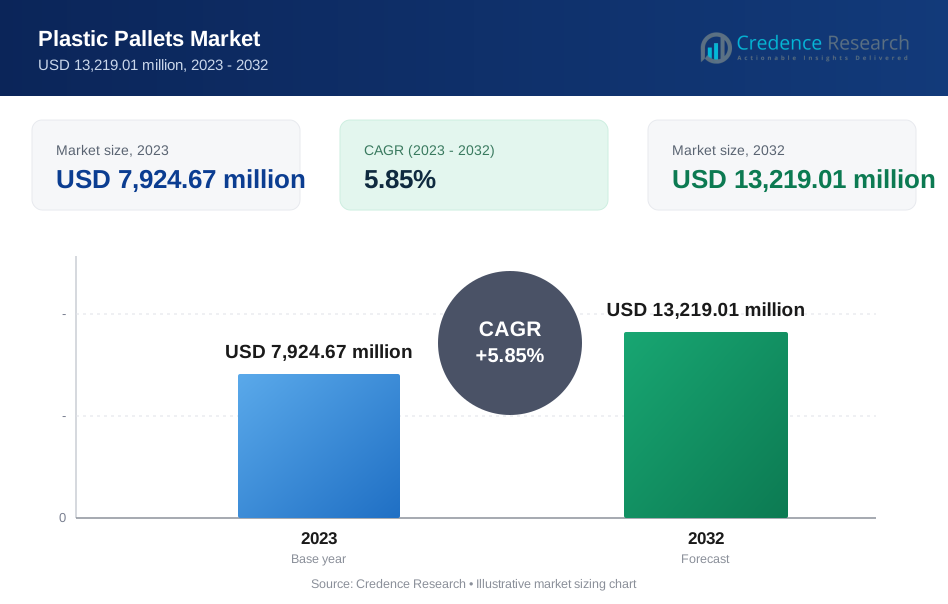
The global Plastic Pallets Market is projected to grow from USD 7,924.67 million in 2023 to USD 13,219.01 million by 2032, registering a CAGR of 5.85% during the forecast period.
The global plastic pallets market is driven by the growing demand for durable, lightweight, and hygienic storage and transportation solutions across industries such as food and beverage, pharmaceuticals, and logistics. Increasing awareness about the environmental benefits of reusable and recyclable plastic pallets over traditional wooden counterparts further supports market growth. Technological advancements in pallet manufacturing, including the use of high-strength polymers and innovative designs, enhance durability and load-carrying capacity, fueling adoption. Rising e-commerce activities and the need for efficient supply chain management amplify demand for standardized and sustainable pallet solutions. Trends such as the integration of RFID and IoT-enabled tracking systems in plastic pallets are gaining traction, enabling better inventory management and operational efficiency. Moreover, the global shift towards eco-friendly practices and stringent regulatory frameworks advocating sustainable packaging solutions present significant growth opportunities for the plastic pallets market in the coming years.
The global plastic pallets market is characterized by significant regional diversity, with major growth observed in North America, Europe, and Asia-Pacific. North America leads the market due to the demand for durable, hygienic, and recyclable pallets, particularly in industries like food & beverages, pharmaceuticals, and logistics. Europe follows with a strong focus on sustainability and circular economy initiatives, fostering the adoption of plastic pallets. Asia-Pacific is expected to witness rapid growth, driven by emerging markets like China and India, along with increasing industrialization and e-commerce activities. Key players in the global plastic pallets market include Brambles Limited, Schoeller Allibert, ORBIS Corporation, Craemer Group, and CABKA Group, among others. These companies dominate the market by offering innovative, eco-friendly pallet solutions and leveraging extensive distribution networks to meet growing demands across various industries. Their strategic expansions and focus on sustainability help maintain their competitive edge globally.
Market Insights
- The global plastic pallets market was valued at USD 7,924.67 million in 2023 and is projected to reach USD 13,219.01 million by 2032, growing at a CAGR of 5.85%.
- Increasing demand for durable, reusable, and lightweight pallets in industries like food & beverages, pharmaceuticals, and chemicals is driving market growth.
- The trend towards sustainability and eco-friendly packaging solutions is pushing businesses to adopt plastic pallets over traditional wooden alternatives.
- The market is competitive, with key players like Brambles Limited, Schoeller Allibert, and ORBIS Corporation focusing on innovation and expanding their product portfolios.
- Rising concerns about hygiene, contamination, and product safety are increasing the need for hygienic and easy-to-clean plastic pallets.
- The Asia-Pacific region is expected to grow rapidly, driven by emerging markets such as China and India, and rising demand from logistics and e-commerce sectors.
- However, challenges such as the high initial cost and environmental concerns regarding plastic waste may hinder market expansion.
Market Drivers
Growing Demand for Durable and Hygienic Solutions
The rising preference for durable, lightweight, and hygienic materials in storage and transportation has significantly driven the demand for plastic pallets. Industries such as food and beverages, pharmaceuticals, and chemicals require pallets that minimize contamination risks and meet stringent hygiene standards. For instance, a survey by the Indian Brand Equity Foundation (IBEF) highlighted that the food and beverage industry increasingly prefers plastic pallets due to their resistance to moisture, chemicals, and pests. Their durability ensures a longer lifecycle compared to traditional wooden pallets, offering cost-effective benefits for industries seeking sustainable logistics solutions.
Expansion of E-commerce and Logistics
The rapid expansion of e-commerce and the need for efficient supply chain management are pivotal drivers for the plastic pallets market. With increasing online shopping activities, companies seek standardized pallets that facilitate seamless transportation and storage of goods. For instance, according to a report by the Indian Ministry of Commerce, the surge in e-commerce activities has led to a higher demand for plastic pallets, which support streamlined operations in warehousing and logistics. This surge in e-commerce activities propels the adoption of plastic pallets to meet the demands of fast-moving consumer goods distribution.
Focus on Sustainability and Recyclability
Growing environmental awareness has encouraged businesses to transition towards sustainable practices, including the adoption of recyclable and reusable materials. Plastic pallets, made from high-strength polymers, can be recycled at the end of their lifecycle, aligning with circular economy principles. Governments and organizations worldwide are introducing stringent regulations to promote eco-friendly packaging, further bolstering the use of plastic pallets. The ability to reduce waste and carbon footprint makes these pallets an appealing choice for companies aiming to meet sustainability goals.
Technological Advancements in Pallet Design
Innovations in plastic pallet manufacturing, including the integration of high-performance materials and advanced design techniques, have enhanced their load-bearing capacity and durability. Additionally, the incorporation of RFID and IoT-enabled tracking systems improves inventory management and operational efficiency. These technological advancements cater to the increasing demand for smart logistics solutions, positioning plastic pallets as a preferred choice in modern supply chains. The ability to deliver both functional and technological benefits drives their adoption across diverse industrial sectors.
Market Trends
Shift Towards Recyclable and Sustainable Materials
A prominent trend in the global plastic pallets market is the growing preference for recyclable and eco-friendly materials. Companies are increasingly adopting pallets made from recycled plastics to align with sustainability goals and comply with environmental regulations. For instance, a report by the Indian Ministry of Environment, Forest and Climate Change highlights the increasing use of recycled plastics in manufacturing to reduce environmental impact. This trend is driven by rising awareness of the ecological benefits of minimizing waste and conserving resources. Recyclable plastic pallets support circular economy practices, providing businesses with a cost-effective and environmentally responsible alternative to traditional materials.
Adoption of IoT-Enabled Smart Pallets
The integration of IoT technology into plastic pallets has revolutionized logistics and supply chain management. Smart pallets equipped with RFID tags and sensors enable real-time tracking of goods, improving inventory accuracy and operational efficiency. This innovation enhances transparency across supply chains, allowing businesses to monitor product conditions such as temperature and humidity. The adoption of IoT-enabled pallets reflects the increasing demand for advanced logistics solutions that cater to the needs of modern, technology-driven industries.
Growing Demand in the E-commerce Sector
The rapid expansion of the e-commerce sector has significantly influenced the demand for plastic pallets. Online retail businesses require durable, lightweight, and standardized pallets to facilitate efficient storage and transportation of goods. Plastic pallets, with their compatibility with automated handling systems and resistance to damage, meet these requirements effectively. As e-commerce continues to grow globally, the demand for reliable and scalable pallet solutions is expected to rise, positioning plastic pallets as a key component of the logistics ecosystem.
Customization and Lightweight Designs Gain Traction
Customization and lightweight designs have emerged as critical trends in the plastic pallets market. Businesses are seeking pallets tailored to specific applications, such as pallets with unique dimensions or those capable of handling specific load requirements. Manufacturers are responding by offering customizable solutions that cater to diverse industrial needs. Additionally, lightweight pallets are gaining popularity due to their ease of handling and reduced transportation costs, further driving innovation and adoption in this segment.
Market Challenges Analysis
High Initial Costs and Limited Affordability
One of the significant challenges in the global plastic pallets market is the high initial investment required for their procurement. Compared to traditional wooden pallets, plastic pallets are more expensive due to the cost of raw materials and manufacturing processes. For instance, a report by the Indian Ministry of Commerce highlights that the cost disparity often discourages small and medium-sized enterprises (SMEs) from adopting plastic pallets. This cost disparity often discourages small and medium-sized enterprises (SMEs) from adopting plastic pallets, especially in regions where affordability is a primary concern. Despite their longer lifecycle and lower maintenance costs, the upfront expense can act as a barrier, limiting their penetration in price-sensitive markets.
Environmental Concerns and Disposal Challenges
While plastic pallets are recyclable, improper disposal and limited recycling infrastructure in certain regions pose environmental challenges. Non-recyclable or poorly managed plastic pallets contribute to environmental pollution, undermining their sustainability benefits. Additionally, stringent government regulations regarding plastic waste management and the increasing push toward biodegradable alternatives create obstacles for manufacturers. Companies must navigate these regulatory frameworks and invest in sustainable practices to address environmental concerns and maintain market competitiveness.
Market Opportunities
Rising Demand for Sustainable and Recyclable Solutions
The growing emphasis on sustainability presents significant opportunities for the global plastic pallets market. Companies are increasingly seeking eco-friendly alternatives to traditional materials, creating a demand for recyclable and reusable plastic pallets. Innovations in manufacturing processes, such as the use of recycled plastics and bio-based materials, offer manufacturers a chance to align with environmental standards while catering to the needs of sustainability-conscious businesses. Governments and organizations worldwide are promoting initiatives and regulations to reduce environmental impact, further encouraging the adoption of recyclable plastic pallets. These developments open avenues for manufacturers to expand their product portfolios and capture a broader customer base.
Expansion in Emerging Markets and Technological Advancements
Emerging markets, particularly in Asia-Pacific and Latin America, provide growth opportunities due to the rapid industrialization and expansion of logistics infrastructure. Increasing e-commerce activities and the development of organized retail sectors in these regions drive the demand for efficient and durable logistics solutions, positioning plastic pallets as a preferred choice. Additionally, advancements in smart technologies, such as IoT-enabled pallets with RFID tracking, offer opportunities for manufacturers to tap into the growing demand for digital supply chain solutions. By integrating innovative features and targeting untapped markets, manufacturers can enhance their competitive edge and capitalize on the increasing demand for modernized pallet systems.
Market Segmentation Analysis:
By Type:
The global plastic pallets market is segmented by type into nestable, rackable, stackable, and others. Among these, nestable plastic pallets are gaining traction due to their space-saving design, making them ideal for companies seeking efficient storage solutions. These pallets can be nested together, reducing the volume during return shipments. Rackable plastic pallets are designed to withstand heavier loads and are suitable for high-density storage systems, making them popular in industries such as manufacturing and logistics. Stackable pallets, on the other hand, are widely used for their ability to be stacked one on top of another, optimizing space in warehouses and transportation. Other types include custom-designed pallets for specialized applications. Each type serves distinct functions and caters to specific industry needs, offering various advantages based on load capacity, durability, and storage requirements. The continued demand for efficient and durable pallet solutions ensures the sustained growth of these types in global markets.
By Application:
The plastic pallets market is also segmented based on application, with key industries including food & beverages, chemicals, pharmaceuticals, petroleum & lubricants, and others. The food & beverages sector is one of the largest contributors to market growth, driven by the need for hygienic, durable, and moisture-resistant pallets. Similarly, the chemical industry relies on plastic pallets for their resistance to chemicals and corrosion. Pharmaceuticals also demand high hygiene standards and secure transportation, making plastic pallets an ideal solution. The petroleum & lubricants industry uses these pallets for safe, efficient handling of products while preventing contamination. Additionally, the "others" segment includes industries like retail and e-commerce, which require efficient, standardized pallet solutions. Each application segment drives demand for specific pallet features, including durability, hygiene, and resistance to various environmental factors, contributing to the overall expansion of the global plastic pallets market.
Segments:
Based on Type:
- Nestable
- Rackable
- Stackable
- Others
Based on Application:
- Food & Beverages
- Chemicals
- Pharmaceuticals
- Petroleum & Lubricants
- Others
Based on Material:
- High-Density Polyethylene
- Low-Density Polyethylene
- Polypropylene (PP)
- Others
Based on the Geography:
- North America
- U.S.
- Canada
- Mexico
- Europe
- UK
- France
- Germany
- Italy
- Spain
- Russia
- Belgium
- Netherlands
- Austria
- Sweden
- Poland
- Denmark
- Switzerland
- Rest of Europe
- Asia Pacific
- China
- Japan
- South Korea
- India
- Australia
- Thailand
- Indonesia
- Vietnam
- Malaysia
- Philippines
- Taiwan
- Rest of Asia Pacific
- Latin America
- Brazil
- Argentina
- Peru
- Chile
- Colombia
- Rest of Latin America
- Middle East
- UAE
- KSA
- Israel
- Turkey
- Iran
- Rest of Middle East
- Africa
- Egypt
- Nigeria
- Algeria
- Morocco
- Rest of Africa
Regional Analysis
North America
North America holds the largest market share, accounting for approximately 30% of the global market in 2023. North America is expected to maintain its leadership in the plastic pallets market, driven by the United States and Canada. The demand in this region is fueled by the increasing need for efficient supply chain management, particularly in industries like food & beverages and pharmaceuticals, where hygiene and product safety are paramount. Furthermore, the growing focus on sustainability and the circular economy is encouraging businesses to switch to eco-friendly plastic pallets. The U.S. and Canada benefit from established recycling infrastructure, ensuring plastic pallets are reused or recycled at the end of their life cycle. North America’s robust manufacturing capabilities and the presence of major players in the logistics and e-commerce sectors ensure the region's continued growth in the coming years.
Europe
Europe is another significant player in the global plastic pallets market, accounting for around 27% of the market share in 2023. The region's rapid adoption of sustainable practices and regulatory support for eco-friendly solutions plays a critical role in driving market growth. European countries, such as Germany, France, and the U.K., are major contributors to this demand, where industries are increasingly switching to recyclable plastic pallets. The growth in e-commerce and the expanding retail sector also propels the adoption of plastic pallets in Europe. With a strong emphasis on sustainability and circular economy principles, Europe’s plastic pallets market is poised for consistent growth, benefiting from ongoing technological advancements and evolving consumer preferences.
Asia-Pacific
The Asia-Pacific region is anticipated to witness the highest growth in the plastic pallets market, with a projected share of 23% in 2023. This growth is primarily driven by emerging markets such as China, India, and Southeast Asia. The rapid industrialization, along with the expanding retail and logistics sectors, drives the need for efficient storage and transportation solutions. As e-commerce in the region continues to rise, there is an increased demand for standardized pallets for faster, more efficient supply chains. Moreover, the region is witnessing a growing focus on sustainable packaging solutions, which bodes well for the plastic pallets market. With large-scale manufacturing operations and an expanding middle class, the Asia-Pacific market is expected to continue its robust growth trajectory over the next decade.
Latin America and the Rest of the World
Latin America and the Rest of the World, which includes the Middle East and Africa, collectively hold a smaller market share of approximately 20%. However, the region is showing significant potential, particularly in Brazil, Mexico, and parts of the Middle East. As industries like agriculture, chemicals, and retail expand, the demand for durable, cost-effective pallet solutions grows. The increasing focus on reducing operational costs and improving supply chain efficiency drives the adoption of plastic pallets. Additionally, countries in the Middle East are investing in modernizing their logistics infrastructure, further fueling the demand for plastic pallets. With rising industrial activities and improving trade dynamics, Latin America and the Rest of the World present promising growth opportunities for the plastic pallets market in the near future.
Key Player Analysis
- Brambles Limited
- Schoeller Allibert
- Loscam
- ORBIS Corporation
- Craemer Group
- CABKA Group
- Greystone Logistics
- Rehrig Pacific Company
- Buckhorn Inc.
- Plastic Pallet & Container, Inc.
- TranPak Inc.
- IPL Inc.
- Material Handling Systems, Inc.
- Litco International, Inc.
- Premier Handling Solutions
- Beecraft UK Ltd.
- Cherry's Industrial Equipment Corp.
- TranPak (Australia) Pty Ltd.
- PalletOne, Inc.
- PDQ Plastics, Inc.
Competitive Analysis
The global plastic pallets market is highly competitive, with leading players focusing on innovation, product differentiation, and strategic expansions. Key players in the market include Brambles Limited, Schoeller Allibert, Loscam, ORBIS Corporation, Craemer Group, CABKA Group, Greystone Logistics, Rehrig Pacific Company, Buckhorn Inc., Plastic Pallet & Container, Inc., TranPak Inc., IPL Inc., Material Handling Systems, Inc., Litco International, Inc., Premier Handling Solutions, Beecraft UK Ltd., Cherry's Industrial Equipment Corp., TranPak (Australia) Pty Ltd., PalletOne, Inc., and PDQ Plastics, Inc. Companies in this market focus heavily on innovation and enhancing product offerings to meet evolving consumer demands, especially in industries like food & beverages, pharmaceuticals, and chemicals. For instance, a report by the Indian Brand Equity Foundation (IBEF) highlights that companies are increasingly focusing on providing durable, lightweight, and sustainable pallet solutions. A major competitive factor is the ability to provide durable, lightweight, and sustainable pallet solutions, with a focus on reducing carbon footprints and supporting circular economy practices. In addition to product innovation, players are expanding their geographical reach through strategic partnerships, acquisitions, and investments in new manufacturing facilities. The increasing demand for hygienic, recyclable, and reusable pallets further intensifies competition. Companies are also differentiating themselves through customer service and value-added offerings such as custom designs and advanced tracking technologies. To stay ahead in this competitive market, companies are placing a strong emphasis on sustainability, leveraging eco-friendly materials, and complying with environmental regulations. As the market grows, companies that can provide cost-effective and environmentally responsible solutions are well-positioned to gain a competitive edge. The growing demand from emerging economies is expected to provide new growth opportunities for market participants.
Recent Developments
- In February 2024, Rockwell Automation launched Embedded Edge Compute Module, which extends Rockwell Automation’s track record of integrating PC or compute capabilities with the strength of Logix. This Edge solution offers essential scalability and remote support features to enhance the capabilities of modern workforces.
- In February 2024, Emerson Electric Co. launched the latest addition to its lineup, the PACSystems IPC 2010 Compact Industrial PC (IPC), engineered to withstand the demands of various machine and discrete part manufacturing automation tasks. This robust solution caters to manufacturing facilities and OEM machine builders requiring a resilient, space-efficient IPC to efficiently bolster their Industrial Internet of Things (IIoT) endeavors and other digital transformation initiatives while maintaining cost-effectiveness.
- In May 2023, Hexagon partnered with Zealand-based Scada Systems, Ltd. to provide comprehensive design and engineering solutions for projects involving electrical and instrumentation requirements.
- In May 2023, Rockwell Automation introduced FactoryTalk View Site V13 software, featuring enhanced interaction with logic controllers and improved HMI animation efficiency for automatic diagnostics through FactoryTalk ViewPoints web points.
- In March 2023, Honeywell International Inc. released Versatilis transmitters for condition-based monitoring of rotating machinery, reducing manufacturing costs and unplanned downtime, enhancing the company’s brand image.
- In December 2022, Canva enhanced its Canva Doc platform with new features, including Magic Write, an AI-powered tool aiding in copyrighting processes and generating text content.
- In September 2022, Schneider Electric acquired AVEVA to accelerate digital transformation for industrial organizations managing complex operational processes, aiming to bolster both hybrid cloud-based subscription models and software growth strategies.
Market Concentration & Characteristics
The global plastic pallets market exhibits moderate concentration, with a mix of large multinational corporations and regional players competing for market share. The market is characterized by a few dominant companies that possess extensive production capabilities, well-established distribution networks, and strong brand recognition. These leading players invest heavily in research and development to innovate and offer products that meet the growing demand for durable, recyclable, and lightweight pallets across various industries, including food & beverages, pharmaceuticals, and chemicals. Additionally, smaller regional players often focus on niche markets, offering customized solutions and leveraging their proximity to customers for competitive advantage. The market is marked by high competition, with players continuously striving to improve product offerings and cater to the increasing preference for sustainable and eco-friendly packaging solutions. Market participants also focus on expanding their geographical reach, particularly in emerging markets, to tap into new growth opportunities. As sustainability becomes a key consideration, many companies are adopting circular economy practices by focusing on recycling and reusability. Technological advancements, such as the integration of RFID for improved tracking and management, are also becoming increasingly common. Overall, the market's characteristics reflect a dynamic environment where innovation, sustainability, and customer-centric strategies are central to success.
Report Coverage
The research report offers an in-depth analysis based on Type, Application, Material and Geography. It details leading market players, providing an overview of their business, product offerings, investments, revenue streams, and key applications. Additionally, the report includes insights into the competitive environment, SWOT analysis, current market trends, as well as the primary drivers and constraints. Furthermore, it discusses various factors that have driven market expansion in recent years. The report also explores market dynamics, regulatory scenarios, and technological advancements that are shaping the industry. It assesses the impact of external factors and global economic changes on market growth. Lastly, it provides strategic recommendations for new entrants and established companies to navigate the complexities of the market.
Future Outlook
- The global plastic pallets market is expected to continue growing, driven by increasing demand for durable, recyclable, and lightweight packaging solutions.
- Sustainability will remain a key focus, with more companies adopting eco-friendly materials and circular economy practices.
- Technological advancements, such as RFID tracking and smart pallets, will enhance supply chain efficiency and product management.
- Emerging markets in Asia-Pacific and Latin America are projected to experience significant growth due to industrialization and rising demand from logistics sectors.
- The food and beverage industry will continue to be a major consumer of plastic pallets due to their hygiene and durability benefits.
- There will be a shift towards larger, stackable, and nestable plastic pallets to optimize storage and transportation efficiency.
- Increased adoption of automation in warehousing and logistics will drive demand for advanced plastic pallets.
- Growing concerns about product contamination and safety will lead to more stringent regulations, boosting the use of hygienic plastic pallets.
- Competition will intensify as more companies enter the market, focusing on product differentiation and customization.
- The continued trend towards e-commerce and global supply chains will further expand the market for plastic pallets.
Request a Free Sample
Fill in your details and we'll send you a free sample report.
- Sample data tables & charts
- Research methodology
Need a Custom Version of This Report?
Tailor the scope, geography, or segments to your exact requirements.
- Custom geography or segment scope
- Direct access to our analyst team
Frequently Asked Questions
What is the current size of the Global Plastic Pallets Market?
What factors are driving the growth of the Global Plastic Pallets Market?
What are the key segments within the Global Plastic Pallets Market?
What are some challenges faced by the Global Plastic Pallets Market?
Who are the major players in the Global Plastic Pallets Market?
Table of Content
Chapter 1. Report Introduction
- 1.1 Report Description & Purpose
- 1.1.1 Report Title & Market Definition
- 1.1.2 Unique Selling Propositions (USP) & Key Differentiators
- 1.1.3 Value Proposition for Stakeholders
- 1.2 Research Objectives
- 1.2.1 Market Sizing Objectives (Volume & Revenue)
- 1.2.2 Segmentation Objectives
- 1.2.3 Competitive Intelligence Objectives
- 1.2.4 Forecast & Scenario Objectives
- 1.3 Report Scope
- 1.3.1 Plastic Pallets Scope – Types & Subtypes Covered
- 1.3.2 Geographic Scope – Regions & Countries Covered
- 1.3.3 Historical Period, Base Year & Forecast Period (2023; forecast to 2032)
- 1.3.4 Inclusions & Exclusions
- 1.4 HS Code & Classification Framework
- 1.5 Currency, Units & Pricing Basis
- 1.6 Target Stakeholders
- 1.7 Limitations & Assumptions
Chapter 2. Executive Summary
- 2.1 Global Plastic Pallets Market Snapshot
- 2.1.1 Market Size – Historical (2023) & Forecast (2023-2032) (2023: USD 7,924.67 million → 2032: USD 13,219.01 million)
- 2.1.2 Volume & Revenue – Global Totals
- 2.1.3 Key Market Highlights – Top Five Facts
- 2.2 Plastic Pallets Market Segmentation Snapshot
- 2.2.1 Market Split by Region – 2023 vs. 2032
- 2.3 Competitive Snapshot
- 2.3.1 Top 10 Players by Revenue Share – 2023
- 2.3.2 Top 10 Players by Volume Share – 2023
- 2.3.3 Recent Strategic Developments (18-Month Summary)
- 2.4 Key Investment Highlights & Strategic Conclusions
Chapter 3. Plastic Pallets Market Dynamics & Industry Analysis
- 3.1 Market Overview & Context
- 3.1.1 Plastic Pallets Market Position in the Broader Automotive Value Chain
- 3.1.2 OEM vs. Replacement Market Dynamics
- 3.1.3 Market Maturity & Development Stage by Region
- 3.2 Plastic Pallets Market Drivers
- 3.3 Plastic Pallets Market Restraints & Challenges
- 3.4 Plastic Pallets Market Opportunities
- 3.5 Porter's Five Forces Analysis
- 3.5.1 Threat of New Entrants
- 3.5.2 Bargaining Power of Suppliers
- 3.5.3 Bargaining Power of Buyers
- 3.5.4 Threat of Substitutes
- 3.5.5 Competitive Rivalry – Intensity Assessment
- 3.6 Plastic Pallets Value Chain Analysis
- 3.6.1 Upstream – Raw Material/Input Suppliers
- 3.6.1.1 Raw Material/Input 1
- 3.6.1.2 Raw Material/Input 2
- 3.6.1.3 Raw Material/Input 3
- 3.6.2 Midstream – Production/Manufacturing/Service Delivery
- 3.6.2.1 Production/Process Overview
- 3.6.2.2 Key Facility Locations & Capacity by Manufacturer
- 3.6.3 Downstream – Distribution & End Consumer
- 3.6.3.1 Primary Channel – B2B/OEM
- 3.6.3.2 Secondary Channels – Dealer, Retail, Online, Direct
- 3.6.4 Value Chain Profitability Analysis
- 3.6.1 Upstream – Raw Material/Input Suppliers
- 3.7 PESTEL Analysis
- 3.7.1 Political Factors
- 3.7.2 Economic Factors
- 3.7.3 Social Factors
- 3.7.4 Technological Factors
- 3.7.5 Environmental Factors
- 3.7.6 Legal Factors
- 3.8 Plastic Pallets Supply Chain Analysis
- 3.8.1 Raw Material/Input Supply Risk Assessment
- 3.8.2 Manufacturing Concentration Risk (Geographic Exposure)
- 3.8.3 Trade Disruption Impact Analysis
- 3.9 Regulatory & Policy Landscape
Note: The regulatory and policy landscape section covers regulations based on their applicability to the market, Plastic Pallets category, geography, and scope of the study. Only regulatory frameworks with a material impact on operations, compliance, trade, sustainability, or market access are analyzed in detail.
Chapter 4. Key Investment Pockets & Opportunity Analysis
- 4.1 Plastic Pallets Market Attractiveness Analysis
- 4.1.1 By Region – Investment Attractiveness Matrix (Volume × CAGR)
- 4.2 Absolute Revenue Growth Opportunity
- 4.2.1 By Region – Absolute USD Growth Through 2032
- 4.3 Incremental Volume Opportunity
- 4.3.1 By Region – Incremental Volume Through 2032
- 4.3.2 Segment – Incremental Volume
- 4.4 Emerging Submarket Opportunity Deep Dive (Subject to Applicability)
- 4.5 Emerging Market Opportunity Scorecards
- 4.5.1 United States
- 4.5.2 Europe
- 4.5.3 Asia
- 4.5.4 Middle East & Africa
Note: Emerging Market Opportunity Scorecards will be included based on relevance and strategic importance. Regions listed are indicative and may vary depending on data availability and market dynamics.
Chapter 5. Plastic Pallets Import-Export Analysis & Trade Flows
- 5.1 Global Trade Overview
- 5.1.1 Global Export Value by Country (2023)
- 5.1.2 Global Export Volume by Country (2023)
- 5.1.3 Global Import Value by Country (2023)
- 5.1.4 Global Import Volume by Country (2023)
- 5.1.5 Net Trade Balance by Country (2023)
- 5.2 Export Analysis – Segment
- 5.2.1 Type 1 (HS Code)
- 5.2.2 Type 2 (HS Code)
- 5.2.3 Type 3 (HS Code)
- 5.2.4 Type 4 (HS Code)
- 5.2.5 Type 5 (HS Code)
- 5.3 Import Analysis – Segment
- 5.3.1 Type 1 (HS Code)
- 5.3.2 Type 2 (HS Code)
- 5.3.3 Type 3 (HS Code)
- 5.3.4 Type 4 (HS Code)
- 5.3.5 Type 5 (HS Code)
- 5.4 Average Unit Trade Prices
- 5.4.1 Average Export Price – Segment & Country
- 5.4.2 Average Import Price – Segment & Source Country
- 5.4.3 Price Trends (2023)
- 5.5 Key Trade Route Analysis
- 5.5.1 Trade Route 1
- 5.5.2 Trade Route 2
- 5.5.3 Trade Route 3
- 5.5.4 Trade Route 4
- 5.5.5 Trade Route 5
- 5.6 Trade Policy Impact Assessment
- 5.6.1 US Anti-Dumping & Section 301 Tariffs
- 5.6.2 EU Customs Union Impact
- 5.6.3 Major Free Trade Agreements
- 5.6.4 USMCA Rules of Origin
Note: Trade policy analysis will be included only where relevant to the Plastic Pallets market.
Chapter 6. Competitive Landscape & Company Benchmarking
- 6.1 Plastic Pallets Market Concentration & Structure
- 6.1.1 Herfindahl-Hirschman Index (HHI) – vs. 2023
- 6.1.2 Tier 1, Tier 2 & Tier 3 Market Structure
- 6.1.3 Global, Regional & Local Player Dynamics
- 6.2 Plastic Pallets Market Share Analysis – 2023
- 6.2.1 Global Revenue Share by Company
- 6.2.2 Global Volume Share by Company
- 6.2.3 Regional Revenue Share
- 6.2.4 Market Share Evolution ( vs. 2023)
- 6.2.5 OEM Segment Share by Company
- 6.2.6 Replacement Segment Share by Company
- 6.3 Production/Delivery Capacity & Facility Analysis
- 6.3.1 Global Installed Capacity
- 6.3.2 Capacity Utilization Rates
- 6.3.3 Production/Output Volume
- 6.3.4 Facility Locations & Capacity Map
- 6.3.5 Planned Capacity Additions
- 6.4 Plastic Pallets Competitive Benchmarking Matrix
- 6.4.1 Revenue, Volume, CAGR & Profitability Comparison
- 6.4.2 Channel Revenue Mix
- 6.4.3 Geographic Revenue Exposure
- 6.4.4 R&D Intensity
- 6.4.5 Sustainability Maturity
- 6.5 Strategic Developments in Plastic Pallets (Last 24 Months)
- 6.5.1 Mergers, Acquisitions & Divestments
- 6.5.2 New Plastic Pallets Launches
- 6.5.3 Facility Expansions
- 6.5.4 Strategic Alliances, Joint Ventures & Partnerships
- 6.5.5 Distribution Expansion & Market Entry
- 6.5.6 Sustainability & ESG Initiatives
- 6.6 Competitive Strategy Mapping
- 6.6.1 Leader, Challenger, Follower & Niche Classification
- 6.6.2 Pricing Strategy Comparison
- 6.6.3 Channel Strategy Matrix
Note: Strategic developments are included based on their materiality and the availability of reliable information.
Chapter 7. Global Plastic Pallets Market – By Distribution Channel
- 7.1 Segment Overview
- 7.1.1 Volume & Revenue Split by Channel (2023 & 2032)
- 7.1.2 Channel Mix Evolution (2023-2032)
Chapter 8. Regional Market Analysis – Global Overview
- 8.1 Global Regional Overview
- 8.1.1 Regional Volume Share
- 8.1.2 Regional Revenue Share
- 8.1.3 Regional Volume by Region
- 8.1.4 Regional Revenue by Region
- 8.1.5 Regional Forecast Through 2032
- 8.2 Cross-Regional Segment Analysis
- 8.2.1 By Distribution Channel
- 8.2.2 By Brand/Price Tier
Chapter 9. North America Plastic Pallets Market
- 9.1 United States
- 9.2 Canada
- 9.3 Mexico
Chapter 10. Europe Plastic Pallets Market
- 10.1 Germany
- 10.2 France
- 10.3 Italy
- 10.4 United Kingdom
- 10.5 Spain
- 10.6 Poland
- 10.7 Russia
- 10.8 Netherlands
- 10.9 Belgium
- 10.10 Sweden
- 10.11 Denmark
- 10.12 Norway
- 10.13 Rest of Europe
Chapter 11. Asia Pacific Plastic Pallets Market
- 11.1 China
- 11.2 India
- 11.3 Japan
- 11.4 South Korea
- 11.5 Thailand
- 11.6 Indonesia
- 11.7 Vietnam
- 11.8 Malaysia
- 11.9 Australia
- 11.10 Rest of Asia Pacific
Chapter 12. Latin America Plastic Pallets Market
- 12.1 Brazil
- 12.2 Argentina
- 12.3 Colombia
- 12.4 Chile
- 12.5 Rest of Latin America
Chapter 13. Middle East Plastic Pallets Market
- 13.1 Saudi Arabia
- 13.2 United Arab Emirates
- 13.3 Turkey
- 13.4 Israel
- 13.5 Iran
- 13.6 Rest of the Middle East
Chapter 14. Africa Plastic Pallets Market
- 14.1 South Africa
- 14.2 Egypt
- 14.3 Nigeria
- 14.4 Morocco
- 14.5 Rest of Africa
Chapter 15. Plastic Pallets Company Profiles
- 15.1 [Company 01]
- 15.1.1 Company Overview
- 15.1.2 Key Management Personnel
- 15.1.3 Products & Services Portfolio
- 15.1.4 Financial Performance
- 15.1.5 Key Market Focus & Geographic Presence
- 15.1.6 Recent Developments & Strategic Initiatives
Note: The company profile list is preliminary and may change based on research findings, market developments, data availability, and client requirements.
Chapter 16. Appendices
- Appendix A – List of Abbreviations & Acronyms
- Appendix B – Industry Classification Code Reference – Full Series
- Appendix C – Production & Capacity Data Tables
- Appendix D – End-Use & Demand Base Tables
- Appendix E – Consumption & Replacement Rate Assumptions
- Appendix F – ASP Reference Tables
- Appendix G – Manufacturing & Facility Database
- Appendix H – Import-Export Data Tables
- Appendix I – Regulatory Summary Tables
- Appendix J – Primary Research Participant List (Anonymized)
- Appendix K – Primary Research Questionnaire Framework
- Appendix L – Data Sources & Bibliography
- Appendix M – Market Size Divergence & Source Comparison
Chapter 17. Research Methodology
- 17.1 Research Framework & Philosophy
- 17.2 Secondary Research – Sources, Hierarchy & Data Extraction
- 17.3 Data Modeling – Bottom-Up & Top-Down Market Sizing
- 17.4 Primary Research – Stakeholder Framework, LOI & Sample Sizes
- 17.5 Forecast Methodology – Regression, Scenario & Sensitivity Analysis
- 17.6 Quality Control – Four-Layer Validation Framework
- 17.7 Limitations & Standard Assumptions
- 17.8 Disclaimer
