
Market Overview
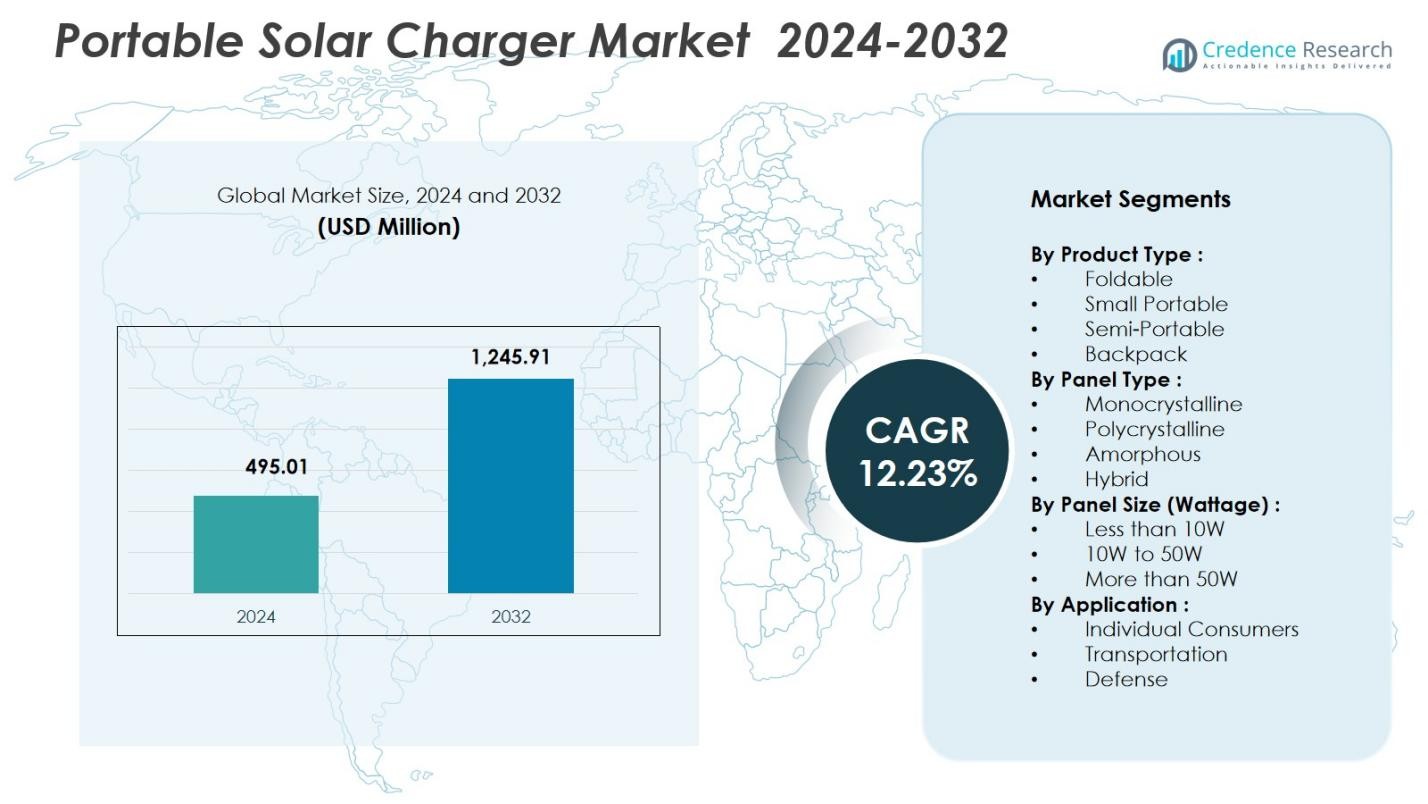
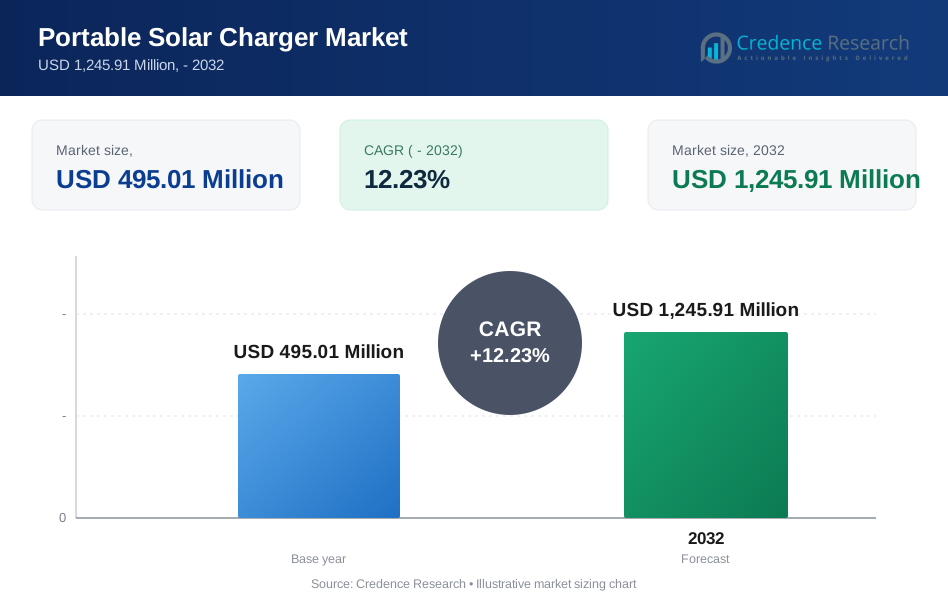
Portable Solar Charger Market size was valued at USD 495.01 Million in 2024 and is anticipated to reach USD 1,245.91 Million by 2032, at a CAGR of 12.23% during the forecast period.
| REPORT ATTRIBUTE | DETAILS |
|---|---|
| Historical Period | 2020-2023 |
| Base Year | 2024 |
| Forecast Period | 2025-2032 |
| Portable Solar Charger Market Size 2024 | USD 495.01 Million |
| Portable Solar Charger Market, CAGR | 12.23% |
| Portable Solar Charger Market Size 2032 | USD 1,245.91 Million |
Portable Solar Charger Market features leading players such as Suntactics, Jackery Inc., Goal Zero LLC, Instapark, Zamp Solar, Voltaic Systems, Powertraveller International Ltd., GigaWatt Inc., Gomadic Corporation, and Renogy LLC, all focusing on high-efficiency panels, durable designs, and advanced charging technologies. These companies strengthen their presence through product innovation in foldable, monocrystalline, and hybrid chargers tailored for outdoor, emergency, and off-grid use. Regionally, North America led the market with a 34.2% share in 2024, supported by strong adoption across recreational activities and emergency preparedness programs, followed by Asia-Pacific and Europe, which continue expanding due to rising solar adoption and outdoor mobility trends.
Market Insights
- The Portable Solar Charger Market reached USD 495.01 Million in 2024 and is set to grow at a 23% CAGR through 2032, driven by rising off-grid and outdoor power needs.
- Strong growth is fueled by increasing outdoor recreation, adventure travel, and off-grid energy demand, with foldable chargers leading the product type segment with a 6% share.
- Key trends include upgrades in monocrystalline and hybrid efficiency, lightweight foldable designs, and integration of MPPT, USB-C fast charging, and hybrid solar-plus-storage systems.
- Major players such as Jackery Inc., Goal Zero LLC, Renogy LLC, Zamp Solar, and Suntactics focus on enhancing durability, performance, and multifunctional charging features to strengthen their market presence.
- Regionally, North America led with a 2% share, followed by Asia-Pacific at 29.6% and Europe at 27.8%, driven by outdoor adoption, strong renewable policies, and rising use of portable charging solutions across consumer and field applications.
Market Segmentation Analysis:
By Product Type
The Foldable portable solar chargers dominated the product type segment in 2024 with a 41.6% share, driven by their high portability, multi-panel efficiency, and suitability for outdoor, travel, and emergency uses. Consumers prefer foldable models for their lightweight construction, faster charging capability, and compatibility with smartphones, power banks, and compact appliances. Small Portable units maintained demand for urban mobility, while Semi-Portable and Backpack chargers gained traction among campers and trekkers. Rising adoption by hikers, military professionals, and remote workers continues to reinforce foldable chargers’ leading position.
- For instance, BigBlue's 28W solar charger features three USB-A ports delivering a total maximum output of 5V/4.8A, enabling simultaneous charging of multiple devices like smartphones with smart technology that optimizes speed for each. Its SunPower panels ensure efficient performance even in partial shade, making it ideal for hikers and backpackers.
By Panel Type
Monocrystalline solar chargers led the panel type segment with a 52.4% share in 2024, supported by superior conversion efficiency, longer operational lifespan, and reliable performance in low-light conditions. This dominance is strengthened by falling silicon prices and increasing consumer preference for high-efficiency portable charging. Polycrystalline panels remain relevant for cost-focused buyers, while Amorphous panels appeal to users seeking flexible and lightweight options. Hybrid panels are emerging solutions combining improved durability and charging consistency, but monocrystalline panels maintain clear leadership due to better efficiency in outdoor and rugged environments.
- For instance, Trina Solar's Vertex series uses monocrystalline cells and advanced manufacturing technologies like high-density interconnection (which involves non-destructive cutting into multiple pieces, often referred to as half-cut or one-third-cut designs) in bifacial dual-glass panels.
By Panel Size (Wattage)
The 10W to 50W wattage range dominated the market in 2024 with a 48.7% share, offering an ideal blend of power output, portability, and broad device compatibility. These chargers efficiently support smartphones, GPS devices, tablets, cameras, and other small electronics, making them the preferred choice for camping, travel, and emergency readiness. Less than 10W chargers remain limited to low-load applications, while units above 50W cater to high-demand uses such as RV batteries and portable refrigerators. Rising outdoor recreation, adventure travel, and remote connectivity needs continue strengthening the leadership of the 10W–50W category.
Key Growth Drivers
Rising Outdoor Recreation and Off-Grid Power Demand
Growing participation in camping, hiking, trekking, and adventure tourism is significantly boosting the demand for portable solar chargers. Consumers increasingly seek lightweight, renewable power sources for charging smartphones, GPS devices, wearables, and cameras in off-grid environments. The expanding culture of digital connectivity during outdoor activities further accelerates adoption, as travelers prefer reliable solar charging to avoid battery depletion. In addition, government promotions of eco-friendly tourism and the rising popularity of RV and caravan travel continue to strengthen market growth for efficient portable solar charging solutions.
- For instance, Goal Zero offers the Nomad 50 Solar Panel, a 50-watt foldable charger that, when paired with their Sherpa 100 AC battery, supports the power needs of families or mountaineers on extended outdoor trips.
Rapid Advancements in Solar Panel Efficiency
Technological improvements in monocrystalline and hybrid solar panel designs are driving strong market expansion. Higher conversion efficiencies, improved low-light performance, and enhanced durability enable portable solar chargers to deliver faster and more consistent charging for multiple devices. Manufacturers are leveraging MPPT controllers, lightweight composites, and integrated storage options to boost usability. These advancements make portable solar chargers attractive for both consumer and professional applications, especially for military, disaster-response, and remote field operations requiring dependable, renewable energy supplies.
- For instance, Aiko Solar's NEOSTAR 3P54 series, released in 2025, achieves 25.0% module efficiency through near-gapless cell spacing and optimized string connectors, allowing portable solar chargers to offer higher power output in smaller form factors.
Growing Sustainability Awareness and Declining Solar Costs
Consumers and enterprises are increasingly shifting toward clean energy products, making portable solar chargers a preferred alternative to power banks and fuel-based generators. Falling costs of photovoltaic materials and mass production efficiencies have made compact solar chargers more affordable and accessible. Corporate ESG initiatives and personal sustainability preferences further encourage adoption. Additionally, the rising use of solar-powered devices in emergency kits, humanitarian missions, and preparedness programs contributes to demand, as users prioritize renewable, maintenance-free power sources with minimal environmental impact.
Key Trends & Opportunities
Integration of Smart Features and Energy Storage
A major trend shaping the market is the integration of smart charging technologies, including USB-C fast charging, wireless charging, and built-in MPPT controllers for optimizing power flow. Manufacturers are incorporating compact lithium-ion or LiFePO₄ battery packs to enable hybrid solar-plus-storage designs. These intelligent chargers offer uninterrupted charging even during cloud cover, expanding usability for urban commuters, remote workers, and outdoor travelers. Opportunities are rising for brands offering multifunctional, rugged chargers with LED lighting, IoT tracking, and power-management apps to differentiate their portfolios.
- For instance, Victron Energy's SmartSolar MPPT 75/10 controller uses advanced tracking algorithms to extract maximum energy from sunlight, even in partial shade, while automatically switching between bulk, absorption, and float stages for efficient battery charging.
Growing Adoption in Emergency Preparedness and Humanitarian Missions
Portable solar chargers are increasingly used in disaster-prone regions and emergency response operations due to their reliability, independence from grid power, and ability to function during outages. Governments and NGOs are integrating solar chargers into relief kits to support communication, lighting, and medical equipment in vulnerable areas. This trend creates strong opportunities for manufacturers providing durable, high-output, weather-resistant chargers. As climate-related disasters rise, demand from humanitarian agencies, defense forces, and off-grid communities will continue to expand, positioning portable solar chargers as essential emergency tools.
- For instance, EcoFlow's portable solar panels have been applied in disaster relief to charge phones, power lights, and run small appliances in emergency shelters without needing fuel deliveries.
Key Challenges
Intermittent Solar Availability and Weather Dependence
One of the most significant challenges is the heavy dependence of portable solar chargers on sunlight, which affects charging efficiency during cloudy weather, shading, or low-light conditions. Users often experience inconsistent performance compared to battery-based chargers, limiting adoption in regions with limited sun exposure. This challenge increases the need for integrated energy storage or hybrid solar-battery systems. Seasonal variations, geographic limitations, and unpredictable weather patterns continue to restrict performance reliability, making technological innovation essential to mitigate variability in solar output.
Competition from Power Banks and Alternative Charging Solutions
The market faces strong competitive pressure from high-capacity power banks, fast-charging technologies, and compact portable generators that offer predictable and immediate power. Many consumers prioritize convenience and faster charging speeds, reducing preference for solar-only solutions during short trips or urban use. Additionally, falling lithium-ion battery prices allow power banks to offer greater capacity at lower costs. The challenge for the solar charger industry lies in differentiating through efficiency improvements, rugged designs, smart features, and hybrid models that ensure greater value and reliability compared to alternative power sources.
Regional Analysis
North America
North America held a 34.2% share of the Portable Solar Charger Market in 2024, driven by strong adoption across outdoor recreation, defense operations, and emergency preparedness programs. High participation in camping, hiking, RV travel, and off-grid adventures continues to stimulate demand for lightweight and durable chargers. The U.S. leads the region due to government support for renewable products and widespread consumer spending on portable electronics. Growth is further supported by disaster-response agencies integrating solar-powered equipment into emergency kits. Increasing sustainability awareness and technological innovation reinforce North America’s position as a leading market.
Europe
Europe captured a 27.8% share in 2024, supported by rising eco-tourism, stringent environmental policies, and growing consumer preference for clean energy products. Countries such as Germany, the UK, and the Nordics exhibit strong demand for high-efficiency monocrystalline and hybrid portable chargers due to extensive outdoor activities and renewable-friendly lifestyles. The region benefits from supportive government incentives promoting solar adoption and high penetration of premium outdoor gear brands. Cross-border travel, caravan tourism, and emphasis on sustainable mobility solutions further strengthen demand. Europe’s focus on reducing carbon footprints continues to expand opportunities for advanced portable solar technologies.
Asia-Pacific
Asia-Pacific accounted for a 29.6% share in 2024 and represents the fastest-growing region, driven by large-scale adoption among trekkers, rural consumers, and tech-savvy travelers. China, India, Japan, and South Korea lead due to high production capabilities, rising disposable incomes, and increasing demand for off-grid power solutions. Expanding outdoor recreation, growing smartphone dependency, and large populations in remote areas fuel adoption of portable solar chargers. Government initiatives supporting renewable energy integration and disaster management preparedness also contribute to growth. The region’s rapid urbanization and affordability of compact solar devices position Asia-Pacific as a major expansion hub.
Latin America
Latin America held a 5.1% share in 2024, with growing demand driven by increasing outdoor tourism, remote-area electrification needs, and expanding use of portable devices. Countries such as Brazil, Chile, Argentina, and Colombia are witnessing rising preference for renewable charging solutions for camping and fieldwork activities. Solar-powered equipment is gaining traction in rural communities where grid access remains limited. Disaster-prone regions are also adopting portable solar chargers for emergency communication and lighting. Market growth is supported by improving retail access and government interest in solar programs, though pricing sensitivity remains a key challenge.
Middle East & Africa
The Middle East & Africa region accounted for a 3.3% share in 2024, supported by high solar irradiation levels and increasing adoption of off-grid energy tools. Demand is rising in countries like the UAE, Saudi Arabia, South Africa, and Kenya for outdoor, commercial, and humanitarian applications. Communities in remote and rural areas rely on portable solar chargers for essential device powering due to limited grid connectivity. Growing use in safaris, field research, and desert expeditions further drives adoption. While awareness and affordability issues persist, expanding renewable initiatives and NGO-driven energy programs strengthen market potential.
Market Segmentations:
By Product Type :
- Foldable
- Small Portable
- Semi-Portable
- Backpack
By Panel Type :
- Monocrystalline
- Polycrystalline
- Amorphous
- Hybrid
By Panel Size (Wattage) :
- Less than 10W
- 10W to 50W
- More than 50W
By Application :
- Individual Consumers
- Transportation
- Defense
By Geography
- North America
- U.S.
- Canada
- Mexico
- Europe
- Germany
- France
- U.K.
- Italy
- Spain
- Rest of Europe
- Asia Pacific
- China
- Japan
- India
- South Korea
- South-east Asia
- Rest of Asia Pacific
- Latin America
- Brazil
- Argentina
- Rest of Latin America
- Middle East & Africa
- GCC Countries
- South Africa
- Rest of the Middle East and Africa
Competitive Landscape
The competitive landscape of the Portable Solar Charger Market includes major players such as Suntactics, Jackery Inc., Goal Zero LLC, Instapark, Zamp Solar, Voltaic Systems, Powertraveller International Ltd., GigaWatt Inc., Gomadic Corporation, and Renogy LLC. The market remains moderately fragmented, with companies focusing on high-efficiency panels, rugged designs, and multifunctional charging features to strengthen their positions. Leading brands compete through innovation in monocrystalline and hybrid technologies, integration of MPPT controllers, and enhanced durability for outdoor use. Strategic partnerships with outdoor gear distributors, e-commerce expansion, and continuous product upgrades support their market presence. Manufacturers increasingly invest in foldable and lightweight designs to target travelers, campers, and emergency users. Sustainability-driven consumers also push companies to adopt eco-friendly materials and promote renewable charging solutions. As demand rises for high-output and smart-enabled chargers, players emphasize differentiation through design advancements, reliability, portability, and expanded device compatibility, intensifying competition across global markets.
Key Player Analysis
- GigaWatt Inc.
- Zamp Solar
- Renogy LLC
- Goal Zero LLC
- Powertraveller International Ltd.
- Instapark
- Suntactics
- Voltaic Systems
- Jackery Inc.
- Gomadic Corporation
Recent Developments
- In September 2024, Jackery Inc. completed the acquisition of Geneverse, expanding its product and service portfolio in the portable energy segment.
- In January 2025, Jackery announced a new lineup at CES including a “solar roof” option and enhanced solar generators extending their reach beyond portable chargers to home and mobile solar power systems.
- In January 2025, EcoFlow launched a new Alternator Charger for on-the-road charging, expanding its product range for adventurers and mobile power users.
Report Coverage
The research report offers an in-depth analysis based on Product Type, Panel Type, Panel Size, Application and Geography. It details leading market players, providing an overview of their business, product offerings, investments, revenue streams, and key applications. Additionally, the report includes insights into the competitive environment, SWOT analysis, current market trends, as well as the primary drivers and constraints. Furthermore, it discusses various factors that have driven market expansion in recent years. The report also explores market dynamics, regulatory scenarios, and technological advancements that are shaping the industry. It assesses the impact of external factors and global economic changes on market growth. Lastly, it provides strategic recommendations for new entrants and established companies to navigate the complexities of the market.
Future Outlook
- Demand will grow as outdoor recreation, adventure travel, and off-grid activities continue to increase globally.
- Advancements in monocrystalline and hybrid solar technologies will enhance charging efficiency and durability.
- Integration of smart features such as MPPT controllers, wireless charging, and USB-C fast charging will become standard.
- Hybrid solar-plus-storage models will gain traction for uninterrupted power supply in varying weather conditions.
- Military, disaster-response, and humanitarian sectors will expand adoption of rugged high-output portable solar chargers.
- Growth of eco-friendly consumer behavior will strengthen demand for renewable portable charging solutions.
- Lightweight, ultra-compact, and foldable designs will remain key product development priorities.
- Emerging markets in Asia-Pacific, Africa, and Latin America will offer significant expansion opportunities.
- E-commerce and direct-to-consumer brands will drive competitive pricing and product accessibility.
- Manufacturers will increasingly collaborate with outdoor gear brands and mobility solution providers for product integration.
Request a Free Sample
Fill in your details and we'll send you a free sample report.
- Sample data tables & charts
- Research methodology
Need a Custom Version of This Report?
Tailor the scope, geography, or segments to your exact requirements.
- Custom geography or segment scope
- Direct access to our analyst team
Frequently Asked Questions
What is the current market size for Portable Solar Charger Market, and what is its projected size in 2032?
At what Compound Annual Growth Rate is the Portable Solar Charger Market projected to grow between 2025 and 2032?
Which Portable Solar Charger Market segment held the largest share in 2024?
What are the primary factors fueling the growth of the Portable Solar Charger Market?
Who are the leading companies in the Portable Solar Charger Market?
Which region commanded the largest share of the Portable Solar Charger Market in 2024?
Table of Content
Chapter 1. Report Introduction
- 1.1 Report Description & Purpose
- 1.1.1 Report Title & Market Definition
- 1.1.2 Unique Selling Propositions (USP) & Key Differentiators
- 1.1.3 Value Proposition for Stakeholders
- 1.2 Research Objectives
- 1.2.1 Market Sizing Objectives (Volume & Revenue) (Volume Where Applicable)
- 1.2.2 Segmentation Objectives
- 1.2.3 Competitive Intelligence Objectives
- 1.2.4 Forecast & Scenario Objectives
- 1.3 Report Scope
- 1.3.1 Portable Solar Charger Scope – Segments & Subsegments Covered
- 1.3.2 Geographic Scope – Regions & Countries Covered
- 1.3.3 Historical Period, Base Year & Forecast Period (2024; forecast to 2032)
- 1.3.4 Inclusions & Exclusions
- 1.4 Industry Classification & Applicable Codes
- 1.5 Currency, Measurement Units & Valuation Basis
- 1.6 Target Stakeholders
- 1.7 Limitations & Assumptions
Chapter 2. Executive Summary
- 2.1 Global Portable Solar Charger Market Snapshot
- 2.1.1 Market Size – Historical (2024) & Forecast (2024-2032) (2024: USD 495.01 Million → 2032: USD 1,245.91 Million)
- 2.1.2 Volume & Revenue – Global Totals (Volume Where Applicable)
- 2.1.3 Key Market Highlights – Top Five Facts
- 2.2 Portable Solar Charger Market Segmentation Snapshot
- 2.2.1 Market Split by Region – 2024 vs. 2032
- 2.3 Competitive Snapshot
- 2.3.1 Top 10 Players by Revenue Share – 2024
- 2.3.2 Top 10 Players by Volume Share – 2024 (Volume Where Applicable)
- 2.3.3 Recent Strategic Developments (18-Month Summary)
- 2.4 Key Investment Highlights & Strategic Conclusions
Chapter 3. Portable Solar Charger Market Dynamics & Industry Analysis
- 3.1 Market Overview & Context
- 3.1.1 Portable Solar Charger Market Position in the Broader Industry Value Chain
- 3.1.2 Demand Structure & Purchasing Dynamics
- 3.1.3 Market Maturity & Development Stage by Region
- 3.2 Portable Solar Charger Market Drivers
- 3.3 Portable Solar Charger Market Restraints & Challenges
- 3.4 Portable Solar Charger Market Opportunities
- 3.5 Porter's Five Forces Analysis
- 3.5.1 Threat of New Entrants
- 3.5.2 Bargaining Power of Suppliers
- 3.5.3 Bargaining Power of Buyers
- 3.5.4 Threat of Substitutes
- 3.5.5 Competitive Rivalry – Intensity Assessment
- 3.6 Portable Solar Charger Value Chain Analysis
- 3.6.1 Upstream – Key Inputs, Resources & Suppliers
- 3.6.1.1 Key Input/Resource 1
- 3.6.1.2 Key Input/Resource 2
- 3.6.1.3 Key Input/Resource 3
- 3.6.2 Midstream – Core Operations & Value Creation
- 3.6.2.1 Operating Model & Process Overview
- 3.6.2.2 Key Operating Locations & Capabilities by Company
- 3.6.3 Downstream – Market Channels & End Users
- 3.6.3.1 Direct Sales & Customer Engagement Channels
- 3.6.3.2 Indirect Sales, Intermediaries & Partner Channels
- 3.6.4 Value Chain Profitability Analysis
- 3.6.1 Upstream – Key Inputs, Resources & Suppliers
- 3.7 PESTEL Analysis
- 3.7.1 Political Factors
- 3.7.2 Economic Factors
- 3.7.3 Social Factors
- 3.7.4 Technological Factors
- 3.7.5 Environmental Factors
- 3.7.6 Legal Factors
- 3.8 Portable Solar Charger Supply Chain Analysis
- 3.8.1 Critical Input & Resource Availability Risk Assessment
- 3.8.2 Supplier & Operational Concentration Risk (Geographic Exposure)
- 3.8.3 Supply & Service Disruption Impact Analysis
- 3.9 Regulatory & Policy Landscape
Note: The regulatory and policy landscape section covers regulations based on their applicability to the market, Portable Solar Charger category, geography, and scope of the study. Only regulatory frameworks with a material impact on operations, compliance, trade, sustainability, or market access are analyzed in detail.
Chapter 4. Key Investment Pockets & Opportunity Analysis
- 4.1 Portable Solar Charger Market Attractiveness Analysis
- 4.1.1 By Region – Investment Attractiveness Matrix (Market Size × CAGR)
- 4.2 Absolute Revenue Growth Opportunity
- 4.2.1 By Region – Absolute Revenue Growth Through 2032
- 4.3 Incremental Demand Opportunity
- 4.3.1 By Region – Incremental Demand Through 2032
- 4.3.2 Segment – Incremental Demand
- 4.4 Emerging Submarket Opportunity Deep Dive (Subject to Applicability)
- 4.5 Priority Market Opportunity Scorecards
- 4.5.1 United States
- 4.5.2 Europe
- 4.5.3 Asia
- 4.5.4 Middle East & Africa
Note: Priority market opportunity scorecards reflect the geographic scope and strategic relevance of the study. Listed markets are indicative and may be adapted to the industry.
Chapter 5. Portable Solar Charger Cross-Border Trade & Market Access Analysis
- 5.1 International Trade & Cross-Border Activity Overview
- 5.1.1 Global Export Value by Country (2024)
- 5.1.2 Global Export Volume by Country (2024) (Volume Where Applicable)
- 5.1.3 Global Import Value by Country (2024)
- 5.1.4 Global Import Volume by Country (2024) (Volume Where Applicable)
- 5.1.5 Net Trade Balance by Country (2024)
- 5.2 Export Analysis – Segment
- 5.2.1 Category 1 (Applicable Classification Code)
- 5.2.2 Category 2 (Applicable Classification Code)
- 5.2.3 Category 3 (Applicable Classification Code)
- 5.2.4 Category 4 (Applicable Classification Code)
- 5.2.5 Category 5 (Applicable Classification Code)
- 5.3 Import Analysis – Segment
- 5.3.1 Category 1 (Applicable Classification Code)
- 5.3.2 Category 2 (Applicable Classification Code)
- 5.3.3 Category 3 (Applicable Classification Code)
- 5.3.4 Category 4 (Applicable Classification Code)
- 5.3.5 Category 5 (Applicable Classification Code)
- 5.4 Cross-Border Pricing & Transaction Benchmarks
- 5.4.1 Export Pricing – Segment & Country
- 5.4.2 Import Pricing – Segment & Source Country
- 5.4.3 Price Trends (2024)
- 5.5 Key Cross-Border Trade & Delivery Routes
- 5.5.1 Cross-Border Trade/Delivery Route 1
- 5.5.2 Cross-Border Trade/Delivery Route 2
- 5.5.3 Cross-Border Trade/Delivery Route 3
- 5.5.4 Cross-Border Trade/Delivery Route 4
- 5.5.5 Cross-Border Trade/Delivery Route 5
- 5.6 Trade Policy & Market Access Impact Assessment
- 5.6.1 Tariff & Non-Tariff Barriers
- 5.6.2 Regional Trade & Economic Integration Frameworks
- 5.6.3 Bilateral & Multilateral Trade Agreements
- 5.6.4 Cross-Border Operating, Licensing & Localization Requirements
Note: This chapter applies where cross-border trade or delivery is relevant to Portable Solar Charger. Goods, services, and digital offerings are assessed using applicable classifications and transaction measures. Import-export volumes, trade balances, and route analyses are included only where meaningful to the market.
Chapter 6. Competitive Landscape & Company Benchmarking
- 6.1 Portable Solar Charger Market Concentration & Structure
- 6.1.1 Herfindahl-Hirschman Index (HHI) – vs. 2024
- 6.1.2 Leading, Mid-Sized & Emerging Player Structure
- 6.1.3 Global, Regional & Local Player Dynamics
- 6.2 Portable Solar Charger Market Share Analysis – 2024
- 6.2.1 Global Revenue Share by Company
- 6.2.2 Global Volume Share by Company (Volume Where Applicable)
- 6.2.3 Regional Revenue Share
- 6.2.4 Market Share Evolution ( vs. 2024)
- 6.2.5 Company Market Share by Key Segment
- 6.2.6 Company Market Share by Customer Group
- 6.3 Operating Scale, Capacity & Infrastructure Analysis
- 6.3.1 Global Operating Scale & Supply Capacity
- 6.3.2 Resource Utilization & Operating Efficiency
- 6.3.3 Output, Service Delivery & Activity Metrics
- 6.3.4 Operating Footprint & Infrastructure Map
- 6.3.5 Planned Operational & Capacity Expansion
- 6.4 Portable Solar Charger Competitive Benchmarking Matrix
- 6.4.1 Revenue, Growth, Profitability & Operating Metric Comparison
- 6.4.2 Channel Revenue Mix
- 6.4.3 Geographic Revenue Exposure
- 6.4.4 R&D Intensity
- 6.4.5 Sustainability Maturity
- 6.5 Strategic Developments in Portable Solar Charger (Last 24 Months)
- 6.5.1 Mergers, Acquisitions & Divestments
- 6.5.2 New Products, Services & Solutions in Portable Solar Charger
- 6.5.3 Operational & Infrastructure Expansions
- 6.5.4 Strategic Alliances, Joint Ventures & Partnerships
- 6.5.5 Distribution Expansion & Market Entry
- 6.5.6 Sustainability & ESG Initiatives
- 6.6 Competitive Strategy Mapping
- 6.6.1 Leader, Challenger, Follower & Niche Classification
- 6.6.2 Pricing Strategy Comparison
- 6.6.3 Channel Strategy Matrix
Note: Strategic developments are included based on their materiality and the availability of reliable information.
Chapter 7. Global Portable Solar Charger Market – By Sales & Delivery Channel
- 7.1 Segment Overview
- 7.1.1 Volume & Revenue Split by Channel (2024 & 2032) (Volume Where Applicable)
- 7.1.2 Channel Mix Evolution (2024-2032)
Chapter 8. Regional Market Analysis – Global Overview
- 8.1 Global Regional Overview
- 8.1.1 Regional Volume Share (Volume Where Applicable)
- 8.1.2 Regional Revenue Share
- 8.1.3 Regional Volume by Region (Volume Where Applicable)
- 8.1.4 Regional Revenue by Region
- 8.1.5 Regional Forecast Through 2032
- 8.2 Cross-Regional Segment Analysis
- 8.2.1 By Sales & Delivery Channel
- 8.2.2 By Competitive Positioning & Price Tier
Chapter 9. North America Portable Solar Charger Market
- 9.1 United States
- 9.2 Canada
- 9.3 Mexico
Chapter 10. Europe Portable Solar Charger Market
- 10.1 Germany
- 10.2 France
- 10.3 Italy
- 10.4 United Kingdom
- 10.5 Spain
- 10.6 Poland
- 10.7 Russia
- 10.8 Netherlands
- 10.9 Belgium
- 10.10 Sweden
- 10.11 Denmark
- 10.12 Norway
- 10.13 Rest of Europe
Chapter 11. Asia Pacific Portable Solar Charger Market
- 11.1 China
- 11.2 India
- 11.3 Japan
- 11.4 South Korea
- 11.5 Thailand
- 11.6 Indonesia
- 11.7 Vietnam
- 11.8 Malaysia
- 11.9 Australia
- 11.10 Rest of Asia Pacific
Chapter 12. Latin America Portable Solar Charger Market
- 12.1 Brazil
- 12.2 Argentina
- 12.3 Colombia
- 12.4 Chile
- 12.5 Rest of Latin America
Chapter 13. Middle East Portable Solar Charger Market
- 13.1 Saudi Arabia
- 13.2 United Arab Emirates
- 13.3 Turkey
- 13.4 Israel
- 13.5 Iran
- 13.6 Rest of the Middle East
Chapter 14. Africa Portable Solar Charger Market
- 14.1 South Africa
- 14.2 Egypt
- 14.3 Nigeria
- 14.4 Morocco
- 14.5 Rest of Africa
Chapter 15. Portable Solar Charger Company Profiles
- 15.1 [Company 01]
- 15.1.1 Company Overview
- 15.1.2 Key Management Personnel
- 15.1.3 Products & Services Portfolio
- 15.1.4 Financial Performance
- 15.1.5 Key Market Focus & Geographic Presence
- 15.1.6 Recent Developments & Strategic Initiatives
Note: The company profile list is preliminary and may change based on research findings, market developments, data availability, and client requirements.
Chapter 16. Appendices
- Appendix A – List of Abbreviations & Acronyms
- Appendix B – Industry Classification Code Reference – Full Series
- Appendix C – Supply, Output & Operating Capacity Data Tables
- Appendix D – End-Use & Demand Base Tables
- Appendix E – Demand, Adoption & Usage Assumptions
- Appendix F – Pricing & Revenue Metric Reference Tables
- Appendix G – Company Operations & Infrastructure Database
- Appendix H – Cross-Border Trade & Activity Data Tables (Where Applicable)
- Appendix I – Regulatory Summary Tables
- Appendix J – Primary Research Participant List (Anonymized)
- Appendix K – Primary Research Questionnaire Framework
- Appendix L – Data Sources & Bibliography
- Appendix M – Market Size Divergence & Source Comparison
Chapter 17. Research Methodology
- 17.1 Research Framework & Philosophy
- 17.2 Secondary Research – Sources, Hierarchy & Data Extraction
- 17.3 Data Modeling – Bottom-Up & Top-Down Market Sizing
- 17.4 Primary Research – Stakeholder Framework, LOI & Sample Sizes
- 17.5 Forecast Methodology – Regression, Scenario & Sensitivity Analysis
- 17.6 Quality Control – Four-Layer Validation Framework
- 17.7 Limitations & Standard Assumptions
- 17.8 Disclaimer
