
Market overview
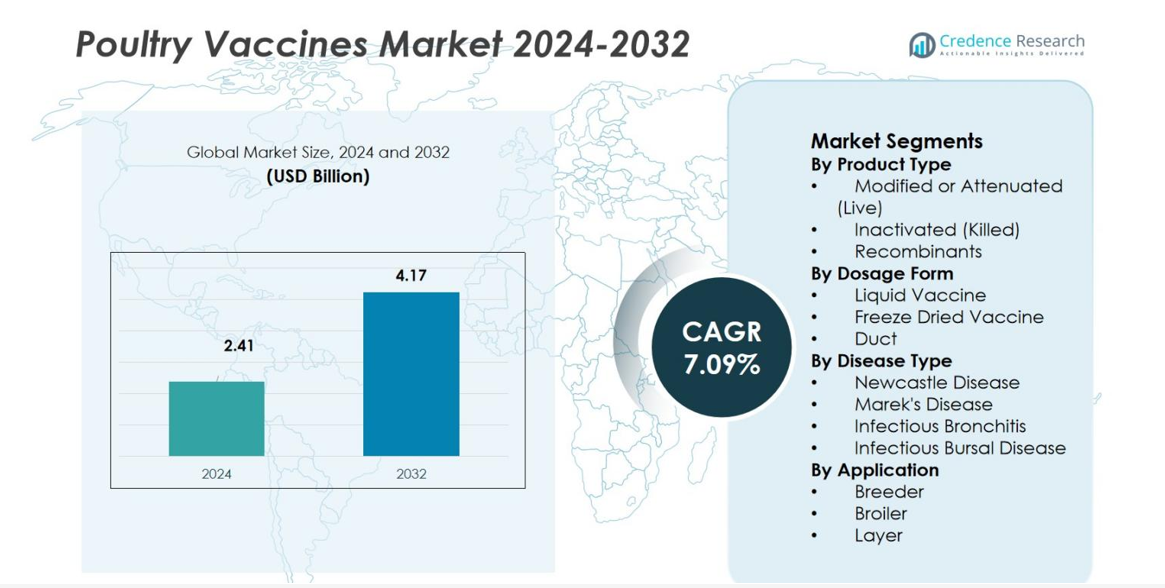
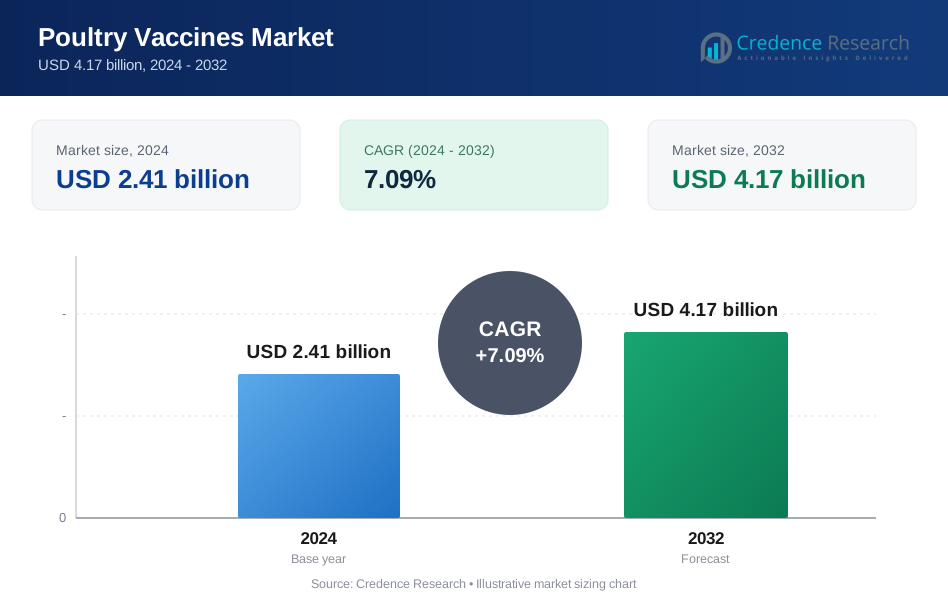
Poultry Vaccines Market size was valued at USD 2.41 billion in 2024 and is anticipated to reach USD 4.17 billion by 2032, at a CAGR of 7.09% during the forecast period.
| REPORT ATTRIBUTE | DETAILS |
|---|---|
| Historical Period | 2020-2023 |
| Base Year | 2024 |
| Forecast Period | 2025-2032 |
| Poultry Vaccines Market Size 2024 | USD 2.41 billion |
| Poultry Vaccines Market, CAGR | 7.09% |
| Poultry Vaccines Market Size 2032 | USD 4.17 billion |
Poultry Vaccines Market is driven by strong participation from leading companies such as Merck & Co., Inc., Boehringer Ingelheim, Ceva Santé Animale, Elanco Animal Health, HIPRA, Phibro Animal Health Corporation, Dechra Pharmaceuticals, Hester Biosciences, Biovac, and Vaxxinova. These players focus on expanding advanced live, inactivated, and recombinant vaccine portfolios to address major poultry diseases and enhance flock immunity. Asia-Pacific leads the Poultry Vaccines Market with a 36.2% share, supported by large-scale poultry production and high vaccination adoption, followed by North America and Europe, which benefit from robust animal health systems and stringent biosecurity standards.
Market Insights
- Poultry Vaccines Market stands at USD 2.41 billion in 2024 and will reach USD 4.17 billion by 2032, expanding at a 09% CAGR during the forecast period.
- The market grows rapidly as rising outbreaks of Newcastle Disease, Marek’s Disease, and Infectious Bronchitis drive producers to adopt structured immunization programs, supported by expanding commercial poultry farming and stronger animal health regulations.
- Key trends include increasing adoption of hatchery-based vaccination systems, rising demand for recombinant and vector-based vaccines, and growing preference for thermostable formulations to improve efficiency and reduce losses.
- Major players such as Merck, Boehringer Ingelheim, Ceva, Elanco, HIPRA, and Phibro actively develop advanced live and recombinant vaccines, focusing on R&D, partnerships, and automated vaccination solutions; however, high costs and cold-chain challenges restrict access for small-scale producers.
- Asia-Pacific leads the market with a 2% share, followed by North America at 29.8%, while Modified or Attenuated (Live) vaccines dominate product segments with a 51.4% share.
Market Segmentation Analysis:
By Product Type
The Poultry Vaccines Market by product type is dominated by Modified or Attenuated (Live) vaccines, accounting for 51.4% of the total share in 2024. Their strong adoption stems from their ability to provide rapid, long-lasting immunity and reduce disease severity across large flocks, making them highly efficient for intensive poultry farming. Inactivated (killed) vaccines follow due to their safety profile, particularly for layers and breeders, while recombinant vaccines gain traction as producers adopt advanced genetic technologies that enhance targeted disease prevention and reduce post-vaccination reactions.
By Dosage Form
Within dosage forms, Liquid Vaccines lead the Poultry Vaccines Market with a 57.2% share in 2024. Their dominance is driven by ease of administration through drinking water, spray, or injection, enabling rapid mass immunization in commercial poultry operations. Freeze-dried vaccines continue to grow as they provide better stability and longer shelf life, especially in regions with cold-chain challenges. Duct vaccines serve niche applications but see rising adoption alongside automated hatchery-based immunization, which supports early-life protection and reduces manual handling on farms.
- For instance, live attenuated vaccines like those produced by Ceva are widely applied via drinking water or spray, facilitating rapid delivery across large flocks without manual handling.
By Disease Type
By disease type, Newcastle Disease vaccines hold the largest share at 38.6% in 2024, driven by the persistent global threat of virulent ND virus strains and mandatory vaccination policies in many poultry-producing countries. Marek’s Disease vaccines follow due to increasing prevalence in broilers and the need for early-life protection at hatcheries. Vaccines for Infectious Bronchitis and Infectious Bursal Disease also maintain strong demand, supported by high disease incidence and the requirement for multi-strain immunization to minimize flock mortality, performance losses, and economic impact.
- For instance, thermostable Newcastle Disease vaccines are increasingly used in regions with limited cold chain infrastructure, providing effective protection with reduced dependency on refrigeration.
Key Growth Drivers
Rising Prevalence of Poultry Diseases
The Poultry Vaccines Market experiences strong growth due to the rising prevalence of highly contagious diseases such as Newcastle Disease, Infectious Bronchitis, and Marek’s Disease. Increasing disease outbreaks across commercial farms create substantial economic losses, prompting producers to rely on routine vaccination programs. Regulatory bodies in major poultry-producing regions have also strengthened mandatory vaccination protocols, further boosting demand. Continuous viral mutations and evolving pathogenic strains drive the need for updated and combination vaccines, ensuring sustained market expansion across broilers, layers, and breeders.
- For instance, Merck Animal Health launched Innovax®-ND-IBD in the U.S., a recombinant vaccine that protects poultry against Marek’s Disease, Newcastle Disease, and Infectious Bursal Disease, supporting broader disease control strategies in commercial operations.
Expansion of Commercial Poultry Farming
Rapid industrialization of poultry farming significantly drives vaccine adoption as producers shift toward high-density operations that require strict disease prevention strategies. Rising global consumption of poultry meat and eggs encourages farmers to maintain flock health and productivity through comprehensive immunization schedules. Growing investments in modern hatcheries, improved biosecurity systems, and automated vaccination technologies further contribute to higher vaccine usage. Emerging markets in Asia-Pacific, Africa, and Latin America show accelerated adoption as countries scale production to meet rising domestic and export demand.
- For instance, Automated systems, such as the in-ovo vaccination technology used by hatcheries like Ceva’s Egginject®, inject vaccines into eggs on day 18 of incubation, providing immunity before chicks hatch and reducing handling stress while ensuring uniform protection.
Advancements in Vaccine Technology
Technological advancements play a crucial role, with innovations such as recombinant vaccines, vector-based platforms, and improved thermostability enhancing vaccine safety and effectiveness. These advancements help overcome limitations associated with traditional vaccines, including reduced sensitivity to cold-chain disruptions and improved cross-protection against multiple viral strains. R&D efforts by major manufacturers focus on developing combination vaccines that reduce handling stress and streamline immunization protocols. The integration of biotechnology and genomics accelerates the introduction of precision vaccines tailored to emerging pathogens and regional disease profiles.
Key Trends & Opportunities
Growing Adoption of Hatchery Vaccination Systems
A major trend reshaping the market is the widespread adoption of hatchery-based vaccination systems that enable uniform, early-life protection. In-ovo and day-old chick vaccination technologies ensure consistent dosing and reduce labor-intensive field administration. This shift enhances vaccine efficacy and minimizes stress on flocks, supporting better productivity outcomes. Manufacturers are increasingly partnering with hatchery automation providers to introduce integrated solutions, creating strong opportunities for premium vaccine sales and boosting long-term adoption in large-scale commercial poultry operations.
- For instance, PREVENT’s project in sub-Saharan Africa enabled 37 hatcheries to produce over 200 million vaccinated day-old chicks, administering almost 500 million doses, which transformed poultry health management and fostered vaccine accessibility among small-scale producers.
Rising Demand for Recombinant and Vector-Based Vaccines
Growing preference for recombinant and vector-based vaccines presents notable opportunities, driven by their superior safety profiles, reduced risk of reversion to virulence, and ability to deliver multivalent protection. These advanced vaccines support improved immune responses and offer flexibility to target emerging strains, making them highly attractive for high-performance poultry operations. As producers prioritize lower antibiotic usage and enhanced flock immunity, demand for genetically engineered vaccines increases. Investing in novel recombinant platforms offers manufacturers a competitive edge and aligns with evolving regulatory and sustainability standards.
- For instance, Boehringer Ingelheim’s VAXXITEK® HVT+IBD is a single-shot recombinant vaccine that provides life-long protection across broiler, layer, and breeder chickens by building a strong immune foundation, resulting in better flock health and performance.
Key Challenges
Cold-Chain Dependency and Storage Limitations
One of the major challenges in the Poultry Vaccines Market is the high dependency on cold-chain infrastructure to maintain vaccine potency. Many regions, particularly in developing countries, struggle with inconsistent refrigeration facilities and supply-chain gaps, resulting in reduced vaccine efficacy. Breaks in the cold chain increase wastage, raise operational costs, and limit access in rural areas. Expanding reliable storage networks and developing thermostable formulations remain essential to overcoming distribution barriers and ensuring broad immunization coverage across global poultry farms.
High Cost Burden on Small-Scale Producers
Despite strong market growth, vaccine affordability remains a significant hurdle for small and backyard poultry producers. Limited financial resources restrict their ability to adopt comprehensive vaccination programs, increasing susceptibility to disease outbreaks that affect overall market health. Rising prices of advanced vaccines and associated administration costs further widen the gap between commercial farms and smallholder operations. Addressing this challenge requires government subsidies, awareness programs, and cost-effective vaccine alternatives to support wider adoption and reduce disease prevalence across the broader poultry ecosystem.
Regional Analysis
North America
North America holds a 29.8% share of the Poultry Vaccines Market, driven by strong commercial poultry production across the U.S. and Canada. The region benefits from advanced veterinary infrastructure, stringent biosecurity regulations, and high adoption of hatchery-based vaccination systems. Producers prioritize live attenuated and recombinant vaccines to combat persistent threats such as Marek’s Disease and Infectious Bronchitis. Growing consumer demand for antibiotic-free poultry further accelerates vaccine uptake. Continuous R&D investments by key manufacturers and robust regulatory oversight strengthen North America’s market leadership in technologically advanced poultry immunization solutions.
Europe
Europe accounts for a 24.7% share of the Poultry Vaccines Market, supported by strict animal health standards and widespread implementation of disease prevention programs across major poultry-producing countries such as France, Germany, and the Netherlands. The region shows strong preference for inactivated and recombinant vaccines due to high regulatory emphasis on safety and traceability. Increasing outbreaks of avian influenza and Newcastle Disease have heightened demand for effective immunization protocols. Moreover, ongoing sustainability initiatives and reduced antibiotic usage across European farms promote broader adoption of innovative vaccines that enhance flock immunity and overall productivity.
Asia-Pacific
Asia-Pacific dominates the global Poultry Vaccines Market with a 36.2% share, driven by expanding poultry farming operations in China, India, Indonesia, and Vietnam. Rapid urbanization, rising meat and egg consumption, and large-scale broiler production strongly contribute to vaccine demand. The region faces recurrent outbreaks of infectious diseases, prompting governments and producers to invest in comprehensive vaccination programs. Growth in commercial hatcheries and adoption of cost-effective vaccines further fuel market expansion. Increasing collaborations between global vaccine manufacturers and regional distributors also enhance access to advanced poultry immunization technologies across emerging markets.
Latin America
Latin America holds an 8.1% share of the Poultry Vaccines Market, supported by growing poultry production in Brazil, Mexico, and Argentina. The region’s increasing export activities necessitate strict disease control measures and compliance with international health standards. Producers rely heavily on live attenuated vaccines due to their cost-effectiveness and strong immunity benefits for large flocks. However, rising incidences of Infectious Bursal Disease and Newcastle Disease continue to drive demand for improved recombinant and multivalent vaccines. Investments in modern hatchery automation and expanding commercial farming operations further strengthen market growth across Latin America.
Middle East & Africa
The Middle East & Africa region represents a 7.2% share of the Poultry Vaccines Market, driven by rising poultry consumption and growing reliance on imported day-old chicks across Gulf and African nations. Frequent disease outbreaks, particularly Newcastle Disease and Infectious Bronchitis, increase the need for effective vaccination programs. Limited cold-chain infrastructure poses challenges, but government-led animal health initiatives are improving access to quality vaccines. Expanding commercial farms in Saudi Arabia, South Africa, and Egypt support steady market growth. Increasing partnerships with global vaccine manufacturers further enhance availability of advanced poultry immunization solutions.
Market Segmentations:
By Product Type
- Modified or Attenuated (Live)
- Inactivated (Killed)
- Recombinants
By Dosage Form
- Liquid Vaccine
- Freeze Dried Vaccine
- Duct
By Disease Type
- Newcastle Disease
- Marek's Disease
- Infectious Bronchitis
- Infectious Bursal Disease
By Application
- Breeder
- Broiler
- Layer
By Geography
- North America
- U.S.
- Canada
- Mexico
- Europe
- Germany
- France
- U.K.
- Italy
- Spain
- Rest of Europe
- Asia Pacific
- China
- Japan
- India
- South Korea
- South-east Asia
- Rest of Asia Pacific
- Latin America
- Brazil
- Argentina
- Rest of Latin America
- Middle East & Africa
- GCC Countries
- South Africa
- Rest of the Middle East and Africa
Competitive Landscape
Competitive landscape analysis of the Poultry Vaccines Market reflects strong participation from leading companies including Merck & Co., Inc., Boehringer Ingelheim, Ceva Santé Animale, Elanco Animal Health, HIPRA, Phibro Animal Health Corporation, Dechra Pharmaceuticals, Hester Biosciences, Biovac, and Vaxxinova. These players actively expand their portfolios through advanced live attenuated, inactivated, and recombinant vaccines addressing major poultry diseases such as Newcastle Disease, Marek’s Disease, and Infectious Bronchitis. The market is characterized by continuous R&D investments, strategic partnerships with hatcheries, and growing emphasis on innovative vector-based and thermostable formulations. Companies focus on integrating automated hatchery vaccination systems and developing multivalent vaccines to improve immunity and reduce handling stress. Expansions into emerging markets, enhanced manufacturing capacities, and compliance with evolving regulatory standards further strengthen their global positioning while fostering technological leadership in high-performance poultry immunization solutions.
Key Player Analysis
- Merck & Co., Inc.
- Hester Biosciences Limited
- Dechra Pharmaceuticals PLC
- Vaxxinova International BV
- Biovac
- HIPRA
- Elanco Animal Health Incorporated
- Ceva Sante Animale
- Phibro Animal Health Corporation
- Boehringer Ingelheim International GmbH
Recent Developments
- In March 2025, Merck Animal Health secured European approval for its NOBILIS MULTRIVA™ REOm vaccine, formulated for chickens from seven weeks of age to protect against avian reovirus-related disease.
- In May 2024, Merck & Co., Inc. received marketing authorization from the European Commission for its INNOVAX-ND-H5 vaccine for chickens, expanding its product portfolio and strengthening revenue potential.
- In January 2024, Boehringer Ingelheim introduced Vaxxilive Cocci 3, a rebranded version of Hatchpak Cocci III, enhancing its coccidiosis vaccine lineup and reinforcing its market position.
- In June 2025, VaxThera entered a partnership with Quantoom Biosciences to develop a vaccine targeting highly pathogenic avian influenza in poultry, utilizing Quantoom’s advanced N-Force technology platform
Report Coverage
The research report offers an in-depth analysis based on Product Type, Dosage Form, Disease Type, Application and Geography. It details leading market players, providing an overview of their business, product offerings, investments, revenue streams, and key applications. Additionally, the report includes insights into the competitive environment, SWOT analysis, current market trends, as well as the primary drivers and constraints. Furthermore, it discusses various factors that have driven market expansion in recent years. The report also explores market dynamics, regulatory scenarios, and technological advancements that are shaping the industry. It assesses the impact of external factors and global economic changes on market growth. Lastly, it provides strategic recommendations for new entrants and established companies to navigate the complexities of the market.
Future Outlook
- The market will expand steadily as poultry producers increase vaccination coverage to reduce disease-related losses.
- Adoption of recombinant and vector-based vaccines will accelerate due to their strong safety profiles and multivalent protection.
- Hatchery-based vaccination systems will gain wider acceptance for ensuring consistent early-life immunity.
- Demand for thermostable vaccines will rise as producers seek solutions that overcome cold-chain challenges.
- Integration of automation and digital monitoring in vaccination processes will enhance accuracy and flock health outcomes.
- Governments will strengthen disease control regulations, driving higher compliance in commercial farms.
- Emerging markets will experience rapid growth as poultry meat and egg consumption continues to climb.
- Manufacturers will intensify R&D efforts to develop vaccines targeting evolving and emerging viral strains.
- Partnerships between global vaccine companies and regional distributors will improve accessibility across developing regions.
- Increased focus on antibiotic-free poultry production will further boost vaccination adoption as a core biosecurity measure.
Request a Free Sample
Fill in your details and we'll send you a free sample report.
- Sample data tables & charts
- Research methodology
Need a Custom Version of This Report?
Tailor the scope, geography, or segments to your exact requirements.
- Custom geography or segment scope
- Direct access to our analyst team
Frequently Asked Questions
What is the current market size for Poultry Vaccines Market, and what is its projected size in 2032?
At what Compound Annual Growth Rate is the Poultry Vaccines Market projected to grow between 2025 and 2032?
Which is the leading region of the market for poultry vaccines?
What are the key drivers for the growth of the poultry vaccines market?
Which is the major segment in the poultry vaccines market by disease type?
Who are the leading companies in the Poultry Vaccines Market?
Table of Content
Chapter 1. Report Introduction
- 1.1 Report Description & Purpose
- 1.1.1 Report Title & Market Definition
- 1.1.2 Unique Selling Propositions (USP) & Key Differentiators
- 1.1.3 Value Proposition for Stakeholders
- 1.2 Research Objectives
- 1.2.1 Market Sizing Objectives (Volume & Revenue)
- 1.2.2 Segmentation Objectives
- 1.2.3 Competitive Intelligence Objectives
- 1.2.4 Forecast & Scenario Objectives
- 1.3 Report Scope
- 1.3.1 Poultry Vaccines Scope – Types & Subtypes Covered
- 1.3.2 Geographic Scope – Regions & Countries Covered
- 1.3.3 Historical Period, Base Year & Forecast Period (2024; forecast to 2032)
- 1.3.4 Inclusions & Exclusions
- 1.4 HS Code & Classification Framework
- 1.5 Currency, Units & Pricing Basis
- 1.6 Target Stakeholders
- 1.7 Limitations & Assumptions
Chapter 2. Executive Summary
- 2.1 Global Poultry Vaccines Market Snapshot
- 2.1.1 Market Size – Historical (2024) & Forecast (2024-2032) (2024: USD 2.41 billion → 2032: USD 4.17 billion)
- 2.1.2 Volume & Revenue – Global Totals
- 2.1.3 Key Market Highlights – Top Five Facts
- 2.2 Poultry Vaccines Market Segmentation Snapshot
- 2.2.1 Market Split by Region – 2024 vs. 2032
- 2.3 Competitive Snapshot
- 2.3.1 Top 10 Players by Revenue Share – 2024
- 2.3.2 Top 10 Players by Volume Share – 2024
- 2.3.3 Recent Strategic Developments (18-Month Summary)
- 2.4 Key Investment Highlights & Strategic Conclusions
Chapter 3. Poultry Vaccines Market Dynamics & Industry Analysis
- 3.1 Market Overview & Context
- 3.1.1 Poultry Vaccines Market Position in the Broader Automotive Value Chain
- 3.1.2 OEM vs. Replacement Market Dynamics
- 3.1.3 Market Maturity & Development Stage by Region
- 3.2 Poultry Vaccines Market Drivers
- 3.3 Poultry Vaccines Market Restraints & Challenges
- 3.4 Poultry Vaccines Market Opportunities
- 3.5 Porter's Five Forces Analysis
- 3.5.1 Threat of New Entrants
- 3.5.2 Bargaining Power of Suppliers
- 3.5.3 Bargaining Power of Buyers
- 3.5.4 Threat of Substitutes
- 3.5.5 Competitive Rivalry – Intensity Assessment
- 3.6 Poultry Vaccines Value Chain Analysis
- 3.6.1 Upstream – Raw Material/Input Suppliers
- 3.6.1.1 Raw Material/Input 1
- 3.6.1.2 Raw Material/Input 2
- 3.6.1.3 Raw Material/Input 3
- 3.6.2 Midstream – Production/Manufacturing/Service Delivery
- 3.6.2.1 Production/Process Overview
- 3.6.2.2 Key Facility Locations & Capacity by Manufacturer
- 3.6.3 Downstream – Distribution & End Consumer
- 3.6.3.1 Primary Channel – B2B/OEM
- 3.6.3.2 Secondary Channels – Dealer, Retail, Online, Direct
- 3.6.4 Value Chain Profitability Analysis
- 3.6.1 Upstream – Raw Material/Input Suppliers
- 3.7 PESTEL Analysis
- 3.7.1 Political Factors
- 3.7.2 Economic Factors
- 3.7.3 Social Factors
- 3.7.4 Technological Factors
- 3.7.5 Environmental Factors
- 3.7.6 Legal Factors
- 3.8 Poultry Vaccines Supply Chain Analysis
- 3.8.1 Raw Material/Input Supply Risk Assessment
- 3.8.2 Manufacturing Concentration Risk (Geographic Exposure)
- 3.8.3 Trade Disruption Impact Analysis
- 3.9 Regulatory & Policy Landscape
Note: The regulatory and policy landscape section covers regulations based on their applicability to the market, Poultry Vaccines category, geography, and scope of the study. Only regulatory frameworks with a material impact on operations, compliance, trade, sustainability, or market access are analyzed in detail.
Chapter 4. Key Investment Pockets & Opportunity Analysis
- 4.1 Poultry Vaccines Market Attractiveness Analysis
- 4.1.1 By Region – Investment Attractiveness Matrix (Volume × CAGR)
- 4.2 Absolute Revenue Growth Opportunity
- 4.2.1 By Region – Absolute USD Growth Through 2032
- 4.3 Incremental Volume Opportunity
- 4.3.1 By Region – Incremental Volume Through 2032
- 4.3.2 Segment – Incremental Volume
- 4.4 Emerging Submarket Opportunity Deep Dive (Subject to Applicability)
- 4.5 Emerging Market Opportunity Scorecards
- 4.5.1 United States
- 4.5.2 Europe
- 4.5.3 Asia
- 4.5.4 Middle East & Africa
Note: Emerging Market Opportunity Scorecards will be included based on relevance and strategic importance. Regions listed are indicative and may vary depending on data availability and market dynamics.
Chapter 5. Poultry Vaccines Import-Export Analysis & Trade Flows
- 5.1 Global Trade Overview
- 5.1.1 Global Export Value by Country (2024)
- 5.1.2 Global Export Volume by Country (2024)
- 5.1.3 Global Import Value by Country (2024)
- 5.1.4 Global Import Volume by Country (2024)
- 5.1.5 Net Trade Balance by Country (2024)
- 5.2 Export Analysis – Segment
- 5.2.1 Type 1 (HS Code)
- 5.2.2 Type 2 (HS Code)
- 5.2.3 Type 3 (HS Code)
- 5.2.4 Type 4 (HS Code)
- 5.2.5 Type 5 (HS Code)
- 5.3 Import Analysis – Segment
- 5.3.1 Type 1 (HS Code)
- 5.3.2 Type 2 (HS Code)
- 5.3.3 Type 3 (HS Code)
- 5.3.4 Type 4 (HS Code)
- 5.3.5 Type 5 (HS Code)
- 5.4 Average Unit Trade Prices
- 5.4.1 Average Export Price – Segment & Country
- 5.4.2 Average Import Price – Segment & Source Country
- 5.4.3 Price Trends (2024)
- 5.5 Key Trade Route Analysis
- 5.5.1 Trade Route 1
- 5.5.2 Trade Route 2
- 5.5.3 Trade Route 3
- 5.5.4 Trade Route 4
- 5.5.5 Trade Route 5
- 5.6 Trade Policy Impact Assessment
- 5.6.1 US Anti-Dumping & Section 301 Tariffs
- 5.6.2 EU Customs Union Impact
- 5.6.3 Major Free Trade Agreements
- 5.6.4 USMCA Rules of Origin
Note: Trade policy analysis will be included only where relevant to the Poultry Vaccines market.
Chapter 6. Competitive Landscape & Company Benchmarking
- 6.1 Poultry Vaccines Market Concentration & Structure
- 6.1.1 Herfindahl-Hirschman Index (HHI) – vs. 2024
- 6.1.2 Tier 1, Tier 2 & Tier 3 Market Structure
- 6.1.3 Global, Regional & Local Player Dynamics
- 6.2 Poultry Vaccines Market Share Analysis – 2024
- 6.2.1 Global Revenue Share by Company
- 6.2.2 Global Volume Share by Company
- 6.2.3 Regional Revenue Share
- 6.2.4 Market Share Evolution ( vs. 2024)
- 6.2.5 OEM Segment Share by Company
- 6.2.6 Replacement Segment Share by Company
- 6.3 Production/Delivery Capacity & Facility Analysis
- 6.3.1 Global Installed Capacity
- 6.3.2 Capacity Utilization Rates
- 6.3.3 Production/Output Volume
- 6.3.4 Facility Locations & Capacity Map
- 6.3.5 Planned Capacity Additions
- 6.4 Poultry Vaccines Competitive Benchmarking Matrix
- 6.4.1 Revenue, Volume, CAGR & Profitability Comparison
- 6.4.2 Channel Revenue Mix
- 6.4.3 Geographic Revenue Exposure
- 6.4.4 R&D Intensity
- 6.4.5 Sustainability Maturity
- 6.5 Strategic Developments in Poultry Vaccines (Last 24 Months)
- 6.5.1 Mergers, Acquisitions & Divestments
- 6.5.2 New Poultry Vaccines Launches
- 6.5.3 Facility Expansions
- 6.5.4 Strategic Alliances, Joint Ventures & Partnerships
- 6.5.5 Distribution Expansion & Market Entry
- 6.5.6 Sustainability & ESG Initiatives
- 6.6 Competitive Strategy Mapping
- 6.6.1 Leader, Challenger, Follower & Niche Classification
- 6.6.2 Pricing Strategy Comparison
- 6.6.3 Channel Strategy Matrix
Note: Strategic developments are included based on their materiality and the availability of reliable information.
Chapter 7. Global Poultry Vaccines Market – By Distribution Channel
- 7.1 Segment Overview
- 7.1.1 Volume & Revenue Split by Channel (2024 & 2032)
- 7.1.2 Channel Mix Evolution (2024-2032)
Chapter 8. Regional Market Analysis – Global Overview
- 8.1 Global Regional Overview
- 8.1.1 Regional Volume Share
- 8.1.2 Regional Revenue Share
- 8.1.3 Regional Volume by Region
- 8.1.4 Regional Revenue by Region
- 8.1.5 Regional Forecast Through 2032
- 8.2 Cross-Regional Segment Analysis
- 8.2.1 By Distribution Channel
- 8.2.2 By Brand/Price Tier
Chapter 9. North America Poultry Vaccines Market
- 9.1 United States
- 9.2 Canada
- 9.3 Mexico
Chapter 10. Europe Poultry Vaccines Market
- 10.1 Germany
- 10.2 France
- 10.3 Italy
- 10.4 United Kingdom
- 10.5 Spain
- 10.6 Poland
- 10.7 Russia
- 10.8 Netherlands
- 10.9 Belgium
- 10.10 Sweden
- 10.11 Denmark
- 10.12 Norway
- 10.13 Rest of Europe
Chapter 11. Asia Pacific Poultry Vaccines Market
- 11.1 China
- 11.2 India
- 11.3 Japan
- 11.4 South Korea
- 11.5 Thailand
- 11.6 Indonesia
- 11.7 Vietnam
- 11.8 Malaysia
- 11.9 Australia
- 11.10 Rest of Asia Pacific
Chapter 12. Latin America Poultry Vaccines Market
- 12.1 Brazil
- 12.2 Argentina
- 12.3 Colombia
- 12.4 Chile
- 12.5 Rest of Latin America
Chapter 13. Middle East Poultry Vaccines Market
- 13.1 Saudi Arabia
- 13.2 United Arab Emirates
- 13.3 Turkey
- 13.4 Israel
- 13.5 Iran
- 13.6 Rest of the Middle East
Chapter 14. Africa Poultry Vaccines Market
- 14.1 South Africa
- 14.2 Egypt
- 14.3 Nigeria
- 14.4 Morocco
- 14.5 Rest of Africa
Chapter 15. Poultry Vaccines Company Profiles
- 15.1 [Company 01]
- 15.1.1 Company Overview
- 15.1.2 Key Management Personnel
- 15.1.3 Products & Services Portfolio
- 15.1.4 Financial Performance
- 15.1.5 Key Market Focus & Geographic Presence
- 15.1.6 Recent Developments & Strategic Initiatives
Note: The company profile list is preliminary and may change based on research findings, market developments, data availability, and client requirements.
Chapter 16. Appendices
- Appendix A – List of Abbreviations & Acronyms
- Appendix B – Industry Classification Code Reference – Full Series
- Appendix C – Production & Capacity Data Tables
- Appendix D – End-Use & Demand Base Tables
- Appendix E – Consumption & Replacement Rate Assumptions
- Appendix F – ASP Reference Tables
- Appendix G – Manufacturing & Facility Database
- Appendix H – Import-Export Data Tables
- Appendix I – Regulatory Summary Tables
- Appendix J – Primary Research Participant List (Anonymized)
- Appendix K – Primary Research Questionnaire Framework
- Appendix L – Data Sources & Bibliography
- Appendix M – Market Size Divergence & Source Comparison
Chapter 17. Research Methodology
- 17.1 Research Framework & Philosophy
- 17.2 Secondary Research – Sources, Hierarchy & Data Extraction
- 17.3 Data Modeling – Bottom-Up & Top-Down Market Sizing
- 17.4 Primary Research – Stakeholder Framework, LOI & Sample Sizes
- 17.5 Forecast Methodology – Regression, Scenario & Sensitivity Analysis
- 17.6 Quality Control – Four-Layer Validation Framework
- 17.7 Limitations & Standard Assumptions
- 17.8 Disclaimer
