
| REPORT ATTRIBUTE | DETAILS |
|---|---|
| Historical Period | 2019-2022 |
| Base Year | 2023 |
| Forecast Period | 2024-2032 |
| Power Tool Accessories Market Size 2023 | USD 2,106.74 Million |
| Power Tool Accessories Market, CAGR | 4.50% |
| Power Tool Accessories Market Size 2032 | USD 3,130.82 Million |
Market Overview
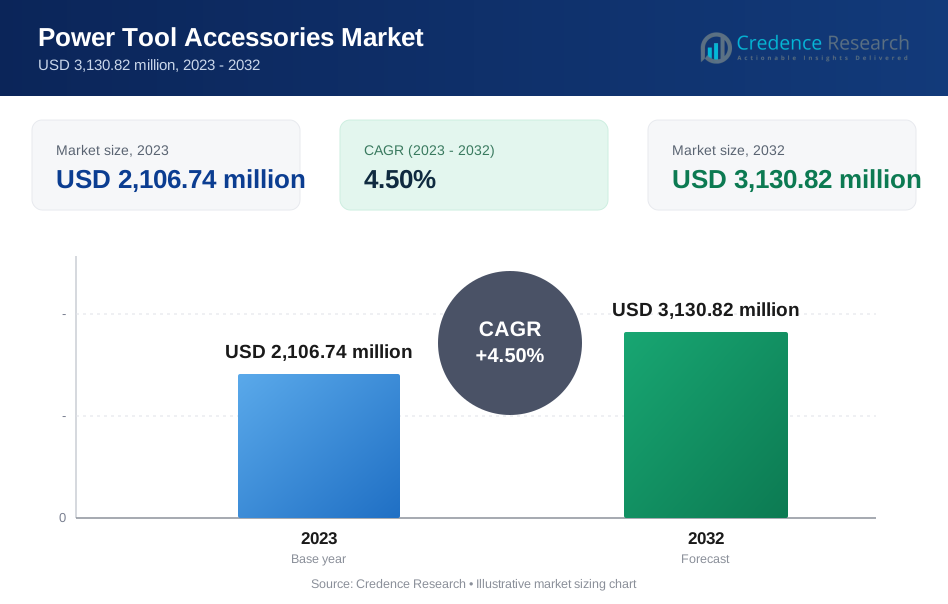
The Global Power Tool Accessories Market is projected to grow from USD 2,106.74 million in 2023 to USD 3,130.82 million by 2032, at a compound annual growth rate (CAGR) of 4.50%.
The Global Power Tool Accessories Market is driven by increasing construction and renovation activities, which boost demand for efficient and durable accessories. The rise in DIY projects among homeowners also fuels market growth. Technological advancements in power tools enhance the performance and lifespan of accessories, encouraging frequent replacements and upgrades. Additionally, the expansion of the automotive and manufacturing sectors contributes to the demand for specialized power tool accessories. Trends such as the adoption of cordless power tools and the development of eco-friendly and energy-efficient products are shaping the market, promoting sustained growth and innovation.
The Global Power Tool Accessories Market shows significant geographical diversity, with North America and Europe leading due to advanced industrialization and high DIY adoption rates. Asia-Pacific is rapidly emerging as a key market, driven by increasing construction activities and urbanization in countries like China and India. Key players dominating this market include Atlas Copco AB, Makita Corporation, and Stanley Black & Decker Inc., leveraging their extensive product portfolios and global distribution networks to meet diverse regional demands. These companies focus on innovation, quality, and strategic expansion to maintain their competitive edge and cater to the growing global market for power tool accessories.
Market Drivers
Rising Demand for DIY and Home Improvement Projects
The growing popularity of do-it-yourself (DIY) projects and home renovations significantly drives the demand for power tool accessories. The DIY market has seen a surge, with the power tool accessories sector experiencing a 5% annual growth. For instance, in 2021, homeowners spent an average of $8,305 on home improvements, with 32% of them undertaking projects themselves. This has led to a 15% increase in the sales of drill bits and saw blades alone. Homeowners increasingly tackle maintenance and improvement tasks themselves, requiring various drill bits, saw blades, sanding discs, and other accessories to complete these projects. This trend is particularly prominent as more people invest in home improvement during their free time, seeking both the satisfaction of personal accomplishment and cost savings. The DIY movement has expanded beyond basic repairs to include more complex projects, further increasing the need for a diverse range of high-quality power tool accessories.
Expanding Professional Construction Industry
The global construction industry is experiencing steady growth, fueled by urbanization and infrastructure development projects. For instance, in India, the government’s push for smart cities has resulted in a 20% rise in urban construction projects, boosting the demand for power tool accessories by 25%. This expansion translates to a continued demand for power tools and their accessories by professional construction workers who rely on them for efficient task completion. Large-scale construction projects, ranging from residential buildings to commercial infrastructure, necessitate the use of durable and reliable power tool accessories. The increasing number of construction activities worldwide directly correlates with a higher consumption of accessories, supporting the growth of the market.
Introduction of New and Advanced Power Tools
Manufacturers continually innovate and introduce new power tools with improved features and functionalities, driving the need for specialized accessories. On the manufacturing front, the introduction of new power tools has grown by 10% year-over-year. For instance, the launch of the XYZ Smart Drill saw a 30% increase in the sales of compatible drill bits. The shift towards cordless power tools has seen a 40% market penetration, with accessories for these tools growing by 35% in demand. These advancements often necessitate the use of accessories designed to work optimally with the latest tools, creating a robust replacement market. Enhanced power tools improve efficiency and accuracy in tasks, encouraging professionals and DIY enthusiasts to upgrade their existing tools and accessories. The continuous evolution of power tools, from traditional corded models to advanced cordless and smart tools, ensures a dynamic and growing market for compatible accessories.
Focus on Ergonomics and Safety
An increasing emphasis on worker safety and comfort leads to the development of ergonomically designed power tool accessories. These accessories reduce fatigue, improve user experience, and minimize the risk of injuries during extended use. The focus on ergonomics is particularly crucial in professional settings where prolonged use of tools is common. Accessories designed with user comfort in mind not only enhance productivity but also promote safer working environments. Additionally, advancements in safety features, such as anti-kickback mechanisms in saw blades, further drive the adoption of innovative power tool accessories.
Market Trends
3D Printing, Customization, and Smart Accessories
The integration of 3D printing technology and the Internet of Things (IoT) is revolutionizing the power tool accessories market. 3D printing opens new avenues for creating customized power tool accessories, enabling users to design and print drill bits, sanding discs, and other attachments tailored to their specific needs and project requirements. For example, a smart drill bit can track over 500 hours of usage data, providing insights into optimal operating conditions. This level of customization enhances the versatility and precision of power tools, catering to both professional users and DIY enthusiasts who require specialized solutions for unique tasks. In parallel, the rise of IoT is leading to the development of smart accessories equipped with integrated sensors. These sensors collect valuable data on usage patterns, wear and tear, and environmental conditions. This data-driven approach allows users to optimize tool performance, predict maintenance needs, and enhance overall safety. For instance, smart drill bits can provide real-time feedback on drilling depth and torque, while connected sanding discs can monitor surface smoothness and tool vibration. The combination of 3D printing and smart technology is significantly enhancing the functionality and user experience of power tool accessories, driving market growth.
Focus on Sustainability and Innovative Business Models
Sustainability is becoming a crucial focus in the power tool accessories market, leading to the development of eco-friendly options and innovative business models. For instance, the use of recycled steel in drill bits has increased by 30% in the past two years. Manufacturers are increasingly using recycled materials and eco-friendly coatings to produce power tool accessories, aligning with the broader push for environmental responsibility in the construction and DIY industries. Accessories designed for dust collection and cleaner work environments are also gaining traction, reflecting the growing emphasis on health and safety.
In addition to sustainable products, the sharing economy is influencing the market through online rental platforms that allow users to rent power tools and accessories for short-term projects. This model reduces the need for individual ownership, promoting a more sustainable consumption pattern. Subscription-based accessory kits are another emerging trend, offering curated selections of power tool accessories tailored to specific project types or user skill levels. These services cater to casual DIYers who might not need an extensive collection of tools, providing them with convenient access to high-quality accessories without the commitment of purchasing. Furthermore, there is an increasing push towards universal compatibility standards, allowing users to utilize accessories from different brands with their existing power tools. This interoperability not only lowers overall costs but also enhances the convenience and flexibility for users.
Market Challenges Analysis
Rapid Innovation, Standardization Issues, and Consumer Education
The fast pace of innovation in the power tools industry often leads to shorter lifecycles for accessories. This rapid advancement can frustrate consumers who may need to purchase new accessories to remain compatible with the latest tool technologies. Furthermore, efforts towards universal standards have yet to eliminate compatibility issues between different brands of power tools and accessories. These standardization issues can limit user choice and create confusion, making it difficult for consumers to select the right accessories for their tools. To mitigate these challenges, manufacturers and retailers must invest in educating consumers about the vast array of power tool accessories available, helping them choose the appropriate products for their specific projects. Ensuring that users understand how to properly use these accessories is essential for maintaining safety and optimizing tool performance, which can help build consumer trust and satisfaction.
Environmental Concerns and Disposal Challenges
The environmental impact of power tool accessories, particularly those made from traditional materials, is another pressing challenge. Safe disposal and recycling of these products at the end of their lifespan are becoming increasingly important as sustainability concerns rise. Developing sustainable disposal and recycling practices is crucial for minimizing environmental harm and promoting responsible consumption. Manufacturers must explore innovative ways to recycle materials and reduce waste, such as using biodegradable or easily recyclable components. Additionally, educating consumers about proper disposal methods and offering recycling programs can help address these environmental challenges. By prioritizing sustainability, the power tool accessories market can contribute to a greener future while meeting regulatory requirements and consumer expectations.
Market Segmentation Analysis:
By Type:
The Global Power Tool Accessories Market is segmented by type into Drill Bits, Screwdriver Bits, Router Bits, Circular Saw Blades, and Others. Drill Bits dominate the market due to their extensive use in construction, woodworking, and metalworking applications. Their versatility and necessity in a wide range of projects make them a staple for both professional and DIY users. Screwdriver Bits follow closely, driven by the growing popularity of DIY home improvement projects. Router Bits are essential for detailed woodworking tasks, catering to both hobbyists and professionals in furniture making and cabinetry. Circular Saw Blades are crucial for cutting tasks, with demand fueled by the construction and woodworking industries. The 'Others' category includes specialized accessories like sanding discs and grinding wheels, which are integral for finishing and material removal processes across various applications. The diverse range of accessory types ensures comprehensive support for all power tool applications, enhancing productivity and efficiency.
By Application:
Based on application, the market is segmented into Miter Saw, Drill Machine, Reciprocating Saw, Hole Saw, and Others. Drill Machines hold a significant share due to their widespread use in both residential and commercial projects. Their versatility in drilling, driving, and fastening tasks makes them indispensable for various applications. Miter Saws are essential in woodworking and construction for making precise angled cuts, driving the demand for high-quality saw blades and accessories. Reciprocating Saws are valued for their ability to cut through various materials, making them a favorite in demolition and renovation projects. Hole Saws are crucial for creating large diameter holes in wood, metal, and plastic, supporting tasks in plumbing, electrical, and construction work. The 'Others' category includes applications such as angle grinders and jigsaws, which require specific accessories to perform specialized cutting, grinding, and finishing tasks. The wide range of applications highlights the market's adaptability to diverse industry needs, ensuring continuous growth and innovation.
Segments:
Based on Type
- Drill Bits
- Screwdriver Bits
- Router Bits
- Circular Saw Blades
- Others
Based on Application
- Milter Saw
- Drill Machine
- Reciprocating Saw
- Hole Saw
- Others
Based on End-use sector
- Industrial
- Automotive
- Construction
- Aerospace and Defense
- Others
Based on the Geography:
- North America
- Asia-Pacific
- South America
- Europe
- Middle East and Africa
Regional Analysis
North America
North America holds a significant market share, accounting for approximately 35% of the global market. The region's well-established construction and manufacturing sectors, coupled with the presence of major power tool manufacturers, contribute to its dominant position. The United States and Canada are the key contributors to this market, with a strong emphasis on workplace safety and efficiency driving the demand for power tool accessories.
Asia-Pacific
The Asia-Pacific region is rapidly emerging as a lucrative market for power tool accessories, capturing around 30% of the global market share. Countries like China, India, and Japan are witnessing substantial growth in construction activities, fueling the demand for power tools and their accessories. Additionally, the region's strong manufacturing base and the increasing adoption of automation are propelling the market growth.
Key Player Analysis
- Atlas Copco AB
- Apex Tool Group LLC (Bain Capital Partners)
- Hilti Aktiengesellschaft
- Husqvarna Group
- Ingersoll-Rand Plc (Gardner Denver Holdings Inc.)
- Klein Tools Inc.
- Koki Holdings Co. Ltd. (KKR & Co. Inc.)
- Makita Corporation
- Robert Bosch GmbH
- Stanley Black & Decker Inc.
- Techtronic Industries Company Limited Hasbro Inc.
Competitive Analysis
The Global Power Tool Accessories Market is highly competitive, with key players such as Atlas Copco AB, Makita Corporation, Stanley Black & Decker Inc., and Robert Bosch GmbH leading the market. These companies leverage extensive product portfolios, robust R&D capabilities, and strong global distribution networks to maintain their market dominance. Atlas Copco AB focuses on innovative, high-performance tools, while Makita Corporation excels in cordless technology, driving the demand for compatible accessories. Stanley Black & Decker Inc. emphasizes brand strength and diversified offerings, catering to both professional and DIY segments. Robert Bosch GmbH integrates advanced technologies and user-friendly designs to enhance tool efficiency and safety. The intense competition among these market leaders is characterized by continuous product innovation, strategic acquisitions, and expanding geographic presence. These strategies enable them to address diverse customer needs and adapt to the rapidly evolving market dynamics, ensuring sustained growth and competitive advantage.
Recent Developments
- In April 2024, Stanley Black & Decker declared the completion of its previously announced sale of STANLEY Infrastructure to Epiroc AB for $760 million in cash. After deducting modest taxes, the company plans to use the cash proceeds to reduce its debt.
- In March 2024, Bosch Power Tools and the Chicago Cubs have announced a new sponsorship deal, confirming Bosch Power Tools as the club's Official Partner for Power Tools, Power Tool Accessories, and Measuring Tools. This partnership reflects the home state pride of both organizations and their mutual values of hard work, determination and a strong commitment to the community.
- In March 2024, Bosch introduced four cordless nail guns and a cordless stapler designed for carpentry and interior finishing tasks, a new addition to the Professional 18V System. Bosch suggests using a ProCore18V battery with a 4.0 Ah capacity for efficient and easy operation.
- In February 2024, Bosch Power Tools and the Boston Bruins announced a new sponsorship agreement underpinned by shared values of hard work, determination, and a strong commitment to the community. This partnership establishes Bosch Power Tools as the Boston Bruins' Official Power Tools, Power Tool Accessories, and Measuring Tools Partner.
- In January 2023, Hilti North America announced that it would add over 30 new cordless tools to its existing collection of more than 70 Nuron battery-powered tools. Additionally, at the forthcoming World of Concrete event in Las Vegas, attendees will be able to experience more than a dozen of these new Nuron tools firsthand.
Market Concentration & Characteristics
The Global Power Tool Accessories Market exhibits a moderate to high level of market concentration, dominated by major players such as Atlas Copco AB, Makita Corporation, Stanley Black & Decker Inc., and Robert Bosch GmbH. These industry leaders leverage their extensive product portfolios, robust research and development capabilities, and comprehensive global distribution networks to maintain their competitive edge. The market is characterized by continuous innovation, with companies frequently introducing new and advanced accessories to enhance tool performance and user experience.
Additionally, there is a strong focus on ergonomics and safety, driving the development of accessories that reduce user fatigue and minimize injury risks. Despite the dominance of established brands, the market remains dynamic with the entry of new players and the increasing popularity of e-commerce platforms, which provide consumers with access to a wide variety of products. This competitive landscape ensures ongoing advancements and diversity in power tool accessories, catering to both professional and DIY markets.
Report Coverage
The research report offers an in-depth analysis based on Type, Application, End-use sector, and Geography. It details leading market players, providing an overview of their business, product offerings, investments, revenue streams, and key applications. Additionally, the report includes insights into the competitive environment, SWOT analysis, current market trends, as well as the primary drivers and constraints. Furthermore, it discusses various factors that have driven market expansion in recent years. The report also explores market dynamics, regulatory scenarios, and technological advancements that are shaping the industry. It assesses the impact of external factors and global economic changes on market growth. Lastly, it provides strategic recommendations for new entrants and established companies to navigate the complexities of the market.
Future Outlook
- Continued growth in DIY and home improvement projects will drive demand for diverse power tool accessories.
- Expansion in the global construction industry will sustain high demand for professional-grade accessories.
- Technological advancements will lead to the development of more efficient and durable accessories.
- The rise of smart and connected accessories will enhance tool performance and maintenance.
- Increasing focus on ergonomics and safety will drive innovation in user-friendly accessory designs.
- Sustainable and eco-friendly materials will become more prevalent in accessory manufacturing.
- E-commerce platforms will expand accessibility and variety of power tool accessories for consumers.
- Subscription-based models for accessory kits will gain popularity among casual users and DIY enthusiasts.
- Customization and 3D printing of accessories will offer tailored solutions for specific project needs.
- Integration with battery-powered tools will boost the market for compatible batteries and chargers.
Request a Free Sample
Fill in your details and we'll send you a free sample report.
- Sample data tables & charts
- Research methodology
Need a Custom Version of This Report?
Tailor the scope, geography, or segments to your exact requirements.
- Custom geography or segment scope
- Direct access to our analyst team
Frequently Asked Questions
What is the current size of the Global Power Tool Accessories Market?
What factors are driving the growth of the Global Power Tool Accessories Market?
What are the key segments within the Global Power Tool Accessories Market?
What are some challenges faced by the Global Power Tool Accessories Market?
Table of Content
Chapter 1. Report Introduction
- 1.1 Report Description & Purpose
- 1.1.1 Report Title & Market Definition
- 1.1.2 Unique Selling Propositions (USP) & Key Differentiators
- 1.1.3 Value Proposition for Stakeholders
- 1.2 Research Objectives
- 1.2.1 Market Sizing Objectives (Volume & Revenue)
- 1.2.2 Segmentation Objectives
- 1.2.3 Competitive Intelligence Objectives
- 1.2.4 Forecast & Scenario Objectives
- 1.3 Report Scope
- 1.3.1 Power Tool Accessories Scope – Types & Subtypes Covered
- 1.3.2 Geographic Scope – Regions & Countries Covered
- 1.3.3 Historical Period, Base Year & Forecast Period (2023; forecast to 2032)
- 1.3.4 Inclusions & Exclusions
- 1.4 HS Code & Classification Framework
- 1.5 Currency, Units & Pricing Basis
- 1.6 Target Stakeholders
- 1.7 Limitations & Assumptions
Chapter 2. Executive Summary
- 2.1 Global Power Tool Accessories Market Snapshot
- 2.1.1 Market Size – Historical (2023) & Forecast (2023-2032) (2023: USD 2,106.74 million → 2032: USD 3,130.82 million)
- 2.1.2 Volume & Revenue – Global Totals
- 2.1.3 Key Market Highlights – Top Five Facts
- 2.2 Power Tool Accessories Market Segmentation Snapshot
- 2.2.1 Market Split by Region – 2023 vs. 2032
- 2.3 Competitive Snapshot
- 2.3.1 Top 10 Players by Revenue Share – 2023
- 2.3.2 Top 10 Players by Volume Share – 2023
- 2.3.3 Recent Strategic Developments (18-Month Summary)
- 2.4 Key Investment Highlights & Strategic Conclusions
Chapter 3. Power Tool Accessories Market Dynamics & Industry Analysis
- 3.1 Market Overview & Context
- 3.1.1 Power Tool Accessories Market Position in the Broader Automotive Value Chain
- 3.1.2 OEM vs. Replacement Market Dynamics
- 3.1.3 Market Maturity & Development Stage by Region
- 3.2 Power Tool Accessories Market Drivers
- 3.3 Power Tool Accessories Market Restraints & Challenges
- 3.4 Power Tool Accessories Market Opportunities
- 3.5 Porter's Five Forces Analysis
- 3.5.1 Threat of New Entrants
- 3.5.2 Bargaining Power of Suppliers
- 3.5.3 Bargaining Power of Buyers
- 3.5.4 Threat of Substitutes
- 3.5.5 Competitive Rivalry – Intensity Assessment
- 3.6 Power Tool Accessories Value Chain Analysis
- 3.6.1 Upstream – Raw Material/Input Suppliers
- 3.6.1.1 Raw Material/Input 1
- 3.6.1.2 Raw Material/Input 2
- 3.6.1.3 Raw Material/Input 3
- 3.6.2 Midstream – Production/Manufacturing/Service Delivery
- 3.6.2.1 Production/Process Overview
- 3.6.2.2 Key Facility Locations & Capacity by Manufacturer
- 3.6.3 Downstream – Distribution & End Consumer
- 3.6.3.1 Primary Channel – B2B/OEM
- 3.6.3.2 Secondary Channels – Dealer, Retail, Online, Direct
- 3.6.4 Value Chain Profitability Analysis
- 3.6.1 Upstream – Raw Material/Input Suppliers
- 3.7 PESTEL Analysis
- 3.7.1 Political Factors
- 3.7.2 Economic Factors
- 3.7.3 Social Factors
- 3.7.4 Technological Factors
- 3.7.5 Environmental Factors
- 3.7.6 Legal Factors
- 3.8 Power Tool Accessories Supply Chain Analysis
- 3.8.1 Raw Material/Input Supply Risk Assessment
- 3.8.2 Manufacturing Concentration Risk (Geographic Exposure)
- 3.8.3 Trade Disruption Impact Analysis
- 3.9 Regulatory & Policy Landscape
Note: The regulatory and policy landscape section covers regulations based on their applicability to the market, Power Tool Accessories category, geography, and scope of the study. Only regulatory frameworks with a material impact on operations, compliance, trade, sustainability, or market access are analyzed in detail.
Chapter 4. Key Investment Pockets & Opportunity Analysis
- 4.1 Power Tool Accessories Market Attractiveness Analysis
- 4.1.1 By Region – Investment Attractiveness Matrix (Volume × CAGR)
- 4.2 Absolute Revenue Growth Opportunity
- 4.2.1 By Region – Absolute USD Growth Through 2032
- 4.3 Incremental Volume Opportunity
- 4.3.1 By Region – Incremental Volume Through 2032
- 4.3.2 Segment – Incremental Volume
- 4.4 Emerging Submarket Opportunity Deep Dive (Subject to Applicability)
- 4.5 Emerging Market Opportunity Scorecards
- 4.5.1 United States
- 4.5.2 Europe
- 4.5.3 Asia
- 4.5.4 Middle East & Africa
Note: Emerging Market Opportunity Scorecards will be included based on relevance and strategic importance. Regions listed are indicative and may vary depending on data availability and market dynamics.
Chapter 5. Power Tool Accessories Import-Export Analysis & Trade Flows
- 5.1 Global Trade Overview
- 5.1.1 Global Export Value by Country (2023)
- 5.1.2 Global Export Volume by Country (2023)
- 5.1.3 Global Import Value by Country (2023)
- 5.1.4 Global Import Volume by Country (2023)
- 5.1.5 Net Trade Balance by Country (2023)
- 5.2 Export Analysis – Segment
- 5.2.1 Type 1 (HS Code)
- 5.2.2 Type 2 (HS Code)
- 5.2.3 Type 3 (HS Code)
- 5.2.4 Type 4 (HS Code)
- 5.2.5 Type 5 (HS Code)
- 5.3 Import Analysis – Segment
- 5.3.1 Type 1 (HS Code)
- 5.3.2 Type 2 (HS Code)
- 5.3.3 Type 3 (HS Code)
- 5.3.4 Type 4 (HS Code)
- 5.3.5 Type 5 (HS Code)
- 5.4 Average Unit Trade Prices
- 5.4.1 Average Export Price – Segment & Country
- 5.4.2 Average Import Price – Segment & Source Country
- 5.4.3 Price Trends (2023)
- 5.5 Key Trade Route Analysis
- 5.5.1 Trade Route 1
- 5.5.2 Trade Route 2
- 5.5.3 Trade Route 3
- 5.5.4 Trade Route 4
- 5.5.5 Trade Route 5
- 5.6 Trade Policy Impact Assessment
- 5.6.1 US Anti-Dumping & Section 301 Tariffs
- 5.6.2 EU Customs Union Impact
- 5.6.3 Major Free Trade Agreements
- 5.6.4 USMCA Rules of Origin
Note: Trade policy analysis will be included only where relevant to the Power Tool Accessories market.
Chapter 6. Competitive Landscape & Company Benchmarking
- 6.1 Power Tool Accessories Market Concentration & Structure
- 6.1.1 Herfindahl-Hirschman Index (HHI) – vs. 2023
- 6.1.2 Tier 1, Tier 2 & Tier 3 Market Structure
- 6.1.3 Global, Regional & Local Player Dynamics
- 6.2 Power Tool Accessories Market Share Analysis – 2023
- 6.2.1 Global Revenue Share by Company
- 6.2.2 Global Volume Share by Company
- 6.2.3 Regional Revenue Share
- 6.2.4 Market Share Evolution ( vs. 2023)
- 6.2.5 OEM Segment Share by Company
- 6.2.6 Replacement Segment Share by Company
- 6.3 Production/Delivery Capacity & Facility Analysis
- 6.3.1 Global Installed Capacity
- 6.3.2 Capacity Utilization Rates
- 6.3.3 Production/Output Volume
- 6.3.4 Facility Locations & Capacity Map
- 6.3.5 Planned Capacity Additions
- 6.4 Power Tool Accessories Competitive Benchmarking Matrix
- 6.4.1 Revenue, Volume, CAGR & Profitability Comparison
- 6.4.2 Channel Revenue Mix
- 6.4.3 Geographic Revenue Exposure
- 6.4.4 R&D Intensity
- 6.4.5 Sustainability Maturity
- 6.5 Strategic Developments in Power Tool Accessories (Last 24 Months)
- 6.5.1 Mergers, Acquisitions & Divestments
- 6.5.2 New Power Tool Accessories Launches
- 6.5.3 Facility Expansions
- 6.5.4 Strategic Alliances, Joint Ventures & Partnerships
- 6.5.5 Distribution Expansion & Market Entry
- 6.5.6 Sustainability & ESG Initiatives
- 6.6 Competitive Strategy Mapping
- 6.6.1 Leader, Challenger, Follower & Niche Classification
- 6.6.2 Pricing Strategy Comparison
- 6.6.3 Channel Strategy Matrix
Note: Strategic developments are included based on their materiality and the availability of reliable information.
Chapter 7. Global Power Tool Accessories Market – By Distribution Channel
- 7.1 Segment Overview
- 7.1.1 Volume & Revenue Split by Channel (2023 & 2032)
- 7.1.2 Channel Mix Evolution (2023-2032)
Chapter 8. Regional Market Analysis – Global Overview
- 8.1 Global Regional Overview
- 8.1.1 Regional Volume Share
- 8.1.2 Regional Revenue Share
- 8.1.3 Regional Volume by Region
- 8.1.4 Regional Revenue by Region
- 8.1.5 Regional Forecast Through 2032
- 8.2 Cross-Regional Segment Analysis
- 8.2.1 By Distribution Channel
- 8.2.2 By Brand/Price Tier
Chapter 9. North America Power Tool Accessories Market
- 9.1 United States
- 9.2 Canada
- 9.3 Mexico
Chapter 10. Europe Power Tool Accessories Market
- 10.1 Germany
- 10.2 France
- 10.3 Italy
- 10.4 United Kingdom
- 10.5 Spain
- 10.6 Poland
- 10.7 Russia
- 10.8 Netherlands
- 10.9 Belgium
- 10.10 Sweden
- 10.11 Denmark
- 10.12 Norway
- 10.13 Rest of Europe
Chapter 11. Asia Pacific Power Tool Accessories Market
- 11.1 China
- 11.2 India
- 11.3 Japan
- 11.4 South Korea
- 11.5 Thailand
- 11.6 Indonesia
- 11.7 Vietnam
- 11.8 Malaysia
- 11.9 Australia
- 11.10 Rest of Asia Pacific
Chapter 12. Latin America Power Tool Accessories Market
- 12.1 Brazil
- 12.2 Argentina
- 12.3 Colombia
- 12.4 Chile
- 12.5 Rest of Latin America
Chapter 13. Middle East Power Tool Accessories Market
- 13.1 Saudi Arabia
- 13.2 United Arab Emirates
- 13.3 Turkey
- 13.4 Israel
- 13.5 Iran
- 13.6 Rest of the Middle East
Chapter 14. Africa Power Tool Accessories Market
- 14.1 South Africa
- 14.2 Egypt
- 14.3 Nigeria
- 14.4 Morocco
- 14.5 Rest of Africa
Chapter 15. Power Tool Accessories Company Profiles
- 15.1 [Company 01]
- 15.1.1 Company Overview
- 15.1.2 Key Management Personnel
- 15.1.3 Products & Services Portfolio
- 15.1.4 Financial Performance
- 15.1.5 Key Market Focus & Geographic Presence
- 15.1.6 Recent Developments & Strategic Initiatives
Note: The company profile list is preliminary and may change based on research findings, market developments, data availability, and client requirements.
Chapter 16. Appendices
- Appendix A – List of Abbreviations & Acronyms
- Appendix B – Industry Classification Code Reference – Full Series
- Appendix C – Production & Capacity Data Tables
- Appendix D – End-Use & Demand Base Tables
- Appendix E – Consumption & Replacement Rate Assumptions
- Appendix F – ASP Reference Tables
- Appendix G – Manufacturing & Facility Database
- Appendix H – Import-Export Data Tables
- Appendix I – Regulatory Summary Tables
- Appendix J – Primary Research Participant List (Anonymized)
- Appendix K – Primary Research Questionnaire Framework
- Appendix L – Data Sources & Bibliography
- Appendix M – Market Size Divergence & Source Comparison
Chapter 17. Research Methodology
- 17.1 Research Framework & Philosophy
- 17.2 Secondary Research – Sources, Hierarchy & Data Extraction
- 17.3 Data Modeling – Bottom-Up & Top-Down Market Sizing
- 17.4 Primary Research – Stakeholder Framework, LOI & Sample Sizes
- 17.5 Forecast Methodology – Regression, Scenario & Sensitivity Analysis
- 17.6 Quality Control – Four-Layer Validation Framework
- 17.7 Limitations & Standard Assumptions
- 17.8 Disclaimer
