
Market Overview
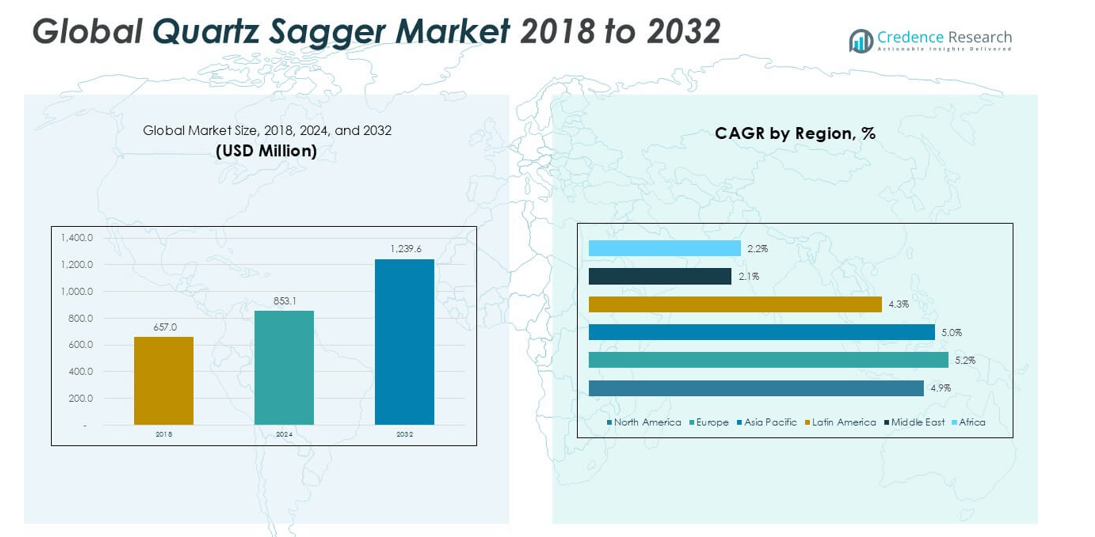
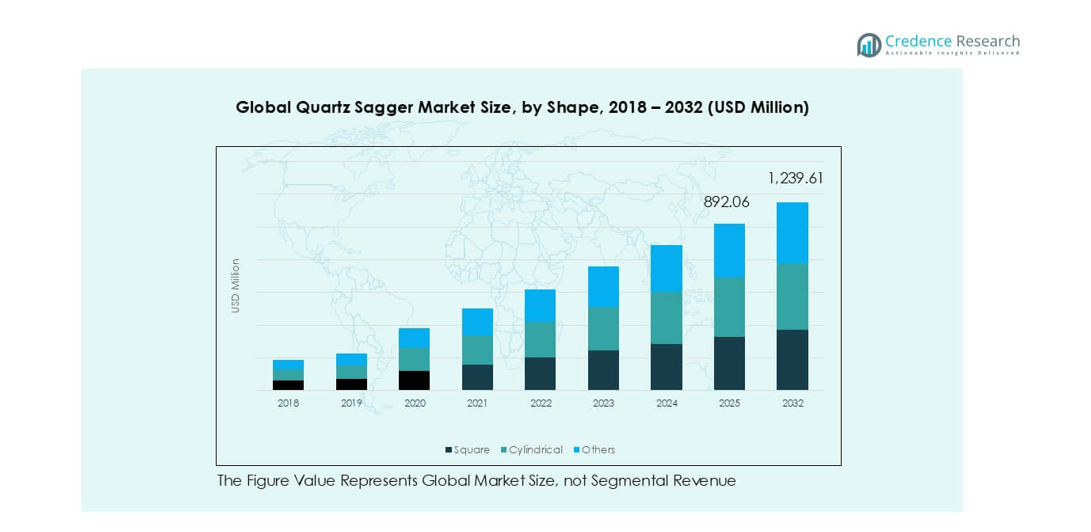
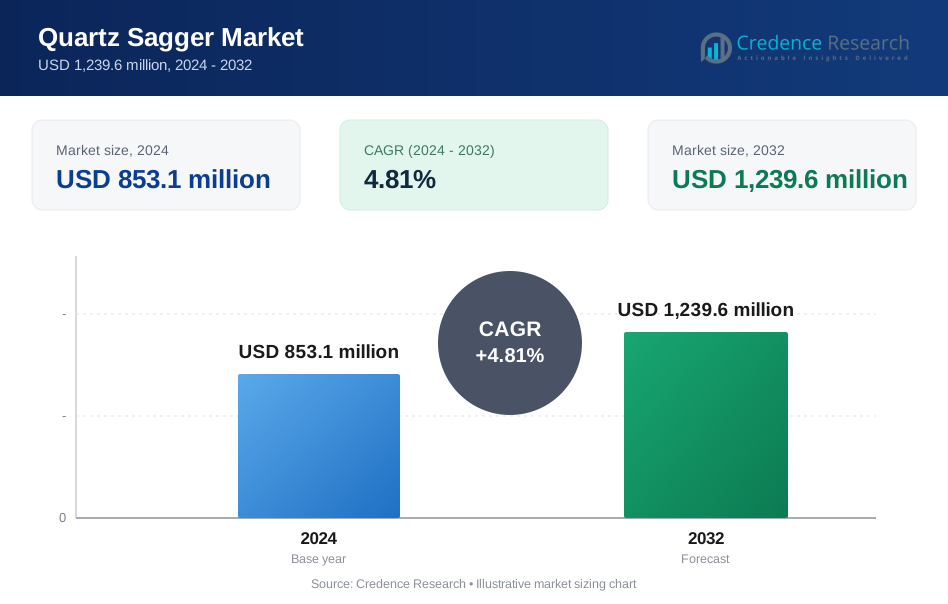
Global Quartz Sagger market size was valued at USD 657.0 million in 2018 and increased to USD 853.1 million in 2024. The market is projected to reach USD 1,239.6 million by 2032, at a CAGR of 4.81% during the forecast period.
| REPORT ATTRIBUTE | DETAILS |
|---|---|
| Historical Period | 2020-2023 |
| Base Year | 2024 |
| Forecast Period | 2025-2032 |
| Quartz Sagger Market Size 2024 | USD 853.1 million |
| Quartz Sagger Market, CAGR | 4.81% |
| Quartz Sagger Market Size 2032 | USD 1,239.6 million |
Top players in the global quartz sagger market include Saint-Gobain, Morgan Advanced Materials, NORITAKE, Zibo Gotrays Industry Co., Ltd., Liling Zen Ceramic, Shandong Topower, and Magma Group. These companies compete through high-purity fused-quartz grades, long thermal-cycle durability, and precise shaping for automated sintering lines. Asia Pacific leads the market with 35% share, driven by strong semiconductor, electronics, and battery-material production. Europe follows with 29%, supported by advanced ceramics and industrial processing. North America holds 26%, anchored by strong demand from chip packaging and technical ceramics. Global players expand capacity and refine purity standards to meet rising performance needs.
Market Insights
- The global quartz sagger market reached USD 853.1 million in 2024 and is projected to hit USD 1,239.6 million by 2032, growing at a 4.81% CAGR during the forecast period.
- Strong demand from semiconductor, electronics, and advanced ceramics drives adoption, with producers seeking high-purity saggers that reduce contamination and improve thermal stability during long sintering cycles.
- Key trends include rising use in battery-material processing, growth of custom large-format saggers, and increased automation that requires tighter dimensional control across firing lines.
- Competition focuses on purity grades, durability, and engineered shapes, with players like Saint-Gobain, NORITAKE, Morgan Advanced Materials, and Zibo Gotrays expanding capacity and enhancing forming and inspection capabilities; restraints include high production costs and shorter lifespan under intense thermal cycling.
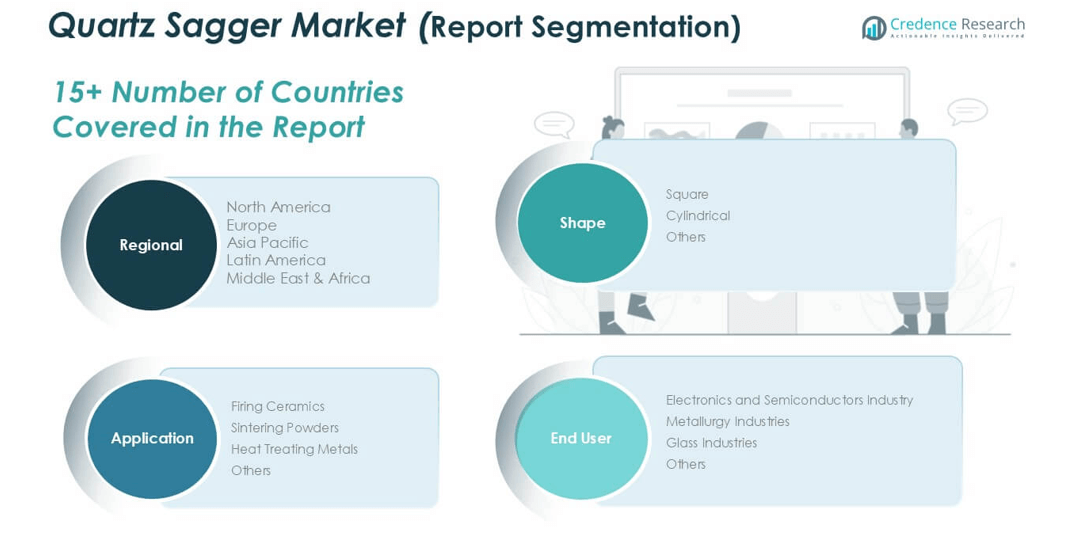
- Asia Pacific leads with 35% share, followed by Europe at 29% and North America at 26%; by shape, square saggers dominate with 48% share, while firing ceramics leads applications with 52% share.
Market Segmentation Analysis:
By Shape
Square saggers hold the dominant share at about 48% due to strong use in high-temperature ceramic firing lines and stable load-bearing performance. These units support uniform heat transfer and reduce cracking during long thermal cycles. Cylindrical designs follow, supported by sintering tasks that need even gas flow. The remaining share includes custom forms used in specialty kilns. Demand rises as producers seek tighter dimensional stability for EV parts, technical ceramics, and powder metallurgy. Growth also links to better quartz purity and longer operating life under repeated thermal shocks.
- For instance, Saint-Gobain’s fused silica components used in thermal-processing hardware exhibit a low thermal expansion of about 0.55×10⁻⁶/K and can operate continuously above 1,000 °C, making them suitable for saggers exposed to repeated high-temperature firing.
By Application
Firing ceramics leads the market with nearly 52% share as advanced ceramics makers adopt high-purity quartz saggers for stable thermal behavior. These saggers help prevent contamination during multi-step firing and reduce defect rates for substrates, filters, and structural parts. Sintering powders shows steady growth with niche use in metal powders and battery material lines. Heat-treating metals holds a smaller share but gains from cleaner atmospheres and longer cycle demands. Other uses span lab processes and specialty sintering tasks in research labs and pilot plants.
- For instance, Morgan Advanced Materials supplies fused-silica and alumina-based kiln furniture engineered for sintering loads above 1,400 °C, with dimensional change kept below 0.2% across long firing schedules, supporting ceramic and powder-processing lines that require stable thermal performance.
By End User
Electronics and semiconductors remain the largest end-user group with about 55% share, driven by strong demand for ultra-clean firing steps in chip packaging, ceramic substrates, and passive components. These users adopt high-purity quartz saggers to avoid trace metal migration and support narrow temperature windows. Metallurgy industries follow, using saggers in alloy part sintering and thermal conditioning steps. Glass industries use them for small-batch heat cycles and coating processes. Other users include research centers and pilot-scale plants that need stable saggers for controlled thermal testing.
Key Growth Drivers
Rising Demand for High-Purity Thermal Processing
Growing use of advanced ceramics and battery materials drives need for stable thermal containers. Quartz saggers offer low impurity levels and strong resistance to thermal shock. These features help producers reduce contamination during long sintering cycles. Electronics, semiconductors, and EV component lines prefer quartz because metal contact risks remain low. Many plants upgrade older alumina saggers to improve yield and reduce scrap. Automation in sintering systems increases demand for consistent dimensions. Global fab expansions also increase volume needs. This shift keeps high-purity saggers in steady demand across major manufacturing hubs.
- For instance, NORITAKE supplies fused silica parts with certified thermal expansion near 0.55×10⁻⁶/K and service temperatures above 1,000 °C, which helps maintain stable geometry during repeated sintering cycles.
Expansion of Semiconductor and Electronics Production
Semiconductor growth increases the need for reliable firing steps. Quartz saggers support tight temperature control during substrate and component processing. These saggers help avoid trace metal diffusion that affects device performance. Rising investment in chip packaging, MLCCs, sensors, and ceramic substrates drives adoption. Many fabs raise cleanliness rules as node sizes shrink. Quartz performance aligns well with these strict limits. Asia’s large electronics ecosystem expands thermal-processing capacity each year. This expansion boosts demand for saggers with precise geometry and stable heat behavior. Strong equipment upgrades further support long-term growth.
- For instance, CoorsTek produces high-purity ceramic firing hardware with impurity levels for Fe, Ti, and Na kept below 10 ppm, which supports cleaner thermal steps in advanced substrate and sensor fabrication.
Shift Toward Advanced Ceramics and Powder Metallurgy
High-performance ceramics gain use in EVs, aerospace parts, filters, and medical tools. These products require uniform sintering conditions and low contamination risk. Quartz saggers allow consistent heat flow across large batches. Powder metallurgy plants also adopt quartz to stabilize heat-treat cycles. Many producers need saggers that withstand repeated firing without deformation. This requirement makes quartz a strong choice for long production runs. Growing use of technical ceramics in renewable energy systems expands demand. Global industries now seek saggers with longer life and tighter tolerances. These needs push steady year-round orders.
Key Trends & Opportunities
Adoption of Automation and Temperature-Stable Sagger Designs
Producers automate kilns and sintering lines to improve yield. Automated handling requires saggers with stable walls, smooth surfaces, and repeatable dimensions. This trend drives demand for engineered quartz formats. Many plants want saggers that support fast heating and cooling cycles. This shift encourages suppliers to offer custom shapes and stronger purity grades. The trend creates clear opportunities for makers with advanced forming and finishing tools. Growing use of digital inspection systems also increases quality needs. Better traceability features open space for premium products.
- For instance, Morgan Advanced Materials applies advanced manufacturing and quality control techniques, including CNC machining and laser-based dimensional checks, that maintain shape tolerances required for high-temperature kiln furniture used in automated loading and fast-cycle sintering lines.
Rising Use in Battery Materials and High-Performance Powders
Demand for cathode and anode powders expands quickly in global EV supply chains. These powders require multi-stage sintering under strict temperature limits. Quartz saggers help avoid contamination that affects energy density. Their thermal stability supports long cycles at high temperatures. This trend creates openings for suppliers who offer reinforced saggers with long fatigue life. Many battery plants add new sintering lines each year. Research labs also test new chemistries that need clean firing steps. These developments create strong growth prospects for quartz saggers in powder processing.
Growth of Custom and Large-Format Sagger Designs
Producers need saggers that match new furnace loads and part sizes. Large ceramic plates, EV components, and specialty optics often require wider formats. Quartz stability allows scaling without losing dimensional control. This shift encourages suppliers to invest in CNC shaping and new fusion methods. Custom solutions command higher margins. Plants with diverse product lines seek flexible sagger options. These needs create ongoing opportunities for engineered shapes and hybrid material blends.
Key Challenges
High Production Costs and Price Sensitivity
Quartz saggers require high-purity feedstock and energy-intensive processing. These steps increase cost compared with alumina or cordierite options. Many buyers remain price-sensitive, especially in low-margin ceramic segments. High energy costs further raise production expenses. Smaller suppliers struggle to balance quality and affordability. Some buyers delay upgrades or shift to mixed material saggers. These issues limit fast adoption in cost-constrained regions. Market growth slows when raw-material prices rise sharply.
Limited Lifespan Under Extreme Thermal Cycling
Quartz saggers resist heat but still degrade under repeated rapid cycling. Many advanced applications need long firing times at high temperatures. Thermal shock and micro-cracking reduce service life over time. Saggers distort when overloaded or exposed to uneven heat. Plants face downtime when replacements occur too often. Producers must maintain strict furnace control to protect sagger integrity. These reliability concerns remain a challenge for large ceramic and powder lines.
Regional Analysis
North America
North America accounts for nearly 26% of the 2024 global quartz sagger market, rising from USD 155.52 million in 2018 to USD 202.74 million in 2024, supported by a 4.9% CAGR. Growth comes from strong semiconductor activity, advanced ceramic production, and steady upgrades in sintering lines. Electronics firms in the U.S. and Canada deploy high-purity saggers to meet strict thermal and contamination rules. The market is set to reach USD 296.14 million by 2032, driven by tight process controls and expanding capacity among chip packaging and precision manufacturing plants.
Europe
Europe holds roughly 29% of the 2024 market, increasing from USD 173.79 million in 2018 to USD 231.32 million in 2024, with a projected 5.2% CAGR through 2032. Demand grows as advanced ceramics, EV components, and specialty materials expand across Germany, France, and the U.K. Producers adopt high-purity saggers to improve yield stability and meet stricter firing standards. By 2032, Europe is set to reach USD 347.09 million, supported by strong industrial automation and clean-processing requirements in technical ceramics and metallurgy.
Asia Pacific
Asia Pacific represents the largest share at nearly 35% in 2024, rising from USD 211.04 million in 2018 to USD 277.57 million in 2024, supported by a 5.0% CAGR. Strong semiconductor output, technical ceramics manufacturing, and battery-material sintering create sustained demand. China, Japan, South Korea, and India expand furnace capacity to support electronics and EV supply chains, driving higher adoption of high-purity saggers. The market is projected to reach USD 410.19 million by 2032, reflecting ongoing industrial scaling and expansions in powder metallurgy applications.
Latin America
Latin America accounts for around 11% of the 2024 market, increasing from USD 70.83 million in 2018 to USD 89.23 million in 2024, reflecting a 4.3% CAGR. Growth stems from rising use of ceramic components, moderate semiconductor assembly activity, and adoption of heat-treating processes in regional metals industries. Manufacturers seek saggers that support stable firing cycles and reduce contamination risk. By 2032, the region is expected to reach USD 124.33 million, with gains linked to expanding industrial clusters in Brazil and Mexico.
Middle East
The Middle East holds about 5% of the 2024 market, growing from USD 31.41 million in 2018 to USD 35.73 million in 2024, at a 2.1% CAGR. Demand increases through investments in specialty glass, technical ceramics, and small-scale electronics processing. Industries adopt quartz saggers for consistent heat distribution and long thermal-cycle stability. By 2032, the region is projected to reach USD 42.15 million, driven by industrial diversification programs and rising interest in clean, high-purity materials for precision applications.
Africa
Africa represents nearly 3% of the 2024 global market, rising from USD 14.46 million in 2018 to USD 16.54 million in 2024, supported by a 2.2% CAGR. Growth remains modest but steady as small and mid-scale ceramics, glass producers, and metallurgy units adopt better thermal-processing tools. Demand centers on saggers that deliver durability under basic firing cycles. By 2032, the market is projected to reach USD 19.71 million, with gains tied to gradual industrialization and expansion of ceramic tile and materials production across key African economies.Top of FormBottom of Form
Market Segmentations:
By Shape
- Square
- Cylindrical
- Others
By Application
- Firing Ceramics
- Sintering Powders
- Heat Treating Metals
- Others
By End User
- Electronics and Semiconductors Industry
- Metallurgy Industries
- Glass Industries
- Others
By Geography
- North America
- U.S.
- Canada
- Mexico
- Europe
- Germany
- France
- U.K.
- Italy
- Spain
- Rest of Europe
- Asia Pacific
- China
- Japan
- India
- South Korea
- South-east Asia
- Rest of Asia Pacific
- Latin America
- Brazil
- Argentina
- Rest of Latin America
- Middle East & Africa
- GCC Countries
- South Africa
- Rest of the Middle East and Africa
Competitive Landscape
The competitive landscape of the global quartz sagger market features a mix of established material technology companies and specialized ceramic producers that compete on purity, durability, and engineering precision. Leading players such as Saint-Gobain, Morgan Advanced Materials, NORITAKE, and Zibo Gotrays focus on high-purity fused-quartz grades, long thermal-cycle life, and custom shaping capabilities to serve semiconductor, electronics, and advanced ceramics manufacturers. Many companies invest in improved forming, sintering, and inspection technologies to deliver consistent dimensions for automated kiln lines. New entrants strengthen their position by offering cost-efficient saggers for metallurgy and general ceramics. Strategic partnerships with furnace makers, regional distributors, and electronic component suppliers help expand customer reach. Across the market, firms compete through product reliability, tighter tolerance control, and clean-processing performance that limits contamination during high-temperature cycles. Continuous expansion in Asia Pacific and growing demand for EV-related materials encourage global players to enhance capacity and broaden technical support services.
Key Player Analysis
- Zibo Gotrays Industry Co., Ltd
- Saint-Gobain
- NORITAKE CO., LIMITED
- Morgan Advanced Materials plc
- Liling Zen Ceramic Co., Ltd
- Shandong Topower Pte Ltd
- Magma Group
Recent Developments
- In December 2022, Sibelco acquired Bassanetti Group of Italy, a local player in Southern Europe's extraction, processing, and marketing of sand products. This move will strengthen the company's positioning in Southern Europe.
- In June 2022, Tata Consultancy Services (TCS) announced that its new “Quartz” was named the ‘Best New Post Trade Solution’ at the 2022 FTF News Technology Innovation Awards. The Quartz offering includes end-to-end services around tokenized securities to MIIs (Market Infrastructure Institutions).
Report Coverage
The research report offers an in-depth analysis based on Shape, Application, End-User and Geography. It details leading market players, providing an overview of their business, product offerings, investments, revenue streams, and key applications. Additionally, the report includes insights into the competitive environment, SWOT analysis, current market trends, as well as the primary drivers and constraints. Furthermore, it discusses various factors that have driven market expansion in recent years. The report also explores market dynamics, regulatory scenarios, and technological advancements that are shaping the industry. It assesses the impact of external factors and global economic changes on market growth. Lastly, it provides strategic recommendations for new entrants and established companies to navigate the complexities of the market.
Future Outlook
- Demand will rise as semiconductor and electronics producers expand clean thermal-processing capacity.
- Advanced ceramics and battery-material sintering will create steady long-term growth.
- High-purity quartz grades will gain preference over traditional materials for stability and low contamination.
- Automation in kilns and handling systems will increase demand for dimensionally consistent saggers.
- Custom and large-format saggers will see higher adoption for EV, optics, and specialty components.
- Suppliers will invest in new forming and fusion methods to improve lifespan and heat stability.
- Regional manufacturing clusters in Asia Pacific will strengthen supply chains and production volumes.
- Sustainability goals will push interest in saggers with longer cycle life and reduced waste.
- Partnerships with furnace makers and materials producers will help broaden market reach.
- Rising quality standards across industries will drive adoption of premium-grade quartz saggers.
Request a Free Sample
Fill in your details and we'll send you a free sample report.
- Sample data tables & charts
- Research methodology
Need a Custom Version of This Report?
Tailor the scope, geography, or segments to your exact requirements.
- Custom geography or segment scope
- Direct access to our analyst team
Frequently Asked Questions
What is the current market size for the Global Quartz Sagger market, and what is its projected size in 2032?
At what Compound Annual Growth Rate is the Global Quartz Sagger market projected to grow between 2024 and 2032?
Which Global Quartz Sagger market segment held the largest share in 2024?
What are the primary factors fueling the growth of the Global Quartz Sagger market?
Who are the leading companies in the Global Quartz Sagger market?
Table of Content
Chapter 1. Report Introduction
- 1.1 Report Description & Purpose
- 1.1.1 Report Title & Market Definition
- 1.1.2 Unique Selling Propositions (USP) & Key Differentiators
- 1.1.3 Value Proposition for Stakeholders
- 1.2 Research Objectives
- 1.2.1 Market Sizing Objectives (Volume & Revenue)
- 1.2.2 Segmentation Objectives
- 1.2.3 Competitive Intelligence Objectives
- 1.2.4 Forecast & Scenario Objectives
- 1.3 Report Scope
- 1.3.1 Quartz Sagger Scope – Types & Subtypes Covered
- 1.3.2 Geographic Scope – Regions & Countries Covered
- 1.3.3 Historical Period, Base Year & Forecast Period (2024; forecast to 2032)
- 1.3.4 Inclusions & Exclusions
- 1.4 HS Code & Classification Framework
- 1.5 Currency, Units & Pricing Basis
- 1.6 Target Stakeholders
- 1.7 Limitations & Assumptions
Chapter 2. Executive Summary
- 2.1 Global Quartz Sagger Market Snapshot
- 2.1.1 Market Size – Historical (2024) & Forecast (2024-2032) (2024: USD 853.1 million → 2032: USD 1,239.6 million)
- 2.1.2 Volume & Revenue – Global Totals
- 2.1.3 Key Market Highlights – Top Five Facts
- 2.2 Quartz Sagger Market Segmentation Snapshot
- 2.2.1 Market Split by Region – 2024 vs. 2032
- 2.3 Competitive Snapshot
- 2.3.1 Top 10 Players by Revenue Share – 2024
- 2.3.2 Top 10 Players by Volume Share – 2024
- 2.3.3 Recent Strategic Developments (18-Month Summary)
- 2.4 Key Investment Highlights & Strategic Conclusions
Chapter 3. Quartz Sagger Market Dynamics & Industry Analysis
- 3.1 Market Overview & Context
- 3.1.1 Quartz Sagger Market Position in the Broader Automotive Value Chain
- 3.1.2 OEM vs. Replacement Market Dynamics
- 3.1.3 Market Maturity & Development Stage by Region
- 3.2 Quartz Sagger Market Drivers
- 3.3 Quartz Sagger Market Restraints & Challenges
- 3.4 Quartz Sagger Market Opportunities
- 3.5 Porter's Five Forces Analysis
- 3.5.1 Threat of New Entrants
- 3.5.2 Bargaining Power of Suppliers
- 3.5.3 Bargaining Power of Buyers
- 3.5.4 Threat of Substitutes
- 3.5.5 Competitive Rivalry – Intensity Assessment
- 3.6 Quartz Sagger Value Chain Analysis
- 3.6.1 Upstream – Raw Material/Input Suppliers
- 3.6.1.1 Raw Material/Input 1
- 3.6.1.2 Raw Material/Input 2
- 3.6.1.3 Raw Material/Input 3
- 3.6.2 Midstream – Production/Manufacturing/Service Delivery
- 3.6.2.1 Production/Process Overview
- 3.6.2.2 Key Facility Locations & Capacity by Manufacturer
- 3.6.3 Downstream – Distribution & End Consumer
- 3.6.3.1 Primary Channel – B2B/OEM
- 3.6.3.2 Secondary Channels – Dealer, Retail, Online, Direct
- 3.6.4 Value Chain Profitability Analysis
- 3.6.1 Upstream – Raw Material/Input Suppliers
- 3.7 PESTEL Analysis
- 3.7.1 Political Factors
- 3.7.2 Economic Factors
- 3.7.3 Social Factors
- 3.7.4 Technological Factors
- 3.7.5 Environmental Factors
- 3.7.6 Legal Factors
- 3.8 Quartz Sagger Supply Chain Analysis
- 3.8.1 Raw Material/Input Supply Risk Assessment
- 3.8.2 Manufacturing Concentration Risk (Geographic Exposure)
- 3.8.3 Trade Disruption Impact Analysis
- 3.9 Regulatory & Policy Landscape
Note: The regulatory and policy landscape section covers regulations based on their applicability to the market, Quartz Sagger category, geography, and scope of the study. Only regulatory frameworks with a material impact on operations, compliance, trade, sustainability, or market access are analyzed in detail.
Chapter 4. Key Investment Pockets & Opportunity Analysis
- 4.1 Quartz Sagger Market Attractiveness Analysis
- 4.1.1 By Region – Investment Attractiveness Matrix (Volume × CAGR)
- 4.2 Absolute Revenue Growth Opportunity
- 4.2.1 By Region – Absolute USD Growth Through 2032
- 4.3 Incremental Volume Opportunity
- 4.3.1 By Region – Incremental Volume Through 2032
- 4.3.2 Segment – Incremental Volume
- 4.4 Emerging Submarket Opportunity Deep Dive (Subject to Applicability)
- 4.5 Emerging Market Opportunity Scorecards
- 4.5.1 United States
- 4.5.2 Europe
- 4.5.3 Asia
- 4.5.4 Middle East & Africa
Note: Emerging Market Opportunity Scorecards will be included based on relevance and strategic importance. Regions listed are indicative and may vary depending on data availability and market dynamics.
Chapter 5. Quartz Sagger Import-Export Analysis & Trade Flows
- 5.1 Global Trade Overview
- 5.1.1 Global Export Value by Country (2024)
- 5.1.2 Global Export Volume by Country (2024)
- 5.1.3 Global Import Value by Country (2024)
- 5.1.4 Global Import Volume by Country (2024)
- 5.1.5 Net Trade Balance by Country (2024)
- 5.2 Export Analysis – Segment
- 5.2.1 Type 1 (HS Code)
- 5.2.2 Type 2 (HS Code)
- 5.2.3 Type 3 (HS Code)
- 5.2.4 Type 4 (HS Code)
- 5.2.5 Type 5 (HS Code)
- 5.3 Import Analysis – Segment
- 5.3.1 Type 1 (HS Code)
- 5.3.2 Type 2 (HS Code)
- 5.3.3 Type 3 (HS Code)
- 5.3.4 Type 4 (HS Code)
- 5.3.5 Type 5 (HS Code)
- 5.4 Average Unit Trade Prices
- 5.4.1 Average Export Price – Segment & Country
- 5.4.2 Average Import Price – Segment & Source Country
- 5.4.3 Price Trends (2024)
- 5.5 Key Trade Route Analysis
- 5.5.1 Trade Route 1
- 5.5.2 Trade Route 2
- 5.5.3 Trade Route 3
- 5.5.4 Trade Route 4
- 5.5.5 Trade Route 5
- 5.6 Trade Policy Impact Assessment
- 5.6.1 US Anti-Dumping & Section 301 Tariffs
- 5.6.2 EU Customs Union Impact
- 5.6.3 Major Free Trade Agreements
- 5.6.4 USMCA Rules of Origin
Note: Trade policy analysis will be included only where relevant to the Quartz Sagger market.
Chapter 6. Competitive Landscape & Company Benchmarking
- 6.1 Quartz Sagger Market Concentration & Structure
- 6.1.1 Herfindahl-Hirschman Index (HHI) – vs. 2024
- 6.1.2 Tier 1, Tier 2 & Tier 3 Market Structure
- 6.1.3 Global, Regional & Local Player Dynamics
- 6.2 Quartz Sagger Market Share Analysis – 2024
- 6.2.1 Global Revenue Share by Company
- 6.2.2 Global Volume Share by Company
- 6.2.3 Regional Revenue Share
- 6.2.4 Market Share Evolution ( vs. 2024)
- 6.2.5 OEM Segment Share by Company
- 6.2.6 Replacement Segment Share by Company
- 6.3 Production/Delivery Capacity & Facility Analysis
- 6.3.1 Global Installed Capacity
- 6.3.2 Capacity Utilization Rates
- 6.3.3 Production/Output Volume
- 6.3.4 Facility Locations & Capacity Map
- 6.3.5 Planned Capacity Additions
- 6.4 Quartz Sagger Competitive Benchmarking Matrix
- 6.4.1 Revenue, Volume, CAGR & Profitability Comparison
- 6.4.2 Channel Revenue Mix
- 6.4.3 Geographic Revenue Exposure
- 6.4.4 R&D Intensity
- 6.4.5 Sustainability Maturity
- 6.5 Strategic Developments in Quartz Sagger (Last 24 Months)
- 6.5.1 Mergers, Acquisitions & Divestments
- 6.5.2 New Quartz Sagger Launches
- 6.5.3 Facility Expansions
- 6.5.4 Strategic Alliances, Joint Ventures & Partnerships
- 6.5.5 Distribution Expansion & Market Entry
- 6.5.6 Sustainability & ESG Initiatives
- 6.6 Competitive Strategy Mapping
- 6.6.1 Leader, Challenger, Follower & Niche Classification
- 6.6.2 Pricing Strategy Comparison
- 6.6.3 Channel Strategy Matrix
Note: Strategic developments are included based on their materiality and the availability of reliable information.
Chapter 7. Global Quartz Sagger Market – By Distribution Channel
- 7.1 Segment Overview
- 7.1.1 Volume & Revenue Split by Channel (2024 & 2032)
- 7.1.2 Channel Mix Evolution (2024-2032)
Chapter 8. Regional Market Analysis – Global Overview
- 8.1 Global Regional Overview
- 8.1.1 Regional Volume Share
- 8.1.2 Regional Revenue Share
- 8.1.3 Regional Volume by Region
- 8.1.4 Regional Revenue by Region
- 8.1.5 Regional Forecast Through 2032
- 8.2 Cross-Regional Segment Analysis
- 8.2.1 By Distribution Channel
- 8.2.2 By Brand/Price Tier
Chapter 9. North America Quartz Sagger Market
- 9.1 United States
- 9.2 Canada
- 9.3 Mexico
Chapter 10. Europe Quartz Sagger Market
- 10.1 Germany
- 10.2 France
- 10.3 Italy
- 10.4 United Kingdom
- 10.5 Spain
- 10.6 Poland
- 10.7 Russia
- 10.8 Netherlands
- 10.9 Belgium
- 10.10 Sweden
- 10.11 Denmark
- 10.12 Norway
- 10.13 Rest of Europe
Chapter 11. Asia Pacific Quartz Sagger Market
- 11.1 China
- 11.2 India
- 11.3 Japan
- 11.4 South Korea
- 11.5 Thailand
- 11.6 Indonesia
- 11.7 Vietnam
- 11.8 Malaysia
- 11.9 Australia
- 11.10 Rest of Asia Pacific
Chapter 12. Latin America Quartz Sagger Market
- 12.1 Brazil
- 12.2 Argentina
- 12.3 Colombia
- 12.4 Chile
- 12.5 Rest of Latin America
Chapter 13. Middle East Quartz Sagger Market
- 13.1 Saudi Arabia
- 13.2 United Arab Emirates
- 13.3 Turkey
- 13.4 Israel
- 13.5 Iran
- 13.6 Rest of the Middle East
Chapter 14. Africa Quartz Sagger Market
- 14.1 South Africa
- 14.2 Egypt
- 14.3 Nigeria
- 14.4 Morocco
- 14.5 Rest of Africa
Chapter 15. Quartz Sagger Company Profiles
- 15.1 [Company 01]
- 15.1.1 Company Overview
- 15.1.2 Key Management Personnel
- 15.1.3 Products & Services Portfolio
- 15.1.4 Financial Performance
- 15.1.5 Key Market Focus & Geographic Presence
- 15.1.6 Recent Developments & Strategic Initiatives
Note: The company profile list is preliminary and may change based on research findings, market developments, data availability, and client requirements.
Chapter 16. Appendices
- Appendix A – List of Abbreviations & Acronyms
- Appendix B – Industry Classification Code Reference – Full Series
- Appendix C – Production & Capacity Data Tables
- Appendix D – End-Use & Demand Base Tables
- Appendix E – Consumption & Replacement Rate Assumptions
- Appendix F – ASP Reference Tables
- Appendix G – Manufacturing & Facility Database
- Appendix H – Import-Export Data Tables
- Appendix I – Regulatory Summary Tables
- Appendix J – Primary Research Participant List (Anonymized)
- Appendix K – Primary Research Questionnaire Framework
- Appendix L – Data Sources & Bibliography
- Appendix M – Market Size Divergence & Source Comparison
Chapter 17. Research Methodology
- 17.1 Research Framework & Philosophy
- 17.2 Secondary Research – Sources, Hierarchy & Data Extraction
- 17.3 Data Modeling – Bottom-Up & Top-Down Market Sizing
- 17.4 Primary Research – Stakeholder Framework, LOI & Sample Sizes
- 17.5 Forecast Methodology – Regression, Scenario & Sensitivity Analysis
- 17.6 Quality Control – Four-Layer Validation Framework
- 17.7 Limitations & Standard Assumptions
- 17.8 Disclaimer
