
Market Overview:
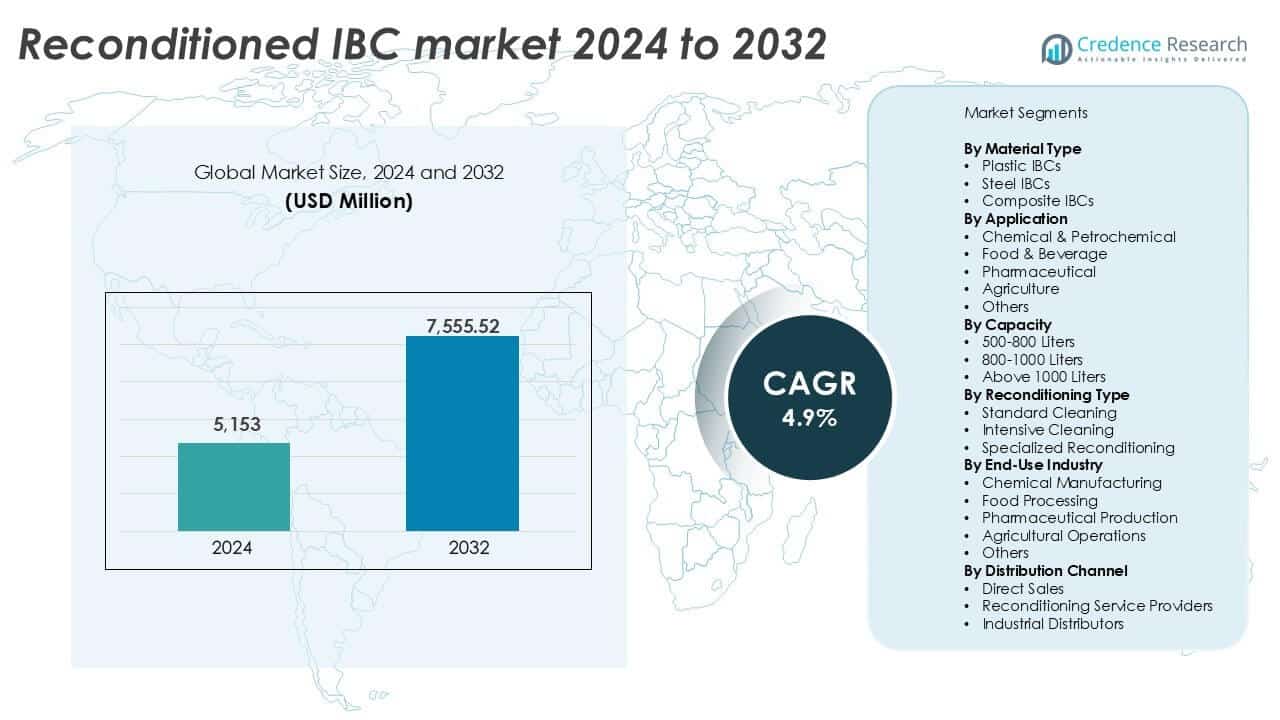
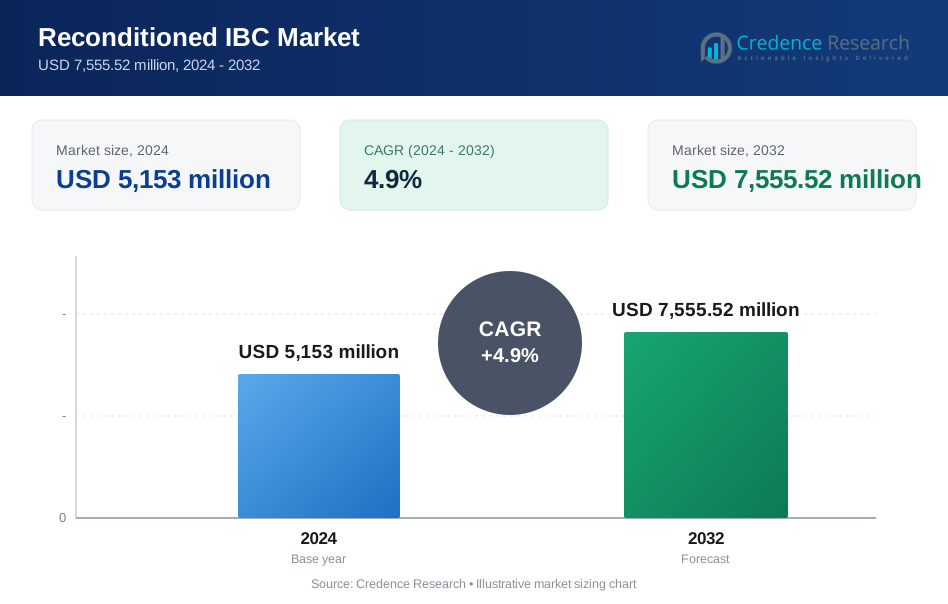
The Reconditioned IBC Market size was valued at USD 5,153 million in 2024 and is anticipated to reach USD 7,555.52 million by 2032, at a CAGR of 4.9% during the forecast period.
| REPORT ATTRIBUTE | DETAILS |
|---|---|
| Historical Period | 2020-2023 |
| Base Year | 2024 |
| Forecast Period | 2025-2032 |
| Reconditioned IBC Market Size 2024 | USD 5,153 million |
| Reconditioned IBC Market, CAGR | 4.9% |
| Reconditioned IBC Market Size 2032 | USD 7,555.52 million |
Top players in the reconditioned IBC market include Mauser Packaging Solutions, Greif Inc., Schütz Container Systems, Berry Global Inc., and Brambles Limited (CHEP). These companies lead the market through large-scale reconditioning facilities, global collection networks, and strong client portfolios across chemicals, food, and pharmaceuticals. Time Technoplast, Snyder Industries, Hoyer Group, and CurTec Holdings BV maintain competitive positions by offering certified cleaning services and region-specific logistics solutions. North America is the leading region, holding a 35% market share in 2024, driven by strict environmental regulations, high reconditioning standards, and widespread adoption of IBC pooling and rental models across industrial sectors.
Market Insights
- The Reconditioned IBC Market was valued at USD 5,153 million in 2024 and is projected to reach USD 7,555.52 million by 2032, growing at a CAGR of 4.9% during the forecast period.
- Growing demand for cost-effective, sustainable packaging across chemicals, food, and agriculture sectors is driving strong adoption of reconditioned IBCs.
- Companies are adopting rental and pooling models, while RFID and traceability tools are enhancing container lifecycle monitoring and quality assurance.
- Key players like Mauser Packaging Solutions, Greif Inc., and Schütz dominate with certified reconditioning capabilities, but small regional firms face quality inconsistency challenges.
- North America leads with a 35% share, followed by Europe at 30%, while Asia Pacific holds 22%; by capacity, the 800–1000 liters segment dominates with over 50% share, driven by standard pallet logistics and high reusability across end-use industries.
Market Segmentation Analysis:
By Material Type
Plastic IBCs dominate the reconditioned IBC market, accounting for over 60% of the total share in 2024. Their lightweight structure, lower reconditioning costs, and broad chemical compatibility drive strong adoption across industries. Plastic units are easier to clean and more resistant to corrosion, making them ideal for reuse. Steel IBCs follow due to their strength in high-pressure or flammable liquid applications, especially in petrochemical sectors. Composite IBCs see slower adoption but gain traction in hybrid-use cases requiring dual-material performance. Demand for sustainable packaging boosts reconditioning of plastic IBCs across global logistics chains.
- For instance, Schütz reconditions plastic IBCs with inner bottles pressure-tested to 100 kPa and steel cages inspected for load ratings up to 1,600 kg.
By Application
The chemical and petrochemical segment leads with nearly 45% of the application share, driven by high-volume liquid handling needs and hazardous material transport. These sectors benefit from reconditioned IBCs due to their cost savings and compliance with UN/DOT packaging standards. Food and beverage is the second-largest segment, leveraging certified reconditioned containers for non-sensitive ingredients. Pharmaceuticals and agriculture show steady uptake with niche demands for sealed, hygienic, or pesticide-compatible storage. The “Others” category includes paints, coatings, and water treatment, expanding the market base through short-cycle reusability and container pooling programs.
- For instance, Mauser Packaging Solutions reconditions IBCs certified under UN 31HA1 standards, with leak testing conducted at 20 kPa for hazardous liquids.
By Capacity
IBCs with 800–1000 liters capacity dominate the market, contributing over 50% of total volume in 2024. This size offers optimal balance between bulk storage and ease of handling for standard pallet logistics. High demand comes from chemical, beverage, and industrial fluid sectors, where standardization and forklift compatibility drive efficiencies. The 500–800 liter segment holds notable share in regions with small-batch or dense liquid usage. IBCs above 1000 liters are growing in agricultural and wastewater industries due to their advantage in reducing refill frequency and optimizing transport economics.
Key Growth Drivers
Cost Efficiency and Sustainability Appeal
Reconditioned IBCs offer a significantly lower total cost of ownership compared to new containers, making them attractive to cost-sensitive industries. Enterprises reduce packaging expenses by 25–40% through reconditioning programs, particularly in bulk handling sectors like chemicals, agriculture, and food ingredients. Additionally, reconditioned IBCs reduce landfill waste and promote circular economy practices. With rising pressure on companies to meet sustainability goals, reconditioned packaging supports carbon footprint reduction without compromising performance. Brands increasingly prefer reuse over recycling due to lower environmental impact. Governments in North America and Europe also promote reusability through packaging waste directives. These factors drive steady demand for reconditioned IBCs, especially among large manufacturers and distributors with repeat-use cycles. As companies shift toward ESG reporting and green supply chains, reconditioned IBCs continue to gain favor across various industrial applications.
- For instance, Schütz reports that each reconditioned IBC saves up to 150 kg of virgin plastic and steel compared to producing a new unit, supporting circular packaging models.
Expanding Industrial and Agricultural Fluid Transport Needs
The rise in liquid logistics across industrial sectors directly boosts reconditioned IBC adoption. Industries such as petrochemicals, lubricants, paints, fertilizers, and food ingredients require durable, bulk-compatible transport containers. IBCs offer higher volume efficiency and stackability compared to drums, making them ideal for intermodal shipping. Reconditioned units extend this value at a fraction of new IBC cost, creating a strong business case for fleet managers and warehouse operators. Agricultural applications especially benefit from IBCs in handling liquid fertilizers, pesticides, and irrigation chemicals. The rural focus on cost-saving logistics further boosts reuse cycles. Demand is also surging in emerging markets across Southeast Asia and Latin America, where small- and mid-sized businesses prioritize value-driven packaging. With regional logistics expansion and infrastructure improvements, the demand for affordable, reusable IBCs for both storage and transport is expected to remain a key driver in the coming years.
- For instance, Greif’s reconditioned IBCs support nominal capacities of 1,000 liters and are certified for multiple transport cycles under UN performance testing.
Regulatory Support for Reuse and Container Traceability
Increasing global regulatory focus on packaging waste reduction has created a favorable environment for reconditioned IBCs. The EU’s Packaging and Packaging Waste Regulation (PPWR), U.S. EPA reuse initiatives, and other national frameworks are pushing industries toward reuse models. Certified reconditioners now operate under clear UN/DOT and ISO guidelines for IBC cleaning, leak testing, and integrity verification. This has enhanced industry confidence in reused containers, particularly for hazardous material handling. Technological improvements in container tracking—such as RFID tags and QR-based inventory management—have also enabled better monitoring of IBC life cycles. These systems help ensure safety and compliance while extending container usability. Regulatory bodies are increasingly recognizing verified reconditioning as a safe, sustainable practice, further strengthening the market. This alignment between policy and practice drives adoption in sectors that previously hesitated due to safety concerns, including chemicals, pharma, and food processing.
Key Trends & Opportunities
Growth of IBC Pooling and Rental Services
The rise of shared container models is reshaping IBC logistics. Companies increasingly rely on third-party pooling services that supply, collect, clean, and redistribute reconditioned IBCs across regions. This model reduces capital expenditure while increasing asset utilization. Key players offer end-to-end services including reconditioning, tracking, and regulatory compliance, which appeals to SMEs and multinational firms alike. Pooling helps reduce storage space needs, downtime, and IBC loss. With the growth of e-commerce, 3PLs and warehousing providers also adopt rental models for flexibility and speed. In Europe and North America, rental-based circular logistics networks are scaling quickly, driven by demand from chemical and food sectors. The trend also opens opportunity for digital platforms to manage container tracking, return cycles, and real-time condition monitoring creating an ecosystem of smart, reusable packaging. This shift toward service-based ownership continues to unlock value in the reconditioned IBC landscape.
- For instance, Mauser Packaging Solutions operates global IBC pooling networks with RFID-enabled tracking across more than 100 service locations.
Advancements in Reconditioning Technology and Inspection Tools
Technological improvements are enhancing the quality and safety of reconditioned IBCs. Automated cleaning systems with steam, alkaline, or ultrasonic technology now offer consistent interior decontamination, crucial for food and pharma applications. Leak detection systems using pressure testing, vision systems, and robotic inspections ensure container integrity meets ISO and UN standards. These innovations increase trust in reconditioned units and reduce operational risks. Smart sensors and RFID tagging further allow condition tracking and asset management throughout the IBC’s lifecycle. Some providers now offer blockchain-based traceability for high-value contents, assuring buyers of cleanliness and container history. The growing ability to recondition with precision opens new markets, including pharma-grade and food-grade reuse. As end-users demand greater transparency and standardization, these technological advancements help scale adoption across global supply chains while maintaining regulatory compliance and safety benchmarks.
Key Challenges
Safety Concerns and Compatibility Limitations
Despite improvements, some industries remain cautious about reconditioned IBC use due to contamination and safety risks. Handling hazardous or high-purity products often requires stringent validation that reused containers can’t always guarantee. Chemical residues, odor retention, and micro-abrasions in plastic IBCs can pose safety hazards during reuse. In sectors such as pharmaceuticals, biotech, and food processing, where hygiene is non-negotiable, adoption of reconditioned units is limited. Additionally, certain chemicals react with previously stored contents or the cleaned surface, reducing cross-use compatibility. While standards exist, not all reconditioners follow uniform protocols, leading to inconsistent quality in some regions. This inconsistency creates barriers in trust and regulatory acceptance, especially in export applications. End-users may opt for new containers despite the cost, to ensure zero-risk operations. Overcoming these safety limitations remains a key challenge for expanding reconditioned IBC penetration into sensitive or regulated sectors.
Fragmented Market and Supply Chain Variability
The reconditioned IBC market is highly fragmented, with a mix of large certified players and small unregulated operators. Regional disparities in infrastructure, collection networks, and reconditioning capabilities create supply-demand mismatches. In emerging economies, lack of organized return logistics and cleaning facilities hinders market growth. Small-scale operators may not adhere to standard testing or cleaning processes, leading to variability in product quality. This affects customer trust and limits repeat use in industries requiring strict standards. Moreover, supply chain disruptions, especially during global crises, affect the timely return, inspection, and redistribution of containers. The unpredictability in IBC availability and inconsistent pricing structures across geographies create further challenges for users seeking stable, compliant packaging solutions. To grow uniformly, the market must invest in standardized systems, quality benchmarking, and robust reverse logistics infrastructure. Without this, the reconditioned IBC market risks being restricted to low-margin or non-critical applications.
Regional Analysis
North America
North America holds the largest share of the global reconditioned IBC market, accounting for over 35% in 2024. The region benefits from strong adoption across the chemical, food, and pharmaceutical industries. Stringent environmental regulations and well-developed reconditioning infrastructure support high container reuse rates. The U.S. leads due to its mature logistics network, widespread pooling services, and established reconditioning guidelines under EPA and DOT. Canada's market is also growing with increasing adoption in agriculture and oilfield services. Major players operate regional collection centers and adhere to certified cleaning and leak-testing protocols, ensuring high-quality reconditioned IBC supply.
Europe
Europe captures around 30% of the reconditioned IBC market in 2024, driven by the EU’s circular economy mandates and Packaging Waste Regulations. Germany, France, and the UK lead in container reuse due to strict industrial waste norms and advanced recycling infrastructure. IBC reconditioning is closely monitored under UN standards, making Europe a highly regulated yet innovation-friendly region. Chemical and food sectors drive demand, while pooling services are widely used. Sustainability targets encourage businesses to switch to reused packaging formats. Eastern Europe is seeing growing adoption through partnerships with Western reconditioners, expanding the overall regional network.
Asia Pacific
Asia Pacific accounts for approximately 22% of the global market, with significant growth driven by manufacturing expansion, agricultural exports, and rising chemical production. China, India, and Japan are the top contributors. China leads in volume, supported by low-cost reconditioning services and widespread industrial fluid transport. India’s market is accelerating due to rising awareness of container reuse in agrochemicals and specialty chemicals. Regional logistics modernization and the push for lower packaging costs support the transition to reconditioned IBCs. However, quality standardization varies widely across countries, which limits adoption in regulated sectors such as pharma and food.
Latin America
Latin America represents around 7% of the reconditioned IBC market, with growing activity in Brazil, Mexico, and Argentina. Agriculture and food processing sectors dominate usage, particularly in fertilizer, edible oils, and beverages. Lower cost pressures make reconditioned IBCs attractive for regional SMEs. However, supply chain fragmentation and inconsistent reconditioning practices pose adoption challenges. Brazil shows the most structured development, with regional cleaning centers supporting the export of bulk agro-products. As trade grows and sustainable packaging gains attention, market share is expected to rise steadily, supported by partnerships with multinational suppliers and third-party pooling firms.
Middle East & Africa (MEA)
The MEA region holds a modest 6% share of the global market in 2024. The Gulf countries see moderate demand in petrochemicals and water treatment sectors, with the UAE and Saudi Arabia leading adoption. Africa’s growth remains nascent but promising, especially in agriculture and mining sectors where reconditioned IBCs help reduce packaging costs. Limited reconditioning infrastructure and regulatory oversight hinder scale, though international providers are entering via partnerships. South Africa shows potential with increasing use in fertilizer and industrial fluids. Gradual infrastructure investment and sustainability-driven initiatives are expected to improve regional market penetration over time.
Market Segmentations:
By Material Type
- Plastic IBCs
- Steel IBCs
- Composite IBCs
By Application
- Chemical & Petrochemical
- Food & Beverage
- Pharmaceutical
- Agriculture
- Others
By Capacity
- 500-800 Liters
- 800-1000 Liters
- Above 1000 Liters
By Reconditioning Type
- Standard Cleaning
- Intensive Cleaning
- Specialized Reconditioning
By End-Use Industry
- Chemical Manufacturing
- Food Processing
- Pharmaceutical Production
- Agricultural Operations
- Others
By Distribution Channel
- Direct Sales
- Reconditioning Service Providers
- Industrial Distributors
By Geography
- North America
- U.S.
- Canada
- Mexico
- Europe
- Germany
- France
- U.K.
- Italy
- Spain
- Rest of Europe
- Asia Pacific
- China
- Japan
- India
- South Korea
- South-east Asia
- Rest of Asia Pacific
- Latin America
- Brazil
- Argentina
- Rest of Latin America
- Middle East & Africa
- GCC Countries
- South Africa
- Rest of the Middle East and Africa
Competitive Landscape
The reconditioned IBC market is moderately consolidated, with global and regional players competing through pricing, service quality, and compliance certifications. Leading companies such as Mauser Packaging Solutions, Greif Inc., and Schütz Container Systems maintain strong positions through vertically integrated operations, proprietary cleaning technologies, and expansive collection networks. Berry Global, Time Technoplast, and Brambles (CHEP) further strengthen their presence via rental and pooling models. These players benefit from established relationships in chemical, food, and industrial sectors. Smaller reconditioners compete in local markets by offering flexible, low-cost services but often lack global standardization. Strategic partnerships, acquisition of regional reconditioners, and investments in automated reconditioning technologies are common competitive strategies. Certification under UN, DOT, or ISO standards is a key differentiator, especially in hazardous material applications. The market is also seeing innovation in traceability systems, with some companies deploying RFID or blockchain to improve container lifecycle tracking and regulatory compliance.
Key Player Analysis
- Mauser Packaging Solutions
- Greif Inc.
- Schütz Container Systems
- Berry Global Inc.
- BWAY Corporation
- Hoyer Group
- Time Technoplast Limited
- Brambles Limited (CHEP)
- CurTec Holdings BV
- Snyder Industries
Recent Developments
- In July 2025, Schütz announced a $31 million expansion in St. Joseph, Missouri, adding new manufacturing lines and jobs to enhance container production capacity, including IBCs.
- In June 2025, Mauser opened a new reconditioning and recycling facility at BASF’s site in Tarragona, Spain, expanding its footprint in sustainable packaging and boosting reconditioning capacity in Europe.
- In April 2023, Greif completed an acquisition to increase its ownership in Centurion Container LLC, strengthening its IBC reconditioning network and service capabilities in North America.
Report Coverage
The research report offers an in-depth analysis based on Material Type, Application, Capacity, Reconditioning Type, End-Use Industry, Distribution Channel and Geography. It details leading market players, providing an overview of their business, product offerings, investments, revenue streams, and key applications. Additionally, the report includes insights into the competitive environment, SWOT analysis, current market trends, as well as the primary drivers and constraints. Furthermore, it discusses various factors that have driven market expansion in recent years. The report also explores market dynamics, regulatory scenarios, and technological advancements that are shaping the industry. It assesses the impact of external factors and global economic changes on market growth. Lastly, it provides strategic recommendations for new entrants and established companies to navigate the complexities of the market.
Future Outlook
- The market will continue expanding due to rising demand for sustainable bulk packaging solutions.
- Adoption of pooling and rental models will grow across logistics and chemical sectors.
- Technological upgrades in reconditioning processes will improve quality and container lifespan.
- Certification and compliance with UN/DOT standards will become more critical for market access.
- Asia Pacific will see faster growth due to industrial expansion and cost-driven demand.
- North America and Europe will maintain leadership through strict regulatory frameworks.
- Digital tracking tools like RFID and blockchain will enhance container traceability.
- Food and pharmaceutical industries will gradually increase adoption with better cleaning assurance.
- Consolidation among reconditioners will intensify to standardize quality and expand reach.
- Environmental regulations will continue pushing businesses toward reusable packaging formats.
Request a Free Sample
Fill in your details and we'll send you a free sample report.
- Sample data tables & charts
- Research methodology
Need a Custom Version of This Report?
Tailor the scope, geography, or segments to your exact requirements.
- Custom geography or segment scope
- Direct access to our analyst team
Frequently Asked Questions
What is the current market size for the Reconditioned IBC market, and what is its projected size in 2032?
At what Compound Annual Growth Rate is the Reconditioned IBC market projected to grow between 2024 and 2032?
Which Reconditioned IBC market segment held the largest share in 2024?
What are the primary factors fueling the growth of the Reconditioned IBC market?
Who are the leading companies in the Reconditioned IBC market?
Which region commanded the largest share of the Reconditioned IBC market in 2024?
Table of Content
Chapter 1. Report Introduction
- 1.1 Report Description & Purpose
- 1.1.1 Report Title & Market Definition
- 1.1.2 Unique Selling Propositions (USP) & Key Differentiators
- 1.1.3 Value Proposition for Stakeholders
- 1.2 Research Objectives
- 1.2.1 Market Sizing Objectives (Volume & Revenue)
- 1.2.2 Segmentation Objectives
- 1.2.3 Competitive Intelligence Objectives
- 1.2.4 Forecast & Scenario Objectives
- 1.3 Report Scope
- 1.3.1 Reconditioned IBC Scope – Types & Subtypes Covered
- 1.3.2 Geographic Scope – Regions & Countries Covered
- 1.3.3 Historical Period, Base Year & Forecast Period (2024; forecast to 2032)
- 1.3.4 Inclusions & Exclusions
- 1.4 HS Code & Classification Framework
- 1.5 Currency, Units & Pricing Basis
- 1.6 Target Stakeholders
- 1.7 Limitations & Assumptions
Chapter 2. Executive Summary
- 2.1 Global Reconditioned IBC Market Snapshot
- 2.1.1 Market Size – Historical (2024) & Forecast (2024-2032) (2024: USD 5,153 million → 2032: USD 7,555.52 million)
- 2.1.2 Volume & Revenue – Global Totals
- 2.1.3 Key Market Highlights – Top Five Facts
- 2.2 Reconditioned IBC Market Segmentation Snapshot
- 2.2.1 Market Split by Region – 2024 vs. 2032
- 2.3 Competitive Snapshot
- 2.3.1 Top 10 Players by Revenue Share – 2024
- 2.3.2 Top 10 Players by Volume Share – 2024
- 2.3.3 Recent Strategic Developments (18-Month Summary)
- 2.4 Key Investment Highlights & Strategic Conclusions
Chapter 3. Reconditioned IBC Market Dynamics & Industry Analysis
- 3.1 Market Overview & Context
- 3.1.1 Reconditioned IBC Market Position in the Broader Automotive Value Chain
- 3.1.2 OEM vs. Replacement Market Dynamics
- 3.1.3 Market Maturity & Development Stage by Region
- 3.2 Reconditioned IBC Market Drivers
- 3.3 Reconditioned IBC Market Restraints & Challenges
- 3.4 Reconditioned IBC Market Opportunities
- 3.5 Porter's Five Forces Analysis
- 3.5.1 Threat of New Entrants
- 3.5.2 Bargaining Power of Suppliers
- 3.5.3 Bargaining Power of Buyers
- 3.5.4 Threat of Substitutes
- 3.5.5 Competitive Rivalry – Intensity Assessment
- 3.6 Reconditioned IBC Value Chain Analysis
- 3.6.1 Upstream – Raw Material/Input Suppliers
- 3.6.1.1 Raw Material/Input 1
- 3.6.1.2 Raw Material/Input 2
- 3.6.1.3 Raw Material/Input 3
- 3.6.2 Midstream – Production/Manufacturing/Service Delivery
- 3.6.2.1 Production/Process Overview
- 3.6.2.2 Key Facility Locations & Capacity by Manufacturer
- 3.6.3 Downstream – Distribution & End Consumer
- 3.6.3.1 Primary Channel – B2B/OEM
- 3.6.3.2 Secondary Channels – Dealer, Retail, Online, Direct
- 3.6.4 Value Chain Profitability Analysis
- 3.6.1 Upstream – Raw Material/Input Suppliers
- 3.7 PESTEL Analysis
- 3.7.1 Political Factors
- 3.7.2 Economic Factors
- 3.7.3 Social Factors
- 3.7.4 Technological Factors
- 3.7.5 Environmental Factors
- 3.7.6 Legal Factors
- 3.8 Reconditioned IBC Supply Chain Analysis
- 3.8.1 Raw Material/Input Supply Risk Assessment
- 3.8.2 Manufacturing Concentration Risk (Geographic Exposure)
- 3.8.3 Trade Disruption Impact Analysis
- 3.9 Regulatory & Policy Landscape
Note: The regulatory and policy landscape section covers regulations based on their applicability to the market, Reconditioned IBC category, geography, and scope of the study. Only regulatory frameworks with a material impact on operations, compliance, trade, sustainability, or market access are analyzed in detail.
Chapter 4. Key Investment Pockets & Opportunity Analysis
- 4.1 Reconditioned IBC Market Attractiveness Analysis
- 4.1.1 By Region – Investment Attractiveness Matrix (Volume × CAGR)
- 4.2 Absolute Revenue Growth Opportunity
- 4.2.1 By Region – Absolute USD Growth Through 2032
- 4.3 Incremental Volume Opportunity
- 4.3.1 By Region – Incremental Volume Through 2032
- 4.3.2 Segment – Incremental Volume
- 4.4 Emerging Submarket Opportunity Deep Dive (Subject to Applicability)
- 4.5 Emerging Market Opportunity Scorecards
- 4.5.1 United States
- 4.5.2 Europe
- 4.5.3 Asia
- 4.5.4 Middle East & Africa
Note: Emerging Market Opportunity Scorecards will be included based on relevance and strategic importance. Regions listed are indicative and may vary depending on data availability and market dynamics.
Chapter 5. Reconditioned IBC Import-Export Analysis & Trade Flows
- 5.1 Global Trade Overview
- 5.1.1 Global Export Value by Country (2024)
- 5.1.2 Global Export Volume by Country (2024)
- 5.1.3 Global Import Value by Country (2024)
- 5.1.4 Global Import Volume by Country (2024)
- 5.1.5 Net Trade Balance by Country (2024)
- 5.2 Export Analysis – Segment
- 5.2.1 Type 1 (HS Code)
- 5.2.2 Type 2 (HS Code)
- 5.2.3 Type 3 (HS Code)
- 5.2.4 Type 4 (HS Code)
- 5.2.5 Type 5 (HS Code)
- 5.3 Import Analysis – Segment
- 5.3.1 Type 1 (HS Code)
- 5.3.2 Type 2 (HS Code)
- 5.3.3 Type 3 (HS Code)
- 5.3.4 Type 4 (HS Code)
- 5.3.5 Type 5 (HS Code)
- 5.4 Average Unit Trade Prices
- 5.4.1 Average Export Price – Segment & Country
- 5.4.2 Average Import Price – Segment & Source Country
- 5.4.3 Price Trends (2024)
- 5.5 Key Trade Route Analysis
- 5.5.1 Trade Route 1
- 5.5.2 Trade Route 2
- 5.5.3 Trade Route 3
- 5.5.4 Trade Route 4
- 5.5.5 Trade Route 5
- 5.6 Trade Policy Impact Assessment
- 5.6.1 US Anti-Dumping & Section 301 Tariffs
- 5.6.2 EU Customs Union Impact
- 5.6.3 Major Free Trade Agreements
- 5.6.4 USMCA Rules of Origin
Note: Trade policy analysis will be included only where relevant to the Reconditioned IBC market.
Chapter 6. Competitive Landscape & Company Benchmarking
- 6.1 Reconditioned IBC Market Concentration & Structure
- 6.1.1 Herfindahl-Hirschman Index (HHI) – vs. 2024
- 6.1.2 Tier 1, Tier 2 & Tier 3 Market Structure
- 6.1.3 Global, Regional & Local Player Dynamics
- 6.2 Reconditioned IBC Market Share Analysis – 2024
- 6.2.1 Global Revenue Share by Company
- 6.2.2 Global Volume Share by Company
- 6.2.3 Regional Revenue Share
- 6.2.4 Market Share Evolution ( vs. 2024)
- 6.2.5 OEM Segment Share by Company
- 6.2.6 Replacement Segment Share by Company
- 6.3 Production/Delivery Capacity & Facility Analysis
- 6.3.1 Global Installed Capacity
- 6.3.2 Capacity Utilization Rates
- 6.3.3 Production/Output Volume
- 6.3.4 Facility Locations & Capacity Map
- 6.3.5 Planned Capacity Additions
- 6.4 Reconditioned IBC Competitive Benchmarking Matrix
- 6.4.1 Revenue, Volume, CAGR & Profitability Comparison
- 6.4.2 Channel Revenue Mix
- 6.4.3 Geographic Revenue Exposure
- 6.4.4 R&D Intensity
- 6.4.5 Sustainability Maturity
- 6.5 Strategic Developments in Reconditioned IBC (Last 24 Months)
- 6.5.1 Mergers, Acquisitions & Divestments
- 6.5.2 New Reconditioned IBC Launches
- 6.5.3 Facility Expansions
- 6.5.4 Strategic Alliances, Joint Ventures & Partnerships
- 6.5.5 Distribution Expansion & Market Entry
- 6.5.6 Sustainability & ESG Initiatives
- 6.6 Competitive Strategy Mapping
- 6.6.1 Leader, Challenger, Follower & Niche Classification
- 6.6.2 Pricing Strategy Comparison
- 6.6.3 Channel Strategy Matrix
Note: Strategic developments are included based on their materiality and the availability of reliable information.
Chapter 7. Global Reconditioned IBC Market – By Distribution Channel
- 7.1 Segment Overview
- 7.1.1 Volume & Revenue Split by Channel (2024 & 2032)
- 7.1.2 Channel Mix Evolution (2024-2032)
Chapter 8. Regional Market Analysis – Global Overview
- 8.1 Global Regional Overview
- 8.1.1 Regional Volume Share
- 8.1.2 Regional Revenue Share
- 8.1.3 Regional Volume by Region
- 8.1.4 Regional Revenue by Region
- 8.1.5 Regional Forecast Through 2032
- 8.2 Cross-Regional Segment Analysis
- 8.2.1 By Distribution Channel
- 8.2.2 By Brand/Price Tier
Chapter 9. North America Reconditioned IBC Market
- 9.1 United States
- 9.2 Canada
- 9.3 Mexico
Chapter 10. Europe Reconditioned IBC Market
- 10.1 Germany
- 10.2 France
- 10.3 Italy
- 10.4 United Kingdom
- 10.5 Spain
- 10.6 Poland
- 10.7 Russia
- 10.8 Netherlands
- 10.9 Belgium
- 10.10 Sweden
- 10.11 Denmark
- 10.12 Norway
- 10.13 Rest of Europe
Chapter 11. Asia Pacific Reconditioned IBC Market
- 11.1 China
- 11.2 India
- 11.3 Japan
- 11.4 South Korea
- 11.5 Thailand
- 11.6 Indonesia
- 11.7 Vietnam
- 11.8 Malaysia
- 11.9 Australia
- 11.10 Rest of Asia Pacific
Chapter 12. Latin America Reconditioned IBC Market
- 12.1 Brazil
- 12.2 Argentina
- 12.3 Colombia
- 12.4 Chile
- 12.5 Rest of Latin America
Chapter 13. Middle East Reconditioned IBC Market
- 13.1 Saudi Arabia
- 13.2 United Arab Emirates
- 13.3 Turkey
- 13.4 Israel
- 13.5 Iran
- 13.6 Rest of the Middle East
Chapter 14. Africa Reconditioned IBC Market
- 14.1 South Africa
- 14.2 Egypt
- 14.3 Nigeria
- 14.4 Morocco
- 14.5 Rest of Africa
Chapter 15. Reconditioned IBC Company Profiles
- 15.1 [Company 01]
- 15.1.1 Company Overview
- 15.1.2 Key Management Personnel
- 15.1.3 Products & Services Portfolio
- 15.1.4 Financial Performance
- 15.1.5 Key Market Focus & Geographic Presence
- 15.1.6 Recent Developments & Strategic Initiatives
Note: The company profile list is preliminary and may change based on research findings, market developments, data availability, and client requirements.
Chapter 16. Appendices
- Appendix A – List of Abbreviations & Acronyms
- Appendix B – Industry Classification Code Reference – Full Series
- Appendix C – Production & Capacity Data Tables
- Appendix D – End-Use & Demand Base Tables
- Appendix E – Consumption & Replacement Rate Assumptions
- Appendix F – ASP Reference Tables
- Appendix G – Manufacturing & Facility Database
- Appendix H – Import-Export Data Tables
- Appendix I – Regulatory Summary Tables
- Appendix J – Primary Research Participant List (Anonymized)
- Appendix K – Primary Research Questionnaire Framework
- Appendix L – Data Sources & Bibliography
- Appendix M – Market Size Divergence & Source Comparison
Chapter 17. Research Methodology
- 17.1 Research Framework & Philosophy
- 17.2 Secondary Research – Sources, Hierarchy & Data Extraction
- 17.3 Data Modeling – Bottom-Up & Top-Down Market Sizing
- 17.4 Primary Research – Stakeholder Framework, LOI & Sample Sizes
- 17.5 Forecast Methodology – Regression, Scenario & Sensitivity Analysis
- 17.6 Quality Control – Four-Layer Validation Framework
- 17.7 Limitations & Standard Assumptions
- 17.8 Disclaimer
