
| REPORT ATTRIBUTE | DETAILS |
|---|---|
| Historical Period | 2019-2022 |
| Base Year | 2023 |
| Forecast Period | 2024-2032 |
| Retail Printers and Consumables market Size 2024 | USD 3,065.10 million |
| Retail Printers and Consumables market, CAGR | 4.3% |
| Retail Printers and Consumables market Size 2032 | USD 4,292.58 million |
Market Overview
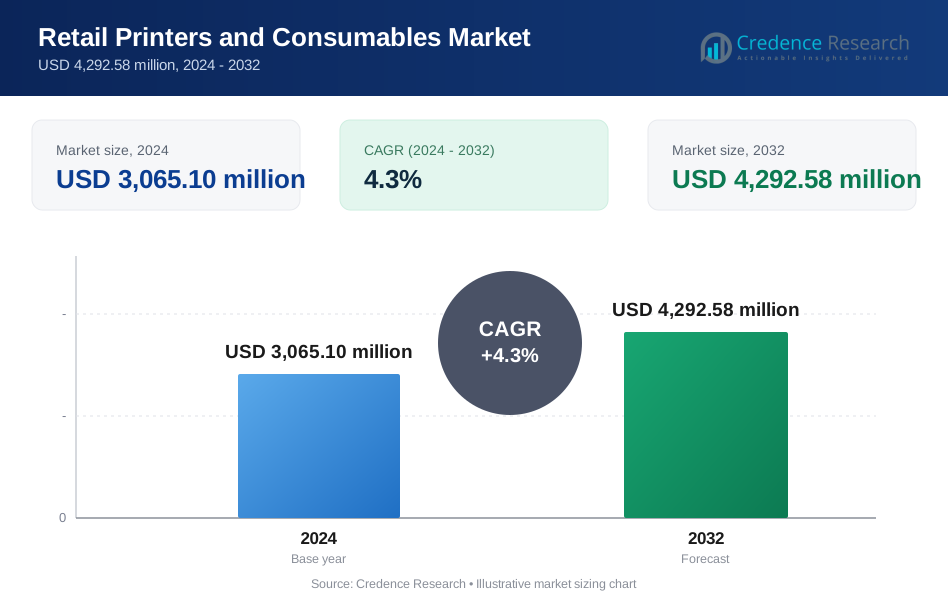
The Retail Printers and Consumables market is projected to grow from USD 3,065.10 million in 2024 to USD 4,292.58 million by 2032, reflecting a compound annual growth rate (CAGR) of 4.3% during the forecast period (2024-2032).
The Retail Printers and Consumables market is driven by the increasing adoption of advanced printing technologies to enhance operational efficiency and improve customer experiences in retail environments. The demand for point-of-sale (POS) printers is rising, fueled by the expansion of e-commerce and the integration of omnichannel strategies across retail chains. Retailers are increasingly investing in mobile and wireless printers to streamline checkout processes and support contactless transactions. Trends such as the adoption of eco-friendly consumables, including recyclable ink cartridges and thermal papers, are gaining traction as sustainability becomes a core focus. Additionally, advancements in thermal printing technologies and the integration of cloud-based solutions in printing systems are transforming retail operations. The growing need for high-speed, high-quality label and receipt printers in logistics, warehousing, and inventory management further accelerates market growth. Retailers' efforts to adopt automated systems and improve supply chain visibility continue to shape the market landscape.
The Retail Printers and Consumables market showcases strong geographical diversity, with North America leading due to advanced retail infrastructure and technological adoption, contributing to approximately 35% of the global market share. Asia-Pacific is the fastest-growing region, driven by rapid retail expansion, rising e-commerce penetration, and increasing demand for cost-effective solutions in markets like China and India. Europe also holds a significant share, supported by established retail chains and growing sustainability initiatives. Key players such as Zebra Technologies Corporation, Honeywell International Inc., Toshiba TEC Corporation, and SATO Holdings Corporation dominate the market with innovative offerings and extensive distribution networks. These companies focus on integrating advanced technologies like cloud-based solutions and eco-friendly consumables to maintain a competitive edge across these diverse regional markets.
Market Drivers:
Increasing Adoption of Advanced Printing Technologies:
The Retail Printers and Consumables market is driven by the growing need for advanced printing technologies that enhance operational efficiency in retail environments. Retailers are leveraging high-performance point-of-sale (POS) printers, barcode label printers, and receipt printers to streamline transactions and inventory management. For instance, a report by the Ministry of Electronics and Information Technology (MeitY) highlights the significant impact of advanced printing technologies on operational efficiency in retail environments. The integration of these advanced solutions reduces operational errors and accelerates customer service, making them indispensable for modern retail operations. Continuous innovation in printing technology, such as wireless and cloud-based connectivity, further supports the market's growth trajectory.
Expansion of E-commerce and Omnichannel Retailing:
The rapid expansion of e-commerce and the adoption of omnichannel strategies have significantly fueled the demand for retail printers and consumables. Retailers require robust printing systems for order management, shipment labeling, and warehouse operations to meet growing consumer demands. For example, a report by the Ministry of Statistics and Programme Implementation (MoSPI) discusses the impact of e-commerce growth on the demand for robust printing systems in retail. Barcode and label printers play a crucial role in ensuring smooth logistics and inventory tracking, while receipt printers support seamless in-store and online checkout experiences. This trend is expected to drive consistent investment in printing technologies across the retail sector.
Growing Emphasis on Sustainability:
Sustainability concerns are shaping the Retail Printers and Consumables market, prompting a shift toward eco-friendly solutions. Retailers are increasingly opting for recyclable consumables, such as eco-friendly thermal papers and ink cartridges, to align with environmental regulations and corporate social responsibility initiatives. For instance, a report by the Global Electronics Council (GEC) outlines new sustainability criteria for printers and consumables, emphasizing the importance of eco-friendly solutions. These sustainable options not only reduce environmental impact but also resonate with eco-conscious consumers, thereby enhancing brand image and loyalty.
Demand for Automation in Retail Operations:
The rising need for automation in retail operations is a key driver for the market. Automated systems integrated with advanced printers streamline processes such as inventory management, labeling, and customer service. For example, a report by the Retailers Association of India (RAI) highlights the benefits of automation in retail operations, including improved accuracy and efficiency. These solutions improve accuracy, reduce manual errors, and enhance efficiency, enabling retailers to focus on value-added activities. The adoption of automated retail printing solutions is particularly prominent in large-scale retail chains, further boosting market growth.
Market Trends:
Shift Towards Mobile and Wireless Printing:
A significant trend in the Retail Printers and Consumables market is the increasing adoption of mobile and wireless printing solutions. Retailers are integrating these technologies to enable flexible and efficient operations, particularly in environments requiring high mobility, such as warehouses and on-the-go retail outlets. For instance, a report by the Ministry of Electronics and Information Technology (MeitY) highlights the significant impact of mobile and wireless printing technologies on operational efficiency in retail environments. Wireless connectivity allows seamless integration with point-of-sale (POS) systems and inventory management tools, enhancing the speed and accuracy of printing tasks. This shift is driven by the need to support contactless transactions and streamline customer service in a fast-paced retail landscape.
Adoption of Eco-Friendly Consumables:
Sustainability is becoming a defining trend in the market, with retailers emphasizing the use of eco-friendly consumables. Products such as recyclable ink cartridges and biodegradable thermal paper are gaining traction as businesses aim to reduce their environmental footprint. This shift is aligned with global efforts toward environmental conservation and is supported by increasing consumer awareness of sustainable practices. For example, a report by the Global Electronics Council (GEC) outlines new sustainability criteria for printers and consumables, emphasizing the importance of eco-friendly solutions. Retailers are leveraging these eco-friendly options to enhance brand reputation while meeting regulatory requirements.
Integration of Cloud-Based Printing Solutions:
The integration of cloud-based technologies is transforming the Retail Printers and Consumables market. Cloud-enabled printers allow retailers to manage and execute printing tasks remotely, providing greater operational flexibility and scalability. For instance, a report by the National Data and Analytics Platform (NDAP) discusses the benefits of cloud-based printing solutions in enhancing operational flexibility and scalability in retail. This trend is particularly beneficial for large retail chains managing multiple locations, as it ensures consistent quality and real-time updates across the network. Cloud printing also enhances data security and reduces the reliance on local servers, making it a cost-effective solution.
Market Challenges Analysis:
High Initial Investment and Maintenance Costs:
One of the major challenges in the Retail Printers and Consumables market is the high initial investment required for advanced printing technologies. Retailers, particularly small and medium-sized enterprises (SMEs), often face budget constraints, making it difficult for them to adopt state-of-the-art printing solutions. Moreover, the cost of regular maintenance, software updates, and consumables like ink cartridges and thermal paper adds to the financial burden. For businesses operating in cost-sensitive regions, these expenses can hinder widespread adoption and limit the market’s growth potential. Additionally, the rapid pace of technological advancements often renders existing systems obsolete, compelling retailers to incur additional costs for upgrades.
Rising Concerns Over Environmental Impact:
Environmental challenges pose another significant hurdle for the Retail Printers and Consumables market. The production and disposal of non-recyclable consumables, such as thermal paper coated with BPA (bisphenol A) and traditional ink cartridges, contribute to environmental degradation. Increasing regulatory pressures to minimize waste and adopt eco-friendly practices are forcing retailers to transition to sustainable options, which often come at a higher cost. While eco-friendly consumables offer long-term benefits, their upfront costs and limited availability create barriers for many retailers. Furthermore, as consumers grow more conscious of environmental issues, businesses face heightened scrutiny, necessitating a balance between meeting sustainability goals and maintaining profitability. Addressing these challenges requires substantial investment in research and development to create cost-effective, environmentally friendly alternatives.
Market Segmentation Analysis:
By Technology
The Retail Printers and Consumables market is segmented by technology into thermal, impact, and inkjet printing. Thermal printing dominates the market due to its efficiency, reliability, and cost-effectiveness, particularly in high-volume applications like barcode labeling and receipt generation. This technology eliminates the need for consumables such as ink or toner, making it a preferred choice for retailers focused on operational efficiency. Impact printing, though less prevalent, remains critical in applications requiring multi-copy receipts or long-lasting prints. Meanwhile, inkjet printers are gaining traction for their ability to produce high-resolution prints, making them ideal for promotional and graphical applications. The continuous advancements in printing technology, including wireless connectivity and cloud integration, are driving innovation across all segments, meeting the diverse needs of modern retail operations.
By Application
Based on application, the market is categorized into point-of-sale (POS) systems, inventory labeling, shipping documentation, and promotional printing. The POS segment holds the largest share, driven by the widespread adoption of POS printers to streamline checkout processes and enhance customer experiences. Inventory labeling and shipping documentation applications are experiencing rapid growth, fueled by the expansion of e-commerce and omnichannel retailing. High-quality printers for barcode generation and logistics tracking ensure efficient inventory management and seamless delivery operations. Promotional printing, although a smaller segment, is crucial for marketing campaigns, with demand for vibrant, high-resolution prints steadily increasing. These varied applications underscore the critical role of printing solutions in modernizing retail workflows.
Segments:
Based on Type:
- Desktop Printers
- Industrial Printers
- Mobile Printers
- Others
Based on Technology:
- Label Printer
-
- Thermal Transfer
- Direct Thermal
- Inkjet
- Laser
- Paper Printer
- Thermal Transfer
- Direct Transfer
- Impact
- Inkjet
Based on Application:
- Departmental Stores
- Warehouse Retailers
- Mom & Pop Stores
- E-Commerce
- Supermarkets
Based on the Geography:
- North America
- U.S.
- Canada
- Mexico
- Europe
- Germany
- France
- U.K.
- Italy
- Spain
- Rest of Europe
- Asia Pacific
- China
- Japan
- India
- South Korea
- South-east Asia
- Rest of Asia Pacific
- Latin America
- Brazil
- Argentina
- Rest of Latin America
- Middle East & Africa
- GCC Countries
- South Africa
- Rest of the Middle East and Africa
Regional Analysis:
North America
North America holds a dominant position in the Retail Printers and Consumables market, accounting for approximately 35% of the global market share in 2024. The region's market leadership is underpinned by the extensive adoption of advanced printing technologies, such as thermal and wireless printers, across a diverse range of retail sectors. Retailers in North America are early adopters of innovative solutions, including mobile and cloud-based printing systems, which enhance operational efficiency and customer experiences. The growing integration of e-commerce platforms with retail operations further fuels the demand for reliable and high-performance printers for applications like barcode labeling, receipt generation, and shipping documentation. Sustainability has emerged as a key focus in the region, with businesses actively transitioning to eco-friendly consumables, such as recyclable ink cartridges and biodegradable thermal papers, to meet stringent environmental regulations and cater to environmentally conscious consumers. Additionally, the presence of major industry players, such as Zebra Technologies and Honeywell, ensures consistent technological advancements and widespread availability of products. The region's well-established retail infrastructure and supportive regulatory environment are expected to sustain its leading position in the market over the forecast period.
Asia-Pacific
Asia-Pacific is the fastest-growing region in the Retail Printers and Consumables market, contributing to around 28% of the global market share in 2024. The region's rapid growth is fueled by the expansion of retail infrastructure, increasing adoption of digital technologies, and the rise of e-commerce platforms in emerging economies such as China, India, and Indonesia. Retailers are increasingly investing in cost-effective printing solutions, particularly thermal printers, which offer affordability, speed, and reliability for high-volume applications like inventory management, logistics, and point-of-sale operations. Governments in Asia-Pacific are also promoting digital transformation in retail, which is driving the adoption of connected and automated printing systems. The focus on sustainability is gaining momentum, with businesses gradually adopting eco-friendly consumables to align with global environmental goals. The region's burgeoning middle-class population and rising disposable incomes further enhance retail activity, creating robust demand for retail printers and consumables. Additionally, local manufacturers and global players are capitalizing on the region’s growth potential by introducing tailored products and expanding their distribution networks. With strong economic growth and increasing technological adoption, Asia-Pacific is poised to emerge as a crucial market for retail printers and consumables in the coming years.
Key Player Analysis:
- Honeywell International Inc.
- Brother Industries Ltd.
- Zebra Technologies Corporation
- Bixolon Co. Ltd.
- Toshiba TEC Corporation
- Seiko Holdings Corporation
- Cab Produkttechnik GmbH & Co KG
- SATO Holdings Corporation
- CognitiveTPG LLC
- Avery Dennison Corporation
Competitive Analysis:
The Retail Printers and Consumables market is characterized by intense competition among key players, driven by innovation and a focus on meeting diverse retail needs. Companies like Zebra Technologies Corporation, Honeywell International Inc., Toshiba TEC Corporation, and SATO Holdings Corporation lead the market with their advanced printing solutions and extensive product portfolios. These players prioritize R&D to develop technologies such as cloud-enabled and wireless printers, ensuring seamless integration with modern retail operations. For example, a report by the Global Electronics Council (GEC) outlines new sustainability criteria for printers and consumables, emphasizing the importance of eco-friendly solutions. Additionally, Avery Dennison Corporation and Brother Industries Ltd. emphasize sustainability by offering eco-friendly consumables, aligning with global environmental goals. Regional players like Citizen Watch Co. Ltd. and BlueBird Inc. strengthen the competitive landscape with cost-effective and region-specific offerings. The competitive intensity is further fueled by collaborations, product launches, and strategic expansions by these companies, which aim to capture market share and cater to evolving consumer preferences across diverse retail environments.
Recent Developments:
- In July 2023, Brother launched a groundbreaking color inkjet printer, the first multifunction printer in the market designed to support businesses in creating high-quality banners and signage.
- In March 2023, Toshiba unveiled the Duplex Linerless Thermal Printer (DL1024), an innovative industrial printer that optimizes packaging processes for logistics and shipping. This printer reduces costs, improves productivity, and aligns with the growing demand for eco-friendly printing solutions.
- In 2022, Epson, a global leader in label and receipt printers, introduced the TM-L100, a liner-free label printer designed specifically for hospitality and retail food service providers.
- In February 2022, Canon expanded its range of business inkjet printers with the launch of the MAXIFY GX5070 printer.
Market Concentration & Characteristics:
The Retail Printers and Consumables market is moderately concentrated, with a mix of established global players and regional competitors driving innovation and competition. Leading companies such as Zebra Technologies Corporation, Honeywell International Inc., and Toshiba TEC Corporation dominate the market with advanced printing solutions, extensive product portfolios, and robust distribution networks. The market is characterized by significant technological advancements, including the integration of wireless and cloud-enabled printing systems, which cater to evolving retail needs. Sustainability trends are shaping the competitive landscape, with a growing emphasis on eco-friendly consumables like recyclable ink cartridges and liner-free label printers. Additionally, the presence of regional players strengthens competition by offering cost-effective and localized solutions. The market's dynamic nature is fueled by constant product launches, strategic collaborations, and the increasing adoption of automation in retail operations, positioning it as a highly competitive and innovation-driven industry.
Report Coverage:
The research report offers an in-depth analysis based on Type, Technology, Application and Geography. It details leading market players, providing an overview of their business, product offerings, investments, revenue streams, and key applications. Additionally, the report includes insights into the competitive environment, SWOT analysis, current market trends, as well as the primary drivers and constraints. Furthermore, it discusses various factors that have driven market expansion in recent years. The report also explores market dynamics, regulatory scenarios, and technological advancements that are shaping the industry. It assesses the impact of external factors and global economic changes on market growth. Lastly, it provides strategic recommendations for new entrants and established companies to navigate the complexities of the market.
Future Outlook:
- The market is expected to witness increased adoption of cloud-based and wireless printing technologies to streamline retail operations.
- Sustainability will remain a key focus, with a shift towards eco-friendly consumables such as recyclable ink cartridges and liner-free labels.
- The expansion of e-commerce and omnichannel retailing will drive demand for advanced printing solutions, particularly for logistics and inventory management.
- Technological advancements in thermal printing will enhance efficiency, speed, and cost-effectiveness in retail applications.
- The Asia-Pacific region is projected to experience significant growth due to rising retail infrastructure investments and increasing e-commerce penetration.
- Integration of artificial intelligence (AI) in printers for predictive maintenance and real-time monitoring is anticipated to gain traction.
- Mobile printing solutions will see rising demand, especially in applications requiring flexibility and mobility in retail environments.
- Companies are likely to invest in R&D to introduce innovative features such as touchless printing and automation.
- The demand for high-resolution printing solutions for promotional and graphical applications will continue to grow.
- Strategic partnerships and regional expansions by key players will remain central to market growth and competitiveness.
Request a Free Sample
Fill in your details and we'll send you a free sample report.
- Sample data tables & charts
- Research methodology
Need a Custom Version of This Report?
Tailor the scope, geography, or segments to your exact requirements.
- Custom geography or segment scope
- Direct access to our analyst team
Frequently Asked Questions
What is the current size of the Retail Printers and Consumables market?
What factors are driving the growth of the Retail Printers and Consumables market?
What are the key segments within the Retail Printers and Consumables market?
What are some challenges faced by the Retail Printers and Consumables market?
Table of Content
Chapter 1. Report Introduction
- 1.1 Report Description & Purpose
- 1.1.1 Report Title & Market Definition
- 1.1.2 Unique Selling Propositions (USP) & Key Differentiators
- 1.1.3 Value Proposition for Stakeholders
- 1.2 Research Objectives
- 1.2.1 Market Sizing Objectives (Volume & Revenue)
- 1.2.2 Segmentation Objectives
- 1.2.3 Competitive Intelligence Objectives
- 1.2.4 Forecast & Scenario Objectives
- 1.3 Report Scope
- 1.3.1 Retail Printers and Consumables Scope – Types & Subtypes Covered
- 1.3.2 Geographic Scope – Regions & Countries Covered
- 1.3.3 Historical Period, Base Year & Forecast Period (2024; forecast to 2032)
- 1.3.4 Inclusions & Exclusions
- 1.4 HS Code & Classification Framework
- 1.5 Currency, Units & Pricing Basis
- 1.6 Target Stakeholders
- 1.7 Limitations & Assumptions
Chapter 2. Executive Summary
- 2.1 Global Retail Printers and Consumables Market Snapshot
- 2.1.1 Market Size – Historical (2024) & Forecast (2024-2032) (2024: USD 3,065.10 million → 2032: USD 4,292.58 million)
- 2.1.2 Volume & Revenue – Global Totals
- 2.1.3 Key Market Highlights – Top Five Facts
- 2.2 Retail Printers and Consumables Market Segmentation Snapshot
- 2.2.1 Market Split by Region – 2024 vs. 2032
- 2.3 Competitive Snapshot
- 2.3.1 Top 10 Players by Revenue Share – 2024
- 2.3.2 Top 10 Players by Volume Share – 2024
- 2.3.3 Recent Strategic Developments (18-Month Summary)
- 2.4 Key Investment Highlights & Strategic Conclusions
Chapter 3. Retail Printers and Consumables Market Dynamics & Industry Analysis
- 3.1 Market Overview & Context
- 3.1.1 Retail Printers and Consumables Market Position in the Broader Automotive Value Chain
- 3.1.2 OEM vs. Replacement Market Dynamics
- 3.1.3 Market Maturity & Development Stage by Region
- 3.2 Retail Printers and Consumables Market Drivers
- 3.3 Retail Printers and Consumables Market Restraints & Challenges
- 3.4 Retail Printers and Consumables Market Opportunities
- 3.5 Porter's Five Forces Analysis
- 3.5.1 Threat of New Entrants
- 3.5.2 Bargaining Power of Suppliers
- 3.5.3 Bargaining Power of Buyers
- 3.5.4 Threat of Substitutes
- 3.5.5 Competitive Rivalry – Intensity Assessment
- 3.6 Retail Printers and Consumables Value Chain Analysis
- 3.6.1 Upstream – Raw Material/Input Suppliers
- 3.6.1.1 Raw Material/Input 1
- 3.6.1.2 Raw Material/Input 2
- 3.6.1.3 Raw Material/Input 3
- 3.6.2 Midstream – Production/Manufacturing/Service Delivery
- 3.6.2.1 Production/Process Overview
- 3.6.2.2 Key Facility Locations & Capacity by Manufacturer
- 3.6.3 Downstream – Distribution & End Consumer
- 3.6.3.1 Primary Channel – B2B/OEM
- 3.6.3.2 Secondary Channels – Dealer, Retail, Online, Direct
- 3.6.4 Value Chain Profitability Analysis
- 3.6.1 Upstream – Raw Material/Input Suppliers
- 3.7 PESTEL Analysis
- 3.7.1 Political Factors
- 3.7.2 Economic Factors
- 3.7.3 Social Factors
- 3.7.4 Technological Factors
- 3.7.5 Environmental Factors
- 3.7.6 Legal Factors
- 3.8 Retail Printers and Consumables Supply Chain Analysis
- 3.8.1 Raw Material/Input Supply Risk Assessment
- 3.8.2 Manufacturing Concentration Risk (Geographic Exposure)
- 3.8.3 Trade Disruption Impact Analysis
- 3.9 Regulatory & Policy Landscape
Note: The regulatory and policy landscape section covers regulations based on their applicability to the market, Retail Printers and Consumables category, geography, and scope of the study. Only regulatory frameworks with a material impact on operations, compliance, trade, sustainability, or market access are analyzed in detail.
Chapter 4. Key Investment Pockets & Opportunity Analysis
- 4.1 Retail Printers and Consumables Market Attractiveness Analysis
- 4.1.1 By Region – Investment Attractiveness Matrix (Volume × CAGR)
- 4.2 Absolute Revenue Growth Opportunity
- 4.2.1 By Region – Absolute USD Growth Through 2032
- 4.3 Incremental Volume Opportunity
- 4.3.1 By Region – Incremental Volume Through 2032
- 4.3.2 Segment – Incremental Volume
- 4.4 Emerging Submarket Opportunity Deep Dive (Subject to Applicability)
- 4.5 Emerging Market Opportunity Scorecards
- 4.5.1 United States
- 4.5.2 Europe
- 4.5.3 Asia
- 4.5.4 Middle East & Africa
Note: Emerging Market Opportunity Scorecards will be included based on relevance and strategic importance. Regions listed are indicative and may vary depending on data availability and market dynamics.
Chapter 5. Retail Printers and Consumables Import-Export Analysis & Trade Flows
- 5.1 Global Trade Overview
- 5.1.1 Global Export Value by Country (2024)
- 5.1.2 Global Export Volume by Country (2024)
- 5.1.3 Global Import Value by Country (2024)
- 5.1.4 Global Import Volume by Country (2024)
- 5.1.5 Net Trade Balance by Country (2024)
- 5.2 Export Analysis – Segment
- 5.2.1 Type 1 (HS Code)
- 5.2.2 Type 2 (HS Code)
- 5.2.3 Type 3 (HS Code)
- 5.2.4 Type 4 (HS Code)
- 5.2.5 Type 5 (HS Code)
- 5.3 Import Analysis – Segment
- 5.3.1 Type 1 (HS Code)
- 5.3.2 Type 2 (HS Code)
- 5.3.3 Type 3 (HS Code)
- 5.3.4 Type 4 (HS Code)
- 5.3.5 Type 5 (HS Code)
- 5.4 Average Unit Trade Prices
- 5.4.1 Average Export Price – Segment & Country
- 5.4.2 Average Import Price – Segment & Source Country
- 5.4.3 Price Trends (2024)
- 5.5 Key Trade Route Analysis
- 5.5.1 Trade Route 1
- 5.5.2 Trade Route 2
- 5.5.3 Trade Route 3
- 5.5.4 Trade Route 4
- 5.5.5 Trade Route 5
- 5.6 Trade Policy Impact Assessment
- 5.6.1 US Anti-Dumping & Section 301 Tariffs
- 5.6.2 EU Customs Union Impact
- 5.6.3 Major Free Trade Agreements
- 5.6.4 USMCA Rules of Origin
Note: Trade policy analysis will be included only where relevant to the Retail Printers and Consumables market.
Chapter 6. Competitive Landscape & Company Benchmarking
- 6.1 Retail Printers and Consumables Market Concentration & Structure
- 6.1.1 Herfindahl-Hirschman Index (HHI) – vs. 2024
- 6.1.2 Tier 1, Tier 2 & Tier 3 Market Structure
- 6.1.3 Global, Regional & Local Player Dynamics
- 6.2 Retail Printers and Consumables Market Share Analysis – 2024
- 6.2.1 Global Revenue Share by Company
- 6.2.2 Global Volume Share by Company
- 6.2.3 Regional Revenue Share
- 6.2.4 Market Share Evolution ( vs. 2024)
- 6.2.5 OEM Segment Share by Company
- 6.2.6 Replacement Segment Share by Company
- 6.3 Production/Delivery Capacity & Facility Analysis
- 6.3.1 Global Installed Capacity
- 6.3.2 Capacity Utilization Rates
- 6.3.3 Production/Output Volume
- 6.3.4 Facility Locations & Capacity Map
- 6.3.5 Planned Capacity Additions
- 6.4 Retail Printers and Consumables Competitive Benchmarking Matrix
- 6.4.1 Revenue, Volume, CAGR & Profitability Comparison
- 6.4.2 Channel Revenue Mix
- 6.4.3 Geographic Revenue Exposure
- 6.4.4 R&D Intensity
- 6.4.5 Sustainability Maturity
- 6.5 Strategic Developments in Retail Printers and Consumables (Last 24 Months)
- 6.5.1 Mergers, Acquisitions & Divestments
- 6.5.2 New Retail Printers and Consumables Launches
- 6.5.3 Facility Expansions
- 6.5.4 Strategic Alliances, Joint Ventures & Partnerships
- 6.5.5 Distribution Expansion & Market Entry
- 6.5.6 Sustainability & ESG Initiatives
- 6.6 Competitive Strategy Mapping
- 6.6.1 Leader, Challenger, Follower & Niche Classification
- 6.6.2 Pricing Strategy Comparison
- 6.6.3 Channel Strategy Matrix
Note: Strategic developments are included based on their materiality and the availability of reliable information.
Chapter 7. Global Retail Printers and Consumables Market – By Distribution Channel
- 7.1 Segment Overview
- 7.1.1 Volume & Revenue Split by Channel (2024 & 2032)
- 7.1.2 Channel Mix Evolution (2024-2032)
Chapter 8. Regional Market Analysis – Global Overview
- 8.1 Global Regional Overview
- 8.1.1 Regional Volume Share
- 8.1.2 Regional Revenue Share
- 8.1.3 Regional Volume by Region
- 8.1.4 Regional Revenue by Region
- 8.1.5 Regional Forecast Through 2032
- 8.2 Cross-Regional Segment Analysis
- 8.2.1 By Distribution Channel
- 8.2.2 By Brand/Price Tier
Chapter 9. North America Retail Printers and Consumables Market
- 9.1 United States
- 9.2 Canada
- 9.3 Mexico
Chapter 10. Europe Retail Printers and Consumables Market
- 10.1 Germany
- 10.2 France
- 10.3 Italy
- 10.4 United Kingdom
- 10.5 Spain
- 10.6 Poland
- 10.7 Russia
- 10.8 Netherlands
- 10.9 Belgium
- 10.10 Sweden
- 10.11 Denmark
- 10.12 Norway
- 10.13 Rest of Europe
Chapter 11. Asia Pacific Retail Printers and Consumables Market
- 11.1 China
- 11.2 India
- 11.3 Japan
- 11.4 South Korea
- 11.5 Thailand
- 11.6 Indonesia
- 11.7 Vietnam
- 11.8 Malaysia
- 11.9 Australia
- 11.10 Rest of Asia Pacific
Chapter 12. Latin America Retail Printers and Consumables Market
- 12.1 Brazil
- 12.2 Argentina
- 12.3 Colombia
- 12.4 Chile
- 12.5 Rest of Latin America
Chapter 13. Middle East Retail Printers and Consumables Market
- 13.1 Saudi Arabia
- 13.2 United Arab Emirates
- 13.3 Turkey
- 13.4 Israel
- 13.5 Iran
- 13.6 Rest of the Middle East
Chapter 14. Africa Retail Printers and Consumables Market
- 14.1 South Africa
- 14.2 Egypt
- 14.3 Nigeria
- 14.4 Morocco
- 14.5 Rest of Africa
Chapter 15. Retail Printers and Consumables Company Profiles
- 15.1 [Company 01]
- 15.1.1 Company Overview
- 15.1.2 Key Management Personnel
- 15.1.3 Products & Services Portfolio
- 15.1.4 Financial Performance
- 15.1.5 Key Market Focus & Geographic Presence
- 15.1.6 Recent Developments & Strategic Initiatives
Note: The company profile list is preliminary and may change based on research findings, market developments, data availability, and client requirements.
Chapter 16. Appendices
- Appendix A – List of Abbreviations & Acronyms
- Appendix B – Industry Classification Code Reference – Full Series
- Appendix C – Production & Capacity Data Tables
- Appendix D – End-Use & Demand Base Tables
- Appendix E – Consumption & Replacement Rate Assumptions
- Appendix F – ASP Reference Tables
- Appendix G – Manufacturing & Facility Database
- Appendix H – Import-Export Data Tables
- Appendix I – Regulatory Summary Tables
- Appendix J – Primary Research Participant List (Anonymized)
- Appendix K – Primary Research Questionnaire Framework
- Appendix L – Data Sources & Bibliography
- Appendix M – Market Size Divergence & Source Comparison
Chapter 17. Research Methodology
- 17.1 Research Framework & Philosophy
- 17.2 Secondary Research – Sources, Hierarchy & Data Extraction
- 17.3 Data Modeling – Bottom-Up & Top-Down Market Sizing
- 17.4 Primary Research – Stakeholder Framework, LOI & Sample Sizes
- 17.5 Forecast Methodology – Regression, Scenario & Sensitivity Analysis
- 17.6 Quality Control – Four-Layer Validation Framework
- 17.7 Limitations & Standard Assumptions
- 17.8 Disclaimer
