
| REPORT ATTRIBUTE | DETAILS |
|---|---|
| Historical Period | 2020-2023 |
| Base Year | 2024 |
| Forecast Period | 2025-2032 |
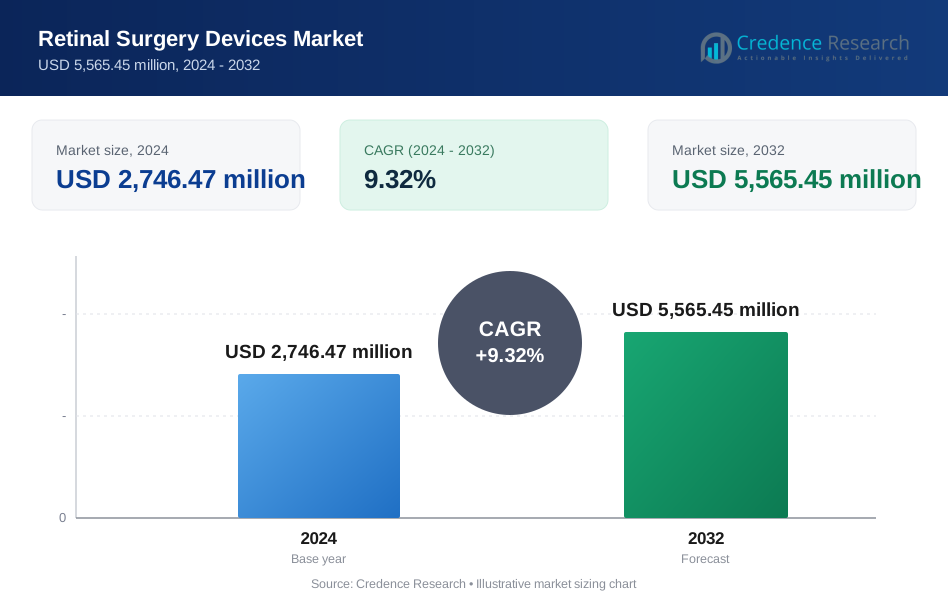
| Retinal Surgery Devices Market Size 2024 | USD 2,746.47million |
| Retinal Surgery Devices Market, CAGR | 9.32% |
| Retinal Surgery Devices Market Size 2032 | USD 5,565.45million |
Market Overview
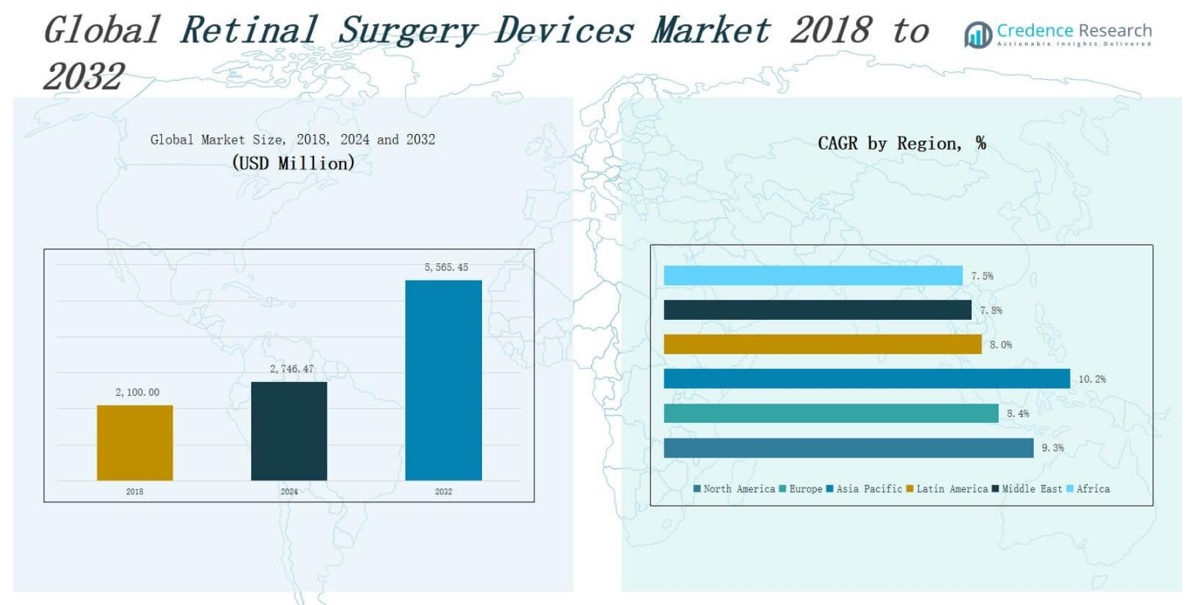
The Retinal Surgery Devices Market size was valued at USD 2,100.00million in 2018 to USD 2,746.47million in 2024 and is anticipated to reach USD 5,565.45million by 2032, at a CAGR of 9.32% during the forecast period.
The Retinal Surgery Devices Market is driven by the rising prevalence of retinal disorders such as diabetic retinopathy, age-related macular degeneration (AMD), and retinal detachment, along with the global increase in the aging population. Advancements in minimally invasive surgical techniques and the development of high-precision instruments, including vitrectomy systems, micro-incision tools, and advanced visualization technologies, are enhancing surgical outcomes and patient safety. Growing awareness about early diagnosis and the expanding availability of ophthalmic care in emerging economies further support market growth. Surgeons are increasingly adopting digital platforms, intraoperative OCT, and 3D visualization systems to improve procedural accuracy and reduce recovery time. The market also benefits from favorable reimbursement policies and continuous R&D efforts by key manufacturers to introduce user-friendly, multifunctional devices. Additionally, the integration of AI in diagnostic imaging and robotic assistance in ophthalmic surgery is emerging as a key trend, reshaping the landscape of retinal surgery and offering new opportunities for innovation and market expansion.
The Retinal Surgery Devices Market demonstrates strong global growth, with North America leading due to advanced healthcare infrastructure and early adoption of innovative technologies. Europe follows closely, supported by established eye care systems and favorable reimbursement policies. Asia Pacific is the fastest-growing region, driven by rising diabetic populations and expanding surgical capabilities in China, India, and Japan. Latin America shows steady progress with improvements in ophthalmic access in Brazil and Mexico. The Middle East is witnessing growth through healthcare investments in GCC countries, while Africa presents long-term potential amid efforts to improve access and reduce preventable blindness. Key players shaping the market include Alcon, Bausch & Lomb Incorporated, Carl Zeiss, Topcon Corporation, Nidek Co., Ltd., Iridex Corporation, Lumenis, Leica Microsystems GmbH, Ellex Medical Lasers, and Second Sight Medical Products, focusing on product innovation, regional expansion, and clinical partnerships.
Market Insights
- The Retinal Surgery Devices Market is growing rapidly, expected to double in size between 2024 and 2032 due to rising retinal disease burden and aging populations.
- Technological advancements such as micro-incision vitrectomy, 3D visualization systems, and AI-assisted tools are enhancing precision, safety, and surgeon control in retinal procedures.
- The market benefits from increased healthcare infrastructure and rising demand for outpatient procedures, particularly in emerging economies and ambulatory surgery centers.
- High costs of advanced surgical systems and limited access in rural and low-income areas continue to restrict market penetration and technology adoption.
- A shortage of trained retinal surgeons and the steep learning curve of modern surgical tools remain barriers to scalability and wider adoption.
- North America leads the market, while Asia Pacific shows the fastest growth due to expanding healthcare access, government initiatives, and high diabetic populations.
- Key players such as Alcon, Carl Zeiss, Bausch & Lomb, and Topcon focus on product innovation, regional expansion, and strategic clinical partnerships.
Market Drivers
Rising Incidence of Retinal Disorders Across the Globe
The Retinal Surgery Devices Market is witnessing significant growth due to the increasing global burden of retinal disorders such as diabetic retinopathy, macular holes, and retinal detachment. The surge in diabetes and hypertension cases directly contributes to vision complications requiring surgical intervention. With aging populations expanding in both developed and developing regions, age-related macular degeneration (AMD) continues to fuel demand. Early diagnosis and the availability of advanced surgical solutions are supporting timely treatment. Healthcare providers are emphasizing surgical management to reduce vision loss risks. This trend reinforces the need for reliable and high-performance surgical devices.
- For instance, the Stellaris Elite system by Bausch + Lomb introduced a hypersonic vitrectomy probe that liquefies the vitreous, offering advantages in complex retinal surgeries, especially for pediatric patients with highly adherent vitreous.
Technological Advancements in Minimally Invasive Retinal Procedures
he evolution of surgical technologies is a major growth driver for the Retinal Surgery Devices Market. Innovations such as micro-incision vitrectomy systems, wide-angle viewing platforms, and real-time intraoperative OCT imaging have improved precision and safety. These tools reduce patient trauma, accelerate recovery, and improve clinical outcomes. It benefits from the rising adoption of 3D visualization systems and robot-assisted tools in complex procedures. High-definition imaging enhances intraoperative decision-making and supports surgeon accuracy. Hospitals and specialty clinics continue to invest in these advancements to offer high-quality retinal care.
- For instance, Alcon’s EdgePlus Entry System uses a proprietary blade and 27-gauge valved cannulas, enabling surgeons to perform one-step, self-sealing incisions that reduce operating time and eliminate the need for sutures, even in complex cases
Expanding Geriatric Population and Healthcare Infrastructure
The global increase in the elderly population is a key factor driving the Retinal Surgery Devices Market. Older adults face a higher risk of degenerative retinal conditions, which often require surgical intervention. Governments and private players are expanding ophthalmic care infrastructure to meet growing demand. It is also gaining traction in emerging markets where access to eye care is improving through public health initiatives and mobile surgical units. Rising healthcare expenditure allows greater adoption of advanced surgical technologies. This trend supports market penetration in underserved areas.
Growing Demand for Precision Surgery and Outpatient Care
Demand for precise and less invasive procedures is reshaping the Retinal Surgery Devices Market. Surgeons are seeking tools that enhance control and visualization during delicate retinal operations. Ambulatory surgical centers are increasing their adoption of compact, portable devices that support high-efficiency workflows. It aligns with the global trend toward outpatient retinal surgeries, offering cost and time benefits. Reimbursement policies in favor of day-care procedures are also driving this shift. Manufacturers are responding with ergonomic, integrated systems designed for clinical versatility and ease of use.
Market Trends
Integration of Digital Imaging and Intraoperative Visualization Systems
Digital imaging and high-resolution visualization tools are transforming surgical practices in the Retinal Surgery Devices Market. Surgeons now rely on 3D visualization platforms, intraoperative OCT, and digital heads-up displays to enhance surgical accuracy and depth perception. These technologies help improve procedural outcomes and reduce complications in delicate retinal surgeries. It supports improved surgeon ergonomics by reducing the need for traditional microscopes. Advanced imaging enables better real-time assessment of retinal layers. The trend is increasing adoption among both hospitals and specialty eye centers.
- For instance, Alcon’s NGENUITY 3D Visualization System allows surgeons to perform retinal surgeries using high-resolution digital heads-up displays, improving depth perception and ergonomics.
Surge in Demand for Micro-Incision Vitrectomy Systems (MIVS)
Micro-incision vitrectomy systems are gaining traction for their ability to reduce surgical trauma, accelerate recovery, and enhance patient comfort. These systems typically use smaller gauge instruments such as 23-, 25-, or 27-gauge tools that minimize postoperative inflammation. The Retinal Surgery Devices Market is responding to this shift by introducing flexible, lightweight devices with improved fluidics and cutting speeds. It reflects a growing preference among ophthalmic surgeons for less invasive techniques. MIVS also supports outpatient procedures and shorter hospital stays. This trend aligns with cost-effective, high-efficiency care delivery models.
- For instance, Bausch + Lomb introduced a 25-gauge transconjunctival vitrectomy system that supports minimally invasive retinal surgeries, enabling shorter hospital stays and improved patient comfort.
Adoption of AI and Robotics in Retinal Surgery
The incorporation of artificial intelligence and robotic systems is influencing clinical decision-making and precision in the Retinal Surgery Devices Market. AI-based algorithms assist in preoperative planning and real-time surgical guidance by analyzing retinal scans and identifying critical areas. Robotic platforms help stabilize instrument movements, especially in micro-scale tasks such as membrane peeling. It enhances procedural safety and surgeon control. Market participants are investing in smart surgical platforms with machine learning capabilities. These innovations improve repeatability, reduce human error, and increase confidence during complex procedures.
Expansion of Outpatient Surgery and Ambulatory Care Models
The shift toward outpatient retinal procedures is reshaping demand for compact, efficient surgical systems. Ambulatory surgical centers are increasing in number, particularly in urban markets, due to their cost-efficiency and convenience. The Retinal Surgery Devices Market is aligning with this trend by offering portable, integrated solutions optimized for space and workflow. It supports the use of single-use devices and modular systems designed for rapid sterilization and turnover. This model reduces patient wait times and hospital congestion. Market players are targeting this segment with scalable and adaptable technologies.
Market Challenges Analysis
High Cost of Advanced Surgical Equipment and Limited Accessibility
The high cost of retinal surgery devices and associated technologies poses a major challenge for healthcare providers, especially in low- and middle-income regions. Advanced vitrectomy systems, 3D visualization platforms, and robotic surgical tools demand significant capital investment and ongoing maintenance. Smaller clinics and rural hospitals struggle to justify such expenditures without adequate reimbursement support. The Retinal Surgery Devices Market faces barriers to adoption in regions lacking public funding or insurance coverage for ophthalmic surgeries. It limits access to high-quality retinal care for underserved populations. Cost constraints also slow equipment upgrades in many established institutions.
Shortage of Skilled Retinal Surgeons and Training Barriers
A limited pool of trained retinal surgeons and the complex learning curve associated with advanced surgical systems hinder wider adoption. New technologies like intraoperative OCT, robotic platforms, and AI-guided tools require extensive training and experience. The Retinal Surgery Devices Market is constrained by the slow pace of skill development across many regions. It also faces challenges in standardizing training protocols across various healthcare systems. This shortage affects procedure volumes, delays patient treatment, and impacts surgical outcomes. Expanding specialized training programs is critical to support market scalability.
Market Opportunities
Emerging Markets with Expanding Ophthalmic Infrastructure
Rapid healthcare development in emerging economies presents strong growth potential for the Retinal Surgery Devices Market. Countries across Asia Pacific, Latin America, and the Middle East are investing in ophthalmic care facilities and modernizing surgical infrastructure. Rising disposable income and urbanization increase access to specialized eye treatments. The market can benefit from government-led initiatives focused on diabetic retinopathy and age-related vision loss. It creates demand for cost-effective, compact surgical devices tailored to local needs. Manufacturers that prioritize regional customization and training support can strengthen their presence in these underserved areas.
Innovation in Portable and AI-Powered Surgical Solutions
Technological innovation offers significant opportunity in developing smart, portable retinal surgery tools. AI-powered systems that assist in diagnosis, image interpretation, and surgical navigation can improve procedural accuracy and efficiency. The Retinal Surgery Devices Market is well-positioned to leverage such tools in both high-volume centers and outpatient clinics. It also opens doors for teleophthalmology and remote surgical guidance, especially in rural regions. Startups and established players focusing on affordability, modularity, and intuitive user interfaces can gain a competitive edge. These innovations align with global trends toward decentralized, data-driven healthcare delivery.
Market Segmentation Analysis:
By Product
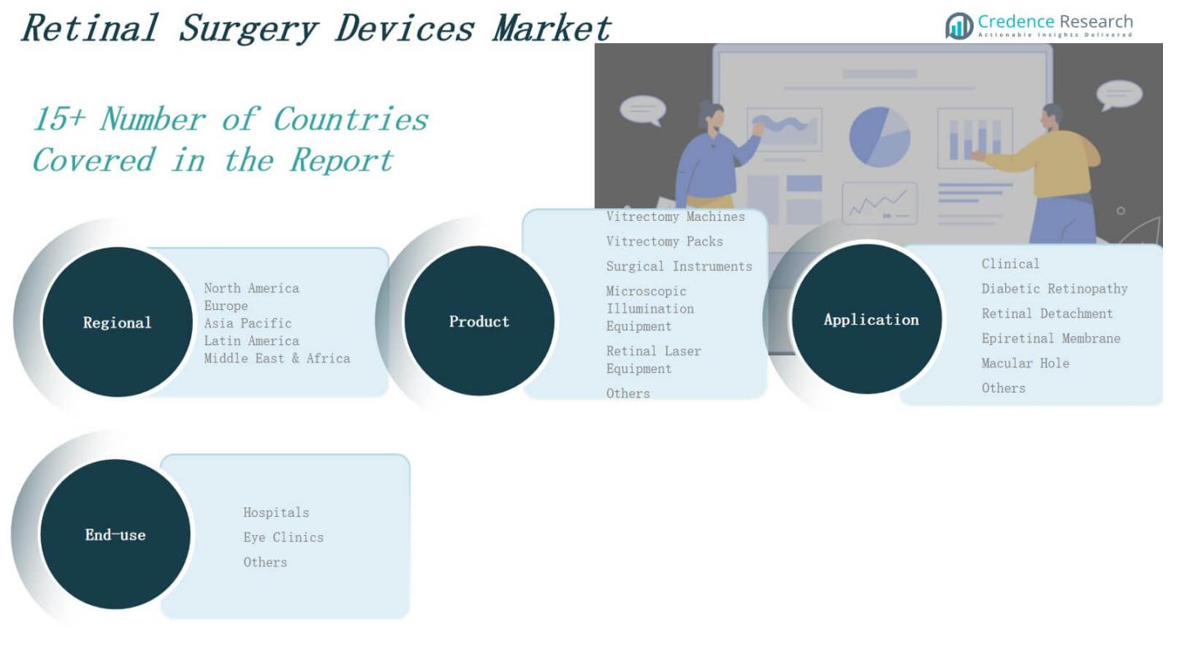
The Retinal Surgery Devices Market is segmented by product into vitrectomy machines, vitrectomy packs, surgical instruments, microscopic illumination equipment, retinal laser equipment, and others. Vitrectomy machines hold a dominant share due to their critical role in retinal procedures, offering enhanced control and precision. Retinal laser equipment is gaining traction for its role in treating diabetic retinopathy and macular degeneration. Demand for surgical instruments and illumination systems continues to rise with advancements in minimally invasive techniques. It benefits from the integration of high-resolution optics and ergonomic designs that improve surgical outcomes and reduce fatigue.
- For instance, the PASCAL Pattern Scanning Laser (Topcon) is employed in clinics to treat diabetic retinopathy and macular edema, reducing treatment time and patient discomfort by delivering multiple laser spots in rapid succession with short pulse durations.
By Application
Based on application, the market includes clinical, diabetic retinopathy, retinal detachment, epiretinal membrane, macular hole, and others. Diabetic retinopathy represents a significant share due to the global rise in diabetes cases and related vision disorders. The Retinal Surgery Devices Market is experiencing growing demand for solutions that address retinal detachment and macular holes, which require precise, timely intervention. It supports targeted application tools designed for disease-specific procedures. Clinical applications span diagnostic and preventive procedures, broadening product usage across care settings.
- For instance, Carl Zeiss Meditec AG manufactures the RESIGHT 700 fundus viewing system, enabling high-resolution visualization during retinal surgeries, which is essential for complex interventions like retinal detachment repair.
By End-use
The market is divided by end-use into hospitals, eye clinics, and others. Hospitals lead due to their advanced infrastructure, broader surgical capabilities, and access to trained ophthalmic surgeons. Eye clinics are witnessing rapid adoption of compact and portable devices suited for outpatient procedures. The Retinal Surgery Devices Market is evolving with increased demand from specialized eye care centers that focus exclusively on retinal treatments. It enables quicker turnaround, enhanced patient convenience, and reduced healthcare costs in ambulatory environments.
Segments:
Based on Product
- Vitrectomy Machines
- Vitrectomy Packs
- Surgical Instruments
- Microscopic Illumination Equipment
- Retinal Laser Equipment
- Others
Based on Application
- Clinical
- Diabetic Retinopathy
- Retinal Detachment
- Epiretinal Membrane
- Macular Hole
- Others
Based on End-use
- Hospitals
- Eye Clinics
- Others
Based on Region
- North America
- U.S.
- Canada
- Mexico
- Europe
- Germany
- France
- U.K.
- Italy
- Spain
- Rest of Europe
- Asia Pacific
- China
- Japan
- India
- South Korea
- South-east Asia
- Rest of Asia Pacific
- Latin America
- Brazil
- Argentina
- Rest of Latin America
- Middle East & Africa
- GCC Countries
- South Africa
- Rest of the Middle East and Africa
Regional Analysis
North America
The North America Retinal Surgery Devices Market size was valued at USD 606.90 million in 2018 to USD 781.63 million in 2024 and is anticipated to reach USD 1,581.15 million by 2032, at a CAGR of 9.3% during the forecast period. North America dominates the Retinal Surgery Devices Market due to its advanced healthcare infrastructure, high prevalence of retinal disorders, and strong technological adoption. The United States leads the region with a large network of specialized ophthalmic centers and access to state-of-the-art surgical equipment. It benefits from a favorable reimbursement environment and strong presence of global medical device manufacturers. Ongoing investments in AI-assisted diagnostics and 3D surgical visualization systems are driving procedural efficiency. Canada and Mexico are also expanding access to eye care through public health initiatives. Market demand continues to grow with rising awareness of diabetic eye diseases and macular degeneration.
Europe
The Europe Retinal Surgery Devices Market size was valued at USD 487.20 million in 2018 to USD 609.09 million in 2024 and is anticipated to reach USD 1,156.24 million by 2032, at a CAGR of 8.4% during the forecast period. Europe holds a significant share in the Retinal Surgery Devices Market, supported by widespread availability of eye care services and skilled ophthalmologists. Countries like Germany, France, and the UK drive demand through early diagnosis programs and well-developed surgical facilities. It benefits from strong research and clinical collaboration, promoting innovation in minimally invasive retinal procedures. Public health systems play a key role in funding surgical interventions for diabetic retinopathy and AMD. Adoption of advanced vitrectomy systems and laser equipment is rising in outpatient settings. The region also sees growing use of digital visualization platforms to enhance surgical precision.
Asia Pacific
The Asia Pacific Retinal Surgery Devices Market size was valued at USD 764.40 million in 2018 to USD 1,029.50 million in 2024 and is anticipated to reach USD 2,233.42 million by 2032, at a CAGR of 10.2% during the forecast period. Asia Pacific is the fastest-growing regional market, driven by increasing cases of diabetic eye diseases and a growing elderly population. China, India, and Japan are at the forefront due to rising healthcare investments and improvements in surgical infrastructure. The Retinal Surgery Devices Market in the region benefits from expanding private hospitals, affordability initiatives, and localized manufacturing. It is experiencing strong demand for portable vitrectomy systems and modular surgical tools in both urban and semi-urban centers. Government health programs focusing on vision screening and mobile surgery units are enhancing access to care. The region offers substantial growth opportunities for global and regional manufacturers.
Latin America
The Latin America Retinal Surgery Devices Market size was valued at USD 102.69 million in 2018 to USD 132.63 million in 2024 and is anticipated to reach USD 243.60 million by 2032, at a CAGR of 8.0% during the forecast period. Latin America is steadily expanding its footprint in the Retinal Surgery Devices Market, led by countries such as Brazil and Mexico. These nations are improving access to ophthalmic care through private healthcare expansion and international collaborations. It faces challenges such as limited funding and uneven distribution of surgical facilities, especially in rural areas. However, mobile eye clinics and awareness campaigns are helping bridge these gaps. Technological upgrades in surgical equipment and growing demand for outpatient procedures are boosting adoption. Market players focusing on cost-effective solutions and training initiatives are well-positioned to capture regional growth.
Middle East
The Middle East Retinal Surgery Devices Market size was valued at USD 71.82 million in 2018 to USD 87.32 million in 2024 and is anticipated to reach USD 157.53 million by 2032, at a CAGR of 7.8% during the forecast period. The Middle East is emerging as a promising market, supported by rising incidences of diabetes-related vision loss and expanding medical infrastructure. GCC countries such as the UAE and Saudi Arabia are investing in advanced ophthalmology centers and attracting global healthcare providers. The Retinal Surgery Devices Market benefits from high patient awareness and the introduction of new technologies in urban hospitals. It sees increasing demand for AI-assisted diagnostics, compact vitrectomy machines, and outpatient laser systems. Medical tourism and public-private partnerships are enhancing access and affordability. Regional growth depends on expanding services into remote and underserved areas.
Africa
The Africa Retinal Surgery Devices Market size was valued at USD 66.99 million in 2018 to USD 106.30 million in 2024 and is anticipated to reach USD 193.51 million by 2032, at a CAGR of 7.5% during the forecast period. Africa holds untapped potential in the Retinal Surgery Devices Market, with a rising burden of preventable blindness and limited access to advanced eye care. South Africa leads regional adoption with better surgical infrastructure and specialist availability. The market is gaining support from international NGOs, government initiatives, and mobile vision units targeting diabetic retinopathy and retinal detachment. It still faces significant hurdles, including affordability, lack of training, and equipment shortages. However, localized manufacturing, donation programs, and portable surgical tools are helping expand reach. Increased investment in vision health and public education is essential to unlock growth across the continent.
Key Player Analysis
- Alcon
- Bausch & Lomb Incorporated
- Carl Zeiss
- Ellex Medical Lasers
- Erbe Elektromedizin
- Escalon Medicals
- Iridex Corporation
- Leica Microsystems GmbH
- Lumenis
- Nidek Co., Ltd.
- Optos PLC
- Second Sight Medical Products
- Synergetics USA Inc.
- Topcon Corporation
Competitive Analysis
The Retinal Surgery Devices Market is highly competitive, with key players focusing on innovation, product portfolio expansion, and strategic partnerships. Leading companies such as Alcon, Bausch & Lomb, Carl Zeiss, and Topcon Corporation dominate the landscape through advanced technologies and global distribution networks. It is driven by continuous R&D in minimally invasive surgical tools, AI-enabled imaging systems, and high-precision vitrectomy equipment. Companies are investing in user-friendly, compact devices to support outpatient care and expand reach in emerging markets. Mergers, acquisitions, and collaborations are common strategies to gain market share and enhance technological capabilities. The market also includes several mid-sized and regional players offering cost-effective solutions, intensifying competition. Regulatory approvals and product differentiation play a critical role in maintaining a competitive edge. It continues to evolve with a focus on clinical outcomes, surgical efficiency, and patient safety, pushing manufacturers to innovate across all segments of the value chain.
Recent Developments
- In April 2025, Alcon launched the UNITY VCS and UNITY CS platforms featuring the HYPERVIT® 30K vitrectomy probe to enhance efficiency in vitreoretinal surgeries.
- In 2025, McKesson signed an agreement to acquire a controlling interest in PRISM Vision Holdings LLC to strengthen its position in the retinal and ophthalmic care sector.
- In May 2025, OcuSciences received FDA clearance for its OcuMet Beacon, a noninvasive tool using autofluorescence and infrared imaging to assess retinal health in clinics and hospitals.
- In May 2025, Topcon Healthcare acquired RetInSight, advancing its AI-powered imaging capabilities and enabling earlier interventions for major retinal diseases
Market Concentration & Characteristics
The Retinal Surgery Devices Market is moderately concentrated, with a mix of global leaders and regional players competing on innovation, quality, and distribution reach. Leading companies such as Alcon, Carl Zeiss, Bausch & Lomb, Topcon Corporation, and Nidek Co., Ltd. maintain a strong presence through broad product portfolios and advanced surgical technologies. It is characterized by continuous research and development in high-precision tools, AI-integrated systems, and minimally invasive solutions. Market players focus on enhancing clinical outcomes, reducing surgical complexity, and improving ergonomics. Strategic partnerships, acquisitions, and product launches remain central to maintaining competitiveness and expanding into new geographies. The market also features emerging companies offering cost-effective and portable systems tailored for outpatient care. Regulatory compliance, surgeon training, and product reliability play a critical role in gaining and retaining customer trust. It continues to evolve with a growing emphasis on safety, efficiency, and personalized surgical solutions that meet diverse clinical needs worldwide.
Report Coverage
The research report offers an in-depth analysis based on Product, Application, End-Use and Region. It details leading market players, providing an overview of their business, product offerings, investments, revenue streams, and key applications. Additionally, the report includes insights into the competitive environment, SWOT analysis, current market trends, as well as the primary drivers and constraints. Furthermore, it discusses various factors that have driven market expansion in recent years. The report also explores market dynamics, regulatory scenarios, and technological advancements that are shaping the industry. It assesses the impact of external factors and global economic changes on market growth. Lastly, it provides strategic recommendations for new entrants and established companies to navigate the complexities of the market.
Future Outlook
- Demand for advanced vitrectomy systems will rise as retinal surgeries become more precise and minimally invasive.
- Portable and compact surgical devices will see increased adoption in outpatient and ambulatory settings.
- AI integration in retinal diagnostics and surgical planning will enhance accuracy and clinical decision-making.
- Robotic-assisted retinal procedures will gain traction in specialized hospitals and eye care centers.
- Emerging economies will offer growth opportunities due to expanding healthcare access and rising diabetic populations.
- Strategic collaborations between device manufacturers and eye care networks will support product penetration.
- 3D visualization and intraoperative OCT technologies will become standard in complex retinal surgeries.
- Public health initiatives targeting diabetic retinopathy will drive product demand across primary care settings.
- Manufacturers will focus on ergonomic designs and multifunctional tools to improve surgical workflow.
- Training programs and skill development for retinal surgeons will be essential to support technology adoption.
Request a Free Sample
Fill in your details and we'll send you a free sample report.
- Sample data tables & charts
- Research methodology
Need a Custom Version of This Report?
Tailor the scope, geography, or segments to your exact requirements.
- Custom geography or segment scope
- Direct access to our analyst team
Frequently Asked Questions
What is the current size of the Retinal Surgery Devices Market?
What are the key segments within the Retinal Surgery Devices Market?
What are some challenges faced by the Retinal Surgery Devices Market?
Who are the major players in this market?
Table of Content
Chapter 1. Report Introduction
- 1.1 Report Description & Purpose
- 1.1.1 Report Title & Market Definition
- 1.1.2 Unique Selling Propositions (USP) & Key Differentiators
- 1.1.3 Value Proposition for Stakeholders
- 1.2 Research Objectives
- 1.2.1 Market Sizing Objectives (Volume & Revenue)
- 1.2.2 Segmentation Objectives
- 1.2.3 Competitive Intelligence Objectives
- 1.2.4 Forecast & Scenario Objectives
- 1.3 Report Scope
- 1.3.1 Retinal Surgery Devices Scope – Types & Subtypes Covered
- 1.3.2 Geographic Scope – Regions & Countries Covered
- 1.3.3 Historical Period, Base Year & Forecast Period (2024; forecast to 2032)
- 1.3.4 Inclusions & Exclusions
- 1.4 HS Code & Classification Framework
- 1.5 Currency, Units & Pricing Basis
- 1.6 Target Stakeholders
- 1.7 Limitations & Assumptions
Chapter 2. Executive Summary
- 2.1 Global Retinal Surgery Devices Market Snapshot
- 2.1.1 Market Size – Historical (2024) & Forecast (2024-2032) (2024: USD 2,746.47 million → 2032: USD 5,565.45 million)
- 2.1.2 Volume & Revenue – Global Totals
- 2.1.3 Key Market Highlights – Top Five Facts
- 2.2 Retinal Surgery Devices Market Segmentation Snapshot
- 2.2.1 Market Split by Region – 2024 vs. 2032
- 2.3 Competitive Snapshot
- 2.3.1 Top 10 Players by Revenue Share – 2024
- 2.3.2 Top 10 Players by Volume Share – 2024
- 2.3.3 Recent Strategic Developments (18-Month Summary)
- 2.4 Key Investment Highlights & Strategic Conclusions
Chapter 3. Retinal Surgery Devices Market Dynamics & Industry Analysis
- 3.1 Market Overview & Context
- 3.1.1 Retinal Surgery Devices Market Position in the Broader Automotive Value Chain
- 3.1.2 OEM vs. Replacement Market Dynamics
- 3.1.3 Market Maturity & Development Stage by Region
- 3.2 Retinal Surgery Devices Market Drivers
- 3.3 Retinal Surgery Devices Market Restraints & Challenges
- 3.4 Retinal Surgery Devices Market Opportunities
- 3.5 Porter's Five Forces Analysis
- 3.5.1 Threat of New Entrants
- 3.5.2 Bargaining Power of Suppliers
- 3.5.3 Bargaining Power of Buyers
- 3.5.4 Threat of Substitutes
- 3.5.5 Competitive Rivalry – Intensity Assessment
- 3.6 Retinal Surgery Devices Value Chain Analysis
- 3.6.1 Upstream – Raw Material/Input Suppliers
- 3.6.1.1 Raw Material/Input 1
- 3.6.1.2 Raw Material/Input 2
- 3.6.1.3 Raw Material/Input 3
- 3.6.2 Midstream – Production/Manufacturing/Service Delivery
- 3.6.2.1 Production/Process Overview
- 3.6.2.2 Key Facility Locations & Capacity by Manufacturer
- 3.6.3 Downstream – Distribution & End Consumer
- 3.6.3.1 Primary Channel – B2B/OEM
- 3.6.3.2 Secondary Channels – Dealer, Retail, Online, Direct
- 3.6.4 Value Chain Profitability Analysis
- 3.6.1 Upstream – Raw Material/Input Suppliers
- 3.7 PESTEL Analysis
- 3.7.1 Political Factors
- 3.7.2 Economic Factors
- 3.7.3 Social Factors
- 3.7.4 Technological Factors
- 3.7.5 Environmental Factors
- 3.7.6 Legal Factors
- 3.8 Retinal Surgery Devices Supply Chain Analysis
- 3.8.1 Raw Material/Input Supply Risk Assessment
- 3.8.2 Manufacturing Concentration Risk (Geographic Exposure)
- 3.8.3 Trade Disruption Impact Analysis
- 3.9 Regulatory & Policy Landscape
Note: The regulatory and policy landscape section covers regulations based on their applicability to the market, Retinal Surgery Devices category, geography, and scope of the study. Only regulatory frameworks with a material impact on operations, compliance, trade, sustainability, or market access are analyzed in detail.
Chapter 4. Key Investment Pockets & Opportunity Analysis
- 4.1 Retinal Surgery Devices Market Attractiveness Analysis
- 4.1.1 By Region – Investment Attractiveness Matrix (Volume × CAGR)
- 4.2 Absolute Revenue Growth Opportunity
- 4.2.1 By Region – Absolute USD Growth Through 2032
- 4.3 Incremental Volume Opportunity
- 4.3.1 By Region – Incremental Volume Through 2032
- 4.3.2 Segment – Incremental Volume
- 4.4 Emerging Submarket Opportunity Deep Dive (Subject to Applicability)
- 4.5 Emerging Market Opportunity Scorecards
- 4.5.1 United States
- 4.5.2 Europe
- 4.5.3 Asia
- 4.5.4 Middle East & Africa
Note: Emerging Market Opportunity Scorecards will be included based on relevance and strategic importance. Regions listed are indicative and may vary depending on data availability and market dynamics.
Chapter 5. Retinal Surgery Devices Import-Export Analysis & Trade Flows
- 5.1 Global Trade Overview
- 5.1.1 Global Export Value by Country (2024)
- 5.1.2 Global Export Volume by Country (2024)
- 5.1.3 Global Import Value by Country (2024)
- 5.1.4 Global Import Volume by Country (2024)
- 5.1.5 Net Trade Balance by Country (2024)
- 5.2 Export Analysis – Segment
- 5.2.1 Type 1 (HS Code)
- 5.2.2 Type 2 (HS Code)
- 5.2.3 Type 3 (HS Code)
- 5.2.4 Type 4 (HS Code)
- 5.2.5 Type 5 (HS Code)
- 5.3 Import Analysis – Segment
- 5.3.1 Type 1 (HS Code)
- 5.3.2 Type 2 (HS Code)
- 5.3.3 Type 3 (HS Code)
- 5.3.4 Type 4 (HS Code)
- 5.3.5 Type 5 (HS Code)
- 5.4 Average Unit Trade Prices
- 5.4.1 Average Export Price – Segment & Country
- 5.4.2 Average Import Price – Segment & Source Country
- 5.4.3 Price Trends (2024)
- 5.5 Key Trade Route Analysis
- 5.5.1 Trade Route 1
- 5.5.2 Trade Route 2
- 5.5.3 Trade Route 3
- 5.5.4 Trade Route 4
- 5.5.5 Trade Route 5
- 5.6 Trade Policy Impact Assessment
- 5.6.1 US Anti-Dumping & Section 301 Tariffs
- 5.6.2 EU Customs Union Impact
- 5.6.3 Major Free Trade Agreements
- 5.6.4 USMCA Rules of Origin
Note: Trade policy analysis will be included only where relevant to the Retinal Surgery Devices market.
Chapter 6. Competitive Landscape & Company Benchmarking
- 6.1 Retinal Surgery Devices Market Concentration & Structure
- 6.1.1 Herfindahl-Hirschman Index (HHI) – vs. 2024
- 6.1.2 Tier 1, Tier 2 & Tier 3 Market Structure
- 6.1.3 Global, Regional & Local Player Dynamics
- 6.2 Retinal Surgery Devices Market Share Analysis – 2024
- 6.2.1 Global Revenue Share by Company
- 6.2.2 Global Volume Share by Company
- 6.2.3 Regional Revenue Share
- 6.2.4 Market Share Evolution ( vs. 2024)
- 6.2.5 OEM Segment Share by Company
- 6.2.6 Replacement Segment Share by Company
- 6.3 Production/Delivery Capacity & Facility Analysis
- 6.3.1 Global Installed Capacity
- 6.3.2 Capacity Utilization Rates
- 6.3.3 Production/Output Volume
- 6.3.4 Facility Locations & Capacity Map
- 6.3.5 Planned Capacity Additions
- 6.4 Retinal Surgery Devices Competitive Benchmarking Matrix
- 6.4.1 Revenue, Volume, CAGR & Profitability Comparison
- 6.4.2 Channel Revenue Mix
- 6.4.3 Geographic Revenue Exposure
- 6.4.4 R&D Intensity
- 6.4.5 Sustainability Maturity
- 6.5 Strategic Developments in Retinal Surgery Devices (Last 24 Months)
- 6.5.1 Mergers, Acquisitions & Divestments
- 6.5.2 New Retinal Surgery Devices Launches
- 6.5.3 Facility Expansions
- 6.5.4 Strategic Alliances, Joint Ventures & Partnerships
- 6.5.5 Distribution Expansion & Market Entry
- 6.5.6 Sustainability & ESG Initiatives
- 6.6 Competitive Strategy Mapping
- 6.6.1 Leader, Challenger, Follower & Niche Classification
- 6.6.2 Pricing Strategy Comparison
- 6.6.3 Channel Strategy Matrix
Note: Strategic developments are included based on their materiality and the availability of reliable information.
Chapter 7. Global Retinal Surgery Devices Market – By Distribution Channel
- 7.1 Segment Overview
- 7.1.1 Volume & Revenue Split by Channel (2024 & 2032)
- 7.1.2 Channel Mix Evolution (2024-2032)
Chapter 8. Regional Market Analysis – Global Overview
- 8.1 Global Regional Overview
- 8.1.1 Regional Volume Share
- 8.1.2 Regional Revenue Share
- 8.1.3 Regional Volume by Region
- 8.1.4 Regional Revenue by Region
- 8.1.5 Regional Forecast Through 2032
- 8.2 Cross-Regional Segment Analysis
- 8.2.1 By Distribution Channel
- 8.2.2 By Brand/Price Tier
Chapter 9. North America Retinal Surgery Devices Market
- 9.1 United States
- 9.2 Canada
- 9.3 Mexico
Chapter 10. Europe Retinal Surgery Devices Market
- 10.1 Germany
- 10.2 France
- 10.3 Italy
- 10.4 United Kingdom
- 10.5 Spain
- 10.6 Poland
- 10.7 Russia
- 10.8 Netherlands
- 10.9 Belgium
- 10.10 Sweden
- 10.11 Denmark
- 10.12 Norway
- 10.13 Rest of Europe
Chapter 11. Asia Pacific Retinal Surgery Devices Market
- 11.1 China
- 11.2 India
- 11.3 Japan
- 11.4 South Korea
- 11.5 Thailand
- 11.6 Indonesia
- 11.7 Vietnam
- 11.8 Malaysia
- 11.9 Australia
- 11.10 Rest of Asia Pacific
Chapter 12. Latin America Retinal Surgery Devices Market
- 12.1 Brazil
- 12.2 Argentina
- 12.3 Colombia
- 12.4 Chile
- 12.5 Rest of Latin America
Chapter 13. Middle East Retinal Surgery Devices Market
- 13.1 Saudi Arabia
- 13.2 United Arab Emirates
- 13.3 Turkey
- 13.4 Israel
- 13.5 Iran
- 13.6 Rest of the Middle East
Chapter 14. Africa Retinal Surgery Devices Market
- 14.1 South Africa
- 14.2 Egypt
- 14.3 Nigeria
- 14.4 Morocco
- 14.5 Rest of Africa
Chapter 15. Retinal Surgery Devices Company Profiles
- 15.1 [Company 01]
- 15.1.1 Company Overview
- 15.1.2 Key Management Personnel
- 15.1.3 Products & Services Portfolio
- 15.1.4 Financial Performance
- 15.1.5 Key Market Focus & Geographic Presence
- 15.1.6 Recent Developments & Strategic Initiatives
Note: The company profile list is preliminary and may change based on research findings, market developments, data availability, and client requirements.
Chapter 16. Appendices
- Appendix A – List of Abbreviations & Acronyms
- Appendix B – Industry Classification Code Reference – Full Series
- Appendix C – Production & Capacity Data Tables
- Appendix D – End-Use & Demand Base Tables
- Appendix E – Consumption & Replacement Rate Assumptions
- Appendix F – ASP Reference Tables
- Appendix G – Manufacturing & Facility Database
- Appendix H – Import-Export Data Tables
- Appendix I – Regulatory Summary Tables
- Appendix J – Primary Research Participant List (Anonymized)
- Appendix K – Primary Research Questionnaire Framework
- Appendix L – Data Sources & Bibliography
- Appendix M – Market Size Divergence & Source Comparison
Chapter 17. Research Methodology
- 17.1 Research Framework & Philosophy
- 17.2 Secondary Research – Sources, Hierarchy & Data Extraction
- 17.3 Data Modeling – Bottom-Up & Top-Down Market Sizing
- 17.4 Primary Research – Stakeholder Framework, LOI & Sample Sizes
- 17.5 Forecast Methodology – Regression, Scenario & Sensitivity Analysis
- 17.6 Quality Control – Four-Layer Validation Framework
- 17.7 Limitations & Standard Assumptions
- 17.8 Disclaimer
