
Market Overview:
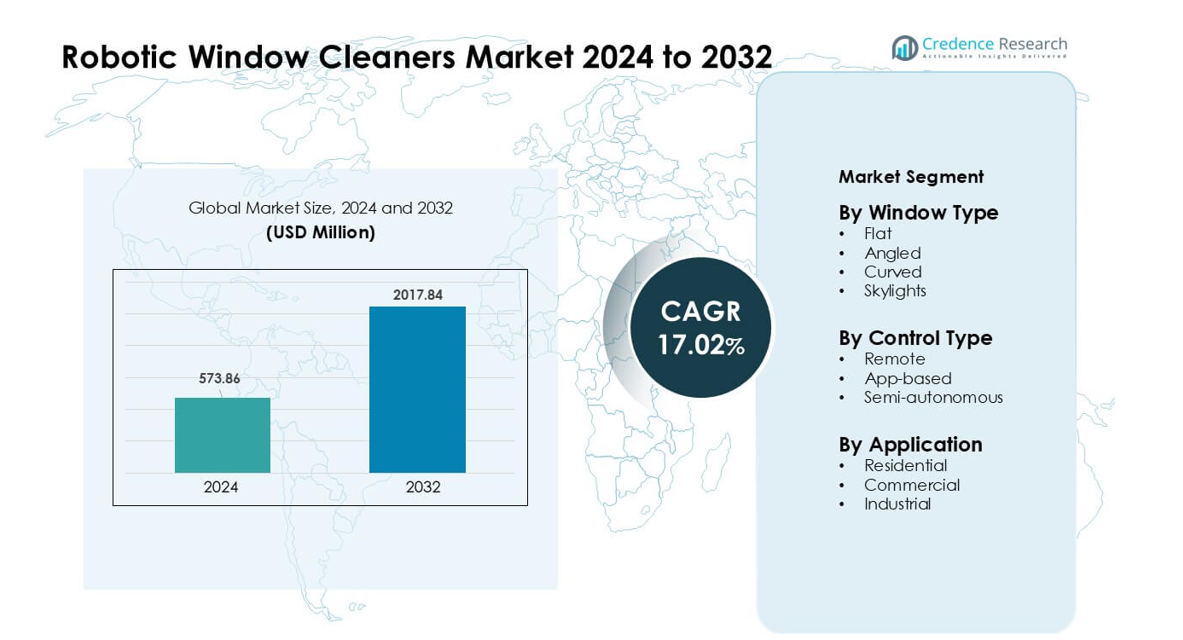
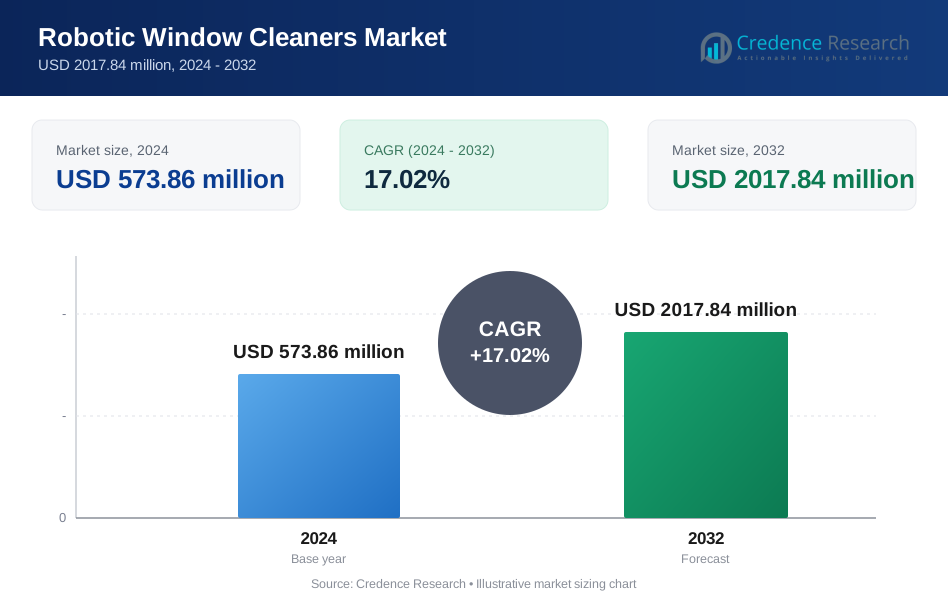
Robotic Window Cleaners Market was valued at USD 573.86 million in 2024 and is anticipated to reach USD 2017.84 million by 2032, growing at a CAGR of 17.02% during the forecast period.
| REPORT ATTRIBUTE | DETAILS |
|---|---|
| Historical Period | 2020-2023 |
| Base Year | 2024 |
| Forecast Period | 2025-2032 |
|
|
USD 573.86 million |
| Robotic Window Cleaners Market, CAGR | 17.02% |
| Robotic Window Cleaners Market Size 2032 | USD 2017.84 million |
The robotic window cleaners market is shaped by key players such as Shenzhen Purerobo Intelligent Tech Co. Ltd., Mamibot Manufacturing USA Inc., Skyline Robotics, Cop Rose Robot Co. Ltd., Dongguan Sun Smile Intelligent Technology Co. Ltd., Hobot Technology Inc., American Fleet Inc., Zhengzhou Bangmi Smart Technology Co. Ltd., Bona, and Ecovacs Robotics Co. Ltd. These companies compete through stronger suction systems, AI-based navigation, app connectivity, and enhanced safety features for high-rise cleaning. North America led the global market in 2024 with about 36% share, supported by high smart home adoption, rising labor costs, and strong demand from high-rise residential and commercial buildings.
Market Insights:
- The robotic window cleaners market reached a strong valuation of USD 573.86 million in 2024 and is projected to grow steadily by USD 2017.84 million by 2032 at a consistent CAGR 02 %, driven by rising automation demand across households and commercial buildings.
- Rising safety concerns in high-rise maintenance and growing smart home adoption drive strong demand for automated cleaning systems across residential and commercial segments.
- AI-enabled navigation, improved suction engines, and app-based controls shape major trends, while flat-window models dominate the window type segment with about 63% share.
- Key players compete through innovation, product durability, and pricing strategies, while high upfront costs and performance limits on curved or textured glass remain notable restraints.
- North America leads the global market with about 36% share, followed by Europe at 29% and Asia Pacific at 25%, while residential applications hold the largest share at nearly 58% across all end-use segments.
Market Segmentation Analysis:
By Window Type
Flat windows dominated the window type segment in 2024 with about 63% share. Most households and offices use flat glass panels, which increased demand for compact robotic cleaners designed for smooth surfaces. Buyers preferred these models because they offer strong suction, stable movement, and quick cleaning cycles. Angled and curved windows grew at a slower pace due to higher design complexity and limited compatibility. Skylight-cleaning robots saw steady interest as buildings added overhead glass for natural lighting, but adoption stayed lower because these units require stronger adhesion and advanced safety features.
- For instance, Milagrow’s Window Seagull 25 model delivers a suction power of 3000 Pa and can clean up to vertical windows of 25 feet height, making it well‑suited for typical flat, high-rise office glazing.
By Control Type
App-based control led the control type segment in 2024 with nearly 52% share. Users selected app-enabled robots due to real-time monitoring, remote scheduling, and integration with smart home ecosystems. App control also improved safety because users could manage cleaning tasks from ground level. Remote-controlled models maintained demand among older consumers who preferred simple buttons. Semi-autonomous robots expanded gradually as brands introduced sensors for edge detection and automatic path planning, though adoption remained moderate due to higher pricing and lower user familiarity.
- For instance, the Milagrow Window Seagull 25 offers a Smartlife App interface enabling fully remote operation users can start, pause, or schedule cleaning from ground level, making it convenient for multi‑storey residences.
By Application
Residential use dominated the application segment in 2024 with around 58% share. Homeowners relied on robotic window cleaners to manage frequent dust, pollution buildup, and hard-to-reach glass areas in urban homes. Growth came from rising apartment living and increased interest in home automation devices. Commercial properties, including offices and retail spaces, recorded strong uptake for safety and labor-saving benefits. Industrial adoption grew steadily in facilities with large glass façades, but share remained lower because these locations often require specialized, heavy-duty cleaning systems
Key Growth Drivers:
Growing Adoption of Smart Home Devices
The robotic window cleaners market grows as households adopt more smart home devices. Many buyers now look for automated tools that reduce daily chores and improve home safety. Smart window cleaners support this shift by offering app connectivity, automated path planning, and integration with home assistants. Urban homes with tall windows or glass balconies drive higher usage because manual cleaning is time-consuming and risky. Companies also release lighter, quieter, and more user-friendly models to appeal to new users. Strong demand comes from rising disposable income and higher interest in home automation, especially in fast-growing urban regions.
- For instance, the Milagrow Window Seagull 25 launched recently in India offers AI‑powered N, Z, and N+Z path planning with full 360° movement and 3000 Pa suction, enabling remote‑controlled cleaning of windows up to 25 feet high.
Rising Safety Concerns in High-Rise Buildings
High-rise apartments and commercial towers rely heavily on robotic window cleaners due to safety concerns. Manual window cleaning on tall buildings poses serious fall risks and requires skilled labor, which increases cost. Robotic systems reduce this risk by using suction, sensors, and controlled movement to handle exterior glass safely. As cities grow vertically, the need for safer maintenance tools rises quickly. Building managers also adopt these robots to reduce operational expenses and ensure consistent cleaning quality. Industrial users benefit from automated cleaning on hazardous glass structures where human access is limited. These systems deliver both safety and efficiency gains, driving wider adoption.
- For instance, many modern window‑cleaning robots use vacuum‑suction adhesion and built-in sensors for edge detection and fall prevention; according to industry‑report summaries, these robots maintain secure adherence to glass while cleaning without human intervention, drastically reducing the accident risk associated with manual cleaning.
Increasing Labor Cost and Shortage of Skilled Cleaners
Global labor shortages and rising wages in facility maintenance boost the market. Many cleaning companies face difficulties hiring skilled workers for risky and time-intensive window cleaning tasks. Robotic cleaners reduce dependency on manual labor and allow teams to focus on higher-value jobs. Businesses adopt automated solutions to cut recurring labor costs and improve productivity in large commercial spaces. Robots also offer predictable performance, which helps facility managers maintain consistent hygiene standards. As wage inflation continues across many regions, automated cleaning tools emerge as a cost-effective replacement for labor-heavy operations, accelerating overall market expansion.
Key Trends & Opportunities:
Rapid Integration of AI and Smart Navigation
A major trend shaping the robotic window cleaners market is the use of AI-powered navigation and advanced sensors. Modern devices use edge detection, route optimization, and real-time obstacle recognition to clean faster and more accurately. These upgrades reduce user intervention and improve coverage on large glass panels. Brands also introduce self-learning features that help robots map window surfaces and adapt to different shapes. AI-enabled diagnostics and predictive maintenance support smoother operation and longer device life. This trend creates strong opportunities for premium robotic models targeting both residential and commercial users.
- For instance, the Milagrow Window Seagull 25 recently launched in India uses AI-powered N, Z and N+Z path‑planning together with 360° movement and 3000 Pa suction, enabling automated cleaning of framed and frameless windows up to 25 feet high.
Growing Demand from Commercial and Retail Properties
Commercial buildings, malls, hotels, and office complexes increasingly prefer automated window cleaning tools for cost and safety reasons. Large glass façades require frequent cleaning to maintain visibility and aesthetics, making labor costs high and cleaning tasks risky. Robotic systems help reduce downtime and offer consistent cleaning quality without disrupting business operations. Many facility managers now invest in fleet-based robotic solutions to reduce long-term operational expenses. This shift presents strong opportunities for manufacturers to develop heavy-duty and scalable robotic cleaning systems tailored to commercial needs.
- For instance, the facade cleaning robots from KITE can clean up to 300–800 m² per hour depending on facade structure far faster than manual cleaning, enabling entire buildings to be maintained overnight or during off‑hours.
Expansion into New Architectural Glass Designs
Modern architecture uses more curved, angled, and large-format glass, creating new opportunities for robotic cleaning solutions. Developers and homeowners prefer expansive glass designs to enhance natural lighting and aesthetics. However, such surfaces are harder to clean manually, increasing demand for adaptable robotic systems. Companies now work on flexible adhesion systems, stronger suction motors, and improved edge detection to handle these complex surfaces. This creates a strong market opportunity for specialized robotic products designed for skylights, glass domes, and curved windows in both residential and commercial projects.
Key Challenges:
High Upfront Cost and Limited Affordability
A key challenge is the high upfront cost of robotic window cleaners, which restricts adoption in price-sensitive markets. Advanced sensors, AI modules, and strong suction systems make production expensive. While long-term savings exist, many residential users still hesitate to invest in premium models. Commercial buyers also evaluate return on investment before switching from manual cleaning. Limited affordability slows penetration across developing regions. Brands must reduce component costs, offer financing models, or introduce mid-range products to grow adoption and compete effectively against low-cost manual cleaning alternatives.
Performance Limitations on Complex Glass Surfaces
Some robotic window cleaners still struggle with highly textured, curved, or very large glass panels. Suction levels may drop on uneven surfaces, and edge detection can be less accurate on irregular shapes. These limitations reduce cleaning quality and increase the need for user supervision. Industrial and commercial buildings with unique architectural designs often require advanced or custom cleaning solutions, which increases cost. Performance issues also arise during extreme weather or on dusty surfaces, leading to inconsistent results. Overcoming these limitations requires stronger motors, better algorithms, and improved stability systems to meet wider usage demands.
Regional Analysis:
North America
North America held about 36% share of the robotic window cleaners market in 2024, supported by strong adoption of smart home devices and high purchasing power. Consumers in the United States and Canada preferred automated cleaning tools to manage large glass surfaces in modern homes and offices. High-rise buildings across major cities also boosted demand due to safety needs and labor shortages in professional cleaning services. Commercial users invested in robotic systems to cut maintenance costs and improve cleaning frequency. Growing interest in connected devices and continued urban expansion strengthened the region’s overall market position.
Europe
Europe accounted for nearly 29% share in 2024, driven by strong demand from residential and commercial buildings focused on safety and energy-efficient cleaning tools. Countries such as Germany, the U.K., France, and the Nordic region saw high adoption due to advanced smart home penetration and rising labor costs in facility management. Many European cities feature high-rise apartments and large glass façades, creating steady demand for automated window cleaning solutions. Strict workplace safety rules also pushed commercial users toward robotics. Growing interest in eco-friendly and low-noise models supported wider market acceptance across key markets.
Asia Pacific
Asia Pacific captured about 25% share in 2024 and remained the fastest-growing region. Rapid urbanization and the rise of high-rise residential towers in China, Japan, South Korea, and Southeast Asia drove strong adoption. Consumers in major cities showed interest in robotic cleaners due to pollution buildup on windows and limited time for manual cleaning. Rising middle-class income and expanding smart home ecosystems further supported growth. Commercial and hospitality sectors also increased use of robotic cleaning systems to enhance efficiency and reduce labor reliance. The region’s expanding construction of glass-heavy buildings strengthened long-term demand.
Latin America
Latin America held roughly 6% share in 2024, with growth driven by increasing adoption of home automation products in Brazil, Mexico, and Chile. Rising urban apartment living and the presence of glass balconies encouraged residential uptake. Commercial properties, including hotels and offices, adopted robotic window cleaners to cut labor costs and improve safety for façade cleaning. However, high product prices limited faster penetration across price-sensitive markets. Growing availability of mid-range robotic models and expanding e-commerce channels helped improve access. Gradual smart home adoption is expected to support steady future market expansion in the region.
Middle East & Africa
The Middle East & Africa region accounted for around 4% share in 2024, supported by rising demand from luxury residential towers, commercial complexes, and hospitality properties. Countries such as the UAE, Saudi Arabia, and South Africa featured growing use of robotic cleaners for large glass façades common in modern architecture. Harsh climates with frequent dust accumulation also increased reliance on automated window cleaning. However, limited awareness and high pricing slowed adoption in several African markets. Ongoing urban development and investment in smart buildings are expected to improve uptake and strengthen future market presence.
Market Segmentations:
By Window Type
- Flat
- Angled
- Curved
- Skylights
By Control Type
- Remote
- App-based
- Semi-autonomous
By Application
- Residential
- Commercial
- Industrial
By Geography
- North America
- U.S.
- Canada
- Mexico
- Europe
- Germany
- France
- U.K.
- Italy
- Spain
- Rest of Europe
- Asia Pacific
- China
- Japan
- India
- South Korea
- South-east Asia
- Rest of Asia Pacific
- Latin America
- Brazil
- Argentina
- Rest of Latin America
- Middle East & Africa
- GCC Countries
- South Africa
- Rest of the Middle East and Africa
Competitive Landscape:
The robotic window cleaners market features strong competition among established global brands and emerging technology developers. Companies such as Shenzhen Purerobo Intelligent Tech Co. Ltd., Mamibot Manufacturing USA Inc., Skyline Robotics, Cop Rose Robot Co. Ltd., Dongguan Sun Smile Intelligent Technology Co. Ltd., Hobot Technology Inc., American Fleet Inc., Zhengzhou Bangmi Smart Technology Co. Ltd., Bona, and Ecovacs Robotics Co. Ltd. focus on advanced suction systems, AI-driven navigation, and improved safety features to strengthen product performance. Many brands expand through online channels, distributor partnerships, and smart home integrations to reach wider consumer bases. Commercial and high-rise cleaning applications push companies to develop heavy-duty robots capable of handling large glass façades. Firms also invest in quieter motors, stronger adhesion technology, and app-based monitoring to enhance user convenience. Continuous innovation and competitive pricing strategies remain key as companies work to differentiate offerings in a fast-growing automation market.
Key Player Analysis:
- Shenzhen Purerobo Intelligent Tech Co. Ltd.
- Mamibot Manufacturing USA Inc.
- Skyline Robotics
- Cop Rose Robot Co. Ltd.
- Dongguan Sun Smile Intelligent Technology Co. Ltd.
- Hobot Technology Inc.
- American Fleet Inc.
- Zhengzhou Bangmi Smart Technology Co. Ltd.
- Bona
- Ecovacs Robotics Co. Ltd.
Recent Developments:
- In 2025, Shenzhen Purerobo Intelligent Tech Co., Ltd. Purerobo s B2B/product listings for 2025 show several newest launch window-cleaner models (examples: W-T50S, W-T10S, W-S8S), indicating the company pushed multiple new consumer/commercial window-robot SKUs and spray/water-port designs into distribution channels in 2025. These product pages (GoldSupplier / Made-in-China / HKTDC listings) are the most recent public evidence of their 2025 rollout activity.
- In September 2024, Skyline has publicly reported field deployments / demonstrations of its Ozmo system on tall buildings (media coverage cites New York City usage), positioning Ozmo as an AI/ML-driven commercial facade cleaning solution that aims to speed cleaning and reduce human risk. Recent company/profile pages (2025) continue to present Ozmo as their flagship automated window-cleaning solution.
- In August 2024, Bona (Shenzhen BONA Robot Technology Co., Ltd.) The robotic window cleaners market report also listed Bona as one of the principal vendors. This inclusion, alongside details of its cleaning robot portfolio, signaled growing recognition of Bona’s robot window cleaner offerings in the international competitive landscape.
Report Coverage:
The research report offers an in-depth analysis based on Window Type, Control Type, Application and Geography. It details leading market players, providing an overview of their business, product offerings, investments, revenue streams, and key applications. Additionally, the report includes insights into the competitive environment, SWOT analysis, current market trends, as well as the primary drivers and constraints. Furthermore, it discusses various factors that have driven market expansion in recent years. The report also explores market dynamics, regulatory scenarios, and technological advancements that are shaping the industry. It assesses the impact of external factors and global economic changes on market growth. Lastly, it provides strategic recommendations for new entrants and established companies to navigate the complexities of the market.
Future Outlook:
- Demand for robotic window cleaners will rise as smart home adoption increases globally.
- AI-based navigation and self-learning cleaning patterns will become standard features.
- Commercial buildings and high-rise towers will drive stronger adoption for safety and efficiency.
- Robots will gain improved suction systems to handle curved, angled, and textured glass surfaces.
- App-controlled models will expand as users prefer remote monitoring and automated scheduling.
- Manufacturers will focus on lighter designs and quieter motors to improve user convenience.
- Integration with broader home automation ecosystems will support long-term market growth.
- More mid-range models will enter the market as brands work to reduce upfront costs.
- Facility management companies will adopt fleet-based robotic cleaning solutions to lower labor dependence.
- Sustainability goals will push companies to develop energy-efficient and low-maintenance robotic cleaning systems.
Request a Free Sample
Fill in your details and we'll send you a free sample report.
- Sample data tables & charts
- Research methodology
Need a Custom Version of This Report?
Tailor the scope, geography, or segments to your exact requirements.
- Custom geography or segment scope
- Direct access to our analyst team
Frequently Asked Questions
What is the current market size for Robotic Window Cleaners Market, and what is its projected size in 2032?
At what Compound Annual Growth Rate is Robotic Window Cleaners Market projected to grow between 2024 and 2032?
Which Power Source equipment segment governs the market demand for Robotic Window Cleaners ?
Who are the major players in the global Robotic Window Cleaners Market?
Who are the leading companies in Robotic Window Cleaners Market?
Table of Content
Chapter 1. Report Introduction
- 1.1 Report Description & Purpose
- 1.1.1 Report Title & Market Definition
- 1.1.2 Unique Selling Propositions (USP) & Key Differentiators
- 1.1.3 Value Proposition for Stakeholders
- 1.2 Research Objectives
- 1.2.1 Market Sizing Objectives (Volume & Revenue)
- 1.2.2 Segmentation Objectives
- 1.2.3 Competitive Intelligence Objectives
- 1.2.4 Forecast & Scenario Objectives
- 1.3 Report Scope
- 1.3.1 Robotic Window Cleaners Scope – Types & Subtypes Covered
- 1.3.2 Geographic Scope – Regions & Countries Covered
- 1.3.3 Historical Period, Base Year & Forecast Period (2024; forecast to 2032)
- 1.3.4 Inclusions & Exclusions
- 1.4 HS Code & Classification Framework
- 1.5 Currency, Units & Pricing Basis
- 1.6 Target Stakeholders
- 1.7 Limitations & Assumptions
Chapter 2. Executive Summary
- 2.1 Global Robotic Window Cleaners Market Snapshot
- 2.1.1 Market Size – Historical (2024) & Forecast (2024-2032) (2024: USD 573.86 million → 2032: USD 2017.84 million)
- 2.1.2 Volume & Revenue – Global Totals
- 2.1.3 Key Market Highlights – Top Five Facts
- 2.2 Robotic Window Cleaners Market Segmentation Snapshot
- 2.2.1 Market Split by Region – 2024 vs. 2032
- 2.3 Competitive Snapshot
- 2.3.1 Top 10 Players by Revenue Share – 2024
- 2.3.2 Top 10 Players by Volume Share – 2024
- 2.3.3 Recent Strategic Developments (18-Month Summary)
- 2.4 Key Investment Highlights & Strategic Conclusions
Chapter 3. Robotic Window Cleaners Market Dynamics & Industry Analysis
- 3.1 Market Overview & Context
- 3.1.1 Robotic Window Cleaners Market Position in the Broader Automotive Value Chain
- 3.1.2 OEM vs. Replacement Market Dynamics
- 3.1.3 Market Maturity & Development Stage by Region
- 3.2 Robotic Window Cleaners Market Drivers
- 3.3 Robotic Window Cleaners Market Restraints & Challenges
- 3.4 Robotic Window Cleaners Market Opportunities
- 3.5 Porter's Five Forces Analysis
- 3.5.1 Threat of New Entrants
- 3.5.2 Bargaining Power of Suppliers
- 3.5.3 Bargaining Power of Buyers
- 3.5.4 Threat of Substitutes
- 3.5.5 Competitive Rivalry – Intensity Assessment
- 3.6 Robotic Window Cleaners Value Chain Analysis
- 3.6.1 Upstream – Raw Material/Input Suppliers
- 3.6.1.1 Raw Material/Input 1
- 3.6.1.2 Raw Material/Input 2
- 3.6.1.3 Raw Material/Input 3
- 3.6.2 Midstream – Production/Manufacturing/Service Delivery
- 3.6.2.1 Production/Process Overview
- 3.6.2.2 Key Facility Locations & Capacity by Manufacturer
- 3.6.3 Downstream – Distribution & End Consumer
- 3.6.3.1 Primary Channel – B2B/OEM
- 3.6.3.2 Secondary Channels – Dealer, Retail, Online, Direct
- 3.6.4 Value Chain Profitability Analysis
- 3.6.1 Upstream – Raw Material/Input Suppliers
- 3.7 PESTEL Analysis
- 3.7.1 Political Factors
- 3.7.2 Economic Factors
- 3.7.3 Social Factors
- 3.7.4 Technological Factors
- 3.7.5 Environmental Factors
- 3.7.6 Legal Factors
- 3.8 Robotic Window Cleaners Supply Chain Analysis
- 3.8.1 Raw Material/Input Supply Risk Assessment
- 3.8.2 Manufacturing Concentration Risk (Geographic Exposure)
- 3.8.3 Trade Disruption Impact Analysis
- 3.9 Regulatory & Policy Landscape
Note: The regulatory and policy landscape section covers regulations based on their applicability to the market, Robotic Window Cleaners category, geography, and scope of the study. Only regulatory frameworks with a material impact on operations, compliance, trade, sustainability, or market access are analyzed in detail.
Chapter 4. Key Investment Pockets & Opportunity Analysis
- 4.1 Robotic Window Cleaners Market Attractiveness Analysis
- 4.1.1 By Region – Investment Attractiveness Matrix (Volume × CAGR)
- 4.2 Absolute Revenue Growth Opportunity
- 4.2.1 By Region – Absolute USD Growth Through 2032
- 4.3 Incremental Volume Opportunity
- 4.3.1 By Region – Incremental Volume Through 2032
- 4.3.2 Segment – Incremental Volume
- 4.4 Emerging Submarket Opportunity Deep Dive (Subject to Applicability)
- 4.5 Emerging Market Opportunity Scorecards
- 4.5.1 United States
- 4.5.2 Europe
- 4.5.3 Asia
- 4.5.4 Middle East & Africa
Note: Emerging Market Opportunity Scorecards will be included based on relevance and strategic importance. Regions listed are indicative and may vary depending on data availability and market dynamics.
Chapter 5. Robotic Window Cleaners Import-Export Analysis & Trade Flows
- 5.1 Global Trade Overview
- 5.1.1 Global Export Value by Country (2024)
- 5.1.2 Global Export Volume by Country (2024)
- 5.1.3 Global Import Value by Country (2024)
- 5.1.4 Global Import Volume by Country (2024)
- 5.1.5 Net Trade Balance by Country (2024)
- 5.2 Export Analysis – Segment
- 5.2.1 Type 1 (HS Code)
- 5.2.2 Type 2 (HS Code)
- 5.2.3 Type 3 (HS Code)
- 5.2.4 Type 4 (HS Code)
- 5.2.5 Type 5 (HS Code)
- 5.3 Import Analysis – Segment
- 5.3.1 Type 1 (HS Code)
- 5.3.2 Type 2 (HS Code)
- 5.3.3 Type 3 (HS Code)
- 5.3.4 Type 4 (HS Code)
- 5.3.5 Type 5 (HS Code)
- 5.4 Average Unit Trade Prices
- 5.4.1 Average Export Price – Segment & Country
- 5.4.2 Average Import Price – Segment & Source Country
- 5.4.3 Price Trends (2024)
- 5.5 Key Trade Route Analysis
- 5.5.1 Trade Route 1
- 5.5.2 Trade Route 2
- 5.5.3 Trade Route 3
- 5.5.4 Trade Route 4
- 5.5.5 Trade Route 5
- 5.6 Trade Policy Impact Assessment
- 5.6.1 US Anti-Dumping & Section 301 Tariffs
- 5.6.2 EU Customs Union Impact
- 5.6.3 Major Free Trade Agreements
- 5.6.4 USMCA Rules of Origin
Note: Trade policy analysis will be included only where relevant to the Robotic Window Cleaners market.
Chapter 6. Competitive Landscape & Company Benchmarking
- 6.1 Robotic Window Cleaners Market Concentration & Structure
- 6.1.1 Herfindahl-Hirschman Index (HHI) – vs. 2024
- 6.1.2 Tier 1, Tier 2 & Tier 3 Market Structure
- 6.1.3 Global, Regional & Local Player Dynamics
- 6.2 Robotic Window Cleaners Market Share Analysis – 2024
- 6.2.1 Global Revenue Share by Company
- 6.2.2 Global Volume Share by Company
- 6.2.3 Regional Revenue Share
- 6.2.4 Market Share Evolution ( vs. 2024)
- 6.2.5 OEM Segment Share by Company
- 6.2.6 Replacement Segment Share by Company
- 6.3 Production/Delivery Capacity & Facility Analysis
- 6.3.1 Global Installed Capacity
- 6.3.2 Capacity Utilization Rates
- 6.3.3 Production/Output Volume
- 6.3.4 Facility Locations & Capacity Map
- 6.3.5 Planned Capacity Additions
- 6.4 Robotic Window Cleaners Competitive Benchmarking Matrix
- 6.4.1 Revenue, Volume, CAGR & Profitability Comparison
- 6.4.2 Channel Revenue Mix
- 6.4.3 Geographic Revenue Exposure
- 6.4.4 R&D Intensity
- 6.4.5 Sustainability Maturity
- 6.5 Strategic Developments in Robotic Window Cleaners (Last 24 Months)
- 6.5.1 Mergers, Acquisitions & Divestments
- 6.5.2 New Robotic Window Cleaners Launches
- 6.5.3 Facility Expansions
- 6.5.4 Strategic Alliances, Joint Ventures & Partnerships
- 6.5.5 Distribution Expansion & Market Entry
- 6.5.6 Sustainability & ESG Initiatives
- 6.6 Competitive Strategy Mapping
- 6.6.1 Leader, Challenger, Follower & Niche Classification
- 6.6.2 Pricing Strategy Comparison
- 6.6.3 Channel Strategy Matrix
Note: Strategic developments are included based on their materiality and the availability of reliable information.
Chapter 7. Global Robotic Window Cleaners Market – By Distribution Channel
- 7.1 Segment Overview
- 7.1.1 Volume & Revenue Split by Channel (2024 & 2032)
- 7.1.2 Channel Mix Evolution (2024-2032)
Chapter 8. Regional Market Analysis – Global Overview
- 8.1 Global Regional Overview
- 8.1.1 Regional Volume Share
- 8.1.2 Regional Revenue Share
- 8.1.3 Regional Volume by Region
- 8.1.4 Regional Revenue by Region
- 8.1.5 Regional Forecast Through 2032
- 8.2 Cross-Regional Segment Analysis
- 8.2.1 By Distribution Channel
- 8.2.2 By Brand/Price Tier
Chapter 9. North America Robotic Window Cleaners Market
- 9.1 United States
- 9.2 Canada
- 9.3 Mexico
Chapter 10. Europe Robotic Window Cleaners Market
- 10.1 Germany
- 10.2 France
- 10.3 Italy
- 10.4 United Kingdom
- 10.5 Spain
- 10.6 Poland
- 10.7 Russia
- 10.8 Netherlands
- 10.9 Belgium
- 10.10 Sweden
- 10.11 Denmark
- 10.12 Norway
- 10.13 Rest of Europe
Chapter 11. Asia Pacific Robotic Window Cleaners Market
- 11.1 China
- 11.2 India
- 11.3 Japan
- 11.4 South Korea
- 11.5 Thailand
- 11.6 Indonesia
- 11.7 Vietnam
- 11.8 Malaysia
- 11.9 Australia
- 11.10 Rest of Asia Pacific
Chapter 12. Latin America Robotic Window Cleaners Market
- 12.1 Brazil
- 12.2 Argentina
- 12.3 Colombia
- 12.4 Chile
- 12.5 Rest of Latin America
Chapter 13. Middle East Robotic Window Cleaners Market
- 13.1 Saudi Arabia
- 13.2 United Arab Emirates
- 13.3 Turkey
- 13.4 Israel
- 13.5 Iran
- 13.6 Rest of the Middle East
Chapter 14. Africa Robotic Window Cleaners Market
- 14.1 South Africa
- 14.2 Egypt
- 14.3 Nigeria
- 14.4 Morocco
- 14.5 Rest of Africa
Chapter 15. Robotic Window Cleaners Company Profiles
- 15.1 [Company 01]
- 15.1.1 Company Overview
- 15.1.2 Key Management Personnel
- 15.1.3 Products & Services Portfolio
- 15.1.4 Financial Performance
- 15.1.5 Key Market Focus & Geographic Presence
- 15.1.6 Recent Developments & Strategic Initiatives
Note: The company profile list is preliminary and may change based on research findings, market developments, data availability, and client requirements.
Chapter 16. Appendices
- Appendix A – List of Abbreviations & Acronyms
- Appendix B – Industry Classification Code Reference – Full Series
- Appendix C – Production & Capacity Data Tables
- Appendix D – End-Use & Demand Base Tables
- Appendix E – Consumption & Replacement Rate Assumptions
- Appendix F – ASP Reference Tables
- Appendix G – Manufacturing & Facility Database
- Appendix H – Import-Export Data Tables
- Appendix I – Regulatory Summary Tables
- Appendix J – Primary Research Participant List (Anonymized)
- Appendix K – Primary Research Questionnaire Framework
- Appendix L – Data Sources & Bibliography
- Appendix M – Market Size Divergence & Source Comparison
Chapter 17. Research Methodology
- 17.1 Research Framework & Philosophy
- 17.2 Secondary Research – Sources, Hierarchy & Data Extraction
- 17.3 Data Modeling – Bottom-Up & Top-Down Market Sizing
- 17.4 Primary Research – Stakeholder Framework, LOI & Sample Sizes
- 17.5 Forecast Methodology – Regression, Scenario & Sensitivity Analysis
- 17.6 Quality Control – Four-Layer Validation Framework
- 17.7 Limitations & Standard Assumptions
- 17.8 Disclaimer
