
Market Overview
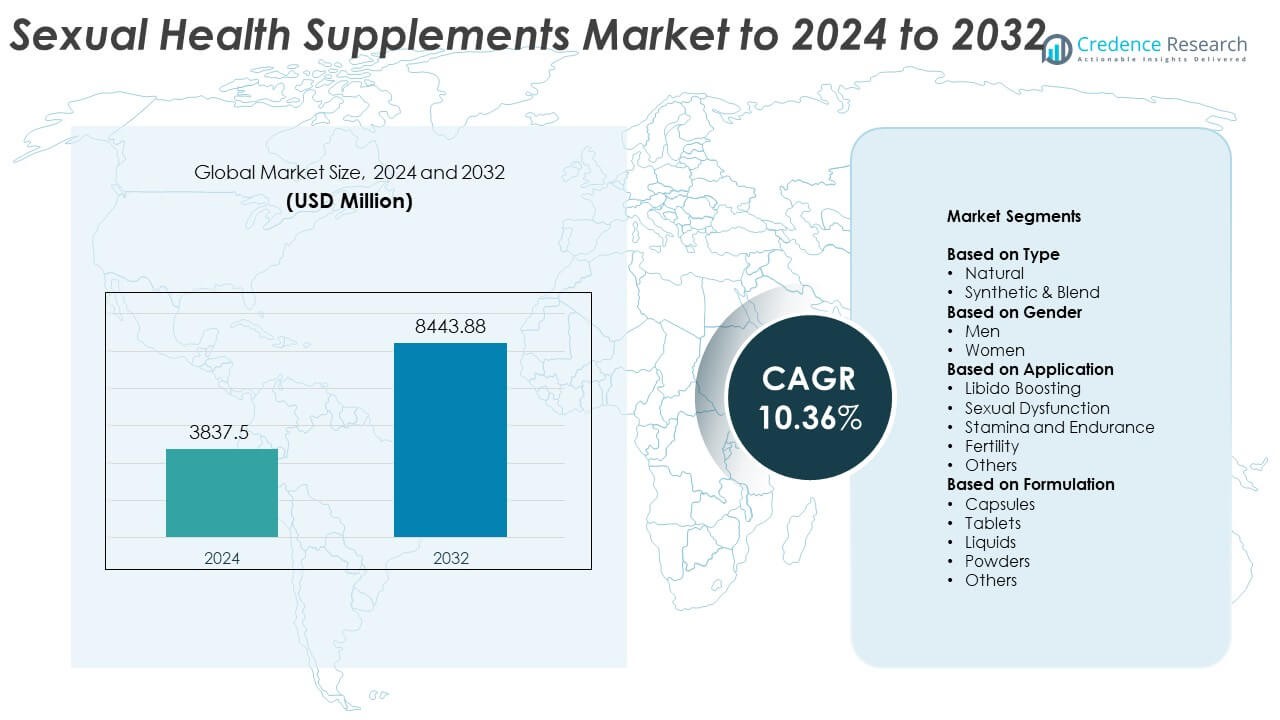
Sexual Health Supplements Market size was valued at USD 3837.5 million in 2024 and is anticipated to reach USD 8443.88 million by 2032, at a CAGR of 10.36% during the forecast period.
| REPORT ATTRIBUTE | DETAILS |
|---|---|
| Historical Period | 2020-2023 |
| Base Year | 2024 |
| Forecast Period | 2025-2032 |
| Sexual Health Supplements Market Size 2024 | USD 3837.5 Million |
| Sexual Health Supplements Market , CAGR | 10.36% |
| Sexual Health Supplements Market Size 2032 | USD 8443.88 Million |
The Sexual Health Supplements Market is shaped by major companies including Nature’s Bounty, BioXgenic, Swisse Wellness, Life Extension, GNC, Amway, Metagenics, Himalaya Drug Company, and NOW Foods. These players strengthen their position through natural formulations, research-backed blends, and strong multichannel distribution. North America leads the market with about 36% share due to high spending on wellness and strong retail and online penetration. Europe follows with nearly 29% share supported by clean-label demand, while Asia Pacific holds around 24% share driven by rising awareness and preference for herbal products. These regions collectively shape global market growth.
Market Insights
- The Sexual Health Supplements Market reached USD 3837.5 million in 2024 and is projected to hit USD 8443.88 million by 2032, growing at a CAGR of 10.36%.
- Strong demand for natural formulations drives market growth, with the natural segment holding about 61% share and gaining traction as consumers prefer clean-label and plant-based blends.
- Key trends include rising adoption of personalized nutrition, growing female-focused product development, and expansion of online and subscription-based models that support consistent product usage.
- Competition intensifies as leading brands enhance clinical validation, improve ingredient transparency, and strengthen digital marketing to stand out in a crowded marketplace with similar offerings.
- North America leads with 36% share, Europe follows with 29%, and Asia Pacific accounts for 24%, while the men’s segment dominates gender demand with about 68% share and libido boosting remains the top application with around 42% share.
Market Segmentation Analysis:
By Type
Natural supplements lead the category with about 61% share in 2024. Buyers prefer natural formulas due to safer profiles, growing consumer trust in plant-based extracts, and wider adoption in preventive health routines. Brands expand natural lines with herbal mixes that support libido, hormonal balance, and stamina. Synthetic and blend products grow steadily as they offer targeted ingredients with faster action, but demand remains lower due to rising clean-label awareness and stricter scrutiny of chemical additives. The shift toward botanical and organic formulations continues to anchor segment leadership.
- For instance, Bayer's Supradyn Naturals Ginseng product for men includes a clinically backed Panax ginseng extract as a key ingredient, alongside 12 vitamins and 5 minerals.
By Gender
Men dominate the segment with nearly 68% share in 2024. Higher demand arises from growing awareness of erectile health, age-related decline in testosterone levels, and rising use of supplements for performance improvement. Marketing strategies focus heavily on male enhancement, leading to wider product availability and stronger brand penetration. Women’s supplements show steady momentum driven by interest in hormonal balance, fertility support, and reproductive wellness, but uptake remains lower due to fewer targeted formulations. Expanding female-focused product lines is expected to reduce this gap over time.
- For instance, clinical studies on L-arginine for ED have used daily dosages ranging from 1,500 to 6,000 milligrams (1.5 to 6 grams), often in combination with other ingredients like Pycnogenol.
By Application
Libido boosting holds the dominant position with about 42% share in 2024. Demand rises as consumers seek quick-acting solutions for desire enhancement, improved mood, and stress reduction. The category benefits from broad marketing reach and a large range of herbal formulations. Sexual dysfunction support follows with steady growth due to high prevalence of performance-related issues. Stamina and endurance, fertility, and other applications expand as users adopt supplements for overall sexual wellness and long-term reproductive health. The rising normalization of supplement-based sexual health aids continues to drive growth across applications.
Key Growth Drivers
Rising Demand for Natural and Herbal Formulations
Consumers increasingly choose natural sexual health supplements due to safer profiles, clean-label preferences, and rising trust in botanical ingredients. This shift supports strong demand for plant-based blends that address libido, vitality, and hormonal balance. Marketing efforts highlight purity, sustainability, and long-term wellness benefits, which strengthens adoption across both genders. The expansion of organic supply chains also helps brands launch broader portfolios. This factor remains a major growth driver as buyers move away from synthetic or chemically processed alternatives.
- For instance, Gaia Herbs' Maca Root capsules contain 500 milligrams of organic gelatinized maca root powder per capsule.
Growing Awareness of Sexual Wellness and Preventive Health
Public awareness campaigns and digital health platforms have made sexual wellness a mainstream topic. Users now treat sexual health as an essential part of overall wellbeing, driving interest in supplements that enhance stamina, mood, and performance. Younger consumers adopt these products for preventive purposes, while older buyers seek support for age-related changes. Widespread use of e-commerce and telehealth consultations further accelerates accessibility. This continued rise in awareness stands as a key growth driver for the market.
- For instance, Haleon's 2024 Annual Report cites the "Ipsos Global Trends Report (2024), study conducted across 50 markets" to understand the evolving definitions of everyday health among consumers.
Increasing Prevalence of Sexual Dysfunction and Lifestyle-Related Issues
Rising cases of stress, obesity, sedentary habits, and chronic health conditions contribute to higher rates of sexual dysfunction. This creates strong demand for supplements that support erectile strength, libido enhancement, and hormonal balance. Men’s health brands benefit the most, but targeted solutions for women are also gaining traction. Many consumers prefer supplements as a non-invasive alternative to prescription treatments. This expanding need for functional support marks another key growth driver for the industry.
Key Trends and Opportunities
Expansion of Female-Focused Sexual Wellness Products
Women’s sexual health supplements gain momentum as brands introduce solutions for hormonal balance, fertility support, and libido enhancement. Social acceptance of female sexual wellness continues to rise, creating a large untapped market. Companies are also designing formulations tailored to women’s nutritional and hormonal needs. This shift opens new growth opportunities and helps diversify product portfolios. Wider availability of female-focused lines represents a major trend and opportunity.
- For instance, DSM-Firmenich offers geniVida®, a unique, proven genistein-based ingredient to support women's health. The effective daily dosage of geniVida® is generally recognized in clinical studies to be around 54 milligrams of genistein to provide benefits such as supporting healthy bone density and relieving menopausal symptoms.
Growth of Personalized and Functional Nutrition Solutions
Brands invest in personalized supplement programs that match user-specific needs such as stress levels, hormonal profiles, or age-related decline. Functional blends combining adaptogens, vitamins, and amino acids gain popularity for delivering targeted benefits. Digital platforms that offer customized recommendations also help boost consumer engagement. This broader move toward personalization signals a key industry trend and a high-value opportunity for manufacturers.
- For instance, the Lonza Capsugel Vcaps® and Vcaps® Plus HPMC capsules are available in various standard sizes. The fill capacity for a specific capsule size, such as size 1, can be around 300 milligrams for a powder with a bulk density of 0.6 g/mL.
Rising Adoption of E-commerce and Subscription-Based Models
Online platforms play a major role in expanding market reach. Subscription plans offer convenience, privacy, and consistent product access, encouraging long-term usage. Digital channels allow brands to target specific demographics with tailored marketing. Growing online penetration represents a strong opportunity and an important trend shaping future demand.
Key Challenges
Regulatory Variability and Quality Control Issues
Sexual health supplements face inconsistent regulatory frameworks across regions, creating challenges in product claims, ingredient approvals, and safety standards. Lack of uniform oversight can lead to quality concerns, reducing consumer confidence. Manufacturers must invest heavily in rigorous testing and transparent labeling to meet evolving regulations. This remains a major challenge that impacts market stability and brand credibility.
High Competition and Product Differentiation Barriers
The market is crowded with numerous brands offering similar formulations, making differentiation difficult. Price competition intensifies pressure on profit margins, while aggressive marketing by established players limits the visibility of smaller companies. Consumers often struggle to identify clinically supported products, leading to slower trust-building. This competitive saturation stands as another significant challenge for sustained market growth.
Regional Analysis
North America
North America holds about 36% share in 2024, driven by strong consumer spending on wellness products and high awareness of sexual health. The region benefits from widespread retail penetration, strong e-commerce activity, and large male-focused supplement demand. Brands introduce advanced natural formulations supported by clinical claims, which further boosts adoption. Rising cases of stress-related dysfunction and age-related decline also support long-term consumption. The presence of established manufacturers and subscription-based delivery models strengthens overall growth in the region.
Europe
Europe accounts for nearly 29% share in 2024, supported by growing acceptance of sexual wellness as part of preventive healthcare. Consumers show strong interest in herbal and clean-label formulations due to stricter regulations on synthetic ingredients. Demand increases among both men and women, driven by rising lifestyle-related issues and wider product distribution across pharmacies and online platforms. Expanding fertility-focused supplements and broader wellness campaigns also support category expansion. The region continues to benefit from high product quality standards and increased spending on natural health solutions.
Asia Pacific
Asia Pacific holds about 24% share in 2024 and emerges as the fastest-growing region due to rising awareness of sexual wellness, increasing urbanization, and expanding middle-class spending. Herbal and traditional ingredient-based supplements dominate, driven by strong cultural acceptance of natural remedies. Growing stress levels, lifestyle changes, and higher infertility rates contribute to rising demand. E-commerce platforms help brands reach younger buyers seeking discreet purchasing options. Rapid product innovation and wider availability across emerging markets continue to strengthen regional momentum.
Latin America
Latin America captures around 6% share in 2024, supported by rising interest in sexual performance enhancers and increasing adoption of natural supplements. Awareness improves as local brands promote herbal ingredients and affordable formulations. Economic recovery in several countries boosts discretionary spending, allowing consumers to explore wellness categories. Growing male-focused demand and increasing visibility of e-commerce channels support higher penetration. Despite slower uptake compared to larger regions, rising youth population and shifting social attitudes contribute to steady market growth.
Middle East and Africa
Middle East and Africa hold close to 5% share in 2024, driven by gradual lifestyle modernization and rising online access to wellness products. Demand grows primarily in urban areas where awareness of sexual health supplements is higher. Male enhancement products see the strongest adoption due to cultural preferences and increasing stress-related issues. However, limited product availability and stricter regulatory environments restrict faster expansion. As awareness campaigns expand and digital retail spreads, the region is expected to experience consistent but moderate growth.
Market Segmentations:
By Type
- Natural
- Synthetic & Blend
By Gender
- Men
- Women
By Application
- Libido Boosting
- Sexual Dysfunction
- Stamina and Endurance
- Fertility
- Others
By Formulation
- Capsules
- Tablets
- Liquids
- Powders
- Others
By Geography
- North America
- U.S.
- Canada
- Mexico
- Europe
- Germany
- France
- U.K.
- Italy
- Spain
- Rest of Europe
- Asia Pacific
- China
- Japan
- India
- South Korea
- South-east Asia
- Rest of Asia Pacific
- Latin America
- Brazil
- Argentina
- Rest of Latin America
- Middle East & Africa
- GCC Countries
- South Africa
- Rest of the Middle East and Africa
Competitive Landscape
The Sexual Health Supplements Market is shaped by leading players such as Nature's Bounty, BioXgenic, Swisse Wellness, Life Extension, GNC (General Nutrition Centers), Amway, Metagenics, Himalaya Drug Company, and NOW Foods. These companies compete by expanding natural product lines, improving clinical validation, and enhancing ingredient quality to meet rising consumer expectations. Many brands focus on research-backed formulations to strengthen trust and differentiate their offerings in a crowded marketplace. Digital marketing, influencer partnerships, and targeted campaigns support stronger visibility across key demographics. Firms also invest in e-commerce platforms and subscription programs to secure long-term customer engagement. Premium formulations with botanical blends and multibenefit features gain traction as consumers seek comprehensive wellness support. Competitive pressure drives continuous innovation in dosage forms, flavor options, and fast-acting solutions. Regulatory compliance, clean-label positioning, and transparent sourcing remain critical as companies work to sustain credibility in a rapidly growing and highly competitive market.
Key Player Analysis
- Nature's Bounty
- BioXgenic
- Swisse Wellness
- Life Extension
- GNC (General Nutrition Centers)
- Amway
- Metagenics
- Himalaya Drug Company
- NOW Foods
Recent Developments
- In 2025, Himalaya promotes its Ayurvedic sexual health product "Confido Tablet," designed to regulate testosterone, improve libido, strengthen tissue in the male sexual organ, increase sperm count, and treat erectile dysfunction using natural ingredients like Kapikachhu and Gokshura.
- In 2025, Life Extension offers "Sexual Health for Her," a plant-based supplement formulated for female libido, arousal, lubrication, and satisfaction.
- In 2022, GNC continued to offer and support its established sexual health supplement "GNC Men’s ArginMax," which combines L-arginine, ginseng, and ginkgo biloba to enhance sexual desire and performance by supporting nitric oxide production and improving blood flow.
Report Coverage
The research report offers an in-depth analysis based on Type, Gender, Application, Formulation and Geography. It details leading market players, providing an overview of their business, product offerings, investments, revenue streams, and key applications. Additionally, the report includes insights into the competitive environment, SWOT analysis, current market trends, as well as the primary drivers and constraints. Furthermore, it discusses various factors that have driven market expansion in recent years. The report also explores market dynamics, regulatory scenarios, and technological advancements that are shaping the industry. It assesses the impact of external factors and global economic changes on market growth. Lastly, it provides strategic recommendations for new entrants and established companies to navigate the complexities of the market.
Future Outlook
- The market will expand steadily as awareness of sexual wellness continues to rise.
- Natural and herbal formulations will gain stronger dominance across key demographic groups.
- Personalized supplement programs will grow with wider adoption of digital health tools.
- Female-focused products will see faster development as brands target unmet needs.
- E-commerce and subscription models will strengthen long-term customer retention.
- Clinical validation and transparent labeling will become essential for brand credibility.
- Innovation in multibenefit blends will increase demand for holistic sexual wellness solutions.
- Regulatory tightening will improve product quality and reduce low-grade offerings.
- Emerging markets in Asia Pacific and Latin America will contribute heavily to growth.
- Collaboration between nutraceutical brands and telehealth platforms will shape future consumer engagement.

Request a Free Sample
Fill in your details and we'll send you a free sample report.
- Sample data tables & charts
- Research methodology
Market Dynamics
Preference for Natural and Herbal Formulations
Consumers are increasingly choosing natural and plant-based sexual health supplements due to perceived safety, clean-label appeal, and trust in botanical ingredients. This trend is driving the dominance of the natural segment and encouraging brands to expand their herbal product lines.
Rising Awareness of Sexual Wellness and Preventive Health
Public health campaigns and digital platforms have normalized sexual wellness as part of overall health, leading to greater adoption of supplements for libido, stamina, and hormonal balance. Both younger and older demographics are turning to these products for preventive and supportive purposes.
Increasing Prevalence of Sexual Dysfunction and Lifestyle-Related Issues
Higher rates of stress, obesity, sedentary lifestyles, and chronic health conditions are contributing to sexual dysfunction, especially among men. This has led to increased demand for supplements that address erectile health, libido, and hormonal support as non-invasive alternatives to prescription medications.
Expansion of Female-Focused Sexual Wellness Products
Brands are developing more supplements tailored to women's needs, such as hormonal balance, fertility, and libido enhancement. Growing social acceptance and targeted product innovation are opening new market opportunities and helping to close the gender gap in supplement usage.
Growth of E-commerce and Subscription-Based Models
Online sales channels and subscription services are making sexual health supplements more accessible and discreet, supporting consistent usage and long-term customer retention. Digital marketing and tailored online experiences are further boosting market penetration.
Need a Custom Version of This Report?
Tailor the scope, geography, or segments to your exact requirements.
- Custom geography or segment scope
- Direct access to our analyst team
Frequently Asked Questions
What is the current market size for Sexual Health Supplements Market, and what is its projected size in 2032?
At what Compound Annual Growth Rate is the Sexual Health Supplements Market projected to grow between 2025 and 2032?
Which Sexual Health Supplements Market segment held the largest share in 2024?
What are the primary factors fueling the growth of the Sexual Health Supplements Market?
Who are the leading companies in the Sexual Health Supplements Market?
Which region commanded the largest share of the Sexual Health Supplements Market in 2024?
Table of Content
Chapter 1 Market Segmentation
- 1.1 Segmentation Framework
- 1.1.1 Product and Service Classification
- 1.1.2 Application and End-Use Classification
- 1.1.3 Technology and Solution Classification
- 1.1.4 Customer and Distribution Channel Classification
- 1.1.5 Geographic Segmentation
- 1.1.6 Market Segment Definitions and Boundaries
- 1.2 By Type
- 1.2.1 Natural
- 1.2.2 Synthetic & Blend
- 1.3 By Gender
- 1.3.1 Men
- 1.3.2 Women
- 1.4 By Application
- 1.4.1 Libido Boosting
- 1.4.2 Sexual Dysfunction
- 1.4.3 Stamina and Endurance
- 1.4.4 Fertility
- 1.4.5 Others
- 1.5 By Formulation
- 1.5.1 Capsules
- 1.5.2 Tablets
- 1.5.3 Liquids
- 1.5.4 Powders
- 1.5.5 Others
Chapter 2 Introduction
- 2.1 Report Objectives and Scope
- 2.2 Product Definition and Industry Terminology
- 2.3 Market Inclusions and Exclusions
- 2.4 Research Process
- 2.4.1 Primary Research and Expert Interviews
- 2.4.2 Secondary Research and Source Review
- 2.4.3 Top-Down and Bottom-Up Estimation
- 2.4.4 Data Triangulation and Verification
- 2.5 Market Size Measurement Basis
- 2.5.1 2024: USD 3,837.5 million → 2032: USD 8,443.88 million
- 2.6 Historical and Forecast Reference Periods
- 2.6.1 Base Year: 2024
- 2.6.2 Forecast Period: 2024-2032
- 2.7 Research Assumptions and Limitations
Chapter 3 Executive Summary
- 3.1 Market Snapshot and Key Findings
- 3.2 Base-Year Market Size, 2024
- 3.3 Forecast Market Size, 2032
- 3.4 Revenue and Volume Growth Outlook
- 3.5 Key Demand and Supply Indicators
- 3.6 Leading Market Segments
- 3.7 Fastest-Growing Market Opportunities
- 3.8 Regional Performance Highlights
- 3.9 Technology and Industry Transformation
- 3.10 Competitive Landscape Summary
- 3.11 Analyst View and Strategic Implications
Chapter 4 Global Sexual Health Supplements Market Trends and Developments
- 4.1 Historical Industry Development
- 4.2 Recent Market Trends and Developments
- 4.3 Demand and Customer Behavior Trends
- 4.4 Technology and Product Innovation
- 4.5 Artificial Intelligence, Automation and Digitalization
- 4.6 Local Manufacturing and Supply Chain Realignment
- 4.7 Industry Partnerships, Mergers and Acquisitions
- 4.8 Sustainability and Circular Economy Developments
- 4.9 Government and Private Sector Investment Trends
- 4.10 Emerging Business Models and Commercialization
- 4.11 Industry Developments and Announcements
Chapter 5 Global Sexual Health Supplements Market Production, Supply and Demand Analysis
- 5.1 Demand Trend and Consumption Analysis
- 5.2 Demand Forecast, 2024-2032
- 5.3 Production and Output Trend
- 5.4 Production and Output Forecast, 2024-2032
- 5.5 Installed Capacity and Capacity Utilization
- 5.6 Company-Wise Production Plants and Statistics
- 5.6.1 Installed Production Capacity
- 5.6.2 Actual Production
- 5.6.3 Planned Capacity and Expansion Targets
- 5.7 Supply Chain Structure and Procurement Trends
- 5.8 Supply-Demand Gap and Bottlenecks
- 5.9 Import Dependence and Sourcing Structure
- 5.10 Contract Manufacturing and Outsourcing
- 5.11 Regional Supply and Demand Concentration
Chapter 6 Global Sexual Health Supplements Market Pricing Analysis
- 6.1 Pricing Structure and Measurement
- 6.2 Historical Pricing Trends
- 6.3 Pricing Outlook, 2024-2032
- 6.4 Average Selling Price and Unit Economics
- 6.5 Pricing by Product and Market Segment
- 6.6 Geographic Pricing Differences
- 6.7 Key Input, Energy, Labor and Logistics Costs
- 6.8 Contract Pricing and Purchasing Models
- 6.9 Pricing Sensitivity and Competitive Positioning
- 6.10 Price, Margin and Profitability Implications
Chapter 7 Global Sexual Health Supplements Market Dynamics
- 7.1 Market Growth Drivers
- 7.1.1 Demand-Side Drivers
- 7.1.2 Technology and Innovation Drivers
- 7.1.3 Infrastructure and Investment Drivers
- 7.1.4 Regulatory and Policy Drivers
- 7.2 Market Restraints
- 7.2.1 Cost and Affordability Constraints
- 7.2.2 Technology and Adoption Barriers
- 7.2.3 Supply Chain and Operational Constraints
- 7.3 Market Challenges
- 7.3.1 Competitive Pressure and Margin Erosion
- 7.3.2 Skills, Infrastructure and Implementation Gaps
- 7.4 Emerging Market Opportunities
- 7.5 Market Dynamics Impact and Time-Horizon Assessment
Chapter 8 Global Sexual Health Supplements Value Chain Analysis
- 8.1 Industry Value Chain Overview
- 8.2 Upstream Suppliers and Critical Inputs
- 8.3 Technology and Component Providers
- 8.4 Manufacturing or Service Delivery
- 8.5 Distribution, Channel Partners and Integrators
- 8.6 Downstream Applications and End Users
- 8.7 Value Addition and Profit Pools
- 8.8 Vertical Integration and Outsourcing
- 8.9 Supplier Concentration and Risk
- 8.10 Supply Chain Localization and Resilience
Chapter 9 Global Sexual Health Supplements Market Regulations and Policies
- 9.1 Relevant Laws, Standards and Compliance Frameworks
- 9.2 Product, Service, Safety and Quality Requirements
- 9.3 Government Policies, Incentives and Subsidies
- 9.4 Imports, Exports and Trade Barriers
- 9.5 Public Procurement and Local Content Requirements
- 9.6 Environmental and Sustainability Compliance
- 9.7 Upcoming Policy Changes and Market Implications
Chapter 10 Global Sexual Health Supplements Market Hotspots and Opportunities
- 10.1 Market Opportunity Mapping and Growth Hotspots
- 10.2 High-Growth Applications and Customer Groups
- 10.3 Underserved Markets and White-Space Opportunities
- 10.4 Emerging Technology and Product Opportunities
- 10.5 New Capacity and Investment Hotspots
- 10.6 Market Entry and Expansion Opportunities
- 10.7 Distribution and Partnership Opportunities
- 10.8 Near-Term and Long-Term Commercial Potential
- 10.9 Opportunity Attractiveness and Execution Risks
Chapter 11 Global Sexual Health Supplements Market Outlook, 2024-2032
- 11.1 Market Size and Analysis
- 11.1.1 Revenue (Market Measurement: 2024: USD 3,837.5 million → 2032: USD 8,443.88 million)
- 11.1.2 Market Volume and Quantity Sold
- 11.1.3 Historical Market Size
- 11.1.4 Base-Year Market Size, 2024
- 11.2 Market Forecast, 2024-2032
- 11.2.1 Revenue Forecast to 2032
- 11.2.2 Volume Forecast to 2032
- 11.2.3 CAGR and Year-on-Year Growth
- 11.2.4 Incremental Revenue Opportunity
- 11.3 Forecast Assumptions and Scenario Analysis
- 11.3.1 Base-Case Forecast
- 11.3.2 Optimistic and Conservative Scenarios
- 11.3.3 Technology, Pricing and Policy Sensitivities
- 11.4 Market Attractiveness and Growth Outlook
Chapter 12 Global Sexual Health Supplements Market Segmentation and Outlook
- 12.1 Segmentation Summary and Market Shares, 2024
- 12.2 Largest and Fastest-Growing Segments
- 12.3 By Type - Market Size and Forecast, 2024-2032
- 12.3.1 Segment Definition and Scope
- 12.3.2 Historical Market Size
- 12.3.3 Revenue Forecast, 2024-2032
- 12.3.4 Volume Forecast, 2024-2032
- 12.3.5 Base-Year Market Share, 2024
- 12.3.6 Segment CAGR and Growth Drivers
- 12.3.7 Subsegment Market Size and Forecast
- 12.3.7.1 Natural
- 12.3.7.2 Synthetic & Blend
- 12.3.8 Subsegment Pricing and Adoption Trends
- 12.3.9 Leading Suppliers and Competition
- 12.3.10 Regional Demand and Opportunities
- 12.4 By Gender - Market Size and Forecast, 2024-2032
- 12.4.1 Segment Definition and Scope
- 12.4.2 Historical Market Size
- 12.4.3 Revenue Forecast, 2024-2032
- 12.4.4 Volume Forecast, 2024-2032
- 12.4.5 Base-Year Market Share, 2024
- 12.4.6 Segment CAGR and Growth Drivers
- 12.4.7 Subsegment Market Size and Forecast
- 12.4.7.1 Men
- 12.4.7.2 Women
- 12.4.8 Subsegment Pricing and Adoption Trends
- 12.4.9 Leading Suppliers and Competition
- 12.4.10 Regional Demand and Opportunities
- 12.5 By Application - Market Size and Forecast, 2024-2032
- 12.5.1 Segment Definition and Scope
- 12.5.2 Historical Market Size
- 12.5.3 Revenue Forecast, 2024-2032
- 12.5.4 Volume Forecast, 2024-2032
- 12.5.5 Base-Year Market Share, 2024
- 12.5.6 Segment CAGR and Growth Drivers
- 12.5.7 Subsegment Market Size and Forecast
- 12.5.7.1 Libido Boosting
- 12.5.7.2 Sexual Dysfunction
- 12.5.7.3 Stamina and Endurance
- 12.5.7.4 Fertility
- 12.5.7.5 Others
- 12.5.8 Subsegment Pricing and Adoption Trends
- 12.5.9 Leading Suppliers and Competition
- 12.5.10 Regional Demand and Opportunities
- 12.6 By Formulation - Market Size and Forecast, 2024-2032
- 12.6.1 Segment Definition and Scope
- 12.6.2 Historical Market Size
- 12.6.3 Revenue Forecast, 2024-2032
- 12.6.4 Volume Forecast, 2024-2032
- 12.6.5 Base-Year Market Share, 2024
- 12.6.6 Segment CAGR and Growth Drivers
- 12.6.7 Subsegment Market Size and Forecast
- 12.6.7.1 Capsules
- 12.6.7.2 Tablets
- 12.6.7.3 Liquids
- 12.6.7.4 Powders
- 12.6.7.5 Others
- 12.6.8 Subsegment Pricing and Adoption Trends
- 12.6.9 Leading Suppliers and Competition
- 12.6.10 Regional Demand and Opportunities
- 12.7 Segment Growth Comparison
- 12.8 Segment Attractiveness and Priority Matrix
Chapter 13 Global Sexual Health Supplements End-Use and Application Market Outlook
- 13.1 End-Use Industry and Customer Demand Structure
- 13.2 Leading Applications and Customer Groups
- 13.3 End-Use Market Size, Share and Forecast
- 13.4 Major End-Use Industry Deep Dives
- 13.4.1 Customer Requirements and Use Cases
- 13.4.2 Demand and Replacement Cycles
- 13.4.3 Technical and Regulatory Considerations
- 13.4.4 Purchasing and Procurement Models
- 13.4.5 Leading Vendors and Distribution Channels
- 13.4.6 Forecast and Commercial Opportunities
- 13.5 Emerging Applications and Cross-Segment Demand
- 13.6 End-Use Industry Investment Priorities
Chapter 14 Global Sexual Health Supplements Geographic Market Outlook, 2024-2032
- 14.1 Regional Market Size and Share, 2024
- 14.2 Regional Market Forecast, 2024-2032
- 14.3 Regional Pricing, Production and Demand Differences
- 14.4 North America
- 14.4.1 United States
- 14.4.2 Canada
- 14.4.3 Mexico
- 14.5 Europe
- 14.5.1 Germany
- 14.5.2 France
- 14.5.3 Italy
- 14.5.4 United Kingdom
- 14.5.5 Spain
- 14.5.6 Poland
- 14.5.7 Russia
- 14.5.8 Netherlands
- 14.5.9 Belgium
- 14.5.10 Sweden
- 14.5.11 Denmark
- 14.5.12 Norway
- 14.5.13 Rest of Europe
- 14.6 Asia Pacific
- 14.6.1 China
- 14.6.2 India
- 14.6.3 Japan
- 14.6.4 South Korea
- 14.6.5 Thailand
- 14.6.6 Indonesia
- 14.6.7 Vietnam
- 14.6.8 Malaysia
- 14.6.9 Australia
- 14.6.10 Rest of Asia Pacific
- 14.7 Latin America
- 14.7.1 Brazil
- 14.7.2 Argentina
- 14.7.3 Colombia
- 14.7.4 Chile
- 14.7.5 Rest of Latin America
- 14.8 Middle East
- 14.8.1 Saudi Arabia
- 14.8.2 United Arab Emirates
- 14.8.3 Turkey
- 14.8.4 Israel
- 14.8.5 Iran
- 14.8.6 Rest of the Middle East
- 14.9 Africa
- 14.9.1 South Africa
- 14.9.2 Egypt
- 14.9.3 Nigeria
- 14.9.4 Morocco
- 14.9.5 Rest of Africa
- 14.10 Regional Investment, Policy and Supply Chain Differences
- 14.11 Regional Competitive Landscape
- 14.12 Geographic Growth Hotspots
Chapter 15 Global Sexual Health Supplements Technology, Innovation and Sustainability Outlook
- 15.1 Technology Landscape and Maturity
- 15.2 Product, Process and Service Innovation
- 15.3 AI, Automation and Digital Tools in the Industry
- 15.4 Technology Adoption and Performance Benchmarking
- 15.5 Innovation Pipeline and R&D Investment
- 15.6 Patent and Intellectual Property Trends
- 15.7 Energy Efficiency and Resource Management
- 15.8 Sustainability, Recycling and Circularity
- 15.9 Technology Roadmap, 2024-2032
- 15.10 Risks of Obsolescence and Technology Substitution
Chapter 16 Global Sexual Health Supplements Market Key Strategic Imperatives
- 16.1 Growth and Market Entry Priorities
- 16.2 High-Return Products and Segments
- 16.3 Pricing, Profitability and Cost Optimization
- 16.4 Technology Investment and Product Differentiation
- 16.5 Supply Chain Localization and Resilience
- 16.6 Distribution and Customer Acquisition
- 16.7 Partnership, Acquisition and Capacity Strategy
- 16.8 Regional Expansion Priorities
- 16.9 Short-, Medium- and Long-Term Actions
Chapter 17 Competition Outlook
- 17.1 Industry Competition Characteristics
- 17.2 Market Structure and Concentration
- 17.3 Market Share and Competitive Positioning, 2024
- 17.4 Company-Wise Revenue and Product Benchmarking
- 17.5 Production and Service Capacity Benchmarking
- 17.6 Technology, Pricing and Differentiation
- 17.7 Regional Footprint and Distribution Strength
- 17.8 Mergers, Acquisitions and Strategic Alliances
- 17.9 New Entrants and Competitive Threats
- 17.10 Porter's Five Forces and Industry Attractiveness
- 17.11 Competitive Outlook, 2024-2032
Chapter 18 Company Profiles
- 18.1 Company Coverage and Selection Criteria
- 18.2 Nature's Bounty
- 18.2.1 Business Description
- 18.2.2 Company Ownership and Geographic Presence
- 18.2.3 Product and Service Portfolio
- 18.2.4 Manufacturing and Operating Footprint
- 18.2.5 Production Capacity and Expansion Plans
- 18.2.6 Financial Performance and Investment
- 18.2.7 Market Share and Competitive Position
- 18.2.8 Technology and Innovation Capabilities
- 18.2.9 Strategic Alliances or Partnerships
- 18.2.10 Recent Developments
- 18.2.11 Growth Strategy and Outlook
- 18.3 BioXgenic
- 18.4 Swisse Wellness
- 18.5 Life Extension
- 18.6 GNC
- 18.7 Amway
- 18.8 Metagenics
- 18.9 Himalaya Drug Company
- 18.10 NOW Foods
- 18.11 Other Relevant Market Participants
Note: Every listed company is profiled on the structure shown under the first company. The company list is preliminary and may change based on research findings, market developments, data availability and client requirements.
Chapter 19 Disclaimer
- 19.1 Research and Forecast Disclaimer
- 19.2 Data Source and Estimation Limitations
Note: The depth of individual sections depends on data availability for this market. Volume, capacity, trade and other unit-based metrics are included where applicable.

