
| REPORT ATTRIBUTE | DETAILS |
|---|---|
| Historical Period | 2019-2022 |
| Base Year | 2023 |
| Forecast Period | 2024-2032 |
| Shrink Bundling Films Market Size 2024 | USD 1,589.66 Million |
| Shrink Bundling Films Market, CAGR | 2.45% |
| Shrink Bundling Films Market Size 2032 | USD 1,929.3 Million |
Market Overview
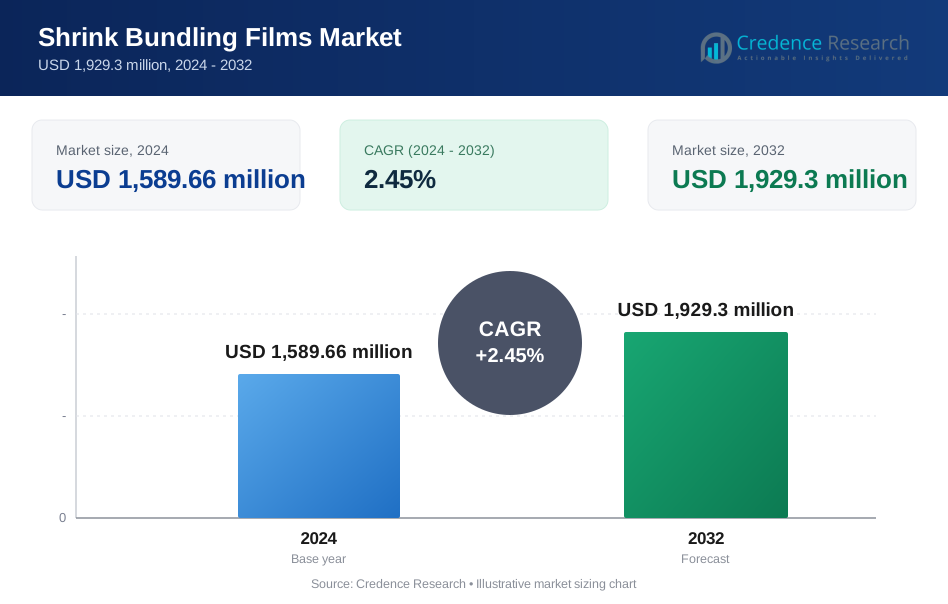
The Shrink Bundling Films Market is projected to grow from USD 1,589.66 million in 2024 to USD 1,929.3 million by 2032, reflecting a compound annual growth rate (CAGR) of 2.45%.
The Shrink Bundling Films Market is driven by the increasing demand for efficient and cost-effective packaging solutions across various industries such as food and beverages, pharmaceuticals, and consumer goods. Trends in the market include a shift towards sustainable and recyclable materials, driven by growing environmental concerns. Additionally, advancements in manufacturing technologies are enhancing the strength and clarity of shrink bundling films, making them more appealing to end-users. The rising popularity of e-commerce is also boosting demand, as these films provide robust protection during shipping and handling, ensuring product integrity and consumer satisfaction.
The Shrink Bundling Films Market features key players such as AEP Industries Inc., Amcor Limited, Bemis Company, Inc., and Berry Plastics Corporation, which dominate due to their extensive production capabilities and global reach. These companies, along with others like Ceisa Packaging SAS, Coveris Holdings S.A., and Novolex, have strong presences in North America and Europe, regions known for their advanced packaging technologies and high demand. Emerging markets in Asia-Pacific and Latin America, represented by firms like Paragon Films Incorporated and Hood Packaging Corporation, are witnessing rapid growth due to increasing industrialization and consumer goods demand. This geographic diversity allows these key players to leverage regional strengths and drive market expansion.
Market Drivers
E-commerce Boom and Supply Chain Optimization
The rapid growth of online shopping has significantly increased the demand for efficient and secure packaging solutions. For instance, retail e-commerce sales are estimated to exceed 6.3 trillion U.S. dollars worldwide in 2024. Shrink bundling films offer a cost-effective and reliable method to bundle multiple items together for shipping, ensuring products reach consumers in optimal condition. Additionally, the focus on improving supply chain efficiency has driven the adoption of these films. They streamline packaging processes, reduce labor costs, and protect products during transportation, contributing to a more effective and resilient logistics framework. The integration of shrink bundling films into e-commerce logistics helps maintain product integrity and enhances overall supply chain performance.
Rising Consumer Demand for Convenience and Cost-Effectiveness
Consumers are increasingly seeking products that are conveniently packaged and easy to handle, driving the demand for shrink bundling films. According to a report, 83 percent of consumers say convenience while shopping is more important to them now compared with five years ago. These films create compact and secure bundles that cater to consumer preferences for ease of use. Moreover, shrink bundling films offer a cost-effective packaging solution compared to other materials, thanks to their high strength-to-weight ratio and efficient application process. This combination of convenience and cost-efficiency makes shrink bundling films an attractive choice for manufacturers looking to meet consumer demands while optimizing their packaging costs.
Customization Options and Specific Applications Driving Demand
Advancements in printing and film technology have enabled the customization of shrink bundling films with branding and product information, enhancing product visibility and consumer appeal. For example, TC Transcontinental offers Integritite™ PCR films, which are sustainable options for shrink bundling, multipack, and case wrap applications for bottles, cans, and jars. This customization is particularly beneficial in competitive markets where product differentiation is crucial. Specific applications further drive the demand for shrink bundling films across different sectors. In the food and beverage industry, these films are used to bundle cans, bottles, and multi-packs for efficient display and transportation. In the consumer goods sector, they package a variety of products like stationery, toys, and personal care items. Pharmaceuticals benefit from the secure packaging of products during distribution, while industrial goods are efficiently bundled for handling and storage. This versatility and adaptability make shrink bundling films an indispensable packaging solution across multiple industries.
Growth in End-Use Industries and Environmental Concerns
Expanding sectors such as food and beverages, consumer goods, and pharmaceuticals heavily rely on efficient packaging solutions provided by shrink bundling films. These films effectively meet the packaging needs of various industries by ensuring secure bundling and protection of products. Furthermore, the industry is increasingly focusing on developing sustainable and eco-friendly shrink bundling films made from recycled materials or biodegradable polymers. This shift aligns with growing environmental consciousness and regulatory pressures, promoting the adoption of greener packaging alternatives that reduce environmental impact.
Market Trends
Sustainability Focus and Customization in Shrink Bundling Films Market
The Shrink Bundling Films Market is increasingly shifting towards sustainability, with a strong emphasis on the use of eco-friendly materials. For instance, manufacturers are prioritizing recycled, biodegradable, or compostable materials to mitigate the environmental impact of packaging. This trend includes efforts to minimize plastic consumption by developing thinner films and exploring alternatives such as paper-based or bio-based shrink films. These eco-conscious innovations not only address environmental concerns but also comply with growing regulatory pressures and consumer demand for greener packaging solutions. Concurrently, customization and branding have become pivotal in the market. Customized shrink films featuring brand logos, product information, and promotional messages are gaining popularity as they enhance product visibility and consumer engagement. Innovative designs and patterns on shrink films are employed to differentiate products on crowded retail shelves, effectively attracting consumers and strengthening brand identity. These trends demonstrate the market’s commitment to combining sustainability with effective marketing strategies to meet evolving consumer expectations.
Technological Advancements and E-commerce Influence Driving Market Evolution
Technological advancements are indeed playing a crucial role in the evolution of the Shrink Bundling Films Market. For instance, shrink bundling films that offer superior product protection during shipping are in high demand to ensure products reach consumers in optimal condition. The development of films with enhanced properties, such as improved shrink performance, puncture resistance, and clarity, is addressing the specific needs of various industries. These advancements are coupled with the increased adoption of automated packaging systems, which improve efficiency, reduce labor costs, and ensure consistent packaging quality. Automation in packaging processes is becoming essential as companies strive to meet high production demands and maintain competitive edges. The influence of e-commerce is another significant driver, as the surge in online shopping has heightened the demand for protective packaging solutions. For example, the exponential growth of e-commerce and online retailing has created significant opportunities for the packaging films market. Shrink bundling films are used extensively in e-commerce for bundling and securing products during transit, contributing to market growth. Ongoing advancements in packaging technology lead to the development of high-performance shrink bundling films with improved properties such as strength, clarity, and sealability. Additionally, there is a focus on developing lightweight films to reduce shipping costs and enhance logistical efficiency. There is a growing preference for lightweight packaging materials like shrink bundling films, as companies aim to reduce packaging waste and transportation costs. The films offer high strength to weight ratios, making them efficient and cost-effective solutions for bundling and protecting products.
Market Challenges Analysis
Environmental Concerns and Raw Material Fluctuations
The Shrink Bundling Films Market faces significant challenges stemming from environmental concerns and raw material fluctuations. Growing awareness about plastic pollution and its detrimental effects on the environment has led to heightened scrutiny of plastic packaging. Consumers are increasingly demanding eco-friendly options, pushing manufacturers to find sustainable alternatives to traditional shrink films. Additionally, stringent regulations on plastic packaging are being enforced globally, compelling companies to innovate and adopt more sustainable practices. These regulatory pressures add complexity and cost to production, as manufacturers must invest in new materials and technologies that meet environmental standards. Concurrently, the volatility of resin prices, particularly polyethylene, which is a primary component of shrink films, poses a considerable challenge. Fluctuations in raw material costs directly impact production expenses and profitability. Supply chain disruptions further exacerbate this issue, leading to shortages and price hikes that affect market stability. These combined pressures require companies to balance sustainability initiatives with cost management to remain competitive.
Technological Advancements and Economic Factors
Technological advancements and economic factors present additional hurdles for the Shrink Bundling Films Market. The development of innovative packaging materials, such as biodegradable films or paper-based alternatives, introduces competition that could potentially disrupt the market. Staying abreast of the latest advancements in film technology and production processes is crucial for manufacturers to maintain a competitive edge. This includes adopting automation and other advanced technologies to improve efficiency and reduce costs. However, economic downturns pose a significant threat to market demand. Recessions can lead to reduced consumer spending, thereby lowering the demand for packaged goods and, consequently, shrink bundling films. Inflation also plays a role in increasing production costs, which can squeeze profit margins and force companies to adjust pricing strategies. Additionally, labor shortages, particularly in skilled labor for film production and packaging operations, impact productivity and efficiency. Rising labor costs further add to production expenses, creating a challenging economic environment for manufacturers. Balancing these economic factors while innovating and meeting regulatory requirements is essential for sustained market growth and stability.
Market Segmentation Analysis:
By Material:
The Shrink Bundling Films Market is segmented by material, with Low Density Polyethylene (LDPE) and Linear Low Density Polyethylene (LLDPE) leading due to their flexibility, durability, and cost-effectiveness. Medium Density Polyethylene (MDPE) and High Density Polyethylene (HDPE) are also significant segments, offering enhanced strength and resistance properties suitable for more demanding applications. Polypropylene is gaining traction for its clarity and high tensile strength, which makes it ideal for showcasing packaged products. Additionally, other plastics such as biodegradable and compostable materials are emerging as eco-friendly alternatives, driven by increasing environmental concerns. These materials cater to various packaging needs, balancing performance, cost, and sustainability considerations, thereby ensuring comprehensive market coverage.
By Thickness:
In terms of thickness, the market is divided into segments below 15 microns, 15 to 25 microns, and above 25 microns. Films below 15 microns are typically used for lightweight and less demanding applications, offering cost savings and material efficiency. The 15 to 25 microns segment is the most versatile, providing a balance between strength and flexibility, making it suitable for a wide range of uses including food and beverage packaging. Films above 25 microns are preferred for heavy-duty applications that require extra durability and protection, such as in transport and logistics. This segmentation allows manufacturers to address specific packaging requirements, ensuring optimal performance across diverse end-use scenarios.
Segments:
Based on Material:
- Low Density Polyethylene (LDPE)
- Linear Low Density Polyethylene (LLDPE)
- Medium Density Polyethylene (MDPE)
- High Density Polyethylene (HDPE)
- Polypropylene
- Other Plastics
Based on Thickness:
- Below 15 microns
- 15 to 25 microns
- Above 25 microns
Based on End Use:
- Food and Beverage
- Cosmetics, Personal Care, and Home Care
- Pharmaceuticals
- Transport and Logistics
- Printing and Publishing
- Other Industrial
Based on the Geography:
- North America
- The U.S.
- Canada
- Mexico
- Europe
- Germany
- France
- The U.K.
- Italy
- Spain
- Rest of Europe
- Asia Pacific
- China
- Japan
- India
- South Korea
- South-east Asia
- Rest of Asia Pacific
- Latin America
- Brazil
- Argentina
- Rest of Latin America
- Middle East & Africa
- GCC Countries
- South Africa
- Rest of the Middle East and Africa
Regional Analysis
North America
North America leads the global shrink bundling films market, commanding a significant 35% market share. This dominant position is primarily driven by the United States and Canada, where robust consumer goods industries and advanced retail sectors fuel the demand for efficient packaging solutions. The region's market is characterized by high adoption rates of innovative shrink film technologies, including those with enhanced strength, clarity, and sustainability features. North America's leadership is further solidified by stringent packaging regulations, which have spurred the development of eco-friendly shrink bundling films. The beverage industry, particularly the bottled water and soft drink segments, remains a key driver of market growth in this region. Additionally, the e-commerce boom has created new opportunities for shrink bundling films in transit packaging applications. Major players in the region are investing heavily in research and development to create thinner, stronger films that reduce material usage while maintaining performance, aligning with the growing demand for sustainable packaging solutions.
Asia-Pacific
Asia-Pacific emerges as the fastest-growing market for shrink bundling films, currently holding a 30% market share and projected to expand at a CAGR of 5.8% over the next five years. This rapid growth is attributed to several factors, including accelerating industrialization, expanding retail sectors, and increasing consumer spending in countries like China, India, and Southeast Asian nations. The region's packaging industry is experiencing a shift towards more sophisticated bundling solutions, driven by the need for product differentiation and enhanced shelf appeal. The food and beverage sector, coupled with the burgeoning e-commerce industry, are primary contributors to the rising demand for shrink bundling films in Asia-Pacific. Local manufacturers are increasingly focusing on producing cost-effective yet high-quality shrink films to meet the diverse needs of the market. Moreover, as sustainability concerns gain traction in the region, there is a growing trend towards the adoption of recyclable and biodegradable shrink film materials.
Key Player Analysis
- AEP Industries Inc.
- Amcor Limited
- Bemis Company, INC
- Berry Plastics Corporation
- Ceisa Packaging SAS
- Coveris Holdings S.A
- Novolex
- Paragon Films Incorporated
- Hood Packaging Corporation
- SIGNODE Industrial Group
- Bollore
- ROBAPAC
Competitive Analysis
In the competitive Shrink Bundling Films Market, leading players such as AEP Industries Inc., Amcor Limited, Bemis Company, Inc., and Berry Plastics Corporation dominate through their extensive production capabilities and innovative product offerings. These companies leverage advanced manufacturing technologies to produce high-quality, durable films that meet diverse industry needs. Amcor and Bemis are noted for their strong focus on sustainability, offering eco-friendly packaging solutions that cater to growing environmental concerns. Berry Plastics and AEP Industries excel in providing cost-effective and customizable film options, enhancing their appeal across various sectors. The competition is intensified by companies like Ceisa Packaging SAS and Coveris Holdings S.A., which emphasize regional market expertise and strategic partnerships to expand their market share. Additionally, firms such as Novolex and Paragon Films Incorporated are investing heavily in research and development to stay ahead of technological advancements and regulatory changes. This dynamic competition drives continuous innovation and improvement in the shrink bundling films market.
Recent Developments
- In May 2024 Coveris completed the acquisition of HADEPOL FLEXO, a flexible packaging company based in Rypin, Poland.
- In April 30, 2024 Novolex announced a strategic investment in OZZI, a reusable systems and container brand. This investment is aimed at bolstering OZZI's growth through Novolex's Eco-Products business unit.
- In January 5, 2024 Hood Packaging Corporation acquired Sumter Packaging Corporation, enhancing its corrugated packaging operations in the Carolinas/Georgia region.
- In June 2024 Hood Container Corporation (a subsidiary) announced plans to acquire the packaging assets of Independent II, expanding its presence in the Kentucky and Ohio region.
- In February 2024 the acquisition of Bolloré Logistics by CEVA Logistics was completed. The Bolloré Logistics brand will be rebranded under CEVA Logistics by the end of 2024.
- In 2023, Berry Global Group, Inc. acquired Reifenhäuser Group, a leading manufacturer of stretch and shrink film solutions. By acquiring Reifenhäuser Group, Berry Global has gained a strong position in the market for food and beverage packaging films made from stretch and shrink materials.
- In 2023, ExxonMobil Corporation and BASF SE have announced their plans to partner in developing new recyclable stretch or shrink film solutions.
- In 2022, Dow, Inc. acquired DowDupont’s Performance Materials business which is known to include a leading global provider of industrial applications’ stretch and shrink films (S&S). Therefore, this acquisition facilitated Dow Inc.’s entry into palletizing/bundling S&S market segment.
- In September 2021, It was during Pack EXPO Las Vegas that Clysar unveiled its Clysar EVO-C confidential shrink film, which can be recycled as it has pre-approval from both the How2Recycle program as well as being considered suitable for shop drop-off label. Clysar EVO-C film is a special security opaque shipping material with UV protection properties that significantly reduce packing weight and space requirements.
- In 2021, Sealed Air Corporation acquired Cryovac Sealed Solutions, a leading manufacturer of shrink films for food and beverages. This acquisition enabled Sealed Air to get a strong foothold in high-performance shrink films.
Market Concentration & Characteristics
The Shrink Bundling Films Market exhibits a moderate to high level of market concentration, with a few dominant players such as AEP Industries Inc., Amcor Limited, and Berry Plastics Corporation leading the industry. These key companies leverage their extensive production capacities, advanced technological capabilities, and comprehensive distribution networks to maintain a competitive edge. The market is characterized by a strong emphasis on innovation, particularly in developing sustainable and recyclable materials to meet increasing environmental regulations and consumer demands. Additionally, product customization and high performance are crucial characteristics, allowing manufacturers to cater to diverse applications across various sectors such as food and beverage, pharmaceuticals, and logistics. The presence of smaller, specialized firms also contributes to the market's dynamism, driving continuous improvements and advancements in film quality and application versatility.
Report Coverage
The research report offers an in-depth analysis based on Material, Thickness, End Use and Geography. It details leading market players, providing an overview of their business, product offerings, investments, revenue streams, and key applications. Additionally, the report includes insights into the competitive environment, SWOT analysis, current market trends, as well as the primary drivers and constraints. Furthermore, it discusses various factors that have driven market expansion in recent years. The report also explores market dynamics, regulatory scenarios, and technological advancements that are shaping the industry. It assesses the impact of external factors and global economic changes on market growth. Lastly, it provides strategic recommendations for new entrants and established companies to navigate the complexities of the market.
Future Outlook
- The market will increasingly focus on developing sustainable and eco-friendly shrink bundling films.
- Advancements in material technology will lead to more durable and lightweight films.
- Automation in production processes will enhance efficiency and reduce costs.
- The rise of e-commerce will boost demand for robust packaging solutions.
- Customization and branding on shrink films will become more prevalent to attract consumers.
- Emerging markets in Asia-Pacific and Latin America will see significant growth due to industrialization.
- Regulatory pressures will drive innovation in biodegradable and recyclable film options.
- Technological integration, such as smart packaging, will enhance product tracking and security.
- Partnerships and acquisitions will increase as companies seek to expand their capabilities and market presence.
- Fluctuations in raw material prices will continue to impact production costs and profitability.
Request a Free Sample
Fill in your details and we'll send you a free sample report.
- Sample data tables & charts
- Research methodology
Market Dynamics
E-commerce Boom and Supply Chain Optimization
The rapid expansion of online retail has increased the need for secure, efficient packaging solutions that protect products during shipping. Shrink bundling films streamline packaging processes, reduce labor costs, and ensure product integrity, making them essential for e-commerce logistics and supply chain efficiency.
Rising Consumer Demand for Convenience and Cost-Effectiveness
Consumers increasingly prefer products that are easy to handle and conveniently packaged. Shrink bundling films create compact, secure bundles and offer a cost-effective alternative to other packaging materials, appealing to manufacturers aiming to optimize packaging costs while meeting consumer expectations.
Customization Options and Specific Applications
Advancements in printing and film technology allow for branding and product information to be added to shrink bundling films, enhancing shelf appeal and differentiation. This customization, along with the films’ versatility across food, beverage, consumer goods, and pharmaceutical sectors, drives broader adoption.
Growth in End-Use Industries and Environmental Concerns
Expanding sectors such as food and beverages, consumer goods, and pharmaceuticals rely on shrink bundling films for secure packaging. Simultaneously, increasing regulatory and consumer pressure for sustainable packaging is driving innovation in recyclable and biodegradable film materials.
Technological Advancements in Film Properties and Automation
Ongoing improvements in film strength, clarity, and puncture resistance, along with the adoption of automated packaging systems, are enhancing the performance and efficiency of shrink bundling films. These advancements help manufacturers meet high production demands and reduce operational costs.
Need a Custom Version of This Report?
Tailor the scope, geography, or segments to your exact requirements.
- Custom geography or segment scope
- Direct access to our analyst team
Frequently Asked Questions
What is the current size of the Shrink Bundling Films Market?
What factors are driving the growth of the Shrink Bundling Films Market?
What are the key segments within the Shrink Bundling Films Market?
What are some challenges faced by the Shrink Bundling Films Market?
Who are the major players in the Shrink Bundling Films Market?
Table of Content
Chapter 1 Market Segmentation
- 1.1 Segmentation Framework
- 1.1.1 Product and Service Classification
- 1.1.2 Application and End-Use Classification
- 1.1.3 Technology and Solution Classification
- 1.1.4 Customer and Distribution Channel Classification
- 1.1.5 Geographic Segmentation
- 1.1.6 Market Segment Definitions and Boundaries
- 1.2 By End Use
- 1.2.1 Food and Beverage
- 1.2.2 Cosmetics, Personal Care, and Home Care
- 1.2.3 Pharmaceuticals
- 1.2.4 Transport and Logistics
- 1.2.5 Printing and Publishing
- 1.2.6 Other Industrial
- 1.3 By Material
- 1.3.1 Low Density Polyethylene (LDPE)
- 1.3.2 Linear Low Density Polyethylene (LLDPE)
- 1.3.3 Medium Density Polyethylene (MDPE)
- 1.3.4 High Density Polyethylene (HDPE)
- 1.3.5 Polypropylene
- 1.3.6 Other Plastics
- 1.4 By Thickness
- 1.4.1 Below 15 microns
- 1.4.2 15 to 25 microns
- 1.4.3 Above 25 microns
Chapter 2 Introduction
- 2.1 Report Objectives and Scope
- 2.2 Product Definition and Industry Terminology
- 2.3 Market Inclusions and Exclusions
- 2.4 Research Process
- 2.4.1 Primary Research and Expert Interviews
- 2.4.2 Secondary Research and Source Review
- 2.4.3 Top-Down and Bottom-Up Estimation
- 2.4.4 Data Triangulation and Verification
- 2.5 Market Size Measurement Basis
- 2.5.1 2024: USD 1,589.66 million → 2032: USD 1,929.3 million
- 2.6 Historical and Forecast Reference Periods
- 2.6.1 Base Year: 2024
- 2.6.2 Forecast Period: 2024-2032
- 2.7 Research Assumptions and Limitations
Chapter 3 Executive Summary
- 3.1 Market Snapshot and Key Findings
- 3.2 Base-Year Market Size, 2024
- 3.3 Forecast Market Size, 2032
- 3.4 Revenue and Volume Growth Outlook
- 3.5 Key Demand and Supply Indicators
- 3.6 Leading Market Segments
- 3.7 Fastest-Growing Market Opportunities
- 3.8 Regional Performance Highlights
- 3.9 Technology and Industry Transformation
- 3.10 Competitive Landscape Summary
- 3.11 Analyst View and Strategic Implications
Chapter 4 Global Shrink Bundling Films Market Trends and Developments
- 4.1 Historical Industry Development
- 4.2 Recent Market Trends and Developments
- 4.3 Demand and Customer Behavior Trends
- 4.4 Technology and Product Innovation
- 4.5 Artificial Intelligence, Automation and Digitalization
- 4.6 Local Manufacturing and Supply Chain Realignment
- 4.7 Industry Partnerships, Mergers and Acquisitions
- 4.8 Sustainability and Circular Economy Developments
- 4.9 Government and Private Sector Investment Trends
- 4.10 Emerging Business Models and Commercialization
- 4.11 Industry Developments and Announcements
Chapter 5 Global Shrink Bundling Films Market Production, Supply and Demand Analysis
- 5.1 Demand Trend and Consumption Analysis
- 5.2 Demand Forecast, 2024-2032
- 5.3 Production and Output Trend
- 5.4 Production and Output Forecast, 2024-2032
- 5.5 Installed Capacity and Capacity Utilization
- 5.6 Company-Wise Production Plants and Statistics
- 5.6.1 Installed Production Capacity
- 5.6.2 Actual Production
- 5.6.3 Planned Capacity and Expansion Targets
- 5.7 Supply Chain Structure and Procurement Trends
- 5.8 Supply-Demand Gap and Bottlenecks
- 5.9 Import Dependence and Sourcing Structure
- 5.10 Contract Manufacturing and Outsourcing
- 5.11 Regional Supply and Demand Concentration
Chapter 6 Global Shrink Bundling Films Market Pricing Analysis
- 6.1 Pricing Structure and Measurement
- 6.2 Historical Pricing Trends
- 6.3 Pricing Outlook, 2024-2032
- 6.4 Average Selling Price and Unit Economics
- 6.5 Pricing by Product and Market Segment
- 6.6 Geographic Pricing Differences
- 6.7 Key Input, Energy, Labor and Logistics Costs
- 6.8 Contract Pricing and Purchasing Models
- 6.9 Pricing Sensitivity and Competitive Positioning
- 6.10 Price, Margin and Profitability Implications
Chapter 7 Global Shrink Bundling Films Market Dynamics
- 7.1 Market Growth Drivers
- 7.1.1 Demand-Side Drivers
- 7.1.2 Technology and Innovation Drivers
- 7.1.3 Infrastructure and Investment Drivers
- 7.1.4 Regulatory and Policy Drivers
- 7.2 Market Restraints
- 7.2.1 Cost and Affordability Constraints
- 7.2.2 Technology and Adoption Barriers
- 7.2.3 Supply Chain and Operational Constraints
- 7.3 Market Challenges
- 7.3.1 Competitive Pressure and Margin Erosion
- 7.3.2 Skills, Infrastructure and Implementation Gaps
- 7.4 Emerging Market Opportunities
- 7.5 Market Dynamics Impact and Time-Horizon Assessment
Chapter 8 Global Shrink Bundling Films Value Chain Analysis
- 8.1 Industry Value Chain Overview
- 8.2 Upstream Suppliers and Critical Inputs
- 8.3 Technology and Component Providers
- 8.4 Manufacturing or Service Delivery
- 8.5 Distribution, Channel Partners and Integrators
- 8.6 Downstream Applications and End Users
- 8.7 Value Addition and Profit Pools
- 8.8 Vertical Integration and Outsourcing
- 8.9 Supplier Concentration and Risk
- 8.10 Supply Chain Localization and Resilience
Chapter 9 Global Shrink Bundling Films Market Regulations and Policies
- 9.1 Relevant Laws, Standards and Compliance Frameworks
- 9.2 Product, Service, Safety and Quality Requirements
- 9.3 Government Policies, Incentives and Subsidies
- 9.4 Imports, Exports and Trade Barriers
- 9.5 Public Procurement and Local Content Requirements
- 9.6 Environmental and Sustainability Compliance
- 9.7 Upcoming Policy Changes and Market Implications
Chapter 10 Global Shrink Bundling Films Market Hotspots and Opportunities
- 10.1 Market Opportunity Mapping and Growth Hotspots
- 10.2 High-Growth Applications and Customer Groups
- 10.3 Underserved Markets and White-Space Opportunities
- 10.4 Emerging Technology and Product Opportunities
- 10.5 New Capacity and Investment Hotspots
- 10.6 Market Entry and Expansion Opportunities
- 10.7 Distribution and Partnership Opportunities
- 10.8 Near-Term and Long-Term Commercial Potential
- 10.9 Opportunity Attractiveness and Execution Risks
Chapter 11 Global Shrink Bundling Films Market Outlook, 2024-2032
- 11.1 Market Size and Analysis
- 11.1.1 Revenue (Market Measurement: 2024: USD 1,589.66 million → 2032: USD 1,929.3 million)
- 11.1.2 Market Volume and Quantity Sold
- 11.1.3 Historical Market Size
- 11.1.4 Base-Year Market Size, 2024
- 11.2 Market Forecast, 2024-2032
- 11.2.1 Revenue Forecast to 2032
- 11.2.2 Volume Forecast to 2032
- 11.2.3 CAGR and Year-on-Year Growth
- 11.2.4 Incremental Revenue Opportunity
- 11.3 Forecast Assumptions and Scenario Analysis
- 11.3.1 Base-Case Forecast
- 11.3.2 Optimistic and Conservative Scenarios
- 11.3.3 Technology, Pricing and Policy Sensitivities
- 11.4 Market Attractiveness and Growth Outlook
Chapter 12 Global Shrink Bundling Films Market Segmentation and Outlook
- 12.1 Segmentation Summary and Market Shares, 2024
- 12.2 Largest and Fastest-Growing Segments
- 12.3 By End Use - Market Size and Forecast, 2024-2032
- 12.3.1 Segment Definition and Scope
- 12.3.2 Historical Market Size
- 12.3.3 Revenue Forecast, 2024-2032
- 12.3.4 Volume Forecast, 2024-2032
- 12.3.5 Base-Year Market Share, 2024
- 12.3.6 Segment CAGR and Growth Drivers
- 12.3.7 Subsegment Market Size and Forecast
- 12.3.7.1 Food and Beverage
- 12.3.7.2 Cosmetics, Personal Care, and Home Care
- 12.3.7.3 Pharmaceuticals
- 12.3.7.4 Transport and Logistics
- 12.3.7.5 Printing and Publishing
- 12.3.7.6 Other Industrial
- 12.3.8 Subsegment Pricing and Adoption Trends
- 12.3.9 Leading Suppliers and Competition
- 12.3.10 Regional Demand and Opportunities
- 12.4 By Material - Market Size and Forecast, 2024-2032
- 12.4.1 Segment Definition and Scope
- 12.4.2 Historical Market Size
- 12.4.3 Revenue Forecast, 2024-2032
- 12.4.4 Volume Forecast, 2024-2032
- 12.4.5 Base-Year Market Share, 2024
- 12.4.6 Segment CAGR and Growth Drivers
- 12.4.7 Subsegment Market Size and Forecast
- 12.4.7.1 Low Density Polyethylene (LDPE)
- 12.4.7.2 Linear Low Density Polyethylene (LLDPE)
- 12.4.7.3 Medium Density Polyethylene (MDPE)
- 12.4.7.4 High Density Polyethylene (HDPE)
- 12.4.7.5 Polypropylene
- 12.4.7.6 Other Plastics
- 12.4.8 Subsegment Pricing and Adoption Trends
- 12.4.9 Leading Suppliers and Competition
- 12.4.10 Regional Demand and Opportunities
- 12.5 By Thickness - Market Size and Forecast, 2024-2032
- 12.5.1 Segment Definition and Scope
- 12.5.2 Historical Market Size
- 12.5.3 Revenue Forecast, 2024-2032
- 12.5.4 Volume Forecast, 2024-2032
- 12.5.5 Base-Year Market Share, 2024
- 12.5.6 Segment CAGR and Growth Drivers
- 12.5.7 Subsegment Market Size and Forecast
- 12.5.7.1 Below 15 microns
- 12.5.7.2 15 to 25 microns
- 12.5.7.3 Above 25 microns
- 12.5.8 Subsegment Pricing and Adoption Trends
- 12.5.9 Leading Suppliers and Competition
- 12.5.10 Regional Demand and Opportunities
- 12.6 Segment Growth Comparison
- 12.7 Segment Attractiveness and Priority Matrix
Chapter 13 Global Shrink Bundling Films End-Use and Application Market Outlook
- 13.1 End-Use Industry and Customer Demand Structure
- 13.2 Leading Applications and Customer Groups
- 13.3 End-Use Market Size, Share and Forecast
- 13.4 Major End-Use Industry Deep Dives
- 13.4.1 Customer Requirements and Use Cases
- 13.4.2 Demand and Replacement Cycles
- 13.4.3 Technical and Regulatory Considerations
- 13.4.4 Purchasing and Procurement Models
- 13.4.5 Leading Vendors and Distribution Channels
- 13.4.6 Forecast and Commercial Opportunities
- 13.5 Emerging Applications and Cross-Segment Demand
- 13.6 End-Use Industry Investment Priorities
Chapter 14 Global Shrink Bundling Films Geographic Market Outlook, 2024-2032
- 14.1 Regional Market Size and Share, 2024
- 14.2 Regional Market Forecast, 2024-2032
- 14.3 Regional Pricing, Production and Demand Differences
- 14.4 North America
- 14.4.1 United States
- 14.4.2 Canada
- 14.4.3 Mexico
- 14.5 Europe
- 14.5.1 Germany
- 14.5.2 France
- 14.5.3 Italy
- 14.5.4 United Kingdom
- 14.5.5 Spain
- 14.5.6 Poland
- 14.5.7 Russia
- 14.5.8 Netherlands
- 14.5.9 Belgium
- 14.5.10 Sweden
- 14.5.11 Denmark
- 14.5.12 Norway
- 14.5.13 Rest of Europe
- 14.6 Asia Pacific
- 14.6.1 China
- 14.6.2 India
- 14.6.3 Japan
- 14.6.4 South Korea
- 14.6.5 Thailand
- 14.6.6 Indonesia
- 14.6.7 Vietnam
- 14.6.8 Malaysia
- 14.6.9 Australia
- 14.6.10 Rest of Asia Pacific
- 14.7 Latin America
- 14.7.1 Brazil
- 14.7.2 Argentina
- 14.7.3 Colombia
- 14.7.4 Chile
- 14.7.5 Rest of Latin America
- 14.8 Middle East
- 14.8.1 Saudi Arabia
- 14.8.2 United Arab Emirates
- 14.8.3 Turkey
- 14.8.4 Israel
- 14.8.5 Iran
- 14.8.6 Rest of the Middle East
- 14.9 Africa
- 14.9.1 South Africa
- 14.9.2 Egypt
- 14.9.3 Nigeria
- 14.9.4 Morocco
- 14.9.5 Rest of Africa
- 14.10 Regional Investment, Policy and Supply Chain Differences
- 14.11 Regional Competitive Landscape
- 14.12 Geographic Growth Hotspots
Chapter 15 Global Shrink Bundling Films Technology, Innovation and Sustainability Outlook
- 15.1 Technology Landscape and Maturity
- 15.2 Product, Process and Service Innovation
- 15.3 AI, Automation and Digital Tools in the Industry
- 15.4 Technology Adoption and Performance Benchmarking
- 15.5 Innovation Pipeline and R&D Investment
- 15.6 Patent and Intellectual Property Trends
- 15.7 Energy Efficiency and Resource Management
- 15.8 Sustainability, Recycling and Circularity
- 15.9 Technology Roadmap, 2024-2032
- 15.10 Risks of Obsolescence and Technology Substitution
Chapter 16 Global Shrink Bundling Films Market Key Strategic Imperatives
- 16.1 Growth and Market Entry Priorities
- 16.2 High-Return Products and Segments
- 16.3 Pricing, Profitability and Cost Optimization
- 16.4 Technology Investment and Product Differentiation
- 16.5 Supply Chain Localization and Resilience
- 16.6 Distribution and Customer Acquisition
- 16.7 Partnership, Acquisition and Capacity Strategy
- 16.8 Regional Expansion Priorities
- 16.9 Short-, Medium- and Long-Term Actions
Chapter 17 Competition Outlook
- 17.1 Industry Competition Characteristics
- 17.2 Market Structure and Concentration
- 17.3 Market Share and Competitive Positioning, 2024
- 17.4 Company-Wise Revenue and Product Benchmarking
- 17.5 Production and Service Capacity Benchmarking
- 17.6 Technology, Pricing and Differentiation
- 17.7 Regional Footprint and Distribution Strength
- 17.8 Mergers, Acquisitions and Strategic Alliances
- 17.9 New Entrants and Competitive Threats
- 17.10 Porter's Five Forces and Industry Attractiveness
- 17.11 Competitive Outlook, 2024-2032
Chapter 18 Company Profiles
- 18.1 Company Coverage and Selection Criteria
- 18.2 AEP Industries Inc.
- 18.2.1 Business Description
- 18.2.2 Company Ownership and Geographic Presence
- 18.2.3 Product and Service Portfolio
- 18.2.4 Manufacturing and Operating Footprint
- 18.2.5 Production Capacity and Expansion Plans
- 18.2.6 Financial Performance and Investment
- 18.2.7 Market Share and Competitive Position
- 18.2.8 Technology and Innovation Capabilities
- 18.2.9 Strategic Alliances or Partnerships
- 18.2.10 Recent Developments
- 18.2.11 Growth Strategy and Outlook
- 18.3 Amcor Limited
- 18.4 Bemis Company, Inc.
- 18.5 Berry Plastics Corporation
- 18.6 Ceisa Packaging SAS
- 18.7 Coveris Holdings S.A.
- 18.8 Novolex
- 18.9 Paragon Films Incorporated
- 18.10 Hood Packaging Corporation
- 18.11 SIGNODE Industrial Group
- 18.12 Other Relevant Market Participants
Note: Every listed company is profiled on the structure shown under the first company. The company list is preliminary and may change based on research findings, market developments, data availability and client requirements.
Chapter 19 Disclaimer
- 19.1 Research and Forecast Disclaimer
- 19.2 Data Source and Estimation Limitations
Note: The depth of individual sections depends on data availability for this market. Volume, capacity, trade and other unit-based metrics are included where applicable.

