
Market Overview:
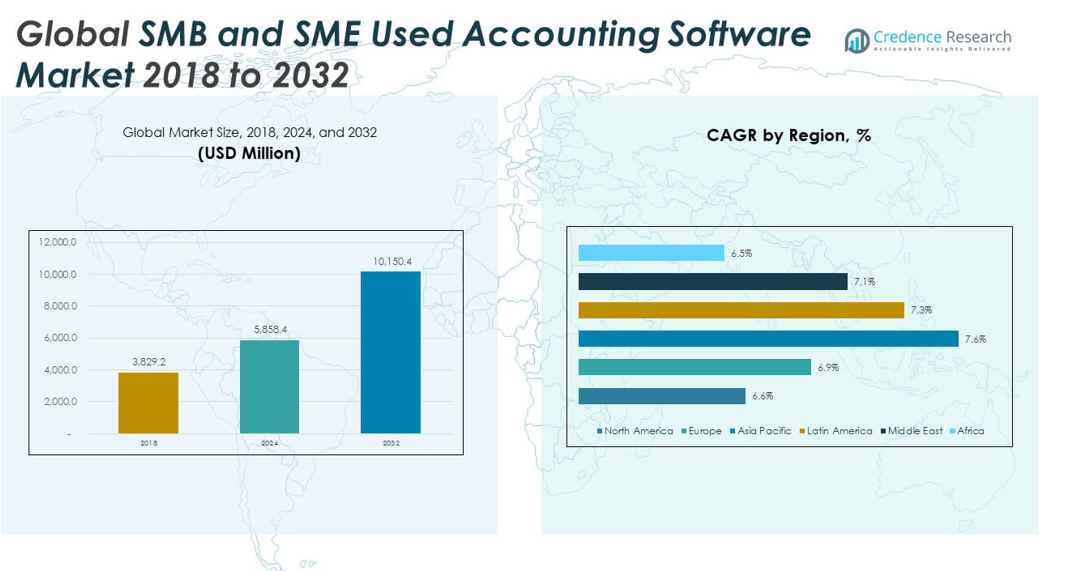
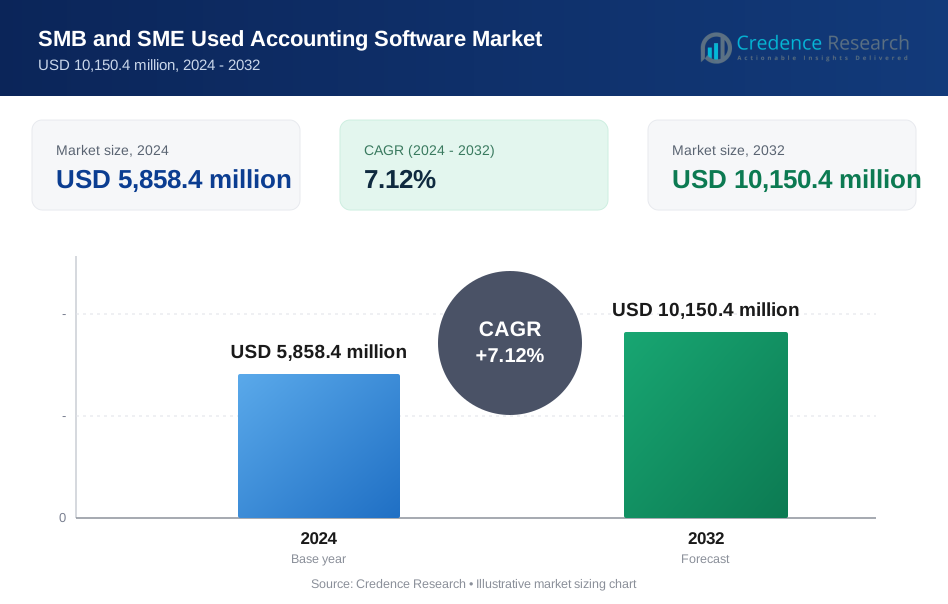
The Global SMB and SME Used Accounting Software Market size was valued at USD 3,829.2 million in 2018 to USD 5,858.4 million in 2024 and is anticipated to reach USD 10,150.4 million by 2032, at a CAGR of 7.12% during the forecast period.
| REPORT ATTRIBUTE | DETAILS |
|---|---|
| Historical Period | 2020-2023 |
| Base Year | 2024 |
| Forecast Period | 2025-2032 |
| SMB and SME Used Accounting Software Market Size 2024 | USD 5,858.4 million |
| SMB and SME Used Accounting Software Market, CAGR | 7.12% |
| SMB and SME Used Accounting Software Market Size 2032 | USD 10,150.4 million |
The market is driven by the growing adoption of cloud-based accounting solutions, which provide cost-effective and scalable options for small and medium-sized businesses. Increasing regulatory compliance requirements and the need for accurate financial reporting are pushing SMBs and SMEs toward automated systems. The integration of AI and machine learning into accounting software enhances data accuracy, streamlines workflows, and supports real-time analytics, further boosting market demand. Additionally, the shift toward remote working has accelerated the adoption of digital accounting platforms.
Regionally, North America leads the market due to strong technology adoption rates and a well-established base of SMBs and SMEs utilizing advanced software tools. Europe follows closely, driven by stringent compliance requirements and a growing preference for automation in financial management. The Asia-Pacific region is emerging as a high-growth market, supported by rapid digital transformation in countries such as India, China, and Southeast Asian economies. Growing internet penetration, rising entrepreneurship, and government initiatives promoting SME digitalization are key factors contributing to this regional expansion.
Market Insights:
- The Global SMB and SME Used Accounting Software Market was valued at USD 5,858.4 million in 2024 and is projected to reach USD 10,150.4 million by 2032, growing at a CAGR of 7.12%.
- Rising adoption of cloud-based accounting platforms is driving market growth by offering scalability, cost efficiency, and remote accessibility.
- Increasing regulatory compliance requirements are boosting demand for automated solutions that ensure accurate reporting and reduce error risks.
- High initial migration costs and limited technical expertise among SMEs are restraining adoption in certain regions.
- Asia Pacific holds the largest market share in 2024, driven by rapid SME digitalization and government-led technology adoption initiatives.
- North America and Europe maintain strong demand due to advanced infrastructure, high cloud penetration, and stringent compliance frameworks.
- Emerging markets in Latin America, the Middle East, and Africa are expected to witness steady growth as internet penetration and digital literacy improve.
Market Drivers:
Growing Adoption of Cloud-Based Accounting Solutions Among SMBs and SMEs
The Global SMB and SME Used Accounting Software Market is experiencing strong growth due to the widespread shift toward cloud-based solutions. Cloud platforms provide scalability, affordability, and ease of access, enabling small and medium-sized enterprises to manage financial operations more efficiently. Businesses can integrate accounting tools with other business applications, improving workflow efficiency. Cloud systems also support remote access, which is critical for modern hybrid and distributed work models. Vendors are enhancing security protocols, ensuring compliance with financial data protection standards. Subscription-based models reduce upfront costs and improve affordability for smaller enterprises. Integration capabilities with third-party apps improve operational efficiency. This transformation is reshaping how SMBs and SMEs handle accounting processes.
- For example, Xero offers cloud benefits, leveraging Amazon Web Services with bank-level AES encryption for both data at rest and in transit, enhancing security while enabling automated backups for over 3 million global users. These platforms integrate seamlessly with more than 1,000 third-party apps, improving workflow efficiency and supporting remote access in distributed work environment.
Increasing Regulatory Compliance Requirements and Financial Transparency
Stringent financial reporting regulations are pushing SMBs and SMEs to adopt more advanced accounting software. Governments and industry regulators are enforcing compliance with tax laws, audit requirements, and reporting standards. The Global SMB and SME Used Accounting Software Market benefits from solutions that automate compliance tracking, reducing human error. Automated systems generate accurate reports in real time, enhancing transparency for stakeholders. Advanced compliance features help businesses avoid penalties and maintain credibility. Industry-specific regulations are also driving demand for specialized accounting modules. It is enabling businesses to maintain consistency in reporting across jurisdictions. This driver ensures long-term demand for robust accounting tools.
- For instance, Sage Intacct automates the generation of audit-ready reports meeting SOC 1, SOC 2, GAAP, and IFRS standards, substantially decreasing manual data entry and errors.
Integration of AI and Machine Learning in Accounting Platforms
AI and machine learning are revolutionizing accounting software capabilities. The Global SMB and SME Used Accounting Software Market is seeing rapid integration of predictive analytics, anomaly detection, and intelligent automation. AI-powered tools identify patterns in financial data, enabling better forecasting and budgeting. Machine learning algorithms improve over time, enhancing accuracy in reconciliation and reporting. Automation reduces repetitive manual tasks, freeing accountants to focus on strategic decision-making. AI also supports fraud detection by flagging irregular transactions in real time. Businesses gain a competitive edge through data-driven insights generated from AI-enhanced platforms. This technological evolution is a key growth driver.
Rising Demand for Remote Access and Mobile-Enabled Accounting Tools
The shift toward flexible work arrangements is increasing the demand for mobile and remote-access accounting platforms. The Global SMB and SME Used Accounting Software Market benefits from solutions that allow secure access from any location. Mobile applications enable business owners to monitor cash flow, approve transactions, and track expenses on the go. Cloud synchronization ensures real-time updates across devices. Vendors are introducing intuitive mobile interfaces to appeal to non-technical users. It is enhancing convenience for small teams operating without dedicated accounting departments. Mobile-enabled accounting also supports collaboration between accountants and business owners. This driver aligns with broader trends in workplace digitization.
Market Trends:
Expansion of Industry-Specific Accounting Solutions for Niche Sectors
Vendors are developing industry-specific accounting platforms tailored to niche markets such as healthcare, retail, and manufacturing. The Global SMB and SME Used Accounting Software Market benefits from solutions designed to address unique operational and compliance needs. Custom modules handle specialized billing formats, inventory tracking, and sector-specific tax structures. These platforms improve operational efficiency by reducing customization costs for end users. Vendors gain a competitive advantage by targeting underserved sectors. Adoption rates are higher in industries with complex regulatory frameworks. It is creating opportunities for vendors to expand into vertical-focused markets. This trend strengthens long-term customer retention.
Growing Use of Embedded Analytics and Business Intelligence Features
Accounting software is evolving beyond basic bookkeeping to incorporate advanced analytics and reporting tools. The Global SMB and SME Used Accounting Software Market is seeing strong demand for solutions with built-in dashboards and visual data insights. Embedded analytics enables decision-makers to track KPIs directly within the accounting platform. These tools help identify profitability trends, cash flow issues, and operational inefficiencies. Businesses gain a deeper understanding of financial performance without requiring external BI tools. Vendors are enhancing customization options for dashboards to suit different user roles. It is increasing the strategic value of accounting platforms. This trend is accelerating market growth.
- For instance, Power BI, embedded within accounting platforms like Microsoft Dynamics 365, offers customizable dashboards that visualize cash flow, profitability, and expense metrics, enabling instant viewing of trends and KPIs.
Emphasis on Automation for End-to-End Financial Processes
Automation is emerging as a dominant trend in the accounting software industry. The Global SMB and SME Used Accounting Software Market is shifting toward fully automated invoicing, expense tracking, and bank reconciliation. Automated workflows reduce the time and resources needed for repetitive tasks. Businesses benefit from improved accuracy and faster processing times. Vendors are also integrating payment gateways and automated reminders to streamline collections. Automation helps SMBs and SMEs focus on growth rather than manual accounting operations. It is driving higher satisfaction among users. This trend positions automation as a core feature in future product offerings.
- For example, Brex’s automated invoice processing platform captures and categorizes invoices instantly, with AI-driven approval routing and payment scheduling. It reduces manual effort, minimizes late fees, and improves cash flow management through streamlined accounts payable workflows.
Rising Importance of Data Security and Cybersecurity Features
Cybersecurity is a growing priority for SMBs and SMEs handling sensitive financial data. The Global SMB and SME Used Accounting Software Market is witnessing strong demand for solutions with multi-factor authentication, encryption, and secure cloud storage. Data breaches can have severe financial and reputational consequences for small businesses. Vendors are investing in advanced threat detection and intrusion prevention systems. Compliance with data protection laws such as GDPR is influencing feature development. It is reassuring customers about the safety of their financial records. This trend aligns with the increasing digitization of financial operations. Enhanced security is becoming a major purchase criterion.
Market Challenges Analysis:
High Initial Transition Costs and Limited Technical Expertise
Small and medium-sized businesses often face challenges when transitioning from manual or outdated systems to modern accounting platforms. The Global SMB and SME Used Accounting Software Market is affected by resistance to change due to budget constraints and perceived complexity. Migration costs, including data transfer and employee training, can be significant. Many SMBs and SMEs lack dedicated IT departments, slowing the adoption process. It is especially challenging for businesses in developing regions with limited digital literacy. The learning curve for advanced software features can also discourage adoption. Vendors must address these barriers with simplified onboarding and affordable pricing models.
Fragmented Market and Interoperability Issues
The accounting software market is highly fragmented, with numerous vendors offering varied capabilities. The Global SMB and SME Used Accounting Software Market is impacted by interoperability challenges between different platforms. Businesses using multiple tools often face integration issues, resulting in inefficiencies. Lack of standardization in data formats can complicate migration between systems. Vendors must ensure compatibility with existing business applications to remain competitive. It is creating complexity for SMBs and SMEs seeking seamless operations. The fragmentation also increases competition, putting pressure on pricing strategies and margins. Overcoming these challenges is essential for sustainable market growth.
Market Opportunities:
Rising Demand in Emerging Economies Driven by Digitalization
Emerging markets present strong growth potential for vendors targeting small and medium-sized enterprises. The Global SMB and SME Used Accounting Software Market is positioned to benefit from increasing internet access and government-led digital transformation initiatives. Businesses in Asia-Pacific, Latin America, and parts of Africa are adopting digital accounting tools to improve efficiency. Vendors can leverage localized solutions to cater to specific regulatory and cultural needs. It is also an opportunity to expand market share through strategic partnerships with local service providers. This trend will create a steady demand pipeline for cost-effective solutions in high-growth economies.
Expansion Through AI-Powered Value-Added Services
AI-driven features present significant opportunities for product differentiation. The Global SMB and SME Used Accounting Software Market is likely to benefit from vendors offering predictive analytics, cash flow forecasting, and fraud detection as integrated services. Businesses are increasingly seeking software that delivers actionable insights alongside basic accounting functions. Vendors can generate recurring revenue through premium AI-enabled modules. It is also enabling cross-selling opportunities for complementary business management tools. The ability to offer personalized, data-driven recommendations will strengthen customer loyalty and retention rates across diverse market segments.
Market Segmentation Analysis:
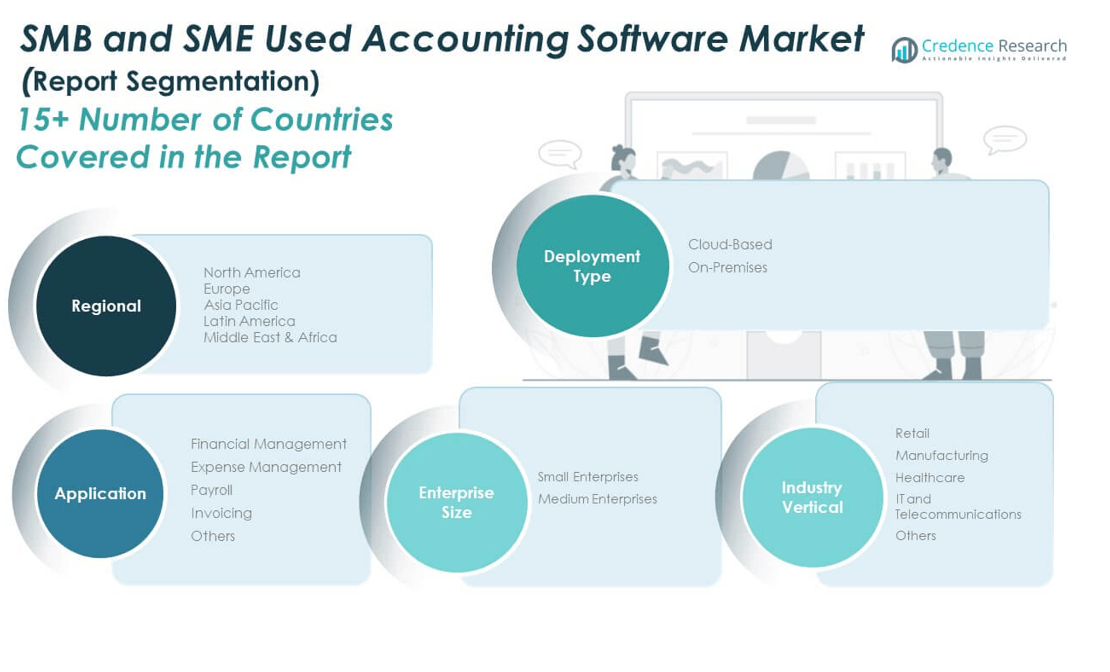
The Global SMB and SME Used Accounting Software Market is segmented
By deployment type into cloud-based and on-premises solutions. Cloud-based platforms dominate due to their scalability, cost efficiency, and ease of integration with other business systems, while on-premises deployments remain relevant for enterprises requiring strict data control and customized infrastructure.
- For example, Sage 300 is a prominent on-premises accounting solution for enterprises needing strict data control and customized infrastructure. It supports organization-wide financial management for complex environments where data sovereignty and physical control are required.
By application, the market includes financial management, expense management, payroll, invoicing, and others. Financial management solutions hold a significant share, driven by the need for accurate reporting and compliance, while invoicing and payroll modules are gaining traction due to automation and regulatory alignment. Expense management tools are increasingly adopted to streamline cost tracking and improve operational visibility.
By enterprise size segment comprises small and medium enterprises. Small enterprises favor affordable, user-friendly solutions with minimal IT requirements, while medium enterprises demand more comprehensive systems with advanced analytics and integration capabilities.
By end user industry, the market serves retail, manufacturing, healthcare, IT and telecommunications, and others. Retail businesses seek solutions for real-time transaction tracking and inventory integration, manufacturing enterprises require cost control and production-linked accounting, healthcare providers prioritize compliance and billing accuracy, and IT and telecommunications firms value scalable, cloud-ready platforms for multi-location operations.
- For example, Epicor ERP's Tax Connect module automates accurate sales tax calculation and compliance for over 14,500 North American jurisdictions, supporting production-linked financial management for multi-location manufacturers.
Segmentation:
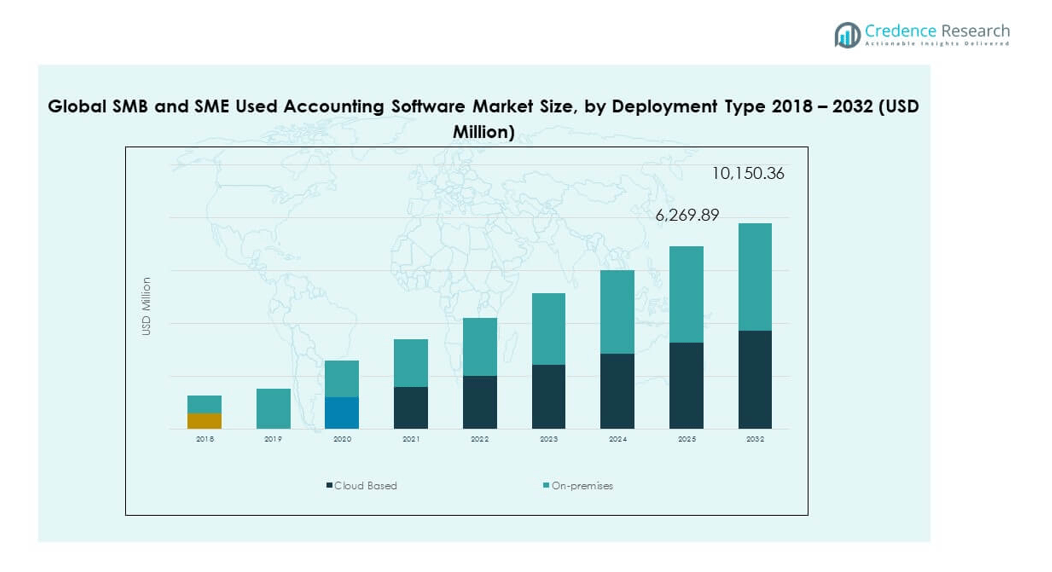
By Deployment Type
- Cloud-Based
- On-Premises
By Application
- Financial Management
- Expense Management
- Payroll
- Invoicing
- Others
By Enterprise Size
- Small Enterprises
- Medium Enterprises
By End User Industry
- Retail
- Manufacturing
- Healthcare
- IT and Telecommunications
- Others
By Region
- North America
- U.S.
- Canada
- Mexico
- Europe
- UK
- France
- Germany
- Italy
- Spain
- Russia
- Belgium
- Netherlands
- Austria
- Sweden
- Poland
- Denmark
- Switzerland
- Rest of Europe
- Asia Pacific
- China
- Japan
- South Korea
- India
- Australia
- Thailand
- Indonesia
- Vietnam
- Malaysia
- Philippines
- Taiwan
- Rest of Asia Pacific
- Latin America
- Brazil
- Argentina
- Peru
- Chile
- Colombia
- Rest of Latin America
- Middle East
- UAE
- KSA
- Israel
- Turkey
- Iran
- Rest of Middle East
- Africa
- Egypt
- Nigeria
- Algeria
- Morocco
- Rest of Africa
Regional Analysis:
North America
The North America Global SMB and SME Used Accounting Software Market size was valued at USD 906.38 million in 2018 to USD 1,347.25 million in 2024 and is anticipated to reach USD 2,243.23 million by 2032, at a CAGR of 6.6% during the forecast period. North America holds a 23.0% share of the global market in 2024. It benefits from a mature digital infrastructure, high cloud adoption rates, and a strong base of SMBs and SMEs actively using advanced accounting solutions. Businesses in the U.S. and Canada are prioritizing automation and AI integration to enhance financial accuracy and reduce operational costs. Regulatory compliance requirements, such as GAAP and tax reporting standards, are pushing companies toward reliable and feature-rich platforms. The region also has a high presence of major global vendors, offering both cloud-based and on-premises solutions tailored to different industries. It is witnessing demand for mobile-enabled applications to support remote operations. Increasing cybersecurity investments are further influencing software adoption. This environment positions North America as a consistent revenue contributor to the global market.
Europe
The Europe Global SMB and SME Used Accounting Software Market size was valued at USD 1,059.55 million in 2018 to USD 1,601.42 million in 2024 and is anticipated to reach USD 2,729.43 million by 2032, at a CAGR of 6.9% during the forecast period. Europe accounts for 27.3% of the global market in 2024. The region benefits from stringent financial compliance frameworks such as IFRS, driving adoption among SMEs seeking to maintain transparent reporting standards. Countries like the UK, Germany, and France are leading in deployment of industry-specific accounting tools, while emerging economies in Eastern Europe are rapidly digitalizing their financial processes. The market is influenced by government incentives supporting SME digital transformation. It is also shaped by a rising preference for localized software with multi-language and multi-currency support. Cloud-based deployments dominate, though on-premises solutions remain relevant for regulated industries. Vendor competition is intensifying, with many players offering scalable packages for growing enterprises. This diverse demand profile supports steady regional expansion.
Asia Pacific
The Asia Pacific Global SMB and SME Used Accounting Software Market size was valued at USD 1,365.89 million in 2018 to USD 2,148.18 million in 2024 and is anticipated to reach USD 3,857.14 million by 2032, at a CAGR of 7.6% during the forecast period. Asia Pacific holds a 36.7% share of the global market in 2024, making it the largest regional contributor. Rapid digital transformation in countries such as China, India, and Japan is driving significant demand. Government-led SME digitalization programs, combined with the increasing availability of affordable cloud solutions, are accelerating adoption. The region has a growing base of startups and mid-sized companies seeking efficient accounting tools for scalability. It is also witnessing increased integration of mobile accounting apps to cater to the high smartphone penetration rate. Industry-specific solutions for manufacturing, retail, and services are gaining traction. Local vendors are expanding aggressively, competing with global players by offering cost-effective and culturally adapted platforms. This growth trajectory is expected to continue with rising entrepreneurial activity.
Latin America
The Latin America Global SMB and SME Used Accounting Software Market size was valued at USD 285.28 million in 2018 to USD 441.97 million in 2024 and is anticipated to reach USD 778.53 million by 2032, at a CAGR of 7.3% during the forecast period. Latin America contributes 7.5% to the global market in 2024. The region is gradually increasing its adoption of accounting software as SMEs modernize their operations to improve efficiency and meet tax compliance requirements. Brazil and Mexico are leading markets, with government-led e-invoicing mandates accelerating software deployment. Cloud adoption is growing, though on-premises systems are still prevalent in sectors with lower internet penetration. It is witnessing interest in mobile-enabled solutions that cater to field-based operations. Local software providers are strengthening their offerings to compete with global brands. Economic volatility in some countries has pushed businesses to seek tools that improve cash flow visibility and cost control. This demand supports moderate yet consistent growth.
Middle East
The Middle East Global SMB and SME Used Accounting Software Market size was valued at USD 123.68 million in 2018 to USD 188.72 million in 2024 and is anticipated to reach USD 325.83 million by 2032, at a CAGR of 7.1% during the forecast period. The Middle East holds a 3.2% share of the global market in 2024. The adoption rate is increasing in Gulf Cooperation Council (GCC) countries, driven by economic diversification programs and tax reforms such as VAT implementation. Businesses are investing in modern accounting tools to align with new compliance frameworks. Cloud deployments are gaining momentum, particularly among SMEs in the UAE and Saudi Arabia. It is also experiencing growth in mobile accounting solutions to serve geographically dispersed workforces. Vendors are offering Arabic-language interfaces and regional customization to appeal to local users. Expansion of e-commerce and service-based sectors is boosting demand. The region’s high-growth potential lies in its underpenetrated SME segment.
Africa
The Africa Global SMB and SME Used Accounting Software Market size was valued at USD 88.46 million in 2018 to USD 130.81 million in 2024 and is anticipated to reach USD 216.20 million by 2032, at a CAGR of 6.5% during the forecast period. Africa accounts for 2.2% of the global market in 2024. Market growth is influenced by a gradual increase in SME digitalization, particularly in South Africa, Nigeria, and Egypt. Limited infrastructure and internet connectivity remain challenges, but mobile accounting solutions are helping to bridge the gap. The demand is rising among SMEs in retail, manufacturing, and professional services for affordable and easy-to-use platforms. It is also seeing increased interest in cloud-based tools as internet penetration improves. Government-led initiatives to formalize small businesses are encouraging adoption. Local and regional vendors are tailoring offerings to meet budget constraints. This trend is expected to support steady but gradual growth in the region.
Key Player Analysis:
- Intuit Inc.
- Sage Group plc
- Xero Limited
- Oracle Corporation
- Microsoft Corporation
- FreshBooks
- Zoho Corporation
- Wave Financial Inc.
- QuickBooks
- NetSuite Inc.
- MYOB Group Pty Ltd
- Infor
- Epicor Software Corporation
- Acumatica, Inc.
- Other Key Players
Competitive Analysis:
The Global SMB and SME Used Accounting Software Market is characterized by intense competition among global and regional vendors offering diversified solutions across cloud-based and on-premises models. Leading players such as Intuit Inc., Sage Group plc, Xero Limited, Oracle Corporation, and Microsoft Corporation hold strong market positions through robust product portfolios, brand recognition, and continuous innovation. Vendors are focusing on AI-driven automation, mobile accessibility, and industry-specific modules to differentiate their offerings. Strategic mergers, acquisitions, and partnerships are expanding market reach and capabilities. It is also witnessing increased participation from emerging software providers targeting niche segments with cost-effective, customizable platforms. Competitive dynamics are shaped by technological advancements, compliance requirements, and evolving SME needs.
Recent Developments:
- In July 2025, Intuit Inc. announced the launch of its new App Partner Program to boost growth for third-party developers and enhance customer experiences for small and mid-market businesses using QuickBooks and Intuit Enterprise Suite. The program offers improved developer access to new APIs and go-to-market support, aiming to deepen integrations and accelerate innovation in the accounting software ecosystem.
- In June 2025, Sage Group plc launched its new high-performance finance software at the Sage Future 2025 event in Atlanta. Highlighted by advanced AI-powered capabilities, Sage's initiatives also included the launch of Sage Copilot for audit-grade automation and a strategic partnership with the LPGA as its official finance software partner.
- In April 2025, Intuit revealed its acquisition of GoCo, a leading HR and benefits platform. This move significantly expands Intuit’s Payroll and Enterprise Suite offerings for SMBs, delivering comprehensive human capital management capabilities and consolidating financial and HR operations for customers in the U.S., especially those on Premium or Elite Payroll.
Market Concentration & Characteristics:
The Global SMB and SME Used Accounting Software Market exhibits moderate to high concentration, with a few major vendors accounting for a significant revenue share. It is defined by rapid technological evolution, strong adoption of cloud platforms, and integration of analytics to enhance decision-making. Vendor differentiation is driven by pricing flexibility, scalability, and user-friendly design. The market is also marked by the presence of agile regional players catering to localized needs, creating a balance between global standardization and regional customization. Increasing regulatory compliance requirements are reinforcing the demand for reliable and feature-rich platforms. Continuous innovation in AI-powered functionalities is expected to intensify competition and shape future market dynamics.
Report Coverage:
The research report offers an in-depth analysis based on Deployment Type, Application, Enterprise Size and End User Industry. It details leading market players, providing an overview of their business, product offerings, investments, revenue streams, and key applications. Additionally, the report includes insights into the competitive environment, SWOT analysis, current market trends, as well as the primary drivers and constraints. Furthermore, it discusses various factors that have driven market expansion in recent years. The report also explores market dynamics, regulatory scenarios, and technological advancements that are shaping the industry. It assesses the impact of external factors and global economic changes on market growth. Lastly, it provides strategic recommendations for new entrants and established companies to navigate the complexities of the market.
Future Outlook:
- Cloud adoption will expand further, driven by the demand for flexible, scalable, and cost-efficient accounting solutions.
- AI and machine learning integration will enhance predictive analytics, automation, and fraud detection capabilities.
- Mobile-enabled platforms will see higher uptake, supporting remote and on-the-go financial management.
- Industry-specific solutions will gain traction, catering to the unique compliance and operational needs of various sectors.
- Data security enhancements will remain a critical priority to address growing cybersecurity threats.
- Vendor partnerships with fintech and ERP providers will create more integrated financial ecosystems.
- Emerging markets will contribute significantly to growth through SME digitalization initiatives.
- Subscription-based pricing models will attract cost-sensitive small enterprises seeking lower upfront investments.
- Advanced reporting and visualization tools will increase the strategic role of accounting platforms in decision-making.
- Competitive pressures will accelerate innovation, driving the launch of more user-friendly and customizable solutions.
Request a Free Sample
Fill in your details and we'll send you a free sample report.
- Sample data tables & charts
- Research methodology
Need a Custom Version of This Report?
Tailor the scope, geography, or segments to your exact requirements.
- Custom geography or segment scope
- Direct access to our analyst team
Frequently Asked Questions
What is the current market size for Global SMB and SME Used Accounting Software Market, and what is its projected size in 2032?
At what Compound Annual Growth Rate is the Global SMB and SME Used Accounting Software Market projected to grow between 2024 and 2032?
What are the primary factors fueling the growth of the Global SMB and SME Used Accounting Software Market?
Who are the leading companies in the Global SMB and SME Used Accounting Software Market?
Table of Content
Chapter 1. Report Introduction
- 1.1 Report Description & Purpose
- 1.1.1 Report Title & Market Definition
- 1.1.2 Unique Selling Propositions (USP) & Key Differentiators
- 1.1.3 Value Proposition for Stakeholders
- 1.2 Research Objectives
- 1.2.1 Market Sizing Objectives (Volume & Revenue) (Volume Where Applicable)
- 1.2.2 Segmentation Objectives
- 1.2.3 Competitive Intelligence Objectives
- 1.2.4 Forecast & Scenario Objectives
- 1.3 Report Scope
- 1.3.1 SMB and SME Used Accounting Software Scope – Segments & Subsegments Covered
- 1.3.2 Geographic Scope – Regions & Countries Covered
- 1.3.3 Historical Period, Base Year & Forecast Period (2024; forecast to 2032)
- 1.3.4 Inclusions & Exclusions
- 1.4 Industry Classification & Applicable Codes
- 1.5 Currency, Measurement Units & Valuation Basis
- 1.6 Target Stakeholders
- 1.7 Limitations & Assumptions
Chapter 2. Executive Summary
- 2.1 Global SMB and SME Used Accounting Software Market Snapshot
- 2.1.1 Market Size – Historical (2024) & Forecast (2024-2032) (2024: USD 5,858.4 million → 2032: USD 10,150.4 million)
- 2.1.2 Volume & Revenue – Global Totals (Volume Where Applicable)
- 2.1.3 Key Market Highlights – Top Five Facts
- 2.2 SMB and SME Used Accounting Software Market Segmentation Snapshot
- 2.2.1 Market Split by Region – 2024 vs. 2032
- 2.3 Competitive Snapshot
- 2.3.1 Top 10 Players by Revenue Share – 2024
- 2.3.2 Top 10 Players by Volume Share – 2024 (Volume Where Applicable)
- 2.3.3 Recent Strategic Developments (18-Month Summary)
- 2.4 Key Investment Highlights & Strategic Conclusions
Chapter 3. SMB and SME Used Accounting Software Market Dynamics & Industry Analysis
- 3.1 Market Overview & Context
- 3.1.1 SMB and SME Used Accounting Software Market Position in the Broader Industry Value Chain
- 3.1.2 Demand Structure & Purchasing Dynamics
- 3.1.3 Market Maturity & Development Stage by Region
- 3.2 SMB and SME Used Accounting Software Market Drivers
- 3.3 SMB and SME Used Accounting Software Market Restraints & Challenges
- 3.4 SMB and SME Used Accounting Software Market Opportunities
- 3.5 Porter's Five Forces Analysis
- 3.5.1 Threat of New Entrants
- 3.5.2 Bargaining Power of Suppliers
- 3.5.3 Bargaining Power of Buyers
- 3.5.4 Threat of Substitutes
- 3.5.5 Competitive Rivalry – Intensity Assessment
- 3.6 SMB and SME Used Accounting Software Value Chain Analysis
- 3.6.1 Upstream – Key Inputs, Resources & Suppliers
- 3.6.1.1 Key Input/Resource 1
- 3.6.1.2 Key Input/Resource 2
- 3.6.1.3 Key Input/Resource 3
- 3.6.2 Midstream – Core Operations & Value Creation
- 3.6.2.1 Operating Model & Process Overview
- 3.6.2.2 Key Operating Locations & Capabilities by Company
- 3.6.3 Downstream – Market Channels & End Users
- 3.6.3.1 Direct Sales & Customer Engagement Channels
- 3.6.3.2 Indirect Sales, Intermediaries & Partner Channels
- 3.6.4 Value Chain Profitability Analysis
- 3.6.1 Upstream – Key Inputs, Resources & Suppliers
- 3.7 PESTEL Analysis
- 3.7.1 Political Factors
- 3.7.2 Economic Factors
- 3.7.3 Social Factors
- 3.7.4 Technological Factors
- 3.7.5 Environmental Factors
- 3.7.6 Legal Factors
- 3.8 SMB and SME Used Accounting Software Supply Chain Analysis
- 3.8.1 Critical Input & Resource Availability Risk Assessment
- 3.8.2 Supplier & Operational Concentration Risk (Geographic Exposure)
- 3.8.3 Supply & Service Disruption Impact Analysis
- 3.9 Regulatory & Policy Landscape
Note: The regulatory and policy landscape section covers regulations based on their applicability to the market, SMB and SME Used Accounting Software category, geography, and scope of the study. Only regulatory frameworks with a material impact on operations, compliance, trade, sustainability, or market access are analyzed in detail.
Chapter 4. Key Investment Pockets & Opportunity Analysis
- 4.1 SMB and SME Used Accounting Software Market Attractiveness Analysis
- 4.1.1 By Region – Investment Attractiveness Matrix (Market Size × CAGR)
- 4.2 Absolute Revenue Growth Opportunity
- 4.2.1 By Region – Absolute Revenue Growth Through 2032
- 4.3 Incremental Demand Opportunity
- 4.3.1 By Region – Incremental Demand Through 2032
- 4.3.2 Segment – Incremental Demand
- 4.4 Emerging Submarket Opportunity Deep Dive (Subject to Applicability)
- 4.5 Priority Market Opportunity Scorecards
- 4.5.1 United States
- 4.5.2 Europe
- 4.5.3 Asia
- 4.5.4 Middle East & Africa
Note: Priority market opportunity scorecards reflect the geographic scope and strategic relevance of the study. Listed markets are indicative and may be adapted to the industry.
Chapter 5. SMB and SME Used Accounting Software Cross-Border Trade & Market Access Analysis
- 5.1 International Trade & Cross-Border Activity Overview
- 5.1.1 Global Export Value by Country (2024)
- 5.1.2 Global Export Volume by Country (2024) (Volume Where Applicable)
- 5.1.3 Global Import Value by Country (2024)
- 5.1.4 Global Import Volume by Country (2024) (Volume Where Applicable)
- 5.1.5 Net Trade Balance by Country (2024)
- 5.2 Export Analysis – Segment
- 5.2.1 Category 1 (Applicable Classification Code)
- 5.2.2 Category 2 (Applicable Classification Code)
- 5.2.3 Category 3 (Applicable Classification Code)
- 5.2.4 Category 4 (Applicable Classification Code)
- 5.2.5 Category 5 (Applicable Classification Code)
- 5.3 Import Analysis – Segment
- 5.3.1 Category 1 (Applicable Classification Code)
- 5.3.2 Category 2 (Applicable Classification Code)
- 5.3.3 Category 3 (Applicable Classification Code)
- 5.3.4 Category 4 (Applicable Classification Code)
- 5.3.5 Category 5 (Applicable Classification Code)
- 5.4 Cross-Border Pricing & Transaction Benchmarks
- 5.4.1 Export Pricing – Segment & Country
- 5.4.2 Import Pricing – Segment & Source Country
- 5.4.3 Price Trends (2024)
- 5.5 Key Cross-Border Trade & Delivery Routes
- 5.5.1 Cross-Border Trade/Delivery Route 1
- 5.5.2 Cross-Border Trade/Delivery Route 2
- 5.5.3 Cross-Border Trade/Delivery Route 3
- 5.5.4 Cross-Border Trade/Delivery Route 4
- 5.5.5 Cross-Border Trade/Delivery Route 5
- 5.6 Trade Policy & Market Access Impact Assessment
- 5.6.1 Tariff & Non-Tariff Barriers
- 5.6.2 Regional Trade & Economic Integration Frameworks
- 5.6.3 Bilateral & Multilateral Trade Agreements
- 5.6.4 Cross-Border Operating, Licensing & Localization Requirements
Note: This chapter applies where cross-border trade or delivery is relevant to SMB and SME Used Accounting Software. Goods, services, and digital offerings are assessed using applicable classifications and transaction measures. Import-export volumes, trade balances, and route analyses are included only where meaningful to the market.
Chapter 6. Competitive Landscape & Company Benchmarking
- 6.1 SMB and SME Used Accounting Software Market Concentration & Structure
- 6.1.1 Herfindahl-Hirschman Index (HHI) – vs. 2024
- 6.1.2 Leading, Mid-Sized & Emerging Player Structure
- 6.1.3 Global, Regional & Local Player Dynamics
- 6.2 SMB and SME Used Accounting Software Market Share Analysis – 2024
- 6.2.1 Global Revenue Share by Company
- 6.2.2 Global Volume Share by Company (Volume Where Applicable)
- 6.2.3 Regional Revenue Share
- 6.2.4 Market Share Evolution ( vs. 2024)
- 6.2.5 Company Market Share by Key Segment
- 6.2.6 Company Market Share by Customer Group
- 6.3 Operating Scale, Capacity & Infrastructure Analysis
- 6.3.1 Global Operating Scale & Supply Capacity
- 6.3.2 Resource Utilization & Operating Efficiency
- 6.3.3 Output, Service Delivery & Activity Metrics
- 6.3.4 Operating Footprint & Infrastructure Map
- 6.3.5 Planned Operational & Capacity Expansion
- 6.4 SMB and SME Used Accounting Software Competitive Benchmarking Matrix
- 6.4.1 Revenue, Growth, Profitability & Operating Metric Comparison
- 6.4.2 Channel Revenue Mix
- 6.4.3 Geographic Revenue Exposure
- 6.4.4 R&D Intensity
- 6.4.5 Sustainability Maturity
- 6.5 Strategic Developments in SMB and SME Used Accounting Software (Last 24 Months)
- 6.5.1 Mergers, Acquisitions & Divestments
- 6.5.2 New Products, Services & Solutions in SMB and SME Used Accounting Software
- 6.5.3 Operational & Infrastructure Expansions
- 6.5.4 Strategic Alliances, Joint Ventures & Partnerships
- 6.5.5 Distribution Expansion & Market Entry
- 6.5.6 Sustainability & ESG Initiatives
- 6.6 Competitive Strategy Mapping
- 6.6.1 Leader, Challenger, Follower & Niche Classification
- 6.6.2 Pricing Strategy Comparison
- 6.6.3 Channel Strategy Matrix
Note: Strategic developments are included based on their materiality and the availability of reliable information.
Chapter 7. Global SMB and SME Used Accounting Software Market – By Sales & Delivery Channel
- 7.1 Segment Overview
- 7.1.1 Volume & Revenue Split by Channel (2024 & 2032) (Volume Where Applicable)
- 7.1.2 Channel Mix Evolution (2024-2032)
Chapter 8. Regional Market Analysis – Global Overview
- 8.1 Global Regional Overview
- 8.1.1 Regional Volume Share (Volume Where Applicable)
- 8.1.2 Regional Revenue Share
- 8.1.3 Regional Volume by Region (Volume Where Applicable)
- 8.1.4 Regional Revenue by Region
- 8.1.5 Regional Forecast Through 2032
- 8.2 Cross-Regional Segment Analysis
- 8.2.1 By Sales & Delivery Channel
- 8.2.2 By Competitive Positioning & Price Tier
Chapter 9. North America SMB and SME Used Accounting Software Market
- 9.1 United States
- 9.2 Canada
- 9.3 Mexico
Chapter 10. Europe SMB and SME Used Accounting Software Market
- 10.1 Germany
- 10.2 France
- 10.3 Italy
- 10.4 United Kingdom
- 10.5 Spain
- 10.6 Poland
- 10.7 Russia
- 10.8 Netherlands
- 10.9 Belgium
- 10.10 Sweden
- 10.11 Denmark
- 10.12 Norway
- 10.13 Rest of Europe
Chapter 11. Asia Pacific SMB and SME Used Accounting Software Market
- 11.1 China
- 11.2 India
- 11.3 Japan
- 11.4 South Korea
- 11.5 Thailand
- 11.6 Indonesia
- 11.7 Vietnam
- 11.8 Malaysia
- 11.9 Australia
- 11.10 Rest of Asia Pacific
Chapter 12. Latin America SMB and SME Used Accounting Software Market
- 12.1 Brazil
- 12.2 Argentina
- 12.3 Colombia
- 12.4 Chile
- 12.5 Rest of Latin America
Chapter 13. Middle East SMB and SME Used Accounting Software Market
- 13.1 Saudi Arabia
- 13.2 United Arab Emirates
- 13.3 Turkey
- 13.4 Israel
- 13.5 Iran
- 13.6 Rest of the Middle East
Chapter 14. Africa SMB and SME Used Accounting Software Market
- 14.1 South Africa
- 14.2 Egypt
- 14.3 Nigeria
- 14.4 Morocco
- 14.5 Rest of Africa
Chapter 15. SMB and SME Used Accounting Software Company Profiles
- 15.1 [Company 01]
- 15.1.1 Company Overview
- 15.1.2 Key Management Personnel
- 15.1.3 Products & Services Portfolio
- 15.1.4 Financial Performance
- 15.1.5 Key Market Focus & Geographic Presence
- 15.1.6 Recent Developments & Strategic Initiatives
Note: The company profile list is preliminary and may change based on research findings, market developments, data availability, and client requirements.
Chapter 16. Appendices
- Appendix A – List of Abbreviations & Acronyms
- Appendix B – Industry Classification Code Reference – Full Series
- Appendix C – Supply, Output & Operating Capacity Data Tables
- Appendix D – End-Use & Demand Base Tables
- Appendix E – Demand, Adoption & Usage Assumptions
- Appendix F – Pricing & Revenue Metric Reference Tables
- Appendix G – Company Operations & Infrastructure Database
- Appendix H – Cross-Border Trade & Activity Data Tables (Where Applicable)
- Appendix I – Regulatory Summary Tables
- Appendix J – Primary Research Participant List (Anonymized)
- Appendix K – Primary Research Questionnaire Framework
- Appendix L – Data Sources & Bibliography
- Appendix M – Market Size Divergence & Source Comparison
Chapter 17. Research Methodology
- 17.1 Research Framework & Philosophy
- 17.2 Secondary Research – Sources, Hierarchy & Data Extraction
- 17.3 Data Modeling – Bottom-Up & Top-Down Market Sizing
- 17.4 Primary Research – Stakeholder Framework, LOI & Sample Sizes
- 17.5 Forecast Methodology – Regression, Scenario & Sensitivity Analysis
- 17.6 Quality Control – Four-Layer Validation Framework
- 17.7 Limitations & Standard Assumptions
- 17.8 Disclaimer
