
| REPORT ATTRIBUTE | DETAILS |
|---|---|
| Historical Period | 2019-2022 |
| Base Year | 2023 |
| Forecast Period | 2024-2032 |
| Soldier Modernization Market Size 2024 | USD 1,533.00 million |
| Soldier Modernization Market , CAGR | 6.00% |
| Soldier Modernization Market Size 2032 | USD 2,443.14 million |
Market Overview
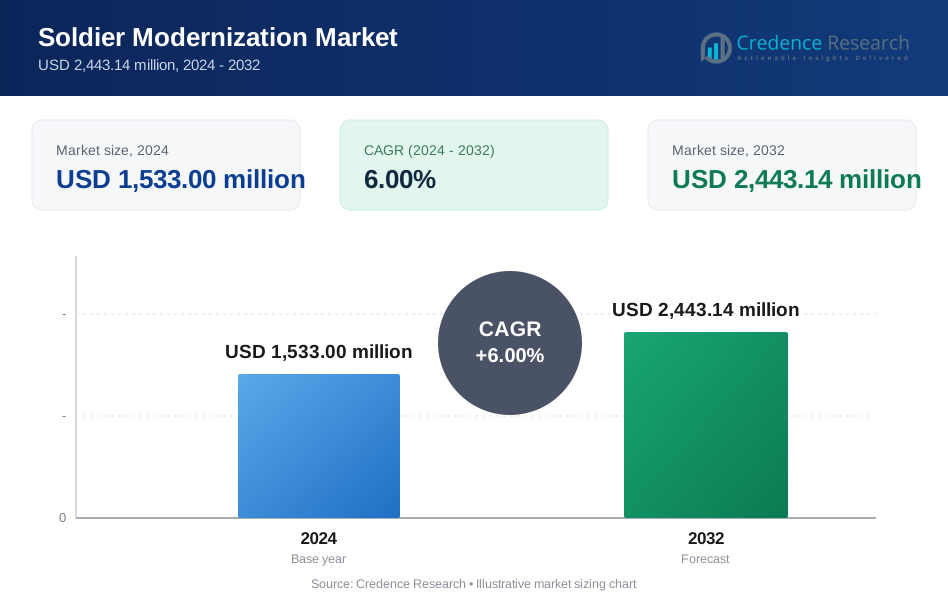
The global soldier modernization market is projected to grow from USD 1,533.00 million in 2024 to USD 2,443.14 million by 2032, reflecting a compound annual growth rate (CAGR) of 6.00%.
The global soldier modernization market is driven by the growing need to enhance military capabilities through advanced technologies and modernized equipment. Increasing defense budgets, particularly in developed and emerging economies, are fueling investments in soldier systems that improve situational awareness, mobility, and survivability. The rising demand for lightweight body armor, sophisticated communication systems, and integrated weapons systems further supports market growth. Additionally, advancements in wearable technologies and augmented reality solutions for battlefield applications are transforming combat strategies and operational efficiency. Governments' focus on replacing obsolete military equipment with next-generation solutions is accelerating modernization efforts. The adoption of network-centric warfare and real-time data-sharing technologies to enhance battlefield connectivity is also a key trend influencing market dynamics. Furthermore, the integration of artificial intelligence and robotics into soldier modernization programs is reshaping defense capabilities. These factors collectively drive market expansion, making soldier modernization a critical area of investment in the evolving defense landscape.
The global soldier modernization market is experiencing significant growth across various regions, with key players driving advancements in technology and soldier systems. In North America, major defense contractors like BAE Systems, Lockheed Martin, and General Dynamics lead the market with cutting-edge innovations in weaponry, communication, and protection systems. Europe also plays a crucial role, with companies such as Rheinmetall, Thales Group, and Leonardo S.p.A. contributing to soldier modernization efforts through advanced solutions for the military. In Asia-Pacific, countries like China, India, and Japan are increasingly investing in soldier systems, with local and global players like Elbit Systems and Saab AB playing key roles in technological advancements. The Middle East and Latin America are also emerging as important markets, with governments focusing on modernizing their military forces to address regional security concerns. These key players collaborate with national defense agencies to enhance soldier capabilities in various operational environments.
Market Insights
- The global soldier modernization market was valued at USD 1,533.00 million in 2024 and is expected to reach USD 2,443.14 million by 2032, growing at a CAGR of 6.00%.
- Increased defense spending and technological advancements are major drivers of market growth.
- Growing demand for advanced communication systems, weaponry, and protective gear is boosting the adoption of soldier modernization solutions.
- Key trends include the integration of AI, robotics, and wearable technologies to enhance soldier capabilities and operational effectiveness.
- The market is highly competitive, with leading players such as BAE Systems, Lockheed Martin, and Raytheon Technologies, focused on innovation and strategic partnerships.
- High development and maintenance costs, along with the complexities of integrating new technologies, are some of the key restraints limiting market growth.
- North America and Europe dominate the market, while Asia-Pacific is emerging as a strong player due to rising defense expenditures.
Market Drivers
Growing Defense Budgets and Modernization Initiatives
The rising allocation of defense budgets globally is a primary driver for the soldier modernization market. Governments in developed and developing nations are prioritizing military modernization to strengthen national security and enhance combat capabilities. Countries like the United States, China, and India are increasingly investing in advanced soldier systems to replace outdated equipment with cutting-edge technologies. For instance, the United States allocated approximately $895 billion to its defense budget in 2025. These investments aim to improve operational efficiency, situational awareness, and troop survivability on the battlefield. The ongoing focus on maintaining technological superiority and preparedness for modern warfare continues to drive the demand for soldier modernization solutions.
Advancements in Wearable and Communication Technologies
Technological advancements in wearable devices and communication systems are significantly contributing to market growth. Innovations in lightweight body armor, advanced sensors, and health monitoring systems enhance soldier safety and performance. For instance, the integration of wearable technology, such as smart uniforms and augmented reality headsets, is enhancing situational awareness and operational efficiency. Additionally, the development of sophisticated communication technologies that offer real-time data sharing and battlefield connectivity is revolutionizing military operations. The integration of augmented reality (AR) and heads-up displays (HUDs) into soldier systems is further improving situational awareness and decision-making in combat scenarios, making these technologies essential for modern defense strategies.
Rising Demand for Network-Centric Warfare Capabilities
The shift toward network-centric warfare is a critical factor driving the adoption of soldier modernization programs. Modern military forces are increasingly leveraging digital platforms and data-driven technologies to improve coordination and command efficiency. The use of connected devices and systems allows for seamless information exchange between soldiers, unmanned vehicles, and command centers. This capability enhances tactical advantage, reduces response times, and improves mission outcomes. The emphasis on interoperable systems that enable comprehensive battlefield awareness and faster decision-making boosts market demand for integrated soldier systems.
Focus on Enhancing Soldier Mobility and Survivability
Improving soldier mobility and survivability remains a top priority for defense organizations. Lightweight materials, modular gear, and compact weapon systems are being developed to reduce soldier load without compromising performance. Innovations in exoskeleton technology and autonomous support systems are also enhancing endurance and physical capabilities. In parallel, advancements in personal protective equipment, including advanced ballistic protection and chemical, biological, radiological, and nuclear (CBRN) defense gear, are improving soldier safety in hostile environments. These factors collectively drive the need for comprehensive soldier modernization solutions across global defense sectors.
Market Trends
Adoption of Artificial Intelligence and Robotics
The integration of artificial intelligence (AI) and robotics into soldier modernization programs is transforming military operations. AI-powered systems enhance decision-making capabilities by providing real-time data analysis, predictive insights, and automated threat detection. For instance, the U.S. Department of Defense has been investing in AI technologies to improve battlefield decision-making and operational efficiency. Autonomous robots are increasingly being used for tasks such as reconnaissance, surveillance, and logistics support, reducing the risk to human soldiers. The development of robotic exoskeletons to improve soldier endurance and physical strength is another significant trend. As AI and robotics technologies continue to evolve, their adoption in soldier systems will further revolutionize battlefield strategies and operational efficiency.
Increased Focus on Augmented and Virtual Reality Solutions
Augmented reality (AR) and virtual reality (VR) technologies are gaining traction in soldier training and battlefield applications. AR systems, such as heads-up displays (HUDs), provide enhanced situational awareness by overlaying critical information onto a soldier’s field of vision. For instance, the U.S. Army's Synthetic Training Environment program utilizes VR to create realistic combat scenarios for training purposes. VR-based training simulations offer realistic combat scenarios that improve soldier preparedness and decision-making without the risks associated with live training. The growing demand for immersive training and advanced visualization tools is driving the integration of AR and VR into soldier modernization programs, enhancing operational effectiveness.
Advancements in Lightweight and Modular Equipment
The development of lightweight, modular soldier equipment is a key trend addressing the need for improved mobility and reduced fatigue. Innovations in materials science are enabling the creation of durable, lightweight armor and weapons systems that enhance soldier agility. Modular gear systems, which allow soldiers to customize their equipment based on mission requirements, are becoming increasingly popular. This trend is particularly significant as modern warfare demands highly adaptable and versatile soldier systems that balance protection, mobility, and performance.
Emphasis on Network-Centric and Integrated Solutions
The shift toward network-centric warfare continues to influence the design of soldier modernization programs. Integrated systems that connect soldiers, command centers, and unmanned assets in real-time are becoming essential for modern military forces. Technologies enabling seamless communication, data sharing, and situational awareness are critical for tactical advantages. The growing need for interoperable systems that operate across multiple platforms and environments is driving the development of comprehensive, fully integrated soldier solutions that enhance coordination and battlefield dominance.
Market Challenges Analysis
High Costs and Budget Constraints
One of the primary challenges in the global soldier modernization market is the high cost of advanced technologies and equipment. The development and integration of cutting-edge systems, such as artificial intelligence, augmented reality, and autonomous robotics, require significant investments. For many countries, especially those with smaller defense budgets, financing these modernization initiatives can be a major hurdle. While the benefits of enhanced military capabilities are clear, the expense associated with procurement, maintenance, and training for these advanced systems can strain national defense budgets. This financial challenge may lead to delays in the adoption of soldier modernization technologies in certain regions or force countries to prioritize certain upgrades over others.
Complexity of Integration and Interoperability
Another significant challenge is the complexity of integrating new technologies into existing military infrastructures. Many armed forces rely on legacy systems that may not be compatible with the latest soldier modernization solutions. For instance, a report by Total Military Insight highlights that interoperability issues between new and old systems can complicate joint operations. Ensuring interoperability between new equipment and older systems can be a complex and time-consuming process. Additionally, the rapid pace of technological advancements means that military organizations must continuously update and upgrade their soldier systems to keep pace with emerging threats and capabilities. This ongoing challenge in maintaining a cohesive, interoperable ecosystem for soldier modernization solutions can hinder the seamless adoption of new technologies and delay the realization of their full potential in enhancing military effectiveness.
Market Opportunities
Expansion in Emerging Markets
One of the key opportunities in the global soldier modernization market lies in the expansion of defense modernization initiatives in emerging economies. Countries in Asia-Pacific, the Middle East, and Latin America are increasingly recognizing the importance of enhancing their military capabilities to address regional security challenges. With rising defense budgets, these nations are investing in next-generation soldier systems to strengthen their defense forces. As many of these countries are upgrading their military infrastructure for the first time, there is a significant demand for advanced soldier technologies such as wearable systems, communication devices, and protective gear. This presents a lucrative growth opportunity for companies in the soldier modernization sector to tap into new markets and establish long-term partnerships with emerging defense powers.
Technological Advancements and Innovation
Another promising opportunity for market growth is the continued innovation in soldier modernization technologies. Advancements in artificial intelligence, robotics, augmented reality, and materials science open new avenues for the development of more efficient, adaptable, and cost-effective soldier systems. The growing need for integrated solutions that provide real-time situational awareness, enhanced mobility, and improved protection presents an opportunity for companies to create cutting-edge products that meet the evolving needs of modern military forces. Moreover, the increasing focus on sustainability and environmental impact in defense operations offers opportunities to develop eco-friendly soldier equipment and solutions. By embracing technological advancements and addressing evolving military needs, companies can capitalize on emerging trends and secure a competitive edge in the soldier modernization market.
Market Segmentation Analysis:
By System:
The global soldier modernization market is segmented by system into weapon systems, communication systems, protection systems, power systems, and others. Weapon systems are a critical segment, focusing on advanced firearms, ammunition, and integrated systems designed to enhance combat effectiveness. Communication systems, including secure and real-time communication networks, are essential for improving coordination and situational awareness on the battlefield. Protection systems encompass technologies such as body armor, helmets, and CBRN (Chemical, Biological, Radiological, and Nuclear) protective gear, designed to ensure soldier safety in high-risk environments. Power systems are gaining importance with the development of lightweight, portable power solutions to support modern soldier systems, including wearable devices and communications equipment. Other systems include a variety of auxiliary technologies, such as environmental sensors, navigation tools, and battlefield management systems, all contributing to overall soldier efficiency and survivability.
By Platform:
The soldier modernization market is also segmented by platform into airborne, naval, and land-based solutions. Airborne platforms focus on technologies designed for soldiers deployed in air-based operations, such as advanced communication, navigation systems, and wearable technologies that enhance mission success in the sky. Naval platforms cater to soldiers operating in maritime environments, emphasizing maritime safety, communication, and navigation. Technologies like marine-specific protective gear and power systems are also key components. Land-based solutions are the most diverse and focus on equipment suited for soldiers on the ground, including protective gear, weaponry, communication systems, and mobility-enhancing technologies like exoskeletons. Each platform has its own unique set of demands, with solutions tailored to the specific challenges faced by soldiers in different operational environments, driving the evolution of specialized soldier modernization systems.
Segments:
Based on System:
- Weapon Systems
- Communication Systems
- Protection Systems
- Power Systems
- Others
Based on Platform:
- Airborne
- Naval
- Land
Based on the Geography:
- North America
- U.S.
- Canada
- Mexico
- Europe
- UK
- France
- Germany
- Italy
- Spain
- Russia
- Belgium
- Netherlands
- Austria
- Sweden
- Poland
- Denmark
- Switzerland
- Rest of Europe
- Asia Pacific
- China
- Japan
- South Korea
- India
- Australia
- Thailand
- Indonesia
- Vietnam
- Malaysia
- Philippines
- Taiwan
- Rest of Asia Pacific
- Latin America
- Brazil
- Argentina
- Peru
- Chile
- Colombia
- Rest of Latin America
- Middle East
- UAE
- KSA
- Israel
- Turkey
- Iran
- Rest of Middle East
- Africa
- Egypt
- Nigeria
- Algeria
- Morocco
- Rest of Africa
Regional Analysis
North America
North America, particularly the United States, dominates the global soldier modernization market with a share of 40%. The U.S. military continues to invest heavily in the development and integration of advanced soldier systems, including weaponry, communication tools, and protective equipment. The demand for cutting-edge technologies such as artificial intelligence (AI), robotics, and exoskeletons is high in this region, reflecting the U.S. commitment to maintaining military superiority. Additionally, the presence of key defense contractors in North America further accelerates market growth, driving continuous advancements in soldier modernization initiatives.
Europe
Europe holds a market share of 25%, with major defense players like the United Kingdom, Germany, and France prioritizing soldier modernization programs. These countries are focusing on enhancing soldier capabilities through advanced communication systems, protective gear, and augmented reality for training purposes. The European market is driven by the rising need for interoperability between military systems and the demand for network-centric warfare technologies. European defense programs, such as the European Defence Fund (EDF), are increasing investments in soldier systems to address evolving security threats. Collaborative efforts across the EU are expected to sustain growth in the European soldier modernization market.
Asia-Pacific
Asia-Pacific accounts for approximately 20% of the global soldier modernization market share. The region’s major contributors include China, India, Japan, and South Korea, all of which are focused on enhancing their military capabilities due to rising security concerns. China’s extensive military modernization program, which involves the integration of advanced technologies into soldier systems, is a key driver of market growth. India’s defense modernization initiatives, particularly in communication and protective gear, contribute significantly to the region’s share. Japan’s adoption of robotics and wearable systems also supports market growth in Asia-Pacific, positioning it as an increasingly influential player in the global soldier modernization market.
Rest of the World
The Rest of the World (RoW) region, which includes the Middle East, Latin America, and parts of Africa, holds a market share of approximately 15%. The Middle East is experiencing strong demand for soldier modernization technologies, with countries such as Saudi Arabia and the UAE investing in advanced systems to address regional instability. Latin American nations like Brazil are focused on modernizing their armed forces, while South Africa in Africa is also upgrading soldier systems to enhance military effectiveness. Although the RoW region faces challenges such as political instability and limited technological infrastructure, its market share continues to grow as defense expenditures rise and security concerns persist.
Key Player Analysis
- BAE Systems
- Lockheed Martin Corporation
- General Dynamics Corporation
- Raytheon Technologies Corporation
- Thales Group
- Northrop Grumman Corporation
- Rheinmetall AG
- Leonardo S.p.A.
- Elbit Systems Ltd.
- Saab AB
Competitive Analysis
The global soldier modernization market is highly competitive, with several leading players driving innovation and technological advancements. Key players such as BAE Systems, Lockheed Martin Corporation, General Dynamics Corporation, Raytheon Technologies Corporation, Thales Group, Northrop Grumman Corporation, Rheinmetall AG, Leonardo S.p.A., Elbit Systems Ltd., and Saab AB play a significant role in shaping the market. These companies offer a wide range of advanced soldier systems, including weapon systems, communication technologies, protective gear, and power solutions. For instance, strategic partnerships between defense companies and government agencies have been instrumental in advancing soldier modernization programs. These companies lead in the development of advanced soldier systems, offering a wide range of solutions including weapon systems, communication technologies, protective gear, and power systems. They invest heavily in research and development to ensure they remain at the forefront of the market, with a focus on improving soldier capabilities and operational efficiency. The competitive landscape is shaped by companies that emphasize the integration of emerging technologies such as artificial intelligence, robotics, and wearable systems into soldier modernization efforts. Collaboration with defense agencies and other key stakeholders is crucial for these companies, enabling them to deliver cutting-edge solutions tailored to the specific needs of military forces worldwide. To maintain a competitive edge, these companies often engage in strategic partnerships, mergers, and acquisitions, allowing them to expand their product portfolios and access new markets. Their ability to deliver high-performance, cost-effective solutions while meeting the growing demand for advanced soldier systems positions them as key players in shaping the future of soldier modernization across the globe.
Recent Developments
- In October 2024, General Dynamics was selected to continue development for the Next Generation Survival Radio (NGSR) for the U.S. Air Force, with plans to deliver prototypes by December 2025, emphasizing advanced communication capabilities for search and rescue operations.
- In September 2024, Thales Defense & Security Inc. was awarded a contract for 2,705 additional AN/PRC-148F radios as part of the Army's HMS tactical radio program, demonstrating ongoing confidence in Thales' technology solutions for military communications.
- In May 2024, Lockheed Martin received a $451 million contract from the U.S. Army to upgrade additional M270 systems, which includes overhauls with new engines and improved armored cabs. This contract aims to enhance the operational readiness and interoperability of these systems with NATO forces.
- In April 2024, Raytheon secured a $344 million contract for the modernization of missile electronics units, specifically for the SM-2 Block IIICU and SM-6 variants. This upgrade enhances production efficiency and capability for both U.S. and allied forces.
Market Concentration & Characteristics
The global soldier modernization market exhibits moderate to high market concentration, with a few major players dominating the space. These companies invest significantly in research and development to maintain a competitive edge by offering advanced technologies and integrated soldier systems. The market is characterized by continuous innovation, particularly in areas such as wearable systems, communication platforms, and protective gear, driven by increasing military expenditure globally. As the demand for cutting-edge, high-performance systems rises, the market has seen an influx of new entrants focused on specific soldier modernization segments, such as AI-driven systems or exoskeletons, which further intensifies competition. Market characteristics include a strong focus on technological integration, where systems are designed to work seamlessly together to enhance soldier capabilities and operational effectiveness. The market is also marked by long development cycles and substantial capital investment, which creates a barrier to entry for smaller companies. While established players dominate the market, there is room for specialized companies focusing on niche areas like advanced communication solutions or soldier health monitoring systems. Partnerships and collaborations with government defense agencies play a crucial role in securing contracts, and these collaborations drive product innovation and adoption across different regions. Overall, the market is dynamic, with significant opportunities for both established and emerging players to contribute to the future of soldier modernization.
Report Coverage
The research report offers an in-depth analysis based on System, Platform, and Geography. It details leading market players, providing an overview of their business, product offerings, investments, revenue streams, and key applications. Additionally, the report includes insights into the competitive environment, SWOT analysis, current market trends, as well as the primary drivers and constraints. Furthermore, it discusses various factors that have driven market expansion in recent years. The report also explores market dynamics, regulatory scenarios, and technological advancements that are shaping the industry. It assesses the impact of external factors and global economic changes on market growth. Lastly, it provides strategic recommendations for new entrants and established companies to navigate the complexities of the market.
Future Outlook
- The global soldier modernization market is expected to continue its robust growth, driven by increasing defense budgets worldwide.
- Advancements in artificial intelligence, robotics, and wearable technologies will play a key role in shaping future soldier systems.
- Increased focus on enhancing communication systems and real-time data sharing will improve soldier effectiveness on the battlefield.
- The integration of exoskeletons and power-assist technologies will enhance soldier mobility and reduce physical strain during operations.
- Demand for enhanced protection systems, including advanced armor and situational awareness tools, will rise to address evolving threats.
- Collaborative defense initiatives and joint military operations across nations will push for standardized soldier systems to ensure interoperability.
- The growing adoption of autonomous technologies, such as unmanned ground vehicles, will complement soldier operations and enhance safety.
- The continued focus on cybersecurity and data protection will ensure secure communication and operational systems for soldiers in the field.
- With evolving geopolitical dynamics, regions like Asia-Pacific and the Middle East are expected to increase investments in soldier modernization.
- Governments will prioritize cost-effective and scalable soldier modernization solutions to ensure sustainability in long-term defense strategies.
Request a Free Sample
Fill in your details and we'll send you a free sample report.
- Sample data tables & charts
- Research methodology
Need a Custom Version of This Report?
Tailor the scope, geography, or segments to your exact requirements.
- Custom geography or segment scope
- Direct access to our analyst team
Frequently Asked Questions
What is the current size of the Global Soldier Modernization Market?
What factors are driving the growth of the Global Soldier Modernization Market?
What are the key segments within the Global Soldier Modernization Market?
What are some challenges faced by the Global Soldier Modernization Market?
Who are the major players in the Global Soldier Modernization Market?
Table of Content
Chapter 1. Report Introduction
- 1.1 Report Description & Purpose
- 1.1.1 Report Title & Market Definition
- 1.1.2 Unique Selling Propositions (USP) & Key Differentiators
- 1.1.3 Value Proposition for Stakeholders
- 1.2 Research Objectives
- 1.2.1 Market Sizing Objectives (Volume & Revenue)
- 1.2.2 Segmentation Objectives
- 1.2.3 Competitive Intelligence Objectives
- 1.2.4 Forecast & Scenario Objectives
- 1.3 Report Scope
- 1.3.1 Soldier Modernization Scope – Types & Subtypes Covered
- 1.3.2 Geographic Scope – Regions & Countries Covered
- 1.3.3 Historical Period, Base Year & Forecast Period (2024; forecast to 2032)
- 1.3.4 Inclusions & Exclusions
- 1.4 HS Code & Classification Framework
- 1.5 Currency, Units & Pricing Basis
- 1.6 Target Stakeholders
- 1.7 Limitations & Assumptions
Chapter 2. Executive Summary
- 2.1 Global Soldier Modernization Market Snapshot
- 2.1.1 Market Size – Historical (2024) & Forecast (2024-2032) (2024: USD 1,533.00 million → 2032: USD 2,443.14 million)
- 2.1.2 Volume & Revenue – Global Totals
- 2.1.3 Key Market Highlights – Top Five Facts
- 2.2 Soldier Modernization Market Segmentation Snapshot
- 2.2.1 Market Split by Region – 2024 vs. 2032
- 2.3 Competitive Snapshot
- 2.3.1 Top 10 Players by Revenue Share – 2024
- 2.3.2 Top 10 Players by Volume Share – 2024
- 2.3.3 Recent Strategic Developments (18-Month Summary)
- 2.4 Key Investment Highlights & Strategic Conclusions
Chapter 3. Soldier Modernization Market Dynamics & Industry Analysis
- 3.1 Market Overview & Context
- 3.1.1 Soldier Modernization Market Position in the Broader Automotive Value Chain
- 3.1.2 OEM vs. Replacement Market Dynamics
- 3.1.3 Market Maturity & Development Stage by Region
- 3.2 Soldier Modernization Market Drivers
- 3.3 Soldier Modernization Market Restraints & Challenges
- 3.4 Soldier Modernization Market Opportunities
- 3.5 Porter's Five Forces Analysis
- 3.5.1 Threat of New Entrants
- 3.5.2 Bargaining Power of Suppliers
- 3.5.3 Bargaining Power of Buyers
- 3.5.4 Threat of Substitutes
- 3.5.5 Competitive Rivalry – Intensity Assessment
- 3.6 Soldier Modernization Value Chain Analysis
- 3.6.1 Upstream – Raw Material/Input Suppliers
- 3.6.1.1 Raw Material/Input 1
- 3.6.1.2 Raw Material/Input 2
- 3.6.1.3 Raw Material/Input 3
- 3.6.2 Midstream – Production/Manufacturing/Service Delivery
- 3.6.2.1 Production/Process Overview
- 3.6.2.2 Key Facility Locations & Capacity by Manufacturer
- 3.6.3 Downstream – Distribution & End Consumer
- 3.6.3.1 Primary Channel – B2B/OEM
- 3.6.3.2 Secondary Channels – Dealer, Retail, Online, Direct
- 3.6.4 Value Chain Profitability Analysis
- 3.6.1 Upstream – Raw Material/Input Suppliers
- 3.7 PESTEL Analysis
- 3.7.1 Political Factors
- 3.7.2 Economic Factors
- 3.7.3 Social Factors
- 3.7.4 Technological Factors
- 3.7.5 Environmental Factors
- 3.7.6 Legal Factors
- 3.8 Soldier Modernization Supply Chain Analysis
- 3.8.1 Raw Material/Input Supply Risk Assessment
- 3.8.2 Manufacturing Concentration Risk (Geographic Exposure)
- 3.8.3 Trade Disruption Impact Analysis
- 3.9 Regulatory & Policy Landscape
Note: The regulatory and policy landscape section covers regulations based on their applicability to the market, Soldier Modernization category, geography, and scope of the study. Only regulatory frameworks with a material impact on operations, compliance, trade, sustainability, or market access are analyzed in detail.
Chapter 4. Key Investment Pockets & Opportunity Analysis
- 4.1 Soldier Modernization Market Attractiveness Analysis
- 4.1.1 By Region – Investment Attractiveness Matrix (Volume × CAGR)
- 4.2 Absolute Revenue Growth Opportunity
- 4.2.1 By Region – Absolute USD Growth Through 2032
- 4.3 Incremental Volume Opportunity
- 4.3.1 By Region – Incremental Volume Through 2032
- 4.3.2 Segment – Incremental Volume
- 4.4 Emerging Submarket Opportunity Deep Dive (Subject to Applicability)
- 4.5 Emerging Market Opportunity Scorecards
- 4.5.1 United States
- 4.5.2 Europe
- 4.5.3 Asia
- 4.5.4 Middle East & Africa
Note: Emerging Market Opportunity Scorecards will be included based on relevance and strategic importance. Regions listed are indicative and may vary depending on data availability and market dynamics.
Chapter 5. Soldier Modernization Import-Export Analysis & Trade Flows
- 5.1 Global Trade Overview
- 5.1.1 Global Export Value by Country (2024)
- 5.1.2 Global Export Volume by Country (2024)
- 5.1.3 Global Import Value by Country (2024)
- 5.1.4 Global Import Volume by Country (2024)
- 5.1.5 Net Trade Balance by Country (2024)
- 5.2 Export Analysis – Segment
- 5.2.1 Type 1 (HS Code)
- 5.2.2 Type 2 (HS Code)
- 5.2.3 Type 3 (HS Code)
- 5.2.4 Type 4 (HS Code)
- 5.2.5 Type 5 (HS Code)
- 5.3 Import Analysis – Segment
- 5.3.1 Type 1 (HS Code)
- 5.3.2 Type 2 (HS Code)
- 5.3.3 Type 3 (HS Code)
- 5.3.4 Type 4 (HS Code)
- 5.3.5 Type 5 (HS Code)
- 5.4 Average Unit Trade Prices
- 5.4.1 Average Export Price – Segment & Country
- 5.4.2 Average Import Price – Segment & Source Country
- 5.4.3 Price Trends (2024)
- 5.5 Key Trade Route Analysis
- 5.5.1 Trade Route 1
- 5.5.2 Trade Route 2
- 5.5.3 Trade Route 3
- 5.5.4 Trade Route 4
- 5.5.5 Trade Route 5
- 5.6 Trade Policy Impact Assessment
- 5.6.1 US Anti-Dumping & Section 301 Tariffs
- 5.6.2 EU Customs Union Impact
- 5.6.3 Major Free Trade Agreements
- 5.6.4 USMCA Rules of Origin
Note: Trade policy analysis will be included only where relevant to the Soldier Modernization market.
Chapter 6. Competitive Landscape & Company Benchmarking
- 6.1 Soldier Modernization Market Concentration & Structure
- 6.1.1 Herfindahl-Hirschman Index (HHI) – vs. 2024
- 6.1.2 Tier 1, Tier 2 & Tier 3 Market Structure
- 6.1.3 Global, Regional & Local Player Dynamics
- 6.2 Soldier Modernization Market Share Analysis – 2024
- 6.2.1 Global Revenue Share by Company
- 6.2.2 Global Volume Share by Company
- 6.2.3 Regional Revenue Share
- 6.2.4 Market Share Evolution ( vs. 2024)
- 6.2.5 OEM Segment Share by Company
- 6.2.6 Replacement Segment Share by Company
- 6.3 Production/Delivery Capacity & Facility Analysis
- 6.3.1 Global Installed Capacity
- 6.3.2 Capacity Utilization Rates
- 6.3.3 Production/Output Volume
- 6.3.4 Facility Locations & Capacity Map
- 6.3.5 Planned Capacity Additions
- 6.4 Soldier Modernization Competitive Benchmarking Matrix
- 6.4.1 Revenue, Volume, CAGR & Profitability Comparison
- 6.4.2 Channel Revenue Mix
- 6.4.3 Geographic Revenue Exposure
- 6.4.4 R&D Intensity
- 6.4.5 Sustainability Maturity
- 6.5 Strategic Developments in Soldier Modernization (Last 24 Months)
- 6.5.1 Mergers, Acquisitions & Divestments
- 6.5.2 New Soldier Modernization Launches
- 6.5.3 Facility Expansions
- 6.5.4 Strategic Alliances, Joint Ventures & Partnerships
- 6.5.5 Distribution Expansion & Market Entry
- 6.5.6 Sustainability & ESG Initiatives
- 6.6 Competitive Strategy Mapping
- 6.6.1 Leader, Challenger, Follower & Niche Classification
- 6.6.2 Pricing Strategy Comparison
- 6.6.3 Channel Strategy Matrix
Note: Strategic developments are included based on their materiality and the availability of reliable information.
Chapter 7. Global Soldier Modernization Market – By Distribution Channel
- 7.1 Segment Overview
- 7.1.1 Volume & Revenue Split by Channel (2024 & 2032)
- 7.1.2 Channel Mix Evolution (2024-2032)
Chapter 8. Regional Market Analysis – Global Overview
- 8.1 Global Regional Overview
- 8.1.1 Regional Volume Share
- 8.1.2 Regional Revenue Share
- 8.1.3 Regional Volume by Region
- 8.1.4 Regional Revenue by Region
- 8.1.5 Regional Forecast Through 2032
- 8.2 Cross-Regional Segment Analysis
- 8.2.1 By Distribution Channel
- 8.2.2 By Brand/Price Tier
Chapter 9. North America Soldier Modernization Market
- 9.1 United States
- 9.2 Canada
- 9.3 Mexico
Chapter 10. Europe Soldier Modernization Market
- 10.1 Germany
- 10.2 France
- 10.3 Italy
- 10.4 United Kingdom
- 10.5 Spain
- 10.6 Poland
- 10.7 Russia
- 10.8 Netherlands
- 10.9 Belgium
- 10.10 Sweden
- 10.11 Denmark
- 10.12 Norway
- 10.13 Rest of Europe
Chapter 11. Asia Pacific Soldier Modernization Market
- 11.1 China
- 11.2 India
- 11.3 Japan
- 11.4 South Korea
- 11.5 Thailand
- 11.6 Indonesia
- 11.7 Vietnam
- 11.8 Malaysia
- 11.9 Australia
- 11.10 Rest of Asia Pacific
Chapter 12. Latin America Soldier Modernization Market
- 12.1 Brazil
- 12.2 Argentina
- 12.3 Colombia
- 12.4 Chile
- 12.5 Rest of Latin America
Chapter 13. Middle East Soldier Modernization Market
- 13.1 Saudi Arabia
- 13.2 United Arab Emirates
- 13.3 Turkey
- 13.4 Israel
- 13.5 Iran
- 13.6 Rest of the Middle East
Chapter 14. Africa Soldier Modernization Market
- 14.1 South Africa
- 14.2 Egypt
- 14.3 Nigeria
- 14.4 Morocco
- 14.5 Rest of Africa
Chapter 15. Soldier Modernization Company Profiles
- 15.1 [Company 01]
- 15.1.1 Company Overview
- 15.1.2 Key Management Personnel
- 15.1.3 Products & Services Portfolio
- 15.1.4 Financial Performance
- 15.1.5 Key Market Focus & Geographic Presence
- 15.1.6 Recent Developments & Strategic Initiatives
Note: The company profile list is preliminary and may change based on research findings, market developments, data availability, and client requirements.
Chapter 16. Appendices
- Appendix A – List of Abbreviations & Acronyms
- Appendix B – Industry Classification Code Reference – Full Series
- Appendix C – Production & Capacity Data Tables
- Appendix D – End-Use & Demand Base Tables
- Appendix E – Consumption & Replacement Rate Assumptions
- Appendix F – ASP Reference Tables
- Appendix G – Manufacturing & Facility Database
- Appendix H – Import-Export Data Tables
- Appendix I – Regulatory Summary Tables
- Appendix J – Primary Research Participant List (Anonymized)
- Appendix K – Primary Research Questionnaire Framework
- Appendix L – Data Sources & Bibliography
- Appendix M – Market Size Divergence & Source Comparison
Chapter 17. Research Methodology
- 17.1 Research Framework & Philosophy
- 17.2 Secondary Research – Sources, Hierarchy & Data Extraction
- 17.3 Data Modeling – Bottom-Up & Top-Down Market Sizing
- 17.4 Primary Research – Stakeholder Framework, LOI & Sample Sizes
- 17.5 Forecast Methodology – Regression, Scenario & Sensitivity Analysis
- 17.6 Quality Control – Four-Layer Validation Framework
- 17.7 Limitations & Standard Assumptions
- 17.8 Disclaimer
