
| REPORT ATTRIBUTE | DETAILS |
|---|---|
| Historical Period | 2019-2022 |
| Base Year | 2023 |
| Forecast Period | 2024-2032 |
| Space Planning Services Market Size 2023 | USD 30,300.00 million |
| Space Planning Services Market, CAGR | 6.90% |
| Space Planning Services Market Size 2032 | USD 55,238.51 million |
Market Overview
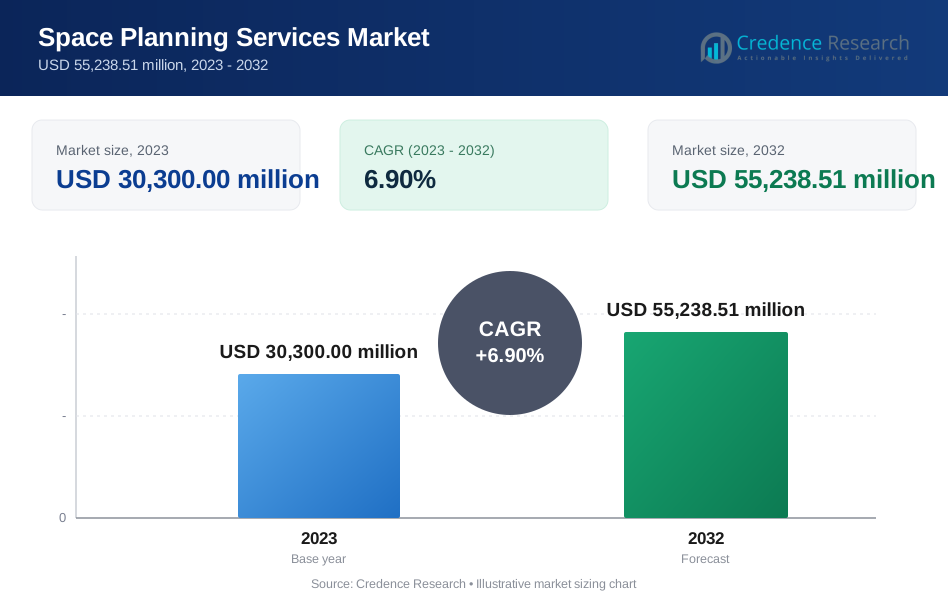
The Global Space Planning Services Market is projected to grow from USD 30,300.00 million in 2023 to an estimated USD 55,238.51 million by 2032, reflecting a compound annual growth rate (CAGR) of 6.90% from 2024 to 2032. This steady expansion underscores the growing demand for optimized spatial design across various industries, including retail, corporate, healthcare, and real estate.
Key market drivers include the rapid adoption of technology-driven solutions such as AI and IoT in space planning processes, which enhance efficiency and decision-making. Additionally, the expansion of the real estate and commercial sectors, coupled with the growing emphasis on sustainability and ergonomic designs, is fostering demand for professional space planning services. Trends like flexible workplace designs and the integration of virtual reality (VR) tools in planning are further shaping the market landscape.
Geographically, North America dominates the market due to its advanced technological infrastructure and high demand for customized spatial solutions. Europe and Asia-Pacific follow closely, with the latter experiencing significant growth driven by urbanization and industrial expansion in countries like China and India. Key players in the market include Gensler, Perkins and Will, HOK, CannonDesign, and Space Matrix. These companies are leveraging innovative technologies and strategic partnerships to maintain their competitive edge and cater to diverse client needs across the globe.
Market Insights
- The market is projected to grow from USD 30,300.00 million in 2023 to USD 55,238.51 million by 2032, with a CAGR of 6.90% from 2024 to 2032.
- The integration of AI, IoT, and VR is transforming space planning, enhancing efficiency and design precision across industries.
- Rising emphasis on sustainability and green building certifications is driving demand for eco-friendly space planning solutions.
- The shift toward hybrid work environments is increasing the need for flexible and adaptive office layouts, influencing space planning trends.
- North America leads the market, followed by Europe and Asia-Pacific, with the latter benefiting from rapid urbanization and industrial growth.
- High implementation costs and a shortage of skilled professionals are key challenges limiting market expansion, particularly in emerging regions.
- The real estate, healthcare, and commercial sectors are major drivers, with growing needs for innovative, efficient space solutions across diverse industries.
Market Drivers
Growing Demand for Efficient Space Utilization
As urban areas face increasing real estate costs, the need for efficient space utilization has become paramount. For example, New York City employs satellite imagery to enhance urban planning and disaster response. Following Hurricane Sandy, officials utilized satellite data to assess damage and prioritize recovery efforts, showcasing how real-time data can inform critical decisions in densely populated areas. Similarly, the integration of space technology with AI algorithms allows for dynamic urban models that predict growth and optimize land use. This approach is not only beneficial for city planners but also for businesses seeking to maximize operational efficiency. In retail, companies like One Stop have leveraged advanced analytics to optimize store layouts, resulting in a significant increase in customer satisfaction and sales. Such examples illustrate the vital role of innovative space planning solutions in addressing the challenges posed by rising urban real estate costs.
Technological Advancements Driving Innovation
The integration of advanced technologies is revolutionizing space planning services across various sectors. For instance, companies are increasingly utilizing digital twin technology to create accurate replicas of physical spaces, enabling real-time monitoring and analysis of occupancy and energy usage. A case study from the Lazio Region Headquarters demonstrated how combining Building Information Modeling (BIM) with IoT devices can enhance energy efficiency and reduce operational costs. Additionally, hybrid office designs are incorporating flexible workspaces that cater to diverse employee needs, supported by tools like intelligent booking systems. This shift not only fosters collaboration but also improves employee satisfaction and retention. As organizations adapt to hybrid work models, the demand for innovative space management solutions will continue to grow, driving further advancements in technology and design that prioritize efficiency and user experience.
Expanding Real Estate and Commercial Sectors
The steady growth of the global real estate and commercial sectors is a significant driver for the space planning services market. Rapid urbanization, particularly in emerging economies, has led to an increase in construction projects, including commercial complexes, residential buildings, and mixed-use developments. As developers and property owners seek to differentiate their projects, they are turning to space planning services to create attractive and functional designs that meet the needs of diverse occupants. Moreover, the demand for sustainable and green buildings has further bolstered the market, as space planning is a critical component of achieving energy efficiency and environmental certifications.
Shift Toward Flexible and Hybrid Workspaces
The shift toward hybrid and flexible work environments is reshaping office space requirements, driving demand for professional space planning services. Companies are transitioning from traditional office layouts to more adaptable designs that accommodate a mix of in-office and remote work arrangements. Space planners are playing a vital role in creating versatile layouts that promote collaboration, support employee well-being, and maximize productivity. Features like hot-desking, breakout zones, and multi-functional areas are becoming increasingly popular, aligning with changing workplace dynamics. This trend is expected to persist as organizations prioritize employee-centric designs to attract and retain talent in a competitive labor market.
Market Trends
Integration of Smart Technologies in Space Planning
The adoption of smart technologies such as AI, IoT, and VR is revolutionizing space planning by enabling data-driven decision-making and enhancing operational efficiency. For instance, IoT sensors are increasingly utilized to monitor real-time occupancy and energy consumption, allowing organizations to optimize space utilization effectively. A notable example is the use of smart building systems that adjust lighting and HVAC based on occupancy levels, significantly improving energy efficiency.Moreover, companies are leveraging AI for predictive analytics, which aids in forecasting space requirements and usage patterns. This integration not only streamlines operations but also enhances employee satisfaction by creating adaptable work environments tailored to user needs. For example, AI-driven platforms can analyze employee preferences and suggest optimal workspace configurations. Additionally, VR technology facilitates immersive design experiences, enabling stakeholders to visualize and interact with proposed layouts before implementation. This combination of technologies fosters a more efficient and responsive approach to space planning, ultimately leading to improved workplace productivity and user experience.
Increasing Demand for Sustainable and Green Space Designs
Sustainability is becoming a critical focus in space planning as organizations strive to minimize their environmental impact. Green building certifications like LEED are increasingly influencing design choices, encouraging the use of sustainable materials and energy-efficient systems. For instance, many new constructions incorporate features such as rainwater harvesting systems and solar panels to reduce resource consumption.Additionally, the trend towards retrofitting existing buildings to meet green standards is gaining momentum. This approach not only reduces waste but also revitalizes urban areas by transforming older structures into eco-friendly spaces. A significant example is the rise of urban centers where developers prioritize sustainability in their projects, reflecting a broader commitment to environmental stewardship. Furthermore, the integration of biophilic design elements—such as natural light and indoor greenery—enhances both aesthetic appeal and occupant well-being, demonstrating that sustainable practices can create healthier work environments while meeting corporate social responsibility goals.
Adoption of Smart Technologies in Space Planning
One of the most notable trends in the global space planning services market is the integration of smart technologies like artificial intelligence (AI), Internet of Things (IoT), and virtual reality (VR). These technologies enable precise and data-driven planning, allowing businesses to create efficient and adaptable spaces. AI is being used for predictive analytics, helping organizations optimize space utilization based on real-time data and future projections. IoT sensors provide insights into foot traffic, occupancy rates, and energy consumption, aiding in the development of layouts that maximize efficiency while minimizing costs. VR technology allows stakeholders to visualize and interact with designs before implementation, improving client satisfaction and decision-making.
Rise of Flexible and Hybrid Spaces
The shift toward flexible and hybrid working models is driving significant changes in space planning. Organizations are moving away from traditional fixed layouts to adopt adaptable designs that cater to a mix of remote and in-office employees. This trend has led to the rise of multipurpose spaces, hot-desking, and collaborative zones that can be reconfigured based on changing needs. Flexible layouts are also being implemented in sectors like retail and healthcare, where the ability to adapt to dynamic customer and patient requirements is crucial. The demand for hybrid spaces is expected to grow as businesses prioritize agility and resilience in their operations.
Market Challenges
High Implementation Costs and Budget Constraints
One of the primary challenges in the global space planning services market is the high cost of implementation. For instance, implementing advanced technologies such as AI-powered planning tools can lead to significant financial burdens for organizations. The costs associated with developing and maintaining these systems can be substantial; a single server necessary for running AI applications can exceed $10,000, while additional expenses for software development and data management can further escalate the total investment required. This is particularly challenging for small and medium-sized enterprises (SMEs) that may lack the financial resources to absorb these costs, ultimately limiting their access to professional space planning services.Moreover, retrofitting existing spaces to align with modern standards often involves extensive expenses. A case study highlighted that a legal practice faced considerable refurbishment costs after assessing the viability of a new office space. The costs associated with labor, materials, and potential downtime during renovations can add up quickly, creating a substantial barrier for organizations looking to upgrade their facilities in line with contemporary requirements. These financial barriers create a significant gap between the demand for innovative space planning and the ability of organizations to afford such solutions, especially in cost-sensitive markets.
Limited Availability of Skilled Professionals and Expertise
The growing demand for customized and technology-driven space planning solutions has highlighted a critical shortage of skilled professionals in the field. For instance, the Space Sector Skills Survey 2023 revealed that 52% of organizations reported skills gaps in their current workforce, a situation that remains relatively unchanged since 2020. This shortage is particularly pronounced in regions experiencing rapid urbanization and industrial growth, where the demand for qualified professionals far exceeds supply. Consequently, companies often encounter delays in project timelines and increased operational costs due to the need to hire external consultants or invest in training programs for existing staff.Additionally, the survey indicated that 72% of organizations experienced increased workloads for their existing employees due to these skills shortages. This not only affects productivity but also impacts employee morale as teams are stretched thin trying to meet growing demands without adequate support. The ongoing struggle to find skilled labor in specialized fields like software engineering and data analysis exacerbates these challenges, leading to inefficiencies and stunted growth within the market. As a result, companies face significant obstacles in delivering effective space planning solutions that meet contemporary needs.
Market Opportunities
Growing Demand for Smart and Sustainable Space Designs
The global emphasis on sustainability and smart technologies is reshaping the space planning services market. For instance, The Edge in Amsterdam exemplifies this trend as a net-zero energy building that utilizes 4,200 square meters of solar panels and advanced thermal mass design to optimize energy efficiency. This integration of smart technologies not only reduces operational costs but also enhances occupant comfort through automated lighting and HVAC systems. Similarly, L&T Technology Services promotes a Sustainable Smart World initiative focused on minimizing environmental impacts through innovative solutions like smart waste management and optimized water usage. By leveraging IoT and AI, these services enable organizations to meet green building certifications while enhancing resource efficiency. As urban centers increasingly prioritize retrofitting existing buildings to align with sustainability goals, the demand for space planning services that incorporate these technologies is set to rise, offering significant opportunities for service providers to innovate and expand their offerings.
Expansion in Emerging Markets and Flexible Workspaces
Emerging economies are witnessing a surge in demand for flexible workspaces, driven by rapid urbanization and changing workforce dynamics. In cities like Mumbai and Beijing, coworking spaces have become essential hubs for local entrepreneurs, providing affordable office solutions that foster collaboration and innovation. For instance, the flexible office market in Mumbai has seen occupancy rates soar, reflecting a shift towards hybrid work models where adaptability is key. Moreover, government initiatives in places like Jakarta support this trend by promoting coworking environments as vital components for economic development. These flexible spaces not only cater to startups but also attract established companies looking for scalable solutions without long-term commitments. As organizations increasingly recognize the benefits of flexible work arrangements—such as reduced overhead costs and enhanced employee satisfaction—the market for adaptable workspace solutions continues to expand, creating robust opportunities for service providers in these regions.
Market Segmentation Analysis
By Type
The Global Space Planning Services Market includes several key segments: Conceptual Space Planning, which focuses on early-stage design and creative layouts for optimal space utilization in offices, retail, and healthcare; Detailed Space Planning, ensuring precision in design execution, including measurements, layout specifications, and regulatory compliance for construction and remodeling; Furniture and Equipment Planning, which enhances functionality and aesthetics through ergonomic and visually appealing arrangements; and Space Management and Optimization, which uses data analytics and IoT to continuously monitor, adapt, and reconfigure spaces, particularly in dynamic industries and hybrid work environments.
By Vertical
The Global Space Planning Services Market spans various verticals, each with distinct demands. In retail and hospitality, the focus is on customer-centric and experiential designs that emphasize functionality and branding. Commercial offices prioritize flexible workspaces, collaborative zones, and employee well-being, driven by hybrid work trends. In healthcare, space planning optimizes layouts to enhance patient care and streamline workflows. Educational institutions emphasize the integration of technology and collaborative environments in their designs. Meanwhile, government and non-profit sectors prioritize efficiency, sustainability, and cost-effectiveness in their space planning projects, reflecting their unique operational needs.
Segments
Based on Type
- Conceptual Space Planning
- Detailed Space Planning
- Furniture and Equipment Planning
- Space Management and Optimization
Based on Vertical
- Retail and Hospitality
- Commercial Offices
- Healthcare
- Education
- Government and Non-Profit
Based on Deployment Method
- On-Premise
- Cloud-Based
- Hybrid
Based on Collaboration & Communication Technology
- Virtual Reality (VR)
- Augmented Reality (AR)
- 3D Modeling
Based on Region
- North America
- Europe
- Asia-Pacific
- Latin America
- Middle East & Africa
Regional Analysis
North America (45%)
North America holds the largest market share in the global space planning services market, accounting for approximately 45% of the total revenue. The region is a leader in adopting advanced space planning technologies, such as artificial intelligence (AI), Internet of Things (IoT), and augmented reality (AR). Additionally, the demand for flexible and sustainable workspaces, driven by the shift toward hybrid work models, has led to increased investments in space planning services. The U.S. and Canada, in particular, are home to some of the largest players in the market, contributing significantly to the region's dominance. Key industries in the region, including commercial real estate, healthcare, retail, and education, further bolster market growth.
Europe (30%)
Europe accounts for approximately 30% of the global market share, driven by its strong focus on sustainability and regulatory standards like the LEED and BREEAM certifications. The demand for green building designs and retrofitting existing structures to improve energy efficiency is a significant driver of space planning services in this region. Countries like Germany, the U.K., and France are leading the way in adopting smart technologies, contributing to the growing need for advanced space planning solutions. Europe also sees a rise in the demand for space planning services in the healthcare and education sectors, as organizations prioritize improving space utilization and enhancing user experience.
Key players
- BVN
- Studios Architecture
- Perkins and Will
- CallisonRTKL
- RTKL
- OP
- NBBJ
- IA Interior Architects
- Mainrock
- Blue Line Design
- Workspaces
Competitive Analysis
The global space planning services market is highly competitive, with a mix of well-established firms and specialized boutique agencies. Major players like BVN, Perkins and Will, and NBBJ are recognized for their comprehensive service offerings and strong global presence, giving them an edge in securing large-scale commercial and institutional projects. These companies excel in providing innovative and sustainable designs, using advanced technologies like AI and VR, which enhances their competitive advantage. Smaller firms, such as Mainrock and Blue Line Design, focus on niche markets and personalized services, offering tailored solutions that appeal to specific industries like healthcare and education. The market is also seeing increasing differentiation in service offerings, with some firms focusing on integrating smart technologies and optimizing space through data analytics. As demand for flexible, hybrid workspaces and sustainable designs rises, companies are positioning themselves by leveraging cutting-edge design tools and a focus on client-centric, efficient space planning.
Recent Developments
- In January 2025, BVN announced its involvement in the redevelopment of Nepean Hospital in Penrith, Australia. This project will introduce a new seven-storey building designed to enhance acute services and improve pedestrian connectivity within the hospital campus. The design aims to create a unified identity for the hospital, making itmore accessible and user-friendly for visitors and staff alike.
- As of January 2025, Perkins and Will unveiled their new European headquarters for the Dar Group in London. This innovative building features a central atrium designed to foster collaboration among various firms within the group. The project emphasizes sustainability, aiming for BREEAM Outstanding and LEED Platinum certifications, and incorporates smart building technologies to optimize energy efficiency and occupant comfort.
- In January 2025, CallisonRTKL expanded its team focused on planning, landscape, and urban design. This initiative aims to create meaningful spaces that balance environmental benefits with public health needs, reflecting a growing trend toward integrated design solutions that prioritize community well-being.
- In January 2025, NBBJ received planning approval for a healthcare research center in Oxford, UK. This facility is designed to enhance collaborative research efforts between scientists and clinicians. The project reflects NBBJ's commitment to creating adaptable spaces that can evolve with changing healthcare needs.
- In January 2025, IA Interior Architects announced a strategic partnership with Space Matrix. This collaboration aims to enhance their design capabilities across Asia and globally by leveraging shared resources and expertise in creating innovative interior environments that promote productivity and employee well-being.
- In September 2024, Blue Line Design completed the design for IndyGo's Blue Line Bus Rapid Transit project in Indianapolis. The project includes extensive improvements to public transportation infrastructure aimed at enhancing accessibility and safety for commuters.
Market Concentration and Characteristics
The global space planning services market exhibits moderate concentration, with a mix of large multinational firms and specialized local players. Major companies like Perkins and Will, BVN, and NBBJ dominate the market, holding significant shares due to their extensive portfolios, global reach, and expertise in delivering large-scale projects across various industries. These key players differentiate themselves through advanced technology integration, such as AI, VR, and IoT, as well as a strong emphasis on sustainability and innovative design. However, the market also features a number of smaller, niche players that cater to specific sectors such as healthcare, education, and retail, offering personalized services and flexible solutions. The overall market is characterized by increasing competition, a strong push for technological advancements, and a shift toward more sustainable, adaptable space solutions driven by evolving client demands and global trends
Report Coverage
The research report offers an in-depth analysis based on Type, Vertical, Deployment Method, Collaboration & Communication Technology and Region. It details leading market players, providing an overview of their business, product offerings, investments, revenue streams, and key applications. Additionally, the report includes insights into the competitive environment, SWOT analysis, current market trends, as well as the primary drivers and constraints. Furthermore, it discusses various factors that have driven market expansion in recent years. The report also explores market dynamics, regulatory scenarios, and technological advancements that are shaping the industry. It assesses the impact of external factors and global economic changes on market growth. Lastly, it provides strategic recommendations for new entrants and established companies to navigate the complexities of the market.
Future Outlook
- As companies continue to embrace hybrid work models, the demand for flexible office layouts will surge, driving the need for space planning services that accommodate diverse workstyles.
- AI-driven tools and automation will play a pivotal role in optimizing space usage, providing real-time data analytics, and streamlining design processes for businesses worldwide.
- With the rise of smart buildings, the integration of Internet of Things (IoT) devices in space planning will become a standard feature, enhancing operational efficiency and user experience.
- The increasing emphasis on sustainability will drive the demand for eco-friendly and energy-efficient space designs, aligning with green building standards like LEED and BREEAM.
- As employee wellness becomes a key focus, space planning will evolve to incorporate designs that prioritize natural lighting, biophilic elements, and ergonomic features to enhance productivity and health.
- Rapid urbanization in emerging economies, particularly in Asia-Pacific and Africa, will create significant growth opportunities for space planning services in the commercial and residential sectors.
- Companies will increasingly invest in collaborative and multifunctional spaces that promote creativity, team interactions, and flexible work environments, driving demand for adaptive designs.
- The growing use of virtual reality (VR) and augmented reality (AR) in space planning will enable clients to visualize designs in immersive 3D environments before implementation, improving decision-making and project outcomes.
- With sustainability at the forefront, there will be a rise in the retrofitting of existing buildings to optimize space and incorporate modern, energy-efficient features, offering new opportunities for space planners.
- The commercial real estate and hospitality industries will continue to demand innovative space planning solutions, as they adapt to changing consumer expectations and trends in design, creating a consistent demand for professional services.
Request a Free Sample
Fill in your details and we'll send you a free sample report.
- Sample data tables & charts
- Research methodology
Need a Custom Version of This Report?
Tailor the scope, geography, or segments to your exact requirements.
- Custom geography or segment scope
- Direct access to our analyst team
Frequently Asked Questions
What is the market size of the Global Space Planning Services Market in 2023 and 2032?
What are the key drivers of the Global Space Planning Services Market?
Which regions are leading the Global Space Planning Services Market?
What industries are driving the demand for space planning services?
Who are the key players in the Global Space Planning Services Market?
Table of Content
Chapter 1. Report Introduction
- 1.1 Report Description & Purpose
- 1.1.1 Report Title & Market Definition
- 1.1.2 Unique Selling Propositions (USP) & Key Differentiators
- 1.1.3 Value Proposition for Stakeholders
- 1.2 Research Objectives
- 1.2.1 Market Sizing Objectives (Volume & Revenue)
- 1.2.2 Segmentation Objectives
- 1.2.3 Competitive Intelligence Objectives
- 1.2.4 Forecast & Scenario Objectives
- 1.3 Report Scope
- 1.3.1 Space Planning Services Scope – Types & Subtypes Covered
- 1.3.2 Geographic Scope – Regions & Countries Covered
- 1.3.3 Historical Period, Base Year & Forecast Period (2023; forecast to 2032)
- 1.3.4 Inclusions & Exclusions
- 1.4 HS Code & Classification Framework
- 1.5 Currency, Units & Pricing Basis
- 1.6 Target Stakeholders
- 1.7 Limitations & Assumptions
Chapter 2. Executive Summary
- 2.1 Global Space Planning Services Market Snapshot
- 2.1.1 Market Size – Historical (2023) & Forecast (2023-2032) (2023: USD 30,300.00 million → 2032: USD 55,238.51 million)
- 2.1.2 Volume & Revenue – Global Totals
- 2.1.3 Key Market Highlights – Top Five Facts
- 2.2 Space Planning Services Market Segmentation Snapshot
- 2.2.1 Market Split by Region – 2023 vs. 2032
- 2.3 Competitive Snapshot
- 2.3.1 Top 10 Players by Revenue Share – 2023
- 2.3.2 Top 10 Players by Volume Share – 2023
- 2.3.3 Recent Strategic Developments (18-Month Summary)
- 2.4 Key Investment Highlights & Strategic Conclusions
Chapter 3. Space Planning Services Market Dynamics & Industry Analysis
- 3.1 Market Overview & Context
- 3.1.1 Space Planning Services Market Position in the Broader Automotive Value Chain
- 3.1.2 OEM vs. Replacement Market Dynamics
- 3.1.3 Market Maturity & Development Stage by Region
- 3.2 Space Planning Services Market Drivers
- 3.3 Space Planning Services Market Restraints & Challenges
- 3.4 Space Planning Services Market Opportunities
- 3.5 Porter's Five Forces Analysis
- 3.5.1 Threat of New Entrants
- 3.5.2 Bargaining Power of Suppliers
- 3.5.3 Bargaining Power of Buyers
- 3.5.4 Threat of Substitutes
- 3.5.5 Competitive Rivalry – Intensity Assessment
- 3.6 Space Planning Services Value Chain Analysis
- 3.6.1 Upstream – Raw Material/Input Suppliers
- 3.6.1.1 Raw Material/Input 1
- 3.6.1.2 Raw Material/Input 2
- 3.6.1.3 Raw Material/Input 3
- 3.6.2 Midstream – Production/Manufacturing/Service Delivery
- 3.6.2.1 Production/Process Overview
- 3.6.2.2 Key Facility Locations & Capacity by Manufacturer
- 3.6.3 Downstream – Distribution & End Consumer
- 3.6.3.1 Primary Channel – B2B/OEM
- 3.6.3.2 Secondary Channels – Dealer, Retail, Online, Direct
- 3.6.4 Value Chain Profitability Analysis
- 3.6.1 Upstream – Raw Material/Input Suppliers
- 3.7 PESTEL Analysis
- 3.7.1 Political Factors
- 3.7.2 Economic Factors
- 3.7.3 Social Factors
- 3.7.4 Technological Factors
- 3.7.5 Environmental Factors
- 3.7.6 Legal Factors
- 3.8 Space Planning Services Supply Chain Analysis
- 3.8.1 Raw Material/Input Supply Risk Assessment
- 3.8.2 Manufacturing Concentration Risk (Geographic Exposure)
- 3.8.3 Trade Disruption Impact Analysis
- 3.9 Regulatory & Policy Landscape
Note: The regulatory and policy landscape section covers regulations based on their applicability to the market, Space Planning Services category, geography, and scope of the study. Only regulatory frameworks with a material impact on operations, compliance, trade, sustainability, or market access are analyzed in detail.
Chapter 4. Key Investment Pockets & Opportunity Analysis
- 4.1 Space Planning Services Market Attractiveness Analysis
- 4.1.1 By Region – Investment Attractiveness Matrix (Volume × CAGR)
- 4.2 Absolute Revenue Growth Opportunity
- 4.2.1 By Region – Absolute USD Growth Through 2032
- 4.3 Incremental Volume Opportunity
- 4.3.1 By Region – Incremental Volume Through 2032
- 4.3.2 Segment – Incremental Volume
- 4.4 Emerging Submarket Opportunity Deep Dive (Subject to Applicability)
- 4.5 Emerging Market Opportunity Scorecards
- 4.5.1 United States
- 4.5.2 Europe
- 4.5.3 Asia
- 4.5.4 Middle East & Africa
Note: Emerging Market Opportunity Scorecards will be included based on relevance and strategic importance. Regions listed are indicative and may vary depending on data availability and market dynamics.
Chapter 5. Space Planning Services Import-Export Analysis & Trade Flows
- 5.1 Global Trade Overview
- 5.1.1 Global Export Value by Country (2023)
- 5.1.2 Global Export Volume by Country (2023)
- 5.1.3 Global Import Value by Country (2023)
- 5.1.4 Global Import Volume by Country (2023)
- 5.1.5 Net Trade Balance by Country (2023)
- 5.2 Export Analysis – Segment
- 5.2.1 Type 1 (HS Code)
- 5.2.2 Type 2 (HS Code)
- 5.2.3 Type 3 (HS Code)
- 5.2.4 Type 4 (HS Code)
- 5.2.5 Type 5 (HS Code)
- 5.3 Import Analysis – Segment
- 5.3.1 Type 1 (HS Code)
- 5.3.2 Type 2 (HS Code)
- 5.3.3 Type 3 (HS Code)
- 5.3.4 Type 4 (HS Code)
- 5.3.5 Type 5 (HS Code)
- 5.4 Average Unit Trade Prices
- 5.4.1 Average Export Price – Segment & Country
- 5.4.2 Average Import Price – Segment & Source Country
- 5.4.3 Price Trends (2023)
- 5.5 Key Trade Route Analysis
- 5.5.1 Trade Route 1
- 5.5.2 Trade Route 2
- 5.5.3 Trade Route 3
- 5.5.4 Trade Route 4
- 5.5.5 Trade Route 5
- 5.6 Trade Policy Impact Assessment
- 5.6.1 US Anti-Dumping & Section 301 Tariffs
- 5.6.2 EU Customs Union Impact
- 5.6.3 Major Free Trade Agreements
- 5.6.4 USMCA Rules of Origin
Note: Trade policy analysis will be included only where relevant to the Space Planning Services market.
Chapter 6. Competitive Landscape & Company Benchmarking
- 6.1 Space Planning Services Market Concentration & Structure
- 6.1.1 Herfindahl-Hirschman Index (HHI) – vs. 2023
- 6.1.2 Tier 1, Tier 2 & Tier 3 Market Structure
- 6.1.3 Global, Regional & Local Player Dynamics
- 6.2 Space Planning Services Market Share Analysis – 2023
- 6.2.1 Global Revenue Share by Company
- 6.2.2 Global Volume Share by Company
- 6.2.3 Regional Revenue Share
- 6.2.4 Market Share Evolution ( vs. 2023)
- 6.2.5 OEM Segment Share by Company
- 6.2.6 Replacement Segment Share by Company
- 6.3 Production/Delivery Capacity & Facility Analysis
- 6.3.1 Global Installed Capacity
- 6.3.2 Capacity Utilization Rates
- 6.3.3 Production/Output Volume
- 6.3.4 Facility Locations & Capacity Map
- 6.3.5 Planned Capacity Additions
- 6.4 Space Planning Services Competitive Benchmarking Matrix
- 6.4.1 Revenue, Volume, CAGR & Profitability Comparison
- 6.4.2 Channel Revenue Mix
- 6.4.3 Geographic Revenue Exposure
- 6.4.4 R&D Intensity
- 6.4.5 Sustainability Maturity
- 6.5 Strategic Developments in Space Planning Services (Last 24 Months)
- 6.5.1 Mergers, Acquisitions & Divestments
- 6.5.2 New Space Planning Services Launches
- 6.5.3 Facility Expansions
- 6.5.4 Strategic Alliances, Joint Ventures & Partnerships
- 6.5.5 Distribution Expansion & Market Entry
- 6.5.6 Sustainability & ESG Initiatives
- 6.6 Competitive Strategy Mapping
- 6.6.1 Leader, Challenger, Follower & Niche Classification
- 6.6.2 Pricing Strategy Comparison
- 6.6.3 Channel Strategy Matrix
Note: Strategic developments are included based on their materiality and the availability of reliable information.
Chapter 7. Global Space Planning Services Market – By Distribution Channel
- 7.1 Segment Overview
- 7.1.1 Volume & Revenue Split by Channel (2023 & 2032)
- 7.1.2 Channel Mix Evolution (2023-2032)
Chapter 8. Regional Market Analysis – Global Overview
- 8.1 Global Regional Overview
- 8.1.1 Regional Volume Share
- 8.1.2 Regional Revenue Share
- 8.1.3 Regional Volume by Region
- 8.1.4 Regional Revenue by Region
- 8.1.5 Regional Forecast Through 2032
- 8.2 Cross-Regional Segment Analysis
- 8.2.1 By Distribution Channel
- 8.2.2 By Brand/Price Tier
Chapter 9. North America Space Planning Services Market
- 9.1 United States
- 9.2 Canada
- 9.3 Mexico
Chapter 10. Europe Space Planning Services Market
- 10.1 Germany
- 10.2 France
- 10.3 Italy
- 10.4 United Kingdom
- 10.5 Spain
- 10.6 Poland
- 10.7 Russia
- 10.8 Netherlands
- 10.9 Belgium
- 10.10 Sweden
- 10.11 Denmark
- 10.12 Norway
- 10.13 Rest of Europe
Chapter 11. Asia Pacific Space Planning Services Market
- 11.1 China
- 11.2 India
- 11.3 Japan
- 11.4 South Korea
- 11.5 Thailand
- 11.6 Indonesia
- 11.7 Vietnam
- 11.8 Malaysia
- 11.9 Australia
- 11.10 Rest of Asia Pacific
Chapter 12. Latin America Space Planning Services Market
- 12.1 Brazil
- 12.2 Argentina
- 12.3 Colombia
- 12.4 Chile
- 12.5 Rest of Latin America
Chapter 13. Middle East Space Planning Services Market
- 13.1 Saudi Arabia
- 13.2 United Arab Emirates
- 13.3 Turkey
- 13.4 Israel
- 13.5 Iran
- 13.6 Rest of the Middle East
Chapter 14. Africa Space Planning Services Market
- 14.1 South Africa
- 14.2 Egypt
- 14.3 Nigeria
- 14.4 Morocco
- 14.5 Rest of Africa
Chapter 15. Space Planning Services Company Profiles
- 15.1 [Company 01]
- 15.1.1 Company Overview
- 15.1.2 Key Management Personnel
- 15.1.3 Products & Services Portfolio
- 15.1.4 Financial Performance
- 15.1.5 Key Market Focus & Geographic Presence
- 15.1.6 Recent Developments & Strategic Initiatives
Note: The company profile list is preliminary and may change based on research findings, market developments, data availability, and client requirements.
Chapter 16. Appendices
- Appendix A – List of Abbreviations & Acronyms
- Appendix B – Industry Classification Code Reference – Full Series
- Appendix C – Production & Capacity Data Tables
- Appendix D – End-Use & Demand Base Tables
- Appendix E – Consumption & Replacement Rate Assumptions
- Appendix F – ASP Reference Tables
- Appendix G – Manufacturing & Facility Database
- Appendix H – Import-Export Data Tables
- Appendix I – Regulatory Summary Tables
- Appendix J – Primary Research Participant List (Anonymized)
- Appendix K – Primary Research Questionnaire Framework
- Appendix L – Data Sources & Bibliography
- Appendix M – Market Size Divergence & Source Comparison
Chapter 17. Research Methodology
- 17.1 Research Framework & Philosophy
- 17.2 Secondary Research – Sources, Hierarchy & Data Extraction
- 17.3 Data Modeling – Bottom-Up & Top-Down Market Sizing
- 17.4 Primary Research – Stakeholder Framework, LOI & Sample Sizes
- 17.5 Forecast Methodology – Regression, Scenario & Sensitivity Analysis
- 17.6 Quality Control – Four-Layer Validation Framework
- 17.7 Limitations & Standard Assumptions
- 17.8 Disclaimer
